Japan Industrial Motors and Drives Market Size and Overview
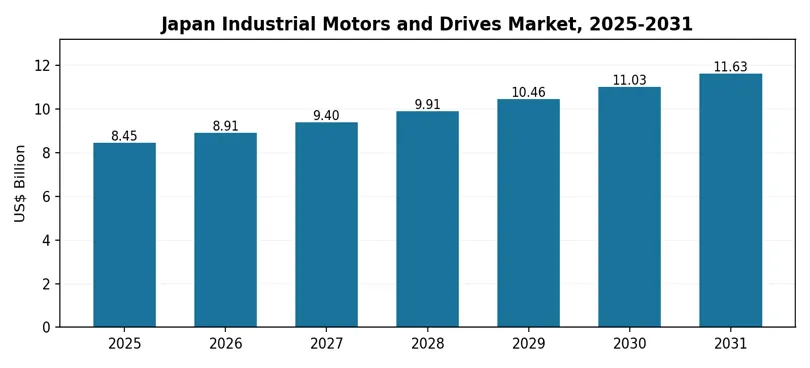
The Japan Industrial Motors and Drives Market is estimated at US$ 8.45 billion in 2025 and is forecast to reach US$ 11.63 billion by 2031, representing an estimated 5.5% CAGR. The market covers industrial electric motors, variable frequency drives and servo systems used in Japanese factories, process facilities and public infrastructure. Demand comes from replacing older equipment, improving motor-system efficiency and upgrading automation in machinery, chemicals, food processing and manufacturing plants.
Industrial motors convert electrical energy to mechanical motion, while inverters and servo drives control speed, torque and machine movements. Japan has an established manufacturing base for precision machinery and industrial equipment, supporting demand for reliable motor-drive combinations. The forecast covers separately supplied motors and drives, while integrated packages are allocated between their equipment components to avoid counting the same sale twice.
| 2025 MARKET SIZE | 2031 FORECAST | CAGR (2026-2031) |
| US$ 8.45 Billion | US$ 11.63 Billion | 5.5% |
Japan Industrial Motors and Drives Key Takeaways
Combined industrial motor and drive equipment revenue is estimated to increase from US$ 8.45 billion in 2025 to US$ 11.63 billion by 2031.
Factory modernization supports replacement of older industrial motors and installation of variable-speed drives on pumps, fans and compressors.
Precision machinery and robotics sustain demand for servo motor-drive packages with stable motion control and high repeatability.
Low-voltage inverters serve general factory machinery, while medium-voltage systems support large pumps, fans and heavy industrial processes.
Japanese suppliers compete through reliability, engineering support and close integration with machine builders and automation systems.
Energy savings and downtime reduction shape motor-drive purchasing decisions across mature Japanese industrial facilities.
Japan Industrial Motors and Drives Industry Trends and Strategic Insights
Energy efficiency is a major retrofit priority for continuously operated plant utility motors, particularly pumps, cooling systems and fans.
Machine builders are combining servo motors, drives and controls into compact motion platforms for robotics and production equipment.
Plants favor replacement equipment that fits existing control cabinets, wiring and installed mechanical systems.
Local technical support, spare parts and proven reliability remain important in a market with demanding quality requirements.
Japan Industrial Motors and Drives Market Scope
| METRICS | DETAILS |
| 2025 Market Size | US$ 8.45 Billion |
| 2031 Projected Market Size | US$ 11.63 Billion |
| CAGR (2026-2031) | 5.5% |
| By Drive Type | AC induction, permanent-magnet, synchronous and servo motors, AC VFDs and servo drives |
| By End-Use Industry | General manufacturing, metals, chemicals, mining, utilities, machinery and process industries |
| By Power Rating | Fractional to high-power equipment, low- and medium-voltage systems |
| By Voltage | IE2, IE3, IE4 and higher motor efficiency, V/f, vector and servo drive control |
| By Control Method | Pumps, fans, compressors, conveyors, mixers, machine tools and precision motion |
| By Application | Low and medium voltage, OEM packages, industrial plant retrofit and replacement |
| By Installation Stage | New-build equipment, motor replacement, VFD retrofit, commissioning and lifecycle service |
| Competitive Landscape | Top 10 major motor, drive and motion-control manufacturers active in Japan |
| Market Data Coverage | Japan industrial motors and drives, equipment revenue and applications, 2025-2031 |
Japan Industrial Motors and Drives Market White Space & Investment Opportunities
Plant efficiency upgrades: target long-running pumps, fans and compressors where motor replacement and variable-speed control improve operating costs.
Precision machine builders: supply matched servo motors, drive electronics and control interfaces to machine tool and robotics OEMs.
Brownfield industrial systems: offer compact replacement motors, inverter retrofits and maintenance services that reduce plant shutdown time.
The strongest commercial opportunities require application-level engineering. Suppliers need to measure actual load profiles, motor duty and operating hours, then develop upgrade proposals around energy savings, equipment compatibility and available maintenance windows. Companies that combine certified products, dependable service and local commissioning capability are well placed to win repeat projects.
Driver Impact Analysis
Japan’s aging industrial equipment base creates a steady need for motor replacement and drive upgrades. Manufacturers are seeking improved output from existing sites rather than relying only on large new factories. As electricity costs and decarbonization goals remain important, operators assess high-efficiency motors and variable-frequency drives for continuously operated pumps, fans, compressors and HVAC equipment. Investments in factory automation and precision production also increase demand for servo motors and drives in machine tools, robots and packaging lines. Higher accuracy and faster changeovers favor well-integrated motion systems. These conditions support equipment purchases across both new machines and plant retrofits.
| DRIVER | AFFECTED PRODUCT / SIGNAL | 2026–2031 IMPACT | STRATEGIC IMPACT |
| Energy-saving retrofits | High | High-efficiency motors and VFD packages | Quantify plant-level energy savings and payback |
| Precision manufacturing and robotics | High | Servo motors, servo drives and matched controls | Build close partnerships with machinery OEMs |
| Replacement of aging plant assets | Medium-High | Reliable LV motors and compact replacement drives | Offer compatible designs and fast commissioning |
| Industrial uptime requirements | Medium-High | Connected drives, monitoring and service contracts | Develop condition-monitoring and lifecycle support |
The benefits vary by application. A high-efficiency motor can reduce losses on equipment that runs for long periods, while a variable-speed drive can deliver additional savings when the process does not need full output at all times. Industrial buyers also value predictable uptime, safe controls and replacement compatibility. Motor-drive suppliers can strengthen their position by providing energy audits, system engineering, harmonic assessments, commissioning and post-installation monitoring. Demand is especially attractive when equipment upgrades can be completed during scheduled maintenance without extending production downtime.
Restraint Impact Analysis
Japan has a mature industrial equipment market, so many customers already operate reliable motors and drives that are replaced only when the economic case is clear. Capital spending can be delayed by weak manufacturing orders, pressure on margins or uncertain payback. High-efficiency motor designs, high-performance servo packages and medium-voltage drives can carry higher upfront prices. Copper, electrical steel, permanent magnets and power-electronic components also affect equipment costs. Domestic suppliers face price competition from imported products in standard motor and inverter categories, making differentiation difficult without measurable lifecycle benefits.
| RESTRAINT | PRIMARY EXPOSURE | RISK LEVEL | STRATEGIC IMPACT |
| Long equipment replacement cycles | Installed industrial motors and drives | High | Document lifecycle economics and reliability benefits |
| Retrofit shutdown limitations | Operating production lines and plant utilities | High | Schedule installation around maintenance outages |
| Legacy equipment integration | Old motors, drives and automation controls | Medium-High | Validate motor insulation, power quality and controls |
| Cost and capital discipline | Premium motors, servos and power semiconductors | Medium-High | Offer phased upgrades and clear payback cases |
Retrofit projects can also be slowed by technical and installation constraints. An existing motor may require insulation, bearing or cooling changes before it can operate reliably with an inverter. Older control panels and plant automation networks may not support newer drive communication and safety functions. Harmonics, electromagnetic interference and motor cable length can add engineering work, particularly on larger systems. Production shutdown windows are often limited in automotive, chemical, food and precision manufacturing plants. Suppliers reduce these risks by offering compatibility checks, compact retrofit solutions, factory acceptance testing and coordinated commissioning schedules.
Japan Industrial Motors and Drives Market Competitive Landscape
Japan’s industrial motors and drives sector includes large electrical equipment groups, motion-control specialists and dedicated motor manufacturers. Nidec supplies a wide motor portfolio, Yaskawa is strong in servo systems and AC drives, and Mitsubishi Electric and Fuji Electric offer industrial inverters and automation products. Toshiba, Hitachi Industrial Equipment Systems and Sumitomo Heavy Industries participate in industrial motor and equipment applications. ABB and Siemens compete in selected motors, drives and process-industry systems. Buyers place strong weight on product reliability, application support and lifecycle service.
| COMPANY | INDUSTRIAL MOTORS AND DRIVES POSITIONING |
| Nidec | Industrial motors for manufacturing equipment, precision machinery and plant systems. |
| Yaskawa Electric | AC drives, servo motors and servo drives for factory automation and motion control. |
| Mitsubishi Electric | Industrial inverters, servo drives and geared motors integrated with factory controls. |
| Fuji Electric | Low- and medium-voltage inverters and industrial drive systems for energy savings. |
| Toshiba Industrial Products and Systems | Industrial and heavy-duty electric motors used across process and infrastructure applications. |
| Hitachi Industrial Equipment Systems | Industrial motors, air compressors and packaged industrial equipment solutions. |
| Sumitomo Heavy Industries | Gear motors, mechanical drive systems and industrial machinery applications. |
| ABB | Industrial motors, low- and medium-voltage variable frequency drives and services. |
| Siemens | Industrial drives, motor systems and integrated automation for manufacturing plants. |
| Oriental Motor | Compact motors, stepping motors and motion systems for precision equipment. |
Competition is shaped by installed equipment relationships and machine-builder specifications. Japanese users often value drop-in compatibility with existing lines, dependable maintenance support and validated energy savings. Suppliers can expand sales through OEM partnerships, integrated motion-control platforms, retrofit engineering and predictive maintenance programs.
Japan Industrial Motors and Drives Market Recent Developments
April 6, 2026: Yaskawa introduced the GA501 compact AC drive with built-in Ethernet connectivity for easier connection with servos and industrial robots.
April 8, 2026: Yaskawa expanded its MPX1000 machine-controller line with the MPX1010 model, which can manage up to 640 servo motors.
June 12, 2026: Nidec announced the launch of the MPLJ precision position detector series, adding to its motion-control component portfolio.
July 22, 2026: Mitsubishi Electric and Sony Semiconductor Solutions agreed to establish a joint venture focused on AI vision sensors for manufacturing.
October 7, 2026: Mitsubishi Electric announced that it would showcase its latest manufacturing technologies at JIMTOF 2026.
October 8, 2026: Yaskawa launched a network safety option for AC drives to support functional safety integration over EtherNet/IP.