Japan Industrial Lighting Market Size and Overview
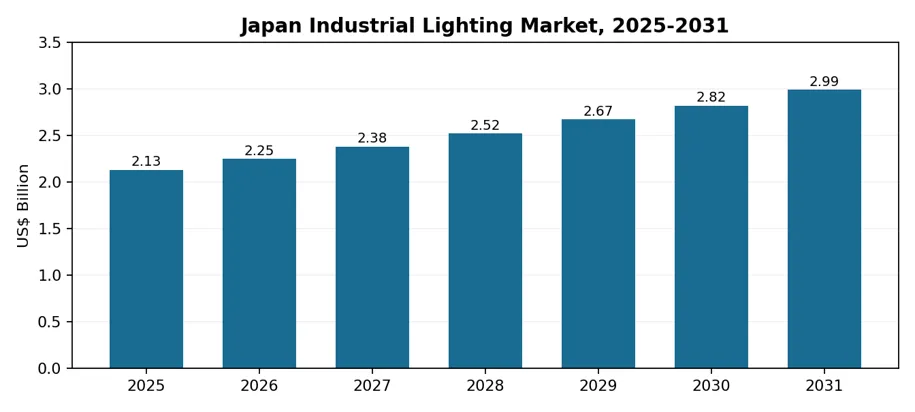
The Japan Industrial Lighting Market is estimated at US$ 2.13 billion in 2025 and is forecast to reach US$ 2.99 billion by 2031, representing approximately 5.8% annualized growth. Factory retrofits, LED replacement of older fluorescent and high-intensity discharge fixtures, and investments in automated manufacturing facilities are supporting demand for industrial lighting in Japan.
Industrial lighting covers the luminaires, LED replacement products and controls used in production halls, warehouses, loading yards, processing plants and technical work areas. Buyers need safe illumination for machinery operation, inspection and maintenance. Products must often withstand dust, vibration, moisture or elevated temperatures. Existing facilities are upgrading to LED systems to reduce power demand and avoid frequent work at height.
| 2025 MARKET SIZE | 2031 FORECAST | CAGR (2026–2031) |
| US$ 2.13 Billion | US$ 2.99 Billion | 5.8% |
Japan Industrial Lighting Key Takeaways
Japan industrial lighting revenue is estimated at US$ 2.13 billion in 2025 and US$ 2.99 billion by 2031.
Replacement of fluorescent and high-intensity discharge fixtures creates steady demand across established factories and warehouses.
LED high-bay fixtures are important in large manufacturing buildings because light output, weight and installation time affect retrofit decisions.
Automotive, electronics, machinery and logistics facilities require different combinations of task lighting, high-bay fixtures and controls.
Explosion-proof, moisture-resistant and high-temperature fixtures serve smaller but higher-specification industrial applications.
Occupancy sensors and lighting controls help reduce electricity use in warehouses, corridors and intermittently occupied production areas.
Japan Industrial Lighting Industry Trends and Strategic Insights
Industrial customers are replacing aging lamps with integrated LED fixtures rather than maintaining older ballasts and legacy fittings.
High-bay product design is improving on fixture weight, mounting flexibility and lumen output to reduce installation disruption.
Production sites increasingly assess illumination quality alongside electricity savings, especially in inspection and precision assembly.
Industrial customers place value on domestic installation support, spare-parts continuity and documented safety performance.
Japan Industrial Lighting Market Scope
| METRICS | DETAILS |
| 2025 Market Size | US$ 2.13 Billion |
| 2031 Projected Market Size | US$ 2.99 Billion |
| CAGR (2026-2031) | 5.8% |
| By Product Type | High-bay, low-bay, linear, task, emergency and hazardous-area lights |
| By End User | Automotive, electronics, machinery, chemicals, food and logistics |
| By Application | Production lines, warehouses, inspection, process and outdoor areas |
| By Technology | Integrated LED luminaires, LED retrofits and specialty fixtures |
| By Controls | Occupancy sensors, zone dimming, networked and local controls |
| By Installation | New factory, expansion, refurbishment and replacement |
| By Procurement Stage | Engineering design, equipment purchase, installation and maintenance |
| Competitive Landscape | Top 10 industrial and professional lighting providers in Japan |
| Market Data Coverage | 2025-2031 Japan industrial lighting equipment and control estimates |
Japan Industrial Lighting Market White Space & Investment Opportunities
Factory conversion programs: supply energy-efficient high-bay and linear fixtures to replace legacy fluorescent and metal-halide lighting.
Harsh-environment products: offer durable sealed, corrosion-resistant and hazardous-area fixtures where standard building lights are unsuitable.
Connected warehousing: combine warehouse high-bay lights with occupancy sensing, zone-based dimming and commissioning services.
Suppliers can improve project conversion by assessing existing luminaires, preparing savings and maintenance calculations, and working with facility engineering teams to schedule installation around plant operations. Standardized replacement packages also support multi-site industrial customers.
Driver Impact Analysis
Industrial facilities in Japan are replacing aging fluorescent and discharge lighting as LED products improve energy efficiency, service life and installation practicality. The staged restrictions on general-purpose fluorescent lamp production and imports are giving plant owners another reason to plan upgrades rather than wait for end-of-life failures. Replacement programs typically cover workshop ceilings, storage areas, production corridors and equipment maintenance zones, creating repeat orders for fixtures and controls.
| DRIVER | AFFECTED PRODUCT / SIGNAL | 2026–2031 CAGR | STRATEGIC IMPACT |
| Fluorescent and HID replacement | High | Factory and warehouse fixture conversion | Offer site audits and standardized LED retrofit packages |
| Industrial energy efficiency | High | High-bay lights and controls | Show energy savings and planned maintenance benefits |
| Factory automation and inspection | Medium-High | Task lighting and precision illumination | Specify glare control and consistent light levels |
| Logistics and warehouse upgrades | Medium-High | High-ceiling fixtures and motion sensors | Combine fixtures with occupancy-based dimming |
Automation and factory modernization also support lighting investments. Precision assembly and inspection lines require consistent brightness and glare management, while warehouses and logistics sites benefit from high-bay LED fixtures with occupancy controls. Industrial operators often conduct upgrades during scheduled shutdowns, which favors light, easy-to-install products backed by reliable delivery and commissioning teams.
Restraint Impact Analysis
Industrial lighting projects compete with machinery, automation and maintenance spending for capital budgets. Even when LEDs offer operating savings, facilities may delay complete replacement until a scheduled shutdown or refurbishment. Work at height, access restrictions and the need to avoid production interruptions raise installation expenses. Smaller factories may also prefer low-cost replacement products over connected lighting packages.
| RESTRAINT | PRIMARY EXPOSURE | RISK LEVEL | STRATEGIC IMPACT |
| Capital spending competition | Factory lighting refurbishment | High | Build staged upgrade plans around plant shutdowns |
| Installation and access costs | High-bay and active production areas | High | Offer quick-install fixtures and specialist contractor support |
| Commodity LED price pressure | Standard industrial linear and high-bay | Medium-High | Differentiate on reliability and lifecycle cost |
| Site-specific safety requirements | Hazardous, wet and hot operating areas | Medium-High | Provide certified fixtures and engineering support |
Product qualification can be complex in chemical plants, food processing areas, high-temperature operations and hazardous locations. Fixtures may need ingress protection, vibration resistance, safety approvals and compatibility with existing electrical systems. Intense competition in standard LED equipment limits margins, while specifications that differ by site increase engineering and inventory costs for suppliers.
Japan Industrial Lighting Market Competitive Landscape
Japan’s industrial lighting market includes specialist high-bay and industrial fixture manufacturers, domestic commercial lighting groups and international professional lighting providers. Competition centers on light output, energy efficiency, durability, ease of installation, product approvals, pricing and support from electrical contractors.
| COMPANY | LIGHTING POSITIONING |
| Iwasaki Electric | High-bay and industrial LED lighting for plants and warehouses |
| Panasonic | Industrial LED fixtures, facility lighting and retrofit systems |
| Toshiba Lighting & Technology | LED lighting solutions for factories, warehouses and building facilities |
| Mitsubishi Electric Lighting | Factory, technical and commercial LED lighting products |
| Iris Ohyama | LED high-bay and general facility lighting products |
| Endo Lighting | Professional LED luminaires and industrial building installations |
| Koizumi Lighting | LED lighting for business facilities and technical areas |
| Odelic | Professional indoor and outdoor lighting fixtures |
| Signify Japan | Professional LED products and connected lighting solutions |
| Stanley Electric | LED technology and specialized lighting components |
Domestic manufacturers benefit from established relationships with factory engineering teams and local installation networks. Suppliers with strong industrial product portfolios can compete on integrated retrofit proposals, hazardous-area designs, smart controls and documented lifecycle performance.
Japan Industrial Lighting Market Recent Developments
January 1, 2026: Japan began phased restrictions on manufacturing and importing certain general-purpose fluorescent lamps, prompting industrial facility owners to review LED replacement schedules.
January 5, 2026: Japan’s government issued public guidance encouraging planned LED conversion ahead of the wider fluorescent lamp phase-out.
March 18, 2026: Mitsubishi Electric published updated guidance on fluorescent lamp restrictions and clarified that existing lamps may still be used and traded from remaining inventories.
April 15, 2026: Japan’s Ministry of the Environment published an update explaining fluorescent lamp manufacturing and import restrictions, including their use in factories and workplaces.
Late July 2026: Iwasaki Electric started taking orders for revised LEDioc HIGH-BAY Gamma high-bay fixtures, targeting lower weight and better energy performance.
August 6, 2026: Iwasaki Electric announced the full model change for its LEDioc HIGH-BAY Gamma series, with lighter fixtures aimed at easier industrial installation.