Japan Industrial Drives Market Size and Overview
The Japan Industrial Drives Market is estimated at US$ 3.20 billion in 2025 and is forecast to reach US$ 4.78 billion by 2031, representing approximately 6.9% annual growth. The market covers variable-frequency drives, medium-voltage drives, servo amplifiers, regenerative drives and related drive electronics used in Japanese industrial equipment. Factory automation, energy-saving motor control and replacement of older inverters are supporting purchases across manufacturing and process industries.
Industrial drives regulate motor speed, torque and positioning in pumps, fans, compressors, conveyors and precision machinery. Japanese buyers place particular value on reliable operation, compatibility with existing motors and factory networks, compact equipment and local maintenance. The market includes standalone inverter and servo-drive hardware and their associated electronics. It excludes sales of industrial motors themselves, which are covered separately.
| 2025 MARKET SIZE | 2031 FORECAST | CAGR (2026-2031) |
| US$ 3.20 Billion | US$ 4.78 Billion | 6.9% |
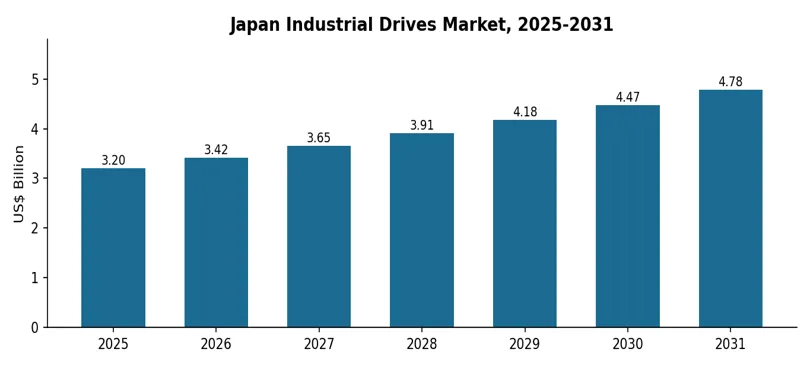
Figure 1. Japan Industrial Drives Market Value, 2025-2031 (US$ Billion)
Japan Industrial Drives Key Takeaways
• Industrial drive revenue is estimated to increase from US$ 3.20 billion in 2025 to US$ 4.78 billion by 2031.
• Variable-frequency drives reduce energy consumption in pumps, fans and compressors operating below full load.
• Factory automation supports demand for servo amplifiers and multi-axis motion systems in robotics and machinery.
• Connected inverters with industrial Ethernet are becoming more important to machinery OEMs and plant operators.
• Retrofit projects require careful checks of existing motors, electrical panels, harmonic performance and control interfaces.
• Medium-voltage and regenerative drives offer opportunities in energy-intensive continuous processes and heavy industry.
Japan Industrial Drives Industry Trends and Strategic Insights
• Industrial Ethernet, remote diagnostics and machine-controller integration are moving into compact AC drive ranges.
• Manufacturers are expanding inverter options for permanent-magnet motors and high-efficiency synchronous systems.
• Japanese plants often replace older inverters in stages to avoid disrupting machinery and production schedules.
• Suppliers offering parameter migration, local commissioning and spare-parts support are well placed for retrofits.
Japan Industrial Drives Market Scope
| METRICS | DETAILS |
| 2025 Market Size | US$ 3.20 Billion |
| 2031 Projected Market Size | US$ 4.78 Billion |
| CAGR (2026-2031) | 6.9% |
| By Drive Type | Low-voltage VFDs, medium-voltage drives, servo amplifiers, regenerative drives |
| By End-Use Industry | Manufacturing, machinery, chemicals, metals, utilities and other process industries |
| By Power Rating | Fractional-kW to multi-megawatt industrial drives |
| By Drive Control | V/f, vector, closed-loop, PM motor, regenerative and servo control |
| By Application | Pumps, fans, compressors, conveyors, extruders, machine tools and robotics |
| By Installation Setting | OEM-mounted, panel-mounted, indoor, outdoor and heavy-duty applications |
| By Installation Stage | New machinery, expansion, inverter retrofit, testing and lifecycle support |
| Competitive Landscape | Top 10 industrial drive and automation suppliers active in Japan |
| Market Data Coverage | Japan industrial drives equipment market, applications and forecast, 2025-2031 |
Japan Industrial Drives Market White Space & Investment Opportunities
• Installed-base inverter replacement: upgrade aging drives on plant pumps, fans, compressors and conveyors with minimal changes to existing electrical equipment.
• Machine automation: supply Ethernet-enabled compact drives and servo amplifiers to robotics, packaging and machine-tool manufacturers.
• Energy and service programs: combine drive sizing, harmonic assessment, parameter conversion, commissioning and predictive diagnostics.
Winning projects requires an understanding of operating profiles and control requirements. Suppliers can identify energy-saving opportunities by reviewing motor load and duty cycles, then propose a replacement drive that fits existing panels and communication systems. Plant operators also want dependable technical assistance during commissioning and access to replacement components throughout equipment life.
Driver Impact Analysis
Demand for industrial drives is supported by Japan’s large installed base of motor-driven production equipment and continued investment in factory automation. Variable-frequency drives allow pumps, fans and compressors to match output to process requirements instead of operating continuously at full speed. Machinery manufacturers also need compact AC drives and servo amplifiers capable of precise motion control and straightforward integration with PLCs and industrial Ethernet systems. Upgrades to aging manufacturing equipment create opportunities for drives that improve efficiency, monitoring and reliability.
| DRIVER | AFFECTED PRODUCT / SIGNAL | 2026–2031 IMPACT | STRATEGIC IMPACT |
| Energy-saving speed control | High | Low-voltage VFDs for pumps, fans and compressors | Target variable-load systems with measurable power savings |
| Automation and precision motion | High | Servo drives and networked inverter systems | Work with machinery OEMs on motion and connectivity |
| Installed-base inverter upgrades | Medium-High | Replacement VFDs and controller interfaces | Provide parameter migration and low-downtime retrofit packages |
| Industrial digital maintenance | Medium-High | Connected drives and diagnostics | Link inverter condition data to plant maintenance workflows |
The strongest opportunities depend on measurable operating benefits. Variable-load installations can reduce energy use when process demand fluctuates, while servo drives can improve positioning accuracy and throughput in precision machinery. Connected drive platforms provide more operating data and can simplify fault diagnosis. Suppliers that assess load profiles, electrical compatibility and controls integration before installation can strengthen their chances of securing retrofit and OEM programs across multiple facilities.
Restraint Impact Analysis
The Japan industrial drives market faces price competition, long equipment service lives and demanding plant qualification requirements. Many manufacturers retain existing inverters while machinery is still operating reliably, especially where downtime would be expensive. Advanced servo and medium-voltage drive systems can also involve higher upfront spending, specialist engineering and commissioning. Power semiconductors, capacitors, control electronics and cooling components influence production cost and availability. Customers often need proof of energy savings before approving large replacements.
| RESTRAINT | PRIMARY EXPOSURE | RISK LEVEL | STRATEGIC IMPACT |
| Existing equipment life and budget limits | Legacy inverters at mature industrial sites | High | Quantify energy savings and payback for replacements |
| Motor and system compatibility | Insulation, cables, panels and legacy controllers | High | Perform electrical checks and preserve critical parameters |
| Harmonics and power quality | Medium-voltage and higher-power drive systems | Medium-High | Specify filters and validate site electrical design |
| Downtime and commissioning risk | Continuous-process plants and OEM machinery | Medium-High | Use staged installation and factory-tested configurations |
Drive replacement is rarely a simple hardware swap. Existing motor insulation, cable length, earthing and bearing protection must be considered when changing switching characteristics. Harmonics and electromagnetic compatibility may require filters or other measures. New network protocols and safety interfaces can also complicate integration with older PLCs. Limited shutdown windows in chemical, steel and other continuous-process plants increase project risk. Detailed parameter migration, factory testing and on-site support help reduce these constraints.
Japan Industrial Drives Market Competitive Landscape
Japan’s industrial drives market includes domestic automation manufacturers and international suppliers of variable-frequency and servo systems. Yaskawa, Mitsubishi Electric and Fuji Electric have established inverter and motion-control product ranges, while Toshiba and Hitachi serve larger industrial applications. Omron and Nidec address automation and motion requirements. ABB, Siemens and Schneider Electric compete in selected general-purpose, heavy-industrial and integrated control applications.
| COMPANY | INDUSTRIAL DRIVE POSITIONING |
| Yaskawa Electric | Industrial AC inverters, servo drives and networked motion platforms. |
| Mitsubishi Electric | FREQROL inverters and servo drive systems for factory machinery. |
| Fuji Electric | Low- and medium-voltage industrial inverters for process and plant applications. |
| Toshiba | Power-electronic drives and variable-speed systems for large industrial loads. |
| Hitachi | Industrial inverter systems and automation-related drive technology. |
| Nidec | Industrial drive technology and motion-control solutions. |
| Omron | Servo drives, motion controllers and automation equipment. |
| ABB | Industrial variable-speed drives with energy and lifecycle service capability. |
| Siemens | SINAMICS industrial drives and motion-control solutions. |
| Schneider Electric | Altivar variable-speed drives for machinery and industrial plant systems. |
Competition depends on drive reliability, electrical efficiency, available power ratings, networking options, integration with industrial controllers and service. Japanese machinery OEMs value repeatable designs and compact devices, while plant operators prioritize migration from existing equipment without unexpected shutdowns. Suppliers can differentiate through application engineering, documentation, parameter-conversion tools and nationwide after-sales assistance.
Japan Industrial Drives Market Recent Developments
• January 2026: Mitsubishi Electric published an updated FR-D800 inverter catalogue, supporting selection of compact drives for machinery applications.
• April 6, 2026: Yaskawa announced its GA501 compact high-performance inverter with built-in Ethernet functionality for industrial motor control.
• April 8, 2026: Yaskawa introduced the MPX1010 machine controller, designed to coordinate large numbers of servo axes in industrial automation.
• May 18, 2026: Mitsubishi Electric updated MELSOFT FR Configurator2, its software for inverter configuration and setup.
• July 22, 2026: Mitsubishi Electric announced additional capacity ratings for its FR-A800-SYN and FR-F800-SYN inverter ranges.
• October 5, 2026: Mitsubishi Electric updated technical information on replacing legacy FR-S500 inverters with FR-D800 products.