


Japan Hydrogen Market Size and Overview
The Japan hydrogen market reached USD 4.63 billion in 2025 and is expected to reach USD 11.58 billion by 2035, growing with a CAGR of 9.6% during the forecast period 2026-2035. The market is expanding as Japan moves from hydrogen technology research and development to actual supply chain formation, which has seen demand creation for power generation, industrial applications, transport, fuel cells, and hydrogen-based steel manufacturing. The Seventh Strategic Energy Plan of Japan, which was passed in February 2025, aims for up to 3 million tons of domestic hydrogen usage by 2030, increasing to 12 million tons by 2040 and 20 million tons by 2050. Price-gap support, worth an estimated 3 trillion Japanese Yen (USD 20 billion), is being provided for low-carbon hydrogen supply chain development.
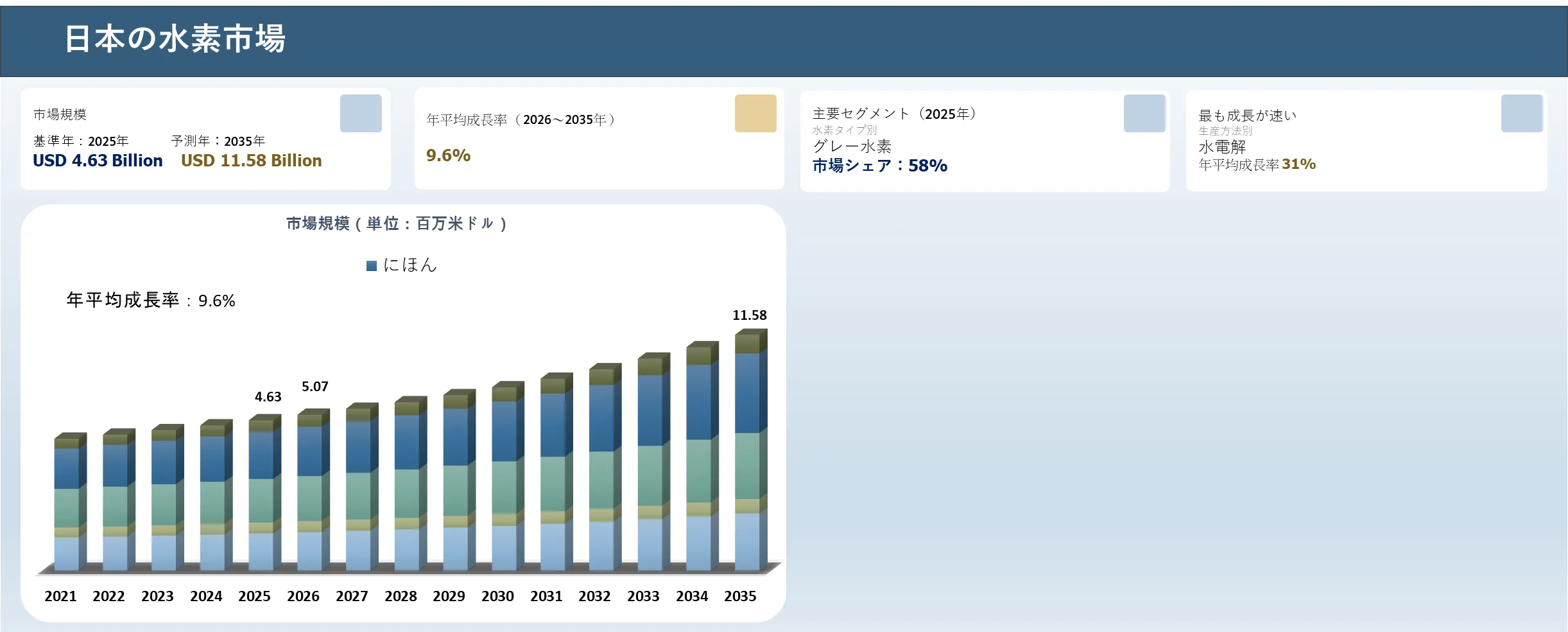
In addition to this, the industry is gaining impetus in the form of mega projects relating to hydrogen infrastructure. In November 2025, Kawasaki Heavy Industries, along with its partners, started construction work for a large-scale liquefied hydrogen terminal in Ogishima, Kawasaki. The facility will be built with a capacity of a 50,000-cubic-meter liquefied hydrogen storage tank and will include facilities for hydrogen unloading, hydrogen storage, hydrogen liquefaction, hydrogen gas supply and delivery by lorry. The terminal will be established under the Japanese Green Innovation Fund, and it aims to establish an international chain of liquefied hydrogen supply commercially.
White-Space Opportunities for Low-Carbon Hydrogen Supply Chain Development in Japan
In June 2025, Japan’s hydrogen market is creating opportunities primarily through large-scale supply-chain and price-gap support, with the ¥3 trillion (USD 19.1 billion) frameworks representing the largest investment area under the Hydrogen Society Promotion Act. The support focuses on closing the cost gap between low-carbon hydrogen and conventional fuels, covering domestic hydrogen production, overseas production, and maritime transportation, while Japan also supports strategic hydrogen hubs, storage tanks, pipelines, and other infrastructure needed to establish commercial-scale supply chains.
Beyond the main price-gap program, Japan is supporting hydrogen supply-base development and feasibility studies with ¥1.5 billion (USD 9.5 million) under the Hydrogen Supply Infrastructure Development Program. In comparison, the broader Long-Term Decarbonised Power Supply Auction framework includes ¥457 billion (USD 2.9 billion) in total fiscal obligations, with hydrogen and ammonia fuel-cost components eligible for support from the second auction round; the FY2024 initial allocation associated with the relevant measures was ¥8.9 billion (USD 56.6 million).
The investment is expected to create significant opportunities for companies across the Japanese hydrogen value chain. In hydrogen production and industrial applications, Toyota Tsusho Corporation, Eurus Energy Holdings Corporation, Iwatani Corporation and Aichi Steel Corporation are benefiting from the first approved low-carbon hydrogen supply plan, involving green hydrogen production and its use for green-steel manufacturing in Aichi, while Resonac Corporation and Nippon Shokubai Co., Ltd. are participating in a project involving waste-plastic gasification to produce hydrogen and ammonia for chemical-material applications.
In hydrogen power generation and large-scale energy use, JERA Co., Inc., Toyota Industries Corporation, AGC Inc., Nippon Electric Glass Co., Ltd., Aisin Fukui Corporation and Chubu Electric Power Miraiz Co., Inc. are involved in approved hydrogen supply and utilisation projects, creating opportunities for hydrogen-fired power generation, industrial fuel switching and associated equipment.
Japan Hydrogen Market Key Takeaways
- Grey hydrogen dominated the market in 2025 with a 58% share due to heavy demand in chemical manufacturing and refining. Meanwhile, green hydrogen demonstrations currently account for only several thousand tonnes of total supply.
- Government price-gap subsidies and supply-chain support account for the highest market growth impact among drivers at 30%. Industrial demand from hard-to-abate sectors like steel, chemicals, and power follows closely with a 25% impact.
- Japan's Seventh Strategic Energy Plan targets 3 million tons of domestic hydrogen usage by 2030, scaling to 12 million tons by 2040. The target expands further to 20 million tons by 2050.
- Price-gap support frameworks are providing an estimated ¥3 trillion (USD 19.1 billion) to close the cost gap with conventional fuels under the Hydrogen Society Promotion Act. Japan is also providing ¥1.5 billion (USD 9.5 million) under its Hydrogen Supply Infrastructure Development Program.
Japan Hydrogen Market Scope
| Metrics | Details |
| 2025 Market Size | USD 4.63 Billion |
| 2035 Projected Market Size | USD 11.58 Billion |
| CAGR (2026-2035) | 9.6% |
| By Hydrogen Type | Grey Hydrogen, Blue Hydrogen, Green Hydrogen, Other Low-Carbon Hydrogen |
| By Production Method | Steam Methane Reforming (SMR), Coal Gasification, By-Product Hydrogen, Water Electrolysis, Others |
| By Storage | Compressed Hydrogen Storage, Liquid Hydrogen Storage, Underground Hydrogen Storage, Hydrogen Storage in Chemical Carriers, Other Storage |
| By Application | Steelmaking, Chemical Manufacturing, Industrial Heat, Refining, Semiconductor Manufacturing, Electronics Manufacturing, Aerospace Applications, Ammonia Production, Synthetic Fuel Production, Others |
| By End Use | Power Generation, Industrial, Mobility, Residential, Commercial, Others |
| Report Insights Covered | Competitive Landscape Analysis, Company Profile Analysis, Market Size, Share, Growth |
Japan Hydrogen Market Disruption Analysis
Shift Toward Integrated Low-Carbon Hydrogen Ecosystems Reshaping Japan’s Hydrogen Supply Chain
The disruption in the Japanese hydrogen market is caused by the transition from traditional hydrogen production to an integrated low-carbon production and use of hydrogen in the form of an integrated renewable energy-powered water electrolysis process. In October 2025, according to the New Energy and Industrial Technology Development Organisation (NEDO), the Yamanashi Prefecture Consortium started operations with a 16 MW PEM water electrolyser facility that was set up to produce around 2,200 metric tons of green hydrogen per year. The plant integrates renewable energy, hydrogen production, and industrial use of hydrogen into one integrated unit system.
The disruption is also extending toward large electrolyser systems, hydrogen products, and new uses in industry. In February 2026, NEDO chose a project that aims at developing a SOEC water electrolysis system and large-scale Power-to-X demonstration projects. The hydrogen R&D program in Japan aims at improving performance, durability, and reducing costs of electrolysers and fuel cells. Meanwhile, Japan managed to demonstrate the use of green hydrogen in iron ore direct reduction in July 2026, connecting the process of hydrogen production with carbon-neutral steel production.
Japan Hydrogen Market BCG Matrix: Company Evaluation
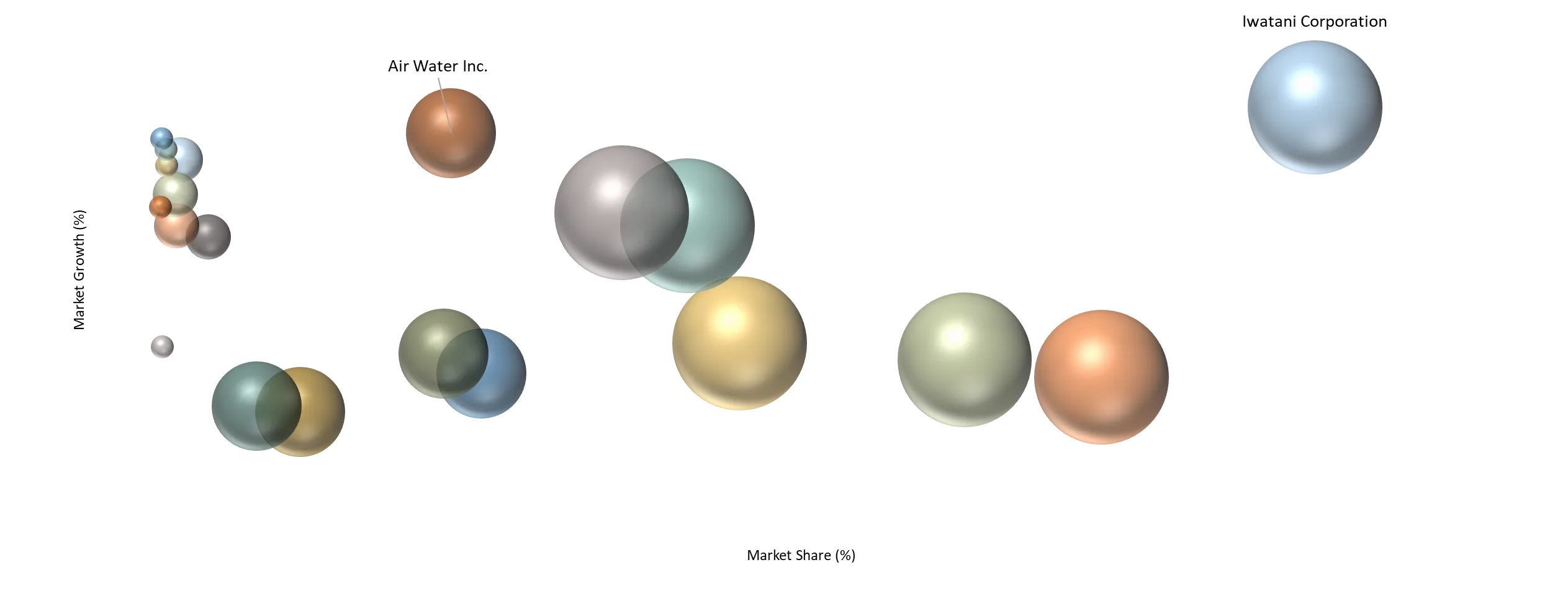
Stars include Iwatani Corporation, ENEOS Corporation, JERA Co., Inc., and Kawasaki Heavy Industries, Ltd. The companies have strong positions across Japan’s hydrogen supply chain and are actively expanding production, transportation, storage, and utilisation capabilities. Question Marks include INPEX Corporation, Toyota Tsusho Corporation, Resonac Corporation, and Asahi Kasei Corporation because they are making substantial investments in emerging hydrogen-production pathways and commercial projects, but their hydrogen businesses are still progressing from demonstration and technology development toward broader commercialisation.
Potential includes Air Water Inc. and Tokuyama Corporation, which have established industrial-gas and chemical-industry capabilities that can support hydrogen production and supply, but their hydrogen activities are more concentrated in specific industrial applications and regional supply chains. Tailenders include Tosoh Corporation, whose hydrogen activity is primarily connected to its established chemical-manufacturing operations rather than a broad standalone hydrogen ecosystem.
Japan Hydrogen Market Dynamics
Driver Impact Analysis
| Driver | Market Growth Impact (%) | Demand Concentration | Impacted Use Case | Strategic Impact |
Expansion of large-scale hydrogen import, storage, and distribution infrastructure is strengthening Japan’s hydrogen supply chain. | 24% | Major ports, industrial clusters, power-generation hubs | Hydrogen import, liquefaction, storage, transportation, distribution, power generation | High – Expands the physical supply network and enables larger-scale hydrogen deployment |
Government price-gap subsidies and supply-chain support are accelerating commercial-scale low-carbon hydrogen deployment in Japan. | 30% | Nationally, with concentration in industrial and energy projects | Low-carbon hydrogen production, industrial use, power generation, hydrogen supply chains | Very High – Improves project economics and supports commercial-scale investment |
Growing hydrogen demand from hard-to-abate industries such as steel, chemicals, and power generation is creating new commercial applications. | 25% | Industrial clusters and large energy-consuming facilities | Green steel, chemicals, industrial heat, refining, power generation, ammonia | High – Creates long-term offtake demand and supports new hydrogen applications |
Advances in fuel-cell and hydrogen-production technologies are supporting higher efficiency, durability, and lower costs across the hydrogen ecosystem. | 21% | Industrial production sites, mobility, distributed energy and power projects | Electrolysis, fuel cells, hydrogen mobility, backup power, distributed energy | High – Improves technology economics and expands the range of commercially viable applications |
Expansion of large-scale hydrogen import, storage, and distribution infrastructure is strengthening Japan’s hydrogen supply chain
The development of infrastructure for the large-scale import, storage, and distribution of hydrogen is enhancing Japan’s hydrogen value chain by improving Japan’s ability to manage hydrogen imported from abroad and bring it to consumers. The development of infrastructure over the past few years is moving away from the development of individual demonstration infrastructures and towards the development of supply chain infrastructures, including maritime transport, receipt infrastructures, storage facilities, hydrogen transformation facilities, and distribution infrastructures in Japan. The development is to remove the logistics constraint and develop the infrastructure necessary to expand Japan’s hydrogen usage.
In parallel, Japan is also building maritime transportation and downstream facilities to facilitate hydrogen supply chains internationally. In January 2026, Kawasaki Heavy Industries entered into a shipbuilding agreement for a liquefied hydrogen carrier, capable of carrying 40,000 m³ of gas, marking a huge leap forward towards commercially viable marine transportation. At the same time, Kawasaki announced in June 2026 that the hydrogen supply-chain project had reached an important milestone in the form of the completion of the Kawasaki LH₂ Terminal in 2025 and the agreement for the 40,000 m³ ship in 2026. Furthermore, Kawasaki's hydrogen technology development centre, which will cover an area of about 11,000 m² and will have a 47 m³ liquefied-hydrogen tank, hydrogen compression and liquefaction demonstration facilities, and is set to be operational in FY2027.
Japan Hydrogen Market Segment Analysis
The Japan hydrogen market is segmented based on hydrogen type, production method, storage, application, and end use.
Established Industrial Hydrogen Demand Sustaining Grey Hydrogen Dominance in Japan
The grey hydrogen segment dominates the hydrogen type in the Japan hydrogen market, since the existing use of hydrogen in Japan is focused on industries using fossil fuel-produced hydrogen. Grey hydrogen constitutes a 58% market share of the Japan hydrogen market in 2025 due to its dominance in chemical manufacturing and refining, among others. The relevance of traditional hydrogen in the Japan hydrogen market fits well with the IEA's 2026 report indicating that global hydrogen demand in 2025 was still based on traditional uses, while low-emission hydrogen was still in the early stages of adoption.
According to the Yano Research Institute, the hydrogen supply in Japan in FY2024 is estimated at around 2.0 million tonnes, consisting of 1.96 million tonnes of domestic hydrogen supply and 40,000 tonnes of imported hydrogen. It is estimated that hydrogen production in Japan last year was mostly related to by-product hydrogen, which is used in the chemical industry, petroleum refining, and the steel industry, with the production process emitting CO₂ because of fossil fuel usage. Green hydrogen demonstrations, on the other hand, sum up to several thousand tonnes, thus showing how much greater the existing conventional hydrogen supply is compared to the low-carbon one. Yano predicts that domestic supply of hydrogen will amount to 2.9 million tonnes in total per year by FY2030, including 2.12 million tonnes of domestic hydrogen supply and 780,000 tonnes of imported hydrogen.
Japan Hydrogen Market Competitive Landscape
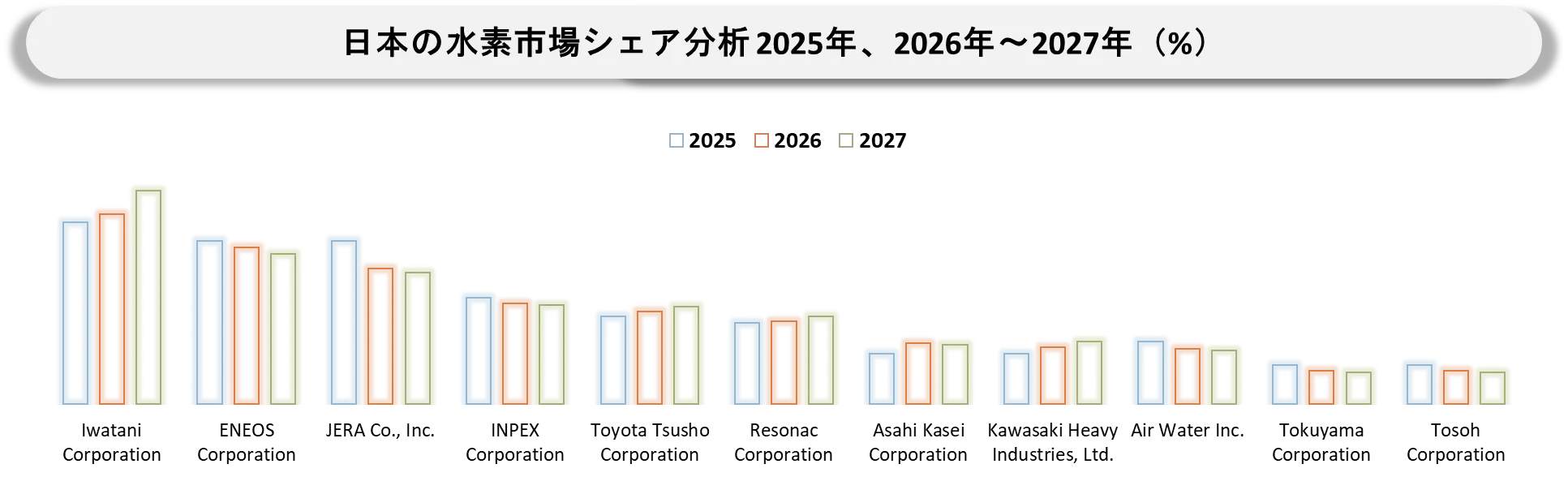
- The market is characterised by three key participant groups: hydrogen production and supply-chain companies, energy and infrastructure providers, and industrial hydrogen technology and application specialists. Iwatani Corporation, ENEOS Corporation, JERA Co., Inc., and INPEX Corporation are active across hydrogen supply, energy infrastructure, production, transportation, and utilisation; Toyota Tsusho Corporation and Kawasaki Heavy Industries, Ltd. focus on international hydrogen supply chains, transportation, and infrastructure development; while Resonac Corporation, Asahi Kasei Corporation, Air Water Inc., Tokuyama Corporation, and Tosoh Corporation are involved in hydrogen production technologies, industrial applications, chemicals, and low-carbon hydrogen initiatives. It creating an integrated competitive landscape in which supply-chain capabilities, technology development, infrastructure deployment, and industrial partnerships shape market participation.
- Key players include Iwatani Corporation (Japan), ENEOS Corporation (Japan), JERA Co., Inc. (Japan), INPEX Corporation (Japan), Toyota Tsusho Corporation (Japan), Resonac Corporation (Japan), Asahi Kasei Corporation (Japan), Kawasaki Heavy Industries, Ltd. (Japan), Air Water Inc. (Japan), Tokuyama Corporation (Japan), and Tosoh Corporation (Japan).
Key Development
- November 2025: INPEX Corporation, a Japan-based energy company, opened the Kashiwazaki Hydrogen Park in Niigata, Japan, establishing Japan’s first integrated demonstration project covering the production and utilisation of blue hydrogen and ammonia.
- June 2026: Amogy Inc., a U.S.-based clean-energy technology company, and KOWA Company, Ltd., a Japan-based diversified trading, manufacturing, and energy company, announced a partnership to deploy ammonia-cracking-based hydrogen supply solutions in Japan, initially targeting the Chubu region.
- December 2025: Kobe Steel, Ltd., a Japan-based steel and engineering company, EBARA Corporation, a Japan-based industrial machinery and pump manufacturer, TB Global Technologies Ltd., a Japan-based industrial equipment and engineering company, and Fukui Seisakusho Co., Ltd., a Japan-based safety-equipment manufacturer, signed a framework agreement with EcoLog Services Ltd., a Greece-based liquid-hydrogen midstream solutions company, to develop a commercial-scale liquid hydrogen (LH₂) supply chain linking Japan-related technology with Europe.
- July 2026: TANAKA Precious Metals, a Japan-based industrial precious-metals manufacturer, began operating the “TANAKA H2 Nexus,” a 500-kW pure-hydrogen fuel-cell power-generation facility, at its Shonan Fuel Cell Power Plant in Hiratsuka, Kanagawa.
- May 2026: The Kansai Electric Power Company, Inc., a Japan-based electric utility, West Japan Railway Company (JR West), a Japan-based railway transportation company, Nippon Telegraph and Telephone Corporation (NTT), a Japan-based telecommunications company, NTT Anode Energy Corporation, a Japan-based energy solutions company, Japan Freight Railway Company, a Japan-based freight railway company, and Panasonic Corporation, a Japan-based electronics and energy technology company, signed a basic agreement to advance joint studies and demonstrations for the large-scale transportation and utilization of green hydrogen in the Kansai region.
Key Procurement Priorities and Buyer Evaluation Criteria
- Organisations investing in the Japan Hydrogen Market increasingly select suppliers based on their ability to provide reliable hydrogen production, storage, transportation, and distribution solutions that can operate safely and scale from demonstration projects to commercial deployment.
- The procurement decision-making process is increasingly influenced by the expansion of low-carbon hydrogen supply chains, hydrogen import infrastructure, industrial decarbonization, power-generation applications, and hydrogen-derived fuels, requiring suppliers to demonstrate compatibility with Japan’s evolving hydrogen ecosystem.
- Buyers consider factors such as hydrogen purity, production efficiency, carbon intensity, supply reliability, storage capacity, transportation compatibility, safety performance, equipment durability, and lifecycle operating costs when selecting hydrogen technology and supply partners.
Why Choose DataM?
- Technological Innovations: Explores advancements across hydrogen production, water electrolysis, liquefaction, compression, storage, transportation, and fuel-cell technologies, highlighting innovations that improve efficiency, safety, scalability, and integration across Japan’s emerging hydrogen supply chain
- Product Performance & Market Positioning: Evaluates hydrogen technologies and solutions based on production efficiency, hydrogen purity, energy consumption, storage performance, transportation compatibility, durability, safety, and cost efficiency, identifying how leading companies differentiate across industrial, power-generation, mobility, and energy applications.
- Real-World Evidence: Highlights the deployment of hydrogen technologies across steelmaking, chemical manufacturing, refining, power generation, mobility, ammonia production, and industrial energy applications, demonstrating practical adoption and integration within Japan’s evolving hydrogen ecosystem.
- Market Updates & Industry Changes: Tracks developments in hydrogen production projects, import and storage infrastructure, liquefied-hydrogen transportation, electrolyser facilities, hydrogen refuelling infrastructure, and low-carbon hydrogen supply chains, supporting analysis of Japan’s transition toward commercial-scale hydrogen utilisation.
- Competitive Strategies: Analyses how leading companies expand their hydrogen businesses through technology development, infrastructure investment, international supply partnerships, integrated production-to-use projects, and collaboration across production, transportation, storage, and utilisation stages.
- Pricing & Market Access: Examines cost differences across hydrogen production pathways, transportation methods, storage technologies, and end-use applications, while assessing the influence of government support mechanisms, supply-chain development, infrastructure availability, and long-term offtake arrangements on market accessibility.
- Market Entry & Expansion: Identifies growth opportunities arising from industrial decarbonization, hydrogen imports, power generation, green steel, ammonia, synthetic fuels, mobility, and distributed energy, while outlining expansion strategies based on technology localisation, infrastructure development, strategic partnerships, and integration with Japan’s broader energy system.
Target Audience 2026
- Hydrogen Producers and Energy Companies
- Hydrogen Infrastructure Developers
- Industrial Hydrogen Consumers
- Power Generation Companies and Utilities
- Hydrogen Technology Providers
- Automotive and Mobility Companies
- Government and Regulatory Authorities


























































