


Japan Humanoid Robot Market Size and Overview
The Japan humanoid robot market reached USD 215 million in 2025 and is expected to reach USD 7,475.3 million by 2035, growing with a CAGR of 42.6% during the forecast period 2026-2035. The market is witnessing rapid expansion as Japanese manufacturers and technology companies shift from conventional task-specific automation toward AI-enabled, general-purpose humanoid robots capable of operating in human-centred environments. In September 2026, according to Reuters, about 7,000 units of humanoid robots were sold globally, indicating that the stage reached at present is that of commercialisation of this technology, while Japan utilises its advantages in robotics, engineering, and manufacturing.
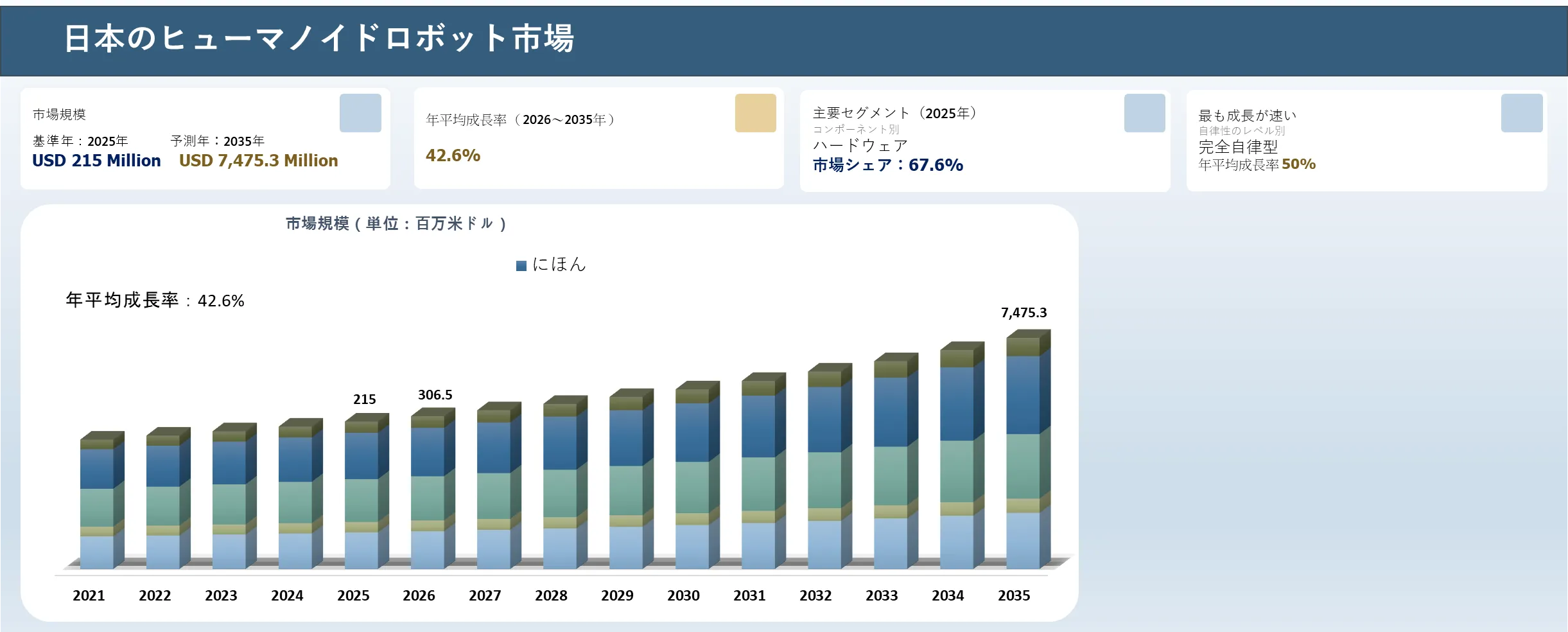
The market is becoming more and more influenced by the emphasis placed by Japan on the production of humanoid parts that have high accuracy, especially in terms of actuators, sensors, high-precision joints, and control systems, by domestic firms who wish to build the technological foundations for the next generation of robots. In December 2025, according to TrendForce, global shipments of humanoid robots will exceed 50,000 units by 2026 and will experience more than 700% year-on-year growth, whereas Kawasaki Heavy Industries showcased the Kaleido 9 humanoid at the iREX 2025 event that could lift loads to 30 kg, operate cleaning tools, and be controlled through a VR headset.
White-Space Opportunities for Japan Humanoid Robotics Market Driven by Physical AI, AI Infrastructure, and Industrial Automation Investments
In June 2026, Japan’s planned ¥10.5 trillion (USD 66.2 billion) in public-private investment through fiscal 2040 creates opportunities across the Physical AI and humanoid robotics ecosystem, with AI robots, particularly humanoid robots and automation, representing the core investment area. The investment is intended to support robot deployment across manufacturing, logistics, healthcare, food service, and other labour-intensive industries, while Japan targets the deployment of 10 million AI robots by 2040.
Beyond humanoid robotics, investment opportunities extend into vertical AI at ¥23.1 trillion (USD 145.6 billion) and semiconductors at ¥68 trillion (USD 428.8 billion) through 2040, providing additional demand for AI computing, processors, sensors, control technologies, data infrastructure, and robotics components. Japan is also directing major funding toward the physical-AI computing layer through the FRONTia project, with ¥387.3 billion (USD 2.44 billion) allocated for the first year and potential government support of up to ¥1 trillion (USD 6.30 billion) over five years for development of a domestic multimodal foundation model for AI robots and physical AI.
The investment creates opportunities for companies across the AI model, robotics, semiconductor, sensing, manufacturing, mobility, and industrial automation value chains. SoftBank, Sony Group, NEC, and Honda are core members and investors in Noetra, giving them direct exposure to the domestic multimodal foundation-model and physical-AI infrastructure program; SoftBank and NEC contribute AI and telecommunications capabilities, Sony brings semiconductor and sensing expertise, while Honda can apply the technology to mobility and robotics.
The robotics hardware opportunity extends to FANUC, Yaskawa Electric, and Kawasaki Heavy Industries, which are collaborating with Fujitsu on physical-AI control platforms for manufacturing, logistics, and healthcare; their opportunities include robot controllers, industrial robots, autonomous motion, simulation, and integration services. Additional beneficiaries across the enabling ecosystem include Preferred Networks for AI and robot-learning technologies; Tokyo Electron and Sony Group for semiconductor and sensing infrastructure; Murata Manufacturing for sensors and electronic components; and Mitsubishi Electric, OMRON, DMG MORI, Kawasaki Heavy Industries and Yamazaki Mazak through automation, machine tools, industrial control, and robot deployment.
Japan Humanoid Robot Market Key Takeaways
- Hardware components dominated the market with a 67.6% share in 2025 due to high demand for specialized mechanical parts. The essential physical assets include actuators, sensors, robotic hands, vision systems, and high-precision joints.
- Global humanoid robot shipments reached approximately 13,000 units in 2025, with China leading at roughly 80% and the US holding 13%. Annual global shipments are projected to grow by over 50% yearly to reach 1.4 million units by 2035.
- Among Japanese firms engaging with AI robotics, 71% target manufacturing, 19% plan to automate hazardous tasks, and 11% focus on customer interaction. Interest is strongest in transportation equipment manufacturing, where 80% of companies are using or considering AI robots.
- Public-private investments in Japan are targeting ¥10.5 trillion (USD 66.2 billion) through fiscal 2040 for Physical AI and humanoid robotics. The initiative sets an ambitious long-term national milestone to deploy 10 million AI robots by 2040.
Japan Humanoid Robot Market Scope
| Metrics | Details |
| 2025 Market Size | USD 215 Million |
| 2035 Projected Market Size | USD 7,475.3 Million |
| CAGR (2026-2035) | 42.6% |
| By Component | Hardware, Software |
| By Movement Type | Bipedal Humanoid Robots, Wheeled Humanoid Robots, Others |
| By Level of Autonomy | Remote-Controlled, Semi-Autonomous, Fully Autonomous |
| By Application | Vital Parameter Monitoring, Food Service, Retail & Customer Service, Disaster Response, Elderly Care, Hospital Assistance, Others |
| By End User | Automotive Manufacturers, Electronics & Semiconductor Manufacturers, General Manufacturing, Logistics Companies, Hospitals & Healthcare Facilities, Household, Government & Public Organizations, Others |
| Report Insights Covered | Competitive Landscape Analysis, Company Profile Analysis, Market Size, Share, Growth |
Japan Humanoid Robot Market Disruption Analysis
AI-Driven Physical AI and Foundation-Model Robotics Disrupting Japan’s Conventional Robotics Landscape
The disruption in the Japan humanoid robot market is primarily associated with the rapid adoption of AI-driven Physical AI and foundation model robotics, which is transforming traditional robots from rigid and programmed devices to more flexible systems that learn, understand their environment, and carry out different operations. Multimodal AI, Vision-Language-Action models, intelligent sensors, and control systems have extended the applicability of humanoid robots from industrial settings to manufacturing, logistics, health care, elderly care, disaster management, and services. The transition is disrupting the conventional robotics approach by making less need for programming to execute various functions and more need for robots to change their actions based on physical environment changes.
The disruption is also fueled by fast-growing humanoid robot manufacturing and the use of AI-powered systems in global robotics. In April 2026, according to the Ministry of Economy, Trade and Industry (METI) of Japan, global humanoid robot shipments stood at around 13,000 in 2025, with China accounting for almost 80% of shipments and the US for around 13%. Moreover, METI points to predictions of annual growth in humanoid robot shipments of more than 50% and around 1.4 million units by 2035. Innovation is disrupting the traditional robotics market in Japan because it is making Japanese domestic companies feel the necessity to go beyond their fixed-function automation and apply AI, advanced sensors, autonomy, and humanoid capabilities.
Japan Humanoid Robot Market BCG Matrix: Company Evaluation
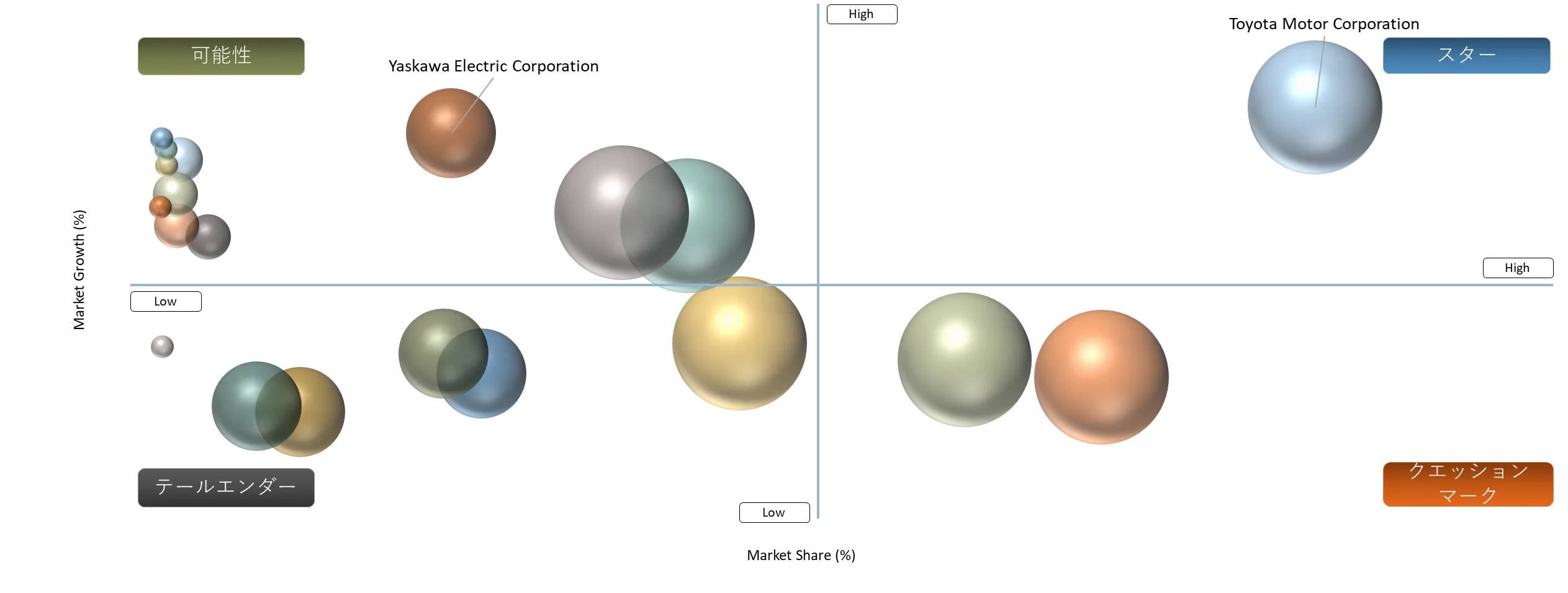
Stars include Toyota Motor Corporation and SoftBank Robotics because they have established humanoid-robot development capabilities and strong technology ecosystems that support continued expansion into AI-enabled and human-centred robotics. Companies such as Kawada Robotics Corporation, Kawasaki Heavy Industries, and Atom Inc. are positioned as Question Marks because they have strong technological capabilities and active development or demonstration of humanoid robots, but their commercialisation scale remains less established than the leading companies.
The Potential category includes Yaskawa Electric Corporation, Toshiba Corporation, and THK Co., Ltd., which possess strong capabilities in industrial automation, motion control, precision components, and robotics technologies that can benefit from the expansion of humanoid robots. Tailenders include Donut Robotics Co., Ltd. and Tmsuk Co., Ltd., whose robotics activities are more specialised or comparatively smaller in scale within the broader Japanese humanoid-robot ecosystem.
Japan Humanoid Robot Market Dynamics
Driver Impact Analysis
| Driver | Market Growth Impact (%) | Demand Concentration | Impacted Use Case | Strategic Impact |
Growing adoption of AI-powered robots by Japanese manufacturers is creating demand for more flexible robots. | 30% | High – Automotive, transportation equipment, electronics and general manufacturing | Assembly, material handling, inspection, machine tending, hazardous manufacturing tasks | Accelerates the shift from fixed automation toward flexible, AI-enabled humanoid robots capable of adapting to changing production environments. |
Labour shortages and Japan’s ageing workforce are accelerating demand for humanoid robots. | 30% | High – Manufacturing, logistics, healthcare, elderly care and essential services | Workforce assistance, logistics handling, elderly care, nursing support, service operations | Strengthens the business case for humanoid robots as labour-saving systems and supports expansion into sectors facing persistent workforce constraints. |
Advancements in AI and robotics foundation models are improving humanoid robots’ ability to perceive environments, learn tasks, and operate more autonomously. | 25% | High – Manufacturing, logistics, infrastructure and human-centred environments | Autonomous manipulation, navigation, inspection, collaborative work, multi-task operation | Moves humanoid robotics from task-specific programming toward general-purpose physical AI, increasing demand for multimodal AI, sensors, actuators, computing and robotics software. |
Government support for AI robotics adoption is driving R&D, commercialisation, and social implementation of advanced robots across Japan. | 15% | Broad – Manufacturing, food service, healthcare, logistics and regional/SME applications | Industrial automation, healthcare assistance, food service, logistics, public and essential services | Reduces technology-development and deployment barriers while creating a policy-backed ecosystem for AI-robot adoption. |
Growing adoption of AI-powered robots by Japanese manufacturers is creating demand for more flexible robots
The growing adoption of AI-powered robots by Japanese manufacturers is creating demand for more flexible robotic systems that can operate across changing production environments rather than being limited to fixed, pre-programmed tasks. The inclusion of artificial intelligence, vision technology, sensors and autonomous decision-making has enabled the robots to sense the surrounding environment and adapt to action, thus facilitating several manufacturing processes. The trend is highly applicable to humanoid robots because of their humanlike form and the ability to carry out tasks in environments made for humans in applications like assembly, material handling, inspections and many others.
In parallel, the growing adoption of AI-powered robots by Japanese manufacturing organisations generates a need for adaptive, autonomous robotics technologies. In May 2026, according to Reuters, 4% of Japanese firms were employing AI robots, 5% of them would employ them soon, and 25% considered their adoption, whereas 66% did not intend to adopt them. The strongest intention for adopting AI robots was reported by transportation equipment manufacturers, where 80% of firms were using or considering AI-equipped robots. Out of those employing, planning to adopt, or considering AI robots, 71% were planning to use them for manufacturing, 19% – for handling hazardous tasks, and 11% for customer interaction.
Japan Humanoid Robot Market Segment Analysis
The Japan humanoid robot market is segmented based on component, movement type, level of autonomy, application, and end user.
Adoption of Advanced Hardware Components Driving Demand for Japan’s Humanoid Robot Market
The hardware segment dominates the Japan humanoid robot market, with a 67.6% market share in 2025, because humanoid robots need a lot of advanced hardware elements to attain a human-like level of movement, balance, perception, and manipulation. With an increased demand for actuators, motors, sensors, robotic hands, vision, batteries, control units, and other precise mechanical elements as Japanese companies develop humanoid robots for manufacturing, logistics, and service purposes. The significant hardware element is very important for the development of humanoid robots due to the autonomous nature of their movements.
The importance of advanced hardware is further demonstrated, in March 2026, Toyota Motor Corporation about humanoid-robots’ reinforcement-learning, in which thousands of robots were utilised simultaneously in a virtual environment to train for walking actions and gained the ability to walk and balance after 1-2 hours of learning. In their research, Toyota added encoders and IMUs in order to sense joint movement and orientation of the robot, while actuator models were optimised using data collected from actual robots in order to decrease the difference between virtual and actual conditions. The research was conducted for the tasks of walking and dribbling in a basketball game, showing the necessity of sensing, actuator and control hardware to make the humanoid robot able to execute such tasks.
Japan Humanoid Robot Market Competitive Landscape
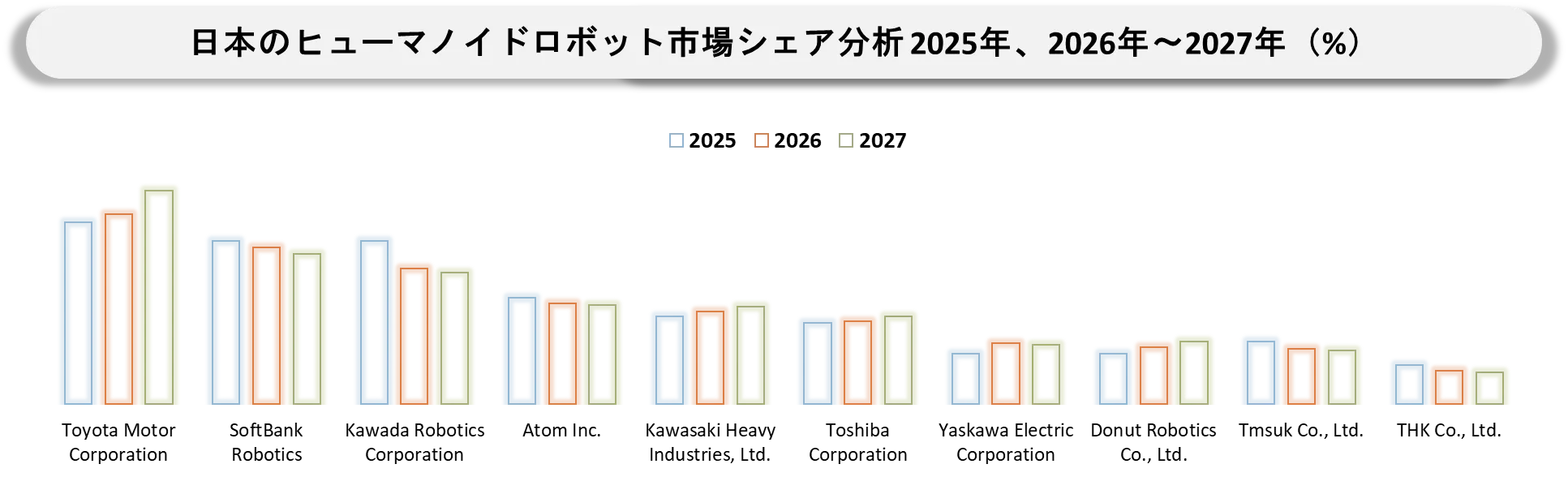
- The market is characterised by three key participant groups: humanoid-robot platform developers, AI-enabled robotics and automation companies, and precision hardware/component providers. Toyota Motor Corporation, SoftBank Robotics, Kawada Robotics Corporation, Atom Inc., Kawasaki Heavy Industries, Ltd., Donut Robotics Co., Ltd., and Tmsuk Co., Ltd. are focused on humanoid platforms, human–robot interaction, AI integration, and application development, while Toshiba Corporation and Yaskawa Electric Corporation leverage established robotics, automation, control, and AI capabilities. THK Co., Ltd. contributes through humanoid and robotic mechanical platforms such as SEED-Noid and associated actuator technologies. The competitive structure remains technology- and ecosystem-driven rather than dominated by a single Japanese supplier.
- Key players include: Toyota Motor Corporation (Japan), SoftBank Robotics (Japan), Kawada Robotics Corporation (Japan), Atom Inc. (Japan), Kawasaki Heavy Industries, Ltd. (Japan), Toshiba Corporation (Japan), Yaskawa Electric Corporation (Japan), Donut Robotics Co., Ltd. (Japan), Tmsuk Co., Ltd. (Japan), and THK Co., Ltd. (Japan).
Key Developments
- December 2025: Sumitomo Heavy Industries, Ltd., a Japan-based industrial machinery manufacturer, and Renesas Electronics Corporation, a Japan-based semiconductor manufacturer, joined the Kyoto Humanoid Association (KyoHA) to support the development of domestically produced humanoid robots in Japan.
- October 2025: NSK Ltd., a Japan-based bearings, precision machinery, and motion-control manufacturer, entered into a business partnership with RT Corporation, a Japan-based AI robotics and humanoid robot developer, and acquired newly issued shares through a third-party allocation, resulting in NSK holding more than one-third of RT’s voting rights.
- August 2026: NSK Ltd., a Japan-based precision machinery, bearings, and motion-control manufacturer, and Atom Corporation, a Japan-based humanoid robotics and Physical AI developer, signed an MOU to jointly develop and implement domestically produced humanoid AI robots.
- December 2025: Telexistence Inc., a Japan-based AI robotics and robotics technology company, headquartered in Tokyo, and Seven-Eleven Japan Co., Ltd., a Japan-based convenience-store operator, headquartered in Tokyo, formed a partnership to develop and validate “Astra,” a generative-AI-powered humanoid robot, with potential deployment across Seven-Eleven stores by 2029.
- October 2025: SoftBank Group Corp., a Japan-based technology investment and telecommunications company, announced an agreement to acquire ABB Ltd.’s Robotics business, a Switzerland-based industrial robotics and automation business, for USD 5.375 billion (¥818.7 billion), with the transaction expected to close in mid-to-late 2026.
- August 2026: SoftBank Group Corp., a Japan-based technology investment and telecommunications company, was reportedly negotiating to acquire a majority stake in 1X Technologies, a U.S.-based humanoid robotics company, in a transaction that would value 1X at approximately USD 6 billion.
- September 2026: O-ID, Inc., a Japan-based humanoid robotics and AI company, raised USD 1.2 million in pre-seed funding, led by TAWANI Ventures, a U.S.-based venture capital firm, with participation from Hustle Fund, a U.S.-based venture capital firm, Techstars, a U.S.-based startup accelerator and investor, and angel investors, to develop fully modular humanoid robots for industrial manufacturing and logistics in Japan.
Key Procurement Priorities and Buyer Evaluation Criteria
- Organisations investing in the Japan Humanoid Robot Market are increasingly selecting suppliers based on their ability to provide high-performance humanoid platforms with reliable actuators, sensors, robotic hands, vision systems, batteries, and motion-control hardware that can support stable locomotion, precise manipulation, and continuous operation across manufacturing, logistics, healthcare, and service environments.
- The decision-making process for procurement is increasingly influenced by the adoption of AI-powered robotics, reinforcement learning, robotics foundation models, and autonomous control technologies. Buyers are therefore evaluating suppliers based on their ability to combine physical robot hardware with AI software, simulation, computer vision, multimodal models, and real-world learning capabilities.
- Buyers consider factors such as robot safety, movement stability, payload capacity, operating time, actuator precision, sensor accuracy, navigation performance, human–robot interaction, reliability, and maintenance requirements when selecting humanoid-robot suppliers. The criteria are particularly important for deployment in human-centred environments where robots must safely interact with workers, customers, patients, or elderly users.
Why Choose DataM?
- Product Performance & Market Positioning: Evaluates humanoid robots based on mobility, payload capability, actuator performance, battery endurance, sensing accuracy, manipulation, autonomy, AI capabilities, and safety, while examining how Japanese companies differentiate their platforms across manufacturing, logistics, healthcare, elderly care, and service applications.
- Real-World Evidence: Highlights practical implementation of humanoid and AI-powered robotics across manufacturing, healthcare, elderly care, disaster response, logistics, food service, and other human-centred environments, providing evidence of how robots can address labour shortages, improve operational flexibility, and support essential services.
- Market Updates & Industry Changes: Tracks major developments in Japan's robotics ecosystem, including AI robotics strategies, robotics foundation-model programmes, new humanoid platforms, R&D initiatives, deployment pilots, and robot-friendly infrastructure.
- Competitive Strategies: Analyses how leading companies such as Toyota Motor Corporation, SoftBank Robotics, Kawada Robotics, Kawasaki Heavy Industries, Atom Inc., Yaskawa Electric, Toshiba, Donut Robotics, Tmsuk, and THK compete through AI integration, proprietary hardware, precision components, strategic partnerships, application-specific development, and expansion from conventional automation toward general-purpose robotics.
- Pricing & Market Access: Examines the factors influencing humanoid-robot procurement costs, including hardware configuration, actuator and sensor complexity, computing requirements, AI/software capabilities, payload, battery capacity, customisation, integration, maintenance, and Robotics-as-a-Service models. The analysis also considers access through direct sales, system integrators, technology partnerships, pilot programmes, and service-based deployment models.
- Market Entry & Expansion: Identifies opportunities created by Japan's labour shortages, ageing population, manufacturing automation requirements, healthcare needs, logistics, food service, and disaster-response applications, while evaluating strategies such as regional deployment, robot-friendly facility design, AI ecosystem partnerships, domestic foundation-model development, and scalable service models.
Target Audience 2026
- Humanoid Robot Manufacturers & Developers
- Automotive & Manufacturing Companies
- AI, Software & Robotics Technology Providers
- Logistics & Warehousing Companies
- Healthcare & Elderly-Care Organizations
- Service Industry & Commercial Operators
- Government Bodies & Public Organizations


























































