


Japan Hospital Specialty Drug Spend Management Market Overview
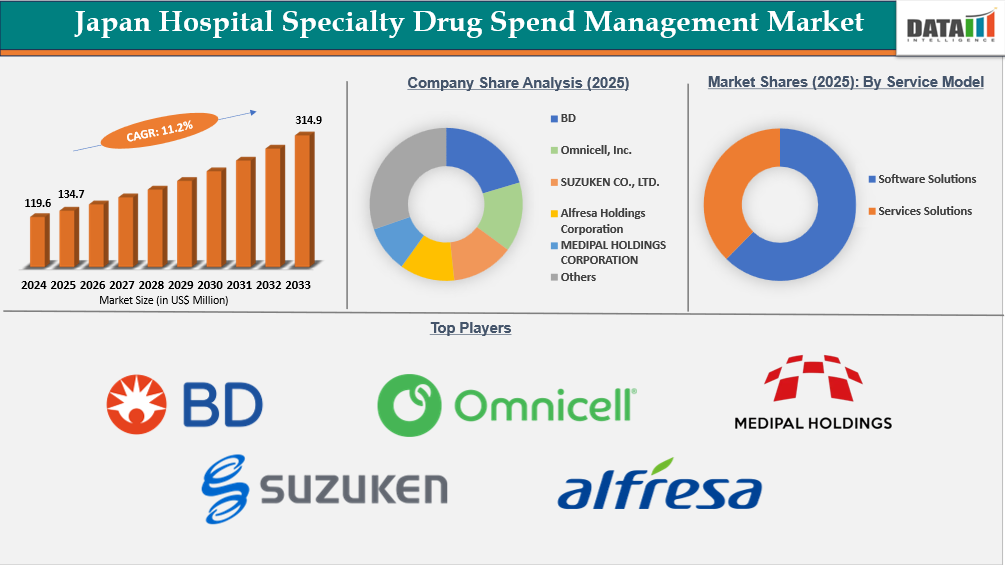
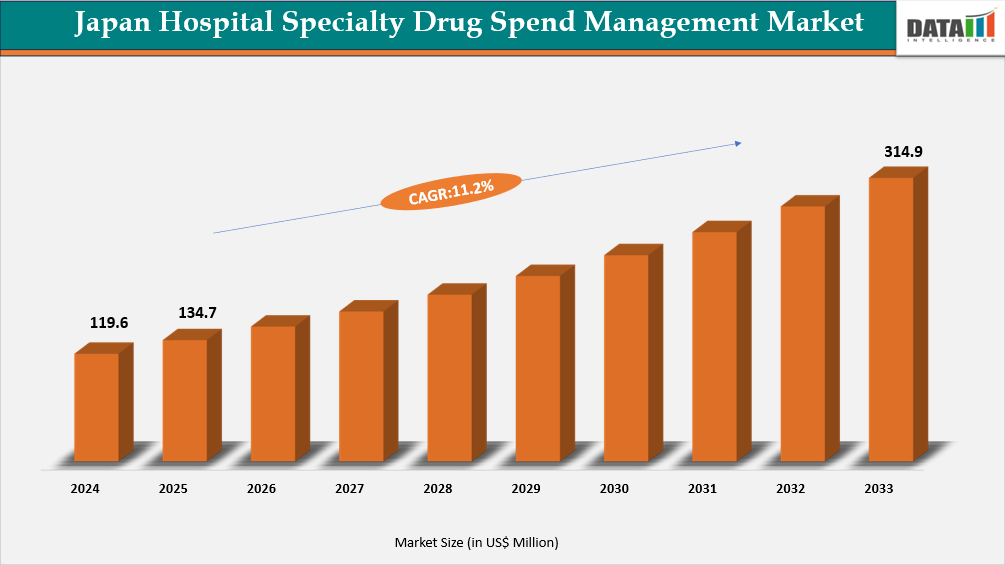
The Japan Hospital Specialty Drug Spend Management Market reached US$119.6 Million in 2024, rising to US$134.7 Million in 2025, and is expected to reach US$314.9 Million by 2033, growing at a CAGR of 11.2% from 2026 to 2033.
Growth is mostly driven by hospital-based use of high-cost specialist medications, notably in cancer, immunology, and critical care departments. As specialty biologics and complex injectables become a larger portion of inpatient pharmaceutical expenditure, hospitals are increasingly implementing structured spend management platforms to improve cost transparency, optimize procurement, and ensure reimbursement accuracy under the National Health Insurance (NHI) system of Japan.
Japan's rising burden of chronic diseases and aging population further support the market projection. The need for specialized medications in hospitals is still growing, since roughly 29% of the population is 65 years of age or older, and over 1 million new cases of cancer are diagnosed each year. There is an increasing demand for real-time use tracking, inventory optimization, and budget management systems because the majority of sophisticated biologics and injectable treatments are provided in hospital settings. The long-term growth of hospital-focused specialty medication expenditure management systems is anticipated to be sustained by these structural healthcare trends as well as ongoing digital transformation activities across Japanese hospitals.
Hospital Specialty Drug Spend Management Industry Trends and Strategic Insights
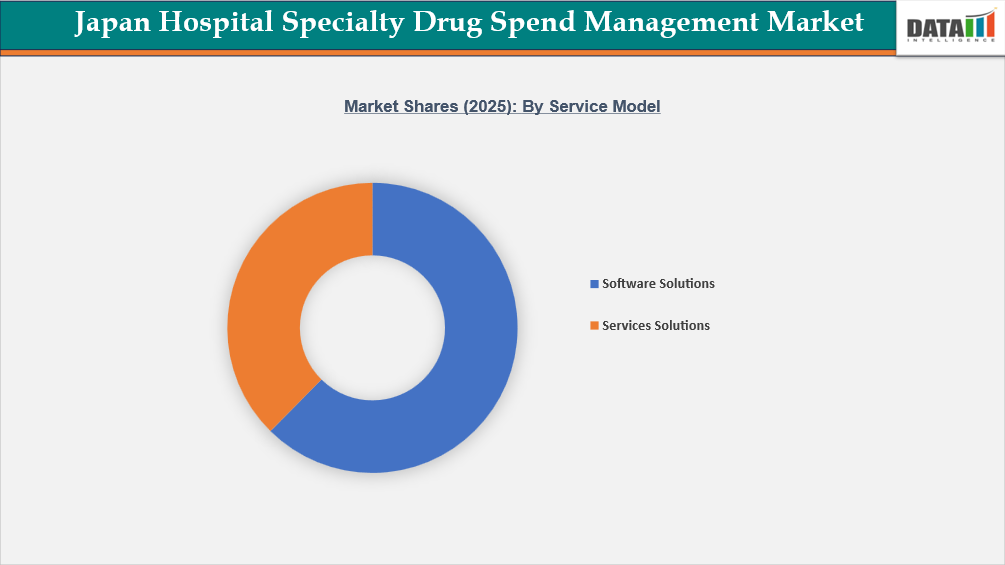
- By solution type segment, software solutions led the Japan hospital specialty drug spend management market, capturing the largest revenue share of 62.4% in 2025.
Japan Hospital Specialty Drug Spend Management Market Size and Future Outlook
- 2025 Market Size: US$134.7 Million
- 2033 Projected Market Size: US$314.9 Million
- CAGR (2026–2033): 11.2%
For More Detailed information, Request for Sample
Market Dynamics
Increasing specialty drug expenditure in hospitals
Japan has one of the highest healthcare expenditures per capita among developed nations, with spending almost 2.5 times the OECD average. The increasing use of specialty pharmaceuticals significantly contributes to this high cost, making it a key driver of the Japanese hospital specialty drug spend management market. Biologics, cancer medications, immunotherapies, and complicated injectables are accounting for a rising percentage of hospital pharmaceutical expenditures due to their high pricing and growing clinical use. With roughly 30% of Japan's population over the age of 65, demand for medical services for cancer, autoimmune disorders, and chronic illnesses is increasing.
Simultaneously, frequent fluctuations in medication prices under the National Health Insurance system, as well as continuous cost-cutting initiatives, put further financial strain on hospitals. The complexities of managing specialty medications, including precise inventory control and use tracking, are driving healthcare institutions to implement integrated spend management systems, pharmacy automation technology, and sophisticated analytics tools. This steady growth in specialty medication spending is driving the demand for structured and technology-driven spend optimization solutions in Japanese hospitals.
Segmentation Analysis
The Japanese hospital specialty drug spend management market is segmented based on solution type, solution model, deployment mode, hospital type, therapeutic area, functional objective, end user, and distribution channel.
Software Solutions Dominate the Market by Digital Transformation and Cost Optimization Needs
Software solutions account for 62.4% of the Japanese hospital specialty drug spend management market, making it the largest revenue sector. The segment's domination is mainly due to the increasingly expensive burden of specialty medicines in hospitals, including cancer biologics, immunotherapies, and complicated injectables. Frequent medication price increases under Japan's National Health Insurance (NHI) system, as well as mounting pressure on hospital administrators to maintain cost efficiency, have increased the need for real-time spend visibility and data-driven decision-making tools. Furthermore, government-supported digital health changes under Medical DX Vision 2030, such as increased e-prescription use and linked electronic health information, are accelerating the transition to sophisticated software-based pharmacy management systems.
Japanese healthcare organizations are investing in analytics platforms, automated inventory management systems, AI-based forecasting tools, and integrated EMR and HIS solutions to better handle high-cost cancer biologics and complicated injectables. These software solutions cut waste, increase inventory accuracy, eliminate stockouts, and maintain reimbursement consistency. Their scalability, recurrent license approach, and long-term integration value continue to boost overall market share.
Competitive Landscape
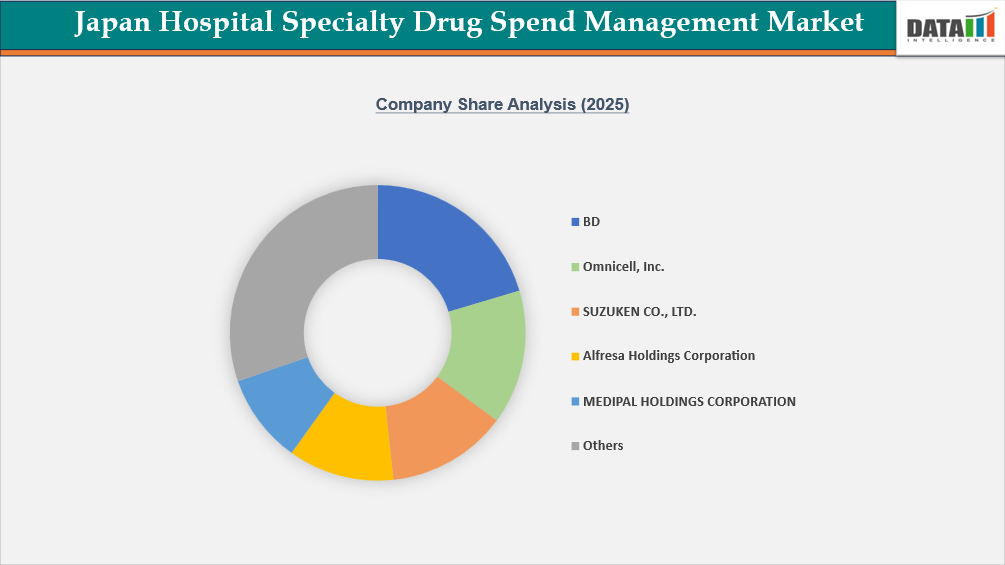
The Japanese hospital specialty drug spend management market is relatively consolidated, with the presence of global automation providers, local pharmaceutical distributors, and healthcare IT system integrators. BD and Omnicell, Inc. hold strong positions due to their sophisticated pharmacy automation, automated dispensing cabinets, and inventory management systems, which directly enable the optimization of specialty medication costs and waste reduction in hospital settings. Yuyama Co., Ltd. makes substantial contributions to the domestic market by providing pharmacy packaging and dispensing technologies tailored to Japanese hospital workflows, thereby improving operational efficiency and enhancing cost visibility.
SUZUKEN CO., LTD., Alfresa Holdings Corporation, MEDIPAL HOLDINGS CORPORATION, and TOHO HOLDINGS CO., LTD. are key players in influencing specialty medication spending through centralized procurement strategies, pricing negotiations, and logistics optimization. Healthcare IT leaders, including NEC Corporation, Hitachi, Ltd., and MEDLEY, INC., compete by integrating hospital information systems, analytics platforms, and electronic medical records to enhance drug utilization tracking, compliance monitoring, and cost transparency. Cooperation agreements, AI-driven inventory forecasting, digital transformation of hospital pharmacy systems, and integrated analytics platforms are still important competitive tactics impacting the growth of the Japan Hospital Specialty Drug Spend Management Market.
Key Developments
- In July 2025, Japan's Digital Agency and Ministry of Health, Labour, and Welfare established the Council for the Renewal of Hospital Information Systems to update hospital IT infrastructure. The initiative aims to transition from on-premise systems to standardized cloud-based platforms by completing system specifications by the end of FY2025 and pilot implementation in FY2026, with an initial focus on small- and medium-sized hospitals (100-200 beds) with integrated electronic medical records and departmental systems, including pharmacy. This upgrade improves real-time pharmacy data integration, cost monitoring, and hospital use of sophisticated analytics tools in the context of specialty medication expenditure control.
What Sets This Japan Hospital Specialty Drug Spend Management Market Intelligence Report Apart
- Latest Data & Forecasts – Updated market intelligence with forecasts through 2033, covering Japan demand across solution type, application, end-user, and distribution channel segments, along with revenue projections and adoption trends in hospital spend optimization systems.
- Regulatory Intelligence – Analysis of Japan’s regulatory and reimbursement environment, including PMDA oversight, National Health Insurance pricing revisions, compliance requirements, and policies influencing hospital procurement and specialty drug cost control.
- Competitive Benchmarking – Structured comparison of leading automation providers, distributors, and healthcare IT vendors based on technology capabilities, hospital penetration, partnerships, and strategic positioning in specialty drug spend management.
- Actionable Strategies & Cost Dynamics – Insights into procurement optimization, automation-driven waste reduction, AI-based forecasting, pricing pressures, and reimbursement trends shaping hospital specialty drug expenditure in Japan.


























































