


Japan Hospital Drug Waste Management Market Overview
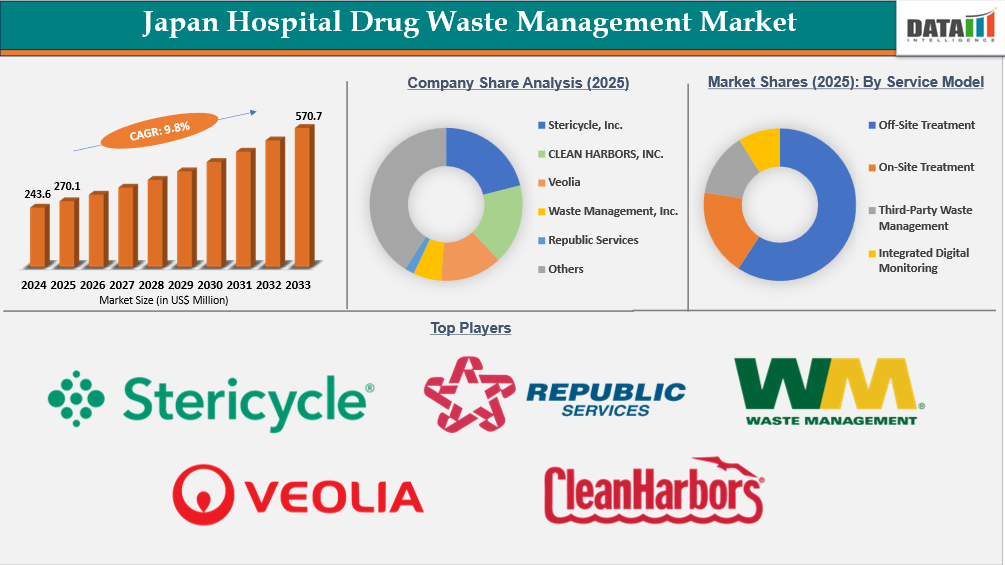
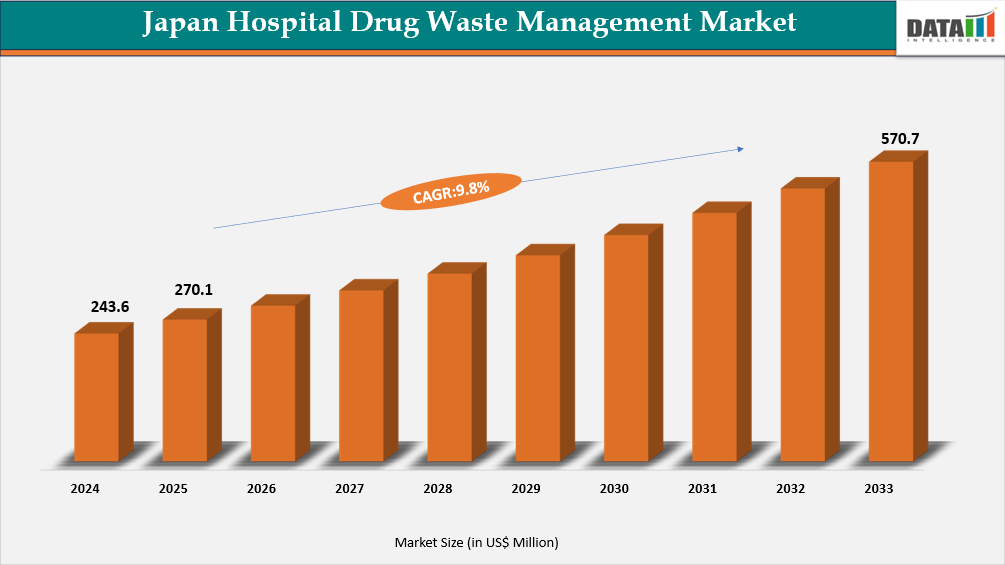
The Japan hospital drug waste management market reached US$243.6 Million in 2024, rising to US$270.1 Million in 2025, and is expected to reach US$570.7 Million by 2033, growing at a CAGR of 9.8% from 2026 to 2033.
Nearly 29% of Japanese citizens are 65 years of age or older, and as hospital treatment demand rises, there is a greater chance of drug waste, particularly for costly therapies. A two-year study conducted at a Japanese university hospital (Ueki et al., 2022) analysed a total of 6,730 medicine waste instances, resulting in losses of JPY 22.78 million, mostly owing to treatment adjustments, discontinuance after preparation, and drug breakage or contamination. Although hospital wards reported the most incidents, the pharmacy department incurred the greatest financial losses, owing mostly to expired high-cost pharmaceuticals.
As a result, Japanese hospitals are implementing waste-management measures such as automated dispensing and inventory tracking systems, data-driven demand forecasts, dosage rounding and vial optimization, and structured waste monitoring programs. Sustainability demands and tighter medical waste management enhance the importance of reducing medication waste.
Hospital Drug Waste Management Industry Trends and Strategic Insights
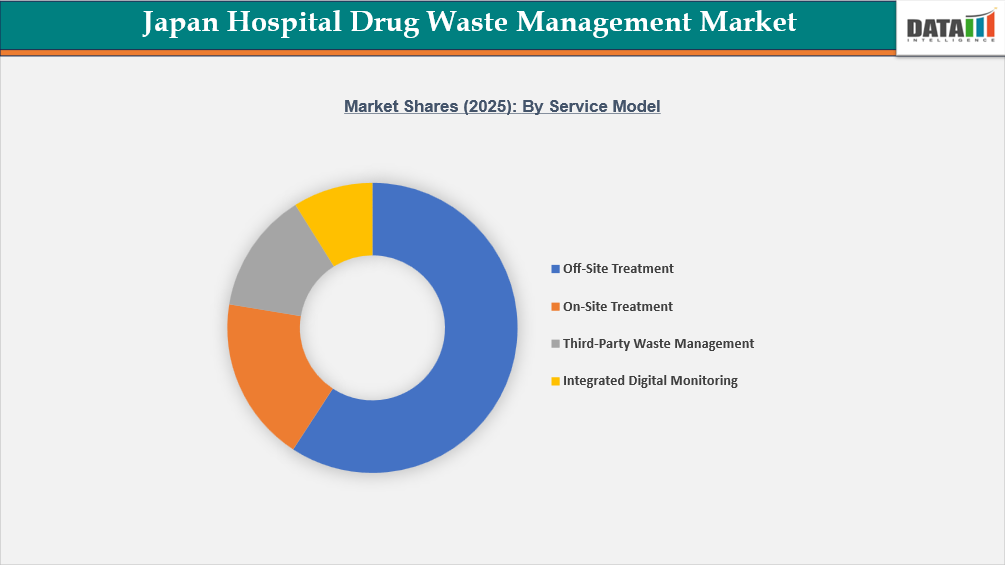
- By service model, off-site treatment led the Japan hospital drug waste management market, capturing the largest revenue share of 59.2% in 2025.
Japan Hospital Drug Waste Management Market Size and Future Outlook
- 2025 Market Size: US$270.1 Million
- 2033 Projected Market Size: US$570.7 Million
- CAGR (2026–2033): 9.8%
Market Dynamics
Strict Regulatory and Environmental Compliance
Strict regulatory enforcement and increased environmental accountability are significant fundamental factors in the Japanese hospital drug waste management market. In Japan, infectious and hazardous medical waste, including hospital waste, is categorized as specially controlled industrial waste and must be tracked, transported, and treated by authorized operators. This mandated compliance framework strengthens hospitals' dependence on certified trash operators and organized waste management systems.
Japan has pledged to become carbon neutral by 2050, focusing on emissions from high-temperature incineration and garbage transit. In FY 2022, national healthcare spending was over ¥47 trillion, indicating that even a small reduction in pharmaceutical waste can lead to large cost savings for hospital systems.
Strict legal obligations, national decarbonization targets, and high healthcare expenditure levels are all driving the adoption of compliant off-site disposal services, on-site sterilization and volume management technologies, and digital tracking platforms that aim to reduce waste generation.
Segmentation Analysis
The Japan hospital drug waste management market is segmented based on the type of waste, treatment method, waste source type, drug value category, service model, service types, and technology adoption level.
Off-Site Treatment Service Model Leads Japan’s Hospital Drug Waste Management Market
Off-site treatment has the biggest market share of any service model, due to Japan's well-established hazardous waste infrastructure and stringent regulatory environment. According to the Ministry of the Environment's report (28th March, 2025) on industrial waste discharge and disposal (for FY2022), Japan's total industrial waste output in FY2022 was 374 million tons. This comprises all types of industrial waste, emphasizing the vast amount of garbage created across industries and the significance of properly regulated waste handling and treatment. According to Japan's Waste Management and Public Cleansing Law, infectious and potentially hazardous medical waste, including hospital waste, is categorized as specially controlled industrial waste. This means it must be traced via a manifest system, carried by licensed operators, and processed in certified facilities. Most hospitals rely on centralized off-site burning, sterilization, and chemical treatment facilities to securely dispose of expired and cytotoxic drugs while adhering to laws and regulations.
At the same time, on-site waste management solutions are gaining popularity as hospitals prioritize cost savings, carbon footprint Management, and better waste segregation methods. Advanced sterilizing systems, volume management devices, and AI-powered inventory and monitoring platforms are rapidly gaining popularity, especially in major metropolitan and tertiary care hospitals.
Competitive Landscape
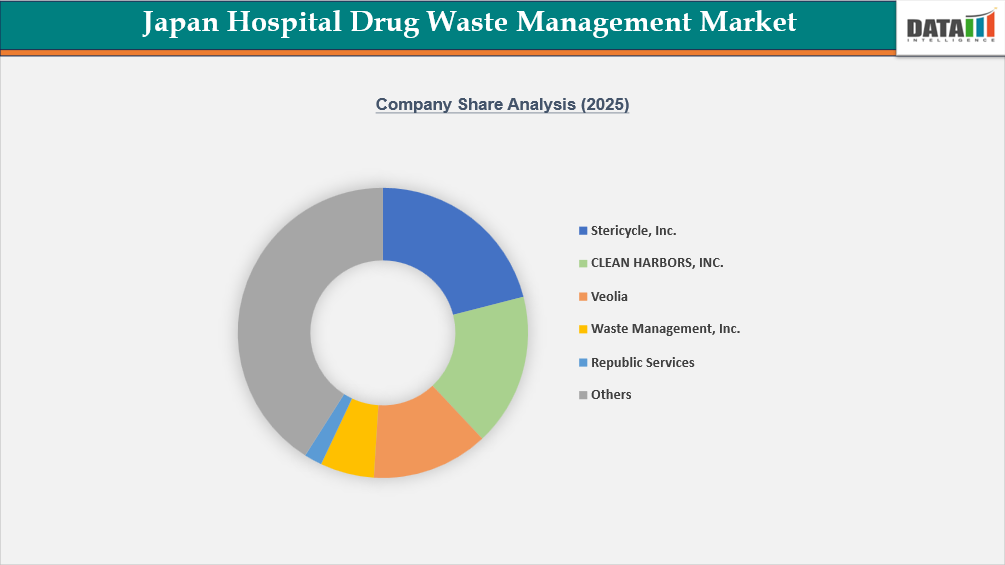
The Japan hospital drug waste management market is relatively fragmented, with competition dominated by multinational environmental service providers such as Stericycle, Inc., Veolia, CLEAN HARBORS, INC., Waste Management, Inc., REMONDIS SE & Co. KG, and Republic Services. These companies compete with modern hazardous waste treatment facilities, incinerator capacity, reverse logistics services, and digital compliance tracking systems. Their expertise focuses on comprehensive pharmaceutical waste collection and disposal solutions tailored to hospital procurement requirements.
Specialized and domestic businesses such as Daniels Sharpsmart Inc., BioMedical Waste Solutions, LLC, NIPON MEDICAL WASTE MANAGEMENT, and KANSAI TSUSHYOU CO., LTD compete by providing container-based systems, sharps management, and regional hospital waste services. International companies utilize their scale, initiatives aimed at sustainability, and waste management programs focused on environmental, social, and governance factors to enhance their market position, while local enterprises benefit from aligned legislation and cooperation with governments.
Key Developments
- In June 2025, Veolia disclosed a global expansion of its hazardous waste treatment activities, including capacity additions and acquisitions in Japan, as part of its GreenUp strategy. Veolia has announced an acquisition agreement for Zeeklite Co., Ltd., a private hazardous waste disposal plant in Yonezawa city, which would expand integrated waste management services in the Japanese market, including hospital pharmaceutical waste streams.
- In May 2025, Macnica deployed its AI-powered dry heat sterilizer "Melt King IOT" at Machida City Hospital. The method reduces infectious and pharmaceutical waste by 70-80%, reducing disposal costs and CO₂ emissions from transportation and incineration. The effort reflects Japan's growing trend of decentralized, hospital-level medication waste management and circular economy-aligned waste management techniques.
What Sets This Japan Hospital Drug Waste Management Market Intelligence Report Apart
- Latest Data & Forecasts – Comprehensive and up-to-date market intelligence with forecasts through 2033, designed to define, describe, and forecast the Japan Hospital Drug Waste Management Market in terms of value, segmented by type of waste, treatment method, waste source type, drug value category, service model, service type, and level of technology adoption.
- Regulatory Intelligence – In-depth assessment of Japan’s regulatory framework specifically impacting hospital drug waste Management, including pharmaceutical waste segregation, safe storage, transportation, reverse logistics, and environmentally responsible disposal practices. The analysis highlights oversight by the Ministry of the Environment, Government of Japan and the Ministry of Health, Labour and Welfare, covering hazardous waste classification, traceability requirements, documentation standards, hospital accountability guidelines, and sustainability policies driving waste minimization initiatives.
- Competitive Benchmarking – Structured benchmarking of leading waste management and environmental service providers based on treatment infrastructure, pharmaceutical waste expertise, hospital contract footprint, digital tracking capabilities, and sustainability positioning within Japan.
- Actionable Strategies & Cost Dynamics – Strategic insights into waste minimization initiatives, reverse logistics models, inventory optimization systems, ESG-driven procurement trends, pricing structures, and operational cost dynamics, supported by expert perspectives from compliance specialists and hospital procurement stakeholders.


























































