


Japan Green Hydrogen Market Size and Overview
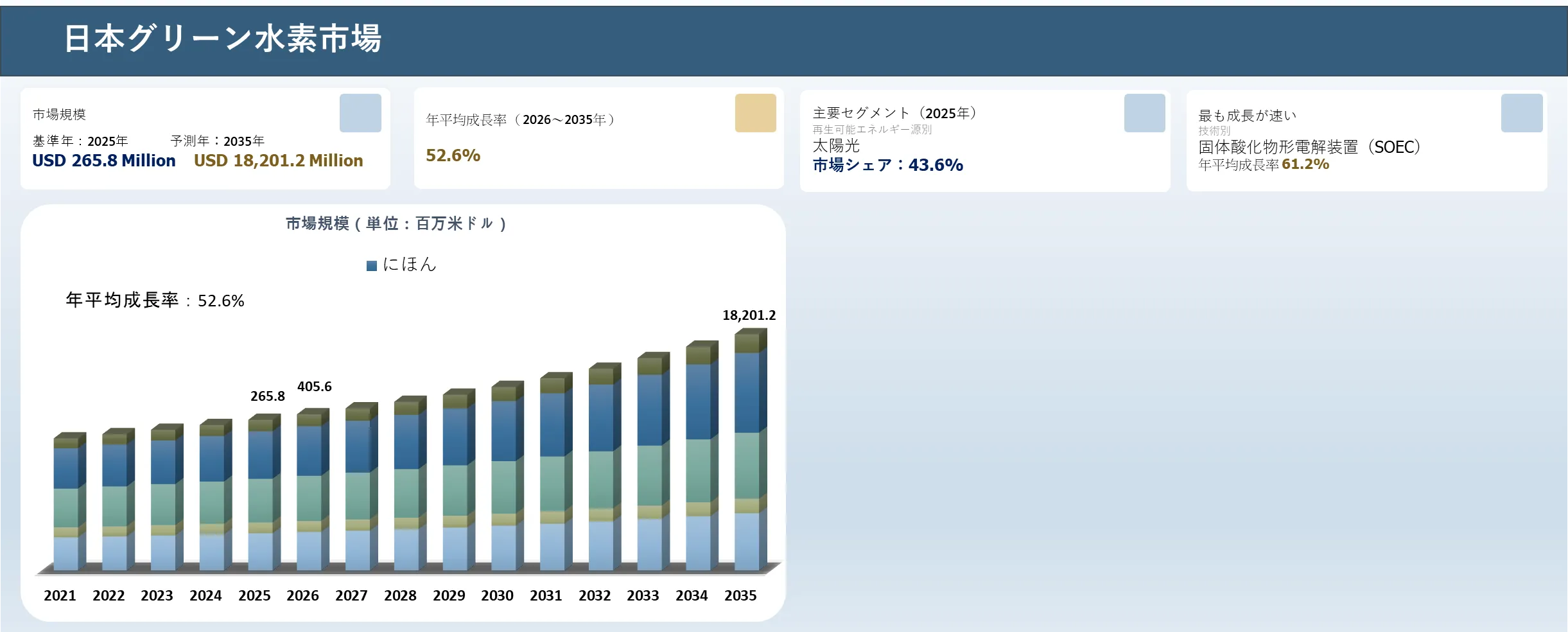
The Japan green hydrogen market reached USD 265.8 million in 2025 and is expected to reach USD 18,201.2 million by 2035, growing with a CAGR of 52.6% during the forecast period 2026-2035. The market is about to undergo a scale-up stage as the country shifts from demonstration projects to commercial hydrogen chains, with electrolysis driven by renewables becoming relevant in industrial decarbonization, power generation, mobility and hydrogen value chain products. In October 2025, the New Energy and Industrial Technology Development Organisation (NEDO) announced the launch of Japan's largest green hydrogen production and utilisation demonstration facility in the city of Hokuto in the Yamanashi prefecture of Japan under the project implemented by the New Energy and Industrial Technology Development Organisation (NEDO).
The project will be realised within the scope of the Green Innovation Fund of NEDO and includes a 16 MW PEM water electrolyser, which is the biggest one of its kind in Japan. According to NEDO, the new facility will enable the annual production of about 2,200 tonnes of green hydrogen in the case of its continuous operation. Moreover, it is estimated that the emission of CO₂ will be reduced by approximately 16,000 tonnes annually through the substitution of part of the gas heat supply at Suntory’s Minami Alps Hakushu Water Plant with hydrogen.
White-Space Opportunities for Japan Green Hydrogen Market: Renewable-Powered Electrolysis and Industrial Decarbonization
In September 2025, Japan’s Ministry of Economy, Trade and Industry (METI) certified the first projects under its approximately ¥3 trillion (USD 20 billion) hydrogen price-gap support scheme, with the green hydrogen and hard-to-abate industrial sector representing the key directly funded area.
The largest directly identified green-hydrogen project is led by Toyota Tsusho Corporation, Eurus Energy Holdings Corporation, and Iwatani Corporation, which will install a 15 MW water-electrolysis system using electricity from Eurus Energy’s onshore wind farms to produce approximately 1,600 tonnes of hydrogen annually for Aichi Steel Corporation’s Chita Plant. The hydrogen will replace natural gas in some steel and iron heating furnaces, creating opportunities in renewable electricity, electrolysers, hydrogen compression and storage, pipeline supply, and green-steel production.
The funding is expected to create opportunities across Japan’s hydrogen production, renewable energy, electrolyser, hydrogen infrastructure, steel, ammonia, chemicals, power generation, transportation, and industrial equipment value chains. In green hydrogen production and renewable power, Toyota Tsusho, Eurus Energy, and Iwatani are positioned to benefit from project development, wind-power supply, hydrogen production, storage, and distribution, while Chiyoda Corporation and Toyota Motor Corporation are involved in the planned water-electrolysis system, with Chiyoda supplying the system using Toyota’s stacks.
Japan Green Hydrogen Market Key Takeaways
- Solar energy dominated the market's renewable energy sources with a 43.6% market share in 2025. Solar's contribution to Japan's total electricity production was 9.9% in FY2024, with projections aiming for 23–29% alongside 20 GW of next-generation solar capacity by FY2040.
- A major green hydrogen project led by Toyota Tsusho, Eurus Energy, and Iwatani features a 15 MW water-electrolysis system powered by onshore wind. The facility aims to generate roughly 1,600 tonnes of hydrogen annually to replace natural gas at Aichi Steel's Chita Plant.
- NEDO initiated a large-scale modular SOEC development project supported by ¥35 billion (USD 222.75 million) in funding. This initiative targets lowering SOEC system costs to below ¥68,000 (USD 432.78) per kW by the year 2032.
- METI certified its first projects under a ¥3 trillion (USD 20 billion) hydrogen price-gap support scheme to bridge the cost difference between clean hydrogen and traditional fuels. Government-backed price-gap support policies represent a major market growth driver, with a calculated 30% impact.
Japan Green Hydrogen Market Scope
| Metrics | Details |
| 2025 Market Size | USD 265.8 Million |
| 2035 Projected Market Size | USD 18,201.2 Million |
| CAGR (2026-2035) | 52.6% |
| By Technology | Alkaline Electrolyzer (AEL), Proton Exchange Membrane (PEM), Solid Oxide Electrolyzer (SOEC), Biomass Pyrolysis, Anion Exchange Membrane Electrolyzer (AEM) |
| By Renewable Energy Source | Solar, Wind, Hydropower, Biomass/Bioenergy, Hybrid, Nuclear-Powered Electrolysis |
| By Application | Power & Grid, Transport / Mobility, Heating, Industrial Feedstock, Energy Storage, Refining, Green Chemicals, Others |
| Report Insights Covered | Competitive Landscape Analysis, Company Profile Analysis, Market Size, Share, Growth |
Japan Green Hydrogen Market Disruption Analysis
Shift Toward Decentralised Renewable-Powered Electrolysis Reshaping Japan’s Hydrogen Supply Structure
The disruption in the Japan green hydrogen market is primarily associated with the shift from traditional central generation of hydrogen to renewable generation through decentralised electrolysis plants nearer to the consumer end. Modern hydrogen generation efforts in Japan are focusing on distributed generation systems with renewables-based electricity generation, water electrolysis, storage, and nearby hydrogen consumption needs instead of using traditional fossil fuels for generating hydrogen.
The disruption is also driving the transition to more efficient and modular electrolyzers. In February 2026, NEDO launched a new SOEC development project that focuses on the development of large-scale and modular electrolysis systems using about ¥35 billion (USD 222.75 million) in funding, with a target of SOEC system costs below ¥68,000 (USD 432.78) per kW by 2032. The new project integrates electrolysis with industrial waste heat and Power-to-X applications, which shows that Japan is not only moving away from hydrogen generation but is now moving into other sectors as well.
Japan Green Hydrogen Market BCG Matrix: Company Evaluation
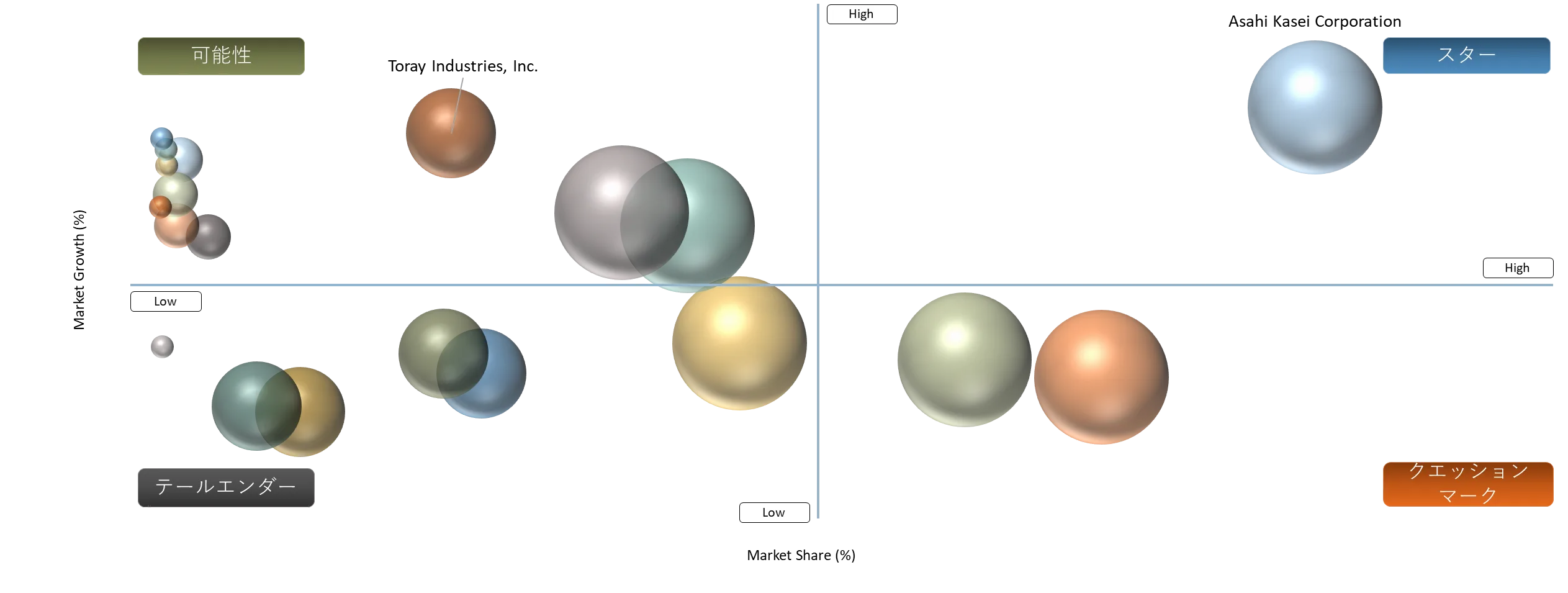
Stars include Asahi Kasei Corporation, Toyota Tsusho Corporation, and DENSO Corporation, which have strong strategic positioning in Japan’s emerging green-hydrogen value chain and are actively advancing production technologies or integrated hydrogen projects. Question Marks include Toshiba Energy Systems & Solutions, JERA Co., Inc., Eurus Energy Holdings Corporation, and Tokyo Electric Power Holdings (TEPCO), which have significant capabilities or project involvement but are operating across a developing market in which commercial-scale green-hydrogen economics and supply-chain structures are still evolving.
Potential includes Toray Industries, Inc. and Suntory Holdings Limited, whose involvement is increasingly linked to the deployment and utilisation of green hydrogen within integrated industrial energy systems rather than broad-based hydrogen production equipment or supply. Tailenders include Mitsubishi Heavy Industries (MHI) within this specific green-hydrogen production comparison because its recent Japanese hydrogen activities are more concentrated on downstream hydrogen utilisation, hydrogen engines, ammonia cracking, and hydrogen-enabled power-generation technologies than on direct renewable-hydrogen production.
Japan Green Hydrogen Market Dynamics
Driver Impact Analysis
| Driver | Market Growth Impact (%) | Demand Concentration | Impacted Use Case | Strategic Impact |
Government-backed price-gap support and hydrogen supply-chain policies are improving project economics and accelerating commercial green hydrogen. | 30% | High – Industrial clusters and large-scale hydrogen projects | Green steel, chemicals, industrial heat, power generation | Improves project bankability, reduces the economic gap with conventional hydrogen, and accelerates commercial-scale investment and offtake development. |
Expansion of renewable-powered electrolysis projects is increasing domestic green-hydrogen production capacity and supporting large-scale commercialisation. | 28% | High – Renewable-rich regions and industrial demand centres | Green hydrogen production, industrial decarbonization, power-to-hydrogen | Expands domestic production capacity and strengthens integration between renewable electricity and hydrogen production. |
Development of regional hydrogen supply-chain models is creating localised production, storage, transportation, and end-use ecosystems for green hydrogen. | 22% | Medium-High – Regional industrial and energy clusters | Industrial heat, mobility, power generation, distributed energy | Reduces supply-chain barriers by connecting local hydrogen production with nearby demand and encourages integrated regional hydrogen hubs. |
New hydrogen supply-chain technology projects are driving cost reduction, equipment modernisation, and broader integration of hydrogen production. | 20% | Medium-High – Production, transportation, storage, and utilisation infrastructure | Hydrogen production, storage, transportation, power generation | Improves technology efficiency, lowers lifecycle supply costs, and supports commercialisation of larger and more integrated hydrogen systems. |
Government-backed price-gap support and hydrogen supply-chain policies are improving project economics and accelerating commercial green-hydrogen development
Government-backed price-gap support and hydrogen supply-chain policies are improving project economics and accelerating commercial green-hydrogen development in Japan. Within Japan's hydrogen policy, the price-gap system is intended to bridge the gap between the benchmarking price of low-carbon hydrogen and the reference price of current fuels and feedstocks, enhancing the economic feasibility of projects and giving clear visibility for investors.
A further development on the part of the policy structure is that it is generating concrete demand and cost targets for hydrogen in Japan. In February 2025, according to the Agency for Natural Resources and Energy (ANRE), the 7th Strategic Energy Plan has established goals for hydrogen production of up to 3 million tonnes per year in 2030, 12 million tonnes per year in 2040, and 20 million tonnes per year in 2050, intending to bring down the cost of hydrogen production to approximately ¥30/Nm³ in 2030 and ¥20/Nm³ or below in 2050. Such targets will enhance the visibility of hydrogen players in the long term by helping scale up production and supply chain infrastructure needed for commercial viability.
Japan Green Hydrogen Market Segment Analysis
The Japan green hydrogen market is segmented based on technology, renewable energy source, and application.
Solar Energy Supporting the Dominance of Renewable-Powered Green Hydrogen Production
Solar energy dominates the renewable energy segment in the Japan green hydrogen market and holds a significant market share of about 43.6% in 2025. Mainly due to the fact that Japan has a strong photovoltaic-based generation foundation, as well as the use of solar power for the electrolysis of water to produce hydrogen. The method of solar power electrolysis helps in directly converting the generated electricity from renewables into hydrogen, which can then be stored and delivered for use.
Solar energy is going to continue playing a key role in renewable energy resources in Japan as part of its switch to hydrogen-based energy systems, as per the government's plans to grow photovoltaic generation. In November 2025, the Agency for Natural Resources and Energy (ANRE) indicated that solar energy was responsible for 9.9% of Japan's total electricity production in the year ended FY2024 and is expected to account for approximately 23-29% by FY2040. Next-generation solar power will also be adopted with the objective of having next-generation solar power cells with a capacity of 20 GW by 2040.
Japan Green Hydrogen Market Competitive Landscape
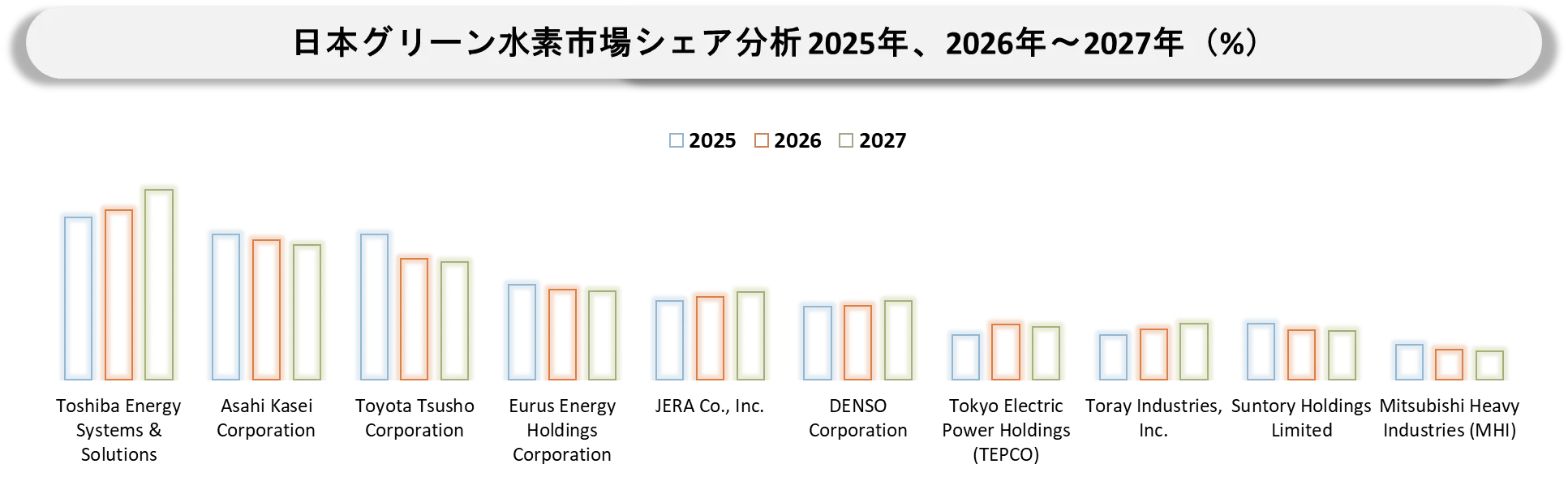
- The market is characterised by three key participant groups: electrolyser and hydrogen technology providers, renewable-energy and hydrogen supply-chain developers, and industrial and power-sector companies integrating hydrogen into their operations. Asahi Kasei Corporation, Toshiba Energy Systems & Solutions, and DENSO Corporation focus on electrolyzer and hydrogen-production technologies; Toyota Tsusho Corporation and Eurus Energy Holdings Corporation contribute through renewable-energy integration and hydrogen supply-chain development; while JERA Co., Inc., Tokyo Electric Power Holdings (TEPCO), Toray Industries, Inc., Suntory Holdings Limited, and Mitsubishi Heavy Industries (MHI) are involved across hydrogen utilisation, power generation, industrial applications, materials, and related infrastructure. It creating an ecosystem-driven competitive landscape where technology development, renewable-energy integration, project execution, supply-chain capabilities, and industrial offtake relationships shape competitiveness.
- Key players include Toshiba Energy Systems & Solutions (Japan), Asahi Kasei Corporation (Japan), Toyota Tsusho Corporation (Japan), Eurus Energy Holdings Corporation (Japan), JERA Co., Inc. (Japan), DENSO Corporation (Japan), Tokyo Electric Power Holdings (TEPCO) (Japan), Toray Industries, Inc. (Japan), Suntory Holdings Limited (Japan), and Mitsubishi Heavy Industries (MHI) (Japan).
Key Developments
- November 2025: INPEX Corporation, a Japan-based energy company, officially opened the Kashiwazaki Hydrogen Park in Niigata, Japan’s first integrated demonstration covering hydrogen and ammonia production through utilization.
- June 2026: Amogy, a U.S.-based clean-energy technology company, and KOWA Company, Ltd., a Japan-based diversified trading and manufacturing company, partnered to deploy ammonia-cracking-based hydrogen supply solutions in Japan.
- July 2026: Kirin Brewery Company, Ltd., Mitsubishi Corporation, MCKB Energy Service Co., Ltd., Takasago Thermal Engineering Co., Ltd., and Miura Co., Ltd., all Japan-based companies spanning the beverage, trading, energy services, engineering, and boiler-equipment sectors, announced a green-hydrogen demonstration at Kirin Brewery’s Hokkaido Chitose Brewery.
- April 2025: Skovgaard Energy A/S, a Denmark-based renewable-energy and Power-to-X company, and Sumitomo Corporation, a Japan-based global trading and business investment company, established North Sky A/S, a joint venture in Denmark in which Sumitomo acquired a 50% stake.
- August 2026: Eiwa Corporation, a Japan-based industrial machinery and measurement-equipment company, acquired the remaining 86% stake in FC Development Co., Ltd., a Japan-based electrochemistry and fuel-cell R&D company, increasing its ownership from 14% to 100%.
Key Procurement Priorities and Buyer Evaluation Criteria
- Organisations investing in the Japan Green Hydrogen Market increasingly select suppliers based on their ability to provide reliable electrolyser systems, renewable-power integration, hydrogen production, storage, and distribution solutions that can operate efficiently at the required scale.
- The procurement decision-making process is increasingly influenced by the need for lower hydrogen production costs, integration with variable renewable electricity, supply-chain reliability, project scalability, and compliance with Japan’s hydrogen-related regulations and certification requirements.
- Buyers consider factors such as electrolyzer efficiency, hydrogen purity, system durability, operational flexibility, renewable-energy compatibility, safety performance, maintenance requirements, and lifecycle operating costs when evaluating hydrogen technology and infrastructure suppliers.
Why Choose DataM?
- Technological Innovations: Explores advancements in green hydrogen production technologies, including alkaline electrolyzers, PEM, SOEC, and AEM systems, along with renewable-power integration, hydrogen storage, and supply-chain technologies that improve efficiency, scalability, and system flexibility.
- Product Performance & Market Positioning: Evaluates how technology providers and project developers differentiate through electrolyzer efficiency, hydrogen purity, operating flexibility, durability, renewable-energy compatibility, system integration, and lifecycle cost performance across industrial, power, mobility, and chemical applications.
- Real-World Evidence: Highlights the deployment of renewable-powered hydrogen systems across industrial facilities, power-generation sites, mobility projects, and regional hydrogen supply chains, demonstrating applications in green steel, industrial heat, green chemicals, energy storage, and transportation.
- Market Updates & Industry Changes: Tracks recent developments in electrolyzer projects, renewable-energy integration, hydrogen hubs, storage and transportation infrastructure, government-backed commercialisation programs, and technology demonstrations across Japan to identify shifts in the emerging hydrogen ecosystem.
- Competitive Strategies: Analyzes how leading companies expand their presence through electrolyzer technology development, renewable-energy partnerships, hydrogen supply-chain integration, project development, industrial offtake agreements, and collaborations across production and utilization.
- Pricing & Market Access: Examines hydrogen production economics based on renewable-electricity costs, electrolyzer technology, capacity utilisation, storage and transportation requirements, and project scale, while assessing access through integrated hydrogen supply chains, industrial users, energy companies, and regional supply hubs.
- Market Entry & Expansion: Identifies opportunities arising from Japan’s industrial decarbonization requirements, renewable-energy expansion, hydrogen power generation, green steel, green chemicals, mobility, and regional hydrogen hubs, while outlining strategies such as technology localisation, strategic partnerships, project integration, and long-term offtake development.
Target Audience 2026
- Green Hydrogen Producers & Electrolyzer Manufacturers
- Renewable Energy Companies
- Energy Utilities & Power Generation Companies
- Industrial Gas & Hydrogen Suppliers
- Steel & Metals Manufacturers
- Chemical & Refining Companies
- Automotive & Mobility Companies


























































