Japan Explosion-Proof Lighting Market Size and Overview
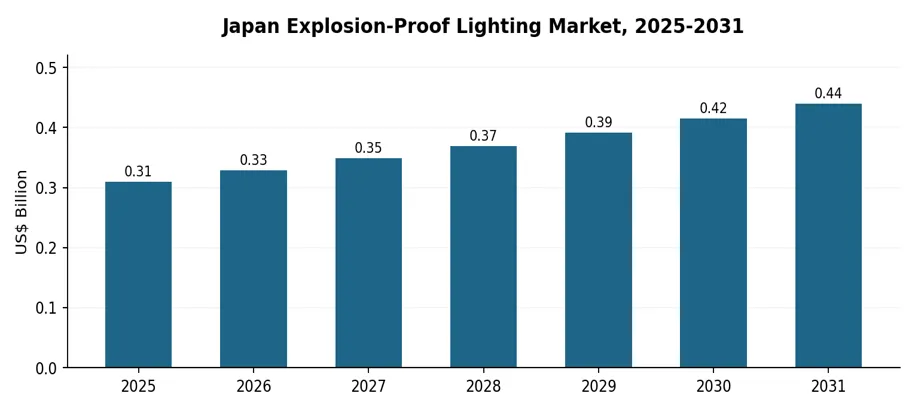
The Japan Explosion-Proof Lighting Market is estimated at US$ 0.31 billion in 2025 and is forecast to reach US$ 0.44 billion by 2031, representing approximately 6.0% annualized growth. Replacement of older hazardous-area luminaires, expanding LED product offerings and safety-led investments at chemical, fuel-handling and process facilities support demand. These figures are directional estimates for specialized certified lighting equipment and related controls and services.
Explosion-proof lighting is installed where flammable gases, vapors, combustible dust or hydrogen can create an ignition risk. It includes certified fixed LED fixtures, high-bay and linear luminaires, emergency fittings and portable maintenance lights. Japanese buyers assess the protection method, permitted hazardous zone, gas or dust group, temperature class and suitability for existing wiring before purchase. Retrofit opportunities are shaped by plant shutdown schedules and site safety approval.
| 2025 MARKET SIZE | 2031 FORECAST | CAGR (2026–2031) |
|---|---|---|
| US$ 0.31 Billion | US$ 0.44 Billion | 6.0% |
Japan Explosion-Proof Lighting Key Takeaways
Japan explosion-proof lighting revenue is estimated at US$ 0.31 billion in 2025 and US$ 0.44 billion by 2031.
Chemical, refining, fuel storage and pharmaceutical facilities remain important buyers of certified hazardous-area luminaires.
LED replacement is reducing maintenance requirements where lighting access requires permits, shutdowns or elevated work.
Gas Zone 1 and Zone 2 applications demand correct equipment ratings, while dust Zones 21 and 22 create additional specialized demand.
Emergency and evacuation lighting attracts attention because safe operation must continue during power interruptions.
Hydrogen-compatible and combined gas-and-dust products offer suppliers opportunities to serve more complex operating environments.
Japan Explosion-Proof Lighting Industry Trends and Strategic Insights
Producers are broadening hazardous-area fixture qualifications to cover gas, hydrogen and dust applications with fewer product families.
Lightweight luminaires and flexible mounting can lower installation effort in congested piping corridors and inaccessible plant areas.
Retrofit customers compare certified fixture performance, site documentation and replacement compatibility alongside unit pricing.
Manufacturers increasingly promote high-efficacy LEDs, surge protection and emergency power options for hazardous locations.
Japan Explosion-Proof Lighting Market Scope
| METRICS | DETAILS |
| 2025 Market Size | US$ 0.31 Billion |
| 2031 Projected Market Size | US$ 0.44 Billion |
| CAGR (2026-2031) | 6.0% |
| By Product Type | Fixed LED linear, high-bay, floodlights, emergency and portable certified lights |
| By End User | Refining, petrochemicals, chemicals, pharmaceuticals, fuel storage and dusty processing |
| By Hazardous Location | Gas Zones 1 and 2, dust Zones 21 and 22, hydrogen-related environments |
| By Protection Method | Flameproof, increased safety, dust ignition protection, combined Ex methods |
| By Lighting Technology | Integrated LED, LED replacement and certified emergency lighting |
| By Components | LED modules, drivers, certified enclosures, seals, glass and cable entries |
| By Installation | Indoor and outdoor hazardous areas, new facilities, retrofit and maintenance |
| Competitive Landscape | Top 10 Japan and international hazardous-area lighting and electrical suppliers |
| Market Data Coverage | Japan explosion-proof lighting market, 2025-2031, technology and demand trends |
Japan Explosion-Proof Lighting Market White Space & Investment Opportunities
Hazardous-area retrofits: replace aging fluorescent and discharge fixtures with certified LED products suited to existing plant layouts.
Multi-hazard coverage: offer luminaires certified for gas and combustible-dust zones, including hydrogen-compatible products where specified.
Emergency and lifecycle support: combine escape-route lighting, tested power arrangements, installation support and spare-part planning.
Suppliers can improve project wins by working with plant safety officers, maintenance teams and engineering contractors before specification approval. Site surveys should confirm zone classification, required approvals, temperature class and mounting conditions. Early documentation and certified replacement packages can reduce installation risk during limited plant turnaround windows.
Driver Impact Analysis
The conversion from fluorescent and other legacy lighting to LED is a significant demand driver for hazardous industrial sites. Chemical plants, refineries and storage terminals often operate older certified fixtures that are costly to maintain, especially in high or hard-to-access locations. New LED equipment offers improved efficacy and lamp life, but replacement decisions still depend on matching the existing hazardous-area classification, cable-entry arrangements and temperature limits. Japan’s broader fluorescent-lamp phase-out also encourages operators to plan upgrades during scheduled turnarounds rather than defer procurement.
| DRIVER | AFFECTED PRODUCT / SIGNAL | 2026–2031 CAGR | STRATEGIC IMPACT |
| LED conversion of older certified fixtures | High | Fluorescent and discharge replacement in process areas | Offer approved retrofit packages with fixture matching |
| Stricter plant safety expectations | High | Gas- and dust-rated equipment, emergency lighting | Provide approvals and technical documentation early |
| Chemical and energy facility maintenance | Medium-High | Turnaround replacement and preventive maintenance | Coordinate orders with plant shutdown schedules |
| Multi-hazard LED product development | Medium-High | Hydrogen, gas and dust compatible luminaires | Invest in certified ranges for complex operating sites |
Safety and operational reliability are equally important. In gas and dust processing areas, buyers need documented protection against ignition and dependable illumination for inspections and emergency evacuation. Hydrogen handling, specialty chemicals and dust-generating operations create demand for wider hazardous-zone compatibility. Lightweight fittings, corrosion-resistant construction and emergency AC/DC options can support higher-value purchases. Suppliers able to provide Japanese certification documents and on-site engineering support are better positioned in complex projects.
Restraint Impact Analysis
Explosion-proof lighting is more expensive than standard industrial LED lighting because it requires engineered enclosures, thermal design, testing and approvals for specific hazardous environments. Customers cannot simply choose any high-output fixture, they must verify the permitted gas or dust group, zone, temperature rating and installation rules. This lengthens technical evaluation and can restrict supplier options. In existing plants, replacing electrical fittings may require certified installers, access permits and coordination with operations, making a retrofit expensive despite attractive energy savings.
| RESTRAINT | PRIMARY EXPOSURE | RISK LEVEL | STRATEGIC IMPACT |
| Certification and qualification costs | All hazardous-area fixture designs | High | Keep approval documents and product variants current |
| Installation during active operations | Refineries, chemical plants and fuel depots | High | Use planned shutdowns and certified contractors |
| High fixture and replacement cost | Specialized LED and emergency lights | Medium-High | Demonstrate lifecycle savings and longer service intervals |
| Limited approved alternatives | Zone-specific replacement and cable entries | Medium-High | Secure spares and confirm fit before purchase |
The timing of demand also depends on maintenance budgets and plant shutdown availability. Chemical and petrochemical operators may postpone noncritical lighting programs when capital spending favors production assets or when operating conditions prevent safe access. Import lead times, component availability and changes to approved models may disrupt matched replacements. Price competition exists in common fixture sizes, but inadequate certification, incomplete product records and after-sales limitations remain substantial procurement risks.
Japan Explosion-Proof Lighting Market Competitive Landscape
Japan’s explosion-proof lighting sector includes Japanese specialists in hazardous-area fixtures and safety equipment alongside international suppliers of industrial and process-plant electrical systems. Customers emphasize local hazardous-area approvals, product availability, service reliability, energy efficiency and support for difficult retrofit installations.
| COMPANY | LIGHTING POSITIONING |
| Iwasaki Electric | Explosion-proof LED systems for process plants, including hydrogen and dust applications |
| Seiwa Electric | Certified hazardous-area LED and emergency luminaires for Japanese industrial sites |
| IDEC | Explosion-protection and industrial safety equipment relevant to hazardous-area installations |
| Panasonic | Japan facility lighting systems and project installation channels |
| Toshiba Lighting & Technology | Commercial and industrial lighting with Japan-market technical support |
| Mitsubishi Electric Lighting | Industrial electrical and lighting infrastructure for factory environments |
| Signify | Professional LED lighting and industrial project offerings |
| Emerson / Appleton | Explosion-proof industrial electrical and luminaire products for process plants |
| Eaton / Crouse-Hinds | Hazardous-area lighting and electrical solutions for industrial operations |
| R. STAHL | Specialist explosion-protected luminaires and electrical apparatus |
Iwasaki Electric and Seiwa Electric offer Japan-market hazardous-area lighting portfolios. IDEC has related explosion-protection and industrial safety expertise. International suppliers such as Emerson, Eaton and R. STAHL serve specialized plant electrical applications through regional channels. Company participation varies by product family, certification and customer project.
Japan Explosion-Proof Lighting Market Recent Developments
April 2, 2026: Iwasaki Electric announced plans to display explosion-proof lighting at the Jumbo Bikkuri trade exhibition alongside other industrial illumination products.
April 15, 2026: Iwasaki Electric published its 2026–2027 facility and outdoor lighting catalog, including products for explosion-proof industrial applications.
May 29, 2026: Seiwa Electric launched its LZLP series of explosion-proof LED fixtures for gas and dust locations, upgrading the earlier LZLA family.
September 1, 2026: Seiwa Electric began taking orders for the LZLP-B explosion-proof LED emergency lighting series with combined AC/DC operation.
October 5, 2026: Iwasaki Electric announced production discontinuation plans for selected lighting and explosion-proof equipment models, affecting replacement planning.
October 15, 2026: Iwasaki Electric launched the LEDioc EX ECOTT range, supporting hydrogen, gas Zones 1/2 and dust Zones 21/22 with higher efficiency and compact installation.