


Japan EV Charging Infrastructure Market Size and Overview
The Japan EV charging infrastructure market reached USD 1.39 billion in 2025 and is expected to reach USD 9.27 billion by 2035, growing with a CAGR of 20.9% during the forecast period 2026-2035. The market is expanding as Japan accelerates the deployment of public, residential, commercial, and highway charging stations. According to the Ministry of Economy, Trade and Industry (METI), the number of charging ports was approximately 68,000 by the end of FY2024. This included approximately 12,000 fast chargers and 56,000 regular chargers. The increase in the number of charging ports in a year is approximately 28,000. The target set for 2030 by METI is 300,000 charging ports, which will include 30,000 fast-charging ports in the public sector, as well as the use of 90-150 kW chargers on highways.
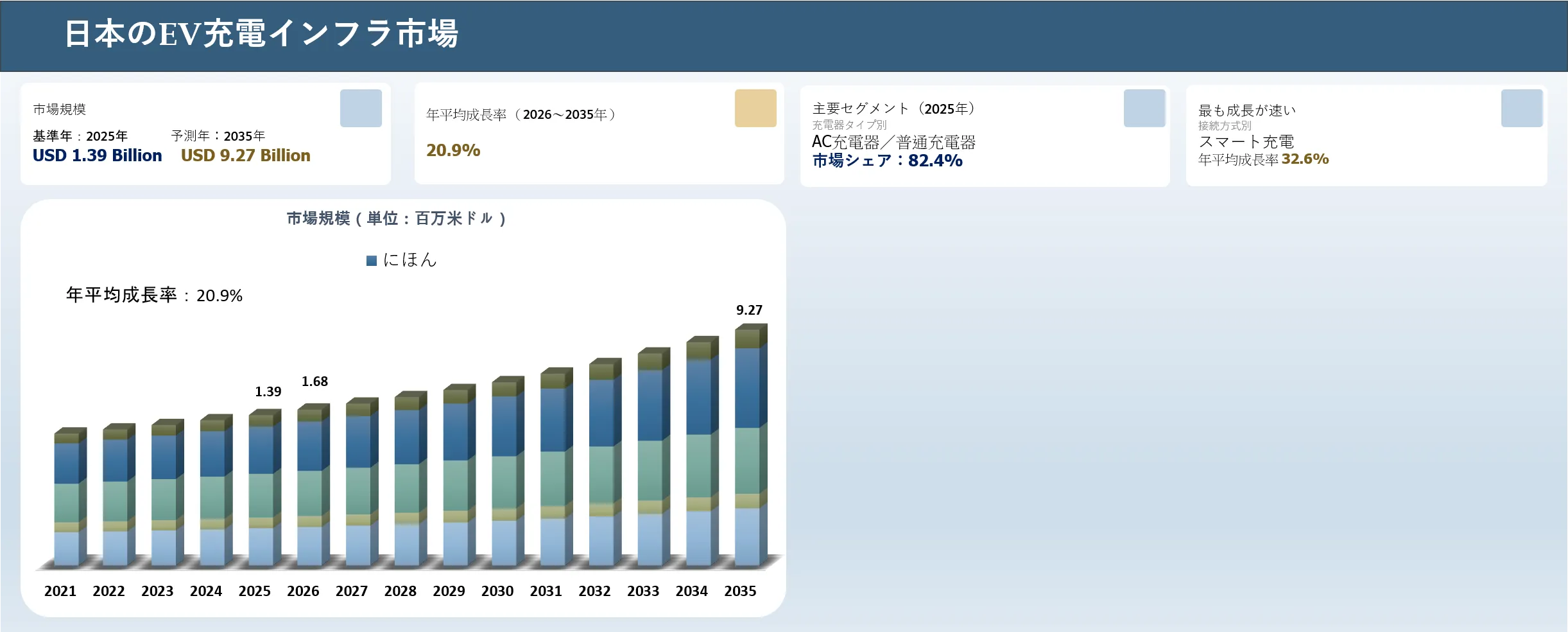
The expansion of high-power charger infrastructure is also accelerating along Japan’s major expressways. In September 2026, according to Carview, the first installation of the ultra-high-capacity 350 kW Toko Takaoka Sera 400 ultra-fast charger was achieved by Toko Takaoka and e-Mobility Power, when the company installed such a charger in the Ebina Service Area located on the Tomei Expressway. The maximum voltage in this device is 1,000 V, with a maximum power of 400 kW and 350 kW per charger. At the same time, e-Mobility Power planned to install or replace 314 fast chargers on expressways in fiscal year 2025, while decommissioning 566 chargers on ordinary roads.
White-Space Opportunities for Japan EV Charging Infrastructure Market from Government-Led Investment
In December 2025, Japan’s supplementary budget provides significant opportunities across the EV charging infrastructure value chain, with ¥36.5 billion (USD 239.7 million) of the total ¥51 billion (USD 334.9 million) allocated specifically to charging infrastructure, making charging deployment the largest investment area under the program. The funding supports the installation of rapid chargers, regular chargers, residential charging outlets, and associated charging infrastructure, with opportunities concentrated particularly in higher-output rapid-charging deployment.
A new support category for 150 kW or higher rapid chargers further expands opportunities for high-power charging at commercial facilities, convenience stores, automobile dealerships, and other locations, while support for residential charging creates additional demand for charging outlets and installation services. The remaining ¥14.5 billion (USD 95.2 million) is directed toward other clean-energy-vehicle infrastructure, including V2H/V2X systems and hydrogen refueling facilities, broadening opportunities beyond conventional EV chargers.
The funding is expected to create significant procurement opportunities across multiple parts of the EV charging infrastructure value chain. Rapid and high-power charging: Toko Takaoka, Tritium, ABB, Siemens, Delta Electronics, Panasonic, and Fuji Electric can benefit from demand for high-output DC charging equipment and associated power-conversion systems. AC and destination charging: Nichicon, Panasonic, Toshiba, Nitto Kogyo, Kawamura Electric, and Shindengen Electric can benefit from residential, workplace, commercial, and destination-charging installations.
Charging networks and deployment: e-Mobility Power, ENEOS, Toyota, Nissan, and Mitsubishi Motors can benefit through the expansion, operation, and utilization of charging networks and charging locations. V2H/V2X and energy management: Nichicon, Panasonic, Shindengen Electric, and Mitsubishi Electric can benefit from increased deployment of bidirectional charging, home energy management, and external power-supply systems.
Japan EV Charging Infrastructure Market Key Takeaways
- A 350 kW Toko Takaoka Sera 400 ultra-fast charger featuring a 1,000 V maximum voltage and 400 kW total power was deployed at the Ebina Service Area.
- e-Mobility Power plans to install or replace 314 fast chargers on expressways in FY2025 while decommissioning 566 older units on ordinary roads.
- Terra Charge announced plans to deploy NACS-compatible chargers starting in FY2028, targeting 2,500 charging points by FY2033 to capture 30–40% of the domestic market.
- Japan's supplementary budget allocated ¥36.5 billion (USD 239.7 million) specifically for EV charging infrastructure out of a total ¥51 billion (USD 334.9 million) program.
- The Ministry of Economy, Trade and Industry aims to reach 300,000 charging ports by 2030, including 30,000 public fast-charging ports.
Japan EV Charging Infrastructure Market Scope
| Metrics | Details |
| 2025 Market Size | USD 1.39 Billion |
| 2035 Projected Market Size | USD 9.27 Billion |
| CAGR (2026-2035) | 20.9% |
| By Charger Type | AC / Normal Chargers, DC / Fast Chargers, Ultra-Fast Chargers |
| By Charging Power | Below 7 kW, 7–22 kW, 23–50 kW, 51–90 kW, 91–150 kW, above 150 kW |
| By Connector Type | CHAdeMO, CCS, Others |
| By Connectivity | Non-connected Charging Stations, Connected Charging Stations, Smart Charging, Others |
| By End-User | Commercial, Residential, Government & Municipal Facilities, Others |
| Report Insights Covered | Competitive Landscape Analysis, Company Profile Analysis, Market Size, Share, Growth |
Japan EV Charging Infrastructure Market Disruption Analysis
Shift Toward Ultra-Fast and High-Power Charging Infrastructure Reshaping Japan EV Charging Landscape
The disruption in the Japan EV charging infrastructure market is becoming synonymous with the shift from normal charging stations to ultra-fast, high-powered, and high-voltage charging stations. The transition is altering the demands of public charging stations with the advent of electric vehicle manufacturers producing vehicles that have higher battery capacities and higher voltage charging capacity, resulting in a need for more powerful charging stations. As a result, Japan’s charging stations are no longer confined to just adding charging stations but also to enhancing the capacity of the stations and next-generation EVs.
The disruption is further emphasized through the introduction of 1,000 V-class ultra-fast charging infrastructure in Japan’s expressways. In September 2026, Takaoka Toko and e-Mobility Power started offering the SERA-400 at the Ebina Service Area on the Tomei Expressway, which is its first application at an expressway rapid charging facility. The SERA-400 provides up to 350 kW of power per port, with the capacity of 400 kW in total, and the capability of providing electricity at 1,000 V. The improved Ebina service area now has 3 rapid chargers with 8 ports and 920 kW of power in total, whereas Takaoka Toko added a 120-kW SERA-120, totaling 520 kW from its own devices at the Ebina site.
Japan EV Charging Infrastructure Market BCG Matrix: Company Evaluation
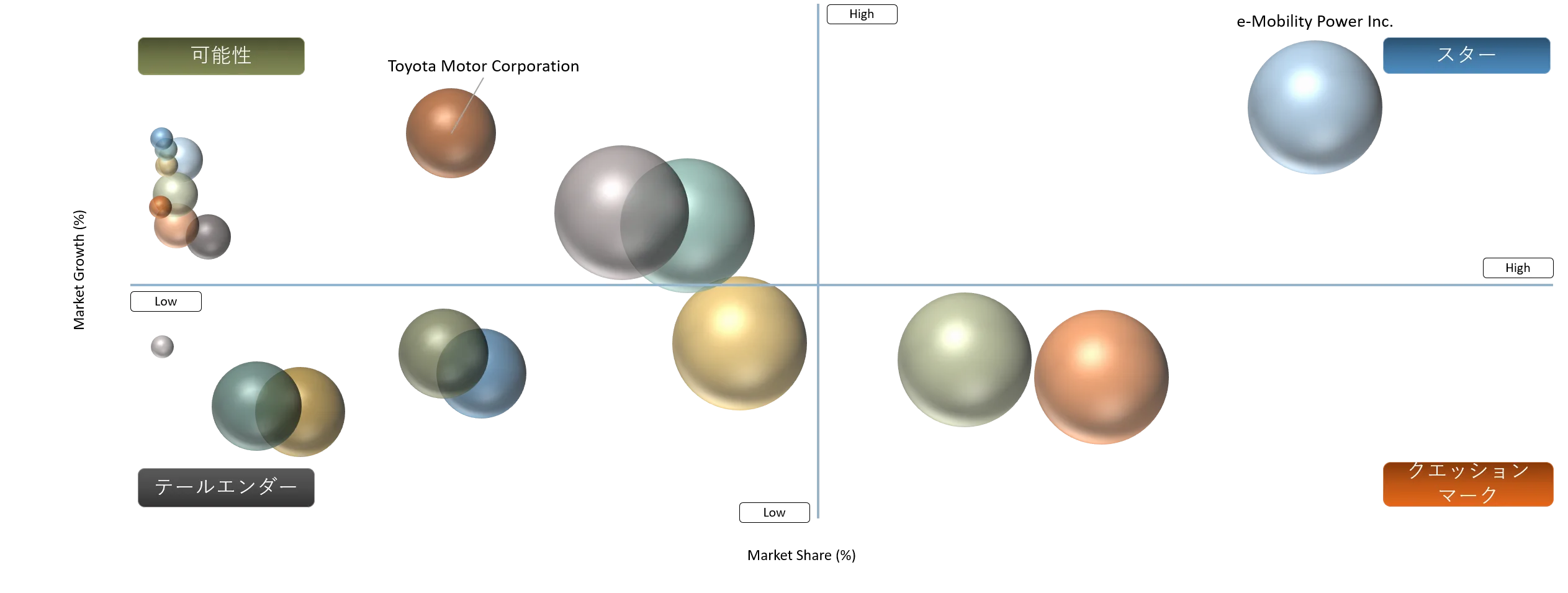
Stars include e-Mobility Power Inc., ENEOS Corporation, and Terra Charge Corporation because they have established or rapidly expanding charging networks and are actively scaling infrastructure across Japan. Question Marks include ENECHANGE Ltd., PowerX, Inc., and PLUGO Inc. because these companies are pursuing differentiated and rapidly expanding charging models but are still developing their scale relative to the largest nationwide networks.
Potential includes Toyota Motor Corporation, Honda Motor Co., Ltd., Nissan Motor Co., Ltd., and Mitsubishi Motors Corporation, whose principal businesses are automotive but which possess significant strategic relevance to Japan's charging ecosystem through vehicle-linked charging services, dealership infrastructure, charging memberships, and partnerships with charging-network operators. Tailenders within this selected 10-company comparison are not identified as a definitive low-performing category, because comparable company-level charging revenue and market-share data are not publicly disclosed consistently across all ten companies.
Japan EV Charging Infrastructure Market Dynamics
Driver Impact Analysis
| Driver | Market Growth Impact (%) | Demand Concentration | Impacted Use Case | Strategic Impact |
Growth in EV battery capacity and vehicle charging capability is increasing demand for ultra-fast chargers. | 24% | High-power highway corridors, major urban charging hubs, high-traffic public locations | Highway fast charging, intercity travel, premium EV charging | Accelerates adoption of 150–350 kW+ chargers and encourages operators to upgrade existing infrastructure to support higher-voltage, higher-capacity EVs. |
Expansion of expressway charging networks is strengthening long-distance EV mobility. | 27% | Expressway SA/PA, major intercity routes, high-volume travel corridors | Long-distance passenger EVs, intercity mobility, commercial EV travel | Drives deployment of strategically located rapid chargers and improves route coverage, reducing charging gaps across major highway networks. |
Multi-port charging deployment is increasing charging availability at high-traffic sites. | 21% | Expressway service areas, parking facilities, commercial hubs, fleet locations | Multiple-EV simultaneous charging, public fast charging, fleet charging | Improves charger availability and site utilization while reducing waiting times; encourages operators to prioritize multi-port and higher-capacity charging configurations. |
Expansion of charging infrastructure at commercial and destination locations is supporting broader public charging coverage. | 16% | Shopping centers, hotels, convenience stores, workplaces, commercial facilities | Destination charging, workplace charging, customer charging | Expands charging beyond highways and residential locations, increasing charging accessibility and creating additional revenue opportunities for site owners and charging operators. |
Growth in EV battery capacity and vehicle charging capability is increasing demand for ultra-fast chargers
The increasing capacity of batteries and greater charging abilities in recent electric vehicles (EVs) have developed a structural need for higher power charging facilities in Japan. With the emergence of higher voltage platforms in vehicles, traditional fast charging stations can act as a constraint by prolonging charging durations for vehicles with higher-capacity batteries. The effort by charging facility operators are working to provide higher-output charging facilities, higher voltages, multiport facilities, and efficient power charging facilities, especially on highways.
As EVs become equipped with larger batteries and more advanced charging capability, the development of such charging stations becomes crucial. In February 2026, e-Mobility Power announced the reactivation of the fast-charging stations at Ebina Service Area on Tomei Expressway, with three fast chargers and eight charging terminals in both directions. In the new layout, there are chargers with ratings of 90 kW, 150 kW, and up to 350 kW per terminal, with SERA-400 capable of charging at 1,000V. e-Mobility Power said that the renewal was prompted by the rise in the size of onboard batteries and capabilities in vehicle charging.
Japan EV Charging Infrastructure Market Segment Analysis
The Japan EV charging infrastructure market is segmented based on charger type, charging power, connector type, connectivity, and end-user.
Expansion of AC / Normal Charging Infrastructure Supporting Japan’s Broad EV Charging Coverage
The AC/normal charger segment dominates the Japan EV charging infrastructure market, since such chargers are appropriate for long-term parking and normal charging within residential, apartment, business, commercial, and destination areas. The lower energy needs and appropriateness for long-term parking mean that such chargers are vital for making charging available outside the fast-charging highway corridors.
As there will be an increased application of destination charging in Japan, there will be more applications of AC/normal chargers in Japan’s tourism industry infrastructure. In January 2026, Terra Charge announced the deployment of 84 units of 6 kW regular chargers in 21 Comfort Inn hotel sites, with four chargers being installed at each site. It is important to note that this initiative allows the charging of EVs during their stay in the hotel, and it benefits travelers on their long-distance tours.
Japan EV Charging Infrastructure Market Competitive Landscape
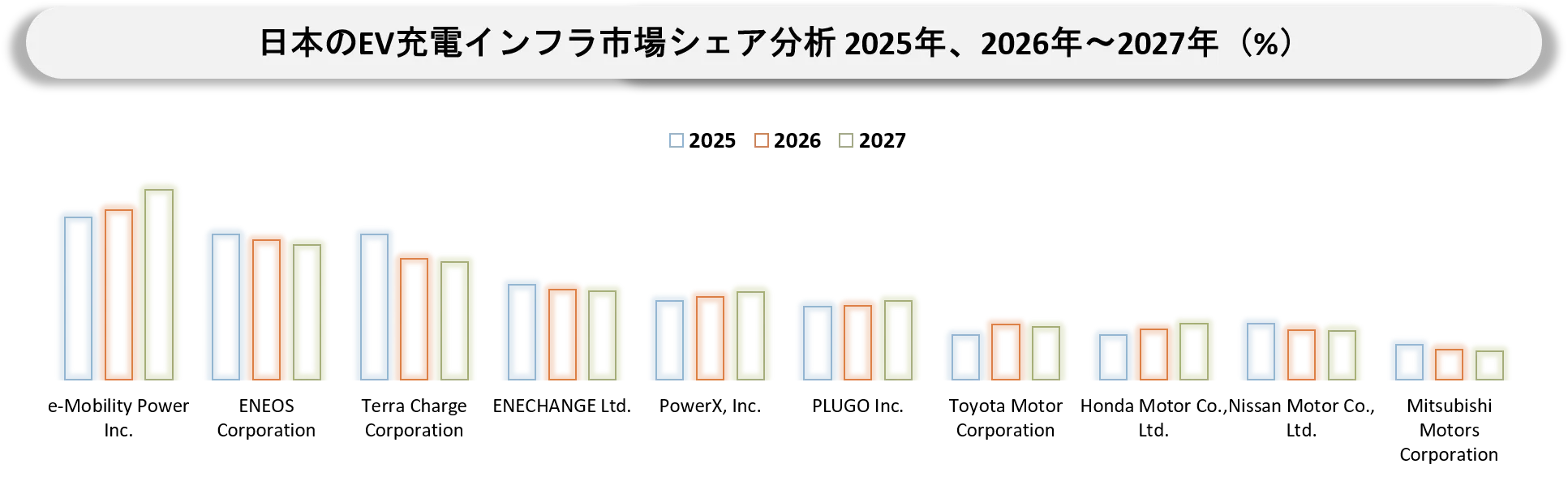
- The market is characterized by three key participant groups: large-scale charging network operators, specialized EV charging service providers, and automotive companies developing integrated charging ecosystems. e-Mobility Power Inc. and ENEOS Corporation have established broad charging networks; Terra Charge Corporation, ENECHANGE Ltd., PowerX, Inc., and PLUGO Inc. focus on expanding charging services, destination charging, digital platforms, and high-power charging solutions; while Toyota Motor Corporation, Honda Motor Co., Ltd., Nissan Motor Co., Ltd., and Mitsubishi Motors Corporation integrate charging services with their EV and mobility ecosystems. It's creating an increasingly ecosystem-driven landscape where network coverage, charging technology, interoperability, digital services, and customer convenience shape competitive positioning.
- Key players include e-Mobility Power Inc. (Japan), ENEOS Corporation (Japan), Terra Charge Corporation (Japan), ENECHANGE Ltd. (Japan), PowerX, Inc. (Japan), PLUGO Inc. (Japan), Toyota Motor Corporation (Japan), Honda Motor Co., Ltd. (Japan), Nissan Motor Co., Ltd. (Japan), and Mitsubishi Motors Corporation (Japan).
Key Developments
- July 2026: PowerX, Inc., a Japan-based EV charging infrastructure company, opened approximately 50 of its EV charging stations across Japan to members of the Premium Charging Alliance (PCA), a fast-charging service for Porsche, Audi, and Volkswagen EV owners.
- October 2025: ENEOS Corporation, a Japan-based energy company, began a demonstration of a shared EV charging station for commercial vehicles at the Shinkiba Truck Station in Tokyo, in collaboration with Japan High Voltage Electrical Co., Ltd., a Japan-based electrical equipment company.
- August 2026: Hubject, a Germany-based e-mobility interoperability company, partnered with Plugo Inc., a Japan-based EV charging infrastructure and services company, to accelerate ISO 15118-based Plug&Charge adoption in Japan.
- August 2026: Terra Charge Co., Ltd., a Japan-based EV charging infrastructure company, announced plans to begin deploying NACS-compatible EV chargers in Japan from FY2028, targeting 2,500 charging points nationwide by FY2033, equivalent to approximately 30-40% of its domestic charging-infrastructure share.
- September 2026: PowerX, Inc., a Japan-based EV charging and battery-energy company, upgraded its existing EV charging station in Ariake, Tokyo, to support high-voltage charging up to 1,000 V and 240 kW using its battery-integrated Hypercharger Standard system.
Key Procurement Priorities and Buyer Evaluation Criteria
- Organizations investing in the Japan EV Charging Infrastructure Market increasingly select suppliers based on their ability to provide reliable charging equipment with appropriate power output, charging speed, interoperability, and scalability across residential, commercial, workplace, and highway applications.
- The procurement decision-making process is increasingly influenced by the expansion of high-power charging, larger EV battery capacities, higher-voltage vehicle architectures, smart charging, and networked charging services, requiring buyers to evaluate whether suppliers can support both current and next-generation EV charging requirements.
- Buyers consider factors such as charger reliability, charging efficiency, power output, connector compatibility, network uptime, payment and authentication capabilities, software integration, installation requirements, and maintenance support when selecting charging infrastructure suppliers.
Why Choose DataM?
- Technological Innovations: Explores advancements in EV charging technologies, including ultra-fast charging, high-voltage charging, multi-port systems, smart charging, connected charging, and Plug & Charge solutions, highlighting their role in improving charging speed, convenience, and network efficiency.
- Product Performance & Market Positioning: Evaluates charging infrastructure providers based on charging power, charging efficiency, reliability, interoperability, network availability, software capabilities, and scalability across residential, commercial, workplace, destination, and highway applications.
- Real-World Evidence: Highlights the deployment of EV charging infrastructure across Japan, including residential properties, hotels, commercial facilities, workplaces, parking areas, and expressway service areas, demonstrating practical applications in daily charging, long-distance mobility, fleet operations, and destination charging.
- Market Updates & Industry Changes: Tracks developments such as high-power charger deployments, expressway charging upgrades, expansion of charging networks, charger replacement programs, interoperability initiatives, and government-supported infrastructure development shaping Japan's EV charging ecosystem.
- Competitive Strategies: Analyzes how leading charging operators, energy companies, technology providers, and automotive manufacturers expand through network development, strategic partnerships, high-power charging deployment, digital charging platforms, roaming services, and integration with EV ecosystems.
- Pricing & Market Access: Examines charging infrastructure economics across hardware, installation, electricity, maintenance, software, and network services, while assessing market access through charging operators, energy companies, automotive manufacturers, property owners, municipalities, and specialized charging-service providers.
- Market Entry & Expansion: Identifies growth opportunities arising from Japan's expansion of public and private charging infrastructure, increasing demand for high-power charging, destination and workplace charging, fleet electrification, smart charging, and improved charging accessibility, while outlining strategies for technology differentiation, strategic partnerships, network expansion, and location optimization.
Target Audience 2026
- EV Charging Network Operators & Service Providers
- Automotive Manufacturers & EV Ecosystem Companies
- Energy & Utility Companies
- Charging Equipment & Technology Suppliers
- Commercial Property Owners & Destination Operators
- Fleet Operators & Transportation Companies
- Government & Municipal Authorities


























































