


Japan EV Battery Recycling Market Size and Overview
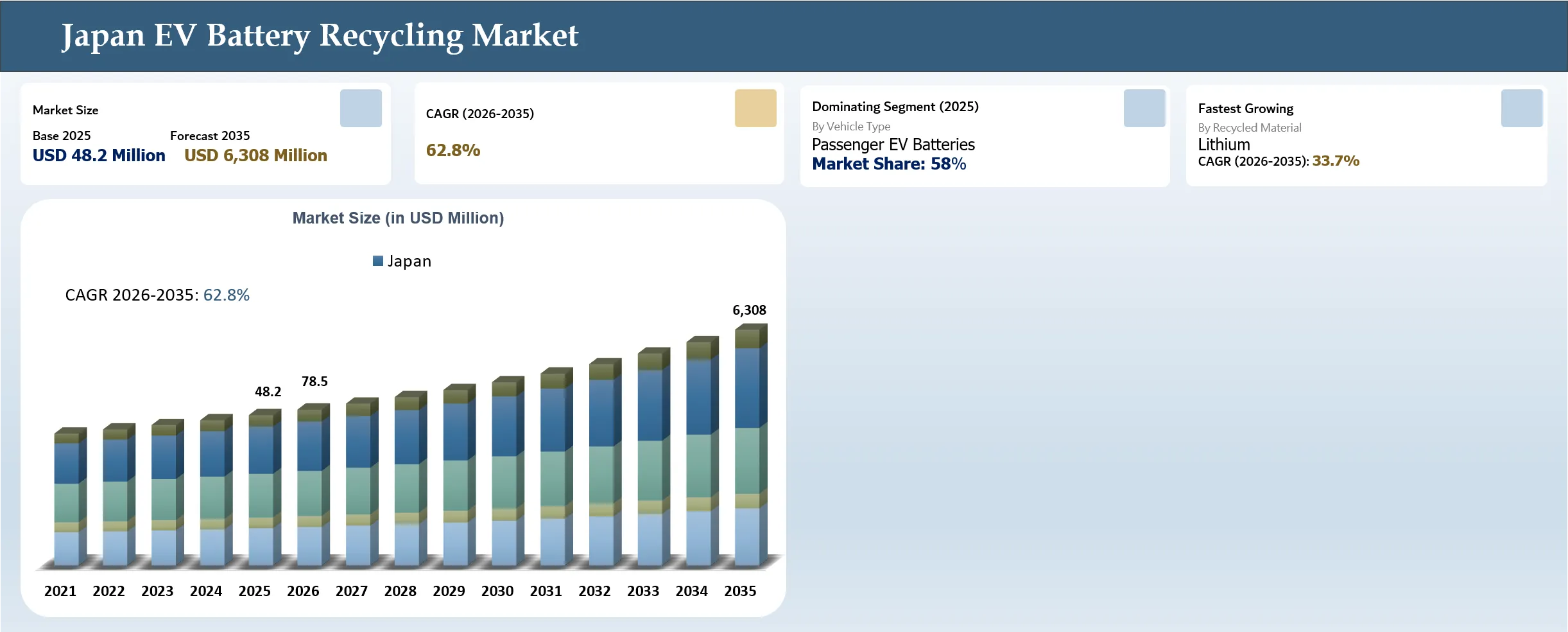
The Japan EV battery recycling market reached USD 48.2 million in 2025 and is expected to reach USD 6,308 million by 2035, growing with a CAGR of 62.8% during the forecast period 2026-2035. The market is moving toward commercial-scale recycling as Japan develops technologies for recovering the critical battery materials and boosting resource recycling domestically. In March 2026, according to the New Energy and Industrial Technology Development Organization (NEDO), the Green Innovation Fund battery recycling projects in Japan have set targets for recycling at least 70% of lithium and 95% of nickel and cobalt. NEDO has further stated that JERA’s high-voltage pulsed discharge technology will recycle more than 80% of lithium, 95% of nickel and cobalt, while reducing CO₂ emissions by 20%.
The expansion of domestic recycling capacity is also being supported by major industrial investments. In May 2025, Asaka Riken plans to commence its lithium-ion battery recycling activities from April 2028, where it will recycle and regenerate lithium, cobalt, nickel, and manganese from EV batteries and reprocess them to form battery-grade materials. The investments in the Iwaki Plant have been increased by JPY 2.5 billion (USD 15.89 million) to make a total of JPY 9.5 billion (USD 60.4 million), with the commencement of its operations expected in October 2026.
White-Space Opportunities for Japan EV Battery Recycling Market Driven by Battery Recycling and Critical-Metal Recovery Investments
In May 2026, Sumitomo Metal Mining Co., Ltd. (SMM), Japan, planned total capital expenditure of JPY 122.5 billion (USD 0.80 billion) for FY2026, covering April 2026-March 2027, with Smelting & Refining receiving the largest allocation at JPY 50.9 billion (USD 325.8 million), followed by Mineral Resources at JPY 42.7 billion (USD 273.5 million), Materials at JPY 22.4 billion (USD 143.4 million), and other activities at JPY 6.5 billion (USD 41.6 million).
The investment plan specifically includes construction and operation of lithium-ion battery recycling plants. The recycling investment is focused on SMM’s facilities at the Toyo Smelter & Refinery and Niihama Nickel Refinery in Ehime, Japan, designed to recover copper, nickel, cobalt, and lithium from used lithium-ion batteries, with planned processing capacity of approximately 10,000 tonnes of lithium-ion battery-cell equivalent per year.
The investment creates opportunities across several areas of the Japan EV battery recycling market, particularly battery recycling, non-ferrous metal recovery, nickel and cobalt refining, copper recovery, lithium recovery, black-mass processing, and recycled battery-material production. Sumitomo Metal Mining Co., Ltd. is the principal beneficiary through its integrated smelting, refining, and battery-material operations, while Kanto Denka Kogyo Co., Ltd. can benefit from lithium-recovery technology and high-purity lithium-compound production.
Primearth EV Energy Co., Ltd. provides downstream opportunities through evaluation of cathode materials produced from recycled LIB-derived metals, supporting recycled battery-material qualification and closed-loop battery supply chains. In battery collection, dismantling, and recycling, companies such as DOWA Holdings Co., Ltd., JX Advanced Metals Corporation, Mitsubishi Materials Corporation, and Toyota Tsusho Corporation can benefit from increased demand for battery collection, pre-processing, metal recovery, and recycling services.
Japan EV Battery Recycling Market Key Takeaways
- Passenger EV batteries dominated the vehicle type segment in 2025 by capturing a 58% market share. This market lead is further supported by electric car sales in Japan surpassing 100,000 units, representing nearly 3% of total vehicle sales.
- Japan Automobile Importers Association reported that 30,513 imported BEVs were sold in Japan as of January 2026. This total represents a 9.5-fold increase compared to the roughly 3,200 units recorded in 2020.
- Advancements in mid-scale battery recycling and hydrometallurgical technologies hold a 30% growth impact on the market. This focus directly improves recovery yield and accelerates the transition from pilot operations to commercial-scale recycling.
- In May 2026, Sumitomo Metal Mining planned a total capital expenditure of JPY 122.5 billion (USD 0.80 billion) for FY2026. The allocation includes JPY 50.9 billion (USD 325.8 million) specifically directed toward Smelting & Refining.
Japan EV Battery Recycling Market Industry Trends and Strategic Insight
- Shift toward closed-loop battery material recovery. Japan’s recycling industry is moving beyond end-of-life battery disposal toward closed-loop recovery of lithium, nickel, cobalt, manganese, and other battery materials, enabling recovered resources to return to domestic battery-material and cell manufacturing. NEDO identifies comprehensive recycling supply chains as a key requirement for commercial implementation.
- Transition from laboratory development to demonstration-scale processing. Recycling technologies developed through Japan’s Green Innovation Fund are progressing toward mid-scale demonstration and validation, with greater emphasis on process stability, operating economics, material quality, and eventual commercial deployment rather than laboratory-level recovery performance alone.
- Integration of recycling with the domestic battery manufacturing strategy. The revised Battery and Power Industry Strategy places greater emphasis on strengthening Japan’s complete battery ecosystem, including upstream resources and supply-chain resilience.
- Resource security is becoming the core market rationale. Japan’s EV battery recycling industry is increasingly positioned as a critical-mineral security mechanism, allowing domestic manufacturers to supplement imported raw materials with locally recovered resources.
- Commercial success will depend on ecosystem integration. The strongest business models are likely to center on stable feedstock access, efficient pretreatment, high-purity material recovery, long-term offtake arrangements, and reintegration into battery-material supply chains.
Japan EV Battery Recycling Market Scope
| Metrics | Details |
| 2025 Market Size | USD 48.2 Million |
| 2035 Projected Market Size | USD 6,308 Million |
| CAGR (2026-2035) | 62.8% |
| By Battery Type | NMC (Nickel Manganese Cobalt), NCA (Nickel Cobalt Aluminium), LFP (Lithium Iron Phosphate), LMO (Lithium Manganese Oxide), LCO (Lithium Cobalt Oxide), Others |
| By Vehicle Type | Passenger EV Batteries, Commercial EV Batteries, Hybrid Electric Vehicle (HEV) Batteries, Others |
| By Recycling Process | Mechanical Recycling, Hydrometallurgical Recycling, Pyrometallurgical Recycling, Others |
| By Recycled Material | Lithium, Nickel, Cobalt, Manganese, Copper, Graphite, Aluminium, Others |
| By Application | EV Battery Manufacturing, Electric Vehicles, Energy Storage Systems, Others |
| Report Insights Covered | Competitive Landscape Analysis, Company Profile Analysis, Market Size, Share, Growth |
Japan EV Battery Recycling Market Disruption Analysis
Advanced Lithium Recovery and Low-Carbon Recycling Disrupting Japan’s EV Battery Recycling Market
The Japan EV battery recycling market is being disrupted by the transition from conventional thermal and metal-extraction to direct cathode regeneration, pure black-mass recovery, and low-carbon recycling methods. Japanese enterprises and government-sponsored programs are taking recycling from just lithium, nickel, and cobalt recovery to a point where the recycled metals are ready to be used in battery making again.
Advanced lithium recovery technology is changing the face of battery recycling in Japan by increasing efficiency and minimizing the impact on the environment in this process. In April 2025, JX Advanced Metals Corporation, a Japanese company engaged in the manufacturing of nonferrous metals and materials, revealed that its subsidiary company, JX Advanced Metals Circular Solutions Co., Ltd., had invented a recycling process enabling recovery of more than 90% of lithium from used automotive lithium-ion batteries, along with a decrease in the carbon footprint of the product by 40% compared to its current process. The implementation of this innovation was scheduled to take place at the company's Tsuruga plant in the second half of FY2026.
Japan EV Battery Recycling Market BCG Matrix: Company Evaluation
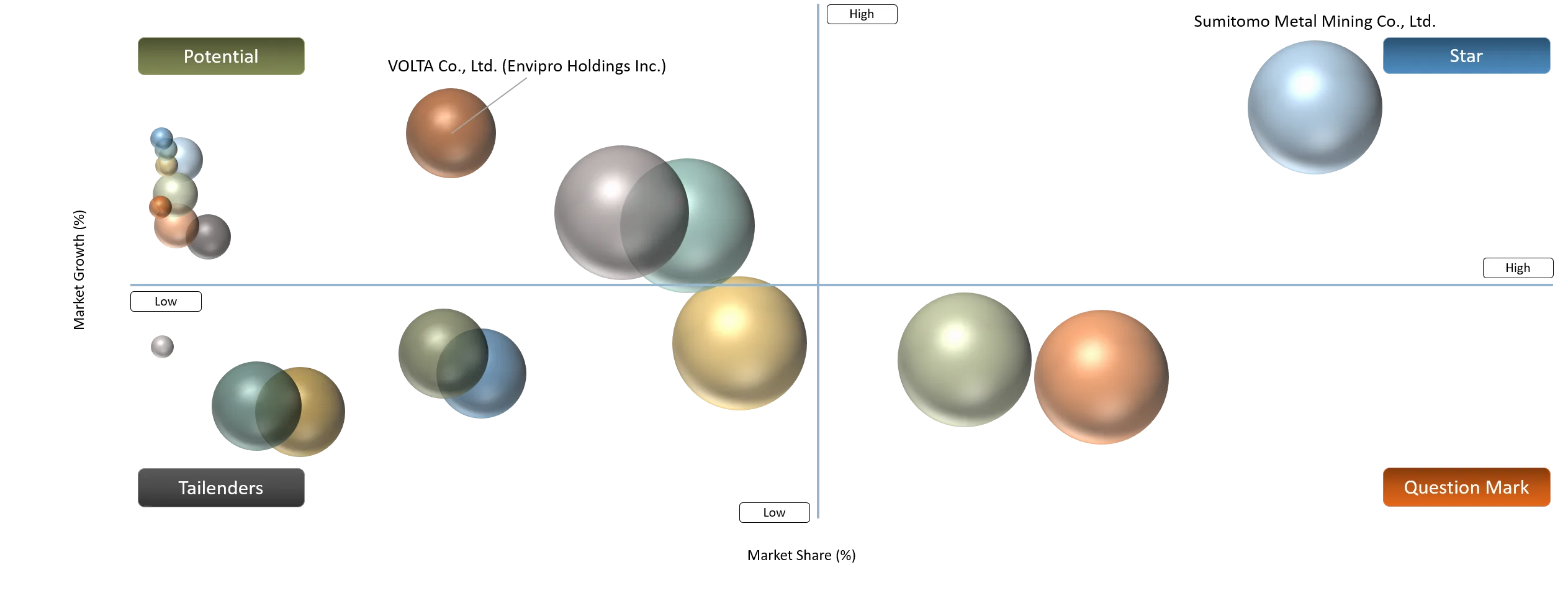
Stars include Sumitomo Metal Mining Co., Ltd., JX Metals Circular Solutions Co., Ltd., and DOWA Eco-System Co., Ltd. because these companies have established large-scale lithium-ion battery recycling capabilities, integrated metal refining infrastructure, and strong participation in Japan’s closed-loop battery supply chain. Question Marks include Mitsubishi Materials Corporation, Toyota Chemical Engineering Co., Ltd., and JERA Co., Inc. because these companies are actively investing in next-generation EV battery recycling technologies, direct cathode material regeneration, and low-carbon recycling processes, but their commercial recycling operations are still in the expansion and demonstration stage.
Potential companies include VOLTA Co., Ltd. (Envipro Holdings Inc.), Matsuda Sangyo Co., Ltd., and Asaka Riken Co., Ltd. because they are expanding battery collection, black-mass production, and critical-material recovery capabilities through new recycling facilities and processing technologies. Tailenders include Nihon Kagaku Sangyo Co., Ltd. because its participation is primarily focused on specialized chemical processing and pilot-scale recovery technologies rather than broad commercial EV battery recycling infrastructure.
Japan EV Battery Recycling Market Dynamics
Driver Impact Analysis
| Driver | Market Growth Impact (%) | Demand Concentration | Impacted Use Case | Strategic Impact |
Government support for domestic lithium-ion battery recycling infrastructure is accelerating the development of collection, processing, and resource-recovery systems. | 25% | High – government-funded recycling projects, municipalities, recyclers, and battery manufacturers | Battery collection, dismantling, material recovery, black-mass processing, and recycling infrastructure | Reduces infrastructure-development barriers and accelerates domestic recycling capacity and critical-material recovery |
Expansion of Japan’s domestic EV battery manufacturing ecosystem is increasing the need for localized recycling and secondary-material supply chains. | 25% | High – automotive and battery manufacturing clusters | Battery manufacturing scrap recycling, recovered-material supply, and closed-loop battery production | Strengthens domestic circular supply chains and reduces dependence on externally sourced battery materials |
Advancement of mid-scale battery recycling technologies is encouraging commercialization of processes capable of recovering high-value materials. | 30% | High – technology developers, metal refiners, battery manufacturers, and recycling companies | Hydrometallurgical recovery, direct recycling, lithium recovery, and cathode-material regeneration | Improves recovery efficiency, lowers processing impacts, and supports transition from pilot development to commercial-scale recycling |
Increasing focus on battery fire prevention and safe collection is strengthening demand for dedicated EV and lithium-ion battery collection and recycling systems. | 15% | Medium–High – municipalities, waste-management operators, recyclers, dealerships, and consumers | Safe collection, battery storage, transportation, discharge, dismantling, and treatment | Expands formal collection channels and reduces safety risks associated with improper handling of damaged or end-of-life batteries |
Government support for domestic lithium-ion battery recycling infrastructure is accelerating the development of collection, processing, and resource-recovery systems
Government funding for lithium-ion battery recycling facilities within the country is aiding in the development of collection, processing, and recovery infrastructure in Japan. Government programs are increasingly geared towards enhancing collection processes, handling practices, recycling technologies, and coordination among municipalities, battery producers, and sellers.
The Japanese government is enhancing the country’s battery recycling framework by providing support to local governments in creating more structured lithium-ion battery recycling programs. In June 2026, the Ministry of the Environment (MOE), Japan, established a lithium-ion battery collection and treatment system. The demonstration projects provided funding for the establishment of the collection system, where up to 8 million JPY (USD 51,200) would be available for each municipality-based collection-system demonstration with approximately six projects, whereas an information-tool demonstration, which had a budget of up to 10 million JPY (USD 64,000), would choose only one project.
Japan EV Battery Recycling Market Segment Analysis
The Japan EV battery recycling market is segmented based on battery type, vehicle type, recycling process, recycled material, application, and region.
Passenger EV Batteries Driving Dominant Demand in Japan EV Battery Recycling
The passenger EV batteries dominate the vehicle type segment in the Japan EV battery recycling market, with a market share of 58% in 2025. The reason behind this is that the growth of passenger battery-powered cars is expected to be accompanied by more used batteries in the future that will need to be collected and recycled. According to the International Energy Agency (IEA), sales of electric cars in Japan were already over 100,000, representing just under 3% of all car sales in the country.
The expansion of passenger BEVs in Japan is making the availability of batteries for future recycling efforts increasingly viable. In January 2026, according to the Japan Automobile Importers Association (JAIA), 30,513 imported BEVs were sold in Japan, where the sales number crossed the 30,000 mark for the first time and was about 9.5 times more than the about 3,200 units in 2020. The percentage of BEVs in foreign brand vehicle registrations was recorded at a record high of 12.6% as the total number of imported BEVs increased to 22 different brands with 174 models in 2025.
Japan EV Battery Recycling Market Competitive Landscape
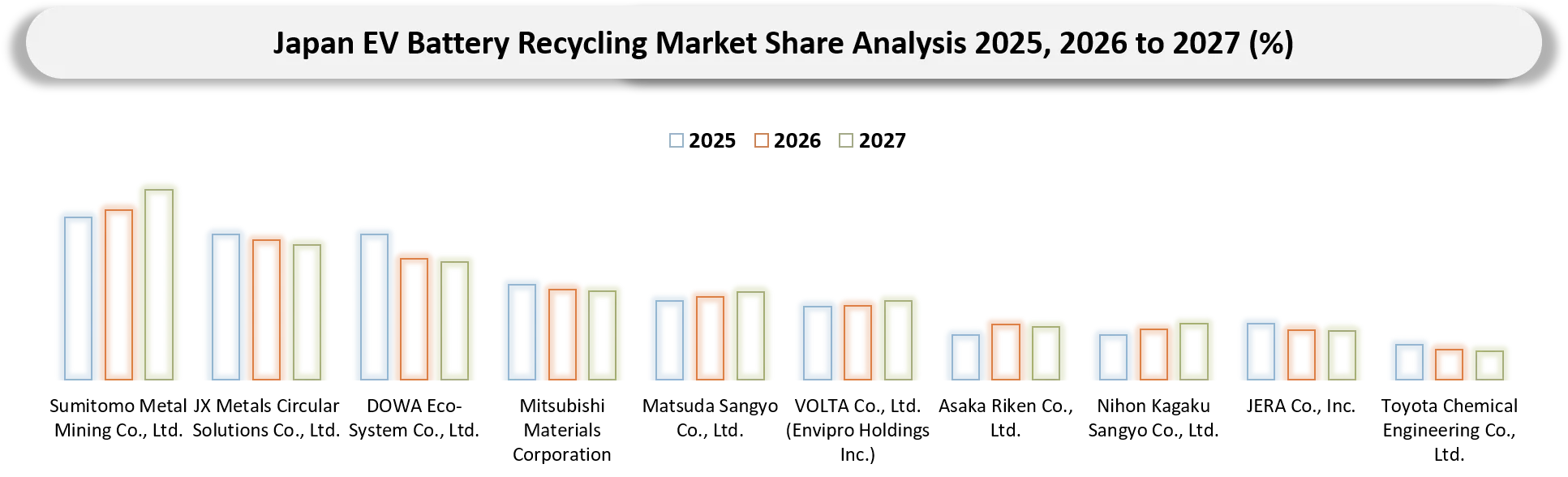
- The market is characterized by three key participant groups: integrated non-ferrous metal recyclers, specialized battery-recycling companies, and technology-focused resource-recovery companies. Sumitomo Metal Mining Co., Ltd., JX Metals Circular Solutions Co., Ltd., DOWA Eco-System Co., Ltd., and Mitsubishi Materials Corporation lead through established metal-refining and resource-recycling capabilities; Matsuda Sangyo Co., Ltd., VOLTA Co., Ltd. (Envipro Holdings Inc.), and Asaka Riken Co., Ltd. focus on battery collection, pretreatment, black-mass processing, and material recovery; while JERA Co., Inc., Nihon Kagaku Sangyo Co., Ltd., and Toyota Chemical Engineering Co., Ltd. contribute specialized recycling, chemical-processing, and battery-treatment technologies. Its creating an ecosystem-driven competitive landscape where recycling technology, material recovery capabilities, collection networks, and integration with battery manufacturers and automotive companies shape competitiveness.
- Key players include Sumitomo Metal Mining Co., Ltd. (Japan), JX Metals Circular Solutions Co., Ltd. (Japan), DOWA Eco-System Co., Ltd. (Japan), Mitsubishi Materials Corporation (Japan), Matsuda Sangyo Co., Ltd. (Japan), VOLTA Co., Ltd. (Envipro Holdings Inc.) (Japan), Asaka Riken Co., Ltd. (Japan), Nihon Kagaku Sangyo Co., Ltd. (Japan), JERA Co., Inc. (Japan), and Toyota Chemical Engineering Co., Ltd. (Japan).
Key Developments
- September 2025: JX Advanced Metals Corporation, a Japan-based non-ferrous metals and recycling company, announced a JPY 7 billion (USD 47 million) investment to expand its pre-treatment capacity for recycled raw materials.
- December 2025: MIRAI-LABO Co., Ltd., a Japan-based environmental technology and EV battery repurposing company, received the Tama Green Award Grand Prize for its end-to-end “EV Repurpose Battery Business,” covering EV battery collection, degradation diagnosis, development, manufacturing, sales, and logistics.
- May 2026: Sumitomo Metal Mining Co., Ltd., a Japan-based non-ferrous metals, mining, smelting, refining, and battery-materials company, and Sumitomo Corporation, a Japan-based diversified trading and investment company, signed an MOU to conduct a feasibility study for an EV and lithium-ion battery recycling business in Oceania.
- March 2025: Panasonic Energy Co., Ltd., a Japan-based lithium-ion battery manufacturer, and Sumitomo Metal Mining Co., Ltd., a Japan-based non-ferrous metals smelting, refining and cathode-materials manufacturer, launched a closed-loop nickel recycling initiative for automotive lithium-ion batteries.
- April 2026: DOWA Eco-System Co., Ltd., a Japan-based environmental management and recycling company, and Nippon Light Metal Co., Ltd., a Japan-based aluminum, chemicals, and electronic materials manufacturer, entered into a strategic partnership for joint technology and business development in metal recycling from lithium-ion batteries, solar panels, EV motors, and related applications.
- May 2025: MIRAI-LABO Co., Ltd., a Japan-based environmental technology and EV battery reuse company, and Aioi Nissay Dowa Insurance Co., Ltd., a Japan-based non-life insurance company, entered into a capital and business alliance to promote the secondary use and circulation of used EV batteries.
Key Procurement Priorities and Buyer Evaluation Criteria
- Organizations investing in the Japan EV Battery Recycling Market are increasingly selecting recycling partners based on their ability to provide safe, scalable, and environmentally compliant battery collection, dismantling, pretreatment, and material-recovery solutions that can efficiently handle different EV battery chemistries and formats.
- The procurement decision-making process is increasingly influenced by the growth of EV battery volumes, critical-material supply security, domestic circular-economy objectives, low-carbon recycling requirements, and the need to establish closed-loop supply chains connecting automakers, battery manufacturers, recyclers, and material suppliers.
- Buyers consider factors such as recovery rates for lithium, nickel, cobalt, manganese, copper, and other valuable materials; recovered-material purity; processing yield; battery safety; fire-risk management; environmental compliance; and the ability to process NMC, NCA, LFP, and other battery chemistries when evaluating recycling technology and service providers.
Why Choose DataM?
- Technological Innovations: Explores advancements in EV battery recycling technologies, including advanced dismantling and pretreatment, hydrometallurgical recovery, direct recycling, black-mass processing, lithium recovery, and low-carbon recycling methods, supporting higher-value material recovery and more efficient circular battery systems in Japan.
- Product Performance & Market Positioning: Evaluates how recycling companies differentiate through material recovery efficiency, recovered-material purity, processing yield, battery safety, chemistry flexibility, carbon performance, and scalability, highlighting capabilities across NMC, NCA, LFP, and other EV battery chemistries.
- Real-World Evidence: Highlights the adoption of EV battery recycling solutions across end-of-life EV batteries, manufacturing scrap, damaged batteries, and second-life battery streams, demonstrating practical applications in battery collection, dismantling, black-mass production, critical-material recovery, and reintegration of recovered materials into battery supply chains.
- Market Updates & Industry Changes: Tracks key developments such as recycling plant investments, demonstration projects, collection-system development, technology commercialization, battery-material recovery initiatives, and closed-loop partnerships across Japan, supporting the evolution of a domestic circular EV battery ecosystem.
- Competitive Strategies: Analyzes how leading companies expand through recycling-capacity development, advanced recovery technologies, strategic partnerships, collection-network expansion, technology integration, and collaboration with automakers and battery manufacturers to secure long-term feedstock and strengthen domestic material supply chains.
- Pricing & Market Access: Explains cost and revenue considerations associated with battery collection, transportation, dismantling, pretreatment, processing complexity, recovered-material quality, chemistry, and critical-material prices, while assessing access through recyclers, automotive manufacturers, battery producers, material suppliers, and reverse-logistics networks.
- Market Entry & Expansion: Identifies growth opportunities driven by rising EV battery volumes, critical-material supply security, domestic battery manufacturing, government-backed recycling infrastructure, direct recycling, lithium recovery, and closed-loop supply chains, while outlining strategies such as regional facility development, technology partnerships, feedstock agreements, and integration with battery-material producers.
Target Audience 2026
- EV Battery Manufacturers
- Automotive OEMs & EV Manufacturers
- Battery Recycling Companies
- Critical-Material & Chemical Companies
- Collection & Reverse-Logistics Providers
- Technology Providers & Equipment Manufacturers
- Energy & Utility Companies


























































