


Japan Electric Vehicle Market Size and Overview
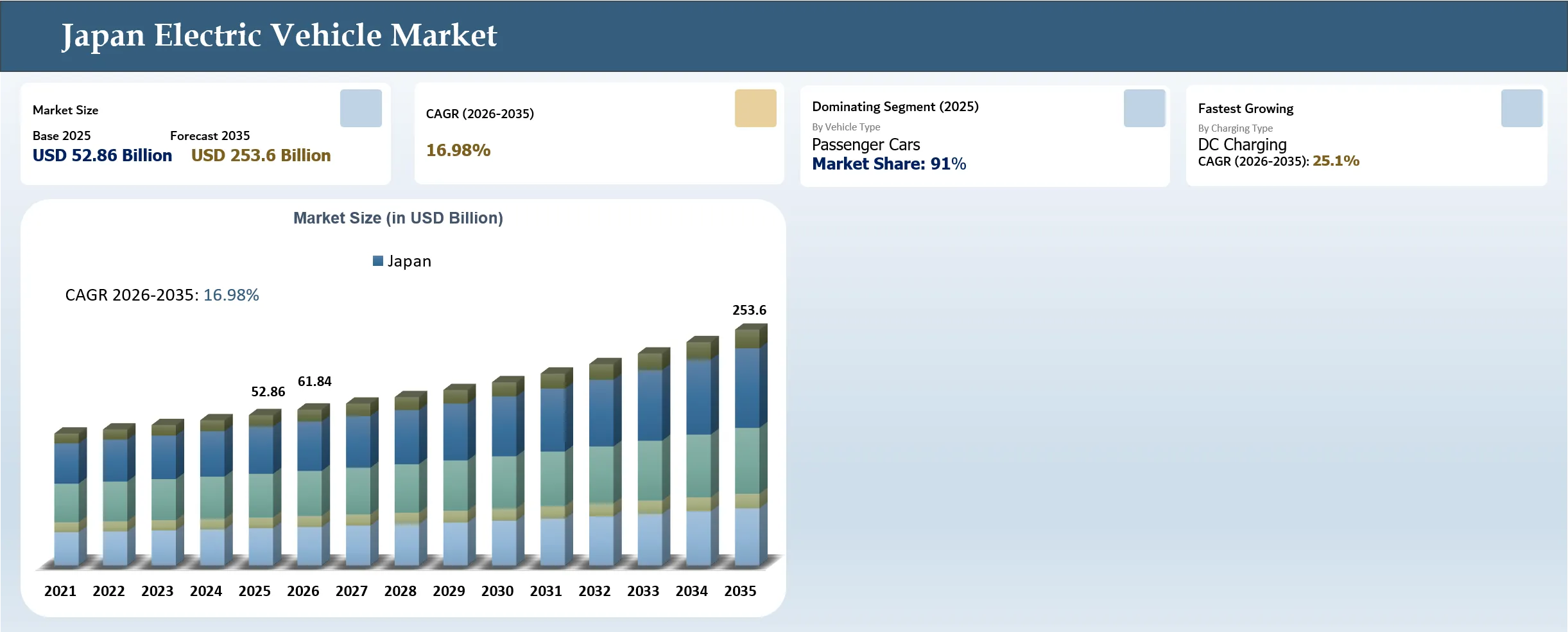
The Japan electric vehicle market reached USD 52.86 billion in 2025 and is expected to reach USD 253.6 billion by 2035, growing with a CAGR of 16.98% during the forecast period 2026-2035. The market is expanding alongside a gradual increase in vehicle electrification, but there are still some restrictions on this growth because of the lack of charging stations and the availability of different models of electric cars. In January 2026, according to Kazinform citing Kyodo and Japanese industry, Japan sold 60,677 EV cars in 2025, up 1.6% from the previous year; EV cars accounted for 1.6% of all new passenger cars. EV minivehicle registrations rose 17.1% to 39,885 vehicles, while EV minivehicle registrations fell 19.0% to 20,792 units. Toyota's EV sales increased 2.3-fold to 4,203 units.
The competitive environment is further changing with foreign brands eyeing Japan’s traditional kei-car market. In July 2026, according to Reuters, the Chinese company BYD introduced the Racco electric mini-car to Japan in 2026 at the base price of JPY 1.95 million (USD 12,418), excluding taxes and subsidies, offering a driving range of up to 320 kilometers. BYD is forecasting 10,000 orders of the Racco by the end of 2026, whereas the share of the kei-car class makes up about one-third of all automobile sales in Japan.
White-Space Opportunities for the Japan Electric Vehicle Market Driven by Government Investment and EV Ecosystem Expansion
In December 2025, Japan's largest EV-related investment under the FY2025 supplementary budget is the ¥110 billion CEV subsidy (USD 733 million) at an indicative exchange rate of ¥150/USD, making vehicle purchase support the largest directly identified funding area in the source. The program supports purchases of EVs and FCVs and revises the subsidy calculation based partly on automakers’ efforts in charging infrastructure and supply stability, creating opportunities for passenger EV manufacturers and their domestic supply chains.
Eligible vehicles include models from Toyota, Nissan, Honda, Subaru, Suzuki, Mitsubishi Motors, Tesla, BYD, BMW, Hyundai, Volkswagen, and other manufacturers, so these companies can benefit through increased consumer access to subsidized EV purchases, although the funding is not a direct corporate grant.
The investment also extends across the supporting EV ecosystem, creating opportunities in charging infrastructure, commercial-vehicle electrification, battery and component supply chains, EV manufacturing, fleet electrification and automotive recycling. In charging infrastructure, companies such as e-Mobility Power, Terra Charge, PLUGO, ENEOS, Toyota, Honda and Panasonic can benefit through the deployment, operation and supply of EV charging equipment, charging networks, smart-charging systems and related services.
In commercial-vehicle electrification, Isuzu Motors, Hino Motors, Mitsubishi Fuso Truck and Bus, Toyota, Honda and Nissan can benefit from rising demand for electric trucks, buses, taxis and commercial fleets, while suppliers such as DENSO, Aisin and Panasonic Energy can gain through batteries, thermal-management systems, power electronics and other EV components.
Japan Electric Vehicle Market Key Takeaways
- The compact kei-car class represents approximately one-third of all automotive sales across Japan. Meanwhile, Nissan’s Sakura kei-EV demonstrated strong consumer adoption by reaching approximately 23,000 sales last year.
- Chinese manufacturer BYD launched the Racco electric mini-car in Japan at a base price of JPY 1.95 million (USD 12,418). Offering a driving range of up to 320 kilometers, BYD is targeting 10,000 orders for the model by the end of 2026.
- EV minivehicle registrations grew by 17.1% to reach 39,885 units in 2025. Conversely, other non-minivehicle EV registrations experienced a decline of 19.0%, falling to 20,792 units.
- Japan allocated ¥110 billion (USD 733 million) to its Clean Energy Vehicle (CEV) subsidy program under the FY2025 supplementary budget. Individual purchase subsidies for models like Toyota's bZ4X increased from JPY 900,000 (USD 5,731) to JPY 1.3 million (USD 8,278).
Japan Electric Vehicle Market Scope
| Metrics | Details |
| 2025 Market Size | USD 52.86 Billion |
| 2035 Projected Market Size | USD 253.6 Billion |
| CAGR (2026-2035) | 16.98% |
| By Vehicle Type | Passenger Cars, Commercial Vehicles, Two-Wheelers |
| By Propulsion | Battery Electric Vehicles (BEV), Hybrid Electric Vehicles (HEV), Others |
| By Charging Type | AC Charging, DC Charging |
| By Drive Type | Front-Wheel Drive, Rear-Wheel Drive, All-Wheel Drive |
| By Component | Batteries, Motors, Brakes, Suspension, Chassis, Low-Voltage Parts, Others |
| By End Use | Personal, Commercial utilization, Public Transportation, Others |
| Report Insights Covered | Competitive Landscape Analysis, Company Profile Analysis, Market Size, Share, Growth |
Japan Electric Vehicle Market Disruption Analysis
Rapid Entry of Chinese EV Manufacturers into Japan’s Kei-Car Segment Reshaping the Domestic EV Competitive Landscape
The disruption in the Japan electric vehicle market is becoming more and more evident with the introduction of competitively priced Chinese EV manufacturers in the already well-established segment of the kei car in Japan. In fact, by designing EVs according to the regulations of Japan's small cars and taking into account their relatively cheap customers, Chinese manufacturers are entering a sector where Japanese manufacturers have maintained control for a long time.
The level of competitiveness is especially important. In October 2025, Reuters noted that the number of sales of kei cars reached one-third of Japan’s car sales, while the number of sales of regular-sized electric cars from BYD was only 6,600 in nearly three years since their entry into the market. Reuters has noted as well that foreign automakers accounted for only 6% of sales of 3.7 million new passenger cars in Japan last year. The scale of potential disruption in case of successful penetration into the compact cars segment by international producers of electric vehicles can be seen from the above data. At the same time, Nissan’s Sakura reached sales of approximately 23,000 units last year, which shows consumers’ interest in kei-sized electric vehicles.
Japan Electric Vehicle Market BCG Matrix: Company Evaluation
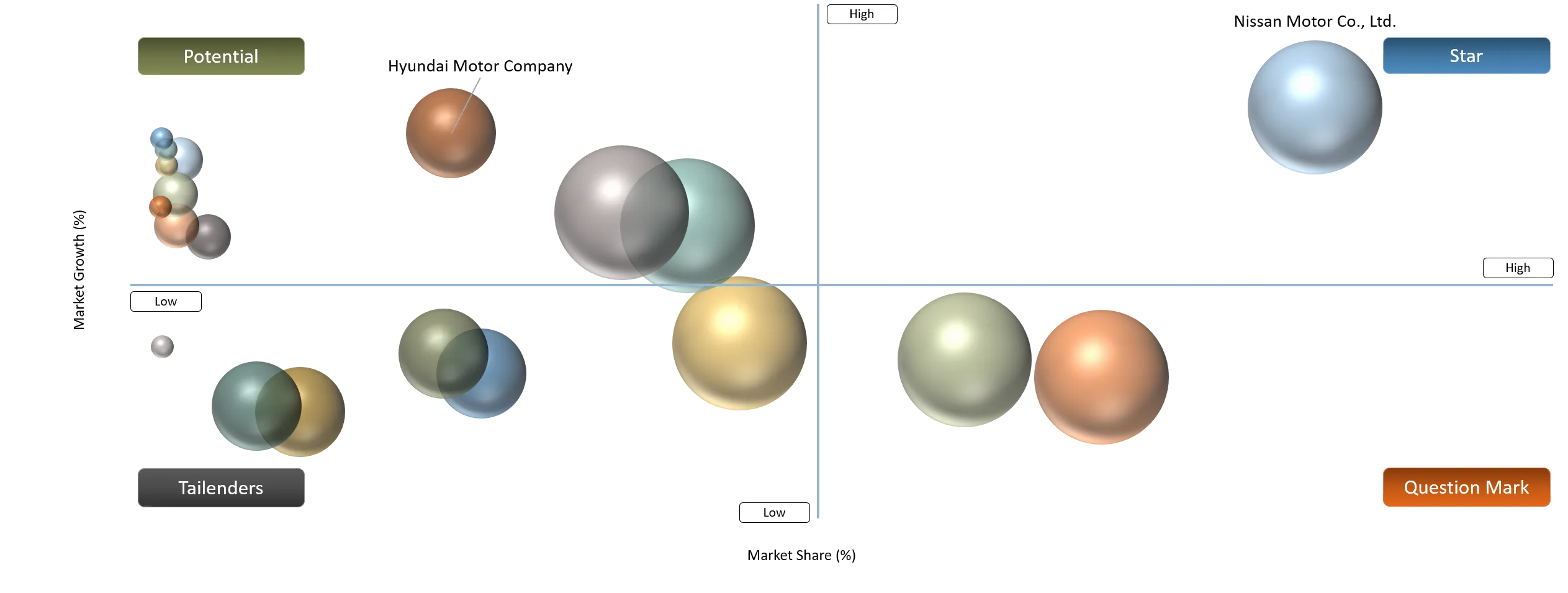
Stars include Nissan Motor Co., Ltd., Mitsubishi Motors Corporation, and BYD Company Limited because they have established or rapidly expanding EV positions in Japan. Question Marks include Toyota Motor Corporation, Honda Motor Co., Ltd., Suzuki Motor Corporation, and Tesla, Inc. The companies have substantial automotive capabilities and EV technologies but are positioned differently in Japan's rapidly developing BEV market.
Potential includes Hyundai Motor Company and Mazda Motor Corporation, which are developing their EV presence in Japan but remain in a market-development phase relative to the stronger domestic kei-EV and established EV players. Tailenders include Daihatsu Motor Co., Ltd. because its historical strength is concentrated in Japan's compact and kei-vehicle market, while its battery-electric passenger-vehicle portfolio has remained more limited than companies such as Nissan, Mitsubishi, and BYD.
Japan Electric Vehicle Market Dynamics
Driver Impact Analysis
| Driver | Market Growth Impact (%) | Demand Concentration | Impacted Use Case | Strategic Impact |
Growing availability of affordable EV models, particularly in the kei-car segment, is widening the addressable consumer base. | 30% | Urban households, price-sensitive consumers, kei-car buyers, first-time EV purchasers | Personal mobility, urban commuting, short-distance travel | Encourages automakers to develop lower-cost compact EVs, optimize battery costs, and expand Japan-specific kei-EV portfolios. |
Expansion of automaker and imported-EV portfolios is increasing consumer choice as companies such as BYD, Tesla, Toyota, Nissan and Suzuki. | 25% | Passenger vehicles, urban consumers, technology-oriented buyers, imported-EV customers | Personal vehicles, premium EVs, family mobility, urban transportation | Intensifies competition, accelerates model launches, and pressures domestic OEMs to broaden EV portfolios and improve pricing and technology. |
Rising fuel-cost concerns are creating additional incentives for Japanese consumers to consider EVs as an alternative to gasoline- and diesel-powered vehicles. | 20% | High-mileage drivers, urban households, commercial users, fuel-cost-sensitive consumers | Daily commuting, fleet operations, delivery and commercial transportation | Strengthens the total-cost-of-ownership proposition of EVs and encourages consumers and fleet operators to shift toward electrified vehicles. |
Increasing investment in charging and vehicle-energy infrastructure is supporting EV deployment. | 25% | Metropolitan areas, highways, residential locations, workplaces, commercial fleets | Home charging, public charging, highway travel, fleet charging, V2H/V2G | Improves charging accessibility, reduces range-related barriers, and supports wider deployment of EVs across passenger and commercial applications. |
Growing availability of affordable EV models, particularly in the kei-car segment, is widening the addressable consumer base
The availability of lower-cost EV cars is now a critical factor driving the adoption of EV cars in Japan, as car manufacturers are now focusing on affordability by offering compact and kei versions of EVs. Kei EVs suit the Japanese market due to their small size, low costs, and suitability for use on narrow city roads where parking space is limited. With more affordable EV cars being introduced into the market, the affordability barrier is therefore being minimized.
In June 2026, according to the Japan Automobile Manufacturers Association (JAMA), the sales of passenger electric vehicles (EVs) in Japan increased by 2.5 times year on year, reaching 9,632 in May 2026 and registering an all-time high market share of 3.5% in passenger car sales. The sales volume of Toyota’s bZ4X was 2,036 units, Nissan’s Leaf registered 1,422 units, and Honda’s Super One had 1,736 units sold during May 2026. In addition to this, JAMA noted that Toyota’s bZ4X had experienced a drop in price to JPY 700,000 (USD 4,457) after an October 2025 product improvement, and a rise in the CEV subsidy from JPY 900,000 (USD 5,731) to JPY 1.3 million (USD 8,278), strengthening the price advantage of EVs over comparable hybrids.
Japan Electric Vehicle Market Segment Analysis
The Japan electric vehicle market is segmented based on vehicle type, propulsion, charging type, drive type, component, and end use.
Passenger Cars Dominate the Japan Electric Vehicle Market Through Expanding Personal EV Adoption
The passenger car segment dominates the Japan electric vehicle market because private transport is still the major use case for the development of vehicle electrification, thanks to the growing number of small, kei, midsize, and SUV electric cars. Passenger EVs are perfect for Japan, where a well-developed market for personal vehicles operates, and people hold their cars for many years and start using electric vehicles when they have to replace their existing cars.
According to the Institute for Sustainable Energy Policies (ISEP), Japan recorded 96,616 new EV registrations, comprising 55,430 BEVs and 41,186 PHEVs. EVs represented 2.52% of new passenger-car registrations, with BEVs accounting for 1.44% and PHEVs 1.07%. The IEA separately reported that electric-car sales in Japan remained just above 100,000 units in 2025, while conventional hybrids represented around one-third of total car sales, indicating that passenger vehicles remain the central market through which Japan's electrification transition is taking place.
Japan Electric Vehicle Market Competitive Landscape
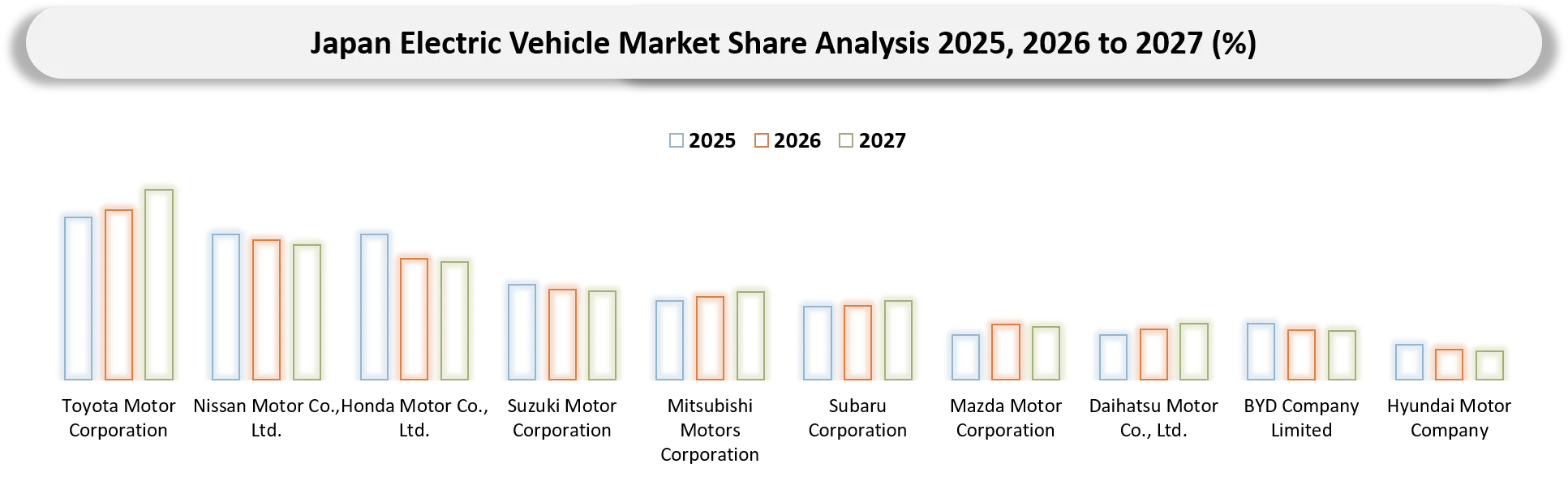
- The Japan Electric Vehicle Market is characterized by three key participant groups: established Japanese automotive manufacturers, domestic automakers expanding their dedicated EV portfolios, and international EV manufacturers entering the Japanese market. Toyota Motor Corporation, Nissan Motor Co., Ltd., Honda Motor Co., Ltd., Suzuki Motor Corporation, Mitsubishi Motors Corporation, Subaru Corporation, Mazda Motor Corporation, and Daihatsu Motor Co., Ltd. form the core domestic competitive base, supported by extensive distribution networks, localized vehicle development, and strong experience in compact and kei vehicles. BYD Company Limited and Hyundai Motor Company represent international EV-focused competitors that are expanding their presence through Japan-specific models, differentiated pricing, and dedicated battery-electric vehicle platforms. It’s creating a competitive landscape where product localization, affordability, battery technology, charging compatibility, brand strength, and model diversity define competitiveness.
- Key players include Toyota Motor Corporation (Japan), Nissan Motor Co., Ltd. (Japan), Honda Motor Co., Ltd. (Japan), Suzuki Motor Corporation (Japan), Mitsubishi Motors Corporation (Japan), Subaru Corporation (Japan), Mazda Motor Corporation (Japan), Daihatsu Motor Co., Ltd. (Japan), BYD Company Limited (China), and Hyundai Motor Company (South Korea).
Key Developments
- January 2026: Toyota Motor Corporation, a Japan-based automotive manufacturer, became the top-selling domestic EV brand in Japan for the first time in Q4 2025, with its bZ4X electric SUV selling 3,448 units, more than 22 times the volume recorded in Q4 2024.
- September 2025: Stanley Electric Co., Ltd., a Japan-based automotive lighting and electronics manufacturer, and Mitsubishi Electric Mobility Corporation, a Japan-based automotive mobility technology company, signed an integration agreement to establish a joint venture for next-generation vehicle lamp systems.
- March 2026: Suzuki Motor Corporation, a Japan-based automotive manufacturer, agreed to acquire Kanadevia Corporation’s, a Japan-based industrial engineering and technology company, all-solid-state lithium-ion battery business, with the transfer scheduled for July 1, 2026.
- December 2025: Honda Motor Co., Ltd., a Japan-based automotive manufacturer, agreed to acquire an additional 21% stake in Astemo, Ltd., a Japan-based automotive technology and components supplier, from Hitachi, Ltd., a Japan-based technology and industrial company, for approximately ¥152.3 billion (USD 970 million).
- July 2026: BMW Group, a Germany-based automotive manufacturer, launched the new BMW iX3 in Japan as the first production model of its next-generation Neue Klasse EV platform.
Key Procurement Priorities and Buyer Evaluation Criteria
- Organizations procuring electric vehicles increasingly prioritize vehicle range, battery capacity, charging compatibility, energy efficiency, and total cost of ownership to ensure that selected EVs meet operational and financial requirements.
- The procurement decision-making process is increasingly influenced by battery technology improvements, availability of fast-charging infrastructure, vehicle affordability, government incentives, and the suitability of EV models for Japan’s compact and urban driving environment.
- Buyers evaluate factors such as battery durability, charging time, driving range, vehicle safety, warranty coverage, after-sales service, spare-parts availability, and battery warranty terms when selecting an EV supplier or vehicle manufacturer.
Why Choose DataM?
- Technological Innovations: Examines advancements in battery technology, fast-charging systems, vehicle electrification, connected EV platforms, energy-management systems, and next-generation battery solutions, highlighting their role in improving driving range, charging efficiency, vehicle performance, and overall EV usability in Japan.
- Product Performance & Market Positioning: Evaluates EV models based on driving range, battery capacity, charging performance, vehicle efficiency, safety, pricing, and vehicle size, while assessing how Japanese and international automakers differentiate their products across kei cars, compact vehicles, SUVs, and other passenger-vehicle categories.
- Real-World Evidence: Highlights the adoption of electric vehicles across personal mobility, urban commuting, commercial fleets, delivery operations, and public transportation, demonstrating practical benefits such as lower operating costs, reduced emissions, improved energy efficiency, and integration with home-energy systems.
- Market Updates & Industry Changes: Tracks key developments including new EV launches, battery manufacturing investments, charging-network expansion, government incentive programs, domestic and international automaker investments, and Japan-specific EV initiatives shaping the country's electrification ecosystem.
- Competitive Strategies: Analyzes how leading companies expand their presence through new EV model launches, kei-EV development, battery partnerships, localized manufacturing, charging collaborations, technology investments, and expansion of international EV portfolios within Japan.
- Pricing & Market Access: Evaluates EV pricing according to vehicle size, battery capacity, range, technology, and equipment while assessing the influence of government subsidies, dealership networks, direct sales, leasing, financing, and charging infrastructure on market accessibility.
- Market Entry & Expansion: Identifies opportunities arising from affordable kei EVs, passenger-vehicle electrification, commercial fleets, fast-charging infrastructure, battery recycling, V2H/V2G applications, and imported EV brands, while outlining strategies such as localized product development, competitive pricing, charging partnerships, and technology differentiation for market expansion.
Target Audience 2026
- Automotive OEMs and EV Manufacturers
- Battery Manufacturers and Technology Providers
- Charging Infrastructure Providers and Energy Companies
- Automotive Component and Electronics Suppliers
- Fleet Operators and Commercial Mobility Companies
- Government Agencies and Industry Associations
- Investors, Financial Institutions, and Infrastructure Funds


























































