Japan Data Center Transformer Market Size and Overview
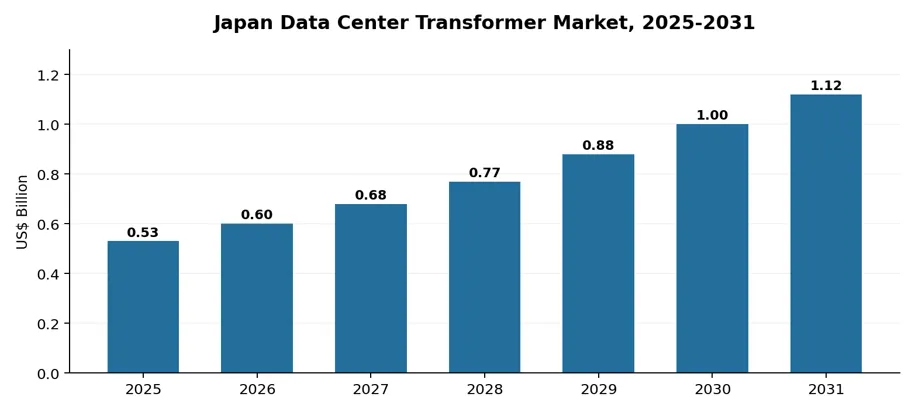
The Japan Data Center Transformer Market is estimated at US$ 0.53 billion in 2025 and is forecast to reach US$ 1.12 billion by 2031, equivalent to an estimated 13.3% compound annual growth rate. New hyperscale and AI computing facilities, colocation investments and utility connections are increasing demand for power and distribution transformers. Greater Tokyo and Kansai remain major procurement centers, while projects in Hokkaido, Kyushu and other regions create additional demand for substations and campus distribution equipment.
Transformers connect high-voltage utility supplies to data center substations and lower-voltage distribution systems. Japan’s limited grid capacity in some established data center clusters makes early electrical design and transformer procurement important. Buyers also need to balance loss performance, seismic requirements, utility acceptance, maintenance access and available delivery windows when planning campus power systems.
| 2025 MARKET SIZE | 2031 FORECAST | CAGR (2026–2031) |
| US$ 0.53 Billion | US$ 1.12 Billion | 13.3% |
Japan Data Center Transformer Key Takeaways
Estimated Japan data center transformer revenue grows from US$ 0.53 billion in 2025 to US$ 1.12 billion in 2031.
AI computing investment and new colocation campuses are increasing demand for primary and secondary transformers.
Grid connection availability around Greater Tokyo and Kansai can affect which locations reach construction and commissioning.
Phased campus developments require transformer capacity planning for initial loads, redundancy and later expansion.
Low-loss designs, dry-type units and efficient cooling gain attention as Japan tightens data center energy-performance requirements.
Factory qualification, local service support and coordination with utilities can help suppliers secure repeat orders.
Japan Data Center Transformer Industry Trends and Strategic Insights
Developers are assessing power availability earlier, before confirming sites and purchasing long-lead electrical equipment.
AI-focused facilities are raising transformer capacity and resilience requirements for large campus substations.
Purchasers weigh efficiency, installation footprint and seismic suitability alongside price and manufacturing slots.
Regional investment outside Tokyo and Osaka creates opportunities for suppliers with strong engineering and field support.
Japan Data Center Transformer Market Scope
| METRICS | DETAILS |
| 2025 Market Size | US$ 0.53 Billion |
| 2031 Projected Market Size | US$ 1.12 Billion |
| CAGR (2026–2031) | 13.3% |
| By Transformer Type | Distribution, medium-power, large-power, modular substation |
| By Data Center Type | Hyperscale, AI, colocation, enterprise, edge |
| By Voltage Rating | Low voltage, medium voltage, high voltage, extra-high voltage |
| By Insulation and Cooling | Mineral oil, ester fluids, dry-type cast resin |
| By Power Architecture | Utility-fed, onsite primary substations, campus distribution, behind-the-meter power |
| By Phase and Installation | Three-phase, indoor, outdoor, pad-mounted and modular |
| By Installation Stage | New-build, expansion, replacement, commissioning and aftermarket |
| Competitive Landscape | Top 10 manufacturers and power-equipment providers serving Japan |
| Market Data Coverage | 2025-2031 Japan data center transformer forecast and equipment applications |
Japan Data Center Transformer Market White Space & Investment Opportunities
Campus power packages: supply primary and secondary transformers for new hyperscale facilities and phased colocation developments.
Efficient designs: offer low-loss oil-immersed and dry-type products that support customer energy-performance goals.
Regional service coverage: expand local testing, commissioning, seismic-design support, monitoring and replacement planning.
Winning projects depends on early work with Japanese utilities, data center operators, designers and electrical contractors. Suppliers that can confirm specifications, utility acceptance and realistic delivery schedules will be better positioned for multi-site contracts.
Driver Impact Analysis
Japan’s hyperscale and AI facility pipeline is raising demand for medium- and large-power transformers, especially where dedicated substations are needed. The broader move toward cloud services also supports distribution transformer orders for new data halls. Utilities and developers may specify major equipment well before commissioning, making approved designs, engineering support and production-slot availability important. Regional projects create a further opportunity for suppliers able to support local grid requirements.
| DRIVER | AFFECTED PRODUCT / SIGNAL | 2026–2031 CAGR | STRATEGIC IMPACT |
| Hyperscale and AI campuses | High | Dedicated primary substation and multiple distribution units | Reserve production slots and coordinate early with utility engineering |
| Cloud and colocation expansion | High | Repeat power blocks for phased data halls | Offer approved standard designs across facility portfolios |
| Stricter energy efficiency | Medium-High | Low-loss oil and dry-type designs | Demonstrate life-cycle loss reduction and thermal performance |
| Regional data center construction | Medium-High | New substations outside main metro clusters | Build local EPC partnerships and commissioning coverage |
Larger computing loads and higher availability expectations add complexity to campus electrical distribution. Operators increasingly assess transformer losses, redundancy and monitoring over the full facility life. Suppliers that can combine low-loss designs with testing, commissioning and maintenance support may achieve stronger positioning, particularly for repeat builds.
Restraint Impact Analysis
Grid access and high-voltage connection work can take longer than building construction, particularly in power-constrained locations. Transformer manufacture and qualification add another scheduling risk when specifications change late in a project. Copper and electrical-steel prices affect costs, while seismic, site-footprint and Japanese utility requirements can limit design flexibility. Developers may postpone orders when the facility power-on schedule remains uncertain.
| RESTRAINT | PRIMARY EXPOSURE | RISK LEVEL | STRATEGIC IMPACT |
| Grid connection delays | High-voltage interconnection and site energization | High | Link transformer releases to utility milestones and power availability |
| Long manufacturing windows | Large-power and custom medium-power units | High | Freeze specifications early and maintain alternative supply options |
| Material cost volatility | Electrical steel, copper and insulation inputs | Medium-High | Use price-adjustment clauses and supplier planning |
| Seismic and site requirements | Custom enclosures, clearances and utility approvals | Medium-High | Confirm Japanese codes and site layouts before ordering |
Equipment delivery can be delayed further by customized designs, factory test availability, transport constraints and coordination across multiple electrical contractors. Early utility engagement, stable technical specifications and alternative sourcing strategies help limit exposure, but they cannot eliminate all grid or construction delays.
Japan Data Center Transformer Market Competitive Landscape
Japan’s data center transformer market includes established domestic electrical equipment manufacturers and international power equipment groups. Buyers compare utility approvals, product losses, seismic design, service responsiveness, delivery certainty and the ability to support complete campus electrical architectures. Strong relationships with electrical contractors and data center developers are important when projects are designed in phases.
| COMPANY | DATA CENTER TRANSFORMER POSITIONING |
| Hitachi Energy | High-voltage and medium-power transformer solutions for grid-connected campuses. |
| Toshiba Energy Systems & Solutions | Large power transformers and Japanese utility-facing electrical infrastructure. |
| Mitsubishi Electric | Power and distribution transformers for commercial and infrastructure applications. |
| Fuji Electric | Distribution transformers and packaged electrical equipment for major facilities. |
| Meidensha | Engineered transformer and substation products for Japanese power infrastructure. |
| Daihen | Distribution transformer and power-equipment capabilities serving domestic customers. |
| Nissin Electric | Power system components, transformers and utility-focused electrical solutions. |
| Siemens Energy | High-voltage transformer portfolio for large interconnection projects. |
| Schneider Electric | Dry-type transformer and integrated building power distribution solutions. |
| Eaton | Distribution and facility power products for critical infrastructure. |
Domestic manufacturers remain important for Japanese utility and industrial specifications, while global suppliers compete for hyperscale and high-voltage packages. Differentiation increasingly depends on project engineering, reliable testing and local service capability as well as nameplate transformer ratings.
Japan Data Center Transformer Market Recent Developments
January 21, 2026: Japan’s grid coordination organization projected rising national electricity consumption through fiscal 2035, with data centers and semiconductor plants contributing to the increase.
May 20, 2026: Japan’s Agency for Natural Resources and Energy outlined tighter energy-efficiency expectations for new data centers, adding attention to lower-loss electrical equipment.
May 2026: At JECA FAIR 2026, suppliers showcased high-efficiency transformer products aligned with Japan’s updated Top Runner efficiency requirements.
July 2026: Industry reporting highlighted the wider shipment of transformers meeting the latest Japanese Top Runner efficiency standard.
September 2026: A survey of Japanese data center operators pointed to a substantial expansion in planned AI computing capacity, supporting future substation investment.
October 2026: Updated power-demand assessments continued to show substantial planned data center load growth, underlining the need for grid and transformer capacity planning.