

Japan Data Center Motors and Drives Market Size and Overview
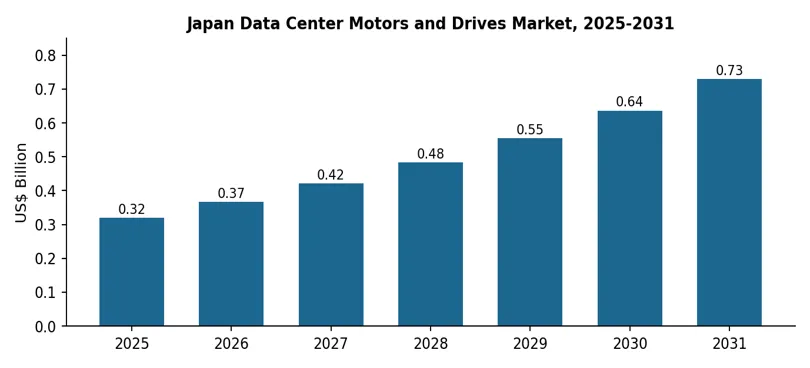
The Japan Data Center Motors and Drives Market is estimated at US$ 0.32 billion in 2025 and is forecast to reach US$ 0.73 billion in 2031, representing approximately 14.7% annualized growth. Equipment demand is linked to cooling-water circulation, chillers, air-handling systems and heat rejection across new and expanding data centers.
Motors and variable frequency drives keep cooling and ventilation equipment operating efficiently. AI-oriented facilities need more active liquid-cooling loops and reliable heat rejection, while operators of existing facilities are upgrading variable-speed control to manage energy use. The forecast covers motor and drive equipment, not entire chillers, pumps or cooling distribution units.
| 2025 MARKET SIZE | 2031 FORECAST | CAGR (2026-2031) |
| US$ 0.32 Billion | US$ 0.73 Billion | 14.7% |
Japan Data Center Motors and Drives Key Takeaways
Data center motor and drive equipment revenue is estimated to rise from US$ 0.32 billion in 2025 to US$ 0.73 billion in 2031.
New hyperscale and AI data centers require pump motors, air-handling fans, cooling tower motors and variable-speed drives.
Liquid cooling adds circulation and distribution equipment, but its motor content depends on the mechanical-system design.
VFDs help operators match flow and airflow to changing thermal loads without running equipment continuously at full speed.
High uptime requirements favor redundant motor-driven equipment, condition monitoring and proven service support.
Both new facilities and retrofit programs create demand for higher-efficiency motors and controls.
Japan Data Center Motors and Drives Industry Trends and Strategic Insights
Operators are coordinating air cooling, chilled-water loops and direct-liquid cooling as AI server heat loads rise.
Mechanical plant suppliers increasingly specify matched pumps, motors and VFDs to simplify commissioning and reliability testing.
Existing facilities are adding controls and variable-speed operation to improve cooling efficiency with minimal downtime.
Site operators prefer drives that can communicate with building management systems and support fault diagnostics.
Japan Data Center Motors and Drives Market Scope
| METRICS | DETAILS |
| 2025 Market Size | US$ 0.32 Billion |
| 2031 Projected Market Size | US$ 0.73 Billion |
| CAGR (2026-2031) | 14.7% |
| By Drive Type | AC induction and permanent-magnet fan and pump motors, low- and medium-voltage VFDs |
| By End-Use Industry | Hyperscale, colocation, enterprise and edge data centers |
| By Power Rating | Chilled water, condenser water, HVAC fans, cooling towers, liquid cooling |
| By Voltage | Below 7.5 kW, 7.5-37 kW, above 37-200 kW, above 200 kW |
| By Control Method | IE3, IE4, PM motor designs, vector and variable-speed drive control |
| By Application | Indoor mechanical rooms, rooftop equipment, packaged cooling systems |
| By Installation Stage | New construction, campus expansion, retrofit and replacement |
| Competitive Landscape | 10 suppliers with Japan operations or data center mechanical-equipment relevance |
| Market Data Coverage | 2025-2031 equipment-revenue estimates, cooling-system applications and market trends |
Japan Data Center Motors and Drives Market White Space & Investment Opportunities
Cooling plant retrofits: upgrade fixed-speed pumps and fans to VFD-controlled equipment where operating profiles justify savings.
High-density AI sites: provide motors and drives qualified for circulating water, heat rejection and modular cooling equipment.
Reliability services: offer predictive diagnostics, spares, planned replacements and commissioning for critical mechanical assets.
Suppliers can win by working with cooling-equipment OEMs, mechanical contractors and facility operators before equipment is specified. Lifecycle support and the ability to maintain redundancy are often as important as equipment price.
Driver Impact Analysis
New data center capacity creates demand for motors and drives used in chilled-water circulation, air handling, condenser systems and heat rejection. AI servers also raise the importance of liquid-cooling loops, although the amount of motor content varies by site architecture. Early engagement with mechanical-system designers helps vendors qualify equipment for new projects.
| DRIVER | AFFECTED PRODUCT / SIGNAL | 2026–2031 IMPACT | STRATEGIC IMPACT |
| AI data center construction | High | Pump, fan and chiller motor drives | Qualify early with cooling-system OEMs and contractors |
| Liquid cooling adoption | High | CDU and secondary circulation motor systems | Support modular cooling designs and redundant loops |
| Cooling-energy optimization | High | VFDs for pumps and air handling | Demonstrate part-load savings and BMS interoperability |
| Reliability and uptime needs | Medium-High | Spare drives and condition monitoring | Offer service coverage and tested redundant configurations |
In existing facilities, variable-speed control can reduce energy consumption when pumps and fans operate below full load. Reliability upgrades create further demand for monitoring, spare drives and standardized components. The strongest opportunities are projects where efficiency improvement can be achieved without compromising cooling redundancy.
Restraint Impact Analysis
Cooling-system procurement is often bundled into packages ordered from chiller, pump and air-handling OEMs. This limits direct access for independent motor and drive suppliers. Facility owners also require long qualification cycles because a failure in mechanical services can interrupt critical computing operations.
| RESTRAINT | PRIMARY EXPOSURE | RISK LEVEL | STRATEGIC IMPACT |
| Bundled mechanical equipment procurement | Cooling OEMs and turnkey mechanical packages | High | Build approved-vendor status with major cooling OEMs |
| High reliability and testing requirements | Motors, drives and controls in critical cooling paths | High | Document qualification, redundancy and service response |
| Live-site retrofit complexity | Operating data centers and legacy BMS interfaces | Medium-High | Sequence installation around maintenance windows |
| Power quality and architecture changes | VFD harmonics and evolving air/liquid cooling mix | Medium-High | Provide filtering, compatibility tests and flexible designs |
Replacement projects must be planned around live data center operations. Harmonic distortion, electromagnetic compatibility, controls integration and space limitations can complicate a drive retrofit. Additionally, a shift toward direct liquid cooling changes where pumps and fans are needed, creating uncertainty about the motor mix in future facilities.
Japan Data Center Motors and Drives Market Competitive Landscape
The market includes Japanese motor manufacturers, industrial inverter suppliers, pump specialists and international drive vendors. Buyers compare equipment efficiency, thermal performance, compatibility with cooling OEM packages and service response. Proven operating reliability carries extra weight in critical facilities.
| COMPANY | DATA CENTER MOTORS AND DRIVES POSITIONING |
| Nidec | Motor technology and liquid-cooling equipment for high-density data center thermal management. |
| Mitsubishi Electric | Motors, inverters, HVAC controls and integrated data center cooling solutions. |
| Yaskawa Electric | AC drives and motor control products relevant to pumps, fans and mechanical plant. |
| Fuji Electric | Industrial inverters and power electronics for cooling equipment and utility systems. |
| Toshiba | Motor and drive solutions for compressors, pumps and large mechanical equipment. |
| Hitachi Industrial Equipment Systems | Industrial motors, inverters and support for plant utility applications. |
| Daikin Industries | Chillers and HVAC systems integrating motor-driven cooling equipment and controls. |
| ABB | High-efficiency motors and VFDs for water circulation, HVAC and service equipment. |
| Siemens | Motors, variable-speed drives and building automation integration. |
| Ebara Corporation | Pump and fluid-handling expertise relevant to cooling and utility circulation. |
Suppliers typically reach projects through mechanical OEMs, data center engineering contractors and facility operators. Motor-drive packages that simplify BMS integration and meet redundancy needs are better placed for repeat orders across data center portfolios.
Japan Data Center Motors and Drives Market Recent Developments
February 24, 2026: Mitsubishi Heavy Industries launched its DIAVAULT edge data center platform, which includes integrated cooling and power systems for industrial sites.
May 29, 2026: Mitsubishi Electric outlined its expansion strategy for IT cooling systems, including air cooling and liquid cooling for data centers.
June 2, 2026: Nidec unveiled a prototype stackable STC 1.0 liquid-cooling system that can adjust cooling capacity using multiple modules.
June 9, 2026: Nidec announced an in-rack coolant distribution unit prototype with up to 300 kW of cooling capacity for high-density AI servers.
July 6, 2026: Daikin and NTT DATA launched a joint trial of AI-based cooling optimization, coordinating HVAC, chillers and liquid cooling at a Japanese data center.
August 3, 2026: Daiichi Jitsugyo expanded its data center solutions business using Nidec coolant distribution units and partner thermal-management systems.