Japan Data Center Lighting Market Size
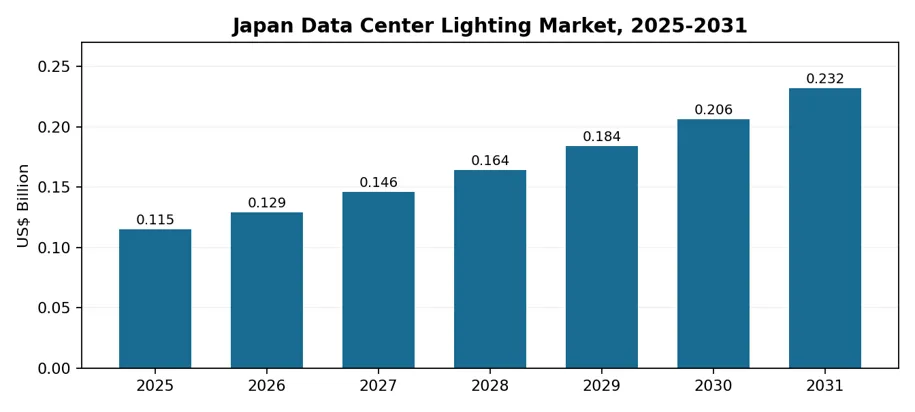
The Japan Data Center Lighting Market is estimated at US$ 0.115 billion in 2025 and is forecast to reach US$ 0.232 billion in 2031, representing approximately 12.4% annualized growth. New data center campuses and expansion of existing sites are raising demand for efficient general, maintenance, emergency and exterior lighting. Most spending is on LED fixtures and associated controls installed within critical facilities.
Data center lighting supports safe access to server aisles, electrical rooms, cooling plants, corridors and outdoor operating areas. Unlike general office lighting, these systems must function during planned maintenance and emergency events. Facility operators prioritize long-life fixtures, reliable emergency operation, low heat output and clear integration with site controls.
| 2025 MARKET SIZE | 2031 FORECAST | CAGR (2026–2031) |
| US$ 0.115 Billion | US$ 0.232 Billion | 12.4% |
Japan Data Center Lighting Key Takeaways
• Japan data center lighting revenue is estimated at US$ 0.115 billion in 2025 and US$ 0.232 billion in 2031.
• Hyperscale and colocation construction is increasing demand for LED lighting across data halls, corridors and mechanical rooms.
• Emergency and egress systems are important procurement categories because facilities require reliable access during power events.
• Occupancy sensing and zone-level dimming can reduce unnecessary lighting energy use in intermittently occupied data halls.
• LED replacement in existing facilities provides additional demand without major changes to electrical and mechanical systems.
• Perimeter and plant-room lighting requires robust housings, maintainability and compatibility with site operating procedures.
Japan Data Center Lighting Industry Trends and Strategic Insights
• Data center owners are standardizing LED fixture and control specifications across repeat building designs.
• Lighting controls are increasingly linked to security, maintenance access and building management platforms.
• Emergency lighting inspection, battery backup and fault reporting are key specification points for critical campuses.
• Retrofit work favors compact fixtures that can be installed without interrupting active computing areas.
Japan Data Center Lighting Market Scope
| METRICS | DETAILS |
| 2025 Market Size | US$ 0.115 Billion |
| 2031 Projected Market Size | US$ 0.232 Billion |
| CAGR (2026–2031) | 12.4% |
| By Product Type | General LED, task lights, emergency and exit lighting, exterior fixtures |
| By Data Center Type | Hyperscale, cloud, colocation, enterprise and edge facilities |
| By Lighting Function | Data halls, equipment rooms, corridors, emergency and outdoor lighting |
| By Controls | Manual, occupancy sensing, dimming, monitored and BMS-connected |
| By Power Interface | Normal mains, emergency circuits, backup systems and controls |
| By Installation | New-build, expansion, retrofit, indoor and outdoor |
| By Procurement Stage | Design, electrical fit-out, commissioning, inspection and replacement |
| Competitive Landscape | Top 10 lighting and electrical suppliers with Japan market presence |
| Market Data Coverage | 2025-2031 Japan data center lighting market and equipment applications |
Japan Data Center Lighting Market White Space & Investment Opportunities
Repeatable data hall packages: supply standardized LED panels, linear luminaires and sensors for phased hyperscale buildings.
Emergency readiness: offer emergency fixtures, exit lighting, battery-backed operation, inspection and centralized monitoring.
Retrofit programs: replace fluorescent fixtures in occupied data centers with long-life LED systems and compatible controls.
Suppliers can win repeat orders through early engagement with data center electrical designers, EPC contractors and operators. The strongest offers combine fixture standardization, documented performance, emergency-system reliability and on-site commissioning support.
Driver Impact Analysis
Data center investment in Japan is increasing the number of buildings, equipment rooms and operational areas requiring lighting. Each new computing hall needs general and task lighting, while UPS rooms, cooling plant rooms, security corridors and external service routes add further fixtures. Developers increasingly procure repeatable lighting packages during early electrical fit-out to simplify installation across multi-building campuses.
| DRIVER | AFFECTED PRODUCT / SIGNAL | 2026–2031 CAGR | STRATEGIC IMPACT |
| Hyperscale and colocation projects | High | New data halls and service buildings | Engage engineering contractors before fit-out |
| LED energy and maintenance savings | High | Efficient fixtures, sensors and controls | Quantify lifetime operating cost and uptime benefits |
| Emergency preparedness | Medium-High | Exit lighting and monitored emergency fixtures | Bundle compliance testing and maintenance |
| Retrofit of operating sites | Medium-High | Existing corridors, plant rooms and data halls | Offer low-disruption replacement kits |
Japan’s shift toward LED lighting also supports replacement projects in older enterprise and colocation facilities. Operators can reduce lighting electricity use and heat gain by moving to efficient fixtures with occupancy sensing. Emergency lights and exit signs remain essential for safe access during maintenance and power interruptions. Suppliers offering durable products, tested controls and maintenance support are better positioned for long-term campus agreements.
Restraint Impact Analysis
Lighting is a relatively small share of total data center capital expenditure, so purchases are often deferred until later building fit-out stages. Changes in project commissioning schedules, power availability and tenant occupancy can therefore delay orders. Tight electrical rooms and operating facilities may also require specialized access, safety approval and off-hours installation, which increases retrofit costs.
| RESTRAINT | PRIMARY EXPOSURE | RISK LEVEL | STRATEGIC IMPACT |
| Delayed fit-out decisions | Lighting orders tied to commissioning phases | High | Track project stage and reserve stock selectively |
| LED fixture price pressure | Standard general and corridor lighting | High | Differentiate reliability and lifecycle service |
| Access and uptime constraints | Retrofits in live data centers | Medium-High | Use controlled work plans and quick-install fixtures |
| Controls and emergency integration | BMS, security and backup power interfaces | Medium-High | Complete site qualification and testing early |
Price competition is strong for basic LED fixtures and some data center operators standardize on a narrow set of approved models. Integration requirements for emergency circuits, building management systems and security controls can slow qualification. Suppliers need to demonstrate reliability, spare-part availability, compliant emergency operation and compatibility with the operator’s engineering standards.
Japan Data Center Lighting Market Competitive Landscape
Competition includes Japanese professional lighting manufacturers, electrical equipment groups and international suppliers of connected lighting and emergency-power systems. Data center customers compare fixture reliability, delivery performance, emergency lighting compatibility, installation support and ongoing maintenance capability.
| COMPANY | LIGHTING POSITIONING |
| Panasonic | LED luminaires and commercial retrofit products for Japan data center facilities |
| Toshiba Lighting & Technology | General and emergency lighting systems for building infrastructure |
| Mitsubishi Electric Lighting | Commercial, industrial and maintenance-area LED lighting |
| Iris Ohyama | LED panels, linear lights and general commercial luminaires |
| Endo Lighting | Professional architectural and technical-area LED fixtures |
| Koizumi Lighting | Commercial luminaires and specialized building lighting |
| Odelic | Indoor and outdoor luminaires for commercial buildings |
| Signify Japan | Professional LED fixtures and networked lighting systems |
| Schneider Electric | Power and building controls relevant to monitored lighting infrastructure |
| Eaton | Emergency lighting and backup-power-related electrical systems |
Domestic brands have strong access to Japan-specific building specifications and contractor networks. International suppliers compete in integrated controls, energy management and emergency lighting, especially on multi-site hyperscale projects.
Japan Data Center Lighting Market Recent Developments
• January 1, 2026: Japan began phased restrictions on manufacturing and importing certain general-purpose fluorescent lamps. The rules strengthen the case for LED replacement in existing technical buildings, including data centers.
• January 5, 2026: Japan’s government renewed public guidance on the fluorescent-lamp phase-out and promoted planned LED conversion, encouraging facility owners to assess older lighting systems.
• April 2026: Japan’s product safety authorities warned about unsafe LED lamp substitutions in aging fluorescent fixtures. Full fixture replacement is relevant for data center corridors and technical rooms.
• May 21, 2026: Panasonic introduced its Palook LED ceiling light Color Frame series, expanding its Japan LED portfolio as the market transitions away from legacy lighting.
• June 9, 2026: Signify Japan introduced professional fixtures under the Signify brand in Japan, broadening its commercial lighting offering for building projects.
• July 20, 2026: Japan’s government ran a nationwide information campaign on the end of general-purpose fluorescent lamp manufacturing and imports, reinforcing scheduled LED retrofit planning.