


Japan Data Center Cables & Wires Market Overview
The Japan data center cables and wires market covers medium- and low-voltage power distribution cables, generator and UPS connections, single-mode and multimode optical fiber, structured copper networking, high-speed interconnect assemblies and fire-rated control wiring used at hyperscale, colocation, enterprise, edge and AI-compute facilities. It includes incoming-power routing, redundant electrical distribution, campus fiber backbones, in-building network pathways and rack-level connectivity. Transformers, switchgear, UPS equipment and active networking devices are excluded.
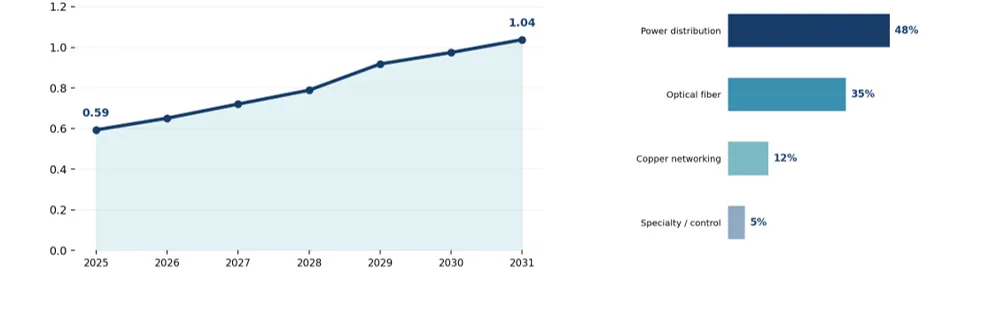
DataM models Japan data center cables and wires expenditure at US$ 0.59 billion in 2025, reaching US$ 1.04 billion by 2031, equivalent to 9.76% CAGR during 2026–2031. The cable-only allocation represents 12% of the data-center electrical-components value in 2025, increasing to 14% in 2031. Increasing AI-compute intensity, fiber-rich architectures, electrical resilience and new capacity deployments support the forecast.
Japan Data Center Cables & Wires Market Key Takeaways
- Japan data-center cables and wires expenditure is estimated at US$ 0.59 billion in 2025, rising to US$ 1.04 billion in 2031 at 9.76% CAGR.
- Power-distribution cables account for an estimated 48% of 2025 value, supporting campus electrical feeders, UPS circuits, generator connections and redundant power infrastructure.
- Optical-fiber products hold an estimated 35% share as cloud, hyperscale and AI workloads require high-fiber-count trunks and low-loss data-hall connectivity.
- Copper networking and short-reach electrical interconnects represent approximately 12% of 2025 demand, including structured cabling and rack-level links.
- Specialty, fire-rated and control cables comprise the remaining estimated 5%, serving monitoring, building management, alarms and resilient circuits.
Japan Data Center Cables & Wires Industry Trends and Strategic Insights
- Hyperscale cloud expansion and AI computing increase requirements for low-loss optical fiber, structured network pathways and preterminated connectivity systems.
- Higher power-density data halls create demand for reliable low-voltage feeders, flexible distribution connections and cable systems designed for operational resilience.
- Tokyo- and Osaka-area colocation and cloud developments concentrate demand for compliant cable products, electrical-room connections and short lead-time installation packages.
- Japanese manufacturers can differentiate through low-loss optical technology, electrical safety, high reliability, fire performance, quality traceability and customized cable assemblies.
Japan Data Center Cables & Wires Market Scope
| METRICS | DETAILS |
| Base Year / Forecast | 2025 / 2026–2031 |
| Geographic Coverage | Japan |
| Market Size and Growth | US$ 0.59 billion (2025); US$ 1.04 billion (2031); 9.76% CAGR (2026–2031). Japan data-center cables and wires market. |
| By Cable Type | Power Cables & Wires (MV feeders, LV distribution, UPS / battery / generator cables, rack power whips); Datacom & Network Cables (SMF, MMF, copper Ethernet, DAC / AEC); Specialty (fire-rated / LSZH, control, grounding). |
| By Data Center Type | Hyperscale; Colocation; Enterprise / Private; Edge / Modular; AI / High-Density Compute. |
| By Cable Application | Site Power / Utility Interconnection; Electrical Distribution; UPS & Backup; Rack-Level Power; Structured Cabling; Campus Fiber; Controls / Fire Safety / BMS. |
| By Network / Transmission Medium | Copper Power Conductors; Copper Data Interconnects; Single-Mode Fiber; Multimode Fiber; Hybrid Copper-Fiber. |
| By Power Cable Voltage Rating | Low Voltage (up to 1 kV); Medium Voltage (above 1 kV to 35 kV); High Voltage (above 35 kV, utility / campus application). |
| By Cable Jacket / Fire Performance | Plenum / Riser; LSZH; Fire-Resistant / Circuit Integrity; XLPE / PVC / EPR and other materials. |
| By Deployment Location | Outside Plant / Campus; Electrical Rooms; Overhead Cable Tray; Underfloor / Conduit; Rack / Row Interconnect. |
| Competitive Landscape | 10 company profiles; product positioning; channel coverage; data-center partnerships and recent developments. |
| Market Insights | Cable-only market sizing, power / optical / networking product mix, installation demand, segment growth, market dynamics, capital opportunities and competition. |
Japan Data Center Cables & Wires Market White Space & Investment Opportunities
- AI network modernization: Higher intra-cluster bandwidth requirements create opportunities for high-density optical fiber backbones, high-count trunks and factory-terminated assemblies.
- Critical-power expansion: Dual-feed architectures, UPS systems and backup generation create demand for qualified low- and medium-voltage power cables.
- Prefabricated cabling: Pretested assemblies, labeled power whips and modular distribution bundles can reduce installation labor and commissioning time.
- Ecosystem partnerships: Collaboration with Japanese engineering contractors, colocation developers, cloud operators and network integrators can support repeat design wins.
- Retrofit upgrades: Established data centers adopting AI racks and higher-bandwidth networking need power-cable replacements, new fiber trunks and redesigned cable routes.
Japan Data Center Cables & Wires Market Dynamics
Japan data-center cable demand reflects staged additions in hyperscale cloud capacity, colocation facilities and AI-computing deployments. The procurement mix varies across development stages: incoming site power and electrical distribution are typically specified earlier, while fiber trunks, copper networks and rack interconnects are ordered nearer IT fit-out. Limited construction space in major metropolitan clusters increases the value of compact cable pathways, modular installation and reliability-tested assemblies. Expansion and retrofit projects both contribute to a broad addressable market.
Driver Impact Analysis
| DRIVER | DEMAND EXPOSURE | IMPACTED CABLES | STRATEGIC IMPLICATION |
| Hyperscale / AI capacity additions | New campus builds and phased hall fit-out | MV / LV power; SMF; rack interconnects | Secure approved vendor status and project-based supply programs. |
| Higher power per rack | UPS / distribution expansion; greater electrical density | LV feeders; rack whips; grounding | Develop application-qualified assemblies and improve installation efficiency. |
| Network architecture upgrades | Migration to high-density links and fiber pathways | SMF; MMF; DAC / AEC | Expand optical portfolio and preterminated system capabilities. |
| Modular / prefabricated construction | Factory-built electrical blocks and repeatable designs | Preassembled power / control / fiber | Partner with OEMs, EPCs and modular integrators. |
The strongest drivers are cloud capacity additions, fiber-intensive AI architectures and investment in resilient power infrastructure. Optical cabling demand benefits from high-bandwidth links between accelerators, storage and switching infrastructure. Power cable demand rises with electrical-room construction, redundant feeders and higher rack densities. Suppliers that combine cable-performance documentation with accelerated project deliveries and engineering support are well placed to secure specifications.
Cable suppliers can expand through early design engagement with electrical consultants, data-center EPCs and structured-cabling integrators. Prefabricated and tested copper and fiber assemblies help reduce onsite installation complexity. For electrical cables, proven fire performance, conductor reliability and documented compatibility with switchgear and power infrastructure improve acceptance. Coordinated project forecasts support inventory planning and reduce delays at commissioning.
Restraint Impact Analysis
| RESTRAINT | EXPOSURE AREA | IMPACTED USE CASE | STRATEGIC RESPONSE |
| Power connection / permitting delays | Utility interconnection and campus energization | MV feeders and facility electrical distribution | Align manufacturing slots to verified utility and EPC milestones. |
| Conductor and polymer cost volatility | Long-duration contracts and fixed-price bids | Copper / aluminum power cables; specialty jackets | Price-index mechanisms, procurement planning and disciplined contract terms. |
| Installation labor and pathway constraints | High-density retrofits and accelerated fit-out | Fiber trunks; structured cabling; power whips | Use preterminated designs, documentation and installer training. |
| Rapid network-standard evolution | High-speed AI and cloud interconnect upgrades | Optical / copper data cables | Maintain flexible architecture and interoperability testing. |
Data-center investment may be delayed by power-connection bottlenecks, development permitting, land scarcity and changing construction schedules. A delay to site energization can defer medium-voltage cable installation as well as downstream procurement of distribution cables. Data-hall fit-out may also be phased according to tenant contracts and AI equipment delivery, creating variability in optical connectivity demand and supplier revenue recognition.
Metal-price changes affect copper- and aluminum-intensive cable quotations, while specialty fiber and low-loss connector systems require stricter production tests and qualification. Fire safety, seismic resilience, installation access and service-continuity standards can increase the cost of compliance. High labor and logistics costs further strengthen the case for prefabrication and efficient cable routing. Suppliers must balance capacity reservations, lead times and fixed-price bids against potential project rescheduling.
Japan Data Center Cables & Wires Market Competitive Landscape
Japan data-center cable competition includes integrated domestic wire and cable manufacturers, optical-fiber specialists and global data-connectivity suppliers. Competitive advantages depend on proven cable reliability, high-density optical performance, installation partnerships, technical qualification and the ability to deliver compatible components under tight project timelines. Players with both power and optical product strengths can serve larger portions of data-center fit-out programs.
| COMPANY | Japan DATA-CENTER POSITIONING |
| Sumitomo Electric Industries | Power cable systems, optical fiber and data connectivity products relevant to Japanese hyperscale and colocation installations. |
| Furukawa Electric | Optical fiber, communication cables and electrical cabling systems for data-center power and network infrastructure. |
| Fujikura | High-density optical fiber, advanced fiber cable products and connectivity solutions for cloud data centers. |
| SWCC Corporation | Power and electrical cable systems for utility interconnections, facility power distribution and critical infrastructure. |
| Proterial | Specialty electrical wires, cable materials and high-reliability connectivity technologies. |
| Corning | Optical fiber, preterminated network assemblies and high-density data-center cabling. |
| CommScope | Structured copper and optical-fiber cabling systems for enterprise, cloud and colocation networks. |
| Amphenol | High-speed copper and optical interconnect assemblies for networking and AI infrastructure. |
| Belden | Copper data, fiber connectivity and control cabling for network and facility applications. |
| AFL | Optical fiber cables, assemblies, accessories and installation support for data-center connectivity. |
Operators and engineering contractors assess suppliers on certification, safety, loss performance, project track record, delivery certainty and installed life-cycle cost. Data-center installations favor dependable cable systems with consistent batch quality and traceable specifications. Cooperation with installers, power-system suppliers and network integrators helps convert data-center expansion plans into recurring procurement demand.
Japan Data Center Cables & Wires Market Recent Developments
- In 2026, continued investment in Japan’s cloud and AI data-center infrastructure supported opportunities for optical fiber and critical-power cable suppliers.
- During 2026, increased emphasis on data-center energy resilience strengthened attention to redundant feeders, UPS connections and compliant electrical cable design.
- In 2026, higher network bandwidth requirements encouraged interest in preterminated fiber trunks, dense optical assemblies and shorter installation windows.
- In 2026, suppliers and contractors continued to prioritize prefabrication, quality testing and repeatable cabling architectures for complex data-center projects.
- During 2026, data-center cable procurement remained influenced by construction scheduling, electricity access, fire-safety specifications and supplier lead times.


























































