


Japan Cloud ERP Market Definition and Overview
The global Japan Cloud ERP market reached USD 3.5 billion in 2025 and is expected to reach USD 14.3 billion by 2035, growing with a CAGR of 15.1% during the forecast period 2026-2035. The market growth is being driven by Japanese firms speeding up the shift towards cloud-native ERP software to improve operational efficiency, streamline business processes, and achieve digital transformation throughout the entire organization. METI keeps focusing on the modernization of core enterprise applications with the help of DX programs, advocating that companies switch from old legacy systems to cloud-based business applications. More frequent use of AI-powered automation, real-time analytics, and cross-site operations management in such sectors as manufacturing, retail, finance, and logistics is contributing to the growth of the demand for cloud ERP software. Top vendors, including SAP Japan, Oracle Japan, Microsoft, Fujitsu, and NTT Data, are developing AI-powered ERP functionalities and vertical cloud solutions to meet enterprise needs. Nonetheless, migration difficulties, legacy systems integration, and a lack of experienced cloud ERP implementation specialists remain obstacles to market growth.
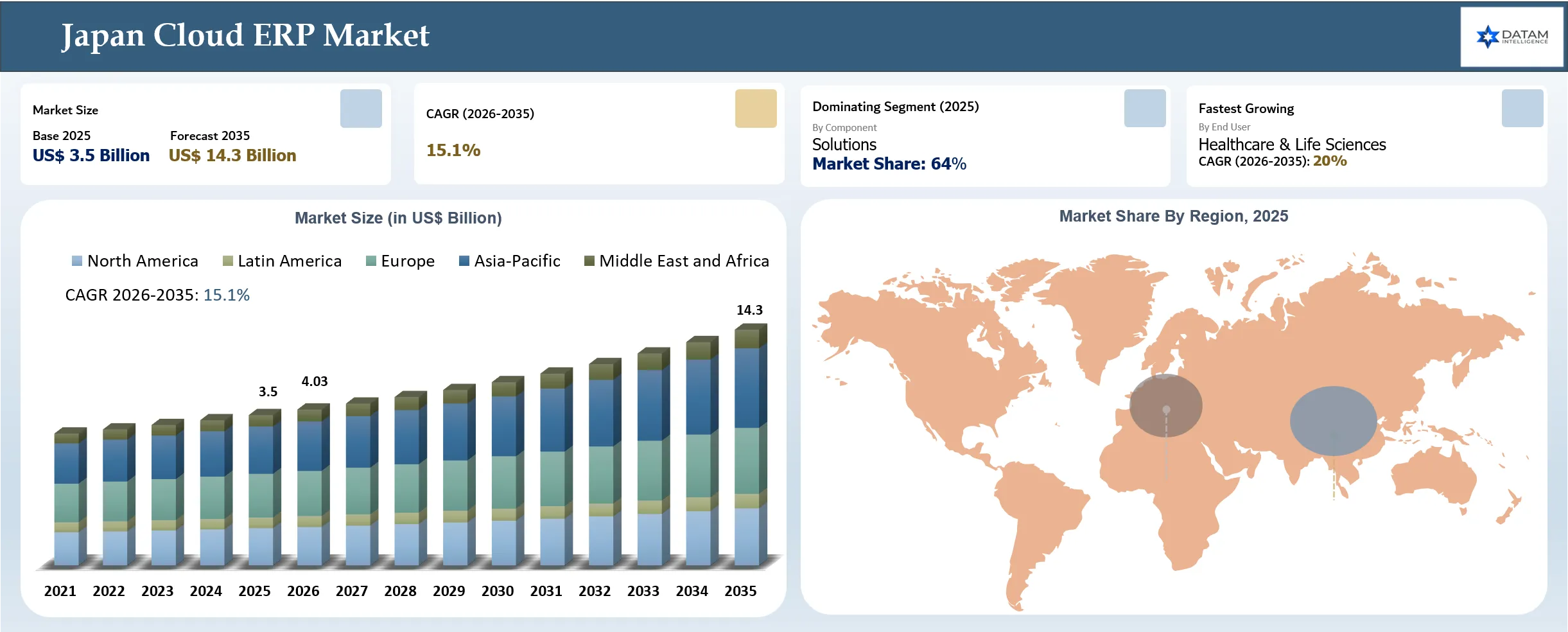
This trend demonstrates the increasing inclination of Japanese companies towards using cloud-based ERP software that ensures business flexibility and allows making decisions based on data analysis. In February 2026, as per IT Leaders, Japanese companies are intensifying the process of modernizing their core business systems through the adoption of cloud ERP software combined with AI technology. There is noted high demand for upgrading the old ERP systems to new cloud-based ones, as well as 16% year-over-year growth in the ERP market of Japan in FY2025 due to system upgrades and AI implementation in enterprise apps.
Japan Cloud ERP Market Strategic Takeaways
- The Solutions segment dominated the Japan Cloud ERP market by capturing approximately 64% of the total market share in 2025, establishing itself as the primary revenue generator as companies prioritize integrated, real-time data platforms.
- SAP leads the Japan ERP solutions market with a 24.5% share, followed closely by Oracle at 19.8% and Microsoft at 14.6% in 2025, showing the strong control that global enterprise software giants maintain over the regional digital landscape.
- The ERP market in Japan experienced a substantial 16% year-over-year growth during the fiscal year 2025, which was heavily fueled by systemic enterprise application upgrades and rapid AI technology integration.
- The complex process of migrating from highly customized legacy ERP systems represents a major 22% drag on market growth, because it significantly increases implementation risks, project timelines, and consulting costs for large enterprises.
Japan Cloud ERP Market Industry Trends and Strategic Insight
- AI is becoming a core capability within cloud ERP platforms rather than an add-on. Japanese enterprises are prioritizing ERP platforms with embedded generative AI, predictive analytics, intelligent automation, and AI-assisted decision support to improve financial planning, procurement, inventory optimization, and operational productivity.
- Migration from highly customized legacy ERP systems to standardized cloud architectures is accelerating. Organizations are increasingly adopting "Fit-to-Standard" implementation approaches to reduce customization, simplify upgrades, lower maintenance costs, and improve long-term scalability.
- Manufacturers are integrating ERP platforms with production planning, MES, IoT, warehouse management, and supply chain systems to improve production visibility, inventory synchronization, and real-time operational control while addressing labor shortages and improving productivity.
- Japanese enterprises operating in regulated industries are placing greater emphasis on cloud environments that satisfy domestic data governance, cybersecurity, and compliance requirements.
- Enterprises are increasingly selecting cloud ERP platforms based on operational resilience, enterprise-wide process harmonization, regulatory compliance, and AI readiness rather than infrastructure replacement alone, making cloud ERP a strategic foundation for long-term digital competitiveness.
Japan Cloud ERP Market Scope
| Metrics | Details |
| 2025 Market Size | USD 3.5 Billion |
| 2035 Projected Market Size | USD 14.3 Billion |
| CAGR (2026-2035) | 15.1% |
| By Component | Solutions, Services |
| By Deployment Model | Public Cloud, Private Cloud, Hybrid Cloud |
| By Organization Size | Large Enterprises, Small & Medium-sized Enterprises (SMEs) |
| By Business Function | Finance & Accounting, Human Resource Management (HRM), Supply Chain Management (SCM), Procurement, Inventory & Warehouse Management, Manufacturing, Customer Relationship Management (CRM), Project Management, Enterprise Asset Management (EAM), Others |
| By End User | Manufacturing, Retail & E-commerce, BFSI, Healthcare & Life Sciences, IT & Telecommunications, Government & Public Sector, Logistics & Transportation, Construction, Energy & Utilities, Education, Others |
| Report Insights Covered | Competitive Landscape Analysis, Company Profile Analysis, Market Size, Share, Growth |
Explore the Future of the Japan Cloud ERP Market
Get a comprehensive sample report covering Japan Cloud ERP market trends, AI-powered ERP advancements, cloud adoption, competitive landscape, application insights, and growth opportunities. Request your sample today to understand the factors shaping the next generation of enterprise resource planning in Japan. Request Sample Report Today!
Japan Cloud ERP Market Disruption Analysis
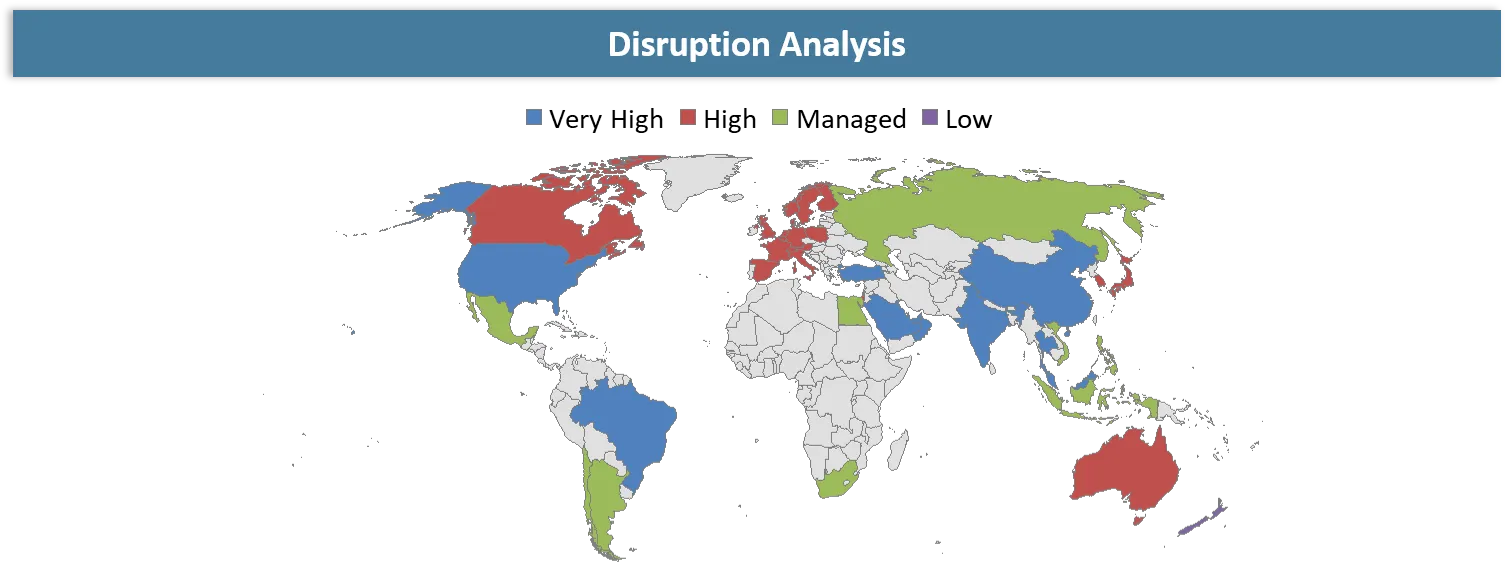
AI-Native Cloud ERP Platforms and Generative AI Reshaping Enterprise Software Modernization
The primary disruption in the Japan Cloud ERP Market is the rapid emergence of AI-native cloud ERP platforms, which are fundamentally transforming enterprise software modernization strategies. Rather than migrating legacy ERP systems solely to reduce infrastructure costs, Japanese enterprises are increasingly replacing highly customized on-premise environments with cloud ERP solutions embedded with generative AI, intelligent automation, predictive analytics, and AI-assisted decision support. This transition is accelerating ERP replacement cycles, shifting enterprise investment toward standardized cloud-native architectures, and redefining competition among ERP vendors through AI-driven capabilities rather than conventional functionality.
This disruption is even further solidified by the incorporation of generative AI in applications, rather than providing AI as an individual service. In May 2025, SAP announced major enhancements to the SAP Business AI product with a target goal of boosting productivity by 30%, using AI assistants, AI autonomous agents, and AI intelligent processes within finance, procurement, supply chain, and HR domains. The same year, OKI Electric Industry chose GROW with SAP and SAP S/4HANA Cloud Public Edition as the core of its company transformation using the Fit-to-Standard approach.
Japan Cloud ERP Market BCG Matrix: Company Evaluation
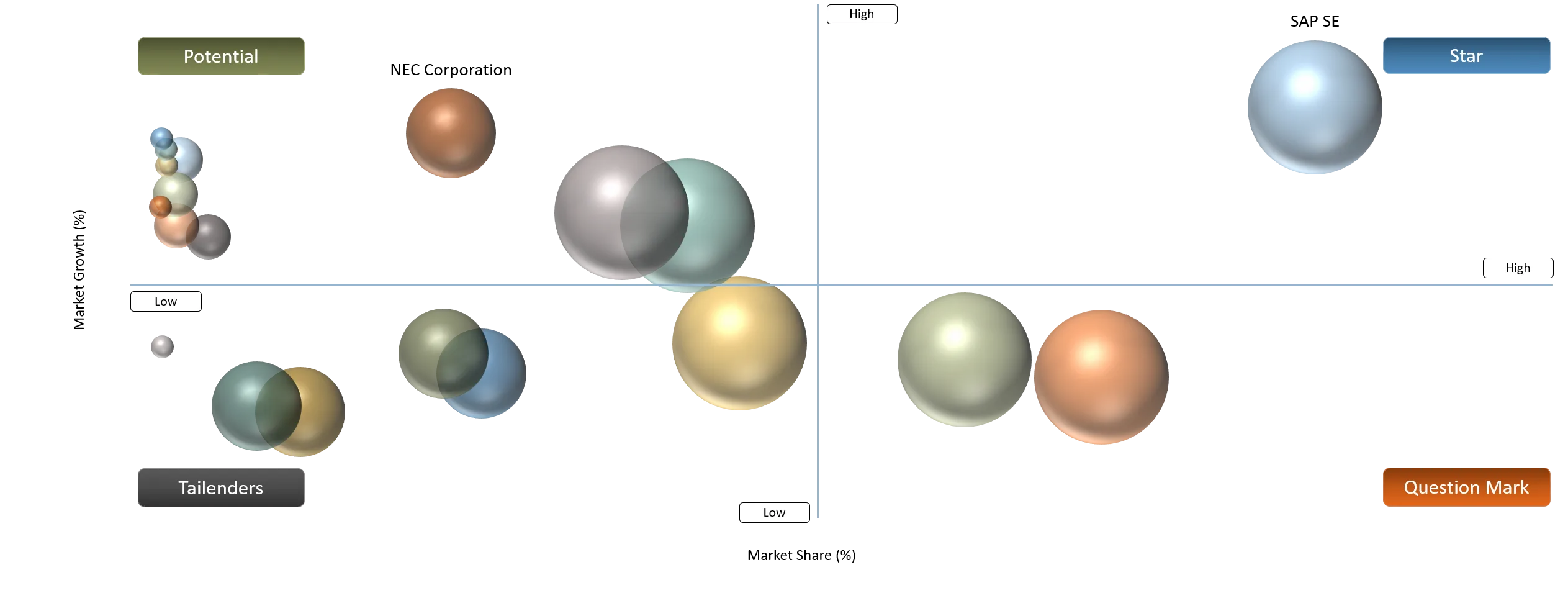
Stars include SAP SE, Oracle, and Microsoft Corporation due to their strong market presence, comprehensive cloud ERP portfolios, and continuous investment in artificial intelligence, generative AI copilots, industry-specific cloud solutions, and hyperscale cloud infrastructure. These companies have established leadership in Japan by supporting large-scale ERP modernization across manufacturing, retail, financial services, healthcare, and the public sector. Question Marks include Workday, Infor, and QAD because they are expanding their presence in Japan through industry-focused cloud ERP solutions for manufacturing, human capital management, and automotive sectors.
The Potential category includes NEC Corporation, Sojitz Tech Innovation, and Epicor Software Corporation. These companies are leveraging their expertise in digital transformation, system integration, manufacturing, and mid-market enterprise solutions to strengthen their cloud ERP offerings. The tailenders category includes Sage Group because its presence in Japan's cloud ERP market remains comparatively limited.
Japan Cloud ERP Market Dynamics
Driver Impact Analysis
| Driver | Market Growth Impact (%) | Demand Concentration | Impacted Use Case | Strategic Impact |
Accelerating digital transformation initiatives across Japanese enterprises is driving migration from legacy ERP systems to cloud-native platforms. | 31% | Large enterprises, Manufacturing, BFSI, Retail | Enterprise-wide ERP modernization and legacy system migration | Accelerates cloud ERP adoption, improves operational agility, and supports long-term digital transformation. |
Growing adoption of AI-enabled ERP solutions is enhancing business process automation and real-time decision-making. | 26% | Manufacturing, BFSI, Logistics, Healthcare | AI-driven finance, procurement, supply chain, and workforce management | Increases automation, predictive analytics, and enterprise productivity while strengthening competitive differentiation. |
Rising adoption of subscription-based SaaS ERP solutions is reducing upfront IT infrastructure and maintenance costs. | 21% | SMEs, Mid-sized enterprises, Professional Services | SaaS ERP deployment and business application modernization | Expands cloud ERP accessibility, lowers total cost of ownership (TCO), and increases recurring SaaS adoption. |
Expansion of cloud infrastructure in Japan is enabling secure and scalable deployment of enterprise ERP applications. | 18% | Large enterprises, Government, Healthcare, Telecommunications | Public, private, and hybrid cloud ERP deployment | Improves scalability, security, business continuity, and enterprise cloud adoption across industries. |
The growing need for integrated supply chain, procurement, and manufacturing management is accelerating cloud ERP implementation. | 15% | Manufacturing, Automotive, Logistics, Industrial Enterprises | Supply chain planning, inventory, procurement, and production management | Strengthens operational visibility, supply chain resilience, and end-to-end enterprise process integration. |
Accelerating digital transformation initiatives across Japanese enterprises are driving migration from legacy ERP systems to cloud-native platforms
The rapid acceleration of enterprise digital transformation is one of the key factors contributing to the growth of the Japan Cloud ERP market. The legacy ERP environment of enterprises is transformed into a more efficient one, enhancing operational efficiency and business agility through the improved transparency of information within the enterprise. Instead of keeping their customized on-premise applications, enterprises in Japan are moving towards the implementation of cloud ERP applications, enabling standardized business processes, updates of the software, integration with artificial intelligence, and digital business operations.
The Japanese companies are increasingly relying on cloud ERP solutions for consolidating their operations across multiple units within a company. In November 2025, as per IT Leaders, Nippon Yusen Kaisha (NYK Line) is migrating its 350-company accounting system to SAP S/4HANA Cloud platform as a part of its digital transformation. The implementation of this large cloud ERP solution intends to bring uniformity and increase efficiency in its operations across the globe.
Restraint Impact Analysis
| Restraint | Drag on Market Growth (%) | Primary Impact Area | Impacted Use Case | Strategic Impact |
Complex migration from highly customized legacy ERP systems is increasing implementation risks and project timelines. | 22% | ERP migration, data transformation, implementation cost | Large enterprises migrating SAP ECC, Oracle EBS, and other customized on-premise ERP systems to cloud ERP platforms | Delays cloud adoption timelines, increases consulting requirements, and raises migration costs for enterprises. |
Integration challenges with existing enterprise applications and proprietary manufacturing systems are increasing deployment complexity. | 18% | System integration, manufacturing operations, supply chain management | Japanese manufacturers connecting cloud ERP with MES, PLM, IoT platforms, and legacy production systems | Slows ERP deployment, requires customized middleware solutions, and increases dependence on specialized implementation partners. |
Business disruption during ERP migration is discouraging organizations from replacing long-established on-premise systems. | 15% | Operational continuity, change management, employee adoption | Finance, procurement, HR, and inventory management functions transitioning from legacy ERP environments | Encourages companies to extend existing ERP lifecycles, reducing short-term cloud ERP migration investments. |
Dependence on vendor-specific cloud ecosystems is increasing concerns over vendor lock-in and long-term operational flexibility. | 13% | Vendor selection, cloud strategy, data portability | Enterprises adopting SAP S/4HANA Cloud, Oracle Fusion Cloud ERP, or Microsoft Dynamics 365 ecosystems | Creates hesitation among enterprises, increasing demand for hybrid ERP strategies and multi-cloud compatibility. |
Complex migration from highly customized legacy ERP systems is increasing implementation risks and project timelines
One of the major constraints that has been limiting the growth of the Japan Cloud ERP market is the difficulty involved in moving away from highly customized traditional ERP systems that have been powering the enterprise operations of businesses for decades. Many Japanese companies, especially those operating in the manufacturing, financial services, and government sectors, use highly customized on-premise ERP systems that work together with their custom-built production, accounting, and supply chain management applications. Moving such an environment to a standardized cloud ERP system will involve massive amounts of data migration and application reconfiguration.
Large-scale ERP migrations usually involve considerable data restructuring, system customizations, and business processes, posing difficulties for organizations moving away from their traditional software systems. In June 2025, ERP Today, SNP Japan, and Accenture Japan brought attention to the difficulties that SAP transformation projects face during SNP Transformation World 2025. They addressed the difficulties involved in the migration of highly customized legacy ERP systems to SAP S/4HANA platforms. This conversation was centered around the management of complex data migration, system customizations, and transformation risks.
Japan Cloud ERP Market Segment Analysis
The Japan Cloud ERP market is segmented based on component, deployment model, organization size, business function, and end user.
Solutions Segment Dominance Driven by Enterprise Cloud Transformation and ERP Modernization Initiatives
The Solutions segment dominates the Japan Cloud ERP Market, accounting for approximately 64% of the market share in 2025, driven by increasing enterprise demand for integrated cloud-based ERP platforms that enable real-time data management, automation, and operational efficiency. Japanese enterprises are increasingly replacing legacy on-premise ERP systems with cloud ERP solutions to support digital transformation initiatives, improve business agility, and address challenges associated with aging IT infrastructure. The demand for cloud ERP solutions has been particularly strong among manufacturing, retail, and financial organizations seeking unified platforms for finance, supply chain, procurement, and workforce management.
The continued adoption of cloud ERP solutions across large enterprises and SMEs, combined with Japan’s push toward digital transformation and productivity improvement, has strengthened the Solutions segment’s leading position as the primary revenue contributor in the Japan Cloud ERP Market. The segment is expected to maintain its dominance as organizations prioritize standardized ERP platforms over fragmented legacy applications to achieve long-term scalability and cost optimization.
Japan Cloud ERP Market Competitive Landscape
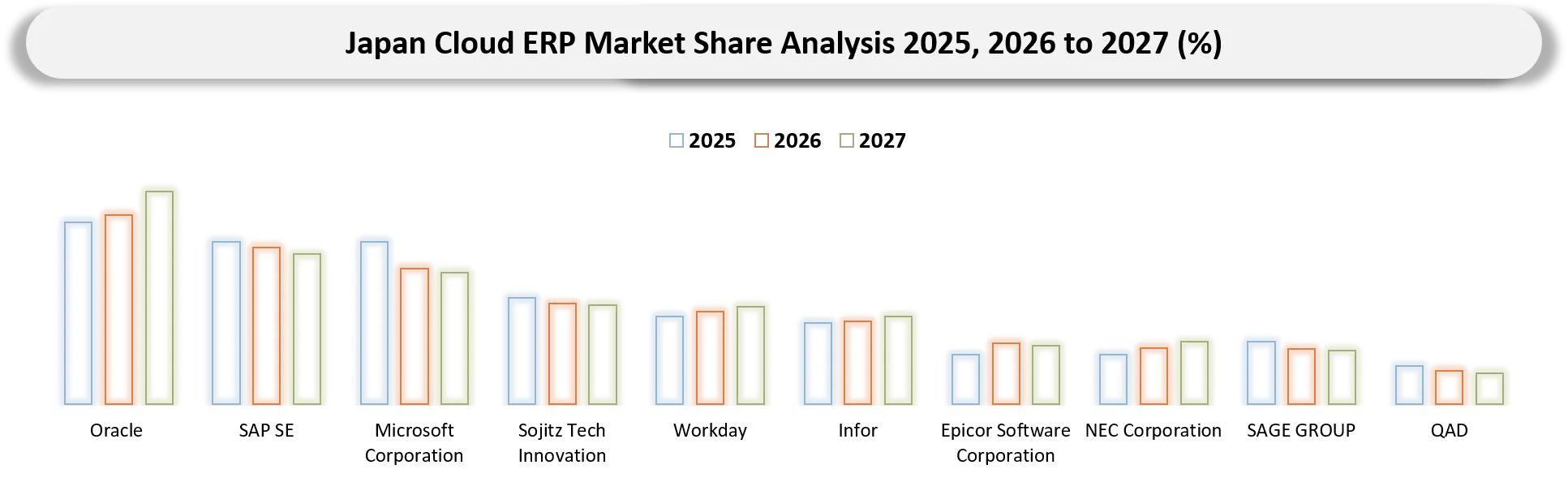
- The Japan Cloud ERP Market competitive landscape is shaped by global ERP software leaders, cloud technology providers, and Japan-focused enterprise solution integrators, with competition primarily driven by cloud platform capabilities, industry-specific ERP solutions, AI integration, localization support, and implementation expertise. Leading global vendors such as SAP SE, Oracle, and Microsoft Corporation hold significant positions due to their strong enterprise customer base, broad ERP portfolios, and established partner ecosystems in Japan. SAP maintains a strong presence in large Japanese enterprises, particularly in manufacturing and automotive sectors, while Oracle and Microsoft continue expanding cloud ERP adoption through integrated cloud infrastructure and business applications. According to 2025 enterprise application market evaluations, SAP, Oracle, and Microsoft collectively account for a major share of Japan’s ERP software ecosystem, with SAP estimated to hold approximately 24.5% share, Oracle around 19.8%, and Microsoft around 14.6% of the Japan ERP solutions landscape.
- Key players include SAP SE, Oracle, Microsoft Corporation, Sojitz Tech Innovation, Workday, Infor, Epicor Software Corporation, NEC Corporation, Sage Group, and QAD.
Key Developments in Japan Cloud ERP Market
July 2026: ITOCHU Corporation / SAP expanded its cloud ERP transformation by adopting SAP Cloud ERP Private and SAP Business Technology Platform after completing a clean-core SAP rollout across 50 global locations, with the next phase focused on autonomous innovation.
- July 2026: NSK Ltd. / SAP selected SAP Cloud ERP Private alongside SAP Business Technology Platform, SAP Integrated Business Planning, SAP Ariba, SAP SuccessFactors and SAP Concur, strengthening its integrated cloud-based enterprise architecture.
- February 2026: Tosoh Corporation / SAP was identified among Japan-based enterprises selecting SAP S/4HANA Cloud, reflecting continued Japanese enterprise migration toward cloud ERP and SAP’s integrated Business AI environment.
- October 2025: Japan Aviation Electronics Industry Ltd. / SAP adopted SAP S/4HANA Cloud Private Edition together with SAP Business AI, SAP Business Data Cloud and SAP Business Technology Platform, combining cloud ERP with AI and enterprise data capabilities.
Key Procurement Priorities and Buyer Evaluation Criteria
- Organizations investing in the Japan Cloud ERP Market are increasingly selecting ERP providers based on their ability to deliver scalable cloud platforms that support business process automation, real-time data visibility, cybersecurity, and seamless integration with existing enterprise systems. Buyers prioritize solutions that can modernize legacy ERP environments while improving operational efficiency across finance, supply chain, human resources, manufacturing, and customer management functions.
- The decision-making process for cloud ERP procurement is increasingly influenced by the growing adoption of digital transformation initiatives, AI-enabled enterprise applications, cloud migration strategies, and the need for flexible SaaS-based business management platforms. Japanese enterprises are evaluating vendors that can provide localized ERP capabilities, regulatory compliance support, and long-term scalability to meet evolving business requirements.
- Buyers evaluate factors such as total cost of ownership (TCO), implementation timelines, system integration capabilities, data security standards, customization flexibility, cloud infrastructure reliability, and vendor support services when selecting cloud ERP providers. Enterprises also consider the ability of ERP platforms to integrate with existing applications, analytics tools, artificial intelligence solutions, and industry-specific workflows.
Why Choose DataM?
- Technological Innovations: Explores advancements in Japan’s cloud ERP ecosystem, including SaaS-based ERP platforms, integrated finance and accounting modules, cloud-based supply chain and procurement management, HR and workforce management, real-time analytics, AI-enabled business automation, and API-based integrations. The analysis evaluates how these technologies support enterprise-wide digital transformation, standardized workflows, remote access, scalability, and data-driven decision-making.
- Product Performance & Market Positioning: Evaluates cloud ERP solutions based on functional coverage, scalability, implementation flexibility, integration capabilities, data security, usability, localization, analytics, automation, and total cost of ownership. It examines how providers differentiate through industry-specific functionality, Japanese business-process support, subscription-based deployment, embedded AI, and integration across finance, procurement, supply chain, sales, and human-resource operations.
- Real-World Evidence: Highlights the adoption of cloud-based business systems as Japanese companies accelerate digitalization and DX. Japan’s Small and Medium Enterprise Agency reports continued progress in digitalization among SMEs, while METI states that DX initiatives are expanding among both large enterprises and SMEs. Cloud-based systems can help organizations centralize business information, improve operational efficiency, enable data utilization, and modernize legacy processes.
- Market Updates & Industry Changes: Tracks developments including increasing enterprise cloud adoption, Japan’s DX policies, modernization of legacy business systems, AI integration into enterprise software, expansion of SaaS-based business applications, and government initiatives supporting digital transformation. METI’s revised DX Promotion Index in 2026 reflects the changing technology environment and the growing importance of structured DX capabilities within Japanese enterprises.
- Competitive Strategies: Analyzes how cloud ERP providers compete through product innovation, AI-enabled capabilities, industry-specific solutions, strategic partnerships, implementation services, integration ecosystems, and expansion of cloud functionality across finance, procurement, supply chain, sales, and human resources. Leading global ERP providers are increasingly positioning cloud ERP around embedded AI, standardized processes, real-time insights, and scalable enterprise operations.
- Pricing & Market Access: Explains pricing differences according to subscription structure, number of users, modules selected, deployment scale, customization, implementation services, integration requirements, support, and security requirements. The analysis also evaluates market access through direct enterprise sales, implementation partners, system integrators, consulting firms, SaaS channels, and specialized technology providers, with particular attention to the requirements of Japanese enterprises and SMEs.
- Market Entry & Expansion: Identifies opportunities arising from continued enterprise digitalization, SME modernization, cloud adoption, workforce constraints, legacy-system replacement, AI-enabled business processes, and government-backed DX initiatives. METI reports that DX recognition has expanded significantly, with SMEs contributing strongly to recent growth, creating opportunities for cloud ERP vendors offering scalable, localized, easy-to-implement, and integrated solutions.
Target Audience
- Enterprise Organizations & Large Japanese Corporations
- Small & Medium-Sized Enterprises (SMEs)
- Cloud ERP Software Providers
- ERP Vendors & SaaS Companies
- System Integrators & IT Consulting Firms
- Cloud Infrastructure & Technology Providers
- Finance, Accounting & Procurement Departments




























































