


Japan Artificial Blood Market Size and Overview
The Japan artificial blood market remains pre-commercial through 2027, with measurable revenue beginning in 2028 at USD 31.33 thousand and expanding to USD 890.03 thousand by 2035, reflecting a transition from clinical development toward selective Commercialization, growing with a CAGR of 61.3% during the forecast period 2030-2035. The market development is supported by Japanese research in haemoglobin-based oxygen carriers, more specifically haemoglobin vesicles that have the capability to deliver oxygen, acting as an alternative to regular blood transfusions through red blood cells.
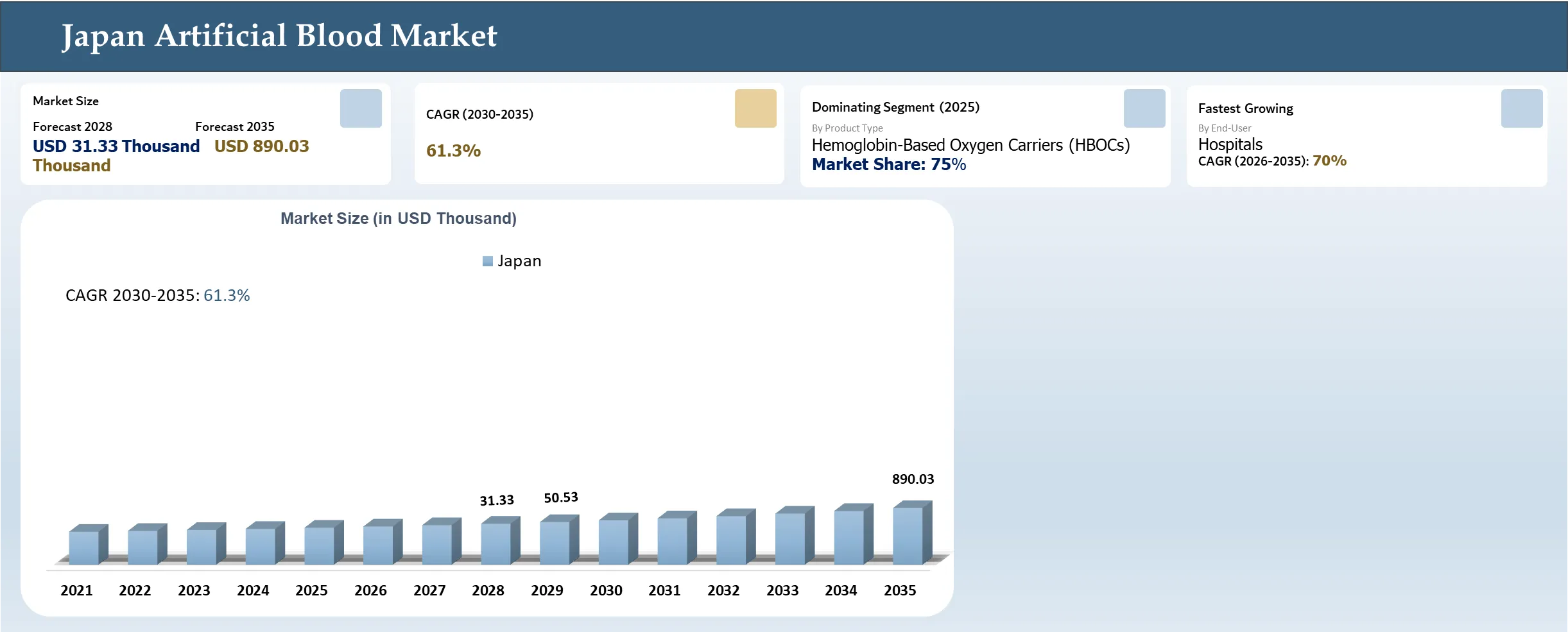
The development efforts will concentrate on determining the safety and dosage aspects of the technology, and the possible uses for emergency medicine and blood loss situations. The ageing population of Japan and the need for an effective emergency transfusion system present a good clinical rationale for the use of the product. Recent clinical developments are strengthening Japan's artificial blood market through progress in human safety evaluation. In August 2025, according to Nara Medical University, the phase Ib safety test of NMU-HbV, an artificial red blood cell made from haemoglobin-vesicles, ended the first cohort study involving four healthy adults, including two males and two females, without reporting any severe adverse reactions or fever over 38°C.
The first cohort received a dose of 100 mL at an infusion rate of 2.5 mL/min. After approval from the safety evaluation committee, the researchers moved to the next cohort with planned doses of 100 mL, 200 mL, and 400 mL for the next four-cohort studies.
White-Space Opportunities for the Japan Artificial Blood Market Through Military Blood-Product Manufacturing and Emergency Transfusion Preparedness
Japan’s Ministry of Defense allocated ¥800 million (USD 5.3 million) in its FY2025 budget for equipment to manufacture and secure blood products independently for injured Self-Defense Force personnel, according to the ministry’s official FY2025 budget overview in February 2025. The largest investment is directed toward blood-product manufacturing and processing equipment, including platelet-preserving leukocyte-removal filters, to support emergency transfusions and improve military medical preparedness.
Additional investments include ¥100 million (USD 0.67 million) for consulting services to establish blood-production capabilities and ¥5.2 billion (USD 34.7 million) for an integrated health information system that includes blood management. The investment could create procurement opportunities across Japan’s blood-processing, medical equipment, healthcare IT, and defense medical logistics sectors.
In blood collection, processing, and transfusion equipment, Japanese suppliers such as Terumo Corporation and JMS Co., Ltd. could be potential suppliers of relevant medical and blood-management equipment, subject to product suitability and government procurement requirements. In blood-processing technologies and transfusion supplies, companies such as Kawasumi Laboratories, Inc. could represent relevant supplier candidates.
Japan Artificial Blood Market Key Takeaways
- Hemoglobin-based oxygen carriers (HBOCs) dominated the market with a 75% share in 2025. The dominance is driven by their ability to transport oxygen inside lipid membranes as a functional alternative to red blood cells.
- The defense budget designated ¥100 million (USD 0.67 million) for consulting services to establish blood-production capabilities. An additional ¥5.2 billion (USD 34.7 million) was allocated toward an integrated health information system including blood management.
- In August 2025, Nara Medical University completed the first cohort safety test of NMU-HbV artificial red blood cells on 4 healthy adult subjects. The trial involved 2 males and 2 females who experienced no severe adverse reactions or fever over 38°C.
- Japan’s Ministry of Defense allocated ¥800 million (USD 5.3 million) in its FY2025 budget for blood product manufacturing equipment. Its initiative aims to independently secure emergency transfusion supplies for injured Self-Defense Force personnel.
Japan Artificial Blood Market Industry Trends and Strategic Insight
- Hemoglobin-based oxygen carriers (HBOCs) dominated the market with a 75% share in 2025. The dominance is driven by their ability to transport oxygen inside lipid membranes as a functional alternative to red blood cells.
- The defense budget designated ¥100 million (USD 0.67 million) for consulting services to establish blood-production capabilities. An additional ¥5.2 billion (USD 34.7 million) was allocated toward an integrated health information system including blood management.
- In August 2025, Nara Medical University completed the first cohort safety test of NMU-HbV artificial red blood cells on 4 healthy adult subjects. The trial involved 2 males and 2 females who experienced no severe adverse reactions or fever over 38°C.
- Japan’s Ministry of Defense allocated ¥800 million (USD 5.3 million) in its FY2025 budget for blood product manufacturing equipment. Its initiative aims to independently secure emergency transfusion supplies for injured Self-Defense Force personnel.
Japan Artificial Blood Market Scope
| Metrics | Details |
| 2025 Market Size | USD 31.33 Thousands |
| 2035 Projected Market Size | USD 890.03 Thousands |
| CAGR (2026-2035) | 61.3% |
| By Product Type | Hemoglobin-Based Oxygen Carriers (HBOCs), Perfluorocarbon-Based Oxygen Carriers (PFCs) |
| By Source | Human Hemoglobin, Animal Hemoglobin, Stem Cells, Synthetic Materials, Recombinant Hemoglobin, Others |
| By Application | Anemia & Blood Loss, Surgical & Perioperative Care, Injuries & Trauma, Organ Transplantation, Emergency & Critical Care, Others |
| By End-User | Hospitals, Military & Defense Healthcare, Organ Transplant Centers, Research Institutes, Others |
| Report Insights Covered | Competitive Landscape Analysis, Company Profile Analysis, Market Size, Share, Growth |
Japan's Artificial Blood Market Disruption Analysis
Shift from Donor-Dependent Transfusion Systems to Engineered Oxygen-Carrying Alternatives
The disruption in the Japan artificial blood market is primarily associated with the development of haemoglobin-vesicle technology designed to transport oxygen without depending on conventional donor-derived red blood cells. The innovation is revolutionising the whole transfusion process by providing an alternative means of delivering oxygen in cases where there are no matching blood samples available and even when the whole process of blood delivery from donors is disrupted. In Japan, researchers are developing haemoglobin molecules for clinical studies and they are focusing on the safety of the molecule, its oxygen delivery capability, and whether it can be used in emergency medicine settings.
The haemoglobin vesicle technology in Japan is an important breakthrough in oxygen carriers as blood substitutes. In December 2025, according to SCIRP.org, the Japanese-developed HbVs have a size range of 250-280 nanometers, where human haemoglobin is encased in a membrane made of PEG-modified phospholipids. The article notes that there is a potential shelf life of two years when stored at room temperature and type-independent compatibility, which can overcome storage and transportation challenges in addition to blood-matching issues related to the conventional transfusion system. The article mentions an early human Phase I trial conducted between 2020 and 2022 on 12 healthy male volunteers, who were administered doses of 10 mL, 50 mL, and 100 mL.
Japan Artificial Blood Market BCG Matrix: Company Evaluation
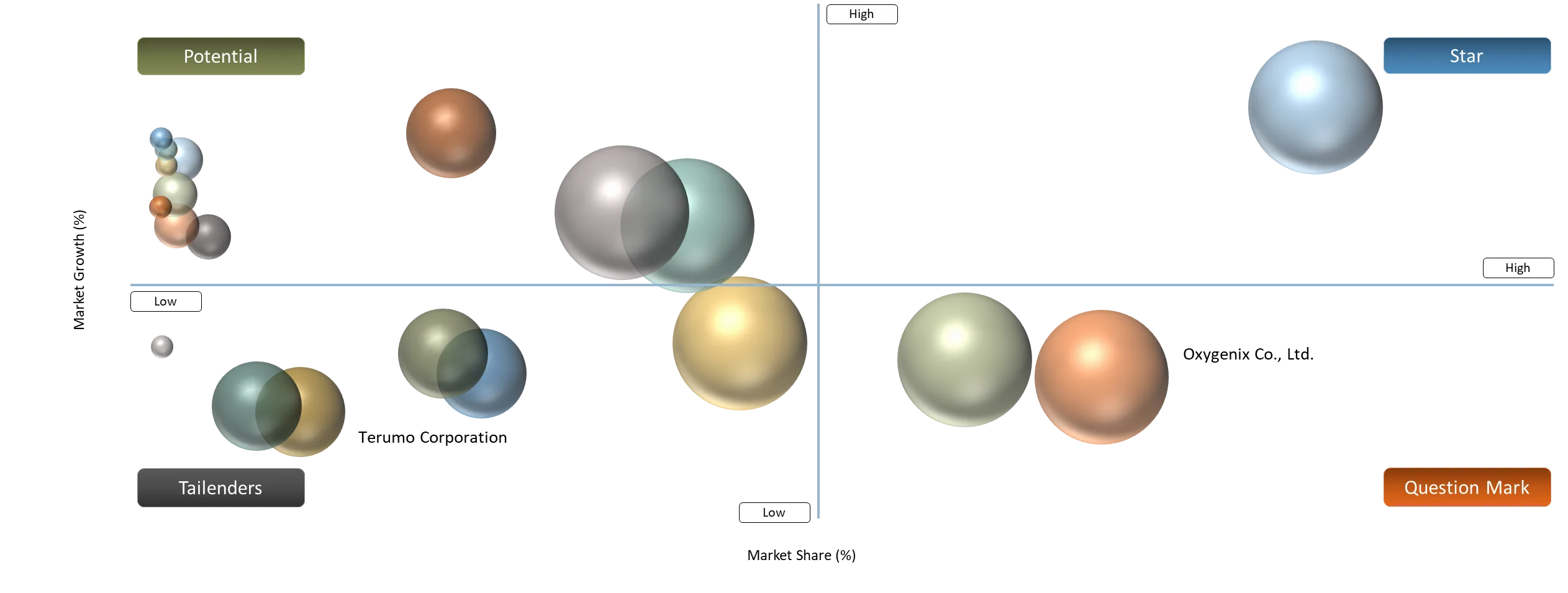
Oxygenix Co., Ltd. is placed in the Question Mark category because of its historically reported involvement in advancing Japanese haemoglobin-vesicle (HbV) artificial blood technology, although its current commercial activity and market position are not independently confirmed.
Terumo Corporation is classified as a Tailender in this market assessment because its historical involvement in HbV development has not been confirmed as an active commercial artificial blood business in Japan.
Japan's Artificial Blood Market Dynamics
Driver Impact Analysis
| Driver | Market Growth Impact (%) | Demand Concentration | Impacted Use Case | Strategic Impact |
Need for Blood Substitutes in Emergencies and Disaster Response. | 25% | Emergency medical services, disaster-prone regions, and military medical support | Trauma care, prehospital treatment, emergency transfusion, and disaster response | Strengthens demand for storable, rapidly deployable oxygen carriers that could supplement conventional blood supplies during emergencies. |
Rising Demand for Alternative Blood Transfusion Solutions. | 30% | Hospitals, specialist medical centres, and clinical research institutions | Red blood cell replacement, surgical support, and treatment of severe blood loss | Encourages development of haemoglobin vesicles and other oxygen-carrying technologies to address limitations associated with donor-derived blood products. |
Ageing Population and Increasing Healthcare Needs. | 25% | Hospitals, geriatric care facilities, and high-volume treatment centres | Surgery, age-related medical complications, and transfusion support | Creates opportunities for alternative transfusion technologies as healthcare providers seek reliable solutions for patients requiring blood-related treatments. |
Government-Supported Biomedical Research and Clinical Development. | 20% | Universities, biotechnology research centres, and clinical trial institutions | Artificial oxygen carrier development, safety testing, and clinical validation | Supports research funding, clinical evaluation, and potential commercialisation of Japanese-developed artificial blood technologies. |
Need for Blood Substitutes in Emergencies and Disaster Response
The need for blood substitutes in emergencies and disaster response is an important driver of the Japan artificial blood market, as earthquakes, large accidents, and other emergencies can lead to the urgent need for blood transfusion when normal blood supply is difficult to obtain or distribute. Natural disasters occurring in Japan make it necessary to explore alternatives that can be easily distributed and stored in such conditions. Haemoglobin vesicles (HbVs), an artificial oxygen carrier developed in Japan, are being considered because of their potential to carry oxygen without the use of traditional blood transfusions.
The research and development process of haemoglobin vesicles in Japan is a representation of attempts to enhance the preparedness for transfusion in situations where normal blood products are not available. In January 2025, researchers outlined a Phase Ib clinical study designed to evaluate the safety and tolerability of NMU-HbV in 16 healthy adult participants. The protocol describes how four doses will be used, with planned HbV doses being 100 mL, 100 mL, 200 mL, and 400 mL, and monitoring of adverse events after administration. The study mentions emergencies, disaster zones, remote islands, and pre-hospital treatment as scenarios where artificial blood could compensate for the lack of conventional blood supply.
Restraint Impact Analysis
| Restraint | Drag on Market Growth (%) | Primary Impact Area | Impacted Use Case | Strategic Impact |
Concerns regarding cardiovascular complications, oxidative stress, and other adverse effects associated with certain haemoglobin-based oxygen carriers (HBOCs). | 20% | Clinical safety and product development | Emergency transfusion, trauma care, and oxygen delivery | Increases the need for improved formulations, cardiovascular safety monitoring, and clinical validation, potentially slowing adoption of certain HBOCs. |
Extensive preclinical testing, clinical trials, and regulatory evaluation in Japan can delay the approval and commercialisation of artificial blood products. | 25% | Regulatory approval and commercialisation timelines | Clinical deployment of artificial oxygen carriers in hospitals and emergency medicine | Extends development timelines and increases research expenditure before products can reach the Japanese market. |
The limited availability of large-scale human clinical data for artificial blood technologies creates uncertainty regarding their safety, efficacy, and long-term outcomes. | 20% | Clinical evidence and physician confidence | Blood replacement during surgery, severe blood loss, and emergency treatment | Creates uncertainty about long-term safety and efficacy, potentially limiting clinical acceptance and investment in commercialization. |
Maintaining product stability, consistent quality, sterility, and reliable performance during large-scale artificial blood production presents significant technical challenges. | 15% | Manufacturing scale-up and quality assurance | Storage, transport, and administration of artificial blood products | Requires advanced manufacturing controls, validated storage conditions, and consistent batch quality, potentially increasing production costs and restricting supply expansion. |
Concerns regarding cardiovascular complications, oxidative stress, and other adverse effects associated with certain haemoglobin-based oxygen carriers (HBOCs)
One of the major restraints affecting the development of the Japanese artificial blood market is the safety concern with respect to some haemoglobin-based oxygen carriers (HBOCs). In contrast to haemoglobin that is contained within the membrane of normal erythrocytes, there are some formulations of HBOCs that release haemoglobin into the circulation, where it causes constriction of blood vessels through reduction of nitric oxide bioavailability, increasing vascular resistance and blood pressure. Such physiological effects pose safety problems for potential cardiovascular side effects.
Safety considerations that associate some HBOC products with elevated cardiovascular risks form an important obstacle to their application. In April 2025, according to Frontiers in Physiology, researchers analysed myocardial infarction (MI) data from clinical trials of five HBOC products. The reported ratios of MI incidence, computed as the incidence in the treatment group divided by the incidence in the control group, were 1.19 for HemAssist, 1.38 for Hemolink, 2.69 for Hemopure, 7.38 for Hemospan, and 7.12 for PolyHeme. For instance, MI was found in 8 out of 464 Hemospan-treated patients (1.72%), and 1 out of 428 control patients (0.23%). Furthermore, there was a high positive correlation between MI incidence ratio and dose of four crosslinked or polymerised HBOCs (\ (R^2 = 0.9994, \ p < 0.05\)).
Japan Artificial Blood Market Segment Analysis
The Japan artificial blood market is segmented based on product type, source, application, end-user, and region.
Hemoglobin-Based Oxygen Carriers Dominate Japan’s Artificial Blood Market Amid Clinical Safety Challenges
The haemoglobin-based oxygen carriers (HBOCs) hold a dominant position in the Japanese artificial blood market, with a market share of 75% in 2025, since they can transport oxygen within the bloodstream and may serve as a substitute for regular transfusion of red blood cells. As opposed to perfluorocarbon-based oxygen carriers, which are made to dissolve oxygen physically, HBOC uses haemoglobin as its oxygen carrier. The scientific interest in Japan to study hemoglobin vesicles (HbV) that contain haemoglobin inside lipid membranes speaks to the significance of this segment.
Clinical evidence emerging in recent times indicates the possible use of haemoglobin-based oxygen carriers for decreasing the reliance on conventional blood transfusion. In September 2025, scientists examined the clinical outcomes and development problems of haemoglobin-based oxygen carriers (HBOCs). The review reports that 59.4% of 688 patients who had orthopaedic surgery and were treated with Hemopure did not need packed red blood cells; however, the experimental group suffered from some serious side effects, such as hypertension and raised cardiac markers. In addition, the review states that according to the results of a study of 714 trauma patients who were under the treatment of PolyHeme, mortality rates were at the same level as usual, but adverse events occurred.
Japan Artificial Blood Market Competitive Landscape
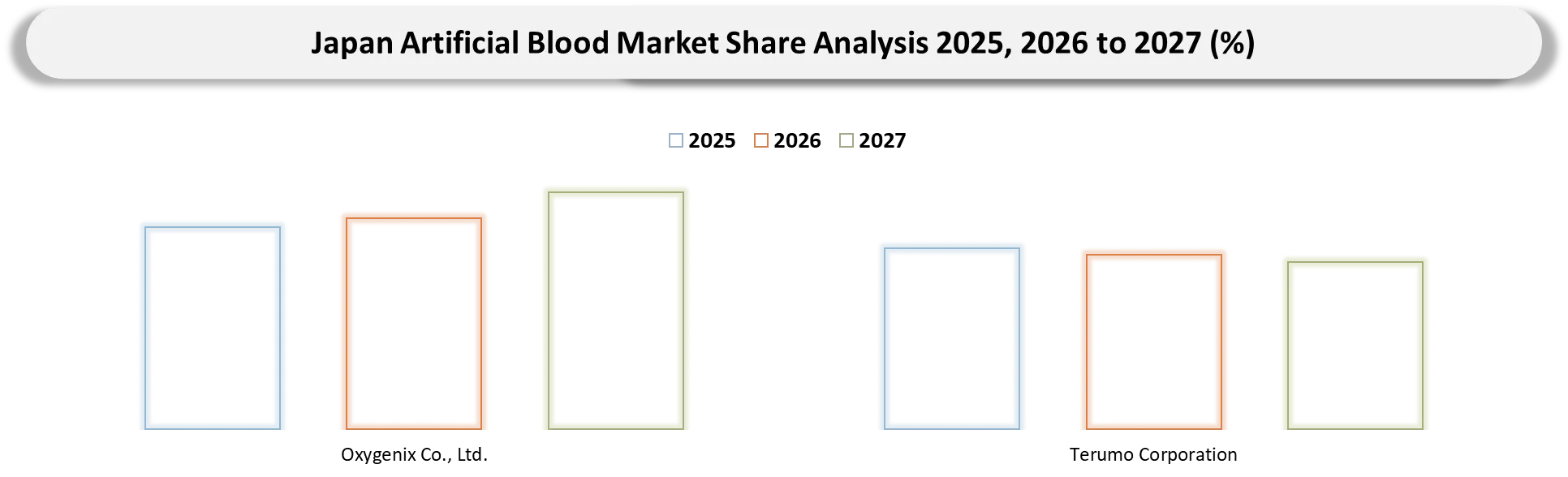
- The Japan artificial blood market is at an early development stage and is characterised by research-led innovation rather than established commercial competition. Oxygenix Co., Ltd. and Terumo Corporation can be discussed as relevant historical or adjacent participants, but their current involvement in commercial artificial blood production should not be overstated. Unlike the FOWLP market, where foundries and outsourced semiconductor assembly and test (OSAT) providers report substantial production revenues, Japan’s artificial blood market does not have publicly verified company-level revenue or market-share data for these two companies. Therefore, any company-specific market-share figures would need to be treated as estimates rather than confirmed statistics.
- Key players include Oxygenix Co., Ltd. (Japan) and Terumo Corporation (Japan).
Key Developments
- January 2026: AdipoSeeds Inc., a Japan-based regenerative medicine biotechnology company, completed a new fundraising round through a third-party share allotment involving Sysmex Corporation, a Japan-based medical diagnostics and clinical testing equipment company, and Daiwa Japan-Taiwan Bio Venture No. 2 Investment Limited Partnership, managed by DCI Partners Co., Ltd.
- April 2025: Sysmex Corporation, a Japan-based medical diagnostics and clinical laboratory equipment company, acquired additional shares in Megakaryon Corporation, a Japan-based biotechnology company, making it a consolidated subsidiary with an 80.9% ownership stake.
- October 2025: MetaTech (AP) Inc., a Taiwan-based biotechnology and regenerative medicine company, signed a memorandum of understanding (MOU) with Megakaryon Corporation, a Japan-based regenerative medicine biotechnology company, to discuss the joint development and commercialisation of induced pluripotent stem cell (iPSC)-derived artificial platelets in Taiwan.
- April 2025: Chuo University, a Japan-based private research and higher education institution, initiated a research project to develop polyoxazoline-conjugated proteins as artificial plasma and oxygen carriers for animals.
Key Procurement Priorities and Buyer Evaluation Criteria
- Buyers in the Japan artificial blood market prioritise suppliers and research partners that can demonstrate oxygen-delivery performance, biocompatibility, product stability, and the potential to reduce dependence on conventional donor blood, particularly in emergency care, trauma treatment, and situations where blood supplies are limited.
- Procurement and partnership decisions are increasingly influenced by Japan’s clinical development of haemoglobin-based oxygen carriers (HBOCs), including haemoglobin vesicles (HbVs), alongside requirements for clinical-trial evidence, regulatory compliance, and readiness for future medical applications.
- Buyers evaluate factors such as oxygen-carrying capacity, infusion safety, cardiovascular side effects, shelf life, storage and transportation requirements, compatibility with existing medical procedures, and consistency between manufacturing batches when assessing artificial blood technologies.
Why Choose DataM?
- Technological Innovations: Examines advancements in artificial blood technologies, including haemoglobin-based oxygen carriers (HBOCs), haemoglobin vesicles (HbVs), and perfluorocarbon-based oxygen carriers, highlighting their oxygen-delivery mechanisms, formulation technologies, and potential applications in transfusion medicine.
- Product Performance & Market Positioning: Evaluates artificial blood technologies based on oxygen-carrying capacity, biocompatibility, infusion safety, storage stability, shelf life, and potential to reduce dependence on conventional donor blood, helping assess the technological positioning of emerging Japanese developments.
- Clinical Evidence & Real-World Applications: Assesses preclinical research, clinical-trial progress, safety outcomes, and development challenges associated with artificial blood, including the potential use of oxygen carriers in emergency medicine, trauma care, and situations involving limited blood availability.
- Market Updates & Industry Developments: Tracks developments in Japan's artificial blood research ecosystem, including haemoglobin vesicle development, clinical evaluations, government-supported research, regulatory progress, and initiatives aimed at strengthening emergency medical preparedness.
- Competitive Strategies: Analyses the roles of research institutions and relevant industry participants, including Nara Medical University and companies such as Oxygenix Co., Ltd. and Terumo Corporation, while distinguishing historical technology involvement from verified current commercial activity.
- Pricing & Market Access: Examines potential cost drivers, including haemoglobin sourcing, specialised encapsulation processes, quality control, storage requirements, clinical testing, and manufacturing scale, alongside regulatory requirements and possible procurement pathways for future clinical adoption.
- Market Entry & Expansion: Identifies opportunities associated with emergency blood supply preparedness, disaster response, military medicine, and potential applications in remote or resource-constrained settings, while evaluating the importance of clinical validation, regulatory approval, manufacturing scalability, and strategic research partnerships for commercial expansion.
Target Audience 2026
- Biotechnology and Artificial Blood Developers
- Pharmaceutical and Biopharmaceutical Companies
- Hospitals and Healthcare Providers
- Blood Banks and Transfusion Services
- Military and Defense Healthcare
- Emergency Medical and Trauma Care Providers
- Research Institutes and Academic Organisations


























































