


Iron Casting Market Size and Overview
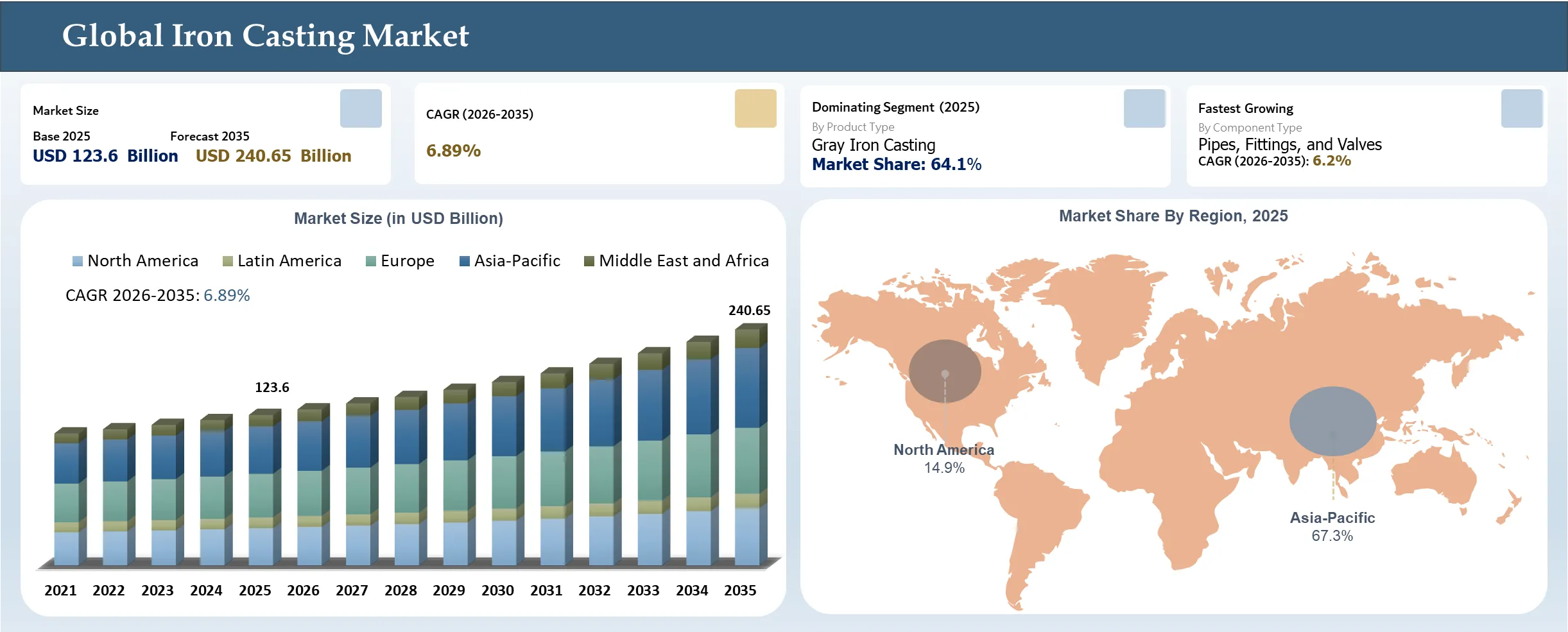
The global iron casting market reached USD 123.6 billion in 2025 and is expected to reach USD 240.65 billion by 2035, growing with a CAGR of 6.89% during the forecast period 2026-2035. The market expansion is supported by the demand for gray and ductile iron products that are employed in vehicle braking systems, machinery, water pipe networks, and construction equipment. The rising need for infrastructure is driving the demand for ductile iron pipes and fittings, whereas vehicle and machinery manufacturers have ongoing needs for high-strength and dimensionally stable cast components.
Foundries' use of automation in moulding, casting simulation software, and energy-efficient melting furnaces is changing their production landscape. In November 2025, the Waupaca Foundry made an announcement that its multi-year capital investment program worth more than USD 100 million was coming to an end. The company had invested about USD 20 million at its Plant 4 located in Marinette, Wisconsin, to enhance its capacity by modernising some equipment in the plant. It also included the installation of a new melt-charging system, high-tech steel-slat conveyor systems, new scales and a charge material drying system.
White-Space Opportunities for Energy-Efficient Iron Casting and Foundry Modernisation
In June 2026, the National New Markets Fund provided USD 20 million in New Markets Tax Credit financing to support the modernisation of American Cast Iron Pipe Company’s manufacturing operations in Birmingham, Alabama, as part of a USD 285 million manufacturing upgrade project. The largest investment area is the modernisation of iron-melting operations through the replacement of an existing cupola furnace with four electric coreless induction furnaces, targeting a 25% increase in melting capacity and at least a 50% reduction in on-site greenhouse gas emissions.
Additional investment areas include foundry equipment modernisation, electrical infrastructure upgrades, energy-efficient manufacturing systems, furnace installation, and production-process improvements to strengthen cast iron pipe manufacturing capacity. The investment is expected to benefit American Cast Iron Pipe Company (AMERICAN), the principal beneficiary, through increased iron-melting capacity, improved production efficiency, and reduced on-site emissions.
Electric induction furnace and foundry equipment suppliers such as Inductotherm Group and ABP Induction are relevant to the furnace modernisation area through their induction-melting technologies and industrial melting systems, while engineering and industrial service providers such as Hatch, Fives Group, and SMS Group offer capabilities in metallurgical plant engineering, equipment integration, and manufacturing process modernisation.
Industrial automation and electrical infrastructure suppliers, including Siemens, ABB, and Rockwell Automation, are relevant to process control, electrical-system integration, and factory automation, while refractory and foundry material suppliers such as Vesuvius and Morgan Advanced Materials serve applications involving furnace linings, thermal management, and high-temperature industrial processes.
Iron Casting Market Key Takeaways
- The Asia-Pacific region held the largest market share at 67.3% in 2025. The dominance is powered by an extensive foundry network and strong demand from the automotive and construction sectors across China, India, and Japan.
- Gray iron casting dominated the global market by capturing a 64.1% market share in 2025. Its strong market position is driven by high demand in mass-produced automotive parts and industrial machinery.
- North American foundry casting sales were expected to grow by 1.9% in 2025, with total metalcasting industry revenue reaching USD 53.7 billion. Furthermore, over 90% of North American foundries invested capital into plant modernisation and automation that year.
- American Cast Iron Pipe Company secured USD 20 million in New Markets Tax Credit financing for a USD 285 million manufacturing upgrade in Alabama. The replacement of a cupola furnace with four electric coreless induction furnaces aims to boost melting capacity by 25% while reducing on-site greenhouse gas emissions by at least 50%.
Iron Casting Market Industry Trends and Strategic Insight
- Iron foundries are installing automated moulding lines, conveyor systems, and controlled charge-handling equipment to reduce manual handling, improve casting consistency, and address production bottlenecks.
- Manufacturers are using production data dashboards and integrated reporting to improve visibility into process performance, identify recurring operating problems, and support faster decisions across foundry operations.
- Foundry engineering is increasingly focused on predicting metal flow, solidification, shrinkage, porosity, and mould-filling behaviour before production, helping reduce avoidable defects and improve first-pass yield.
- Foundries should evaluate charge preparation, melting, moulding, pouring, and finishing as connected operations so that improvements in one area do not create downstream capacity constraints.
- Early involvement in component design, casting simulation, material-grade selection, and prototype validation can reduce redesign costs and improve manufacturability before production tooling is finalised.
Iron Casting Market Scope
| Metrics | Details | |
| 2025 Market Size | USD 123.6 Billion | |
| 2035 Projected Market Size | USD 240.65 Billion | |
| CAGR (2026-2035) | 6.89% | |
| Largest Market | Asia-Pacific | |
| Fastest Growing Market | Asia-Pacific | |
| By Product Type | Gray Iron Casting, Ductile Iron Casting, Malleable Iron Casting, White Iron Casting, Others | |
| By Manufacturing Process | Sand Casting, Shell Mould Casting, Centrifugal Casting, Investment Casting, Continuous Casting, Others | |
| By Component Type | Engine Blocks and Cylinder Heads, Brake Discs and Drums, Gears and Housings, Pipes, Fittings, and Valves, Machine Bases and Frames, Pump and Compressor Housings, Railway and Heavy Equipment Components, Others | |
| By End-Use | Automotive, Construction and Infrastructure, Industrial Manufacturing, Energy and Power, Agriculture, Mining and Metals, Oil and Gas, Water and Wastewater Management, Others | |
| By Region | North America | U.S., Canada, Mexico |
| Europe | Germany, UK, France, Spain, Italy, Poland, Netherlands, Switzerland | |
| Asia-Pacific | China, India, Japan, Australia, South Korea, Indonesia, Malaysia | |
| Latin America | Brazil, Argentina | |
| Middle East and Africa | UAE, Saudi Arabia, South Africa, Israel, Türkiye | |
| Report Insights Covered | Competitive Landscape Analysis, Company Profile Analysis, Market Size, Share, Growth | |
Iron Casting Market Disruption Analysis
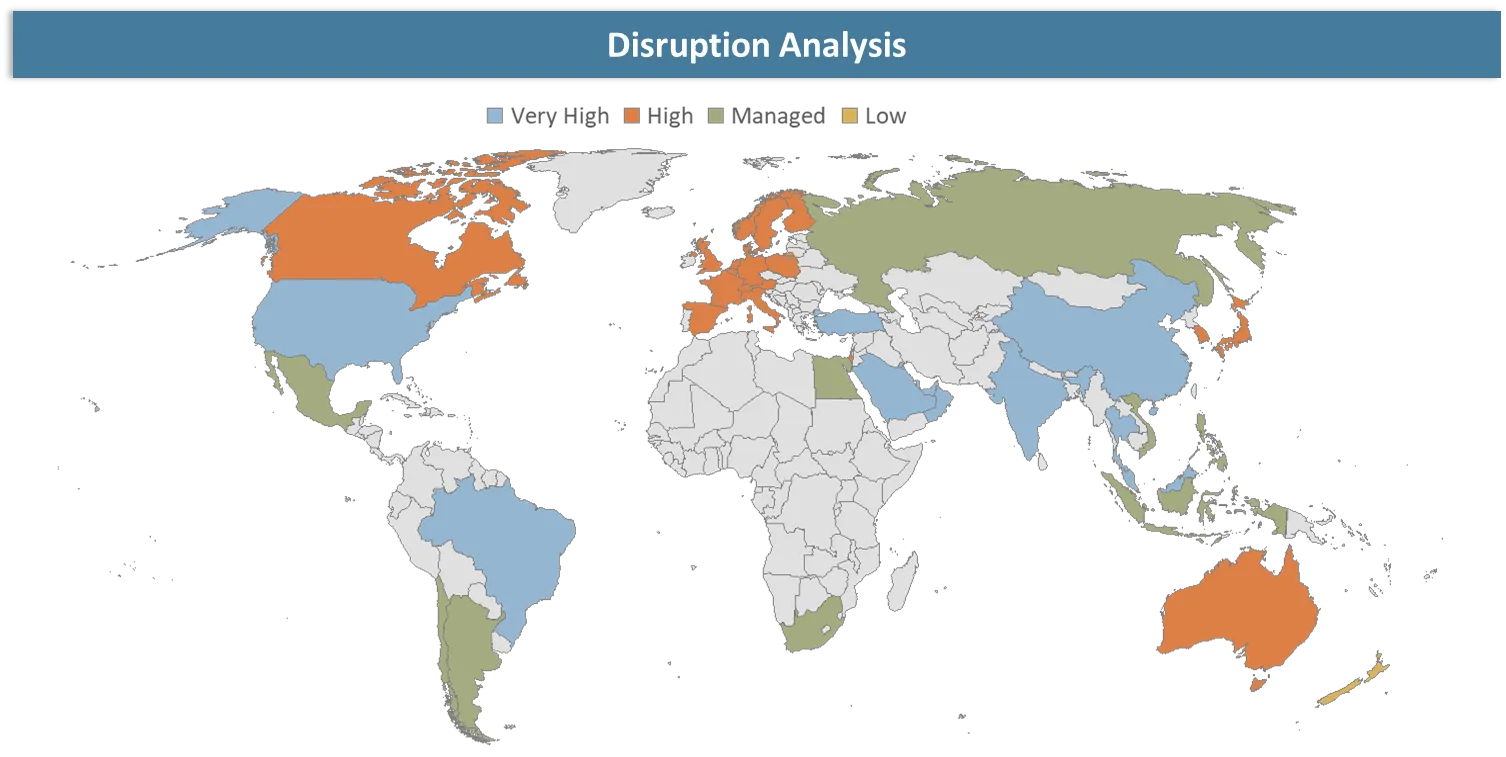
Shift Toward Automated, Energy-Efficient Foundries and Application-Specific Castings Reshaping the Iron Casting Landscape
The disruption in the iron casting market is increasingly driven by the move from traditional foundries to digital manufacturing that is more efficient in the use of resources. The automotive industry is changing its component specifications as electric cars are moving away from engine blocks and cylinder heads, thus pressuring iron casting companies to enter new markets such as brake parts, motor housings, and customised parts. Meanwhile, aluminium alloys, steel, and other metals are competing with iron castings for applications where the objective is to decrease weight and integrate components.
Furthermore, the iron casting industry is undergoing disruption because foundries experience uneven demand and an increasing need to improve their manufacturing processes. In July 2025, according to the American Foundry Society (AFS), total casting sales in North America in 2025 were expected to rise by 1.9%, while more than 90% of foundries invested capital into plant modernisation, automation, and expansion. Producer Price Index of the foundry industry in 2023-2024 showed an increase of 2.2%. The changes reflect the necessity to focus on production efficiency and investments in the advancement of foundry capacities in the context of divergent order tendencies and improvement of production processes.
Iron Casting Market BCG Matrix: Company Evaluation
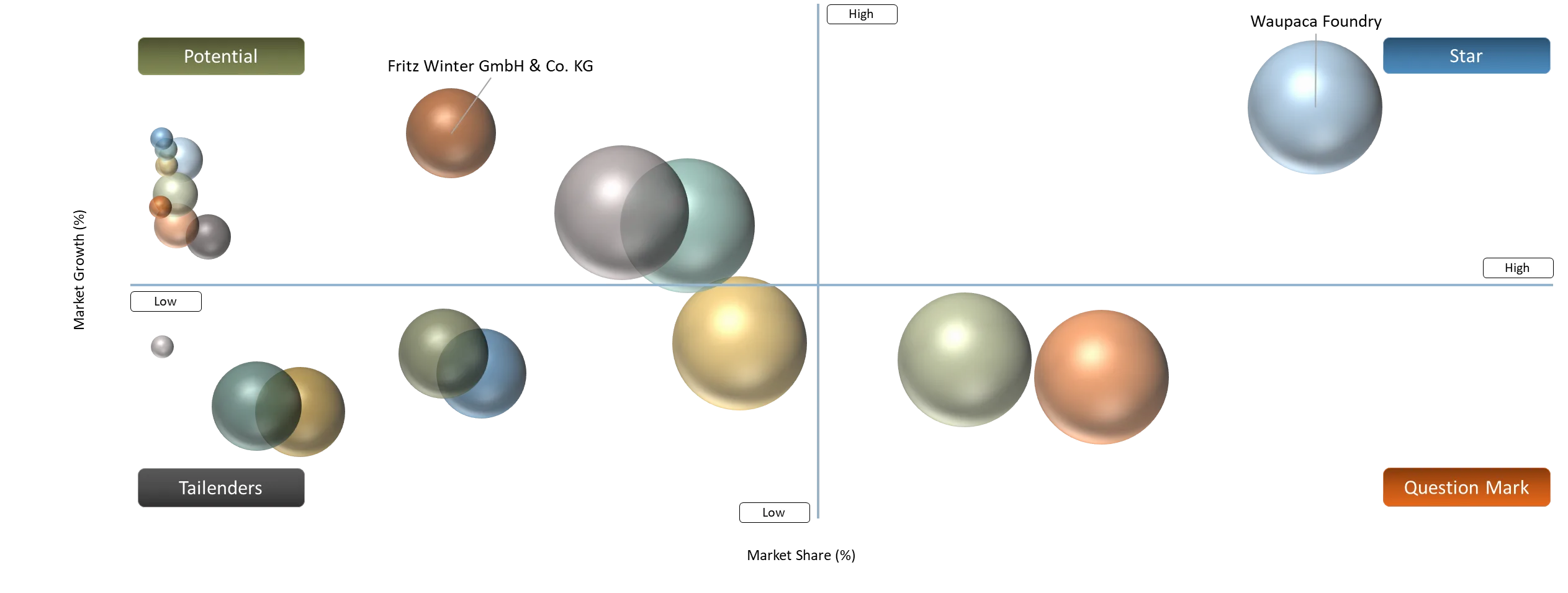
Stars include Waupaca Foundry, Grede Holdings LLC, and Aisin Corporation because of their established iron casting capabilities and presence in major automotive and industrial component supply chains. Question Marks include Proterial, Ltd., Nelcast Limited, and MAT Foundry Group. The companies operate in specialised casting markets where demand is influenced by automotive production, infrastructure investment, and industrial equipment requirements.
Potential includes Fritz Winter GmbH & Co. KG, Metal Technologies, Inc., and Crescent Foundry. The companies have opportunities to strengthen their positions through specialised cast components, customer-specific engineering, and applications across automotive, machinery, and infrastructure markets. Tailenders include Neenah Foundry, which has an established presence in municipal castings, including manhole frames, grates, and related infrastructure products.
Iron Casting Market Dynamics
Driver Impact Analysis
| Driver | Market Growth Impact (%) | Demand Concentration | Impacted Use Case | Strategic Impact |
Investments in robotics, automated moulding, and smart manufacturing are improving casting productivity, dimensional accuracy, and production efficiency. | 25% | Automotive foundries, large-scale iron casting plants, and industrial component manufacturers | Automated moulding, robotic pouring, casting extraction, grinding, and automated defect inspection | Improves productivity, dimensional consistency, throughput, and quality control while reducing scrap and labour-intensive operations. |
Increasing demand for engine blocks, brake components, transmission housings, and other iron-cast automotive parts is driving market growth. | 30% | Automotive manufacturing hubs and commercial vehicle supply chains | Engine blocks, cylinder heads, brake discs, brake drums, and transmission housings | Supports long-term OEM supply contracts and encourages foundries to specialise in precision automotive castings while diversifying toward components suited to changing vehicle architectures. |
Expanding manufacturing activities are increasing the need for durable iron castings in pumps, compressors, machine tools, and heavy industrial equipment. | 30% | Industrial machinery clusters, capital-goods manufacturers, and heavy-equipment producers | Pumps, compressors, machine tools, industrial frames, and equipment housings | Encourages foundries to expand specialised casting capacity, improve metallurgical performance, and integrate machining and finishing services. |
Modernisation projects and furnace upgrades are helping iron casting manufacturers improve melting efficiency, production capacity, and operational reliability. | 20% | Established foundries, energy-intensive casting plants, and manufacturers upgrading legacy facilities | Electric induction melting, furnace control systems, charge-material handling, and emissions-control equipment | Reduces operational inefficiencies and supports more reliable output, improved energy management, and compliance with environmental requirements. |
Investments in robotics, automated moulding, and smart manufacturing are improving casting productivity, dimensional accuracy, and production efficiency
Investments in robots, automation in moulding, and smart manufacturing systems are the factors that will influence the market for iron castings because companies will try to increase the throughput of production, accuracy of dimensions, and productivity while decreasing labour intensity of production processes. The automation of such processes as mould preparation, handling of molten metal, extraction of castings and finishing operations allows companies to keep a stable production process and decrease the number of defects due to manual handling. Innovations are especially important for the manufacture of automobile parts, machinery, pipes and castings of heavy equipment because there is a high importance of dimensional accuracy.
In parallel, the implementation of smart manufacturing practices is fostering the trend towards automation and digitalisation in iron casting processes. In April 2025, according to Modern Casting, 63% of the participants of the March 2025 Quarterly Metalcasters Outlook Survey predicted that the role of automation in their foundries would increase in the next three years, whereas 56% of the participants predicted the increasing role of Industry 4.0 and smart manufacturing in the next three years up until 2028. Moreover, 53% of the participants forecasted the growing role of additive manufacturing, and 52% of the members of foundries predicted the increasing role of artificial intelligence in the industry.
Restraint Impact Analysis
| Restraint | Drag on Market Growth (%) | Primary Impact Area | Impacted Use Case | Strategic Impact |
Sharp fluctuations in pig iron, ferrous scrap, and coke prices are increasing input-cost uncertainty and pressuring foundry profit margins. | 20% | Raw material procurement and foundry profitability | Gray iron and ductile iron production for automotive, machinery, and infrastructure applications | Encourages long-term supplier contracts, diversified sourcing, and inventory optimization to reduce exposure to raw material price volatility. |
Fluctuations in pig iron, scrap metal, coke, and alloy prices increase production costs and create pricing uncertainty for iron casting manufacturers. | 20% | Production costs and component pricing | Automotive castings, industrial equipment components, and specialized alloyed iron castings | Pressures manufacturers to improve material utilization, optimize charge composition, and renegotiate customer contracts to protect margins. |
The substantial electricity and fuel requirements of melting furnaces increase operating expenses and expose foundries to energy price volatility. | 15% | Energy-intensive melting operations and operating expenditure | Cupola and induction furnace operations for automotive parts, pipes, and heavy machinery components | Promotes energy-efficient furnaces, improved melting schedules, waste-heat recovery, and closer monitoring of energy consumption per tonne of cast iron. |
Tighter controls on foundry emissions, particulate matter, and industrial waste increase compliance costs and require investment in pollution-control systems. | 10% | Environmental compliance and capital expenditure | Iron melting, sand preparation and reclamation, casting finishing, and foundry dust collection | Increases the need for emissions-control equipment, waste management systems, and cleaner production technologies, potentially disadvantaging smaller foundries with limited investment capacity. |
Sharp fluctuations in pig iron, ferrous scrap, and coke prices are increasing input-cost uncertainty and pressuring foundry profit margins
One of the major restraints affecting the iron casting market is the volatility of raw material prices, particularly pig iron, ferrous scrap, and coke, which directly affect the cost of production as well as the profit margin of the foundry industry. Iron casting companies rely on the constant availability of metal and energy inputs used for the melting process in order to sustain their production costs. In case the cost of inputs rises faster than that of output prices, foundries are forced to incur extra expenses or renegotiate contracts with car makers, machinery and infrastructure companies.
The raw material price fluctuations became one of the factors that restricted the iron casting industry. In April 2026, according to the Indian Foundry Association's Foundry Frontier, prices of pig iron had risen up to nearly 20% in the past two to three months even though the price of iron ore and coke was more or less steady across the globe and India. It was also mentioned in the report that 95% of foundries come under the category of MSMEs and that the order cycle is 5-6 months long. In case there is an increase in the cost of raw materials, and it takes such a long time to accept orders from customers, this might affect the profit margins of the companies in the industry.
Iron Casting Market Segment Analysis
The global iron casting market is segmented based on product type, manufacturing process, component type, end-use, and region.
Gray Iron Casting Dominating the Iron Casting Market Through Automotive and Industrial Applications
The gray iron casting segment is dominating the iron casting market, with a market share of 64.1% in 2025, due to its vibration damping ability, machinability, thermal conductivity, and low price. Several factors contribute to gray iron's usage in mass-produced parts, which require dimensional stability and low noise levels. Gray iron castings are used in engines, cylinder heads, brake disks, machine bases, pump housings, and various other industrial parts. The fact that it can be produced using traditional casting technologies further contributes to the popularity of gray iron castings.
The segment's dominance is supported by continued demand for automotive and industrial castings, as well as by improved conditions in the foundry industry. In July 2026, according to the American Foundry Society (AFS), casting sales in North America are expected to grow by 8.0% in 2026, an upgrade from their previous projection of a 4.2% growth in January 2026. The organisation also noted that revenue of the metalcasting industry amounted to about USD 53.7 billion in 2025. These forecasts were based on improved prospects for the industry due to infrastructure spending, more favourable financing conditions, and high government order value. It should be pointed out that these estimates pertain to the entire metalcasting industry and not gray iron.
Iron Casting Market Geographical Penetration
Asia-Pacific Dominating the Iron Casting Market Through Foundry Scale and Manufacturing Demand
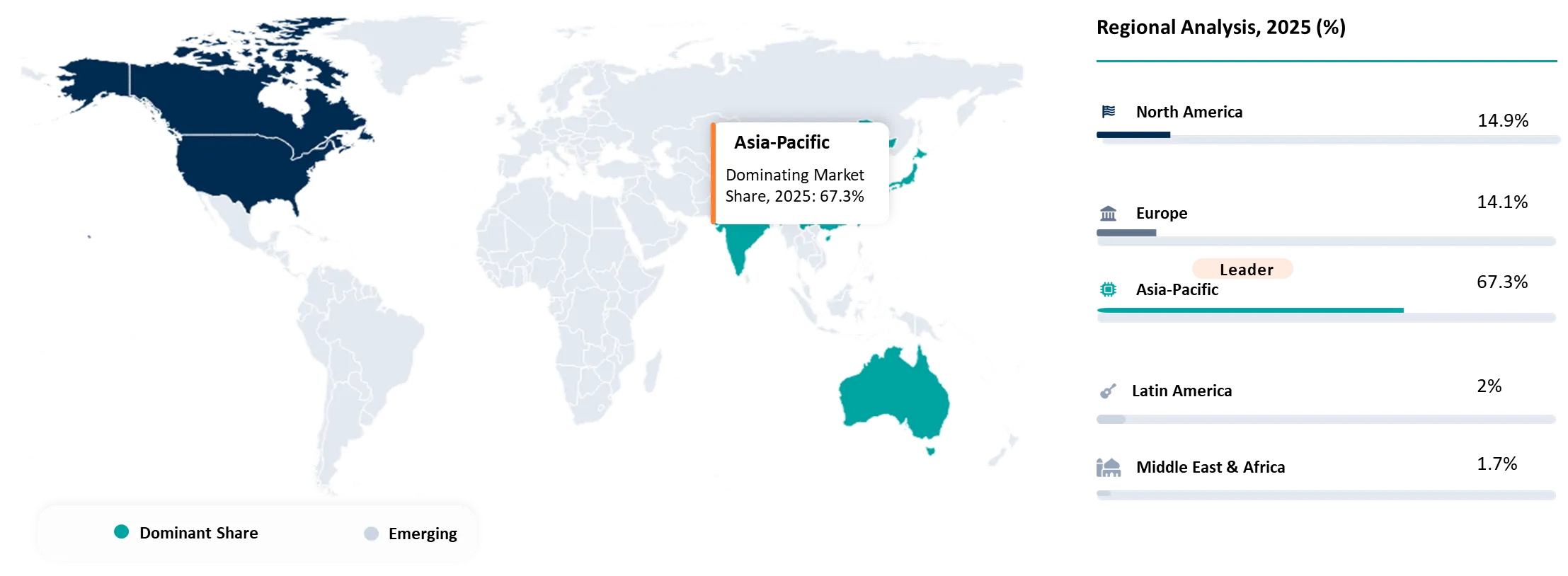
The Asia-Pacific region dominates the iron casting market, with a market share of 67.3% in 2025, because of its extensive foundry base, large automotive manufacturing sector, and strong demand for cast components used in commercial vehicles, agricultural machinery, construction equipment, pumps, and industrial machinery. China, India, and Japan support regional demand through established metalcasting industries and manufacturing supply chains. The region’s competitive foundry ecosystem, established casting expertise, and demand from both infrastructure-related industries and equipment manufacturers reinforce its leading position.
The acquisition reflects Watts Water Technologies’ strategic expansion in the global iron casting value chain through the integration of specialised cast iron drainage manufacturing capabilities. In December 2025, Watts Water Technologies, Inc., a U.S.-based global manufacturer of plumbing, heating, and water-quality products and solutions, announced the completion of its acquisition of Saudi Cast, officially known as The Industrial Company for Castings and Sanitary Fittings. The acquired company generates approximately USD 20 million in annualised sales, and the acquisition was financed with cash on hand.
China Iron Casting Market Trends
China holds a dominant position in the Asia-Pacific iron casting market due to its extensive foundry infrastructure, integrated automotive supply chains, and strong manufacturing base across commercial vehicles, construction machinery, agricultural equipment, and industrial components. The country benefits from established casting capabilities, a broad network of component suppliers, and demand from domestic equipment manufacturers. Several factors support the production of gray iron and ductile iron components for engine blocks, brake systems, pumps, valves, and heavy machinery, reinforcing China's importance in global iron casting supply chains.
The joint venture strengthens China’s precision iron casting capacity by combining domestic automotive manufacturing expertise with Japanese casting technology. In February 2025, Chengdu Haoneng Technology Co., Ltd., a China-based automotive components manufacturer specialising in drivetrain systems and precision manufacturing, partnered with Suzhou Ishikawa Precision Manufacturing Technology Co., Ltd., a China-based precision manufacturing company with Japanese ownership links, to establish the Haoneng Ishikawa Precision Casting (Luzhou) production base in Sichuan, China. The project involves a total investment of RMB 200 million (USD 29.7 million), with each partner contributing RMB 100 million (USD 14.94 million) for a 50% ownership stake.
Japan Iron Casting Market Outlook
Japan maintains an important position in the Asia-Pacific iron casting market because of its advanced automotive manufacturing ecosystem, precision-engineering capabilities, and established production of cast components for industrial machinery. Domestic foundries supply gray iron and ductile iron components for engine blocks, brake systems, transmission parts, pumps, and construction equipment. Close integration between foundries and automotive manufacturers supports consistent component quality, dimensional accuracy, and reliable production, while ongoing manufacturing improvements help Japanese suppliers meet changing requirements for durability, productivity, and material efficiency.
The acquisition highlights continued consolidation in the global iron casting industry, particularly in automotive casting and precision-engineered metal components. In February 2026, Valore Holdings, a U.S.-based private investment firm specialising in corporate acquisitions and manufacturing businesses, completed its acquisition of Mirai Casting Group from Proterial Ltd., a Japan-based materials and advanced metal products company. The acquisition's financial terms were not disclosed in the initial announcement; however, a subsequent financing announcement reported a USD 126 million financing facility supporting the transaction.
North America Supporting Iron Casting Demand Through Foundry Investment and Industrial Modernisation
North America is one of the major regions in the iron casting market, with a market share of 14.9% in 2025, due to its established foundry infrastructure, automotive manufacturing base, and demand for cast components used in commercial vehicles, agricultural machinery, construction equipment, waterworks, and industrial machinery. The region benefits from established supplier relationships between foundries and original equipment manufacturers, while investment in automation, production efficiency, and domestic manufacturing capacity supports the supply of gray iron and ductile iron components.
The acquisition strengthens North America’s iron casting industry by consolidating foundry manufacturers serving municipal infrastructure and utility networks. In November 2025, Charlotte Pipe and Foundry Company, a U.S.-based privately held manufacturer of cast iron and plastic pipes and plumbing fittings, acquired Bingham & Taylor in conjunction with Neenah Foundry Company, a U.S.-based manufacturer of municipal iron castings and waterworks products. The acquisition expands the combined companies’ presence in cast iron products for water and gas utilities, municipal infrastructure, and underground access applications; the transaction value was not disclosed.
U.S. Iron Casting Market Trends
The U.S. holds a dominant position in the North America iron casting market due to its established foundry network, automotive supply chain, and demand for cast components used in commercial vehicles, agricultural machinery, construction equipment, water infrastructure, and industrial systems. Domestic foundries supply gray iron and ductile iron components such as engine blocks, brake parts, pump housings, valves, and machine bases. The integration of casting operations with downstream manufacturers, combined with investments in automation and production modernisation, supports component quality, manufacturing efficiency, and reliable supply for industrial customers.
The acquisition strengthens domestic U.S. iron casting capacity by transferring two established foundry operations to a new industrial investment owner. In January 2026, TRM Equity II, a U.S.-based private equity investment firm focused on manufacturing and industrial businesses, completed the acquisition of Browntown Foundry in Wisconsin and Iron Mountain Foundry in Michigan from Grede Holdings LLC, a U.S.-based manufacturer of gray iron, ductile iron, and speciality iron castings for automotive, commercial vehicle, and industrial applications. The acquired foundries manufacture gray and ductile iron castings weighing up to 1,000 pounds (approximately 454 kg) for construction, agriculture, heating, ventilation and air conditioning (HVAC), heavy-truck, and automotive applications.
Iron Casting Market Competitive Landscape
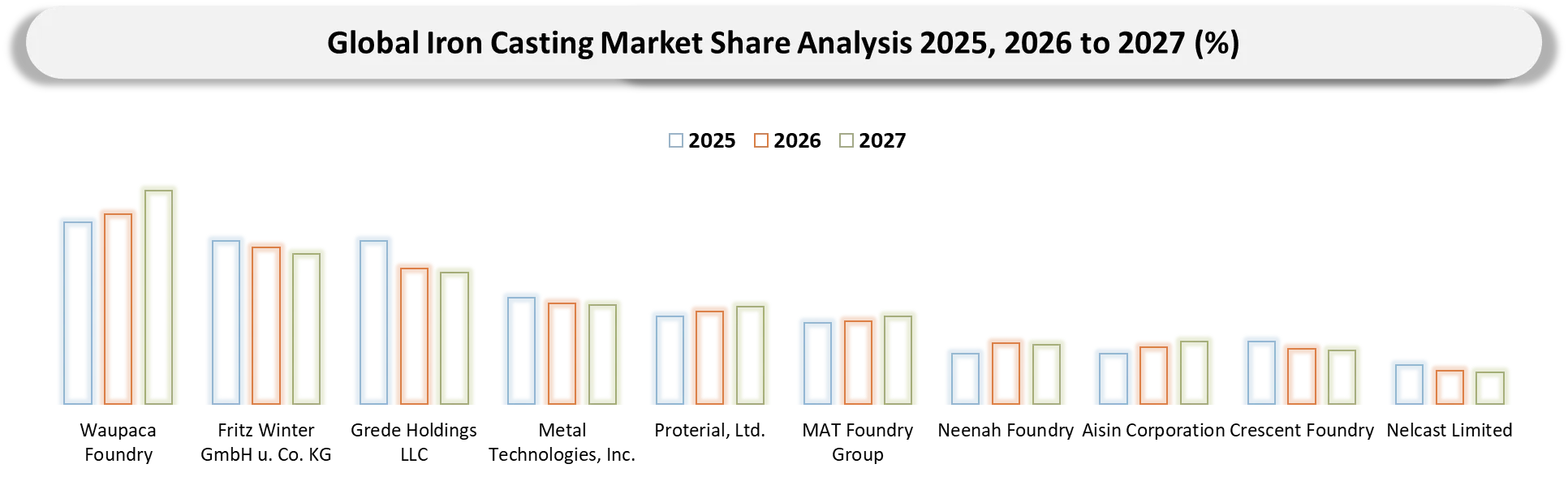
- The iron casting market is characterised by three key participant groups: large-scale automotive and industrial foundries, specialised gray and ductile iron casting manufacturers, and diversified engineering companies with casting operations. Waupaca Foundry, Grede Holdings LLC, Metal Technologies, Inc., and MAT Foundry Group have established positions in North American iron casting, while Fritz Winter GmbH & Co. KG serves automotive and commercial vehicle applications in Europe. Proterial, Ltd. and Aisin Corporation participate through automotive and industrial component manufacturing, whereas Neenah Foundry, Crescent Foundry, and Nelcast Limited serve municipal infrastructure, automotive, agricultural machinery, and industrial markets. Competitiveness is shaped by production scale, casting quality, customer qualification, machining capabilities, and the ability to supply complex components efficiently.
- Key players include Waupaca Foundry (United States), Fritz Winter GmbH & Co. KG (Germany), Grede Holdings LLC (United States), Metal Technologies, Inc. (United States), Proterial, Ltd. (Japan), MAT Foundry Group (United Kingdom), Neenah Foundry (United States), Aisin Corporation (Japan), Crescent Foundry (India), and Nelcast Limited (India).
Key Developments
- May 2025: SinterCast AB, a Sweden-based supplier of process-control technology for compacted graphite iron (CGI) production, secured a licensing agreement in China with Qingdao Xu Ruifeng Foundry Co., Ltd., a Chinese foundry, for the production of large marine engine cylinder liners.
- February 2026: Kobe Steel, Ltd., a Japan-based diversified steel and materials manufacturer, Nippon Koshuha Steel Co., Ltd., a Japan-based special steel and cast-iron business, and Daido Steel Co., Ltd., a Japan-based speciality steel manufacturer, agreed to restructure ownership of Nippon Koshuha Steel and its casting assets.
- December 2025: Anderson Foundries, a U.S.-based foundry holding company, acquired Muncie Castings LLC, a U.S.-based ISO 9001-certified aluminium foundry.
- July 2026: Ironcast de Frontera S.A. de C.V., a Mexico-based foundry specialising in gray iron, ductile iron, and compacted graphite iron (CGI) castings, secured a contract to supply CGI cylinder blocks for a new 13-litre commercial vehicle engine platform in North America.
- June 2026: ACE MFG LLC, a U.S.-based high-performance automotive components manufacturer and prototype foundry, ordered a SinterCast Mini-System to establish compacted graphite iron (CGI) prototyping and niche-volume production capabilities.
Key Procurement Priorities and Buyer Evaluation Criteria
- Organisations procuring iron castings prioritise suppliers that can deliver consistent casting quality, dimensional accuracy, mechanical strength, and reliable production volumes for automotive, construction equipment, agricultural machinery, and industrial applications.
- Procurement decisions are increasingly influenced by demand for lightweight vehicle systems, durable industrial components, manufacturing automation, raw material cost fluctuations, and the need to maintain stable supply chains for gray iron and ductile iron castings.
- Buyers evaluate suppliers based on casting material grades, tensile strength, hardness, wear resistance, defect rates, dimensional tolerances, surface finish, machining requirements, and compliance with customer-specific technical specifications.
Why Choose DataM?
- Technological Innovations: Explores advancements in iron casting technologies, including automated moulding, robotic pouring, simulation-based casting design, and improved melting processes, highlighting their role in enhancing production efficiency, dimensional accuracy, and casting consistency.
- Product Performance & Market Positioning: Evaluates how manufacturers differentiate gray iron and ductile iron castings based on mechanical strength, vibration damping, wear resistance, thermal conductivity, machinability, and suitability for automotive, agricultural, construction, and industrial applications.
- Real-World Evidence: Examines the use of iron castings in engine blocks, brake discs, brake drums, pump housings, valves, transmission components, and heavy machinery, connecting material properties with end-use performance requirements and manufacturing needs.
- Market Updates & Industry Changes: Tracks foundry capacity expansions, automation investments, production modernisation, raw material cost fluctuations, and environmental compliance developments across major iron casting markets, including Asia-Pacific, North America, and Europe.
- Competitive Strategies: Analyses how leading companies such as Waupaca Foundry, Grede Holdings, Fritz Winter, Aisin Corporation, and Nelcast Limited strengthen their market positions through production capabilities, customer relationships, casting quality, process improvements, and product diversification.
- Pricing & Market Access: Assesses cost differences associated with iron grades, casting weight, design complexity, tooling requirements, machining, finishing, energy consumption, and production volumes, helping buyers understand supplier pricing and total procurement costs.
- Market Entry & Expansion: Identifies opportunities arising from automotive component manufacturing, commercial vehicles, agricultural machinery, construction equipment, industrial machinery, and infrastructure applications, while evaluating strategies for capacity expansion, foundry modernisation, customer qualification, and entry into new end-use industries.
Target Audience 2026
- Iron Casting Manufacturers and Foundries
- Automotive OEMs and Component Manufacturers
- Industrial Machinery and Equipment Manufacturers
- Procurement and Supply Chain Managers
- Foundry Technology and Equipment Providers
- Raw Material and Metallurgical Suppliers
- Investors, Private Equity Firms, and Financial Institutions


























































