


Inorganic Scintillators Market Size and Overview
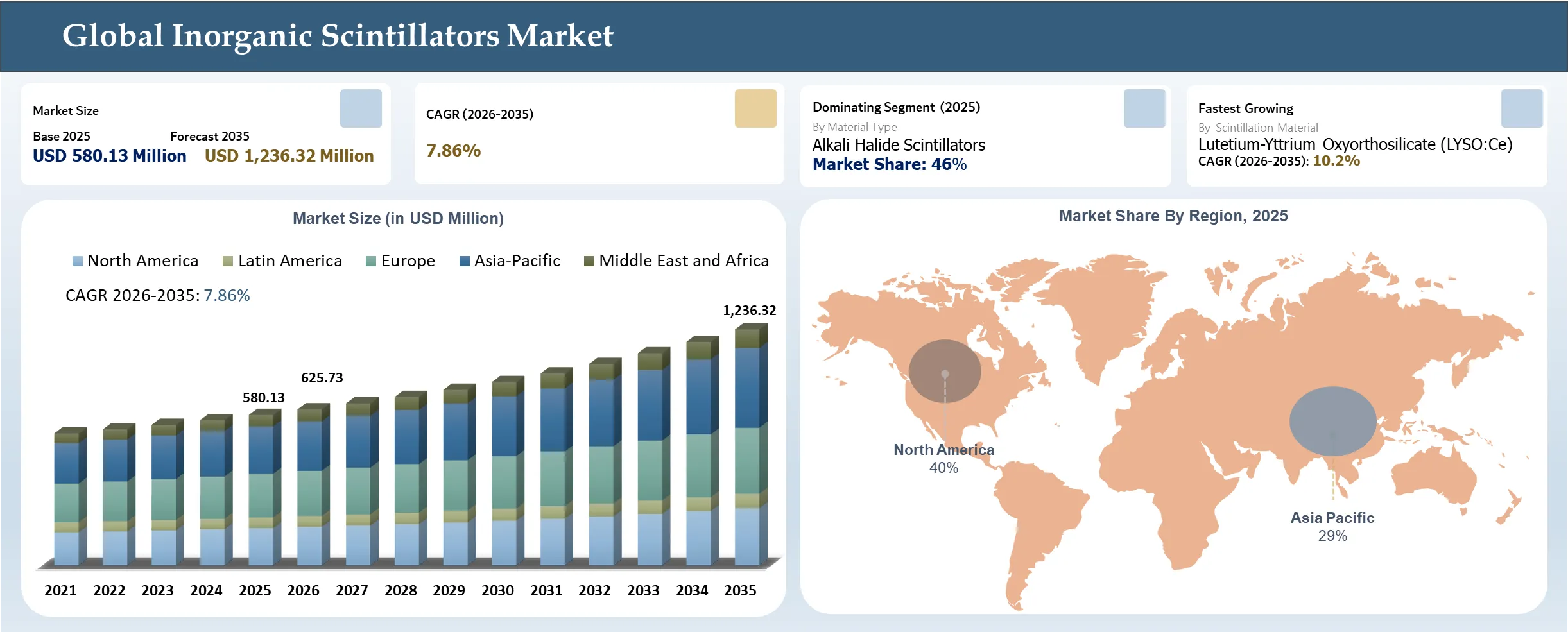
The global inorganic scintillators market was valued at USD 580.13 million in 2025 and is projected to reach USD 1,236.32 million by 2035, growing at a CAGR of 7.86% from 2026 to 2035. The market is witnessing increasing demand for high-performance scintillation crystals used in PET scanners, nuclear medicine, radiation monitoring, and industrial inspection systems. Growing requirements for high light output, faster decay time, improved energy resolution, and efficient gamma-ray detection are strengthening the adoption of inorganic materials such as LYSO, BGO, NaI (Tl), CsI (Tl), and GAGG.
Additional technological developments are broadening the radiation-detection materials landscape. In December 2025, Tokyo Ink Co., Ltd. launched its next-generation Luminade X plastic scintillator, developed through joint research with the High Energy Accelerator Research Organization (KEK). The lead-free material incorporates zirconium, hafnium, and bismuth into a plastic matrix and delivers a maximum detection efficiency of 16.2%/mm under 67.4 keV X-ray irradiation (at 20 wt% hafnium), a decay time of 1.2-2.1 ns, and emission peaks at 422 nm or 386 nm. It supports X-ray and gamma-ray measurement at energies up to approximately 100 keV, with potential applications in radiation-measurement research and medical-device development.
Inorganic Scintillators Market Key Takeaways
- North America led the global inorganic scintillators market in 2025, holding a dominant 40% market share. The position is supported by a USD 43.6 million, 40,000 sq. ft. expansion by Siemens Healthineers at its PET Detector Center in Tennessee.
- The demand for high-efficiency gamma-ray and high-energy X-ray detection serves as a primary market driver, delivering a +2.1% impact on overall market growth. Advanced cerium-doped crystals in these applications achieve an energy resolution of up to 2% at 662 keV.
- Tokyo Ink Co.'s Luminade X plastic scintillator achieves a maximum detection efficiency of 16.2%/mm under 67.4 keV X-ray irradiation (at 20 wt% hafnium). It operates with an ultra-fast decay time of 1.2–2.1 ns for energy measurements up to ~100 keV.
- Over 140 countries operate roughly 27,000 SPECT or SPECT/CT facilities worldwide, while 109 countries house over 5,200 PET/CT systems.
Inorganic Scintillators Market Trends & Disruptions Impacting Customers' Customers
Perovskite-based scintillation materials are gaining research attention as alternatives to conventional inorganic scintillator crystals because of their high X-ray absorption capability, tunable emission properties, and potential for low-cost fabrication. Lead-halide perovskites and perovskite nanocrystals are being investigated for X-ray imaging, radiation detection, and fast-response scintillation applications. The disruption in the inorganic scintillators market is primarily associated with the growing development of direct-conversion semiconductor detectors and alternative radiation-detection materials.
Conventional scintillator-based detectors convert incoming X-rays or gamma rays into visible light, which is subsequently captured by photodetectors. The emergence of perovskite-based scintillators is further changing the competitive landscape by introducing alternative materials with fast radiation response, tunable optical properties, and potential for scalable fabrication. In March 2026, according to Nature Communications, perovskite nanocrystal scintillators achieved a 7.19 ns radioluminescence decay time, 28,800 photons/MeV light yield, and X-ray imaging capability at 7,680 frames per second with 27.6-line pairs/mm spatial resolution.
Inorganic Scintillator Market Dynamics
Driver Impact Analysis
| Driver | Market Growth Impact (%) |
| Increasing Need for High-Efficiency Gamma-Ray and High-Energy X-Ray Detection | 2.1% |
| Technological Advancements in Co-Doped Scintillator Crystals to Improve Light Yield | 1.8% |
| Increasing Demand for High-Performance LYSO Crystals in Next-Generation PET Imaging | 2.4% |
Increasing Need for High-Efficiency Gamma-Ray and High-Energy X-Ray Detection
The growing requirement for accurate gamma-ray spectroscopy and high-energy X-ray detection across nuclear research, medical imaging, industrial inspection, and radiation monitoring is strengthening demand for high-performance inorganic scintillators. The applications require detector materials with high stopping power, efficient light generation, rapid response, and reliable energy discrimination to identify radiation sources and measure photon energies. In May 2025, Frontiers in Detector Science and Technology highlighted that inorganic scintillator crystals are widely used for photon detection above 0.1 MeV, with advanced cerium-doped crystals capable of achieving energy resolution of up to 2% at 662 keV and decay times of approximately 20 ns.
Restraint Impact Analysis
| Restraint | Drag on Market Growth (%) |
| Radiation-Induced Degradation Reduces Long-Term Scintillator Performance | 1.2% |
| Hygroscopic Nature of Conventional Scintillator Crystals Increases Packaging Costs | 0.9% |
Complex Regulatory and Notification Requirements Delaying Abatement Projects
One of the major restraints affecting the inorganic scintillators market is the deterioration of light output and detector response under prolonged exposure to high-energy radiation. Continuous exposure to gamma rays, X-rays, electrons, and protons can generate crystal defects and trapped charge centres, interfering with optical transmission and reducing scintillation efficiency. In September 2025, according to PubMed Central, 10 inorganic scintillator materials were experimentally evaluated and found to have significant differences in radiation resistance. Following prolonged irradiation, BGO recorded the highest response degradation at 44.53%, followed by CsI(Tl) at 39.63%, whereas LYSO(Ce) and YAG(Ce) demonstrated lower degradation of 18.85% and 15.26%, respectively.
Inorganic Scintillators Market: Commercial Use Cases Across Industries
| COMPANY | USE CASE | BENEFITS |

| Hamamatsu Photonics supports medical imaging applications through PET detector modules that combine inorganic scintillation crystals with silicon photomultipliers (SiPMs), photomultiplier tubes (PMTs), and associated electronics. The system can detect 511 keV gamma rays generated during positron emission tomography for cancer diagnosis and neurological imaging. | Enables sensitive gamma-ray detection, improves PET image contrast and timing precision, supports accurate localization of radioactive tracers, and facilitates high-resolution medical imaging. |

| Mirion Technologies uses thallium-doped sodium iodide [NaI (Tl)] inorganic scintillator crystals in its Model 802 scintillation detectors for gamma-ray spectroscopy and radiation measurement. The hermetically sealed detector integrates a NaI (Tl) crystal with a photomultiplier tube for applications requiring reliable radiation identification and monitoring. | Provides high gamma-ray detection efficiency, uniform detector response, reliable energy measurement, and long-term operational stability for nuclear laboratories, radiation-monitoring facilities, and industrial applications. |
Market Ecosystem
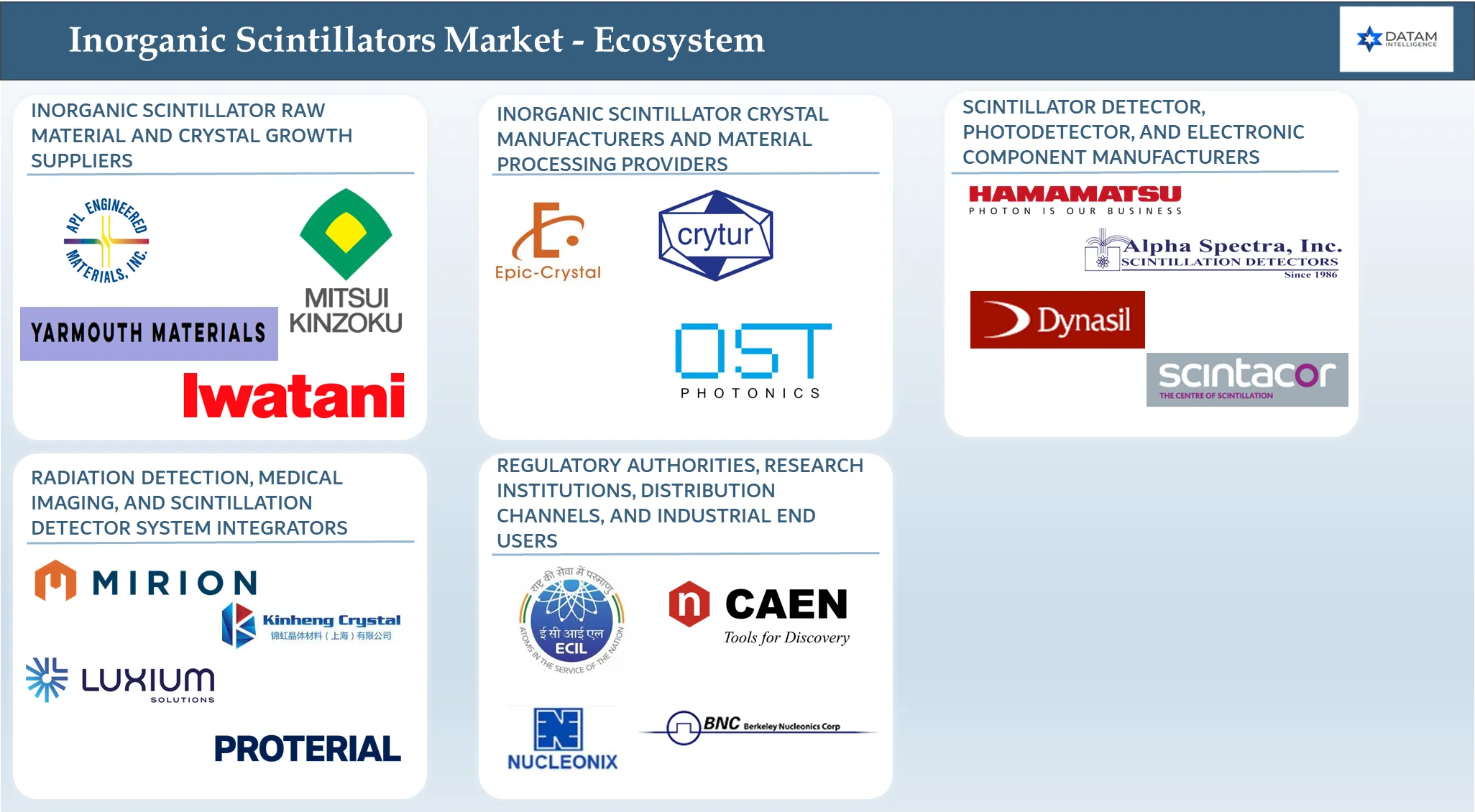
The inorganic scintillators market is a collaborative ecosystem where raw-material suppliers, crystal manufacturers, photodetector companies, medical imaging equipment manufacturers, research institutions, and healthcare and industrial end users work together to develop and deploy radiation-detection solutions. Companies such as Luxium Solutions, Saint-Gobain Crystals, Proterial, Toshiba Materials, and Amcrys manufacture scintillation materials, including LYSO, BGO, NaI (Tl), and CsI(Tl), which are integrated with photomultiplier tubes and silicon photomultipliers by detector manufacturers such as Hamamatsu Photonics and Mirion Technologies.
In the downstream ecosystem, hospitals, diagnostic imaging centers, nuclear medicine facilities, research laboratories, nuclear power plants, industrial inspection companies, and security agencies utilise inorganic scintillator-based detection systems. In April 2025, according to PubMed Central, the International Atomic Energy Agency (IAEA) Perspective, reported that more than 140 countries have SPECT or SPECT/CT facilities, with approximately 27,000 systems installed, while 109 countries have PET/CT facilities with more than 5,200 systems installed. The study also highlighted a significant infrastructure gap: one SPECT scanner serves approximately 57,000 people in high-income countries, compared with 33 million people in low-income countries.
Inorganic Scintillators Market Segment Analysis
By Scintillation Material
The inorganic scintillators market is segmented by scintillation material based on the chemical composition, light-generation characteristics, radiation absorption efficiency, and detector performance of different crystal materials. The materials are selected according to requirements for light output, energy resolution, decay time, density, and suitability for medical imaging, radiation monitoring, and industrial detection applications.
By Material Type
The market is segmented by material type based on the chemical structure and composition of inorganic scintillators. Different material classes offer varying radiation-stopping power, optical transparency, light yield, and response speed, influencing their suitability for PET scanners, gamma-ray spectroscopy, X-ray imaging, and nuclear radiation detection systems.
By Application
The inorganic scintillators market is segmented by application based on the use of scintillation materials in converting ionizing radiation into detectable light signals. Their high radiation absorption capability and energy-measurement performance support applications across medical imaging, nuclear medicine, radiation monitoring, industrial inspection, and specialized radiation detection environments.
By End User
The market is segmented by end user according to the organizations and facilities that purchase or operate inorganic scintillator-based detection equipment. Demand is primarily supported by healthcare facilities, nuclear research organizations, industrial operators, security agencies, and scientific laboratories requiring reliable radiation measurement, imaging, monitoring, and detection capabilities.
Inorganic Scintillators Market Geographical Penetration
Strong Medical Imaging Infrastructure and Advanced Scintillator Manufacturing Capacity in North America
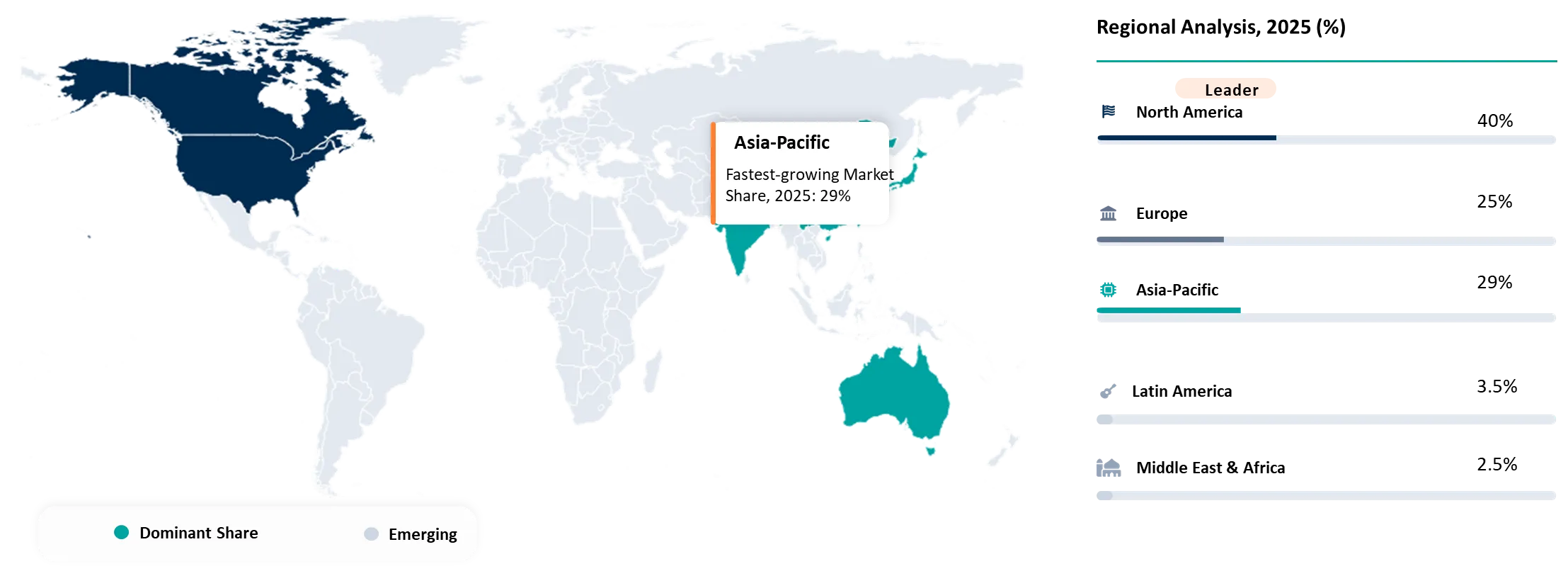
North America is dominating the inorganic scintillators market, with a market share of 40% in 2025. The region's dominance is supported by the widespread adoption of PET/CT and SPECT imaging technologies, advanced nuclear medicine infrastructure, strong investments in healthcare technology, and increasing requirements for radiation detection across medical, industrial, and security applications. The presence of established medical imaging manufacturers, detector developers, nuclear research institutions, and radiation-monitoring equipment suppliers in the United States and Canada strengthens the commercialization of inorganic scintillator materials.
Growing demand for high-performance LYSO, LSO, BGO, and NaI (Tl) crystals in advanced imaging and gamma-ray detection applications further reinforces North America's leading position. For example, in September 2026, Siemens Healthineers, a Germany-based medical technology manufacturer, completed a USD 43.6 million expansion of its PET Detector Center in Rockford, Tennessee, United States. The project added 40,000 square feet of new construction, including dedicated manufacturing and research and development facilities, to increase PET detector production capacity in response to growing demand for PET/CT systems.
Inorganic Scintillators Market BCG Matrix: Company Evaluation
Luxium Solutions, recognized as a leading player in the inorganic scintillators market, offers a diverse portfolio of scintillation crystals and detector assemblies, including LYSO, BGO, NaI (Tl), and CsI(Tl), for medical imaging, radiation detection, nuclear instrumentation, and industrial applications. The company benefits from established crystal-manufacturing capabilities, a broad application base, and a global customer presence. Another significant player in the market is Hamamatsu Photonics, identified as a Potential company due to its strong capabilities in photodetectors and radiation-detection technologies. The company provides photomultiplier tubes, silicon photomultipliers, and detector solutions that work with inorganic scintillation crystals in PET scanners, nuclear medicine equipment, and radiation-measurement systems. Hamamatsu is strengthening its position through the development of advanced PET detector technologies and integrated photodetection solutions.
Inorganic Scintillators Market Competitive Landscape
Key Market Players
- Hamamatsu Photonics (Japan)
- Mirion Technologies (United States)
- Scintacor (United Kingdom)
- Dynasil Corporation (United States)
- Amcrys (Ukraine)
- Kinheng Crystal Material (China)
- Luxium Solutions (United States)
- Proterial Ltd. (Japan)
- Alpha Spectra Inc. (United States)
- EPIC Crystal Co., Ltd. (Japan)
- CRYTUR (Czech Republic)
- OST Photonics (Jiaxing AOSITE Photonics Technology Co., Ltd.) (China)
Inorganic Scintillators Market Scope
| Metrics | Details |
| 2025 Market Size | USD 580.13 Million |
| 2035 Projected Market Size | USD 1.236.32 Million |
| CAGR (2026-2035) | 7.86% |
| Years Considered | 2025 - 2035 |
| Base Year | 2025 |
| Forecast Period | 2025 - 2035 |
| Units Considered | Value (USD Billion) |
| Report Insights Covered | Competitive Landscape Analysis, Company Profile Analysis, Market Size, Share, Growth |
| Segments Covered |
|
| Region Covered | North America, Europe, Asia-Pacific, Latin America, Middle East and Africa |
Inorganic Scintillators Market: Target Audience and Strategic Intelligence Requirements
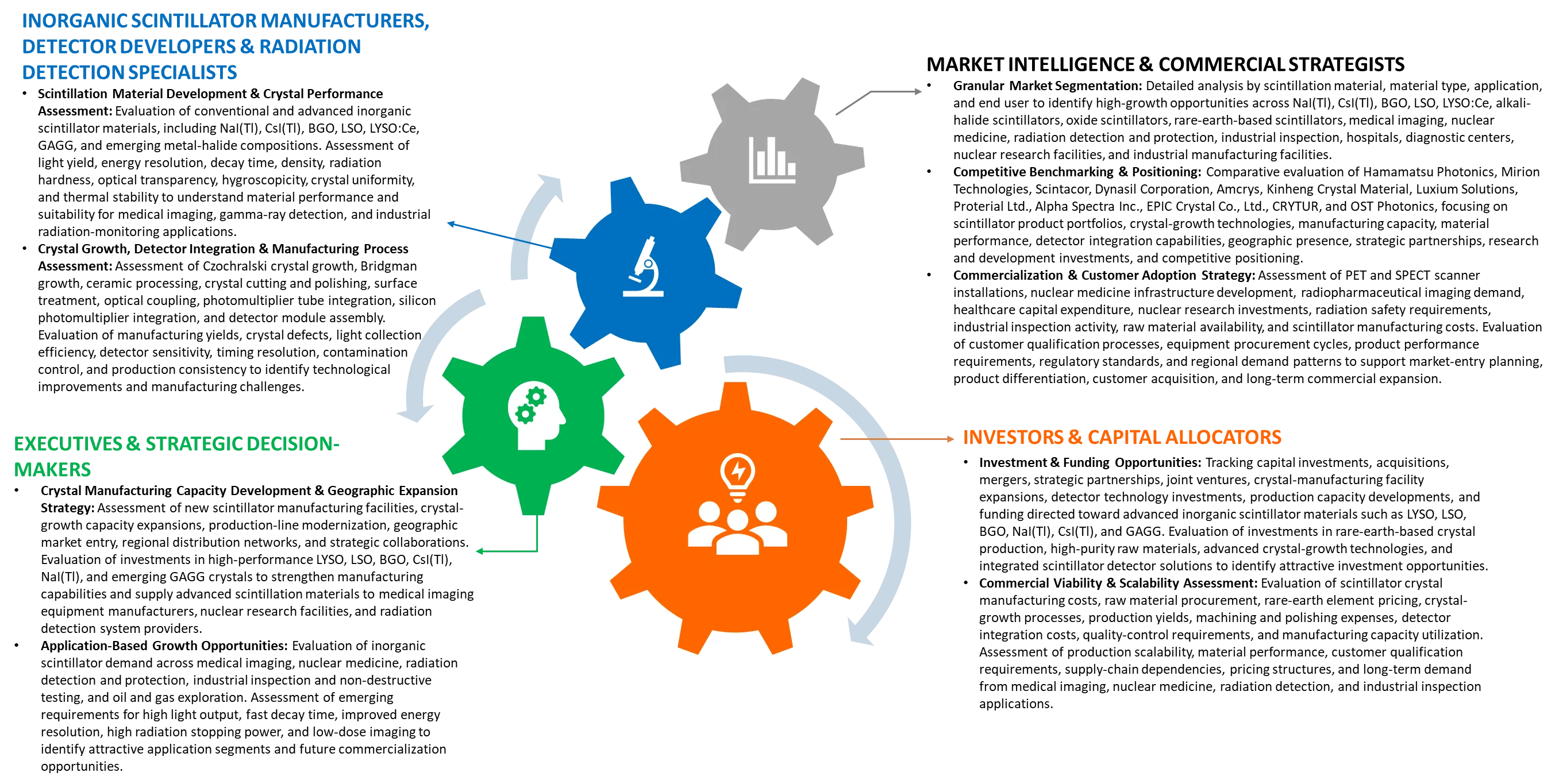
Addressing Client Priorities Through Customized Inorganic Scintillators Research
CLIENT REQUIREMENT | RESEARCH CUSTOMIZATION PROVIDED | STRATEGIC VALUE TO CLIENTS |
Assessing crystal manufacturing capacity and raw material sourcing opportunities | Mapped major inorganic scintillator manufacturers, crystal-growth facilities, rare-earth material suppliers, and specialized processing capabilities, including sourcing dependencies for lutetium, gadolinium, cerium, cesium, sodium iodide, and other high-purity inputs. | Helps clients identify manufacturing partners, strengthen raw material procurement strategies, reduce supply-chain vulnerabilities, evaluate production expansion opportunities, and improve manufacturing cost efficiency. |
Understanding customer requirements for advanced scintillator-based detector systems | Assessed purchasing and technical requirements of PET/CT and SPECT equipment manufacturers, hospitals, diagnostic centers, nuclear research facilities, industrial inspection companies, and radiation-monitoring system developers, focusing on detector sensitivity, timing resolution, energy discrimination, crystal dimensions, and reliability. | Helps clients develop application-specific scintillator solutions, improve customer qualification outcomes, strengthen OEM relationships, and address evolving detector performance requirements. |
Key Developments
- April 2025: ENSEMBLE³, a Poland-based research and advanced materials development centre, collaborated with Adam Mickiewicz University (UAM), a Poland-based public research university, and CERN (Switzerland), an intergovernmental nuclear research organization, under the OPUS24 project, Heterostructures for Ultrafast Scintillation Detectors.
- October 2026: Excelitas Technologies Corp., a U.S.-based manufacturer of photonic technologies, sensing, detection and imaging solutions, announced the consolidation of four U.S.-based brands under its corporate legal entity: Luxium Solutions (United States), a manufacturer of inorganic single-crystal scintillation materials; Reflectivity Holdings (United States), an optical technology business; PLX (United States), a manufacturer of monolithic optical components; and Inrad Optics (United States), a manufacturer of advanced optical components and assemblies.
- February 2026: Excelitas Technologies Corp., a U.S.-based manufacturer of advanced photonics, optical, sensing and radiation detection technologies, completed its acquisition of Luxium Solutions, a U.S.-based manufacturer of inorganic single-crystal scintillation materials for radiation detection.
- February 2025: Scintacor, a UK-based manufacturer of phosphor screens and inorganic scintillation materials and part of Tibidabo Scientific Industries, launched its CsI-on-Aluminium product line featuring high-performance Caesium Iodide (CsI) scintillators for X-ray imaging.
- October 2025: Scintacor, a UK-based manufacturer of inorganic scintillators and phosphor technologies and a subsidiary of Tibidabo Scientific Industries, launched BrightForm CsI, a high-brightness, flexible Caesium Iodide (CsI) scintillator featuring a micro-columnar structure on a lightweight, non-rigid PET substrate.


























































