


Industrial Network Market Size and Overview
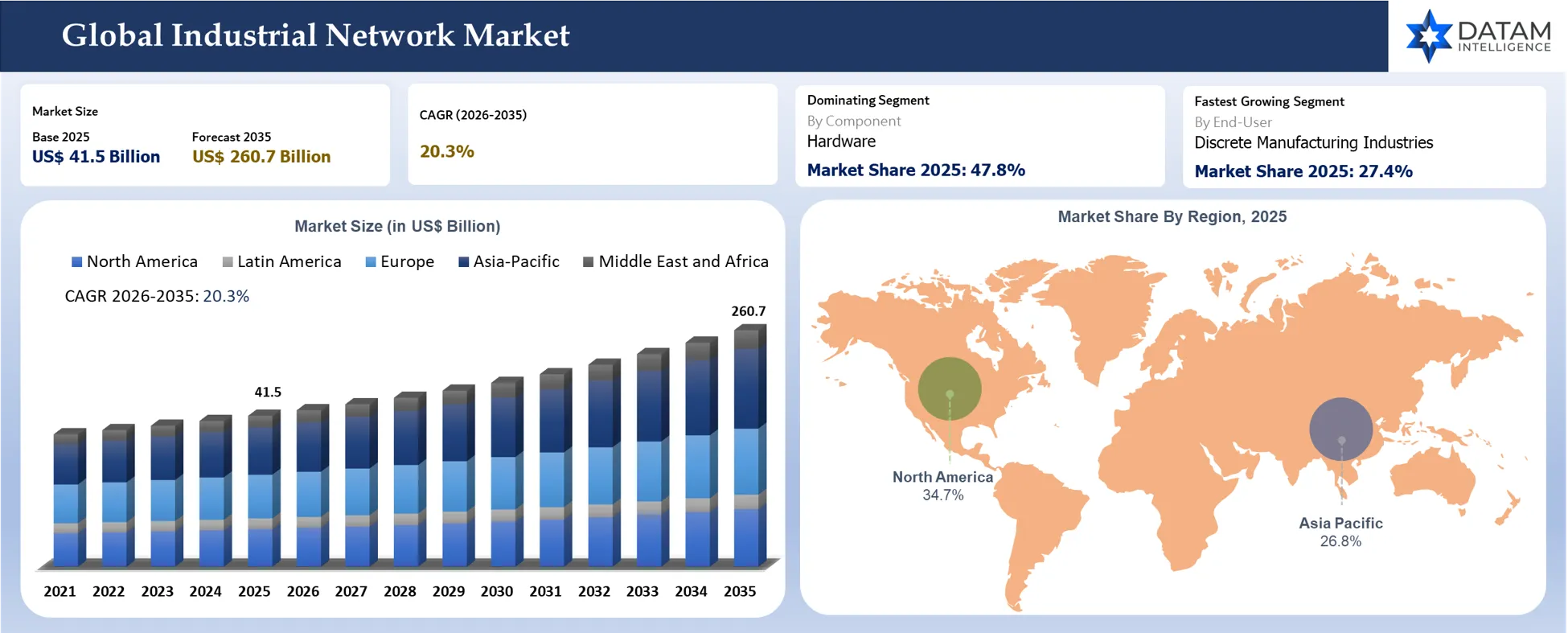
The global industrial network market reached US$ 41.5 billion in 2025 and is expected to reach US$ 260.7 billion by 2035, growing with a CAGR of 20.3% during the forecast period 2026-2035. Industrial networks are rapidly becoming the backbone of smart manufacturing, critical infrastructure automation, and AI-enabled industrial operations as enterprises modernize legacy operational technology (OT) environments. The market is trending due to rising deployment of Industry 4.0 architectures, private 5G infrastructure, edge computing, industrial Ethernet, and cybersecurity-focused networking systems across factories, utilities, logistics hubs, and process industries. Manufacturing companies are increasingly replacing conventional fieldbus systems with deterministic Ethernet and software-defined industrial connectivity to support robotics, machine vision, predictive maintenance, and autonomous mobile equipment. According to the Global Mobile Suppliers Association (GSA), more than 1,907 organizations across 84 countries had deployed private mobile networks by Q3 2025, with manufacturing remaining the largest deployment sector globally.
A major trend reshaping the industrial network market is the convergence of industrial automation with private 5G and edge AI infrastructure. Industrial enterprises are prioritizing ultra-low latency, deterministic communication, and secure wireless networking to support autonomous production systems and real-time analytics. Siemens expanded its industrial private 5G infrastructure in 2025 to multiple countries including Germany, Sweden, the Netherlands, Austria, and Brazil, with each deployment capable of supporting up to 24 radio units covering nearly 5,000 square meters each. Simultaneously, enterprises are increasing investment into AI-enabled industrial connectivity platforms. According to a 2025 industrial digitalization study released by Nokia, 87% of enterprises deploying private wireless and edge infrastructure achieved ROI within one year, while 94% adopted AI-driven industrial applications and 89% reported measurable energy savings from connected industrial systems.
Cybersecurity modernization is also accelerating demand for industrial networking infrastructure as governments tighten regulations around critical infrastructure resilience and operational technology security. Industrial operators are increasingly adopting ISA/IEC 62443-compliant architectures, segmented industrial Ethernet networks, secure gateways, and zero-trust industrial communication systems to protect SCADA, PLC, and distributed control environments from ransomware and cyberattacks. The European Union’s NIS2 Directive implementation and the U.S. CISA “Secure by Design” initiatives are forcing manufacturers, utilities, and transport infrastructure operators to upgrade legacy industrial communication environments. Additionally, industrial facilities are moving away from conventional unmanaged networking systems toward managed Layer 2/Layer 3 industrial Ethernet switches, software-defined OT networking, and AI-assisted monitoring tools to improve uptime, reliability, and cyber resilience in mission-critical operations.
Industrial Network Market Key Takeaways
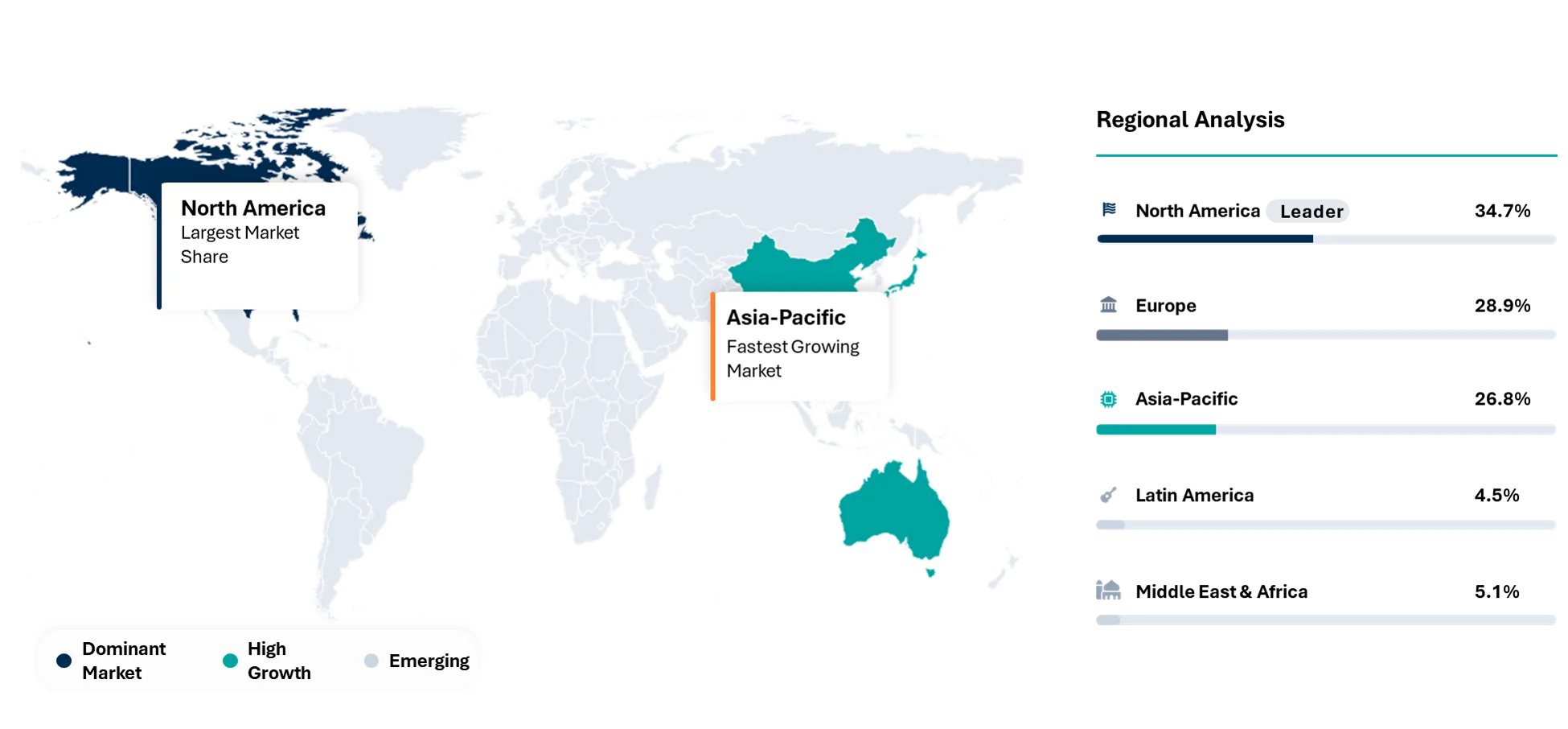
- North America is dominating the global industrial network market, accounting for a share of 34.7% in 2025, while Asia-Pacific is forecast to register a CAGR of 21.2% between 2026 and 2035.
- In 2025, Hardware led the market with a share of approximately 47.8%.
- Discrete manufacturing industries are the fastest-growing segment in 2025, with a CAGR of 19.3%.
- The growing adoption of Industry 4.0, smart manufacturing, and real-time industrial automation is a major driver accelerating deployment and modernization across the industrial network market.
- Cisco Systems, Siemens AG, and Rockwell Automation have established themselves as leading players in the market through continued advancements in industrial Ethernet infrastructure, edge connectivity solutions, cybersecurity integration, and strategic partnerships with manufacturing and process industries.
Industrial Network Industry Trends and Strategic Insights
- According to the International Data Corporation (IDC), global spending on digital transformation technologies surpassed US$ 3.9 trillion in 2024, with manufacturing and industrial operations among the fastest-growing sectors for edge networking investments. Industrial operators are transitioning from proprietary fieldbus systems toward interoperable Ethernet-based communication platforms that support real-time analytics, AI-driven automation, and cloud-native manufacturing operations.
- Industrial Ethernet continues to dominate network modernization projects due to its scalability, deterministic communication capability, and compatibility with smart factory ecosystems. Organizations such as the OPC Foundation and PROFINET International are accelerating standardization efforts to improve interoperability across industrial assets, robotics, and edge computing platforms.
Market Scope
| Metrics | Details | |
| 2025 Market Size | US$ 41.5 Billion | |
| 2035 Projected Market Size | US$ 260.7 Billion | |
| CAGR (2026-2035) | 20.3% | |
| Largest Market | North America | |
| Fastest Growing Market | Asia-Pacific | |
| By Component | Hardware, Software, Services | |
| By Product Type | Industrial Communication Infrastructure, Industrial Automation Connectivity, Industrial IoT Connectivity, Industrial Visualization & Control, Industrial Cybersecurity Networking, Remote Industrial Connectivity | |
| By Connectivity Technology | Wired Industrial Networking, Wireless Industrial Networking, Advanced Networking Architectures | |
| By Network Architecture | Centralized Industrial Networks, Decentralized Edge Networks, Distributed Control System (DCS) Networks, Software-Defined Industrial Networks (SD-OT), Cloud-Native Industrial Networking, Hybrid OT-IT Network Architecture, Edge-to-Cloud Industrial Networks | |
| By Deployment Mode | On-Premise Industrial Networks, Cloud-Managed Industrial Networks, Edge-Deployed Networks, Hybrid OT-IT Networks, Multi-Plant Connected Networks | |
| By End-User | Discrete Manufacturing Industries, Process Industries, Utilities & Infrastructure, Healthcare & Medical, Logistics & Commercial Infrastructure, Data Centers, Smart Buildings, Research Facilities, Defense Communication Facilities, Agriculture & Agri-Tech Facilities Others | |
| By Region | North America | U.S., Canada, Mexico |
| Europe | Germany, UK, France, Spain, Italy, Poland | |
| Asia-Pacific | China, India, Japan, Australia, South Korea, Indonesia, Malaysia | |
| Latin America | Brazil, Argentina | |
| Middle East and Africa | UAE, Saudi Arabia, South Africa, Israel, Turkiye | |
| Report Insights Covered | Competitive Landscape Analysis, Company Profile Analysis, Market Size, Share, Growth | |
Why this report matters in 2026?
The global industrial network market is entering a decisive digital transformation phase in 2026 as manufacturers, energy operators, utilities, logistics providers, and critical infrastructure industries intensify investments in intelligent, connected, and highly secure industrial communication ecosystems. Increasing emphasis on Industry 4.0 adoption, industrial automation, smart manufacturing, and real-time operational visibility is accelerating deployment of advanced industrial Ethernet, wireless communication, edge networking, and software-defined industrial infrastructure across North America, Europe, Asia-Pacific, and other major industrial economies. The transition is rapidly transforming the market from conventional plant-level connectivity systems into a strategically critical infrastructure segment supporting autonomous operations, predictive maintenance, and data-driven industrial decision-making.
At the same time, industrial network providers are witnessing growing pressure to deliver scalable, interoperable, low-latency, and cyber-resilient networking architectures capable of supporting increasingly complex industrial environments. Rapid advancements in Time-Sensitive Networking (TSN), Industrial Internet of Things (IIoT) connectivity, private 5G networks, cloud-integrated industrial communication platforms, and AI-enabled network management solutions are reshaping competitive positioning across the industry. Buyers, investors, and industrial stakeholders now require deeper visibility into network reliability, cybersecurity capabilities, protocol compatibility, edge-to-cloud integration, deterministic communication performance, industrial wireless scalability, strategic technology partnerships, and long-term infrastructure modernization roadmaps to evaluate deployment feasibility, reduce operational risk, and identify commercially competitive industrial networking ecosystems.
Strategic Indicators For Industrial Network
High Regulation Impact
Industrial network deployments are increasingly shaped by cybersecurity and critical infrastructure regulations across United States, Germany, China, and India. The U.S. is accelerating compliance around industrial cybersecurity under NIST-aligned OT frameworks and mandatory reporting requirements for critical manufacturing and utilities. Germany’s industrial operators are rapidly adopting IEC 62443-compliant architectures, particularly across automotive and process industries. China is tightening industrial data localization and industrial Ethernet certification requirements for smart factories. India’s digital manufacturing initiatives are increasing procurement preference for secure, domestically integrated industrial networking systems. These regulations are materially increasing demand for segmented OT architectures, industrial firewalls, TSN-enabled Ethernet, and zero-trust industrial connectivity platforms.
High Investment Activity
Investment momentum is accelerating across industrial Ethernet, private 5G, and AI-enabled operational technology networks in United States, Germany, Japan, and South Korea. U.S.-based hyperscalers and industrial manufacturers are increasing network modernization spending to support AI-driven automation and edge analytics. Germany continues to lead factory digitalization investments through Industry 4.0-linked infrastructure upgrades. Japanese manufacturers are scaling resilient deterministic networking for semiconductor and robotics production. South Korea is aggressively integrating industrial private 5G into electronics manufacturing ecosystems. Industrial networking vendors are prioritizing acquisitions, edge computing partnerships, and software-defined OT networking platforms to capture growing demand for low-latency, cybersecure industrial communications.
New Product Launches
- October 15, 2025: Siemens launched the Sinamics S220 platform integrating advanced industrial connectivity, cybersecurity, and digital workflow integration for high-performance manufacturing automation and intelligent industrial control environments.
- October 1, 2025: Siemens launched SINEC Secure Connect, a zero-trust OT networking platform enabling secure machine-to-machine, cloud, and datacenter connectivity without traditional VPN-based industrial architectures.
Supply Chain Disruption
Industrial networking supply chains remain exposed to semiconductor shortages, geopolitical export controls, and logistics disruptions across China, Taiwan, Germany, and United States. Lead-time volatility continues affecting industrial Ethernet switches, ruggedized routers, and embedded communication modules. U.S.–China technology restrictions are pressuring sourcing strategies for industrial-grade chipsets and network processors. European automation OEMs are increasing regional sourcing to reduce exposure to Asian component dependencies. Taiwan’s semiconductor ecosystem remains strategically critical for industrial communication hardware manufacturing. Companies are redesigning procurement models through dual-sourcing, localized assembly, and inventory buffering to stabilize OT networking infrastructure deliveries for automotive, utilities, and semiconductor manufacturing clients.
Pricing Volatility
Industrial network equipment pricing remains volatile due to semiconductor procurement costs, industrial-grade copper and aluminum fluctuations, and cybersecurity-driven hardware redesign requirements. United States and Germany are experiencing premium pricing for secure industrial Ethernet and private 5G infrastructure solutions, particularly within utilities and critical manufacturing sectors. Chinese vendors continue exerting downward pricing pressure in unmanaged switching and industrial wireless segments, intensifying competitive dynamics globally. Japanese automation suppliers are maintaining higher pricing positions through reliability-focused networking systems for robotics and semiconductor applications. Increasing integration of TSN, AI-enabled diagnostics, and zero-trust capabilities is structurally raising average system costs across advanced industrial networking deployments.
Procurement Pressure
Procurement teams across United States, India, Germany, and China are facing mounting pressure to balance cybersecurity compliance, interoperability, and lifecycle reliability within industrial networking investments. Industrial operators increasingly demand IEC 62443-certified networking infrastructure with deterministic communication support and long-term hardware availability guarantees. Automotive and semiconductor manufacturers are prioritizing vendors capable of integrating OT and IT visibility platforms under unified architectures. Indian manufacturers are emphasizing cost-efficient industrial Ethernet modernization for smart factory programs. Procurement cycles are lengthening as enterprises evaluate geopolitical sourcing risks, software licensing models, and cybersecurity resilience before finalizing industrial networking vendor partnerships.
New Technology Adoption
Adoption of private 5G, TSN-enabled Ethernet, edge AI networking, and zero-trust OT security architectures is accelerating across Germany, United States, South Korea, and China. German manufacturers are leading deterministic industrial Ethernet integration for Industry 4.0 production environments. U.S. enterprises are scaling AI-enabled network visibility and industrial cybersecurity solutions. South Korea is deploying industrial 5G within electronics and battery manufacturing ecosystems. Chinese factories continue accelerating industrial wireless adoption for automated warehousing and robotics operations. Vendors are increasingly integrating edge analytics, AI-assisted fault diagnostics, and software-defined industrial networking to support autonomous manufacturing operations and real-time industrial decision intelligence.
Regional Expansion Opportunity
- Asia-Pacific remains the strongest industrial networking expansion region due to semiconductor, automotive, and electronics manufacturing growth in China, India, South Korea, and Vietnam. Industrial private 5G, smart factory Ethernet upgrades, and industrial wireless automation deployments are accelerating rapidly.
- Europe presents strong expansion opportunities through cybersecurity-focused industrial modernization across Germany, France, and Italy. Automotive, utilities, and process industries are investing heavily in deterministic industrial Ethernet, TSN architectures, and zero-trust operational technology networking platforms.
Government Policy Support
Government-backed industrial digitalization programs are significantly supporting industrial network infrastructure investments across Germany, China, India, and United States. Germany’s Industry 4.0 framework continues driving adoption of interoperable industrial Ethernet systems and secure automation architectures. China’s advanced manufacturing initiatives are strengthening domestic industrial communication equipment deployment. India’s smart manufacturing and production-linked incentive frameworks are accelerating industrial automation investments across factories and logistics infrastructure. The United States is prioritizing critical infrastructure cybersecurity and resilient domestic manufacturing connectivity systems. These policy frameworks are expanding demand for industrial switches, secure OT networking platforms, industrial wireless systems, and private industrial 5G deployments.
Import Export And Pricing Intelligence
Industrial network equipment trade flows are increasingly shifting toward regionalized manufacturing ecosystems as geopolitical tensions reshape sourcing strategies. Asian exports dominate industrial switching hardware and embedded communication modules, while Europe maintains strength in premium industrial automation networking systems. North American importers are increasingly diversifying suppliers beyond single-country semiconductor dependencies to reduce operational vulnerability.
Pricing intelligence indicates widening premium differentiation between commodity industrial networking hardware and cybersecurity-integrated industrial communication systems. Vendors offering TSN, industrial 5G, and zero-trust OT functionality are sustaining higher margins despite broader industrial electronics pricing pressure. Enterprise customers increasingly accept premium pricing for long-lifecycle, compliance-certified, and cybersecure industrial networking platforms.
| HS Code | Reporter | Trade Flow | 2025 Trade Value | Interpretation |
| 851762 | China | Export | USD 148.6 Billion | China dominates global industrial communication hardware and networking equipment exports |
| 851762 | United States | Import | USD 96.2 Billion | Strong industrial infrastructure modernization driving high networking equipment imports |
| 851762 | Germany | Export | USD 41.8 Billion | Germany maintains leadership in premium industrial networking and automation systems |
| 851762 | Japan | Export | USD 27.4 Billion | Japan exports high-reliability industrial communication and robotics networking equipment |
| 851762 | India | Import | USD 24.7 Billion | India’s industrial automation expansion significantly increasing networking equipment imports |
Company Coverage Preview
Siemens AG remains one of the most influential industrial networking vendors globally through its SCALANCE portfolio, industrial cybersecurity platforms, and private industrial 5G infrastructure capabilities. The company is strategically positioning around converged OT-IT architectures, deterministic industrial Ethernet, and zero-trust industrial connectivity. Siemens has strengthened competitive positioning through integration of edge computing, industrial AI, and secure remote networking capabilities into manufacturing ecosystems. Germany-based manufacturing leadership, strong Industry 4.0 alignment, and deep penetration across automotive, utilities, semiconductor, and process industries continue supporting its global industrial networking market influence.
Industrial Network Market: AI Impact Analysis
Artificial intelligence is fundamentally reshaping industrial network architectures by increasing demand for ultra-low-latency connectivity, edge processing, and autonomous operational intelligence. Manufacturers in United States, Germany, and China are integrating AI-driven predictive maintenance, industrial vision systems, and digital twins directly into OT networking environments. Industrial switches and routers increasingly require AI-enabled traffic prioritization, cybersecurity analytics, and edge inferencing capabilities. AI infrastructure expansion is also accelerating enterprise investments in industrial Ethernet backbones, private 5G, and software-defined industrial networking. Vendors capable of combining AI orchestration with deterministic industrial communications are emerging as long-term strategic leaders.
Industrial Network Market: Disruption Analysis
Traditional industrial communication architectures based on proprietary fieldbus systems are increasingly being replaced by open industrial Ethernet protocols, software-defined networking, and AI-enabled industrial connectivity platforms. The growing deployment of Industry 4.0 infrastructure, smart factories, and autonomous industrial operations is fundamentally transforming network performance requirements toward ultra-low latency, deterministic communication, and real-time analytics integration. Industrial 5G and private LTE deployments are disrupting conventional wired industrial communication systems by enabling flexible wireless connectivity across manufacturing plants, logistics facilities, and remote industrial environments. Simultaneously, edge computing adoption is decentralizing industrial data processing, reducing cloud dependency, and enabling faster operational decision-making. Cybersecurity disruption also remains substantial as rising ransomware attacks and critical infrastructure vulnerabilities force enterprises to adopt zero-trust industrial network architectures, secure industrial gateways, and AI-powered threat detection systems. Cloud-native industrial networking platforms are further reshaping market competition by enabling scalable remote operations, predictive maintenance, and centralized industrial asset monitoring.
BCG Matrix: Company Evaluation
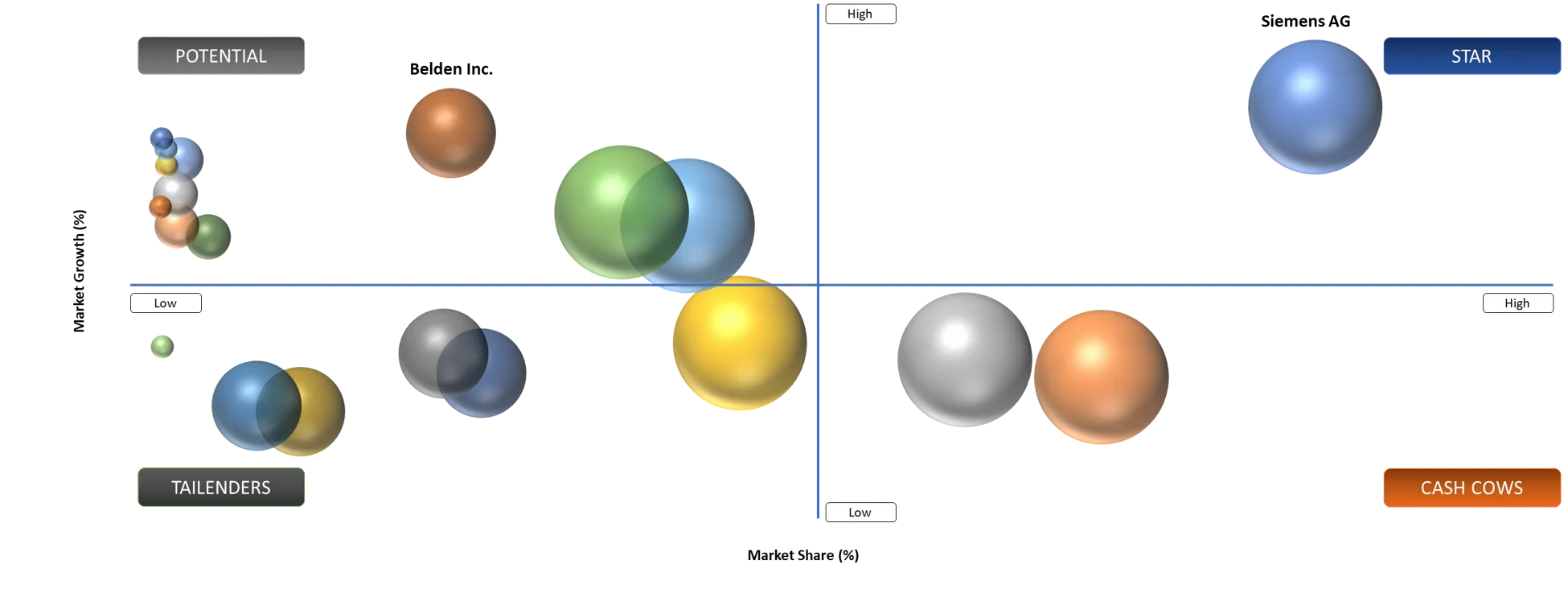
STAR
The Stars segment in the global industrial network market is dominated by companies that combine high market penetration with aggressive investments in industrial automation, Industrial Ethernet, Time-Sensitive Networking (TSN), and Industry 4.0 infrastructure. Key leaders such as Siemens AG, Cisco Systems Inc., Rockwell Automation Inc., and Schneider Electric SE are categorized as Star players due to their strong adoption across smart manufacturing facilities, automotive plants, semiconductor fabs, and process industries. These companies benefit from rising industrial digitization spending, expansion of AI-enabled manufacturing systems, and increasing deployment of edge computing networks in factories. Their competitive advantage lies in integrated hardware-software ecosystems that support real-time industrial communication, predictive maintenance, and cybersecurity-enabled operational technology (OT) environments.
POTENTIAL
Potential players in the global industrial network market are companies experiencing rapid technological advancement and expanding industrial customer adoption but still developing broader global market penetration compared to established leaders. Companies such as Moxa Inc., Belden Inc., HMS Networks AB, and Advantech Co. Ltd. are emerging as high-potential participants due to increasing demand for industrial IoT gateways, edge connectivity, industrial wireless communication, and secure factory networking solutions. These firms are benefiting from the growing adoption of smart sensors, machine-to-machine communication, and cloud-connected manufacturing operations among mid-sized and regional manufacturers.
Market Dynamics
Driver Impact Analysis
| Driver | Market Growth Impact (%) | Demand Concentration | Impacted Use Case | Strategic Impact |
Increasing Adoption of Industrial Automation and Smart Manufacturing Technologies | 5.20% | North America, Europe, China, Japan, and South Korea industrial hubs | Real-time machine communication, predictive maintenance, industrial IoT integration | Accelerates deployment of high-speed, reliable industrial communication infrastructure across manufacturing ecosystems |
Rising Investments in Industry 4.0 and Digital Transformation Initiatives | 4.90% | Advanced manufacturing economies and large-scale industrial enterprises | Connected factories, cloud-integrated operations, remote asset monitoring | Enhances operational efficiency and drives modernization of industrial networking architectures |
Expanding Deployment of Industrial Ethernet and Wireless Networking Solutions | 4.60% | Automotive, energy, chemicals, and process manufacturing sectors | Factory automation, robotics synchronization, distributed control systems | Improves low-latency connectivity and enables scalable industrial data exchange environments |
Growing Collaboration Between Industrial Network Providers, Automation Vendors, and Telecom Companies | 4.10% | Public-private industrial innovation clusters and smart factory ecosystems | Edge computing integration, private 5G industrial networks, AI-driven industrial analytics | Strengthens interoperability standards and accelerates adoption of next-generation industrial communication technologies |
Rising Adoption of Smart Manufacturing and Industry 4.0
The rapid deployment of smart manufacturing technologies is a major growth driver for the industrial network market. Manufacturers are investing heavily in connected production systems to improve efficiency, reduce downtime, and optimize supply chains. According to International Federation of Robotics, annual industrial robot installations exceeded 540,000 units globally in 2024, with automotive, electronics, and metal manufacturing industries leading adoption. These robots require ultra-reliable low-latency industrial communication systems capable of supporting synchronized machine operations.
Germany’s Industrie 4.0 strategy continues to accelerate industrial networking investments across automotive and advanced manufacturing sectors. Meanwhile, China’s “Made in China 2025” initiative has significantly expanded smart factory deployments utilizing Industrial Ethernet switches, industrial wireless LANs, and edge gateways. In Japan, manufacturing companies are integrating AI-enabled predictive maintenance systems that depend on high-speed industrial communication networks to process sensor data in real time.
Private 5G industrial networks are also gaining momentum. According to the Global System for Mobile Communications Association, over 60 countries had introduced enterprise-focused private 5G frameworks by 2025, enabling manufacturers to deploy secure wireless industrial communication systems within factories, ports, mines, and logistics hubs. Companies including Siemens AG, Schneider Electric, and Cisco Systems are increasingly integrating industrial networking platforms with AI-driven automation and cybersecurity solutions.
Restraint Impact Analysis
| Restraint | Drag on Market Growth (%) | Primary Impact Area | Impacted Use Case | Strategic Impact |
High Deployment and Infrastructure Modernization Costs | 4.50% | Industrial network expansion and legacy system upgrades | Smart factory networking, industrial Ethernet deployment, edge connectivity | Slows digital transformation initiatives among small and mid-sized manufacturing facilities |
Lack of Interoperability Across Industrial Communication Protocols | 3.90% | Multi-vendor network integration and system compatibility | Cross-platform industrial automation, IIoT ecosystem integration | Increases integration complexity and delays large-scale industrial network standardization |
Rising Cybersecurity Risks in Connected Industrial Environments | 4.30% | Operational technology (OT) security and network resilience | Remote monitoring, connected production systems, critical infrastructure operations | Raises operational risks and increases investment requirements for secure industrial networking frameworks |
Shortage of Skilled OT and Industrial Networking Professionals | 3.70% | Industrial network deployment, maintenance, and optimization | Network configuration, predictive maintenance systems, industrial cybersecurity management | Limits deployment efficiency and slows adoption of advanced industrial networking technologies |
Cybersecurity Risks and Legacy Infrastructure Challenges
Many industrial facilities continue operating with outdated communication protocols and unsupported industrial control systems originally designed without modern cybersecurity protections. As industrial systems become increasingly connected to enterprise IT and cloud platforms, the attack surface for cyber threats continues to expand.
According to the Cybersecurity and Infrastructure Security Agency, ransomware attacks targeting industrial organizations and critical infrastructure facilities increased substantially during 2024, particularly within manufacturing, energy, and water treatment sectors. The manufacturing sector became one of the most targeted industries globally due to operational disruptions causing significant financial losses. Similarly, the IBM Security X-Force Threat Intelligence Index identified manufacturing as the most attacked industry globally for the fourth consecutive year.
Legacy industrial communication systems using older serial protocols and unmanaged switches create substantial modernization challenges. Upgrading operational facilities often requires significant capital expenditure and production downtime, making many manufacturers hesitant to transition fully toward next-generation industrial networking architectures. Additionally, the shortage of industrial cybersecurity professionals capable of managing IT-OT convergence environments remains a significant barrier across both developed and emerging markets.
Segmentation Analysis
The global industrial network market is segmented based on the component, product type, connectivity technology, network architecture, deployment mode, end-user and region.
Industrial Ethernet Segment Leads Technology Adoption
Industrial ethernet has emerged as the dominant technology segment within the industrial network market due to its ability to support deterministic communication, high-speed data transfer, and interoperability across industrial automation systems. Protocols such as PROFINET, EtherNet/IP, EtherCAT, Modbus TCP, and CC-Link IE are increasingly replacing traditional fieldbus architectures in manufacturing and process industries.
The automotive industry remains one of the largest adopters of Industrial Ethernet solutions. Automotive manufacturers are integrating hundreds of connected robots, sensors, vision systems, and AI-powered quality inspection platforms within highly automated production lines. In 2024, several leading automotive manufacturers expanded fully connected smart manufacturing plants across China, Germany, South Korea, and the United States using TSN-enabled industrial networking infrastructure.
Semiconductor manufacturing is another major driver for advanced industrial networking adoption. Semiconductor fabrication plants require nanosecond-level synchronization and uninterrupted communication between lithography equipment, robotics, environmental systems, and AI-based inspection tools. The global semiconductor investment boom, particularly in the United States, Taiwan, South Korea, and Japan, is significantly increasing demand for resilient industrial networking infrastructure.
Energy and Utilities Sector Accelerates Network Modernization
The energy and utilities sector is rapidly deploying advanced industrial communication networks to support grid modernization, renewable integration, and critical infrastructure resilience. Smart grids, digital substations, and distributed renewable energy systems require real-time monitoring and control systems enabled by secure industrial communication networks.
According to the International Energy Agency, annual global grid investment surpassed US$ 400 billion during 2024 as countries expanded electricity infrastructure modernization programs. Utilities are increasingly deploying fiber-optic industrial communication systems, IEC 61850-based substation automation networks, and private LTE/5G infrastructure to improve reliability and operational visibility.
In the Middle East, countries including Saudi Arabia and the UAE are integrating industrial networking infrastructure into large-scale smart city and industrial diversification projects. Meanwhile, India’s smart grid initiatives and industrial corridor programs are driving investments in industrial wireless communication systems and intelligent automation infrastructure for utilities and manufacturing clusters.
Industrial Network Market Geographical Penetration
U.S. Industrial Network Market Landscape
The United States remains one of the world’s most advanced industrial networking ecosystems, supported by large-scale investments in smart manufacturing, industrial automation, semiconductor fabrication, and critical infrastructure modernization. The country’s industrial sector is increasingly integrating Industrial Ethernet, Time-Sensitive Networking (TSN), private 5G, and edge computing into production facilities to strengthen operational visibility and cybersecurity resilience. The U.S. government has accelerated industrial digitalization through initiatives linked to advanced manufacturing competitiveness and domestic semiconductor production expansion.
The National Institute of Standards and Technology continues promoting smart manufacturing frameworks and interoperable industrial communication standards, while the U.S. Department of Energy has expanded investments in connected industrial energy systems and grid modernization projects. In 2024, industrial enterprises across the U.S. significantly increased spending on AI-enabled operational technologies and industrial cybersecurity to support IT-OT convergence and predictive maintenance capabilities. According to Cisco’s 2024 State of Industrial Networking survey covering more than 1,000 industrial professionals globally, 89% of respondents identified industrial cybersecurity compliance as a critical operational priority, while AI-enabled infrastructure emerged as the leading investment focus for manufacturers.
The United States is also witnessing strong demand for industrial networking solutions from automotive, aerospace, semiconductor, logistics, utilities, and data center operators. Major investments from manufacturers including Intel Corporation, Tesla, Inc., and Micron Technology are increasing requirements for low-latency industrial communication systems and highly secure plant-wide connectivity architectures. The expansion of smart factories across states such as Texas, Arizona, Ohio, and Michigan is accelerating deployment of industrial switches, edge gateways, programmable network controllers, and wireless industrial devices. Industrial Ethernet has become the dominant networking technology for factory automation globally, accounting for nearly 76% of newly installed industrial network nodes in 2024, led by protocols such as PROFINET and EtherNet/IP.
Japan Industrial Network Market Outlook
Japan continues to lead the Asia-Pacific industrial network landscape through its globally recognized expertise in robotics, factory automation, precision manufacturing, and industrial control systems. The country’s industrial ecosystem strongly emphasizes deterministic industrial communication, ultra-reliable connectivity, and integrated robotics networking across automotive, electronics, semiconductor, and heavy machinery sectors. Japan’s manufacturing giants including Fanuc Corporation, Yaskawa Electric Corporation, and Mitsubishi Electric Corporation are heavily investing in intelligent factory systems supported by Industrial Ethernet and AI-enabled industrial control platforms.
Japan’s Ministry of Economy, Trade and Industry has also expanded support for Society 5.0 initiatives, encouraging the integration of industrial IoT, AI, and cyber-physical systems across manufacturing infrastructure. According to Reuters’ 2026 survey of Japanese enterprises, approximately one-third of Japanese firms are already using or considering AI-powered robots, with transportation equipment manufacturers representing the highest adoption intensity.
Japanese electronics and automotive manufacturers are increasingly deploying private 5G networks, edge AI systems, and industrial wireless infrastructure to improve flexible manufacturing capabilities and support labor shortages through autonomous operations. The country’s aging workforce has further accelerated investments in robotics-integrated industrial networking systems, remote machine diagnostics, and predictive maintenance technologies. Japan’s emphasis on high-reliability industrial communications is also supporting growth in semiconductor fabs and smart logistics facilities, where ultra-low latency and cybersecure industrial networks are essential for uninterrupted operations.
China Industrial Network Market Trends
China has established itself as the largest industrial networking and smart manufacturing ecosystem in Asia-Pacific outside Japan, supported by massive investments in Industrial Internet infrastructure, 5G-enabled factories, AI-driven automation, and semiconductor manufacturing expansion. The Chinese government continues prioritizing industrial digitalization through its “5G + Industrial Internet” strategy, which integrates industrial wireless communication, edge intelligence, cloud manufacturing, and cyber-physical production systems.
According to official Chinese industry data, the country surpassed 17,000 “5G + Industrial Internet” projects across 41 industrial sectors by 2024, while more than 4,000 5G-enabled smart factories had already been established nationwide. China also deployed approximately 4.25 million 5G base stations, creating one of the world’s largest industrial-grade wireless infrastructures. The scale of China’s manufacturing ecosystem is substantially increasing demand for industrial routers, edge gateways, industrial wireless devices, and software-defined industrial networking systems.
Additionally, industrial Ethernet and industrial wireless adoption continue accelerating across Chinese factories as enterprises transition from legacy fieldbus systems toward scalable Ethernet-based industrial communication architectures. The country’s extensive deployment of private 5G industrial networks is enabling real-time machine communication, autonomous robotics coordination, remote maintenance, and smart warehousing operations at unprecedented scale.
Competitive Landscape
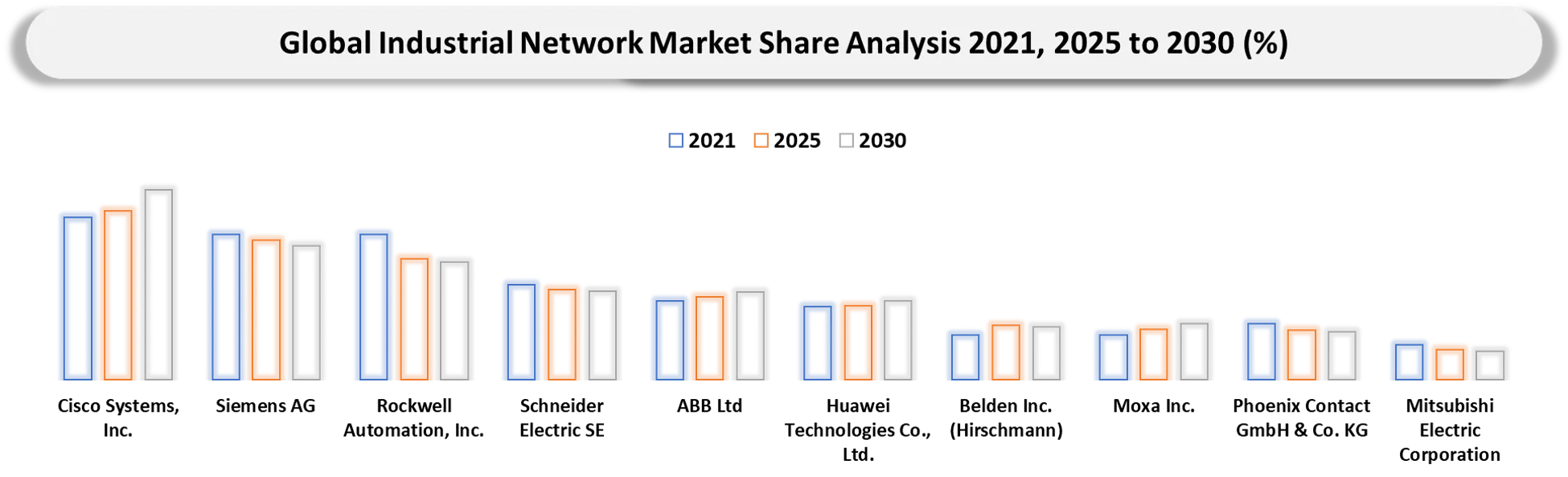
- The global industrial network market features intense competition among industrial automation companies, networking infrastructure providers, semiconductor firms, and industrial cybersecurity vendors. Market participants compete based on deterministic communication performance, interoperability, cybersecurity capabilities, edge computing integration, and support for industrial AI applications.
- Key players include Siemens AG, Cisco Systems, Schneider Electric, Rockwell Automation, Honeywell International, Belden Inc., Moxa Inc., HMS Networks, Advantech, ABB Ltd., and Huawei Technologies.
- Companies are increasingly investing in Time-Sensitive Networking (TSN), AI-enabled network analytics, industrial edge computing, software-defined industrial networks, and quantum-resistant cybersecurity technologies. Strategic collaborations between industrial automation vendors, telecom operators, and cloud hyperscalers are also accelerating the development of fully connected autonomous industrial ecosystems.
MAJOR PAIN POINTS
- Legacy industrial infrastructure incompatible with modern Ethernet and IIoT architectures
- Rising cybersecurity threats targeting operational technology and industrial communication networks
- High deployment costs for ruggedized industrial networking hardware across manufacturing environments
- Limited interoperability between proprietary industrial protocols and multi-vendor network ecosystems
- Network downtime risks disrupting critical production operations and supply chain continuity
- Skilled workforce shortages delaying industrial network configuration, monitoring, and cybersecurity management
- Increasing bandwidth requirements from AI, machine vision, and real-time analytics applications
- Complex migration challenges from fieldbus systems toward industrial Ethernet-based communication platforms
- Harsh industrial environments reducing reliability and lifespan of networking infrastructure components
- Scalability limitations affecting expansion of smart factories, connected assets, and edge computing deployments
RECENT DEVELOPMENTS
- April 2026: Cisco Systems, Inc. released Industrial AI readiness research, highlighting accelerated AI deployment across factory and critical infrastructure networks.
- March 2026: Rockwell Automation, Inc. expanded AI-enabled FactoryTalk industrial networking integrations supporting predictive maintenance and connected manufacturing operations across smart factories.
- February 2026: ABB Ltd strengthened industrial Ethernet and AI-driven automation offerings supporting resilient smart manufacturing and process industry network operations.
- February 2026: Cisco Systems, Inc. launched Silicon One G300 networking platform supporting hyperscale AI data-center and industrial networking infrastructure expansion.
- February 2026: Moxa Inc. launched next-generation secure industrial networking solutions supporting IEC 62443 cybersecurity compliance and mission-critical industrial communications.
- January 2026: Mitsubishi Electric Corporation expanded e-F@ctory industrial networking ecosystem integrating AI analytics and edge connectivity for advanced manufacturing operations.
- January 2026: Schneider Electric SE enhanced EcoStruxure industrial networking portfolio with advanced cybersecurity and edge-computing capabilities for industrial automation environments.
KEY PROCUREMENT PRIORITIES AND BUYER EVALUATION CRITERIA
- Organizations investing in the global industrial network market are increasingly selecting vendors based on their ability to deliver highly secure, scalable, and interoperable networking infrastructure with strong real-time communication performance, low latency, and long-term industrial automation compatibility.
- Procurement strategies are being shaped by the rapid adoption of Industrial Ethernet, Time-Sensitive Networking (TSN), private 5G, wireless industrial communication, and edge-enabled networking architectures, alongside rising demand for seamless integration with Industry 4.0 platforms, industrial IoT ecosystems, and AI-driven smart manufacturing environments.
- Manufacturing companies, energy utilities, transportation operators, process industries, and critical infrastructure providers evaluate network reliability, cybersecurity resilience, protocol compatibility, deterministic communication capabilities, and lifecycle support services before selecting industrial network vendors and technology partners.
ANALYST VIEW / OPINION
- Industrial Ethernet adoption accelerates factory-wide deterministic communication across Industry 4.0 manufacturing ecosystems globally.
- Private 5G integration strengthens real-time industrial connectivity for mission-critical automation and robotics applications.
- Rising deployment of edge computing platforms increases demand for low-latency industrial network architectures worldwide.
- Cybersecurity-focused industrial networking investments expand due to escalating operational technology cyberattack vulnerabilities globally.
- Smart manufacturing modernization programs significantly boost managed industrial switches and secure gateway deployment rates.
- Process industries increasingly prioritize redundant industrial communication systems ensuring uninterrupted operational reliability standards.
- AI-enabled predictive maintenance applications stimulate advanced industrial wireless infrastructure implementation across manufacturing facilities.
- Data center industrialization trends create substantial opportunities for high-bandwidth industrial networking hardware providers globally.
- Energy and utilities sector digital transformation accelerates ruggedized industrial router and connectivity equipment adoption.
- Interoperability requirements between legacy equipment and modern automation platforms drive industrial protocol conversion demand globally.
TARGET AUDIENCE
| INDUSTRY | WHO SHOULD BUY THIS REPORT? | REASON TO BUY THIS REPORT |
| Industrial Automation Companies | Network Architecture Teams, OT Engineers, Automation Integration Managers | Analyze industrial network demand across smart factories, PLC connectivity and Industry 4.0 deployments |
| Manufacturing Enterprises | Plant Operations Managers, Digital Transformation Teams, Production Engineers | Evaluate industrial communication infrastructure for connected manufacturing and operational efficiency improvements |
| Oil & Gas Companies | SCADA Engineers, Industrial Cybersecurity Teams, Asset Reliability Managers | Assess secure industrial networking solutions for remote monitoring and hazardous environment operations |
| Energy & Utilities Companies | Grid Automation Teams, Substation Communication Engineers, Infrastructure Managers | Understand industrial network requirements for smart grids, power distribution and utility automation systems |
| Automotive & EV Manufacturers | Smart Manufacturing Teams, Industrial IoT Engineers, Factory Automation Departments | Evaluate real-time industrial networking for robotic assembly lines and connected vehicle production facilities |
| Aerospace & Defense Companies | Mission-Critical Communication Teams, Industrial Control Engineers, Defense Manufacturing Units | Analyze resilient industrial network solutions for high-security and precision manufacturing environments |
| Data Center & Smart Infrastructure Providers | Edge Connectivity Teams, Network Infrastructure Managers, Digital Infrastructure Engineers | Identify industrial Ethernet and wireless networking demand for intelligent infrastructure operations |
| Industrial Networking Equipment Manufacturers | Product Development Teams, Industrial Communication Specialists, Strategy Departments | Benchmark industrial switches, routers, gateways and wireless communication technology adoption trends |
| Mining & Heavy Equipment Companies | Remote Operations Teams, Industrial Connectivity Engineers, Automation Managers | Evaluate rugged industrial networking solutions for autonomous equipment and remote site connectivity |
| Logistics & Warehousing Companies | Warehouse Automation Teams, Supply Chain Technology Managers, Smart Facility Engineers | Assess industrial networking infrastructure supporting automated warehouses, robotics and real-time asset tracking |
WHY CHOOSE DATAM?
- Data-Driven insights: Dive into detailed analyses with granular insights such as pricing, market shares and value chain evaluations, enriched by interviews with industry leaders and disruptors.
- Post-Purchase Support and Expert Analyst Consultations: As a valued client, gain direct access to our expert analysts for personalized advice and strategic guidance, tailored to your specific needs and challenges.
- White Papers and Case Studies: Benefit quarterly from our in-depth studies related to your purchased titles, tailored to refine your operational and marketing strategies for maximum impact.
- Annual Updates on Purchased Reports: As an existing customer, enjoy the privilege of annual updates to your reports, ensuring you stay abreast of the latest market insights and technological advancements. Terms and conditions apply.
- Specialized Focus on Emerging Markets: DataM differentiates itself by delivering in-depth, specialized insights specifically for emerging markets, rather than offering generalized geographic overviews. The approach equips our clients with a nuanced understanding and actionable intelligence that are essential for navigating and succeeding in high-growth regions.
- Value of DataM Reports: Our reports offer specialized insights tailored to the latest trends and specific business inquiries. The personalized approach provides a deeper, strategic perspective, ensuring you receive the precise information necessary to make informed decisions. The insights complement and go beyond what is typically available in generic databases.
WHAT DATAM UNIQUELY PROVIDES
- OT cybersecurity compliance benchmarking across industrial Ethernet, TSN, and private 5G infrastructure ecosystems.
- Factory-level industrial network deployment intelligence covering automotive, semiconductor, utilities, and logistics sectors globally.
- Competitive mapping of industrial switch, router, wireless, and edge-networking vendors with strategic positioning insights.
- Supply-chain risk assessment for industrial communication chipsets, ruggedized networking hardware, and embedded industrial electronics.
- Regional investment tracking covering Industry 4.0 modernization, smart manufacturing, and industrial wireless infrastructure expansion.
- AI-driven industrial networking adoption analysis across predictive maintenance, digital twins, and autonomous manufacturing environments.
- Procurement intelligence covering lifecycle costs, cybersecurity certification requirements, interoperability risks, and industrial networking vendor evaluation frameworks.