


Industrial Fasteners Market Size and Overview
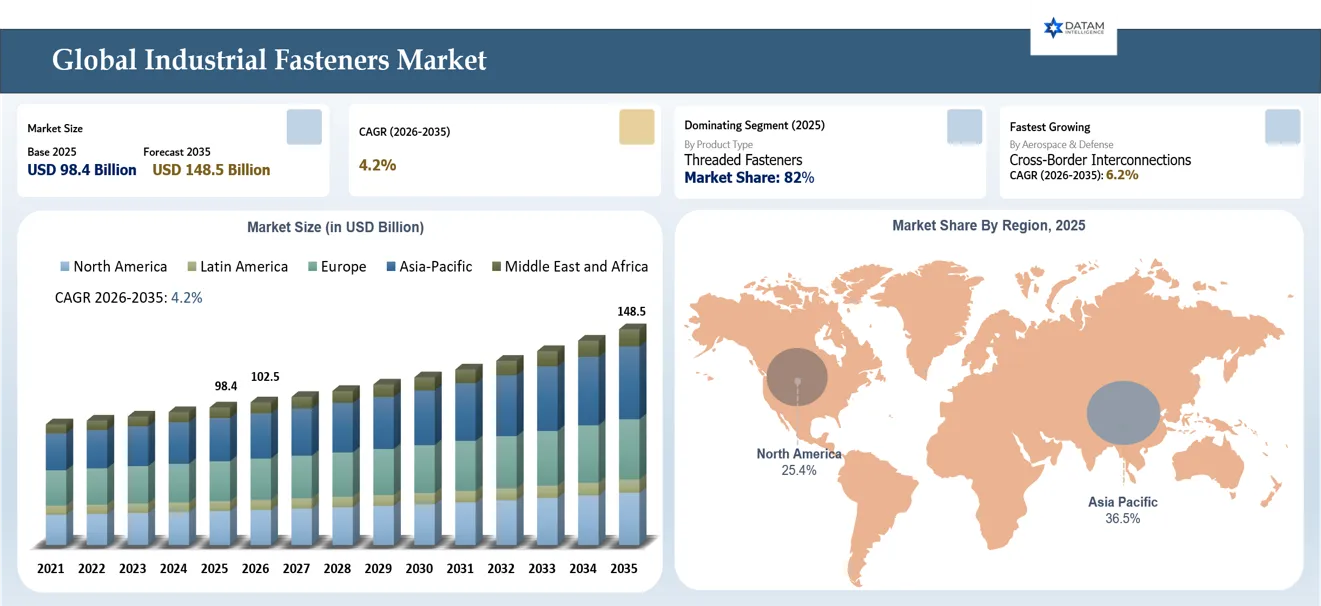
The global industrial fasteners market was valued at approximately USD 98.4 billion in 2025 and is projected to reach around USD 148.5 billion by 2035, expanding at a CAGR of approximately 4.2% during the forecast period (2026–2035). The industrial fasteners market is experiencing a structural transformation driven by the growth of automotive and electric vehicle production, expansion of construction and infrastructure activities, growth of renewable energy infrastructure, rising aerospace and defense manufacturing, and adoption of lightweight and advanced materials. Rising investments in aerospace and defense manufacturing are increasing demand for high-performance industrial fasteners, including lightweight titanium fasteners, high-strength bolts, precision screws, and specialty fastening systems. According to the Aerospace Industries Association (AIA), The U.S. aerospace and defense industry invested $45 billion in capital expenditures in 2025, representing a 13% increase compared with 2024. OEMs and machinery-related subsectors accounted for $34.3 billion of this investment, a $5 billion (+17%) year-over-year increase.
Increased commercial and defense aircraft manufacturing necessitates specialty fasteners to be incorporated into aircraft structure, engines, missiles, and military hardware, which presents growth potential. The leading aircraft manufacturer such as Airbus, has continued to pursue increased production of A320 series aircraft every month, despite engine shortages. While in defense, MBDA’s backlog represents nearly eight years of revenue, and Lockheed Martin’s missiles and fire control division grew its backlog 20% in a single year even while delivering at record rates. Over the past five years, aerospace manufacturing output grew 30%, while broader industry capacity utilization climbed to roughly 74%.
Growing Demand for Lightweight, High-Strength Fastening Solutions
Lightweight and high-performance materials like titanium alloys have been gaining more attention for use in place of standard steel fasteners in many industries including aerospace, military, automotive, and marine engineering. Such fasteners not only contribute to reducing the weight of components but also offer enhanced mechanical properties along with good corrosion and wear resistance. In June 2026, IperionX announced successful testing of its Ti-6Al-4V titanium fasteners by the U.S. Army Combat Capabilities Development Command (DEVCOM) Ground Vehicle Systems Center (GVSC) and Westmoreland Mechanical Testing & Research (WMTR). The tests demonstrated that IperionX titanium fasteners achieved mechanical performance comparable to or exceeding high-strength SAE Grade 8 steel fasteners. The production of high-quality titanium fasteners illustrates the move towards sophisticated fastener systems for critical industries. The growing use of titanium and specialty alloy fasteners presents an opportunity for suppliers of fasteners for aerospace, military, electric vehicle, and machinery industries.
Industrial Fasteners Market Strategic Takeaways
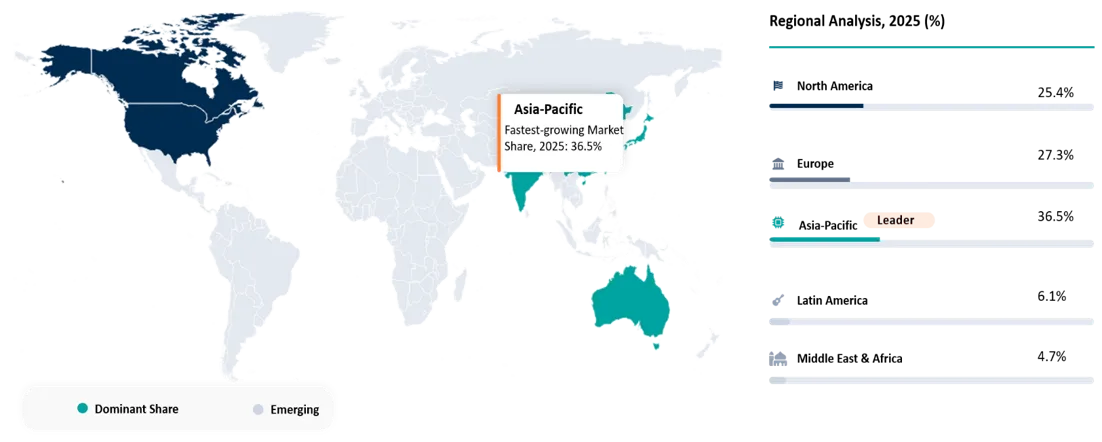
- Asia-Pacific held the highest regional market share, accounting for approximately 36.5% of the global industrial fasteners market in 2025, driven by strong automotive manufacturing, expanding construction activities, industrial machinery production, and the presence of large-scale manufacturing hubs across China, India, Japan, and South Korea. The region’s growth is further supported by increasing demand for high-performance fasteners in automotive, electronics, aerospace, and infrastructure applications. Europe accounted for around 27% of the market share in 2025, supported by its established automotive and aerospace industries, demand for precision-engineered fastening solutions, industrial equipment manufacturing, and increasing adoption of lightweight and specialty alloy fasteners.
- Threaded fasteners dominated the global industrial fasteners market in 2025, accounting for approximately 80–85% of the market share, driven by their extensive use across automotive, aerospace, construction, industrial machinery, energy, and heavy equipment applications. Bolts, screws, studs, and nuts are widely preferred due to their high load-bearing capability, easy installation, reusability, and suitability for critical structural and mechanical assemblies. Non-threaded fasteners accounted for approximately 15–20% of the market in 2025, supported by increasing applications of rivets, pins, clips, washers, and other permanent fastening solutions in automotive, aerospace, electronics, and industrial assembly applications.
Industrial Fasteners Market Industry Trends and Strategic Insight
- Industrial fastener manufacturers are expanding production capabilities and investing in advanced manufacturing technologies to support growing demand from automotive, aerospace, construction, energy, and industrial machinery sectors. Companies such as Stanley Black & Decker, Illinois Tool Works (ITW), SFS Group, LISI Group, and Sundram Fasteners are strengthening manufacturing capacity, developing engineered fastening solutions, and improving production efficiency to address increasing demand for high-performance fasteners.
- Demand for customized and application-specific fastening solutions is becoming a major growth trend as industries require fasteners with improved strength, durability, lightweight properties, and corrosion resistance. Automotive, aerospace, and defense manufacturers are increasingly adopting specialized fasteners, including titanium, aluminum, and specialty alloy components, to support lightweighting initiatives, enhance performance, and meet demanding operational requirements.
- Industrial fastener technology is shifting toward advanced materials, precision engineering, and improved surface treatments to enhance mechanical performance and service life. The adoption of high-strength alloys, corrosion-resistant coatings, and precision-manufactured fasteners is increasing across critical applications such as aircraft structures, electric vehicles, renewable energy systems, and heavy industrial equipment, where reliability and long-term durability are essential.
Industrial Fasteners Market Scope
| Metrics | Details | |
| 2025 Market Size | USD 98.4 Billion | |
| 2035 Projected Market Size | USD 148.5 Billion | |
| CAGR (2026-2035) | 4.2% | |
| Largest Market | Asia-Pacific | |
| Fastest Growing Market | Asia-Pacific | |
| By Product Type | Threaded Fasteners, and Non-Threaded Fasteners | |
| By Raw Material | Metal, Plastic, Other Material | |
| By End-use Industry | Automotive, Construction, Aerospace & Défense, Industrial Machinery, Energy & Power, Electronics, Marine & Shipbuilding, Medical Equipment, and Others | |
| By Region | North America | U.S., Canada, Mexico |
| Europe | Germany, UK, France, Spain, Italy, Poland | |
| Asia-Pacific | China, India, Japan, Australia, South Korea, Indonesia, Malaysia | |
| Latin America | Brazil, Argentina | |
| Middle East and Africa | UAE, Saudi Arabia, South Africa, Israel, Türkiye | |
| Report Insights Covered | Competitive Landscape Analysis, Company Profile Analysis, Market Size, Share, Growth | |
Industrial Fasteners Market Disruption Analysis
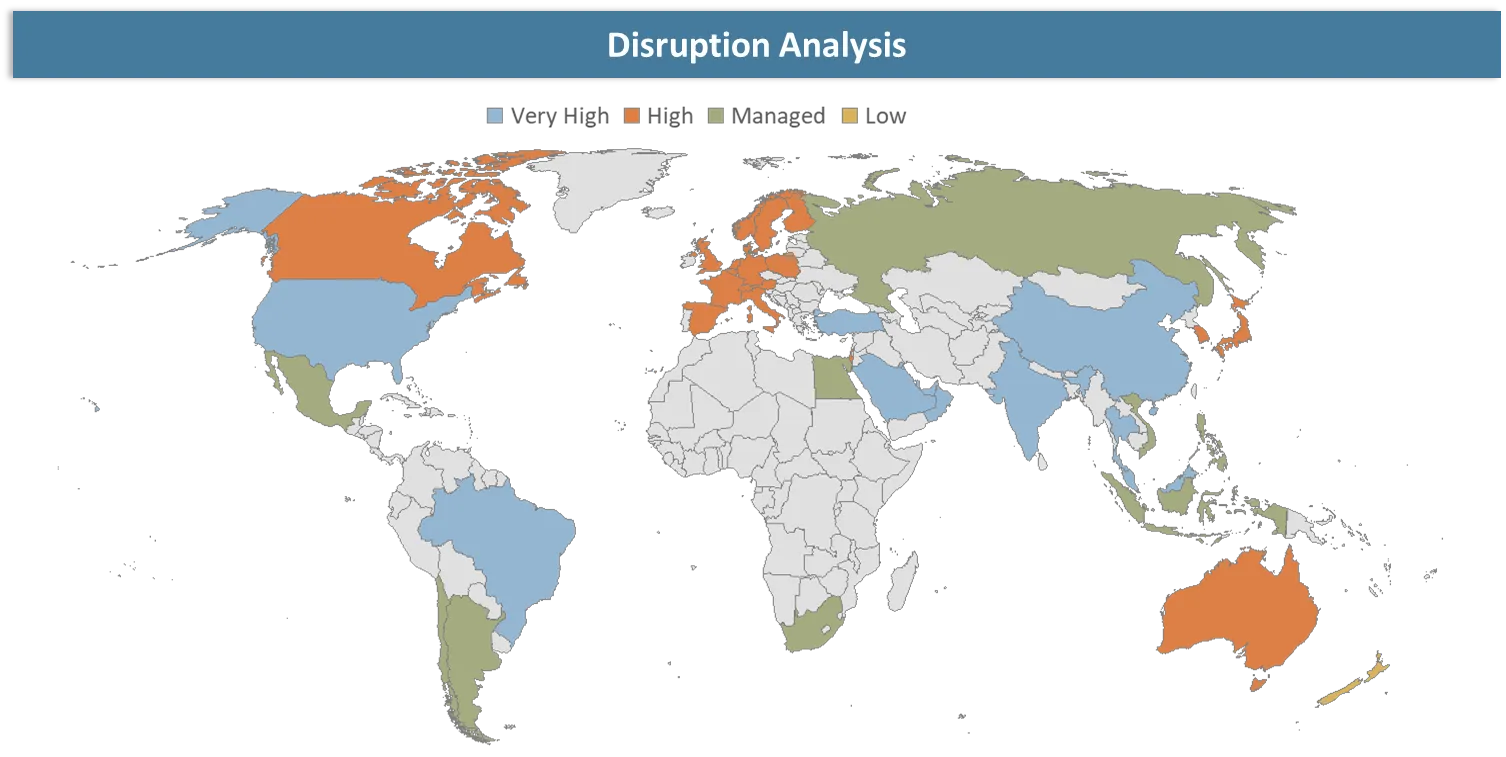
Evolving Manufacturing Requirements and Material Innovations Influencing Industrial Fasteners Market Development
The global industrial fasteners market is undergoing significant transformation due to changing requirements across automotive, aerospace, construction, energy, and industrial manufacturing sectors. Increasing demand for lightweight vehicles, advanced machinery, electric vehicles, and high-performance aerospace systems is driving the adoption of specialized fastening solutions that offer improved strength, durability, corrosion resistance, and weight reduction. Advanced material fasteners, which include titanium alloy, aluminum, and alloy material fasteners, are becoming common alternatives to traditional steel fasteners in order to satisfy performance needs of modern applications. However, there are certain challenges faced by the industry such as volatility in the price of raw material, disruptions in the supply chain, shortage of special manufacturing capabilities, and growing need for cost reduction. Increased complexities of modern end-use applications demand custom-designed and engineered fasteners with increased accuracy and performance.
Industrial Fasteners Market BCG Matrix: Company Evaluation
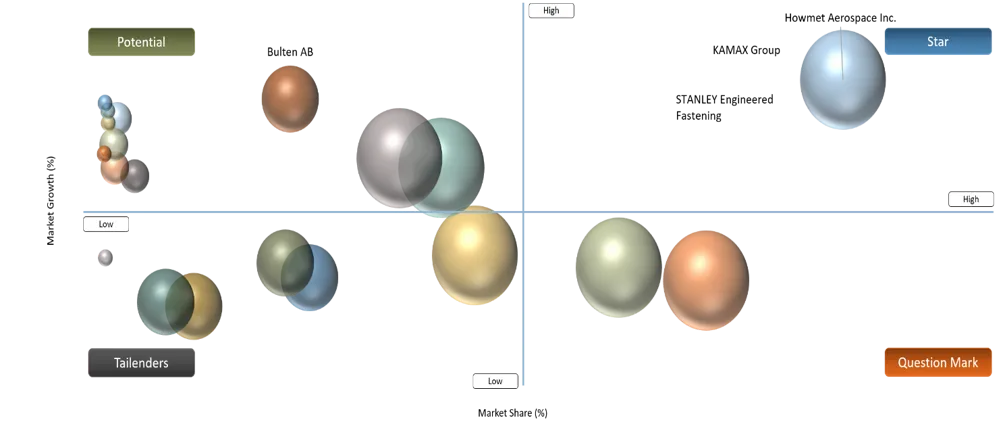
Howmet Aerospace Inc., STANLEY Engineered Fastening, and KAMAX Group are classified as Star competitors due to their strong market positions, extensive manufacturing capabilities, and global presence across aerospace, automotive, defense, and industrial applications. Their focus on high-strength, lightweight, and engineered fastening solutions positions them well to benefit from increasing demand for advanced fasteners. Bulten AB, LISI Group, PennEngineering, and SFS Group AG are categorized as high-growth players, supported by rising adoption of customized fasteners, precision fastening systems, and lightweight materials across automotive, aerospace, and industrial sectors. Würth Group, Illinois Tool Works Inc., and Sundram Fasteners Ltd. represent established competitors with strong customer relationships, broad product portfolios, and significant industry experience. Meanwhile, Portland Bolt & Manufacturing Co., The Federal Group USA Inc., Threaded Fasteners Inc., Birmingham Fastener, and Koelner Rawlplug Group are positioned as emerging/niche players, where growth is driven by specialized fastening products, regional demand, infrastructure development, and customized application requirements.
Industrial Fasteners Market Dynamics
Driver Impact Analysis
| Driver | Market Growth Impact (%) | Demand Concentration | Impacted Use Case | Strategic Impact |
Expansion of Automotive and Electric Vehicle (EV) Production | 30% | Strong demand concentration in Asia-Pacific, North America, and Europe due to large automotive manufacturing hubs and increasing EV production capacity. | Vehicle assembly, battery packs, chassis systems, powertrain components, and lightweight vehicle structures. | Accelerates demand for high-strength, lightweight, and corrosion-resistant fasteners and encourages development of specialized automotive fastening solutions. |
Growth of Construction and Infrastructure Development | 25% | High demand across Asia-Pacific, Middle East, and North America due to urbanization, commercial construction, transportation projects, and industrial infrastructure investments. | Structural fastening, bridges, buildings, rail infrastructure, industrial facilities, and heavy construction equipment. | Supports demand for high-strength bolts, anchors, and corrosion-resistant fastening systems while expanding opportunities for large-scale fastener manufacturers. |
Increasing Aerospace and Defense Manufacturing Activities | 20% | Demand concentrated in North America and Europe, with growing aerospace manufacturing activities in Asia-Pacific. | Aircraft structures, defense equipment, military vehicles, engines, and aerospace components. | Drives adoption of advanced fasteners made from titanium, nickel alloys, and other high-performance materials requiring precision manufacturing capabilities. |
Expansion of Renewable Energy and Power Infrastructure Projects | 15% | Growing demand in Europe, China, North America, and emerging markets due to wind, solar, and energy infrastructure investments. | Wind turbines, solar mounting systems, power generation equipment, and energy transmission infrastructure. | Increases demand for durable, corrosion-resistant, and specialized fasteners designed for harsh operating environments. |
Increasing Infrastructure Investments Driving Demand for Structural Fasteners
The swift development of offshore wind energy solutions represents a key driver for the market for
Increasing investments in transportation networks, urban development, and industrial infrastructure are driving demand for industrial fasteners used in large-scale construction applications. Modern infrastructure projects require high-strength structural fasteners that provide reliable load-bearing performance and long-term joint integrity in critical structures such as bridges, steel buildings, rail systems, and industrial facilities. Government-led infrastructure investment is playing a significant role in supporting demand for industrial fasteners by accelerating large-scale construction and modernization projects. For instance, in June 2025, the U.S. Department of Transportation (USDOT) announced the availability of nearly $5.4 billion in bridge funding under the Bridge Investment Program, including approximately $4.9 billion for major bridge projects and up to $500 million for rural bridge repair and replacement projects. These investments support bridge rehabilitation, replacement, and construction activities, increasing demand for structural fastening components such as high-strength bolts, structural fasteners, and anchoring systems used in large infrastructure projects.
Restraint Impact Analysis
| Restraint | Drag on Market Growth (%) | Primary Impact Area | Impacted Use Case | Strategic Impact |
Fluctuating Raw Material Prices and Supply Chain Disruptions | 30% | Steel, stainless steel, aluminum, titanium, nickel alloys, and other specialty material availability and pricing. | Automotive, aerospace, construction, industrial machinery, and energy sector fasteners. | Increases production costs, affects pricing stability, and creates challenges for manufacturers in maintaining consistent supply and margins. |
High Competition and Price Pressure in Standard Fastener Segments | 25% | Commodity fastener production, supplier margins, and global manufacturing competition. | Standard bolts, nuts, screws, washers, and general-purpose fastening products. | Limits profitability for manufacturers and encourages companies to focus on customized, engineered, and high-value fastening solutions. |
Limited Availability of Specialized Manufacturing Capabilities | 20% | Precision manufacturing, advanced materials processing, quality certification, and specialized production capacity. | Aerospace fasteners, titanium fasteners, EV fastening systems, and defense applications. | Restricts rapid scaling of high-performance fastener production and increases dependency on specialized suppliers. |
Increasing Quality Standards and Certification Requirements | 15% | Compliance with aerospace, automotive, defense, and industrial quality standards such as ISO, AS, and customer-specific requirements. | Aircraft components, automotive safety systems, defense equipment, and critical industrial machinery. | Increases testing, certification, and production costs while extending product development timelines for manufacturers. |
Fluctuating Raw Material Prices and Supply Chain Disruptions Impacting Fastener Production
Fastener manufacturing companies are extremely dependent on the raw materials available in the market such as carbon steel, stainless steel, aluminum, titanium, and alloyed materials. Therefore, the cost sensitivity of the industry is influenced by price changes and availability in materials markets such as steel prices, energy costs, and other related factors. Geopolitical events also affect the prices and cost of material sourcing. In 2025, rising steel costs and trade-related uncertainties increased cost pressures for fastener manufacturers in the U.S. The implementation of higher tariffs on steel and other metal products contributed to increased input costs across industrial supply chains. Fastenal, one of the largest industrial fastener distributors, reported price increases for steel fasteners during 2025 as manufacturers faced higher material costs. During the same period, U.S. hot-rolled steel prices increased from approximately $695 per ton in January 2025 to $877 per ton by July 2025, affecting the pricing of steel-based industrial components, including fasteners.
Moreover, supply chain disruptions may lead to shortages of specialized fasteners. In April 2025, a disruption in the production process of SPS Technologies, an aerospace fasteners provider, caused a shortage of some nuts and bolts needed in the manufacture of airplanes. This disruption led to problems in the aerospace supply chain, as Boeing had to look for other suppliers of these nuts and bolts. After the supply chain interruption, Boeing managed to find alternative sources for the nuts and bolts from other suppliers but at a higher cost in order not to disrupt its manufacturing process of the 737 MAX plane. Boeing also engaged with its current suppliers and looked for other sources of supplies despite the long certification period involved in doing so.
Industrial Fasteners Market Segment Analysis
The global industrial fasteners market is segmented based on product type, raw material, end-use industry and region.
Automotive Applications are Projected to Witness Strong Growth in the Industrial Fasteners Market
The Automotive & Electric Vehicles (EVs) industry is anticipated to experience robust growth owing to the rising vehicle electrification, lightweighting trends, and increased automotive manufacturing capacity globally. The use of industrial fasteners is widespread within the automotive industry in applications such as the construction of vehicles, batteries, chassis, and powertrains. According to the IEA, Global EV Outlook 2025, global sales of electric cars in 2024 were above 17 million units, which accounted for more than 20% of all car sales in the world. Major manufacturers including Tesla, BYD, Volkswagen, and other global OEMs are scaling up their electric vehicle production capabilities, creating opportunities for fastener manufacturers for the automotive industry. There is a need for specialized fastening products in electric vehicles because of the need for increased vibration resistance, thermal stability, weight reduction, and corrosion protection.
Industrial Fasteners Market Geographical Penetration
Infrastructure Renovation and Government Modernization Programs Supporting Fastener Market Growth in North America
Aged infrastructure coupled with investments in transportation, commercial buildings, and industrial structures is fueling the growth of the structural fastener market in North America. Structural renovation projects have high demands for high-strength bolts, fasteners, and anchorages to assist in the renovation, development, and construction of bridges, buildings, railways, and other industrial structures. Structural replacement activities are further contributing towards increased demand for structural fasteners due to their durability and corrosion resistance. Government-led building modernization programs in North America are supporting construction activity and creating demand for industrial fasteners used in structural applications. For instance, in August 2024, the Government of Canada launched the third intake of the Green and Inclusive Community Buildings (GICB) Program, providing funding of up to USD 18.3 million per project for the construction of new community buildings and retrofits, repairs, and upgrades of existing public facilities. The program supports improvements that enhance energy efficiency, reduce environmental impacts, and improve accessibility in community buildings.
U.S. Industrial Fasteners Market Trends
The demand for lightweight, high-performance, and locally-produced fastening components in the US industrial fastener market is growing, especially in defense. The United States Army is conducting a study on the use of titanium fasteners as a substitute for traditional steel fasteners in ground vehicles because of the need to achieve lightweighting, high performance, and corrosion-resistant components and to be less vulnerable in the supply chain. The case of IperionX's titanium fastener program shows how a modern fastener technology can evolve from strategy to qualification and low-rate production. For instance, between 2024 and 2026, IperionX worked with the U.S. Army Ground Vehicle Systems Center (GVSC) to develop titanium products for military ground vehicles. The program later focused specifically on titanium fasteners as a lightweight and high-strength alternative to conventional steel fasteners. GVSC and American Rheinmetall participated in the testing and prototyping phase in 2025, whereas in 2026, the IperionX secured a US$300,000 order in low-rate production that amounts to around 3 metric tons of titanium prior to any machining and finishing. The fasteners are currently undergoing evaluation as replacements for two sets of ground-vehicle fasteners. This case study clearly illustrates the potential for growth in the titanium and specialty alloy fasteners manufacturing industry among U.S. companies. The qualification process also underlines the need for testing, certification, and customer evaluation to transform defense fastener projects into profitable commercial deals.
The swift growth of commercial satellite constellations, space systems that deal with national security issues, and civil space programs is pushing up the spacecraft manufacturing and launching processes and creating a need for more aerospace fasteners that are lighter weight and more durable. Another aspect of the development in the aerospace sector is moving towards the use of large satellite constellations and distributed space architectures. In 2025 alone, more than 3,700 objects were launched from the US, nearly ten times the level seen in 2019.
Rising Industrial Fastener Demand Across Canada’s Manufacturing Sector
The advanced manufacturing system present in Canada, especially in the aerospace and automotive industries, is creating more need for high-quality industrial fasteners. Canada’s robust aerospace industry needs fasteners that meet the specific needs of aircraft construction, as well as fasteners needed to assemble engines and other parts of aircraft. Canada’s aerospace sector makes up more than $26.3 billion each year to GDP and is considered one of the largest aerospace market in the world. Quebec is considered the center for this sector, making up over 50% of Canada’s aerospace industry, where leading aerospace firms such as Bombardier, Pratt & Whitney Canada, CAE, Bell Textron Canada, and Airbus Canada have operations.
Additionally, the growing adoption of electric vehicles is expanding opportunities for automotive fastener manufacturers. According to Statistics Canada, March 2026 data showed that Canada recorded 21,574 zero-emission vehicle (ZEV) sales, representing a 74.7% year-over-year increase. ZEVs accounted for 12.2% of total new vehicle sales, compared with 6.5% in the previous year, highlighting the rapid growth of electric vehicle adoption and increasing demand for advanced automotive fastening solutions. The growth of EV production and adoption is increasing demand for lightweight fastening solutions used in battery packs, electric powertrains, chassis systems, and vehicle structures.
Large-Scale Transmission Infrastructure Expansion in Asia-Pacific Supporting industrial fasteners Market Growth
Asia-Pacific holds the leading position in the industrial fastenerss market during the forecast period (2026–2035), registering a CAGR of around 5.1%, driven by its large manufacturing ecosystem, strong automotive production base, rapid industrialization, and increasing infrastructure investments. Countries such as China, India, Japan, and South Korea are major contributors to regional demand, supported by automotive manufacturing, electric vehicle production, industrial machinery, electronics, and construction activities. As China is the world's biggest manufacturer of EVs, it raises the need for industrial fasteners that are utilized in assembling vehicles, batteries, chassis frames, electric engines, and lightweight parts. The fast growth of the production of EVs leads to the growing demand for highly engineered fasteners made of high-strength, lightweight, corrosion-resistant materials used for next-generation vehicles. In 2025, China produced close to 75% of the total amount of electric cars and accounted for almost 40% of all electric car trade in the world, having produced about 16 million electric cars.
Japan’s Expanding Submarine industrial fasteners Deployment Supporting Market Growth
Japan has a large and well-established fastener manufacturing base, supporting demand across automotive, electronics, construction, machinery, and other manufacturing industries. According to the Fasteners Institute of Japan (FIJ), the Japanese fastener industry comprises approximately 3,000 manufacturers, collectively producing around USD 6.3 billion worth of fasteners annually. In addition, approximately 400 distributors and trading companies generate around USD 2.8 billion in annual revenue, highlighting the depth of Japan's fastener manufacturing and distribution ecosystem.
Furthermore, The rapid adoption of electric vehicles (EVs) is driving demand for specialized automotive fasteners used in battery systems, electric powertrains, vehicle body structures, and other components. EV manufacturers require lightweight, high-strength, corrosion-resistant, and precision fastening solutions to support vehicle weight reduction, battery safety, and reliable assembly. According to Japan Automobile Dealers Association and other industry bodies, Japan’s EV sales reached 59,337 units in the first half of 2026, representing 2.1 times growth compared with the same period in 2025. EVs accounted for a record-high approximately 3% of total passenger car sales during the period. The growth was supported by new EV model launches and government purchase incentives, with models such as Toyota’s bZ4X recording 13,777 units in sales during the period.
Growth Outlook for Industrial Fasteners in India
Growth of domestic manufacturing, automotive production, and infrastructure development is increasing demand for industrial fasteners in India. The large base of automotive manufacturers in India is major factor contributing to the growth in demand for fasteners, which are extensively used in automobile assembly, engine, chassis systems, and in parts that are critical from the perspective of safety. Moreover, the growing trend towards use of electric vehicles is generating demand for fasteners with special properties. India recorded 2.55 million EV sales in FY2025–26, representing a 25% year-on-year increase, while EVs accounted for 8.3% of total vehicle registrations during the period.
The rise in the production capacity of domestic fasteners in India is contributing to the provision of high-quality, precision-engineered fastening systems. Indian fastener manufacturers are focusing on making vertical integration facilities and forging technology advancements along with implementing automation in the quality system to increase the production capacity and to satisfy the needs of the OEMs. For instance, in May 2026, Super Screws Pvt. Ltd. commissioned a vertically integrated cold forging fastener manufacturing facility in Bawal, Haryana, India. The facility enables production of fasteners ranging from M2 to M28 sizes and up to 500 mm lengths, supported by integrated heat treatment, surface treatment, and automated quality inspection capabilities.
Industrial Fasteners Market Competitive Landscape
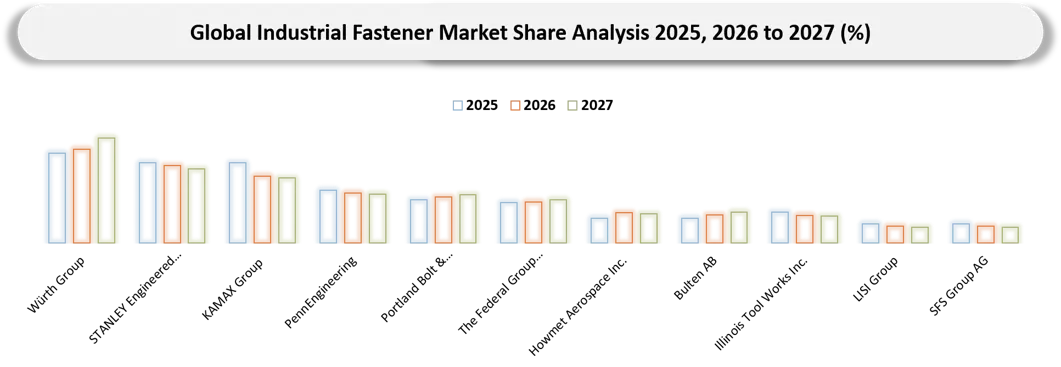
- The global industrial fasteners market is characterized by the presence of large-scale fastener manufacturers, engineered fastening solution providers, and diversified industrial component companies serving automotive, aerospace & defense, construction, machinery, energy, and electronics industries. Würth Group, STANLEY Engineered Fastening, KAMAX Group, PennEngineering, Howmet Aerospace, and Illinois Tool Works (ITW) are among the leading players due to their extensive manufacturing capabilities, broad product portfolios, and strong presence across major industrial applications. Würth Group maintains a strong position through its extensive fastener portfolio, global supply network, and industrial fastening solutions serving automotive, construction, and manufacturing customers. STANLEY Engineered Fastening, KAMAX Group, and PennEngineering hold significant positions in engineered fastening solutions, particularly for automotive, aerospace, and industrial applications, supported by their expertise in specialized fasteners, high-performance components, and application-specific solutions. Howmet Aerospace strengthens its market position through advanced aerospace fastening technologies, supplying lightweight and high-strength fasteners for aircraft and defense applications. Meanwhile, companies such as Bulten AB, LISI Group, SFS Group AG, and Sundram Fasteners Ltd. contribute to the competitive landscape through their automotive, aerospace, and industrial fastener manufacturing capabilities. Portland Bolt & Manufacturing Co., The Federal Group USA, Threaded Fasteners Inc., Birmingham Fastener, and Koelner Rawlplug further support market competition through their expertise in structural fasteners, construction fastening systems, and specialty industrial applications.
- Würth Group (Germany), STANLEY Engineered Fastening (United States), KAMAX Group (Germany), PennEngineering (United States), Howmet Aerospace Inc. (United States), Illinois Tool Works Inc. (ITW) (United States), Bulten AB (Sweden), LISI Group (France), SFS Group AG (Switzerland), Sundram Fasteners Ltd. (India), Portland Bolt & Manufacturing Co. (United States), The Federal Group USA (United States), Threaded Fasteners Inc. (United States), Birmingham Fastener (United States), and Koelner Rawlplug IP (Poland).
Key Developments
- June 2026: Rox Capital Partners acquired Interstate Threaded Products, a Dallas-based manufacturer and distributor of specialty threaded fasteners, to launch its industrial fastener platform. The acquisition aims to support the company’s expansion through organic growth initiatives and strategic acquisitions. Interstate Threaded Products manufactures and supplies threaded fasteners and custom fastening solutions, including anchor bolts, all-thread rods, studs, U-bolts, nuts, and custom components, serving industries such as infrastructure, power generation, construction, telecommunications, industrial manufacturing, and agriculture.
- April 2025: Rocket Industrial expanded its exclusive Zenith product line by launching Zenith Fasteners, adding a range of industrial fastening products including nails, staples, and compatible fastening tools. The new product line is designed to support packaging, pallet manufacturing, crate building, and industrial assembly applications, providing businesses with cost-effective fastening solutions.
- April 2024: TR Fastenings launched its new Plas-Tech 30-20® screws, expanding its range of engineered fastening solutions for plastic applications. Manufactured at TR Fastenings’ own facilities, the new screws feature an optimized thread profile designed to improve joint strength, vibration resistance, and installation efficiency across automotive, industrial machinery, technology, and consumer applications.
Key Procurement Priorities and Buyer Evaluation Criteria
- Buyers prioritize industrial fasteners with proven mechanical performance, dimensional accuracy, material quality, and compliance with international standards to ensure reliability across demanding applications such as automotive, aerospace, construction, energy, and industrial machinery.
- Evaluation is based on criteria such as fastener strength, material composition, corrosion resistance, manufacturing capabilities, quality certifications, production capacity, and experience supplying application-specific fastening solutions for critical industrial applications.
- Buyers consider factors including product durability, load-bearing performance, fatigue resistance, supply chain reliability, delivery capabilities, traceability, and the ability to provide customized fastener solutions based on specific engineering requirements.
- Preference is given to manufacturers with expertise in high-performance fasteners, lightweight materials (titanium and aluminum), specialty alloy fasteners, precision-engineered components, and compliance with standards such as ISO, ASTM, SAE, and aerospace-specific requirements.
- Automotive, aerospace, and defense buyers particularly prioritize suppliers with proven qualification records, advanced manufacturing capabilities, testing facilities, and the ability to support long-term production programs with consistent quality and reliability.
Why Choose DataM?
- Technological Innovations: Explores advancements in data center power infrastructure technologies, including intelligent power distribution systems, high-efficiency UPS solutions, medium-voltage switchgear, digital power monitoring platforms and AI-enabled energy management systems that improve reliability, operational efficiency, scalability and power optimization for hyperscale, colocation and enterprise data centers.
- Product Performance & Market Positioning: Evaluates how different players deliver power infrastructure solutions based on power efficiency, system reliability, scalability, uptime performance, energy management capabilities and integration with renewable energy sources, highlighting how leading companies differentiate through advanced electrical architectures, modular designs and solutions optimized for AI-driven high-density computing environments.
- Real-World Evidence: Highlights adoption of advanced power infrastructure solutions across hyperscale data centers, cloud facilities, AI computing campuses and enterprise data centers, demonstrating benefits such as improved power availability, reduced energy losses, enhanced operational continuity, optimized electricity management and support for increasing rack power densities.
- Market Updates & Industry Changes: Tracks key developments such as AI data center expansion, utility partnerships, renewable power integration, hyperscale facility investments, grid infrastructure upgrades and deployment of next-generation power distribution systems across North America, Asia-Pacific and Europe, supporting the transition toward sustainable and resilient data center ecosystems.
- Competitive Strategies: Analyzes how leading companies expand through product innovation, strategic partnerships, acquisitions, global service network expansion and development of integrated power management solutions to address rising demand for reliable electricity supply driven by AI, cloud computing and high-performance computing applications.
- Pricing & Market Access: Explains pricing variations based on power capacity, equipment type, efficiency ratings, customization requirements and integration complexity, along with access through electrical equipment manufacturers, data center infrastructure providers, system integrators and utility partnerships supporting global deployment.
- Market Entry & Expansion: Identifies growth opportunities driven by AI infrastructure growth, hyperscale data center development, edge computing adoption, renewable energy integration and digital transformation, while outlining strategies such as regional manufacturing expansion, energy-efficient product development, ecosystem partnerships and customized power solutions to strengthen global market presence.
Target Audience
- Data Center Operators and Hyperscale Companies
- Cloud Service Providers and Technology Companies
- Electrical Equipment Manufacturers and Power Solution Providers
- Data Center Infrastructure Developers and Investors
- Utility Companies and Energy Providers
- System Integrators and Engineering, Procurement & Construction (EPC) Companies
- Government Bodies and Regulatory Authorities


























































