


Industrial 3D Printing Gases Market Overview
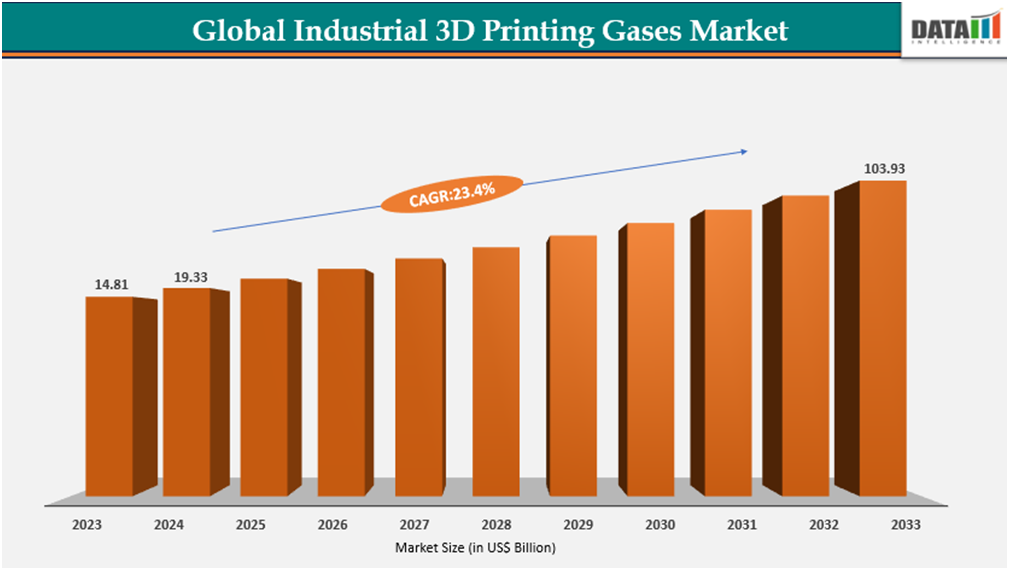
The global industrial 3D printing gases market reached US$ 23.86 billion in 2025 and is expected to reach US$ 128.25 billion by 2033, growing at a CAGR of 23.4% during the forecast period 2026–2033.
The global industrial 3D printing gases market represents a vital segment of the additive manufacturing industry, valued for its role in enhancing print quality, precision, and material performance across sectors such as aerospace, automotive, healthcare, and electronics. With industries increasingly emphasizing sustainability, efficiency, and high-performance production, specialty gases like nitrogen, argon, and oxygen are becoming indispensable for ensuring consistent, defect-free prints. The market is driven by rising adoption of 3D printing technologies, ongoing innovation in gas supply solutions, and growing demand for environmentally-friendly and cost-efficient manufacturing processes on a global scale.
Industrial 3D Printing Gases Market Size and Future Outlook
2025 Market Size: US$23.86 Billion
2033 Projected Market Size: US$128.25 Billion
CAGR (2026-2033):23.4%
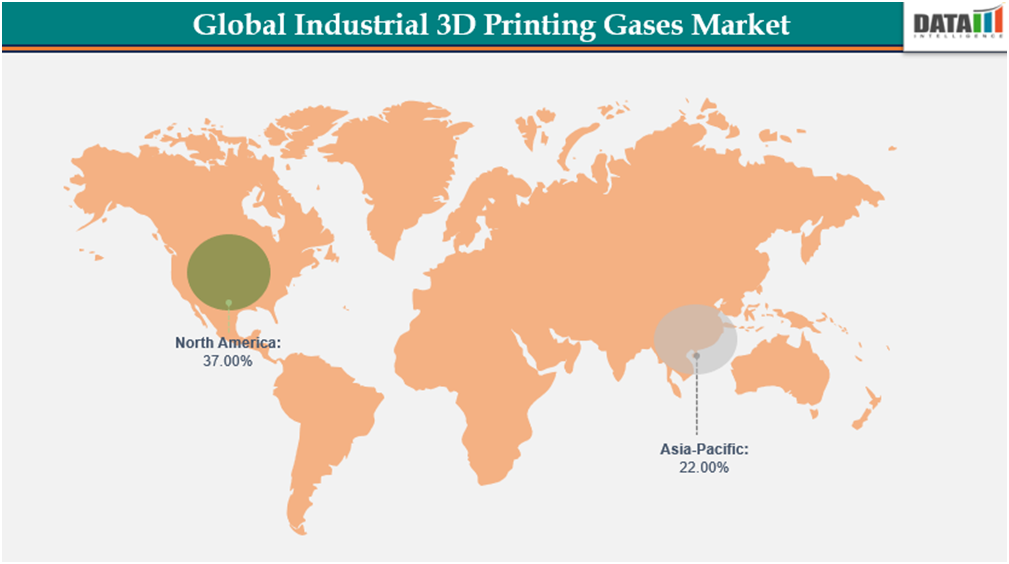
Largest Market: North America
Fastest Market: Asia-Pacific
Industrial 3D printing Gases Market Scope
Metrics | Details |
By Gas Type | Argon, Nitrogen, Helium, Hydrogen, Carbon Dioxide, Others |
By Purity | Ultra-High-Purity, High-Purity |
By Technology | Laser Powder Bed Fusion (LPBF), Electron Beam Melting (EBM), Directed Energy Deposition (DED), Binder-Jetting, Stereolithography / PolyJet / FDM |
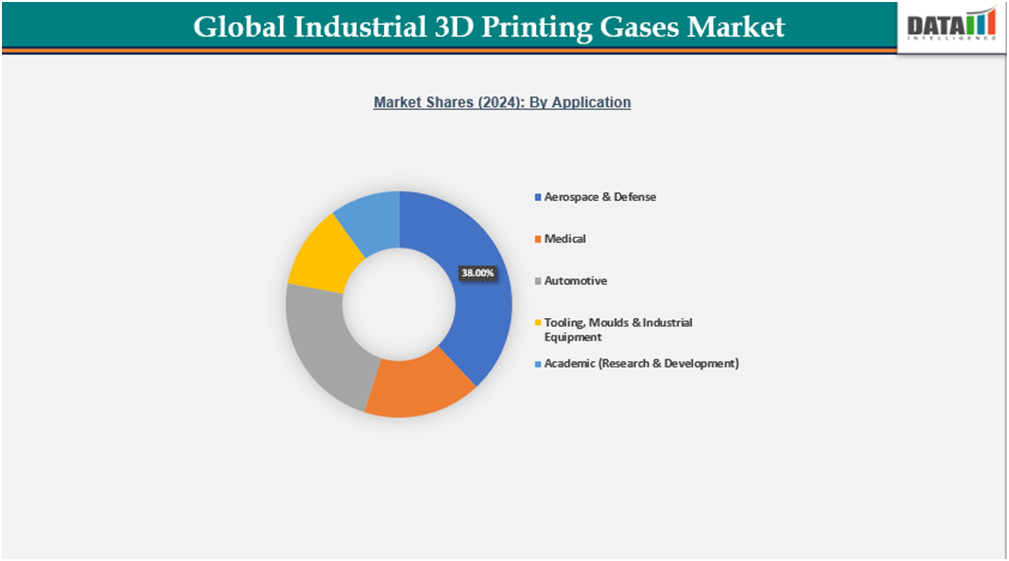
By Application | Aerospace & Defense, Medical, Automotive, Tooling, Moulds& Industrial Equipment, Academic (Research & Development) |
By Region | North America, South America, Europe, Asia-Pacific, Middle East and Africa |
Report Insights Covered | Competitive Landscape Analysis, Company Profile Analysis, Market Size, Share, Growth |
Industrial 3D printing Gases Market Dynamics
Rising Aerospace and Medical Adoption Fuels Demand for High-Purity Gases
Industrial 3D printing gases are increasingly critical across a broad range of end-use industries, including aerospace, medical, automotive, tooling, and research & development. The growing adoption of additive manufacturing for lightweight components, precision parts, and complex geometries is driving demand for high-purity inert, shielding, and reactive gases. Industries are leveraging these gases to enhance print quality, improve mechanical properties, and ensure consistent material deposition. Rising requirements for reliability, performance, and process efficiency in high-value applications such as aerospace parts and medical devices are accelerating the uptake of industrial 3D printing gases globally.
High Production and Purification Costs Limit Affordability Across Emerging Economies
The industrial and aerospace sectors are the largest consumers of industrial 3D printing gases, driven by the growing adoption of additive manufacturing for precision parts, metal components, and high-performance prototypes. Rising demand for high-purity gases is accompanied by challenges such as high production and purification costs, which can limit affordability in emerging economies. To address these issues, enterprises are investing in efficient gas production technologies, recycling methods, and cost-optimization strategies. These efforts help companies improve accessibility, enhance sustainability, and support the broader adoption of 3D printing technologies across diverse industries globally.
Segmentation Analysis
The global industrial 3D printing gases market is segmented based on gas type, purity, technology, application, and region.
Dominating Segment: Blow-Molded Products Driving Packaging Applications
The Asia-Pacific region is emerging as a key growth area for industrial 3D printing gases, driven by the rapid expansion of manufacturing hubs in countries such as China, India, and Japan. Industries including aerospace, automotive, medical, and tooling are increasingly adopting additive manufacturing technologies, creating strong regional demand for high-purity inert, shielding, and reactive gases. The growth of manufacturing infrastructure, coupled with rising investments in advanced 3D printing facilities, is opening lucrative opportunities for gas suppliers to cater to these untapped markets and support the region’s industrial transformation.
Why Industrial 3D Printing Gases Market Matters in 2026-2033
The Floating Industrial 3D Printing Gases Market is becoming a critical enabler of advanced offshore manufacturing and on-site component production.
As offshore energy, marine, defense, and remote industrial operations increasingly adopt additive manufacturing, high-purity industrial gases are essential for ensuring print quality, material integrity, and operational efficiency. The ability to manufacture replacement parts directly on floating platforms minimizes downtime, reduces logistics costs, and strengthens supply chain resilience.
Several macroeconomic and technological factors are accelerating market growth:
- Growing adoption of offshore additive manufacturing
- Rising investments in offshore wind and oil & gas infrastructure
- Increasing demand for on-demand spare parts production
- Expansion of maritime and naval modernization programs
- Advancements in metal additive manufacturing technologies
- Rising use of inert gases such as argon and nitrogen for precision printing
- Focus on reducing maintenance downtime and inventory costs
- Digitalization of offshore industrial operations
- Growth of decentralized manufacturing strategies
- Increasing demand for lightweight, high-performance metal components
Analyst View
DataM Intelligence Analyst Perspective
The Industrial 3D Printing Gases Market is transitioning from a niche industrial application into a strategic component of next-generation offshore manufacturing.
Long-term market growth will depend on:
- Availability of high-purity industrial gases
- Reliability of offshore additive manufacturing systems
- Expansion of offshore renewable energy projects
- Integration of digital manufacturing workflows
- Regulatory compliance for marine and offshore operations
- Development of portable and automated gas delivery solutions
- Strategic collaborations between gas suppliers, additive manufacturing companies, and offshore operators
The United States continues to lead technological innovation in industrial additive manufacturing, while Europe is accelerating adoption through offshore wind expansion and advanced maritime engineering. Japan and South Korea are strengthening investments in precision manufacturing and marine technologies, while China continues expanding offshore industrial capabilities. India is emerging as a promising market, supported by initiatives in offshore energy, shipbuilding, and advanced manufacturing.
Industrial 3D printing Gases Market Geographical Penetration
North America's Market Leadership and Technological Advancements
North America holds a significant share of the global industrial 3D printing gases market, supported by mature industrial adoption, high automation levels, and advanced additive manufacturing infrastructure. The U.S. is the largest regional contributor, driven by strong demand in aerospace, automotive, medical, and tooling sectors. Technological advancements focus on improving gas purity, process efficiency, and sustainable practices. Canada contributes through innovations in high-purity gases and niche applications in research & development and industrial manufacturing.
United States Industrial 3D Printing Gases Market Insights
The United States represents one of the most mature and advanced markets for industrial 3D printing gases, propelled by a large-scale industrial base and widespread adoption of additive manufacturing. High demand from aerospace and medical applications, along with growing use in automotive and tooling industries, drives market expansion. Additionally, increasing focus on process optimization, safety, and sustainability is fostering innovations in high-purity gas production. The U.S. market captures a significant share of the North American market, supported by leading industry players and strategic manufacturing investments.
Canada Industrial 3D printing gases Industry Growth
Canada accounts for a stable portion of the North American industrial 3D printing gases market, underpinned by rising adoption in aerospace, research, and industrial manufacturing applications. Investments in sustainable infrastructure, environmental initiatives, and technological innovations in gas production are boosting market prospects. Canadian suppliers are focusing on differentiated offerings, including high-purity gases for precision applications, driven by demand from niche industrial and research sectors.
Asia Pacific's Rapid Industrialization and Infrastructure Demand
Asia Pacific (APAC) is poised to be the fastest-growing region for industrial 3D printing gases, driven by rapid industrialization, urbanization, and large-scale investments in manufacturing and infrastructure. China leads the region with strong adoption of additive manufacturing in aerospace, automotive, and industrial tooling sectors, supported by leading domestic gas suppliers and advanced R&D initiatives. India is emerging as a high-growth market due to expanding industrial bases, infrastructure projects, and rising adoption of 3D printing technologies in medical, automotive, and packaging applications. Southeast Asia’s expanding manufacturing ecosystem is further fueling regional demand for high-purity and specialty industrial 3D printing gases.
India Industrial 3D Printing Gases Market Outlook
India is among the fastest-growing markets globally for industrial 3D printing gases, propelled by increasing industrial adoption, population growth, and rising use of additive manufacturing across aerospace, automotive, and healthcare sectors. Expanding infrastructure projects, a growing number of 3D printing facilities, and a robust network of domestic supplier’s support market growth. Regulatory emphasis on safety, environmental standards, and sustainable practices further drives the adoption of high-purity and specialty gases.
China Industrial 3D Printing Gases Market Trends
China dominates the APAC industrial 3D printing gases market, backed by strong government policies supporting additive manufacturing and industrial modernization. Regulations encouraging sustainability and efficiency are driving innovation in high-performance and environmentally-friendly gas solutions. Leading domestic producers are investing in R&D to develop specialty gases for aerospace, medical, automotive, and industrial applications, catering to both domestic and export markets. The focus remains on precision, process reliability, and supporting high-value additive manufacturing sectors.
Sustainability Analysis
Industrial 3D printing gases play a critical role in promoting sustainability in additive manufacturing. They enable reduced material wastage, improved energy efficiency, and longer-lasting performance of printed components across aerospace, medical, automotive, and industrial tooling applications. However, environmental concerns persist due to challenges in gas production, handling, and disposal.
Industry leaders are investing in advanced purification technologies, recycling methods, and closed-loop supply chains to minimize environmental impact. Regulatory frameworks are encouraging eco-friendly practices, prompting companies to innovate in sustainable gas solutions, reduce lifecycle emissions, and support greener additive manufacturing processes.
Industrial 3D printing Gases Market Competitive Landscape
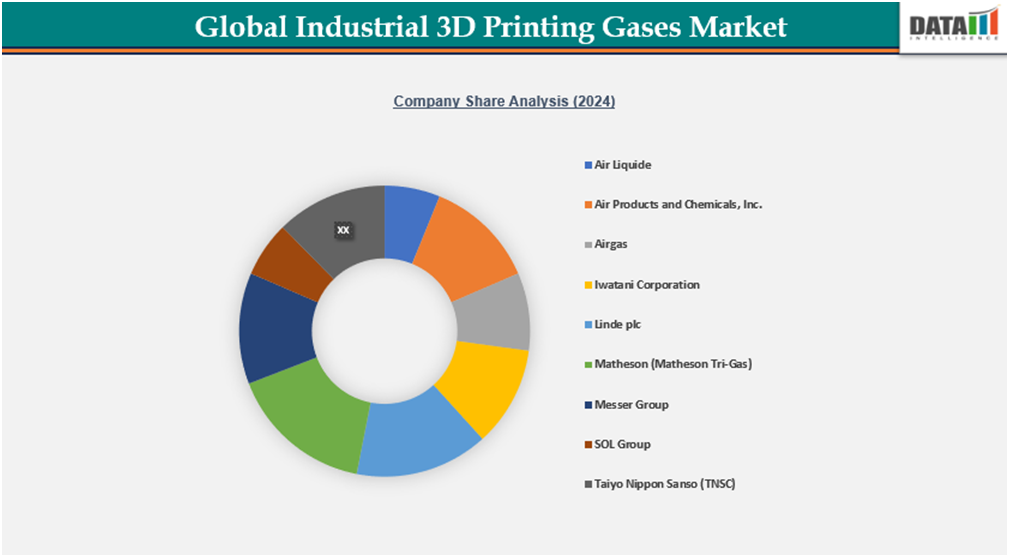
The global industrial 3D printing gases market is highly competitive and consolidated, driven by leading industrial gas suppliers focusing on economies of scale, production efficiency, and global market expansion.
Key players leverage extensive production networks, large-scale R&D investments, and robust distribution channels to maintain leadership.
Companies are developing high-purity and specialty gases tailored for additive manufacturing applications in aerospace, medical, automotive, and industrial tooling sectors.
Market participants are innovating in sustainable gas solutions, including recycling methods and closed-loop supply chains, to enhance environmental credentials.
Strategic partnerships, facility expansions, and technological advancements are core strategies to strengthen competitive positioning.
High-performance and differentiated gas solutions enable superior process reliability, product quality, and compliance with evolving global environmental regulations.
Key Developments
- May 2026: Air Liquide expanded ultra-high-purity gas production capacity in Europe and Asia to support rising demand from industrial 3D printing applications, including metal powder bed fusion and directed energy deposition systems requiring tightly controlled inert atmospheres.
- April 2026: Linde plc strengthened its additive manufacturing gas solutions portfolio by scaling dual-use semiconductor–3D printing gas infrastructure, enabling ultra-low impurity argon and nitrogen supply for high-precision metal additive manufacturing.
- March 2026: Air Products and Chemicals advanced automation-based gas delivery systems for industrial 3D printing facilities, improving real-time atmosphere control, process stability, and print quality consistency in large-scale additive manufacturing operations.
- February 2026: Global industrial gas suppliers increased integration of AI-driven gas monitoring systems for additive manufacturing environments, enabling continuous purity tracking (ppb-level control) to reduce oxidation defects in aerospace and automotive 3D-printed components.
- January 2026: Messer Group expanded partnerships with European additive manufacturing firms to supply customized nitrogen and argon gas blends optimized for selective laser melting (SLM) and electron beam melting (EBM) processes.
- December 2025: Iwatani Corporation strengthened industrial gas distribution networks in Asia-Pacific to support growing adoption of metal additive manufacturing in electronics, healthcare, and precision engineering industries.
Why Choose DataM?
Data-Driven Insights: Dive into detailed analyses with granular insights such as pricing, market shares, and value chain evaluations, enriched by interviews with industry leaders and disruptors.
Post-Purchase Support and Expert Analyst Consultations: As a valued client, gain direct access to our expert analysts for personalized advice and strategic guidance, tailored to your specific needs and challenges.
White Papers and Case Studies: Benefit quarterly from our in-depth studies related to your purchased titles, tailored to refine your operational and marketing strategies for maximum impact.
Annual Updates on Purchased Reports: As an existing customer, enjoy the privilege of annual updates to your reports, ensuring you stay abreast of the latest market insights and technological advancements. Terms and conditions apply.
Specialized Focus on Emerging Markets: DataM differentiates itself by delivering in-depth, specialized insights specifically for emerging markets, rather than offering generalized geographic overviews. This approach equips our clients with a nuanced understanding and actionable intelligence that are essential for navigating and succeeding in high-growth regions.
Value of DataM Reports: Our reports offer specialized insights tailored to the latest trends and specific business inquiries. This personalized approach provides a deeper, strategic perspective, ensuring you receive the precise information necessary to make informed decisions. These insights complement and go beyond what is typically available in generic databases.
Why Buy This Industrial 3D Printing Gases Market Report?
The Industrial 3D Printing Gases Market Report provides comprehensive market intelligence for organizations looking to capitalize on the rapidly evolving additive manufacturing ecosystem. As industries increasingly adopt metal additive manufacturing for aerospace, automotive, healthcare, energy, and industrial applications, the demand for high-purity process gases continues to rise. This report delivers actionable insights that help businesses make informed strategic decisions, reduce operational risks, and identify new revenue opportunities.
This report helps organizations:
Understand Future Industrial 3D Printing Gases Market Trends
Gain in-depth insights into emerging trends influencing the adoption of industrial gases in additive manufacturing, including the growing demand for inert gases, automation, sustainable manufacturing practices, and advanced metal printing technologies.
Identify High-Growth Investment Opportunities
Discover the most promising investment areas across gas production, specialty gas supply, additive manufacturing ecosystems, gas delivery systems, and next-generation metal 3D printing applications.
Benchmark Competitors Effectively
Evaluate the competitive positioning of leading industrial gas suppliers, additive manufacturing companies, and technology providers through detailed market share analysis, product portfolios, strategic initiatives, and innovation benchmarking.
Analyze Demand Across End-Use Industries
Understand how aerospace, automotive, medical devices, defense, energy, tooling, industrial manufacturing, and research institutions are driving demand for industrial 3D printing gases worldwide.
Optimize Market Expansion Strategies
Identify attractive regional markets, emerging economies, customer demand patterns, and industry-specific opportunities to support successful business expansion and strategic planning.
Evaluate Technology Advancements
Stay informed about advancements in gas purification technologies, powder bed fusion processes, directed energy deposition, gas monitoring systems, automated gas management, and additive manufacturing equipment innovations.
Assess Regional Growth Opportunities
Compare market performance across North America, Europe, Asia-Pacific, Latin America, and the Middle East & Africa to identify high-growth regions, favorable investment climates, and evolving manufacturing hubs.
Track Supply Chain and Industry Developments
Monitor raw material availability, industrial gas production capacity, distribution networks, pricing dynamics, supply chain resilience, and strategic partnerships influencing the global market.
What's Included in the Industrial 3D Printing Gases Market Growth?
The report delivers detailed market intelligence supported by extensive research, quantitative analysis, and industry expert insights.
The report provides:
Market Size & Forecast Analysis
Comprehensive market estimates with historical data, current market valuation, future forecasts, CAGR analysis, and long-term growth projections.
Regional Market Outlook
Detailed analysis of regional performance, country-level opportunities, production capabilities, consumption trends, regulatory developments, and investment hotspots.
Competitive Intelligence
Comprehensive profiles of leading industrial gas companies, emerging suppliers, technology innovators, and additive manufacturing ecosystem participants, including strategic initiatives and competitive positioning.
Technology Benchmarking
Evaluation of key gas technologies, additive manufacturing processes, gas delivery systems, purity standards, automation trends, and future technological innovations shaping the industry.
Pricing Analysis
Insights into industrial gas pricing trends, cost structures, procurement strategies, supply-demand dynamics, and pricing factors affecting manufacturers and end users.
Regulatory Assessment
Coverage of global regulations, industrial safety standards, environmental compliance requirements, quality certifications, and industry-specific guidelines impacting market growth.
Supply Chain Analysis
Detailed assessment of raw material sourcing, gas production, storage, transportation, distribution channels, supplier networks, and potential supply chain challenges.
Market Share Analysis
Competitive market share evaluation by company, region, product type, application, and end-use industry to understand market leadership and competitive dynamics.
Investment Landscape Analysis
Analysis of recent investments, mergers and acquisitions, strategic collaborations, expansion projects, manufacturing capacity additions, and funding activities across the industry.
Strategic Recommendations
Practical recommendations to support business expansion, product development, market entry strategies, partnership opportunities, pricing optimization, and long-term competitive growth.
Emerging Trends Analysis
Coverage of next-generation additive manufacturing, sustainable gas solutions, digital manufacturing integration, AI-enabled process optimization, and evolving customer requirements.
Company Profiling
Detailed profiles of major market participants, including business overview, product portfolio, financial performance, strategic developments, regional presence, and innovation initiatives.
Who Should Buy This Industrial 3D Printing Gases Market?
This report is designed for decision-makers, investors, technology providers, and organizations seeking reliable market intelligence within the additive manufacturing and industrial gases ecosystem.
This report is ideal for:
- Industrial gas manufacturers
- Specialty gas suppliers
- Additive manufacturing equipment manufacturers
- Metal 3D printing companies
- Aerospace manufacturers
- Automotive OEMs and suppliers
- Medical device manufacturers
- Energy and power companies
- Defense and aerospace contractors
- Industrial manufacturing companies
- Powder material manufacturers
- Gas distribution companies
- Research institutions and universities
- Engineering and technology consulting firms
- Private equity and venture capital firms
- Government agencies and regulatory organizations
- Market intelligence and business strategy teams
Key Benefits for Stakeholders
The Industrial 3D Printing Gases Market Report equips stakeholders with actionable insights to strengthen competitive positioning, identify growth opportunities, and make data-driven business decisions in a rapidly expanding market.
Gain actionable market intelligence to:
Understand Future Market Dynamics
Analyze evolving customer demand, technological advancements, industry adoption patterns, and macroeconomic factors shaping the future of industrial 3D printing gases.
Evaluate Global Growth Strategies
Understand how leading companies are expanding production capacity, entering new regional markets, forming strategic partnerships, and strengthening global distribution networks.
Assess Technology Innovation
Track innovations in high-purity industrial gases, gas flow management, process monitoring, additive manufacturing equipment, and digital manufacturing technologies.
Identify Strategic Growth Opportunities
Discover emerging application areas, high-growth industries, untapped regional markets, and investment opportunities that can accelerate business growth.
Benchmark Industry Leaders
Compare the strategies, product offerings, innovation capabilities, operational strengths, and market positioning of leading global companies.
Improve Investment and Business Decision-Making
Leverage reliable market forecasts, competitive intelligence, pricing analysis, investment trends, and strategic recommendations to reduce business risk and maximize long-term returns.
Support Long-Term Business Planning
Use comprehensive market insights to develop expansion strategies, optimize product portfolios, strengthen customer relationships, and capitalize on future opportunities in the global Industrial 3D Printing Gases Market.
Target Audience
Manufacturers/ Buyers
Industry Investors/Investment Bankers
Research Professionals
Emerging Companies
Related Reports
Polymers for 3D Printing Market
Polymers are among the most widely used materials in additive manufacturing, making them highly complementary to industrial 3D printing gases. Controlled gas environments improve print quality, minimize contamination, and enhance the mechanical properties of polymer-based components. Growing demand for lightweight, high-performance materials is driving innovation across both markets.
3D Printing High Performance Plastic Market
High-performance plastics require precise atmospheric control during additive manufacturing to ensure dimensional accuracy and material integrity. Industrial gases such as argon and nitrogen help prevent oxidation and improve surface finish during advanced printing processes. Expanding aerospace, medical, and automotive applications continue to fuel demand for both technologies.
Bioprinting and Tissue Engineering Devices Market
Bioprinting technologies rely on advanced additive manufacturing systems where controlled environments are essential for producing high-quality biological structures. Industrial gases support stable operating conditions and improve process reliability in specialized 3D printing applications. Increasing investment in regenerative medicine is creating new opportunities across both markets.
Bioprinting on Organ Transplant Market
The development of 3D bioprinted organs depends on precision manufacturing technologies and optimized printing environments. Specialty gases contribute to stable process conditions that improve print consistency and material performance. Continued advancements in healthcare additive manufacturing are strengthening demand for supporting technologies.
Aerospace and Defense Materials Market
Aerospace manufacturers extensively use metal additive manufacturing processes that depend on ultra-high-purity industrial gases to produce high-performance components. Controlled atmospheres reduce oxidation and ensure superior mechanical properties for mission-critical parts. Rising aircraft production and defense modernization are supporting growth across both markets.





























































