


Indonesia Variable Refrigerant Flow (VRF) System Market Overview
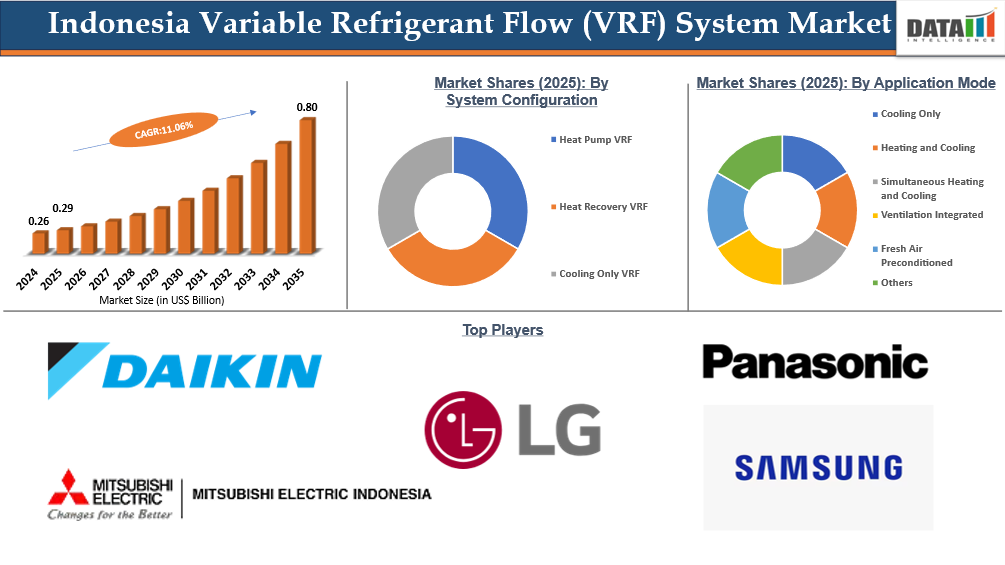
Indonesia Variable Refrigerant Flow (VRF) System market was US$ 0.29 billion in 2025 and is expected to reach US$ 0.80 billion by 2033, growing with a CAGR of 11.06% during the forecast period 2026-2033. The Indonesian Variable Refrigerant Flow (VRF) System Market is experiencing growth thanks to factors like fast-paced urbanization, growing commercial infrastructures and an emphasis on energy-efficient cooling solutions.
The building sector in Indonesia is a significant consumer of energy, consuming more than 30 percent of all consumed electricity according to International Energy Agency. Some recent developments that have occurred emphasize how active the industry is at the moment. Daikin Industries announced in March 2024 that it will continue expanding in Southeast Asia, which includes Indonesia, by emphasizing energy-efficient HVAC systems and inverters.
Variable Refrigerant Flow (VRF) System Industry Trends and Strategic Insights
- By System configurations, the heat pump VRF will be the biggest market by 2025, because these types of units can perform both cooling and heating services with minimal amounts of electricity required. The reason is that they offer high levels of flexibility and cost-efficiency, especially when used in multiple zones.
Indonesia Variable Refrigerant Flow (VRF) System Market Size and Future Outlook
- 2025 Market Size: US$ 0.29 Billion
- 2035 Projected Market Size: US$ 0.80 Billion
- CAGR (2026-2035): 11.06%
Market Scope
| Metrics | Details | |
| By System Configuration | Heat Pump VRF, Heat Recovery VRF, Cooling Only VRF | |
| By Condenser Cooling Source | Air Cooled, Water Cooled, Others | |
| ByOutdoor Unit Capacity | Up to 8 HP, 8.1 to 12 HP, 12.1 to 20 HP, 20.1 to 28 HP, 28.1 to 40 HP, 40.1 to 60 HP, Above 60 HP | |
| By Indoor Unit Type | Cassette, Ducted, Wall Mounted , Floor Standing, Ceiling Suspended, Concealed Floor, AHU Connected Unit, Ventilation Connected Unit, Others | |
| By Controls and Connectivity | Local Controls, Centralized Controls, VRF Interfaces and Project Accessories, Others | |
| ByRefrigerant | R410A, R32, Others | |
| ByImplementation | New Construction, Retrofit Replacement, Retrofit Expansion | |
| By End-User | Residential, Commercial, Industrial | |
| By Application Mode | Cooling Only, Heating and Cooling, Simultaneous Heating and Cooling, Ventilation Integrated, Fresh Air Preconditioned, Others | |
| Report Insights Covered | Competitive Landscape Analysis, Company Profile Analysis, Market Size, Share, Growth | |
Request for Sample Click Here
Market Dynamics
Increasing Demand for Energy-Efficient HVAC Solutions
The growing need for energy-efficient HVAC systems is one of the main factors that is expected to propel the Indonesia VRF system market. As the need for sustainable living continues to increase, building owners are adopting efficient HVAC systems. VRF systems provide energy savings of up to 30% to 40% more than traditional HVAC systems. Therefore, commercial buildings, which require higher air conditioning needs, are opting for VRF systems due to the lower operating costs.
Policies and trends have been supporting the growth of energy efficiency in the construction sector in Indonesia. For instance, Indonesia has been promoting energy-efficient technologies using guidelines that meet global standards developed by the International Energy Agency, among other international institutions. Besides, the Green Building Council of Indonesia has launched local policies for promoting energy efficiency in the building industry. Global HVAC system manufacturers, such as Daikin Industries and LG Electronics, have been introducing inverter-based and smart VRF systems in Southeast Asia.
High Initial Installation Cost of VRF Systems
The relatively expensive cost of installation of VRF technology constitutes a significant constraint in the Indonesian market, especially among the economically conscious consumers. VRF systems demand more initial investments compared to conventional air conditioning devices because of their sophisticated nature and special installation requirements, which makes them more expensive than other heating ventilation air conditioning units. The problem with high initial investment is more pronounced for smaller to medium-sized buildings that have limitations on budget allocation.
Market trends show that this remains a significant barrier. Insights obtained from international energy agencies' research on energy conservation in the region, especially in developing countries such as Indonesia, indicate slow adoption of advanced cooling and heating technology owing to high initial costs and lack of suitable financing mechanisms. Expert installation and proper design are essential factors in installing such systems, thus adding to the initial installation expenses. Despite that, VRF systems still enjoy more application in large commercial or premium buildings; however, cost sensitivity will continue to act as a limitation until awareness of the technology grows.
Segmentation Analysis
The Indonesia variable refrigerant flow (VRF) system market is segmented based on system configuration, condenser cooling source, outdoor unit capacity, indoor unit type, controls and connectivity, refrigerant, implementation, end-user and application mode.
Rising Adoption of Energy-Efficient Heat Pump VRF Systems
Heat pump VRF category is experiencing a growth due to rising demand for energy efficient and flexible HVAC solutions in the commercial and high-rise building applications. The heat pump VRF systems work through transfer of heat and not generation. It makes the heat pump VRF system highly efficient as compared to other HVAC systems. Heat pump VRF can be used for cooling and heating purposes in the same system thereby offering year-round operation at reduced cost of operations and energy consumption. Energy efficiency has been identified as an important requirement in most modern buildings and this factor is driving its use.
Performance wise, the heat pump VRF systems can save up to 30%-40% of energy costs through the use of inverter operated compressors and variable flow of the refrigerant depending on load. Annual energy savings offered by heat pump VRF systems range from 14% to 39% compared to regular roof-top units. Temperature zoning and partial loading capabilities make the heat pump VRF systems highly efficient. Heat pump VRF systems will become more popular in the VRF systems market as a result of cost optimization and energy efficiency measures in buildings.
Sustainability Analysis
The significance of heat pump VRF systems in enhancing the sustainability profile of HVAC infrastructure is attributed to their highly efficient energy consumption and low carbon footprint. Compared to traditional systems that generate heat or cool air through energy-intensive processes, the heat pumps make use of inverter compressor technology that optimizes its performance according to demand. It leads to lower energy consumption and fewer greenhouse gases emitted into the atmosphere, especially in office spaces where HVAC systems consume a considerable amount of energy.
The feature of providing cooling and heating for zones ensures minimal energy wastage, thus making them ideal for green buildings and energy-efficient structures. Heat pumps VRF systems are also aligned with the global sustainability agenda through the use of low Global Warming Potential (GWP) refrigerants and smart technology. Currently, manufacturers are incorporating more environmentally sustainable refrigerants such as R-32 and R-410A substitutes. Furthermore, they are designing IoT-powered systems that improve energy consumption optimization and monitoring. Overall, heat pump VRF systems are emerging as a key enabler of low-carbon, energy-efficient building environments.
Competitive Landscape
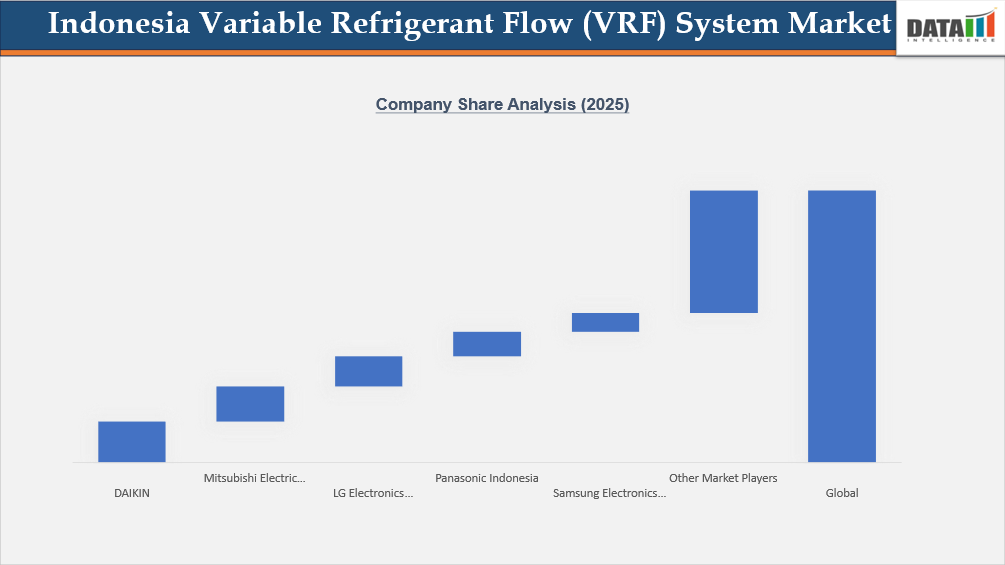
- Indonesia VRF System Market features intense competition among both leading players and regional competitors.
- The major players operating in this industry are DAIKIN, Mitsubishi Electric Indonesia, LG Electronics Indonesia, Panasonic Indonesia, Samsung Electronics Indonesia, Carrier, Trane Indonesia, GREE Comfort, GENERAL, PT Bosch Home Comfort Indonesia, Johnson Controls, Lennox International Inc., Midea Group, Toshiba Carrier Corporation, Rheem Manufacturing Indonesia and Polytron.
Key Developments
- The air conditioning manufacturing firm Mitsubishi Electric received an important order in March 2026 when they won a huge contract to install their HVAC system in the “Two Sudirman Jakarta” real estate venture; the deal includes the provision of 404 air conditioners to the project.
- Daikin initiated its first large-scale factory producing residential air conditioners in Indonesia in May 2025, indicating an important milestone for local HVAC manufacturing by Daikin. The company's move aims at expanding into the region and meeting the ever-growing demand for advanced energy-saving HVAC equipment, especially those using VRF technology.
- Daikin exhibited its latest CO2 (R744)-powered VRF system in March 2025 (ISH Frankfurt), presenting itself as a futuristic HVAC product, which will help mitigate climate change effects. The development shows that more and more companies will start manufacturing VRF equipment as they move towards environmentally-friendly products.
Why Choose DataM?
- Technological Innovations: Explores the latest advancements in Variable Refrigerant Flow (VRF) system technologies, including inverter-driven compressors, heat pump and heat recovery systems, IoT-enabled smart controls, low-GWP refrigerants (R-32, CO₂) and energy-efficient multi-zone cooling solutions, which are enabling higher energy savings, operational flexibility and improved building performance.
- Product Performance & Market Positioning: Explores the latest advancements in Variable Refrigerant Flow (VRF) system technologies, including inverter-driven compressors, heat pump and heat recovery systems, IoT-enabled smart controls, low-GWP refrigerants (R-32, CO₂) and energy-efficient multi-zone cooling solutions, which are enabling higher energy savings, operational flexibility and improved building performance.
- Real-World Evidence: Highlights practical use cases of VRF systems across office buildings, shopping malls, hotels, hospitals and high-rise residential projects, demonstrating measurable benefits such as 30–40% energy savings, reduced operational costs, space optimization and improved occupant comfort.
- Market Updates & Industry Changes: Tracks key developments such as local manufacturing expansion, adoption of low-GWP refrigerants, smart HVAC integration, infrastructure growth and evolving energy efficiency regulations, along with increasing focus on green building certifications in Indonesia.
- Competitive Strategies: Tracks key developments such as local manufacturing expansion (e.g., Daikin Indonesia plant), adoption of low-GWP refrigerants, smart HVAC integration, infrastructure growth (Jakarta, Nusantara) and evolving energy efficiency regulations, along with increasing focus on green building certifications in Indonesia.
- Pricing & Market Access: Explains pricing structures across VRF systems (heat pump, heat recovery), including equipment cost, installation cost, lifecycle cost and maintenance, along with procurement models such as direct sales, EPC contracts and distributor networks, considering Indonesia’s cost-sensitive market dynamics.
- Market Entry & Expansion: Explains pricing structures across VRF systems (heat pump, heat recovery), including equipment cost, installation cost, lifecycle cost and maintenance, along with procurement models such as direct sales, EPC contracts and distributor networks, considering Indonesia’s cost-sensitive market dynamics.
Target Audience 2026
- HVAC Manufacturers & OEMs: Companies such as Daikin Industries, Mitsubishi Electric, LG Electronics and Panasonic Corporation focusing on VRF system innovation and market expansion.
- Real Estate Developers & Construction Companies: Commercial builders, real estate developers and EPC contractors implementing VRF systems in office spaces, malls, hotels and mixed-use developments.
- Facility Management & Building Operators: Organizations managing large commercial and residential properties, focusing on energy efficiency, operational cost reduction and occupant comfort.
- System Integrators & HVAC Contractors: Firms involved in VRF system design, installation, commissioning and maintenance services across Indonesia.
- Government & Urban Development Authorities: Public sector bodies involved in infrastructure development, smart city projects and energy efficiency initiatives.
- Hospitality, Retail & Healthcare Operators: End-users requiring scalable, energy-efficient and flexible HVAC solutions for large and multi-zone facilities.
- Investors & Private Equity Firms: Investment groups tracking growth in HVAC, green buildings and infrastructure development sectors in Indonesia.


























































