


Global Hydrogen Gas Turbine Market Size & Overview
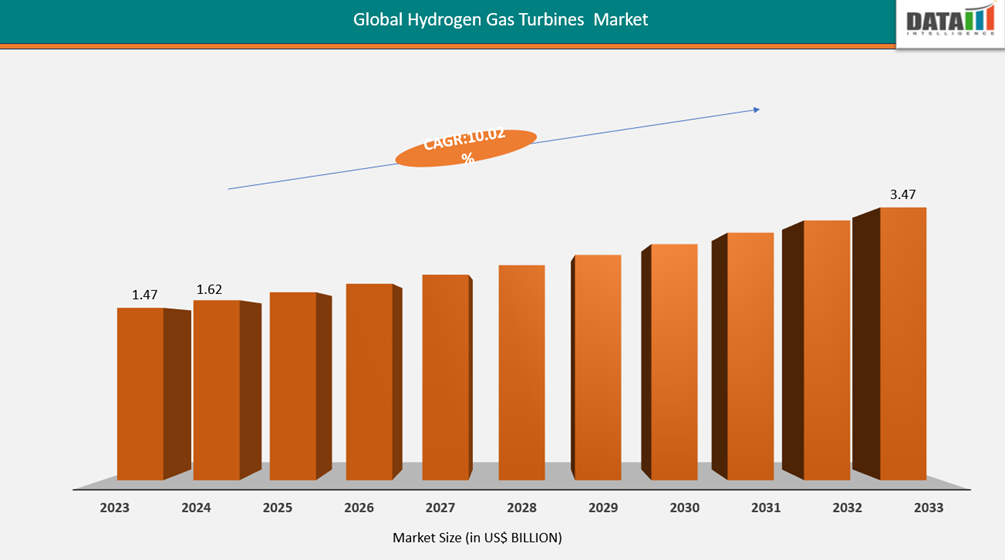
The Global Hydrogen Gas Turbine Market size was at US$ 1.78 billion in 2025 and is expected to reach US$ 3.83 billion by 2033, growing with a CAGR of 10.02% during the forecast period 2026-2033. Th Expansion in the Hydrogen Gas Turbine Market is being driven by the growing emphasis on energy security. As nations seek to reduce dependence on imported fuels and stabilize their power grids, hydrogen-based technologies offer a reliable alternative. Their ability to operate flexibly across various energy systems makes them attractive for long-term infrastructure planning.
At the same time, industries are under increasing pressure to decarbonize operations. Hydrogen turbines provide a pathway to lower emissions without compromising performance, offering high-efficiency power generation with minimal environmental impact. This dual advantage positions them as a key enabler in the shift toward cleaner, more resilient energy systems.
Global Hydrogen Gas Turbine Market Size and Future Outlook
- 2025 Market Size: US$ 1.78 billion
- 2033 Projected Market Size: US$ 3.83 billion
- CAGR (2025-2032): 10.02%
- Largest Market: North America
- Fastest Market: Asia-Pacific
Key Takeaways
- Europe accounts for approximately 35-40% of the global market share, driven by ambitious net-zero targets, hydrogen economy initiatives, and large-scale investments in clean power generation technologies.
- Power generation applications contribute over 50% of total market demand, supported by the growing adoption of low-carbon energy solutions and grid-balancing technologies.
- Hybrid hydrogen gas turbines account for nearly 60% of market adoption, owing to their ability to operate on hydrogen-natural gas blends while enabling a gradual transition to 100% hydrogen combustion.
- Utilities and independent power producers represent more than 55% of end-user demand, leveraging hydrogen gas turbines for flexible and sustainable electricity generation.
- Hydrogen blending technologies are witnessing adoption growth exceeding 20% annually, driven by increasing investments in decarbonization and renewable energy integration.
- Asia-Pacific is expected to register the fastest market growth, supported by expanding hydrogen infrastructure projects across Japan, China, South Korea, and Australia.
- Strategic partnerships among turbine manufacturers, hydrogen producers, and energy companies are accelerating commercialization and technological advancements worldwide.
- The development of 100% hydrogen-compatible gas turbines is emerging as a major innovation trend, enabling carbon-free power generation for utilities and industrial applications.
- Growing investments in green hydrogen production, hydrogen-ready turbines, smart power infrastructure, and industrial decarbonization initiatives are expected to drive long-term market expansion.
Global Hydrogen Gas Turbine Market Scope
| Metrics | Details |
| By Capacity | Below 100, MW, 100–300 MW, above 300 MW |
| By Type | Pure Hydrogen Gas Turbines, Hybrid Gas Turbines |
| By Application | Power Generation, Industry sector, Oil & Gas, Marine , Others |
| By End User | Utilities, Independent Power Producers, Industry sector, Transportation. |
| By Region | North America, South America, Europe, Asia-Pacific, Middle East and Africa |
| Report Insights Covered | Competitive Landscape Analysis, Company Profile Analysis, Market Size, Share, Growth |
Explore the Future of the Hydrogen Gas Turbine Market
Get a comprehensive sample report covering Hydrogen Gas Turbine Market trends, technological advancements, competitive landscape, application insights and growth opportunities. Request your sample today to understand the factors shaping the next generation of hydrogen-powered and low-carbon power generation infrastructure. Request Sample Report Today!
Global Hydrogen Gas Turbine Market Dynamics
Hydrogen Strategy Accelerates Turbine Market Transition
Decarbonization targets refer to formal goals set by governments, industries, and international bodies to reduce greenhouse gas emissions within a specific timeframe. These targets are often part of broader climate action plans aimed at limiting global warming and transitioning to low-carbon economies. They typically involve commitments to phase out fossil fuels, increase the share of renewable energy, improve energy efficiency, and invest in clean technologies.
For instance, in 2025 IRENA projects hydrogen could meet 14% of global energy demand by 2050, requiring a fivefold production increase. This supports decarbonization by replacing fossil fuels with clean hydrogen across power, transport, and industry.
High Costs Slow Hydrogen Turbine Gas Deployment
High cost associated with developing and deploying hydrogen-compatible turbines, which includes expenses for specialized materials, combustion systems, and safety infrastructure. Additionally, the availability of green hydrogen remains limited, and its production requires significant energy input, making it less economically viable in many regions
Global Hydrogen Gas Turbine Market Segmentation Analysis
The global hydrogen gas turbine market is segmented based on capacity, type, application, end user and region
Increasing Use in Power Generation
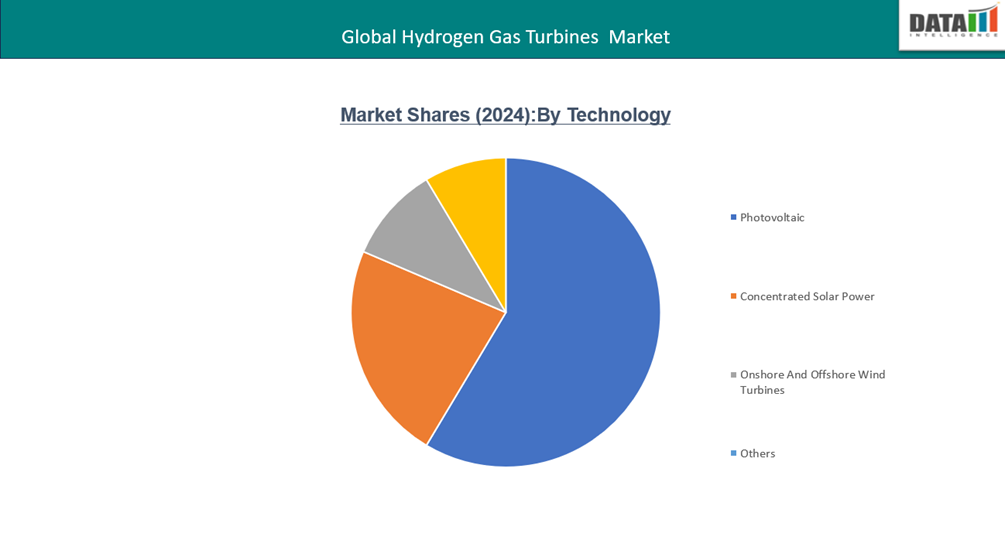
Power Generation remained the leading application in the hydrogen turbine market, accounting for the largest share of global revenue. Hydrogen turbines are increasingly used in utility scale projects, grid balancing, and backup power, thanks to their ability to deliver clean, dispatchable energy. Their compatibility with hydrogen blends and integration with renewable sources like wind and solar further reinforces their dominance.
For instance, in 2025, Mitsubishi Power and Hygenco Green Energies signed a Memorandum of Understanding (MoU), facilitated by the Japan International Cooperation Agency (JICA), to explore the deployment of green hydrogen and ammonia-fired Gas Turbine Combined Cycle (GTCC) power plants. This collaboration aims to accelerate clean energy adoption in India and beyond, supporting industrial decarbonization and enhancing low-emission power generation capacity.
Industry sector segment of the Hydrogen Gas Turbine Market plays a critical role in decarbonizing sectors that require high-temperature heat and continuous power such as steel, cement, chemicals, and refining. These industries often rely on fossil fuels for process heat, making hydrogen turbines a viable alternative for reducing emissions without compromising operational reliability. In 2024, industrial applications ranked as the second-largest market segment after power generation, driven by pilot projects, government incentives, and the push for cleaner production methods.
For instance, in 2025, the European Union launched a Hydrogen Bank auction valued at €2 billion (approximately USD 2.1 billion), with €200 million (around USD 210 million) dedicated to maritime hydrogen fuels. This funding supports industrial sectors by accelerating hydrogen infrastructure, enabling cleaner energy adoption in shipping, refining, and manufacturing.
Global Hydrogen Gas Turbine Market Geographical Penetration
Innovation and Expansion in Europe
Europe’s hydrogen market is expanding steadily, driven by decarbonization goals and industrial demand. The region hosts over 500 operational hydrogen production facilities, with refineries and ammonia plants accounting for more than 80% of consumption. Within this landscape, the UK and Germany represent distinct sub-segments.
U.K Hydrogen Gas Turbine Market Insights
The United Kingdom’s approach to hydrogen development is grounded in technology neutrality, allowing various production methods such as electrolysis, methane reforming with carbon capture, and biomass pathways to qualify for support as long as they meet defined carbon intensity thresholds. This framework encourages innovation across the hydrogen value chain without favoring a single technology.
For instance, in 2025 The UK’s HAR2 shortlist of 27 low-carbon hydrogen projects is expected to unlock significant private investment, accelerating deployment of hydrogen-ready turbines across the country (~US$1.22 billion). This strengthens the UK’s hydrogen infrastructure, supports industrial decarbonization, and positions hydrogen turbines as a key technology in the nation’s clean energy transition.
Germany Hydrogen Gas Turbine Market Insights
Germany maintains one of Europe’s most advanced hydrogen ecosystems, shaped by its national hydrogen strategy and alignment with EU renewable energy directives. The country prioritizes green hydrogen produced via electrolysis using renewable electricity, supported by substantial public funding and regulatory frameworks. For instance, in 2025, A joint hydrogen program is entering its application phase, with Germany committing ~$320 million USD from 2032 to 2042, and the Netherlands funding projects between 2028 and 2036. The initiative aims to accelerate cross-border hydrogen innovation and industrial deployment.
North America Leads the Hydrogen Transition
North America’s hydrogen sector is undergoing rapid transformation, driven by climate policy, industrial decarbonization, and clean energy incentives. The region is witnessing increased investment in production, infrastructure, and end-use technologies, with a strong focus on scaling low-carbon hydrogen across transport, power, and heavy industry. Public-private partnerships and regional hydrogen hubs are central to this growth, positioning North America as a key player in the global hydrogen economy.
U.S Hydrogen Gas Turbine Market Insights
The U.S. hydrogen market is expanding swiftly, supported by federal funding mechanisms such as the Inflation Reduction Act and the Department of Energy’s hydrogen hub program. These initiatives aim to establish large-scale production and distribution networks, with emphasis on clean hydrogen for power generation, mobility, and industrial applications. The country is also advancing hydrogen-compatible turbines and fuel cell systems, backed by tax credits and regional deployment strategies.
Canada Hydrogen Gas Turbine Market Insights
Canada’s hydrogen strategy emphasizes low-carbon production and export readiness, with provinces like Alberta and British Columbia leading project development. The national framework supports diverse technologies, including electrolysis and methane reforming with carbon capture. Canada is also investing in hydrogen infrastructure and pilot projects for power generation, positioning itself as a supplier of clean hydrogen to domestic and international markets.
Sustainability Analysis
Hydrogen gas turbines present a compelling sustainability profile, particularly when powered by green hydrogen, which enables near-zero emissions during operation. Their ability to deliver dispatchable energy makes them valuable for balancing renewable sources like wind and solar. Moreover, the limited availability and high energy input required for green hydrogen production reduce overall efficiency and economic viability in many regions. Long-term sustainability will depend on scaling renewable hydrogen supply, reducing turbine costs, and aligning policy incentives to support clean power deployment.
Global Hydrogen Gas Turbine Market Competitive Landscape
- The global hydrogen gas turbine market is highly competitive, driven by a mix of global and regional players striving for technological efficiency and cost leadership.
- The major global players in the market include, Baker Hughes, Mitsubishi Power, Solar Turbines (Caterpillar), Ansaldo Energia, Doosan Heavy Industries, GE Vernova, MAN Energy Solutions, OPRA Turbines, Siemens Energy
- Companies focus on expanding production capacities, optimizing supply chains, and adopting low-carbon and energy-efficient processes to gain an edge.
Key Developments of the Hydrogen Gas Turbine Market
- June 2026: Mitsubishi Power continued advancing its hydrogen-capable gas turbine technologies by expanding the commercialization of turbines capable of operating on high hydrogen fuel blends for power generation applications.
- June 2026: GE Vernova strengthened its hydrogen-ready gas turbine portfolio by supporting power producers with flexible fuel solutions capable of utilizing natural gas blended with hydrogen to accelerate decarbonization efforts.
- May 2026: Siemens Energy expanded its hydrogen combustion technology initiatives, focusing on developing gas turbines capable of operating with 100% hydrogen to support the global energy transition.
- May 2026: Baker Hughes advanced its NovaLT gas turbine platform by enhancing hydrogen blending capabilities for industrial and power generation applications, supporting low-carbon energy projects worldwide.
- April 2026: MAN Energy Solutions continued developing hydrogen-compatible turbomachinery solutions designed to support large-scale hydrogen infrastructure and sustainable power generation projects.
- April 2026: Ansaldo Energia strengthened its hydrogen-ready turbine technologies through ongoing investments in flexible fuel combustion systems for utility-scale power plants.
- March 2026: Solar Turbines (Caterpillar) expanded its low-carbon energy solutions portfolio by advancing gas turbines capable of operating with hydrogen-natural gas fuel blends for industrial applications.
- March 2026: Doosan Heavy Industries & Construction continued investing in hydrogen turbine technologies and clean energy solutions to support South Korea's hydrogen economy initiatives.
- February 2026: OPRA Turbines advanced the development of hydrogen-fueled microturbine technologies for decentralized and sustainable power generation applications.
- In 2025, P2X Solutions Oy inaugurated Finland’s first industrial-scale green hydrogen plant in Harjavalta. By supplying renewable hydrogen to local industries, the facility supports the deployment of hydrogen-compatible turbines for clean power and heat. This strengthens turbine market viability by ensuring low-emission fuel access and advancing sector-wide decarbonization.
Investment Opportunity Analysis
The Hydrogen Gas Turbine Market presents substantial investment opportunities as governments and industries accelerate efforts toward decarbonization and sustainable energy generation. Increasing demand for flexible power generation systems capable of integrating renewable energy sources is driving investments in hydrogen-ready gas turbines and hydrogen combustion technologies. Energy companies are investing in large-scale hydrogen infrastructure, green hydrogen production facilities, and next-generation turbine technologies to improve efficiency and reduce emissions. Strategic collaborations among turbine manufacturers, utilities, and hydrogen suppliers are expected to strengthen commercialization efforts and create attractive long-term investment opportunities across power generation, industrial applications, and energy storage systems.
Market Drivers, Restraints, Opportunities, and Challenges (DROC Analysis)
The Hydrogen Gas Turbine Market is driven by rising global investments in clean energy infrastructure, increasing adoption of hydrogen-based power generation technologies, and stringent carbon reduction regulations worldwide. Hydrogen gas turbines offer operational flexibility and support the integration of intermittent renewable energy resources into power grids. However, high infrastructure costs, limited availability of green hydrogen, combustion-related technical challenges, and regulatory uncertainties continue to restrain market growth. Significant opportunities are emerging through hydrogen blending technologies, utility-scale power generation projects, industrial decarbonization initiatives, and government-supported hydrogen economy programs.
Why Choose DataM?
- Technological Innovations: Explores advancements in hydrogen gas turbine technologies, including hydrogen co-firing, 100% hydrogen combustion pathways, dry low-NOx combustion systems, hydrogen-compatible combustors, fuel-supply modifications, control-system upgrades, and retrofit solutions for existing gas turbines. These technologies support lower-carbon power generation while maintaining operational flexibility between hydrogen and natural gas.
- Product Performance & Market Positioning: Evaluates hydrogen-capable gas turbines based on critical performance parameters such as hydrogen blending capability, combustion stability, NOx emissions, thermal performance, efficiency, output capacity, ramp rates, startup time, fuel flexibility, retrofit requirements, and compatibility with combined-cycle and cogeneration configurations. The analysis highlights how leading manufacturers differentiate through hydrogen readiness, reliability, efficiency, and scalable turbine platforms.
- Real-World Evidence: Highlights demonstrated and commercial applications of hydrogen-capable gas turbines, including hydrogen co-firing demonstrations, hydrogen-ready power plants, retrofit programs, grid-connected testing, and cogeneration applications. Examples include Mitsubishi Power's 30% hydrogen co-firing demonstration on an advanced-class M501JAC turbine, Kawasaki's 100% hydrogen combustion technology, and hydrogen-capable projects from GE Vernova and Siemens Energy.
- Market Updates & Industry Changes: Tracks developments such as hydrogen combustion demonstrations, hydrogen-ready turbine orders, new turbine and combustor technologies, retrofit programs, hydrogen production and storage integration, validation facilities, and investments in hydrogen-based power generation. Particular attention is given to developments across North America, Europe, and Asia-Pacific as power producers evaluate hydrogen as a pathway for reducing emissions from gas-fired generation.
- Competitive Strategies: Analyzes how leading gas turbine manufacturers strengthen their positions through hydrogen-capable product portfolios, combustion technology development, strategic partnerships, technology demonstrations, retrofit offerings, long-term service agreements, integrated hydrogen-power solutions, and validation facilities. Companies are also leveraging existing gas turbine fleets to provide pathways from natural gas to hydrogen co-firing and, ultimately, higher hydrogen concentrations or 100% hydrogen operation.
- Pricing & Market Access: Explains variations in hydrogen gas turbine project economics based on turbine capacity, hydrogen blending level, combustion technology, fuel-supply infrastructure, retrofit requirements, balance-of-plant modifications, emissions-control systems, project configuration, and service requirements. Market access is supported through turbine OEMs, power plant developers, engineering and construction companies, equipment suppliers, and specialized hydrogen infrastructure providers.
- Market Entry & Expansion: Identifies opportunities created by power-sector decarbonization initiatives, hydrogen infrastructure development, replacement of coal-fired generation, demand for flexible power generation, renewable-energy integration, and modernization of existing gas turbine fleets. Expansion strategies include hydrogen-ready turbine development, retrofit solutions, regional partnerships, integrated hydrogen production-to-power projects, technology validation, and deployment of flexible turbines capable of operating with different hydrogen concentrations.
Target Audience
- Gas Turbine Manufacturers & OEMs
- Power Generation Companies & Utilities
- Hydrogen Gas Turbine Technology Providers
- Hydrogen Production & Infrastructure Companies
- Combined-Cycle & Cogeneration Plant Operators
- Power Plant Developers & EPC Contractors
- Industrial Energy & Captive Power Users





























































