


Hydrodesulfurization Catalyst Market Size and Overview
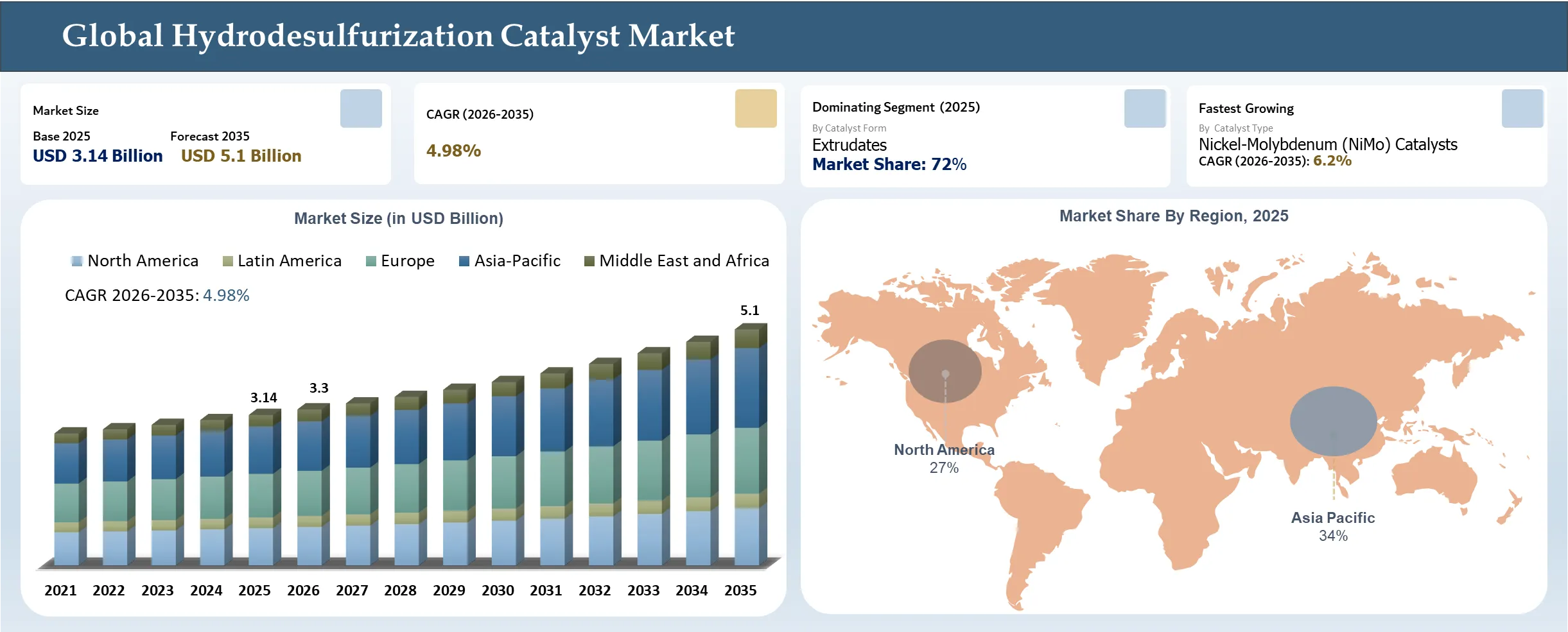
The global hydrodesulfurization catalyst market was valued at USD 3.14 billion in 2025 and is projected to reach USD 5.1 billion by 2035, growing at a CAGR of 4.98% from 2026 to 2035. The market growth is supported by tightening fuel sulfur specifications, refinery hydrotreating upgrades, and increasing demand for high-activity cobalt-molybdenum (CoMo) and nickel-molybdenum (NiMo) catalysts. In October 2026, Topsoe, a Denmark-based company, secured a technology licensing contract with Bharat Petroleum Corporation Limited (BPCL) to upgrade its 4,000 metric tons per day kerosene hydrotreater at the India, Mumbai refinery, enabling co-processing of 5% renewable feedstock and 95% conventional feedstock, with commissioning expected by the end of 2026.
The investment reflects growing refinery interest in upgrading existing hydrotreating infrastructure to accommodate diversified feedstocks and sustainable aviation fuel production. According to Topsoe, India's SAF blending targets for international flights are 1% by 2027, 2% by 2028, and 5% by 2030, strengthening the outlook for adaptable refinery hydrotreating technologies. Companies including Topsoe, Axens, Shell Catalysts & Technologies, and Ketjen are developing advanced catalyst formulations to improve sulfur removal efficiency and processing flexibility.
Hydrodesulfurization Catalyst Market Key Takeaways
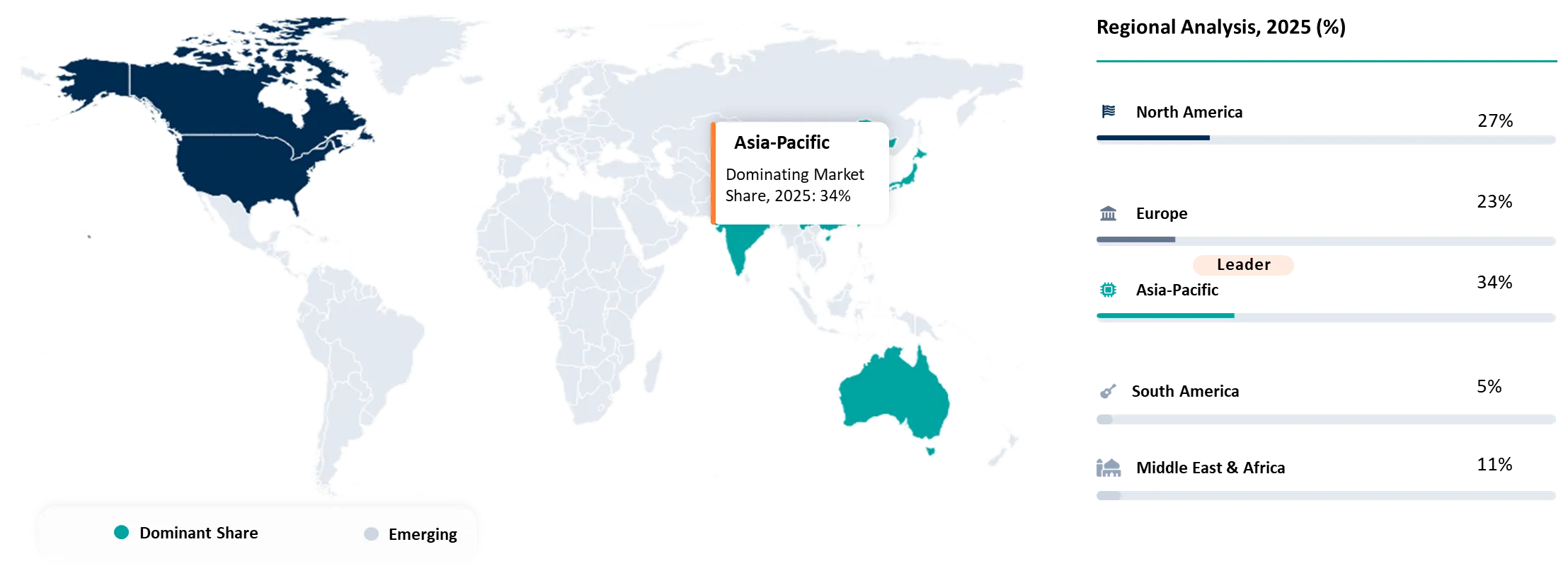
- Asia-Pacific dominated the global market in 2025 with a leading 34% share, ahead of North America at 27% and Europe at 23%. The Middle East & Africa accounted for 11% of the global share, while South America represented the remaining 5%.
- Increasing refinery modernization investments act as the strongest market driver, delivering a 24.2% positive impact on market growth. Expanding ultra-low-sulfur diesel (ULSD) production and tightening marine fuel sulfur rules contribute growth impacts of 21.8% and 18.5%, respectively.
- In Q2 2026, global refinery crude inputs declined by roughly 4.8 million barrels per day, or 6%, due to Middle Eastern supply disruptions. The sudden shifts in processing volumes directly disrupt refinery catalyst consumption and replacement schedules.
- Under MARPOL Annex VI, the Canadian Arctic and Norwegian Sea became Emission Control Areas on March 1, 2026, enforcing a strict 0.10% marine fuel sulfur limit compared to the 0.5% global cap. Previously, the 2020 implementation of the 0.5% global sulfur cap reduced total shipping sulfur oxide emissions by 70%.
Hydrodesulfurization Catalyst Market Trends & Disruptions Impacting Customers
The hydrodesulfurization (HDS) catalyst market is witnessing a growing shift toward high-activity cobalt-molybdenum (CoMo) catalysts as refiners prioritize ultra-low-sulfur diesel (ULSD) production, longer catalyst operating cycles, and improved processing efficiency. According to Topsoe's 2025 Annual Report, the company highlighted its latest-generation TK-580 HyBRIM CoMo catalyst, which delivers significantly higher hydrodesulfurization activity than previous-generation formulations and supports diesel production with sulfur content below 10 ppm.
The disruption in the hydrodesulfurization (HDS) catalyst market is increasingly associated with geopolitical tensions, crude oil supply interruptions, and changing refinery operating rates. The disruptions are affecting refinery feedstock availability, catalyst replacement schedules, and procurement strategies across major petroleum-processing regions. In November 2026, according to the U.S. Energy Information Administration (EIA), global refinery crude inputs declined by approximately 4.8 million barrels per day, or 6%, during the second quarter of 2026, amid Middle Eastern supply disruptions. Such volatility can force refiners to adjust processing volumes and crude oil blends, creating uncertainty in hydrodesulfurization catalyst consumption and replacement planning.
Hydrodesulfurization Catalyst Market Dynamics
Driver Impact Analysis
| Driver | Market Growth Impact (%) |
| Tightening Marine Fuel Sulfur Regulations Accelerating Demand for Deep Desulfurization Catalysts | 18.5% |
| Increasing Refinery Modernization Investments Strengthening Demand for High-Performance Hydrotreating Catalysts | 24.2% |
| Expanding Ultra-Low-Sulfur Diesel Production Supporting Adoption of Advanced CoMo and NiMo Catalysts | 21.8% |
Tightening Marine Fuel Sulfur Regulations Accelerating Demand for Deep Desulfurization Catalysts
The tightening of international marine fuel sulfur regulations is accelerating demand for high-performance hydrodesulfurization (HDS) catalysts across petroleum refineries. In March 2026, according to the International Maritime Organization (IMO), the Canadian Arctic and Norwegian Sea officially became the sixth and seventh Emission Control Areas (ECAs) on March 1, 2026, under MARPOL Annex VI, requiring ships to comply with a stringent 0.10% sulfur content limit in marine fuels, compared with the 0.5% global limit. The IMO also reported that the implementation of the global 0.5% sulfur cap in 2020 resulted in a 70% reduction in total sulfur oxide emissions from shipping.
Restraint Impact Analysis
| Restraint | Drag on Market Growth (%) |
| Increasing Refinery Closures Restricting Installed Demand for Hydrodesulfurization Catalysts | 16.8% |
| Catalyst Deactivation from Heavy Crude Contaminants Increasing Maintenance and Replacement Costs | 12.5% |
Increasing Refinery Closures Restricting Installed Demand for Hydrodesulfurization Catalysts
The increasing closure of petroleum refineries across mature markets is emerging as a significant restraint on the hydrodesulfurization (HDS) catalyst market, reducing the installed base of hydrotreating units and limiting recurring catalyst replacement demand. According to the International Energy Agency (IEA) Oil 2025 Report, approximately 1.6 million barrels per day of global refining capacity is expected to close by 2030, despite 4.2 million barrels per day of new refining capacity being planned over the forecast period. The IEA further projects that global refined petroleum product demand will peak at 86.3 million barrels per day in 2027, representing an increase of only 710,000 barrels per day compared with 2024.
Hydrodesulfurization Catalyst Market: Commercial Use Cases Across Industries
| COMPANY | USE CASE | BENEFITS |

| Ketjen's hydroprocessing catalysts are deployed in petroleum refineries for deep desulfurization of diesel, vacuum gas oil, and other sulfur-containing petroleum fractions. Its catalyst technologies support refineries processing challenging feedstocks while meeting stringent sulfur specifications for transportation fuels. | Improves sulfur removal efficiency, supports ultra-low-sulfur fuel production, enhances processing flexibility for heavier feedstocks, and helps refiners optimize catalyst operating cycles and hydrogen utilization. |

| Topsoe's high-activity CoMo and NiMo hydrodesulfurization catalysts, including its HyBRIM technology, are used in refinery diesel hydrotreating units to remove sulfur compounds and produce ultra-low-sulfur diesel containing below 10 ppm sulfur. These catalysts support deep desulfurization of straight-run and cracked diesel fractions. | Enables compliance with stringent diesel sulfur limits, improves catalyst activity against difficult sulfur compounds, supports longer operating cycles, and helps reduce hydrotreating severity and associated operating costs under suitable refinery conditions. |
Market Ecosystem
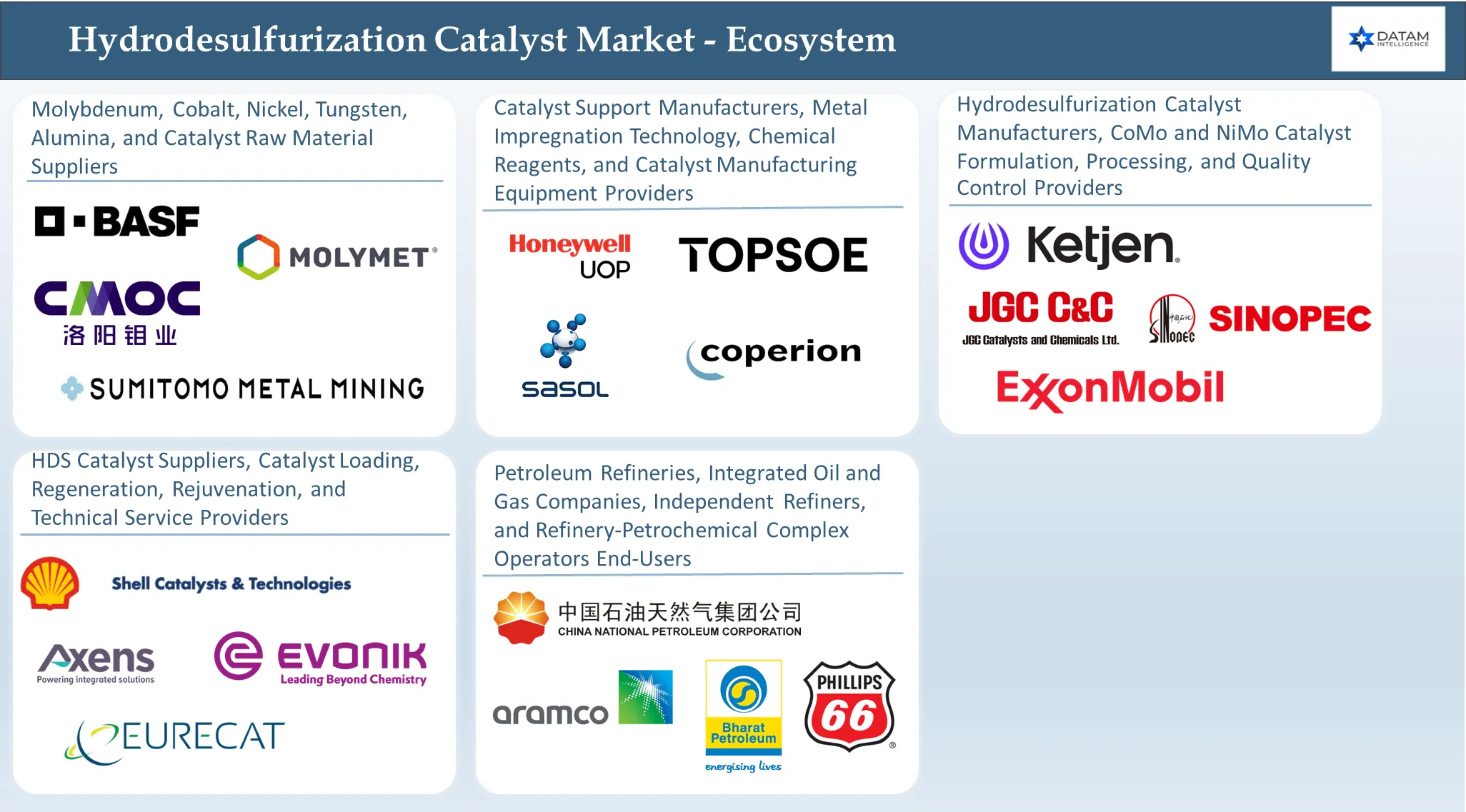
The global hydrodesulfurization (HDS) catalyst market operates through an interconnected ecosystem of molybdenum, cobalt, nickel, and tungsten raw material suppliers, catalyst support manufacturers, HDS catalyst producers, refinery technology licensors, catalyst regeneration companies, and petroleum refiners. Manufacturers develop cobalt-molybdenum (CoMo), nickel-molybdenum (NiMo), and nickel-tungsten (NiW) catalyst formulations for sulfur removal from diesel, naphtha, kerosene, vacuum gas oil, and residual petroleum fractions. Companies such as Topsoe, Ketjen, Axens, and Shell Catalysts & Technologies supply specialized catalysts designed to improve sulfur conversion, processing flexibility, and operating-cycle performance.
According to Ketjen Corporation's 2026 commercial case study, its Celestia hydroprocessing catalyst, used in partnership with ExxonMobil's Celestia, enabled a North American refinery to process 7% more total feed and 13% more light cycle oil (LCO) while maintaining the same operating-cycle length. The catalyst occupied approximately 25% of the active reactor volume alongside conventional NiMo catalysts. It generated an estimated USD 20-25 million in annual net benefits, demonstrating the commercial importance of high-activity catalysts in improving refinery processing flexibility and operating economics.
Hydrodesulfurization Catalyst Market Segment Analysis
By Catalyst Type
The market is segmented by catalyst type based on active metal composition, sulfur removal efficiency, hydrogenation activity, and compatibility with different refinery feedstocks. Catalyst selection depends on sulfur compound complexity, feedstock characteristics, hydrogen availability, and required product specifications. Increasing demand for ultra-low-sulfur transportation fuels and improved processing of heavier petroleum fractions is encouraging refiners to adopt high-activity catalyst formulations that deliver improved desulfurization performance and longer operating cycles.
By Catalyst Form
The HDS catalyst market is segmented by catalyst form based on physical configuration, mechanical strength, surface accessibility, and reactor operating requirements. Catalyst geometry influences pressure drop, fluid distribution, mass transfer efficiency, and resistance to mechanical degradation within hydrotreating reactors. Refiners increasingly prioritize catalyst shapes that improve reactor performance, maintain consistent sulfur removal activity, and minimize operational interruptions associated with catalyst replacement and maintenance.
By Application
The hydrodesulfurization catalyst market is segmented by application according to the petroleum fractions undergoing sulfur removal and their respective processing requirements. HDS catalysts are deployed across refinery hydrotreating operations to reduce sulfur concentrations, meet transportation fuel specifications, and protect downstream processing units. Increasing feedstock complexity, stringent sulfur limits, and refinery optimization initiatives are strengthening demand for application-specific catalyst technologies capable of processing diverse petroleum streams while maintaining operating efficiency.
By End-User
The market is segmented by end-user based on refinery ownership structures, processing configurations, and catalyst procurement requirements. Integrated oil companies, independent refiners, and refinery-petrochemical operators utilize HDS catalysts to maintain product quality, comply with sulfur regulations, and optimize hydrotreating operations. Catalyst purchasing decisions are increasingly influenced by feedstock flexibility, catalyst operating-cycle length, hydrogen consumption, technical support capabilities, and the overall economics of refinery operations.
Hydrodesulfurization Catalyst Market Geographical Penetration
Expanding Refinery Hydrotreating Capacity and Low-Sulfur Fuel Production Strengthening Asia-Pacific Market Leadership
Asia-Pacific dominated the global hydrodesulfurization (HDS) catalyst market, accounting for 34% market share in 2025, supported by its extensive petroleum refining infrastructure, increasing diesel hydrotreating requirements, and stringent transportation fuel sulfur specifications. China, India, Japan, and South Korea represent major consumption centers for CoMo and NiMo catalysts used in naphtha, diesel, and vacuum gas oil desulfurization. Growing refinery complexity, processing of sulfur-rich crude oil, and investments in high-performance hydrotreating technologies are strengthening demand for advanced catalysts capable of achieving ultra-low sulfur concentrations while improving refinery throughput and operating-cycle efficiency.
In September 2025, Axens, a France-based catalyst manufacturer and process technology provider, announced the successful start-up of the world's first 100% Sustainable Aviation Fuel (SAF) production unit using its Vegan technology at a facility in Asia. The project involved upgrading existing hydroprocessing assets with a two-stage processing configuration and Axens' 700-series catalyst technology, enabling flexible production of either 100% renewable diesel or 100% SAF without requiring an additional hydrocracking stage. The development highlights Asia-Pacific's increasing adoption of advanced hydroprocessing catalysts and refinery conversion technologies.
Hydrodesulfurization Catalyst Market BCG Matrix: Company Evaluation
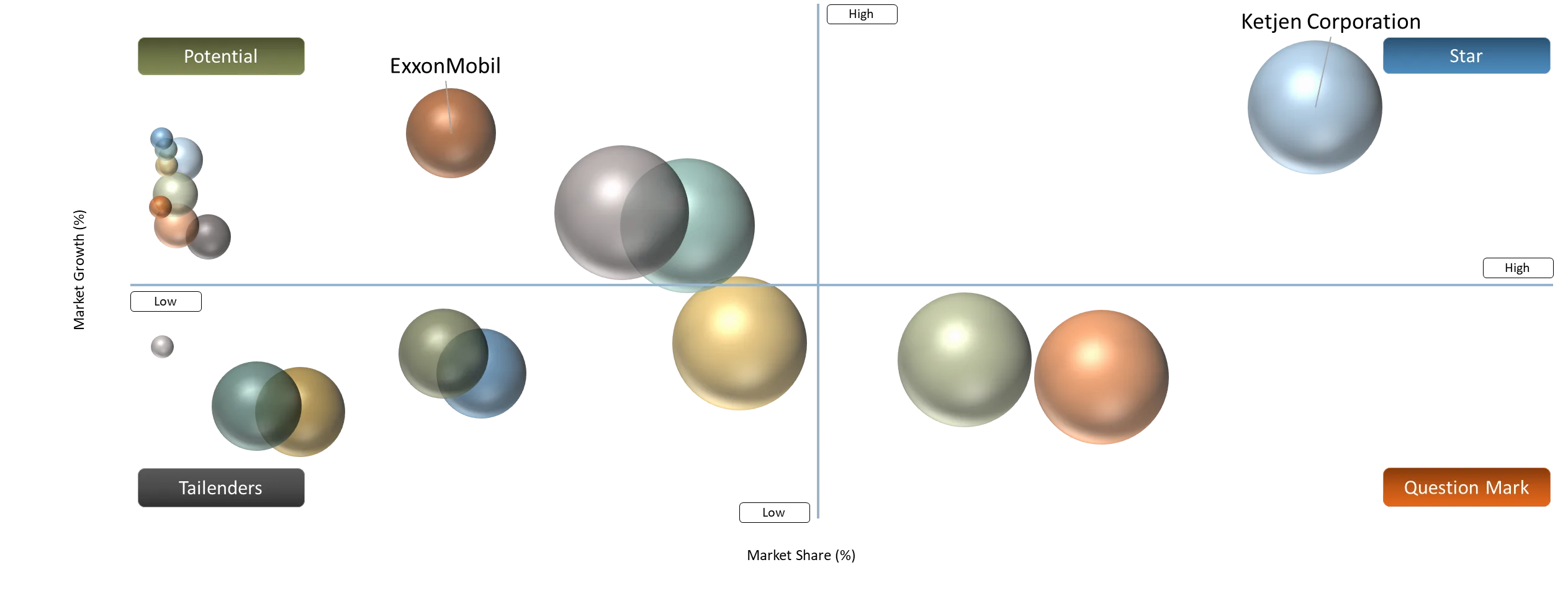
Ketjen Corporation, recognized as a leading player in the hydrodesulfurization (HDS) catalyst market and positioned in the Stars category, offers an extensive portfolio of advanced CoMo, NiMo, and bulk-metal catalysts for diesel hydrotreating, vacuum gas oil desulfurization, and ultra-low-sulfur fuel production. The company maintains a strong global presence and collaborates with major petroleum refiners to improve sulfur removal efficiency, feedstock flexibility, and catalyst operating performance.
Another significant player is ExxonMobil, positioned in the Potential category, with established expertise in refinery hydroprocessing technologies and catalyst development. The company is strengthening its position through collaborations with catalyst manufacturers, including Ketjen, to commercialize advanced Celestia catalyst technology designed to enhance desulfurization performance, increase refinery throughput, and improve processing efficiency across complex petroleum feedstocks.
Hydrodesulfurization Catalyst Market Competitive Landscape
Key Market Players
- Ketjen Corporation (United States)
- Topsoe A/S (Denmark)
- Honeywell UOP (United States)
- Axens SA (France)
- BASF SE (Germany)
- Shell Catalysts & Technologies (Netherlands)
- JGC Catalysts and Chemicals Ltd. (Japan)
- Sinopec Catalyst Co., Ltd. (China)
- Evonik Industries AG (Germany)
- CNPC (China National Petroleum Corporation) (China)
- ExxonMobil (United States)
- Clariant AG (Switzerland)
Hydrodesulfurization Catalyst Market Scope
| Metrics | Details |
| 2025 Market Size | USD 3.14 Billion |
| 2035 Projected Market Size | USD 5.1 Billion |
| CAGR (2026-2035) | 4.98% |
| Years Considered | 2025 - 2035 |
| Base Year | 2025 |
| Forecast Period | 2025 - 2035 |
| Units Considered | Value (USD Billion) |
| Report Insights Covered | Competitive Landscape Analysis, Company Profile Analysis, Market Size, Share, Growth |
| Segments Covered |
|
| Region Covered | North America, Europe, Asia-Pacific, Latin America, Middle East and Africa |
Hydrodesulfurization Catalyst Market: Target Audience and Strategic Intelligence Requirements
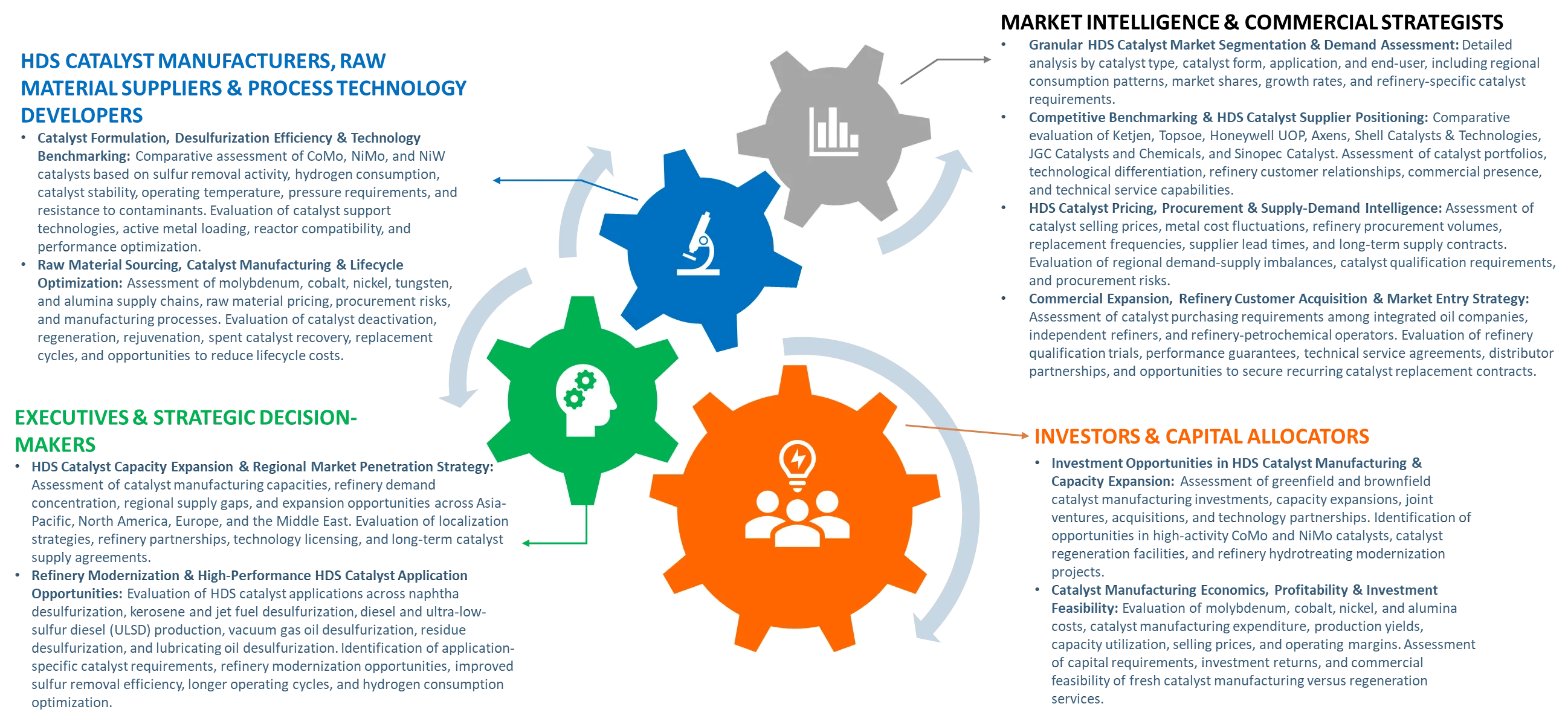
Addressing Client Priorities Through Customized Hydrodesulfurization Catalyst Research
CLIENT REQUIREMENT | RESEARCH CUSTOMIZATION PROVIDED | STRATEGIC VALUE TO CLIENTS |
Benchmarking HDS catalyst performance and identifying opportunities for high-activity catalyst commercialization | Comparative assessment of CoMo, NiMo, and NiW catalysts based on sulfur removal efficiency, hydrogen consumption, catalyst activity, operating-cycle length, contaminant resistance, and performance across naphtha, diesel, vacuum gas oil, and residue desulfurization. Evaluation of advanced catalyst technologies offered by Ketjen, Topsoe, Axens, Honeywell UOP, and other key suppliers. | Enables clients to identify competitive technology gaps, differentiate catalyst formulations, prioritize product development, and demonstrate measurable operating benefits to refinery customers. |
Evaluating refinery catalyst replacement economics and securing long-term commercial contracts | Analyzed catalyst replacement frequencies, deactivation mechanisms, regeneration feasibility, fresh versus regenerated catalyst economics, and refinery procurement practices. Assessed catalyst loading volumes, unit pricing, technical qualification requirements, performance guarantees, and supplier selection criteria across different hydrotreating applications. | Helps clients optimize catalyst pricing, identify recurring replacement demand, develop refinery-specific commercial proposals, strengthen customer retention, and secure multi-cycle catalyst supply agreements. |
Key Developments
- March 2026: KPS Capital Partners, a U.S.-based private equity investment firm, completed its acquisition of Ketjen Corporation, a U.S.-based refinery and petrochemical catalyst manufacturer, from Albemarle Corporation, a U.S.-based specialty chemicals company. Ketjen supplies advanced hydroprocessing catalysts used in hydrodesulfurization applications, including diesel, naphtha, and residue hydrotreating.
- November 2025: W. R. Grace & Co., a U.S.-based specialty chemicals and catalyst manufacturer, announced the acquisition of Chevron U.S.A. Inc.'s 50% ownership interest in Advanced Refining Technologies (ART), a hydroprocessing catalyst joint venture, securing 100% ownership of the business. The acquisition strengthens Grace's hydrodesulfurization catalyst portfolio, technology capabilities, and commercial position in the global refining industry.
- February 2026: Axens SA, a France-based refinery catalyst manufacturer and process technology provider, completed the acquisition of 100% ownership of Eurecat, a France-based global catalyst regeneration and lifecycle management services provider. According to Axens' official announcement, Eurecat operates industrial facilities across four major regions: the Americas, Europe, the Middle East, and Asia, providing catalyst regeneration, rejuvenation, recycling, ex situ activation, and reactor loading and unloading services.
- October 2025: Ketjen Corporation, a U.S.-based refinery and petrochemical catalyst manufacturer, and Axens SA, a France-based refinery catalyst manufacturer and process technology provider, announced a strategic collaboration and ownership restructuring involving Eurecat SA (France), a catalyst regeneration and lifecycle management services provider.
- October 2026: PetroChina, a China-based integrated oil and gas company and subsidiary of China National Petroleum Corporation (CNPC, China), successfully introduced its domestically developed PHR-series residue hydrotreating catalyst at Huabei Petrochemical (China), a petroleum refining company. According to Sunrise Petrochemical, adapted from China Petroleum Daily, the catalyst was commissioned in a residue hydrotreating unit with an annual processing capacity of 3.4 million tonnes.
- May 2026: Ketjen Corporation, a U.S.-based refinery and petrochemical catalyst manufacturer, announced a strategic partnership with Imubit, a U.S.-based industrial artificial intelligence software provider, to introduce real-time catalyst intelligence for refinery operations. According to Ketjen's official announcement, the collaboration integrates Ketjen's proprietary catalyst models and technical expertise with Imubit's AI-powered digital platform through the iKet Connect portal, supporting catalyst performance monitoring and process optimization across two refinery processing categories: fluid catalytic cracking (FCC) and hydroprocessing (HPC).


























































