


Hydrocarbon Remediation Market Size and Overview
The global Hydrocarbon Remediation market reached an estimated US$ 15.60 billion in 2025 and is expected to reach US$ 34.20 billion by 2035, growing at a CAGR of approximately 8.2% during 2026-2035. Demand is generated by petroleum-contaminated soil and groundwater at oilfields, refineries, terminals, pipelines, service stations, ports, industrial sites and legacy brownfields. Market value includes investigation, engineering, treatment, emergency response, monitoring and closure activities.
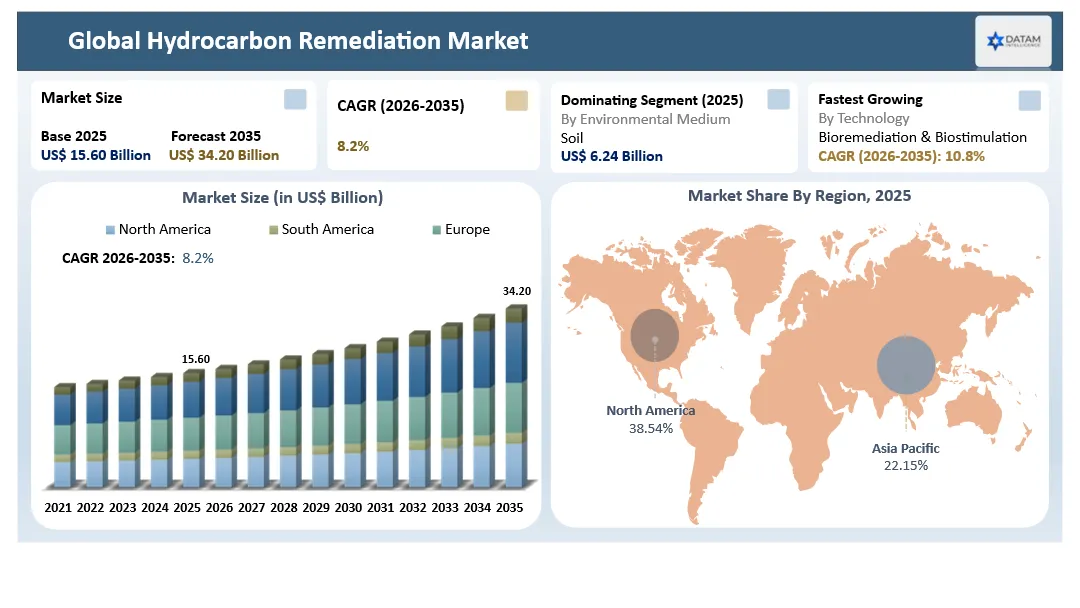
The market is benefiting from stronger enforcement of contaminated-site liability, growing oil and gas asset retirement, industrial land redevelopment and increasing use of lower-impact in-situ technologies. Bioremediation is expanding rapidly because it can reduce excavation, transport and disposal while treating residual petroleum hydrocarbons in place. However, complex sites with free product, heavy hydrocarbons, fractured geology or deep groundwater frequently require treatment trains that combine physical recovery, thermal, chemical and biological methods.
North America is estimated to hold the largest share in 2025 because of its large inventory of petroleum infrastructure, mature environmental liability frameworks and established remediation service sector. Asia-Pacific is expected to record the fastest growth as industrialization, fuel infrastructure, refinery investment, urban redevelopment and environmental enforcement expand across China, India and Southeast Asia.
| Metric | Detail |
| 2025 Market Size | US$ 15.60 Billion |
| 2035 Projected Market Size | US$ 34.20 Billion |
| CAGR (2026-2035) | 8.2% |
| Largest Market | North America |
| Fastest Growing Market | Asia-Pacific |
| Dominant Medium | Soil |
| Fastest-Growing Technology | Bioremediation & Biostimulation |
| Report Period | 2024-2035 |
Hydrocarbon Remediation Market Key Takeaways
- Legacy petroleum contamination remains a long-duration liability for oil & gas companies, refiners, governments and industrial landowners.
- Bioremediation and in-situ treatment are gaining share because they reduce excavation, trucking, disposal volumes and project carbon footprint.
- Groundwater projects command high value because plume delineation, free-product recovery and long monitoring periods increase technical complexity.
- Oilfield decommissioning and brownfield redevelopment create multi-year remediation pipelines tied to asset retirement and land reuse.
- Emergency response remains strategically important because spills require rapid mobilization, containment, recovery, waste handling and regulatory reporting.
- Digital site characterization and continuous monitoring are improving remedy design and reducing uncertainty in heterogeneous subsurface environments.
- North America leads by value, while Asia-Pacific offers the strongest structural growth opportunity through industrial expansion and tightening environmental regulation.
- Future leaders will combine engineering, field execution, proprietary treatment technologies, laboratory capability and long-term monitoring under integrated contracts.
Hydrocarbon Remediation Industry Trends and Strategic Insights
- Treatment trains are replacing single-technology approaches at complex petroleum sites.
- High-resolution site characterization is reducing uncertainty around source zones and plume migration.
- In-situ biological and chemical treatment is expanding where excavation is disruptive or expensive.
- Brownfield redevelopment is linking cleanup budgets to land-value creation and infrastructure investment.
- Remote sensors, cloud dashboards and digital groundwater models are increasing transparency for regulators and asset owners.
- Remediation procurement is moving toward multi-year framework agreements with performance, safety and closure milestones.
Hydrocarbon Remediation Market Scope
| Segmentation | Coverage |
| By Contaminant Type | Crude Oil & Condensate, Diesel & Fuel Oil, Gasoline & BTEX, PAHs & Heavy Hydrocarbons, Lubricants & Oily Wastes, Mixed Petroleum Hydrocarbons |
| By Remediation Approach | In Situ, Ex Situ, Combined / Sequential Treatment |
| By Technology | Bioremediation & Biostimulation, Soil Vapor Extraction & Air Sparging, Thermal Desorption / Thermal Treatment, Pump-and-Treat & Free-Product Recovery, Chemical Oxidation / Reduction, Soil Washing & Excavation, Phytoremediation & Natural Attenuation, Others |
| By Environmental Medium | Soil, Groundwater, Sediment & Sludge, Surface Water / Marine |
| By Service Type | Site Assessment & Characterization, Remediation Design & Engineering, Treatment & Field Execution, Monitoring, Verification & Closure, Emergency Spill Response |
| By Project Type | Legacy Contaminated Site Cleanup, Active Facility Compliance, Spill & Release Response, Decommissioning & Asset Retirement, Brownfield Redevelopment |
| By End Use Industry | Upstream Oil & Gas, Refining & Petrochemicals, Fuel Storage & Distribution, Transportation & Logistics, Industrial & Manufacturing, Government & Defense, Utilities, Ports & Infrastructure |
| By Contract Model | Turnkey / EPC Remediation, Framework & Managed Services, Specialist Subcontracting, Technology Licensing / Equipment-Based, Emergency Response Contracts |
| By Region | North America, Europe, Asia-Pacific, South America, Middle East & Africa |
| Report Insights Covered | Market Size, Share, Growth, Competitive Landscape, Public Company Performance, Ecosystem, Company Profiles and Country-Level Opportunity |
Why does this report matter in 2026?
The year 2026 is a meaningful inflection point for hydrocarbon remediation because environmental liabilities are being addressed alongside accelerated infrastructure redevelopment, oilfield retirement and hazardous-waste consolidation. Large environmental service providers are investing in field services and hazardous-waste networks, while engineering firms are reporting strong pipelines in environment and water. These developments increase the value of integrated service models that can move from investigation through treatment and closure.
The report matters because hydrocarbon remediation is not a homogeneous service market. Project economics vary sharply by contaminant composition, geology, groundwater conditions, access, cleanup standard, land value and schedule. The study separates emergency spill response from long-duration legacy cleanup and distinguishes in-situ biological treatment from excavation, thermal, chemical and recovery-based technologies.
Hydrocarbon Remediation Market White Space & Investment Opportunities
- Microbial consortia and nutrient-delivery systems for weathered petroleum contamination.
- High-resolution site characterization using direct-push sensing, real-time VOC measurement and digital subsurface models.
- Low-carbon remediation approaches that reduce excavation, trucking and off-site disposal.
- Integrated decommissioning and remediation services for aging oilfields, refineries and fuel terminals.
- Brownfield redevelopment partnerships that combine cleanup, permitting, infrastructure and land reuse.
- Remote monitoring and automated reporting platforms for long-duration groundwater remedies.
Hydrocarbon Remediation Future Market Transformation
The market is expected to shift from excavation-led cleanup toward more selective, data-driven treatment trains. Better subsurface characterization will enable contractors to isolate source zones, deploy aggressive treatment only where necessary and use biological or monitored attenuation for lower-risk residual contamination. Digital monitoring will make closure evidence more transparent and reduce unnecessary field visits.
By 2035, large providers are likely to package remediation with decommissioning, hazardous waste, water treatment, brownfield redevelopment and long-term environmental management. Technology vendors will increasingly partner with consulting and field-service companies so proprietary amendments, thermal systems, sensors and analytics can be deployed through broader project networks.
Hydrocarbon Remediation Buyer Decision-Making Criteria
Buyers prioritize demonstrated cleanup performance, safety record, regulatory acceptance, mobilization speed, field capacity and total project cost. Technology selection depends on contaminant volatility, hydrocarbon range, free-product thickness, soil permeability, groundwater depth, site access, land-use objective and required closure timeline. For operating facilities, business interruption and ability to remediate around active infrastructure are critical.
Large asset owners also evaluate contractor financial strength, insurance, bonding, geographic coverage, laboratory and data quality, waste-disposal access and ability to manage regulators. Brownfield developers emphasize schedule certainty and residual-liability transfer, while emergency-response buyers prioritize 24/7 mobilization, containment, recovery and waste logistics.
Hydrocarbon Remediation Market Economic & Investment Analysis
Project economics are driven by contaminated volume, depth, groundwater involvement, waste classification, disposal distance, treatment duration and closure standard. Soil excavation can deliver rapid mass removal but becomes expensive when transport and disposal dominate cost. In-situ remedies may reduce unit cost and carbon intensity but often require longer monitoring. Complex groundwater and NAPL projects typically command the highest engineering intensity and duration.
Investment is moving toward integrated environmental platforms that own specialized equipment, treatment capacity, proprietary media and digital monitoring. Consolidation can create value by combining local field execution with national framework agreements, disposal networks and technical expertise. Brownfield redevelopment adds a second economic layer because successful cleanup can unlock land value and accelerate permitting.
Hydrocarbon Remediation Investment Trends in the Market
- Acquisitions of field-services and hazardous-waste businesses to expand geographic response networks.
- Investment in bioremediation amendments, in-situ delivery systems and low-carbon remedies.
- Expansion of mobile treatment, vapor control and water-treatment equipment fleets.
- Digital characterization and monitoring tools that shorten investigation cycles and improve remedy optimization.
- Partnerships between environmental contractors, brownfield developers and infrastructure investors.
Strategic Indicators For Hydrocarbon Remediation Market
High Regulation Impact
Cleanup standards, spill reporting, groundwater protection, waste classification and liability frameworks directly determine project scope and closure requirements. Regulatory scrutiny is highest at sites affecting drinking water, communities and redevelopment.
High Investment Activity
Environmental service consolidation, hazardous-waste acquisitions and brownfield investment are expanding integrated remediation capabilities and long-term project pipelines.
Supply Chain Disruption
Field projects depend on specialized equipment, treatment chemicals, absorbents, activated carbon, disposal capacity and skilled crews. Emergency events can tighten regional availability quickly.
Pricing Volatility
Labor, fuel, waste disposal, activated carbon, treatment reagents and mobilization costs can materially change project economics. Fixed-price contracts therefore require careful site characterization.
Procurement Pressure
Large oil, chemical and industrial customers use framework agreements, prequalification and safety metrics to reduce contractor risk while demanding schedule and cost transparency.
New Technology Adoption
Direct-push sensing, thermal treatment, advanced biostimulation, automated NAPL recovery and remote monitoring are increasing treatment precision.
Regional Expansion Opportunity
Asia-Pacific, Middle East and selected Latin American markets offer growth as refinery, terminal and industrial infrastructure expands and legacy sites move into formal cleanup programs.
Government Policy Support
Brownfield grants, contaminated-land programs, polluter-pays regulation and public infrastructure redevelopment can accelerate remediation spending.
Pricing Intelligence
Unit cost varies widely by medium and remedy. Excavation is highly sensitive to disposal distance, groundwater treatment to duration, and emergency response to mobilization and waste volumes.
Disruption Analysis of Hydrocarbon Remediation Market
The market is being disrupted by a shift from volume-based excavation toward risk-based, lower-carbon and data-intensive remediation. Digital characterization can reduce over-excavation, while in-situ biological and chemical remedies can limit trucking and landfill dependency. At the same time, stricter groundwater and vapor-intrusion requirements are increasing demand for longer monitoring and more sophisticated treatment trains.
A second disruption is consolidation among environmental and hazardous-waste providers. Larger networks can combine emergency response, treatment, disposal and compliance under one contract. This can pressure smaller contractors on national accounts while leaving specialist opportunities in bioremediation, thermal treatment, source-zone characterization and niche groundwater technologies.
Hydrocarbon Remediation Market BCG Matrix: Company Evaluation
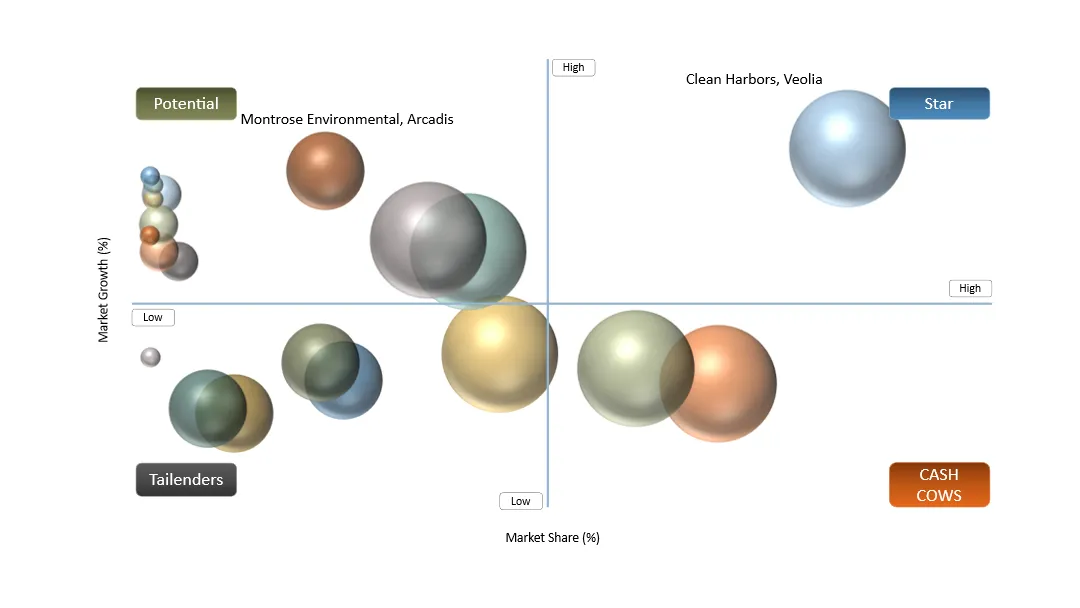
STAR
Clean Harbors, Veolia, Tetra Tech and AECOM are positioned as Stars because they combine large client networks, environmental engineering or field-service scale and exposure to regulatory, industrial and infrastructure cleanup. Their advantage is the ability to pursue multi-site programs and integrate remediation with hazardous waste, water, permitting or redevelopment services.
POTENTIAL
Montrose Environmental, Arcadis, WSP, Stantec, REGENESIS and specialist remediation contractors represent Potential players. Their growth depends on proprietary treatment capabilities, geographic expansion, digital tools, niche technical expertise and partnerships with larger asset owners and engineering platforms.
Hydrocarbon Remediation Market Dynamics
Driver Impact Analysis
| Driver | Market Growth Impact | Demand Concentration | Impacted Use Case | Strategic Impact |
| Stricter contaminated-site and groundwater enforcement | High | North America, Europe, developed APAC | Legacy petroleum sites | Expands mandatory investigation, treatment and monitoring |
| Oilfield and industrial asset retirement | High | Mature oil & gas regions | Decommissioning cleanup | Creates multi-year remediation pipelines |
| Brownfield redevelopment | Medium-High | Urban and industrial corridors | Land reuse | Links cleanup spending to property value and infrastructure |
| Spill response and aging infrastructure | Medium | Pipelines, terminals, transport | Emergency response | Supports rapid-mobilization field-service networks |
Driver: Rising Regulatory Liability and Asset Retirement
Hydrocarbon contamination remains a long-tail liability because petroleum can persist in soil and groundwater long after a facility closes. Stronger enforcement, asset transfers and decommissioning are forcing owners to define liabilities earlier and move sites toward closure. The result is sustained demand for characterization, treatment and verification rather than one-time cleanup events.
Restraint Impact Analysis
| Restraint | Drag on Growth | Primary Impact Area | Impacted Use Case | Strategic Impact |
| Subsurface uncertainty and heterogeneous geology | High | Project design | Groundwater / NAPL | Raises investigation cost and change-order risk |
| Long cleanup timelines | Medium-High | Cash flow and closure | In-situ remedies | Delays site release and extends monitoring |
| High disposal and mobilization cost | Medium | Excavation projects | Remote sites | Encourages in-situ treatment and local processing |
| Skilled labor and specialist capacity | Medium | Field execution | Complex projects | Supports consolidation and premium technical pricing |
Restraint: Site Heterogeneity and Long Closure Timelines
Hydrocarbon remediation is highly site-specific. The same contaminant can behave differently depending on geology, permeability, groundwater flow, weathering and co-contaminants. Incomplete characterization can cause treatment underperformance or unexpected volumes, making fixed-price work risky and extending closure schedules.
Hydrocarbon Remediation Market Segment Analysis
The global Hydrocarbon Remediation market is segmented based on Contaminant Type, Remediation Approach, Technology, Environmental Medium, Service Type, Project Type, End Use Industry, Contract Model and region.
By Contaminant Type
Crude Oil & Condensate Remains a Core Revenue Pool
Crude oil and condensate contamination is concentrated around production fields, pipelines, gathering systems and storage infrastructure. Large source zones may require free-product recovery, excavation, thermal treatment and biological polishing. Gasoline and BTEX projects are technologically distinct because volatility and groundwater migration make vapor extraction, air sparging and plume control more important.
By Remediation Approach
In-Situ Treatment Will Gain Share
In-situ remediation is expected to gain share because it reduces excavation, traffic, disposal and site disruption. Biostimulation, biosparging, chemical oxidation and monitored natural attenuation are increasingly combined with targeted source-zone removal. Ex-situ methods remain essential where rapid closure, redevelopment schedules or high contaminant mass justify excavation and treatment.
By Technology
Bioremediation & Biostimulation Will Record the Fastest Growth
Biological treatment benefits from lower energy and disposal intensity, particularly for biodegradable petroleum hydrocarbons. Adoption is strongest where site conditions can be managed through oxygen, nutrients, moisture and electron acceptors. Thermal and physical recovery remain critical for heavy hydrocarbons, NAPL and rapid source removal.
By Environmental Medium
Soil Holds the Largest Share, Groundwater Carries Higher Complexity
Soil remediation represents the largest volume of work because petroleum releases frequently affect shallow source zones. Groundwater projects can be more valuable per site because plume delineation, pumping, treatment and monitoring may continue for years. Sediment and marine work is more specialized and often linked to ports, terminals and spill events.
By Service Type
Treatment & Field Execution Leads, Monitoring Remains Recurring
Field execution accounts for the largest share because excavation, treatment systems, injections, recovery and waste handling require equipment and labor. Monitoring, verification and closure form recurring revenue streams, especially for groundwater and risk-based remedies.
By Project Type
Legacy Site Cleanup Leads While Decommissioning Accelerates
Legacy petroleum sites remain a large installed liability, but asset retirement is creating new remediation demand at oilfields, refineries and terminals. Brownfield redevelopment can accelerate spending because cleanup must align with transaction and construction schedules.
By End Use Industry
Oil & Gas and Refining Dominate Demand
Upstream oil & gas, refineries and petrochemical facilities generate the largest hydrocarbon-specific remediation demand because they combine extensive historical infrastructure with spill and decommissioning exposure. Transportation, industrial and government sites provide diversified secondary demand.
By Contract Model
Turnkey and Framework Contracts Gain Importance
Large asset owners increasingly favor framework agreements and integrated turnkey packages that reduce interface risk across investigation, treatment, waste management and monitoring. Specialist subcontracting remains important for thermal treatment, drilling, injection, analytical and proprietary biological technologies.
Hydrocarbon Remediation Market Geographical Penetration
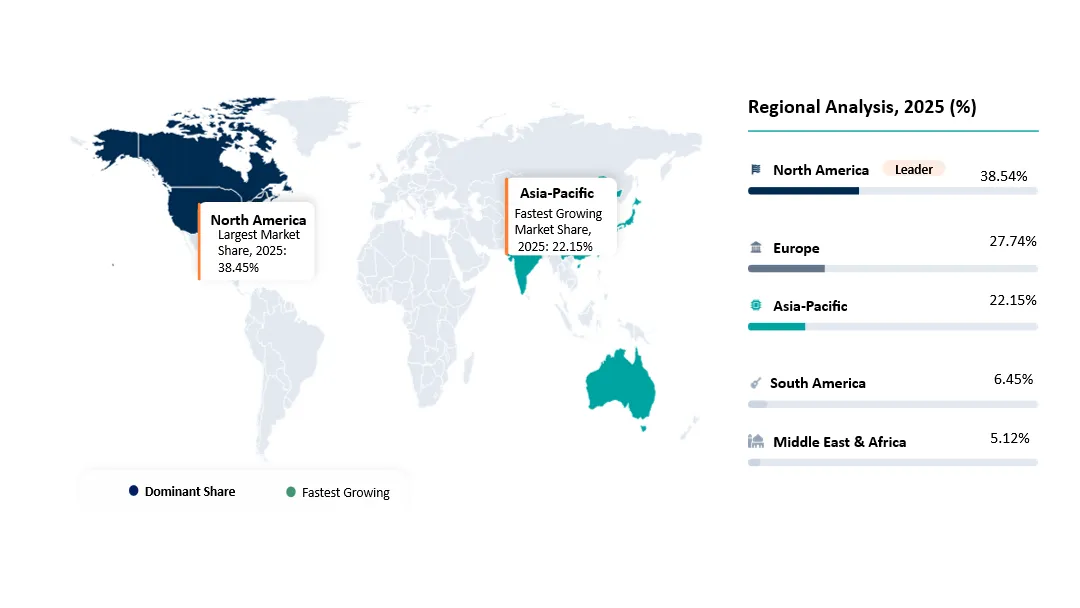
U.S. Hydrocarbon Remediation Market Landscape
The U.S. is the largest national market due to its extensive oil and gas infrastructure, petroleum terminals, service stations, industrial brownfields and mature liability regime. Demand spans emergency response, legacy groundwater cleanup, refinery and terminal projects, oilfield closure and brownfield redevelopment. Large providers benefit from national framework agreements and integrated hazardous-waste networks.
Canada Hydrocarbon Remediation Market Outlook
Canada has substantial demand associated with oil sands, upstream production, pipelines, terminals, rail transport and northern/remote sites. Cold climate, logistics and indigenous/community engagement influence project design. Bioremediation and land reclamation are important for upstream and decommissioning programs.
Germany Hydrocarbon Remediation Market Outlook
Germany has a mature contaminated-land market driven by industrial redevelopment, former fuel infrastructure, groundwater protection and urban brownfield reuse. High landfill and transport costs support in-situ treatment and soil washing where technically feasible.
China Hydrocarbon Remediation Market Trends
China is a major growth market as industrial land conversion, refinery relocation and contaminated-site regulation expand. Large urban redevelopment projects create demand for rapid soil treatment, while industrial provinces increasingly require groundwater investigation and risk control.
India Hydrocarbon Remediation Market Outlook
India offers growth through refinery, pipeline, fuel-terminal and urban industrial expansion. Greater regulatory enforcement, public infrastructure projects and brownfield redevelopment can increase formal remediation demand, although price sensitivity and fragmented execution remain challenges.
Saudi Arabia and UAE Market Outlook
Gulf markets combine large upstream, refining, petrochemical and storage infrastructure with expanding industrial cities. Opportunity is strongest in oilfield restoration, spill response, tank-farm cleanup and soil treatment around large industrial assets.
Hydrocarbon Remediation Market Competitive Landscape
- Competition is split between integrated environmental-service platforms, engineering consultancies, hazardous-waste companies and specialist remediation technology providers.
- Clean Harbors and Veolia benefit from disposal and hazardous-waste networks that complement remediation field services.
- Tetra Tech, AECOM, WSP, Arcadis and Stantec compete strongly in characterization, engineering, program management and brownfield redevelopment.
- Specialists such as REGENESIS compete through proprietary amendments, delivery systems and technical support for in-situ remediation.
- Differentiation increasingly depends on safety, regulatory track record, proprietary technology, digital characterization, treatment performance and ability to manage multi-site programs.
Public Company Q1-Q2 2026 Performance Comparison
| Public Company | Q1-Q2 / H1 2026 Performance | Hydrocarbon Remediation Exposure | Growth Factors |
| Clean Harbors, Inc. | Q2 revenue reached US$1.74 billion, up 12% YoY; Q2 adjusted EBITDA reached US$409.0 million, up 22%. | Environmental Services includes field services, remediation projects, emergency response, disposal and recycling. | Healthy disposal volumes, remediation and PFAS work, pricing, branch expansion, planned ES&H acquisition and Terra Nova acquisition. |
| Veolia Environnement S.A. | H1 2026 revenue approximately €22.2 billion; EBITDA approximately €3.55 billion, up about 5%. | Hazardous waste, contaminated-site services and the Clean Earth platform provide direct U.S. environmental cleanup exposure. | Clean Earth integration, hazardous-waste expansion, environmental-security demand and operational efficiency. |
| Tetra Tech, Inc. | Q2 FY2026 revenue US$1.22 billion; net revenue US$1.05 billion; backlog US$4.28 billion, up 8% sequentially. | Environmental consulting, water, remediation, federal environmental programs and site engineering. | Strong environment/water demand, public-sector contracts, backlog growth and digital/engineering integration. |
| AECOM | Q2 FY2026 revenue US$3.80 billion; adjusted EBITDA up 8%; total backlog US$26.2 billion, up 8%. | Environment and water design, contaminated-site engineering, brownfield and infrastructure programs. | Record design backlog, strong Americas growth, infrastructure funding and environment/water wins. |
| Montrose Environmental Group, Inc. | 2026 public disclosures emphasize continuing investment in environmental solutions and technology; standalone hydrocarbon-remediation revenue is not separately disclosed. | Engineering, remediation, emergency response, industrial VOC abatement and energy-sector environmental services. | Technology innovation, energy-sector compliance, VOC treatment, integrated environmental service model and geographic expansion. |
Hydrocarbon Remediation Market Ecosystem
| Value-Chain Sector | Role in Market | Representative Companies / Organizations |
| Site Characterization & Consulting | Hydrogeology, drilling plans, risk assessment, modeling and remedy design | Tetra Tech, AECOM, WSP, Arcadis, Stantec, GHD, ERM |
| Field Remediation & Emergency Response | Excavation, recovery, in-situ treatment, spill containment and cleanup | Clean Harbors, Montrose Environmental, ENTACT, Sevenson Environmental |
| Hazardous Waste & Disposal | Treatment, landfill, incineration, oily waste processing and logistics | Clean Harbors, Veolia / Clean Earth, Cleanaway |
| Bioremediation & Treatment Chemistry | Microbial amendments, nutrients, electron acceptors and in-situ chemistry | REGENESIS, Evonik/chemical suppliers, specialist biotech providers |
| Equipment & Treatment Systems | SVE, air sparging, pumps, separators, thermal systems, mobile water treatment | Xylem, ECT2/Montrose, equipment rental and specialist OEMs |
| Laboratories & Monitoring | TPH, BTEX, PAH analysis, groundwater sampling and data validation | SGS, Eurofins, ALS, Bureau Veritas and regional labs |
| Digital & Subsurface Analytics | GIS, groundwater models, real-time sensors, digital twins and reporting | Bentley Systems, Esri, Seequent and environmental software providers |
| Asset Owners / Buyers | Oilfields, refineries, terminals, pipelines, industrial sites and brownfields | Shell, ExxonMobil, Chevron, BP, TotalEnergies, refiners, industrial groups |
| Regulators & Standards | Cleanup standards, spill rules, liability, waste and groundwater oversight | U.S. EPA, state regulators, ECHA/EU authorities, national environmental agencies |
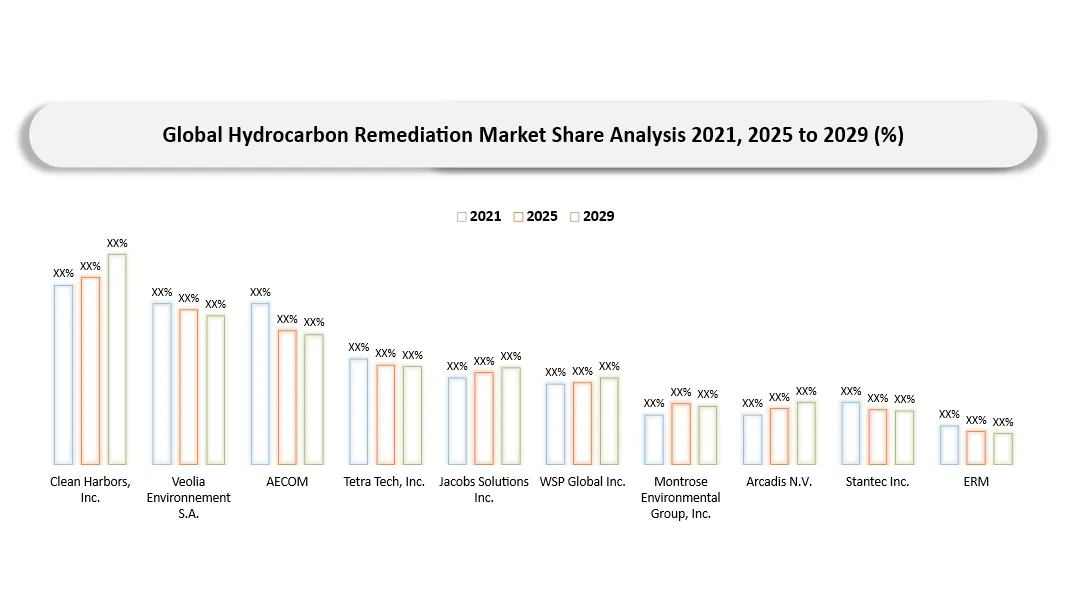
Key Companies
- Clean Harbors, Inc.
- Veolia Environnement S.A.
- Tetra Tech, Inc.
- AECOM
- Montrose Environmental Group, Inc.
- WSP Global Inc.
- Jacobs Solutions Inc.
- Arcadis N.V.
- Stantec Inc.
- GHD
- ERM
- REGENESIS
- Sevenson Environmental Services
- ENTACT
- Cleanaway Waste Management Limited
Company Profiles
Clean Harbors, Inc.
Clean Harbors is one of the most directly exposed public companies through Environmental Services, emergency response, field services, remediation, hazardous-waste disposal and industrial services. Its network allows customers to combine site cleanup with transport, treatment and disposal. Growth is supported by branch expansion, remediation activity, acquisitions and high utilization of disposal assets.
Veolia Environnement S.A.
Veolia provides hazardous-waste, water and environmental services across multiple regions. Its U.S. hazardous-waste position expanded through Clean Earth, strengthening its ability to serve industrial contamination and remediation programs alongside treatment and disposal.
Tetra Tech, Inc.
Tetra Tech provides environmental consulting, engineering, water and sustainable infrastructure services. Hydrocarbon remediation relevance is concentrated in contaminated-site investigation, federal programs, groundwater, brownfield and remediation design and oversight.
AECOM
AECOM provides large-scale environment, water, design and program-management services. The company is relevant to complex industrial and brownfield remediation where cleanup is integrated with infrastructure redevelopment, permitting and asset transformation.
Montrose Environmental Group, Inc.
Montrose combines environmental consulting, measurement, engineering, remediation and technology. Its hydrocarbon exposure includes energy-sector work, industrial VOC treatment, emergency response and contaminated-site services.
WSP Global Inc.
WSP is a global professional-services firm with environmental consulting, contaminated land, hydrogeology and remediation capabilities. Its strength is integrating environmental liability with major infrastructure, transport and property projects.
Jacobs Solutions Inc.
Jacobs provides environmental engineering and program management for industrial, government and infrastructure clients. The company is relevant to complex remediation programs, federal sites and long-duration environmental management.
Arcadis N.V.
Arcadis has a strong global environmental restoration and contaminated-site practice. It combines consulting, remediation design, sustainable remediation and brownfield strategy for industrial and energy clients.
Stantec Inc.
Stantec provides environmental services, hydrogeology, remediation and infrastructure engineering. Its distributed network supports local site work as well as larger multi-site programs.
GHD
GHD provides environmental engineering, contaminated-land and water services across energy, industrial and infrastructure markets, with strong positions in Australia, North America and other regions.
ERM
ERM is a major private environmental consultancy with substantial energy and industrial client exposure. It supports transaction diligence, contaminated-site management, remediation strategy and ESG-linked liability programs.
REGENESIS
REGENESIS is a specialist provider of in-situ remediation technologies, including biological and chemical amendments. Its model relies on proprietary products, technical design support and partnerships with consulting and field contractors.
Sevenson Environmental Services
Sevenson is a specialist environmental remediation contractor with experience in complex soil, sediment and industrial cleanup projects, particularly in the U.S.
ENTACT
ENTACT provides remediation, geotechnical construction and environmental services for complex industrial and contaminated sites. It competes on field execution, safety and large-project delivery.
Cleanaway Waste Management Limited
Cleanaway is a major Australian waste and environmental services company. Its hazardous and industrial waste capabilities support contaminated-site and hydrocarbon cleanup projects through transport, treatment and disposal networks.
Hydrocarbon Remediation Market Major Pain Points
- Incomplete source-zone characterization and uncertain subsurface geology.
- Long closure timelines for groundwater and residual NAPL.
- High excavation, transport and disposal cost for remote or large sites.
- Regulatory uncertainty around risk-based closure and residual contamination.
- Shortage of experienced hydrogeologists, drillers and specialist field crews in some regions.
- Difficult treatment of weathered heavy hydrocarbons and mixed contaminants.
- Need to maintain active facility operations during remediation.
- Liability transfer and long-term monitoring obligations after property transactions.
Hydrocarbon Remediation Market Recent Developments
- July 2026: Clean Harbors reported record second-quarter results and highlighted remediation projects as a contributor to Environmental Services demand; it also announced a planned acquisition of ES&H to expand field services.
- June 2026: Veolia completed the Clean Earth transaction, materially expanding its U.S. hazardous-waste platform and strengthening its integrated environmental-services growth position.
- May 2026: Clean Harbors announced the acquisition of Terra Nova Solutions, extending capabilities in environmental and industrial services.
- April 2026: Tetra Tech reported strong second-quarter fiscal 2026 results and raised full-year guidance, supported by growth across water, environment and sustainable infrastructure.
- January 2026: Montrose Environmental introduced a new industrial VOC abatement technology relevant to hydrocarbon-contaminated vapors at petroleum refineries and chemical facilities.
- May 2026: AECOM reported record second-quarter backlog, with environment and water among the areas supporting Americas design wins.
Analyst View / Opinion on Hydrocarbon Remediation Market
- Hydrocarbon remediation is a durable environmental-services category because petroleum liabilities persist for decades and become actionable during spills, enforcement, asset transfers, decommissioning and redevelopment.
- Bioremediation will gain share, but the market will remain technology-diverse because complex sites require source removal, free-product recovery, groundwater control and treatment trains.
- Large integrated providers will benefit from national framework agreements, disposal networks and ability to combine emergency response with long-term remediation.
- Specialist technology companies can create high-value niches where proprietary amendments, thermal systems, vapor treatment or digital characterization materially improve closure speed.
- Brownfield redevelopment will increasingly shift remediation from a pure compliance cost into a value-creation activity tied to land reuse and infrastructure investment.
- Asia-Pacific offers the strongest long-term expansion potential, while North America remains the deepest market for large, sophisticated remediation programs.
Hydrocarbon Remediation Market Target Audience
| Industry | Who Should Buy This Report? | Reason to Buy This Report |
| Oil & Gas | Environmental managers, asset-retirement teams, HSE and procurement | Benchmark remediation technologies, contractors, costs and decommissioning opportunities. |
| Refining & Petrochemicals | Site managers, compliance teams and corporate environmental leaders | Assess legacy liabilities, groundwater treatment and integrated cleanup strategies. |
| Environmental Services | Consultants, remediation contractors and technology suppliers | Identify growth segments, partnership opportunities and competitive positioning. |
| Waste Management | Hazardous-waste, treatment and disposal companies | Evaluate integration opportunities with field remediation and emergency response. |
| Brownfield & Real Estate | Developers, infrastructure investors and transaction teams | Understand cleanup timelines, liability and land-value unlock. |
| Government & Defense | Environmental agencies, municipalities and defense programs | Plan contaminated-site portfolios, procurement and funding priorities. |
| Investors & Consulting | Private equity, institutional investors and strategy teams | Evaluate consolidation, technology differentiation and regional growth opportunities. |
Why Choose DATAM?
- Data-driven insights combining market sizing, contaminated-site activity, technology economics and country-level regulation.
- Post-purchase analyst consultations for market entry, partnerships, technology positioning and contractor benchmarking.
- Annual updates covering regulatory changes, project awards, acquisitions, new remediation technologies and competitive developments.
- Specialized focus on emerging markets and industrial environmental infrastructure rather than generalized environmental-service overviews.
- Actionable analysis that connects contamination type, treatment technology, project economics and procurement behavior.
What DATAM Uniquely Provides
- Ten-year forecasts across eight segmentation categories and five regions.
- Hydrocarbon-specific analysis separated from broader environmental remediation and hazardous waste.
- Market ecosystem mapping from site characterization through treatment, disposal, monitoring and end users.
- Public-company 2026 performance comparison linked to remediation exposure and growth drivers.
- Buyer-focused analysis of cleanup standards, treatment selection, closure risk and contract models.


























































