


Hydro Turbine Market Size and Overview
The global Hydro Turbine market is estimated at approximately US$ 2.7 billion in 2025 and is projected to reach about US$ 4.9 billion by 2035, representing an estimated CAGR of around 6.1% during 2026-2035. Growth is supported by pumped-storage investment, modernization of aging hydro fleets, emerging-market hydropower additions and demand for dispatchable renewable generation.
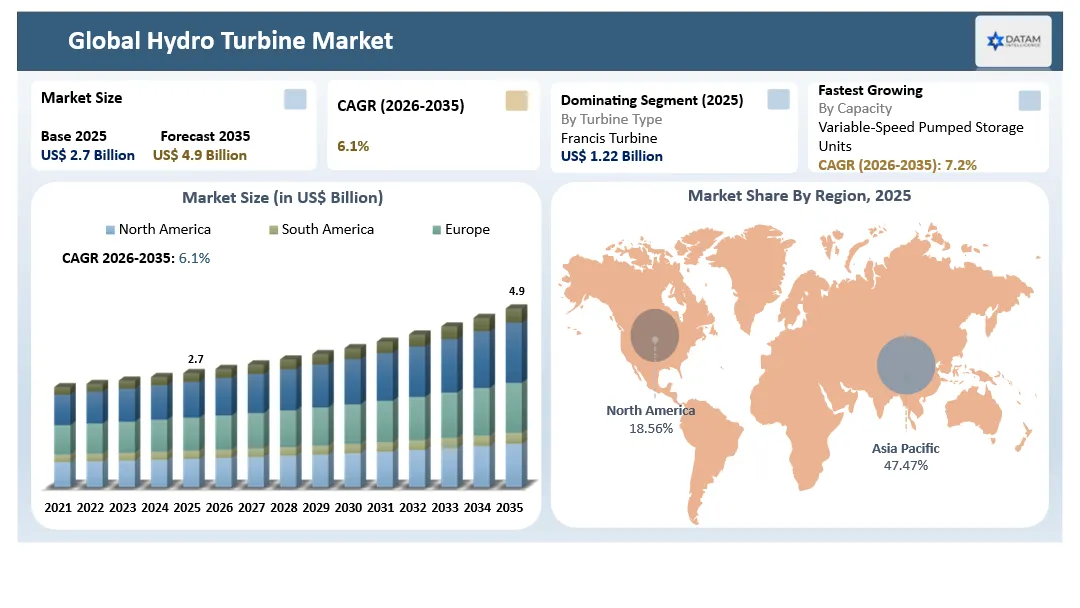
The market is highly project-specific because turbine selection depends on head, flow, operating regime, cavitation limits, grid requirements and civil interfaces. Suppliers compete on guaranteed efficiency, model-test performance, project references, local execution, service capability and lifecycle economics.
| Metrics | Details |
| 2025 Market Size | US$ 2.7 Billion |
| 2035 Projected Market Size | US$ 4.9 Billion |
| CAGR (2026-2035) | ~6.1% |
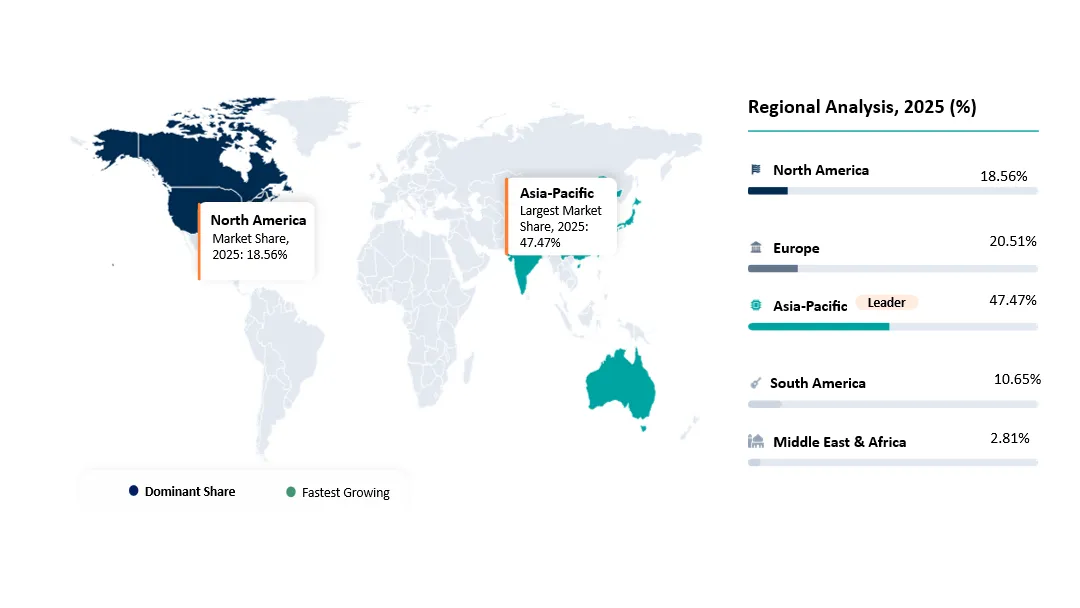
| Largest Regional Market | Asia-Pacific |
| Fastest Investment Theme | Pumped-Storage Hydropower |
| Largest Turbine Type | Francis Turbine |
| Fastest-Growing Equipment Theme | Variable-Speed Pump-Turbines & Modernization |
| Key Demand Theme | Grid flexibility, uprating and renewable balancing |
| Key Growth Theme | LEO hydropower programs, lunar projects, high-cycle turbines and standardized hydropower-qualified products |
Hydro Turbine Market Key Takeaways
- Francis turbines remain the commercial standard for a broad share of medium-head hydropower projects because of their wide operating envelope, mature supply chain and large installed base.
- Variable-speed pump-turbines and digital hydro controls are becoming strategically important as grids absorb more variable renewable generation and require fast-response storage.
- The global Hydro Turbine market is estimated at approximately US$ 2.7 billion in 2025 and is projected to reach about US$ 4.9 billion by 2035, representing an estimated CAGR of around 6.1% during 2026-2035. Growth is supported by pumped-storage investment, modernization of aging hydro fleets, emerging-market hydropower additions and demand for dispatchable renewable generation.
- Competitive advantage is increasingly defined by hydraulic efficiency, installed-base references, project execution, localization, digital service capability and the ability to supply large pumped-storage projects on schedule.
- Verified efficiency gains, cavitation performance, flexible operating range, digital monitoring and lifecycle service coverage are becoming key differentiators.
Hydro Turbine Industry Trends and Strategic Insights
- Francis turbines have been able to establish themselves as the largest turbine type on the commercial scale because of their versatility in a wide range of medium-head and high-capacity hydro power installations.
- Variable-speed pumped-storage systems are gaining strategic importance because they improve operating flexibility, part-load efficiency and grid balancing capability.
- Pumped storage is emerging as a critical pathway for grid flexibility because it can absorb excess renewable generation and provide large-scale, long-duration balancing capacity.
- Public investment programs, capacity-market reforms and grid-planning rules are increasingly shaping hydropower project pipelines and modernization priorities.
- Europe leads policy-driven commercialization, while Asia-Pacific represents the largest long-term volume opportunity because of its scale of turbine production and infrastructure demand.
- Long development timelines, site-specific engineering and financing complexity remain key adoption constraints, particularly for large greenfield hydropower projects.
- Demand varies by region and project type. Mature markets emphasize modernization and pumped storage, while emerging markets focus on new hydropower capacity and refurbishment.
Why does this report matter in 2026?
2026 will be a critical year for the hydro turbine industry in the face of pumped storage capacity, fleet upgrade needs, grid flexibility demands, and large-scale hydro power projects in the Asia-Pacific region and Europe converging with increasing demands for efficient, digital monitoring and flexible turbines. The implications of this include increased scope for retrofit, modernization, variable speed technologies, and control systems, as well as the importance of hydropower in variable renewable energy integration.
Hydro Turbine Market White Space & Investment Opportunities
- Variable-speed pump-turbines, digital governors, condition monitoring, advanced runner materials and regional service hubs are among the most attractive white-space opportunities.
- High-efficiency turbine upgrades and retrofit solutions that can be deployed through existing turbine OEM and service networks offer near-term scalable growth opportunities.
- Hydro turbines are moving from a mature generation technology toward a strategic grid-flexibility asset as renewable penetration increases and utilities value dispatchable low-carbon capacity.
- The next phase of market development will combine high-efficiency runners, flexible operating envelopes, advanced controls, predictive maintenance and stronger integration with pumped storage.
- Variable-speed and ternary pumped-storage systems can address premium projects where operating flexibility and fast-response capability carry strategic value.
Hydro Turbine Future Market Transformation
By 2035, the market will shift toward more efficient turbines, flexible operations, digital controls, and locally produced services. Hydraulic efficiency, operating flexibility, reliability, condition monitoring, and performance will be more important than price and durability when procuring turbines.
Advanced hydraulic designs will be adopted selectively according to head, flow, plant duty and project economics. Near-term gains are likely to come from runner upgrades, digital controls, variable-speed systems and improved condition monitoring.
Hydro Turbine Market Buyer Decision-Making Criteria
Buyer requirements include hydraulic efficiency, project references, reliability, cavitation performance, standard compliance, total cost of delivery, experience of project implementation, local servicing, parts availability, electronic monitoring capacity, and the ability of suppliers to deliver projects. Variable speed, flexibility, quick start-up, and part load efficiency are now gaining importance for pumped storage plants.
Hydro Turbine Market Economic & Investment Analysis
Investment in hydro turbines is fueled by pumped-storage development, rehabilitation of old turbine systems, growth in hydropower capacity and the need for flexibility in the grid. While initial costs associated with the equipment and engineering of the systems might limit investment, turbine upgrades do not necessarily entail the building of new hydropower plants; instead, it may involve making existing turbines more efficient and flexible. Different types of projects present different investment prospects, with pumped storage and big rehabilitations presenting good prospects for investors.
Hydro Turbine Investment Trends in the Market
- There is investment in variable speed and high head hydro turbines that help in energy storage and quick grid balancing.
- Utility companies are investing in replacement runners, upgrading of turbines, and control system upgradation in order to increase the life of existing hydropower stations.
- There is R&D expenditure being made on better runner design, cavitation resistant turbines, and extended envelope turbines that operate in variable flows.
- There is investment being made on digital twin modeling, vibration analysis, predictive maintenance, and remote diagnostics in order to prevent turbine failures.
- There are hydro turbine manufacturers expanding their regional manufacturing capabilities and aftermarket service capabilities in order to cut down delivery time and supply chain risks.
Strategic Indicators for Hydro Turbine Market
High Regulation Impact
Hydropower projects are highly exposed to public policy, grid planning, water regulation, permitting and long-term power-market design, all of which materially shape equipment demand.
High Investment Activity
The leading OEMs and utilities are focusing their investments on upgrading hydropower plants, variable-speed pump turbines, digital controls, regional service networks and turbine technology advancements.
Supply Chain Disruption
Tight availability of heavy forgings, skilled hydro engineers and large manufacturing slots can extend delivery times, increasing interest in early procurement and regional supply-chain localization.
Pricing Volatility
Steel, copper, freight, heavy-haul logistics and project-financing costs can create meaningful volatility in hydro turbine project economics.
Procurement Pressure
Utilities and project developers increasingly request guaranteed efficiency, wide operating envelopes, digital monitoring, local-content commitments and long-term service support.
New Technology Adoption
Variable-speed pumped storage, advanced runners, digital governors, predictive maintenance and hybrid hydro-storage operation are broadening the technical pathway set available to hydro OEMs.
Regional Expansion Opportunity
Asia-Pacific, the Middle East and selected emerging markets offer large-volume growth opportunities as new hydropower and pumped-storage capacity is developed alongside grid expansion.
Government Policy Support
Tax incentives, grid contracts, public procurement standards, innovation grants and infrastructure funding can materially accelerate commercial deployment.
Pricing Intelligence
Premiums on prices are dependent on the following factors: type of turbine, head and flow characteristics, degree of project difficulty, efficiency guarantees, and operation requirements, with increased willingness to pay for variable speed pumped storage systems and extensive projects.
Disruption Analysis of Hydro Turbine Market
New trends in hydro turbines are changing the traditional value chain of hydropower equipment through a shift towards increased value in high efficiency runner design, variable speed pump-turbine, digital governors, condition monitoring, and lifetime optimization. In procurement processes, there is an increasing trend away from initial equipment cost towards guaranteed hydraulic performance, flexibility, digital monitoring, reconditioning, and maintenance contracts.
Hydro Turbine Market BCG Matrix: Company Evaluation
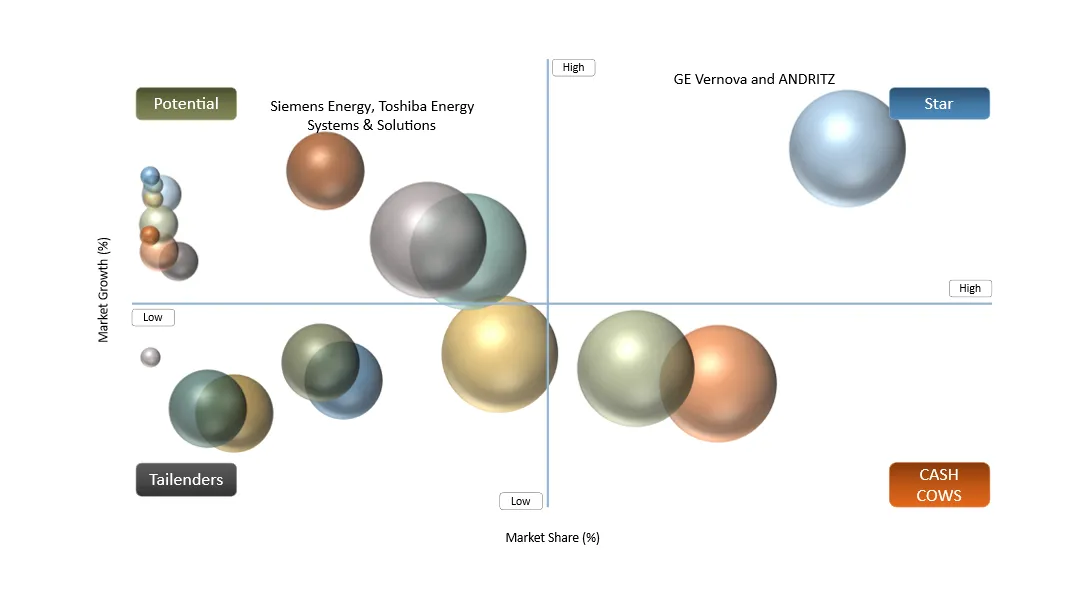
STAR: GE Vernova and ANDRITZ combine global scale, broad turbine portfolios, large installed bases and significant exposure to pumped storage and modernization.
POTENTIAL: Siemens Energy, Toshiba Energy Systems & Solutions, Bharat Heavy Electricals Limited (BHEL), Turbineir and specialist alternative-hydraulic companies can capture growth through regional scale, differentiated products and modernization projects.
Hydro Turbine Market Dynamics
Driver Impact Analysis
| Driver | Market Growth Impact | Demand Concentration | Impacted Use Case | Strategic Impact |
| Pumped-storage investment | High | China, India, Europe, North America | Pump-turbines and reversible units | Expands large-ticket turbine orders and long-duration project backlogs. |
| Aging hydro fleet modernization | High | Europe, North America, Japan | Runner replaturbine and uprating | Creates recurring retrofit and service demand. |
| Grid flexibility requirements | High | Global | Pumped storage and flexible hydro | Raises the value of fast-ramping and variable-speed systems. |
| Emerging-market power investment | Medium-High | Asia-Pacific, Latin America, Africa | New conventional hydro | Supports greenfield Francis and Kaplan deployments. |
Driver: Pumped-Storage Investment
The rising investment in pumped storage facilities is the main factor influencing the development of the Hydro Turbine Market as companies are increasingly using pumped storage facilities to handle fluctuating power output from renewable energy sources and make electricity networks more flexible. The growing investment in pumped storage facilities, especially in China, India, Europe and North America, has raised the demand for powerful pump turbines and variable speed turbines.
Restraint Impact Analysis
| Restraint | Drag on Market Growth | Primary Impact Area | Impacted Use Case | Strategic Impact |
| Long permitting and civil-development timelines | High | Large hydro projects | New-build projects | Delays equipment awards and revenue recognition. |
| High capital intensity and financing risk | High | Emerging markets | Large and pumped-storage hydro | Favors sovereign-backed and utility-led projects. |
| Environmental and hydrology constraints | Medium-High | River-basin projects | Conventional and run-of-river | Raises project design, mitigation and approval complexity. |
| Heavy-forging and skilled-engineering bottlenecks | Medium | Large units | Pumped storage and modernization | Can extend delivery times during order surges. |
Restraint: Long Permitting and Civil-Development Timelines
Long permitting and civil development lead times represent a significant constraint for the Hydro Turbine Market as large hydro projects entail many environmental studies, water usage permits, civil developments and many other factors to be completed before turbines can be procured. This may lead to delayed equipment procurements and delay project time lines resulting in delayed revenues for turbine suppliers.
Hydro Turbine Market Segmentation Analysis
By Turbine Type
Francis Turbine Will Remain the Largest Turbine Type
Francis turbines continue to hold the highest share of all turbines owing to their ability to operate efficiently in diverse applications for both medium heads and high-capacity hydro power plants. Pumped storage capacity increase is anticipated to drive the growth of pump-turbines and variable speed systems.
By Capacity
100–500 MW Turbines Will Maintain Strong Demand
100–500 MW capacity range will see continued strong demand, as it accounts for a significant portion of large-scale conventional hydropower and pumped storage projects, where high-capacity turbines are used. Demand will be fueled by development of new hydropower capacity, installation of new pumps, and modernization of old large-scale capacities, while capacities above 500 MW are limited to only very large projects and capacities up to 100 MW are used in smaller hydropower facilities.
By Head Type
Medium-Head Turbines Will Remain a Core Demand Segment
Medium head (30-300m) is anticipated to be a key demand segment in this market because these operational environments are suitable for various applications of the Francis turbines. High-heads will maintain their use in Pelton turbines and speciality systems while low-heads will see preference for Kaplan, bulb, and tubular types.
By Application
Pumped-Storage Hydropower Will Gain Strategic Importance
The need for large storage capacity and balancing ability in power generation will make pumped-storage hydro more strategically important. While conventional hydro power will continue to be the most important application sector, smaller, mini, and run-of-river plants will be further applications requiring turbine systems with less capacity.
By Project Type
Modernization, Retrofit & Uprating Will Drive Recurring Demand
Modernization and retrofitting/uprating projects will be key drivers of demand as operators try to raise turbine efficiencies and boost generation capabilities of their old hydro plants. Turbine runner changes, improved control systems, and reconditioning of turbines can provide such gains without a complete greenfield project.
By Plant Type
Conventional Hydropower Plants Will Maintain the Largest Installed Demand Base
Conventional hydropower plants will continue to have the highest installed base of demand due to the presence of a large number of such plants all around the world and continuous requirements for their rehabilitation. Pumped storage projects are becoming more significant as grid storage increases, and run-of-river and small/mini hydropower applications emerge.
By End User
Utilities & Independent Power Producers Will Remain the Core End Users
Utilities and IPPs will continue to be the major consumers due to their ownership of vast fleets of hydropower plants, as well as their efforts to develop and upgrade new capacities. In addition, governmental bodies responsible for power generation and hydropower projects developers are major players in the market demand.
By Sales Channel
Direct OEM / EPC Contracts Will Remain the Dominant Sales Channel
Direct OEM/EPC Contracts will continue to be the most popular sales channel due to the nature of the hydro turbine project which requires site specific engineering, installation of equipment, performance guarantees, and technical support. There will be growth in aftermarket and service channels as old turbine sets become obsolete and need upgrading.
Hydro Turbine Market Geographical Penetration
Germany Hydro Turbine Market Outlook
Germany constitutes a mature market for hydro turbines, where demand is concentrated in modernization, refurbishment, energy efficiency improvements, and digital monitoring of the country’s existing hydro power plants. The growth of pumped storage systems, flexibility needs for the grid, along with the already developed technological know-how of major European manufacturers constitute additional growth drivers.
Japan Hydro Turbine Market Outlook
Japan represents a sophisticated hydro turbine market where potential exists primarily in the modernization of old fleets, turbine uprates, efficiency enhancements, and digital controls. Few chances for large-scale greenfield projects make retrofits and uprates even more relevant, with harsh operating conditions promoting the need for reliable turbines.
India Hydro Turbine Market Outlook
India provides great prospects in terms of development in the field of hydropower, pumped storage, and upgradation of existing hydro resources. The growing need for integration of renewable energy sources in India along with balancing of the grid is providing opportunities for manufacturers of high capacity and flexible turbines.
Hydro Turbine Market Competitive Landscape
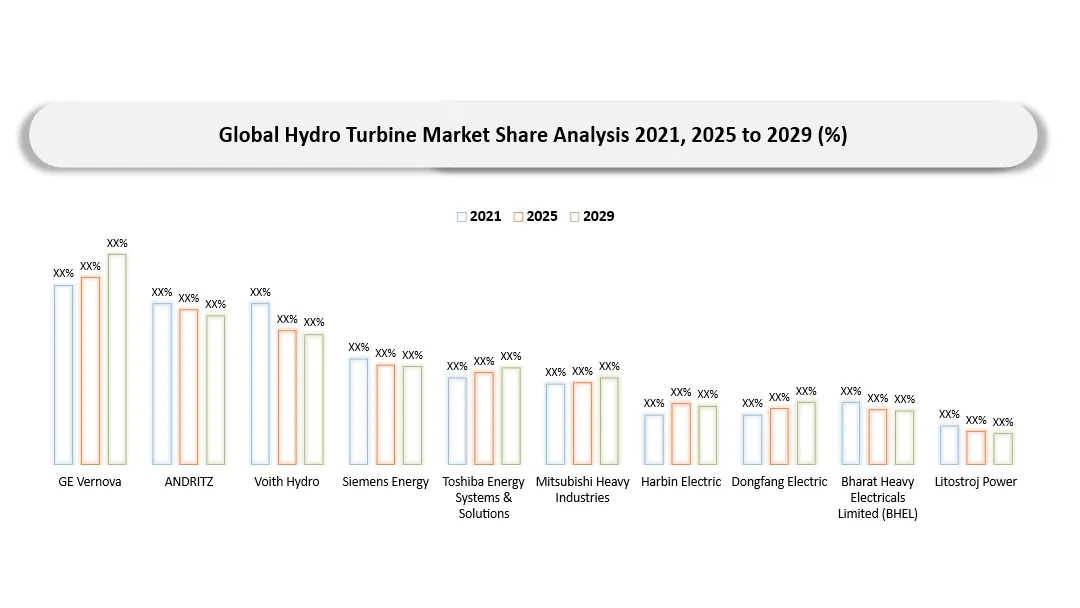
- The global OEMs rule in large hydro and PSPP projects, with the leading ones competing via extensive product lines, installed-base experience, engineering skills and after-sales support.
- Technological differentiation is on the rise, especially in relation to highly efficient runners, variable speed pumps-turbines, digital controls, condition monitoring systems and flexible operation.
- Installed-base is an important competitive advantage, as refurbishment, uprating and modernization provide opportunities for OEMs already possessing relevant equipment and established relations with utilities.
- Competition differs from one type of turbine and project size, with large custom-engineered turbines produced by a few manufacturers only, while small hydro turbines are supplied by a more fragmented set of suppliers.
- The local production and service capability are becoming crucial factors, especially in the fast-growing Asian Pacific market and other regions.
Public Company Q1-Q2 2026 Performance Comparison
| Public Company | Q1-Q2 2026 Performance Snapshot | Hydro Turbine Exposure | Factors Driving Growth |
| GE Vernova (NYSE: GEV) | Q2 2026 results showed continued revenue growth and a total company backlog of about US$176B; management raised 2026 guidance. | Direct through GE Vernova Hydro, including conventional hydro, pumped-storage turbines, generators, controls and modernization services. | Grid investment, modernization, pumped-storage awards and large installed-base service demand. |
| ANDRITZ (VIE: ANDR) | Q2 2026 revenue reached EUR 2.05B, up 8.5%; H1 revenue was EUR 3.84B. Hydropower helped drive H1 revenue growth, while Q2 Hydro order intake was EUR 569M. | Highly direct through Francis, Kaplan, Pelton, pump-turbines, generators and hydro modernization. | Pumped-storage awards, Indian and Asian projects, modernization and service revenue. |
| Siemens Energy (ETR: ENR) | Q2 FY2026 revenue reached EUR 10.3B, up 8.9% comparably, with orders at EUR 17.7B and backlog at EUR 154B. | Selective / indirect today; exposure is primarily through generators, grid equipment and energy-system integration rather than being a leading standalone hydro-turbine OEM. | Global power-system investment, grid expansion, rotating equipment and services. |
| Toshiba Corp. / Toshiba Energy Systems | 2026 performance reflects Toshiba Group energy-system execution and continued investment in power infrastructure. | Direct through hydro turbines, generators, pumped-storage equipment and refurbishment in Japan and international markets. | Japanese modernization, pumped-storage projects, efficiency upgrades and service. |
| Bharat Heavy Electricals Ltd. (NSE: BHEL) | BHEL published unaudited results for the quarter ended June 30, 2026, alongside a growing power-project execution pipeline. | Direct through hydro turbines, generators and electro-mechanical packages for Indian hydropower projects. | India hydro and pumped-storage pipeline, domestic manufacturing preference and utility capex. |
Market Ecosystem Table
| Value-Chain Sector | Representative Companies / Organizations | Role in Hydro Turbine Ecosystem |
| Engineering & Hydraulic Design | GE Vernova, ANDRITZ, Voith Hydro, Toshiba, BHEL, Harbin Electric | Design runners, guide vanes, casings, pump-turbines and integrated hydraulic systems. |
| Heavy Forgings & Castings | Specialty steelmakers, foundries and forging suppliers | Provide large shafts, runners, stay rings, casings and other critical rotating components. |
| Generators & Electrical Systems | GE Vernova, ANDRITZ, Siemens Energy, Toshiba, BHEL, Hitachi Energy partners | Supply generators, excitation, transformers, converters and balance-of-plant electrical systems. |
| Controls, Governors & Digital Hydro | OEM digital platforms, ABB, Schneider Electric, Emerson and specialist control suppliers | Provide governors, automation, condition monitoring, predictive maintenance and plant optimization. |
| EPC & Civil Contractors | PowerChina, Larsen & Toubro, Strabag, Salini/WeBuild, regional hydro EPCs | Execute dams, waterways, caverns, powerhouse hydropower and installation. |
| Utilities & Project Developers | State utilities, IPPs, pumped-storage developers and public power agencies | Develop, finance, own and operate hydropower assets. |
| Service & Modernization | OEM service networks and independent hydro service firms | Perform runner replaturbine, uprating, rewinds, life extension and digital upgrades. |
| Research, Standards & Industry Bodies | International Hydropower Association, IEC, CIGRE, national laboratories | Support technical standards, sustainability guidance and innovation. |
| Logistics & Installation | Heavy-haul logistics, crane specialists and site-installation contractors | Transport and install oversized turbine and generator components. |
Key Companies
- GE Vernova
- ANDRITZ
- Siemens Energy
- Toshiba Energy Systems & Solutions Corporation
- Bharat Heavy Electricals Limited (BHEL)
- Voith Hydro
- Mitsubishi Heavy Industries
- Harbin Electric
- Dongfang Electric
- Litostroj Power
- Rainpower
- Flovel Energy
- Gilbert Gilkes & Gordon
- WWS Wasserkraft
- Global Hydro Energy
Company Profiles
GE Vernova
GE Vernova is a major global hydropower equipment supplier with an installed base spanning conventional hydro, pumped storage, generators, controls and modernization. Its hydro business benefits from long-lived assets, recurring service demand and renewed investment in pumped storage.
Competitive priorities include large-project execution, variable-speed pumped storage, modernization, digital diagnostics, service monetization and regional manufacturing capability.
ANDRITZ
ANDRITZ is one of the world’s leading hydropower OEMs, supplying Francis, Kaplan and Pelton turbines, pump-turbines, generators, automation and modernization services. Its 2026 order pipeline includes major pumped-storage projects in Asia.
Competitive priorities include converting pumped-storage awards into backlog, expanding modernization services, improving hydraulic efficiency and strengthening digital lifecycle offerings.
Siemens Energy
Siemens Energy participates directly in hydro turbine through its Vertua lower-grid portfolio and broader Future in Action modernization strategy. The company combines runner-factor reduction, grid services, renewable electricity, novel materials and grid-management initiatives across its vertically integrated turbine and hydro OEM network.
Siemens Energy participates selectively in hydropower through generators, rotating equipment, grid technologies and energy-system integration rather than as a leading standalone hydro-turbine OEM.
Toshiba Energy Systems & Solutions
Toshiba Energy Systems & Solutions is a major vertically integrated hydropower equipments producer with significant turbine, aggregates and downstream exposure. Its high-efficiency opportunity is supported by local market density, recycled materials, Head Type use, grid services and the ability to integrate lower-grid turbine into hydro OEM, asphalt and infrastructure solutions.
Toshiba Energy Systems & Solutions has longstanding hydro turbine, generator and pumped-storage capabilities, with particular strength in Japan and selected international modernization projects.
Bharat Heavy Electricals Limited (BHEL)
Bharat Heavy Electricals Limited (BHEL) is a major Indian power-equipment manufacturer with established hydro turbine and generator capabilities. Its opportunity is supported by India’s expanding pumped-storage pipeline, domestic manufacturing policies, refurbishment demand and new hydropower development.
BHEL has established hydro turbine and generator manufacturing capability in India and is positioned to benefit from the country’s large pumped-storage and hydropower project pipeline.
Voith Hydro
Voith Hydro is a long-established turbine producer active across Europe, the Americas, Asia and Africa. Its green-turbine positioning includes lower-grid formulations, grid services, process efficiency and research into advanced controls and novel hydraulics.
Voith Hydro is a leading private hydropower technology supplier with a broad portfolio spanning turbines, pump-turbines, generators, automation and modernization. Its installed base and service network are major competitive strengths.
Hydro Turbine Market Major Pain Points
- Inconsistent definitions and grid-accounting boundaries can make green-turbine claims difficult for buyers to compare.
- Availability of high-quality legacy equipment and aging assets is tightening in several regions as coal power and conventional steelmaking decline.
- Large pump-turbine projects require advanced hydraulic design, heavy manufacturing, extensive testing, specialized installation and close coordination with civil works.
- pumped storage projects remain capital intensive and depend on transport, storage, permitting and policy support.
- Owners may require requalification or detailed model testing when runner geometry, operating envelope or control philosophy changes materially during modernization.
- Project economics can remain challenging where power-market revenues do not fully value flexibility, storage or ancillary services.
- Regional logistics can offset part of the grid benefit when Head Types or alternative materials move long distances.
- Producers need robust efficiency certifications and product-level grid data to satisfy procurement and disclosure requirements.
Hydro Turbine Market Recent Developments
- July 2026: GE Vernova announced a contract for the next phase of modernization at the Dinorwig pumped-storage hydropower plant in North Wales, reinforcing service and pumped-storage exposure.
- July 2026: ANDRITZ reported Q2 revenue growth of 8.5% and H1 revenue growth of 5.2%; Hydropower contributed to H1 revenue growth despite lower Q2 order intake versus a strong prior-year comparison.
- January 2026: Hydro OEMs continued expanding pumped-storage, modernization, digital-control and service programs as utilities prioritized flexibility and life extension.
- January 2026: Large-scale turbine grid-capture projects progressed across Europe and North America, strengthening the pathway toward near-zero turbine for regulated and premium hydropower projects.
- November 2025: Grid-planning reforms, renewable-balancing needs and public infrastructure investment continued to increase the strategic value of hydropower modernization and pumped storage.
Analyst View/Opinion on Hydro Turbine Market
- Hydro turbine demand is shifting toward higher-efficiency, more flexible and digitally monitored systems. Near-term growth will come from refurbishment and large conventional projects, while pumped storage and variable-speed technology create the largest structural change in the sector.
- Francis turbines will remain the dominant turbine type through much of the forecast period because of their broad head range, mature design base and large installed fleet.
- high-efficiency hydropower programs will favor standardized products, automated acceptance testing and long-term material system sourcing, while pumped storage programs will remain highly customized.
- The strongest competitive moat is an integrated combination of hydraulic design expertise, manufacturing quality, model testing, project references, digital controls and long-term service capability.
- New entrants can gain share by filling the gap between expensive one-off custom turbines and insufficiently qualified commercial products.
- Regional hydropower-industrial policies will increasingly reward suppliers that can localize manufacturing, testing and long-term support.
Hydro Turbine Market Target Audience
| INDUSTRY | WHO SHOULD BUY THIS REPORT? | REASON TO BUY THIS REPORT |
| Hydro OEMs | Strategy, sales, product and service teams | Benchmark turbine demand, project pipeline, competitors and retrofit opportunities. |
| Utilities / IPPs | Generation planning, procurement and engineering teams | Evaluate equipment trends, supplier positioning and pumped-storage economics. |
| EPC & Developers | Project development, tendering and commercial teams | Assess regional project pipelines, technologies and supplier ecosystems. |
| Governments / Public Agencies | Energy planning and infrastructure teams | Understand hydro modernization and grid-flexibility investment needs. |
| Component & Digital Suppliers | Business development and product teams | Identify opportunities in controls, sensors, forgings, converters and service. |
| Investors & Consulting | Infrastructure investors and strategy teams | Evaluate growth drivers, project risks and competitive positioning. |
Why Choose DATAM?
- Data-driven insights combining hydropower project demand, turbine technology, qualification economics and supplier benchmarking.
- Post-purchase analyst consultations supporting supplier selection, market entry, partnership screening and customized forecasting.
- Integrated market intelligence combining market sizing, technology analysis, policy assessment, company benchmarking and project-level commercial insights for the Hydro Turbine Market.
- Specialized coverage of emerging markets and high-efficiency hydropower supply chains, with emphasis on turbine modernization, pumped storage and flexible generation technologies.
What DATAM Uniquely Provides?
- Detailed segmentation across turbine type, capacity, head type, application, project type, plant type, end user and sales channel.
- Regional and country-level analysis linking turbine demand with hydropower investment, grid-flexibility requirements, manufacturing capacity and procurement trends.
- Ten-year forecasts across key market segments and major geographic regions to support long-term planning and investment decisions.
- Technology analysis covering runner uprating, variable-speed pumped storage, digital governors, condition monitoring, cavitation mitigation and hydraulic optimization.
- Competitive benchmarking of global turbine OEMs and emerging regional suppliers based on technology capabilities, installed base, project execution and service reach.
- Market ecosystem mapping covering heavy forgings, hydraulic components, turbine OEMs, EPC contractors, utilities, project developers and aftermarket service providers.
- Company and investment analysis linking supplier performance and strategic positioning with pumped-storage expansion, modernization and hydropower efficiency opportunities.


























































