


HVDC cable Market Overview
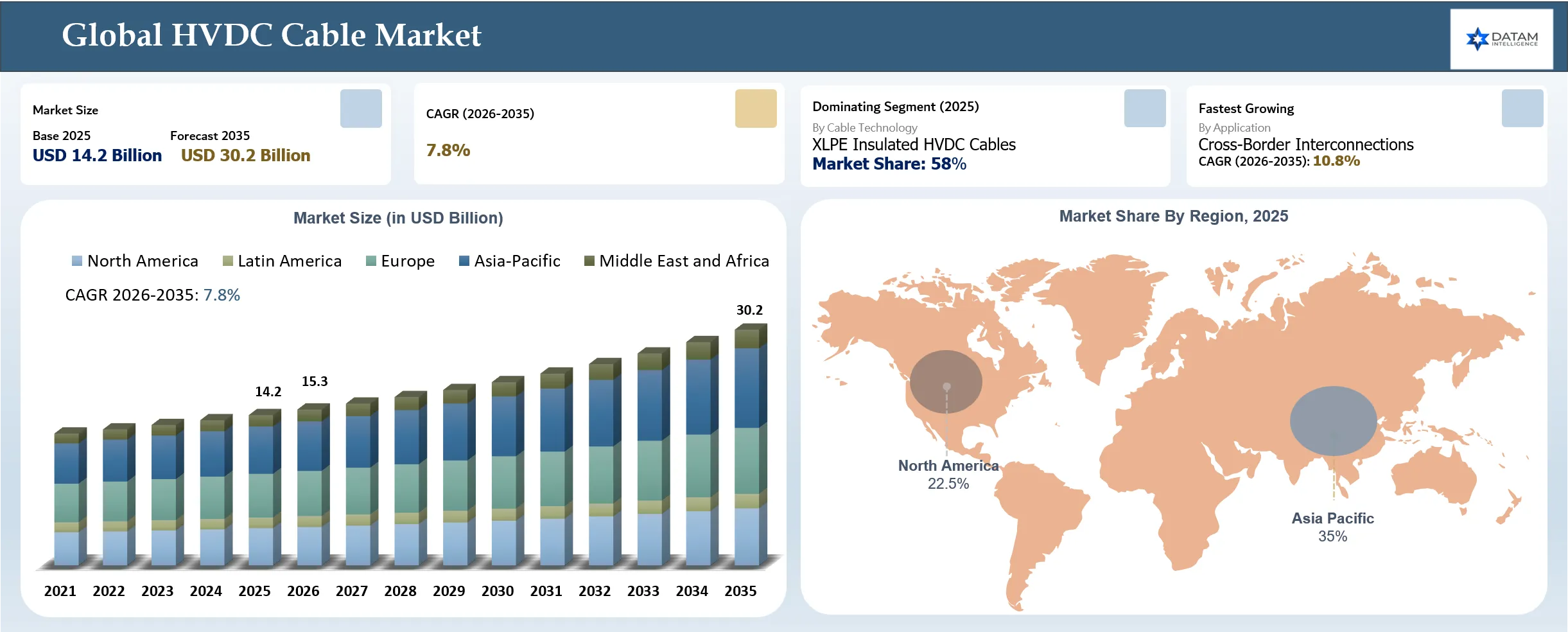
The global HVDC cable market was valued at approximately USD 14.2 billion in 2025 and is expected to reach around USD 30.2 billion by 2035, growing at a CAGR of approximately 7.8% during the forecast period (2026–2035). The HVDC Cable market is experiencing a structural transformation driven by the global transition toward renewable energy, increasing investments in high-capacity transmission infrastructure, and the growing need for efficient long-distance electricity transfer across interconnected power networks. The increase in investment in infrastructure with capacity to transmit power and incorporate renewable energy sources has increased the demand for HVDC cables. For instance, in May 2026, Sumitomo Electric Group has signed an Engineering, Procurement, and Construction (EPC) contract with Amprion for the DC35 project, a 525 kV HVDC cable project spanning 530 km of the route length. A newly established subsidiary, Sumitomo Electric Power Cable (Europe) GmbH (SEP-E), will engage in power cable EPC projects for the Europe market, as well as related sales activities. Completion of this project is scheduled for 2032, and Sumitomo Electric will proceed with its execution in parallel with the two other projects. The power cables to be used in the DC35 project, including the Dedicated Metallic Return (DMR), will be manufactured at Südkabel, Sumitomo Electric’s local subsidiary in Mannheim.
Expansion of HVDC Cable Manufacturing Capacity Supporting Future Transmission Demand
The increasing deployment of offshore wind projects, cross-border interconnectors, and renewable energy transmission networks is creating pressure on global HVDC cable supply capacity. To address the growing demand for high-voltage subsea cables, investments are being directed toward new manufacturing facilities and regional supply chain development. Expanding cable production capacity is becoming increasingly important as large-scale HVDC projects require specialized manufacturing capabilities and long lead times. For instance, in January 2025, the Scottish National Investment Bank announced a $26.4 million investment in XLCC, a subsea cable manufacturer, to support the development of a new HVDC cable manufacturing facility at the former Hunterston Terminal in Ayrshire, Scotland. The facility is expected to produce thousands of kilometers of HVDC cable annually and support approximately 900 jobs, strengthening the regional supply chain for offshore wind and long-distance electricity transmission projects.
HVDC cable Market Key Takeaways
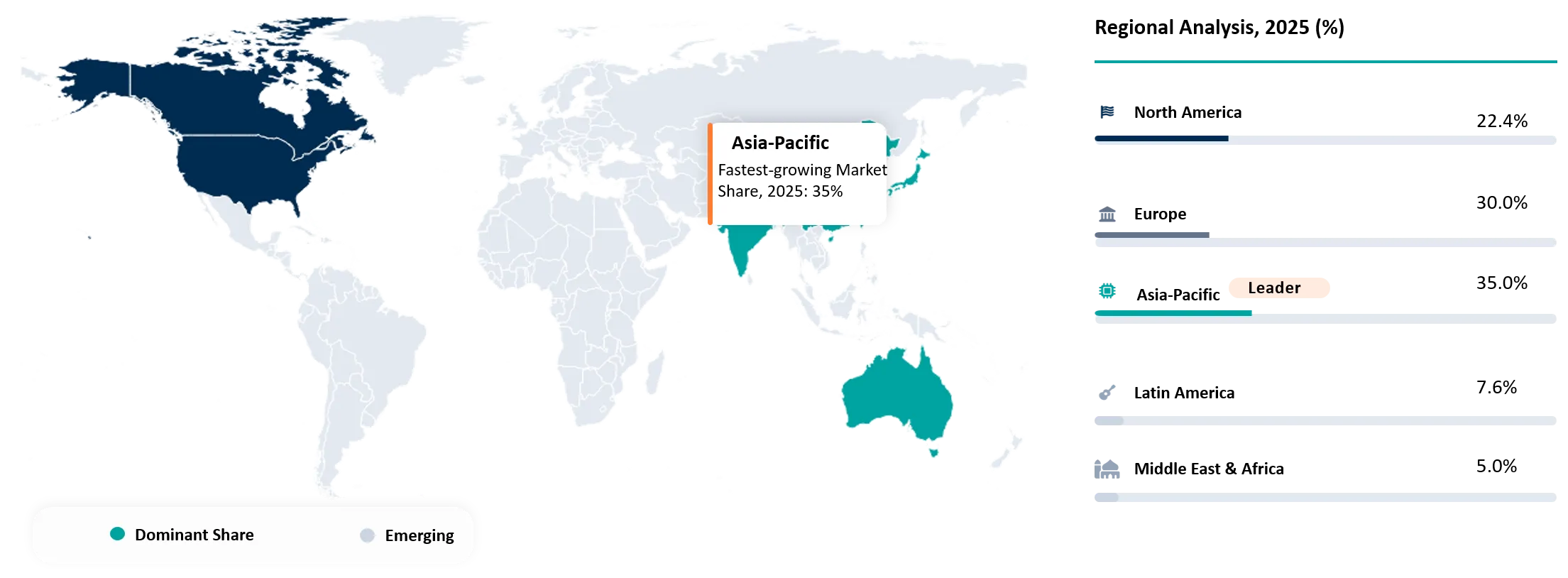
- Asia-Pacific held the highest regional market share, accounting for approximately 35% of the global HVDC cable market in 2025, driven by large-scale ultra-high-voltage direct current (UHVDC) transmission projects in China, increasing renewable energy integration, and growing investments in long-distance power transmission networks across China, India, Japan, and South Korea. Europe accounted for around 30% of the market share in 2025, supported by strong demand for submarine HVDC cables, offshore wind power transmission projects, and cross-border electricity interconnection initiatives across the region.
- XLPE insulated HVDC cables dominated the global HVDC cable market in 2025, accounting for approximately 58% of the total market share, supported by increasing deployment in offshore wind transmission, submarine interconnectors, and underground power transmission projects. Mass impregnated HVDC cables represented the second-largest segment due to their established use in legacy HVDC systems, while oil-filled cables accounted for a limited share due to declining adoption.
- Cross-border interconnections are projected to be the fastest-growing application segment in the HVDC cable market during 2026–2035, registering an estimated CAGR of approximately 10.8%. Growth will be supported by increasing investments in regional electricity networks, renewable energy integration, and energy security initiatives. HVDC cables enable efficient long-distance electricity exchange between countries by providing high-capacity transmission with lower losses and improved grid stability.
HVDC Cable Market Industry Trends and Strategic Insight
- HVDC cable manufacturers are expanding production capacity and investing in advanced cable technologies to support rising demand for submarine and underground transmission projects. Companies such as Prysmian Group, Nexans, NKT, and Asian cable manufacturers are increasing manufacturing capabilities to address the growing pipeline of offshore wind projects and cross-border interconnector developments
- Cross-border electricity interconnections are becoming a major growth area for HVDC cable deployment as countries strengthen regional power networks, improve energy security, and enable renewable electricity exchange. Projects such as the LirIC Interconnector between Scotland and Northern Ireland demonstrate increasing adoption of HVDC cable technology for high-capacity transmission links between interconnected power markets
- HVDC cable technology is shifting toward higher voltage ratings and advanced insulation systems, with XLPE-insulated HVDC cables gaining preference over conventional technologies. Increasing adoption of ±525 kV and higher-capacity cable systems is supporting efficient transmission over longer distances while improving reliability, reducing environmental risks, and enabling large-scale renewable energy integration.
HVDC Cable Market Scope
| Metrics | Details | |
| 2025 Market Size | USD 14.2 Billion | |
| 2035 Projected Market Size | USD 15.3 Million | |
| CAGR (2026-2035) | 7.8% | |
| Largest Market | Asia-Pacific | |
| Fastest Growing Market | Asia-Pacific | |
| By Cable Technology | XLPE Insulated HVDC Cables, Mass Impregnated (MI) HVDC Cables, Oil-Filled HVDC Cables | |
| By Voltage Rating | Up to 320 kV, 321–500 kV, above 500 kV | |
| By Installation Type | Submarine HVDC Cables, Underground HVDC Cables | |
| By Application | Offshore Wind Power Transmission, Cross-Border Interconnections, Grid Reinforcement & Stabilization, Long-Distance Bulk Power Transmission, and Island & Remote Area Interconnections | |
| By Region | North America | U.S., Canada, Mexico |
| Europe | Germany, UK, France, Spain, Italy, Poland | |
| Asia-Pacific | China, India, Japan, Australia, South Korea, Indonesia, Malaysia | |
| Latin America | Brazil, Argentina | |
| Middle East and Africa | UAE, Saudi Arabia, South Africa, Israel, Türkiye | |
| Report Insights Covered | Competitive Landscape Analysis, Company Profile Analysis, Market Size, Share, Growth | |
HVDC Cable Market Disruption Analysis
Evolving Transmission Requirements and Supply Chain Dynamics Influencing HVDC Cable Market Development
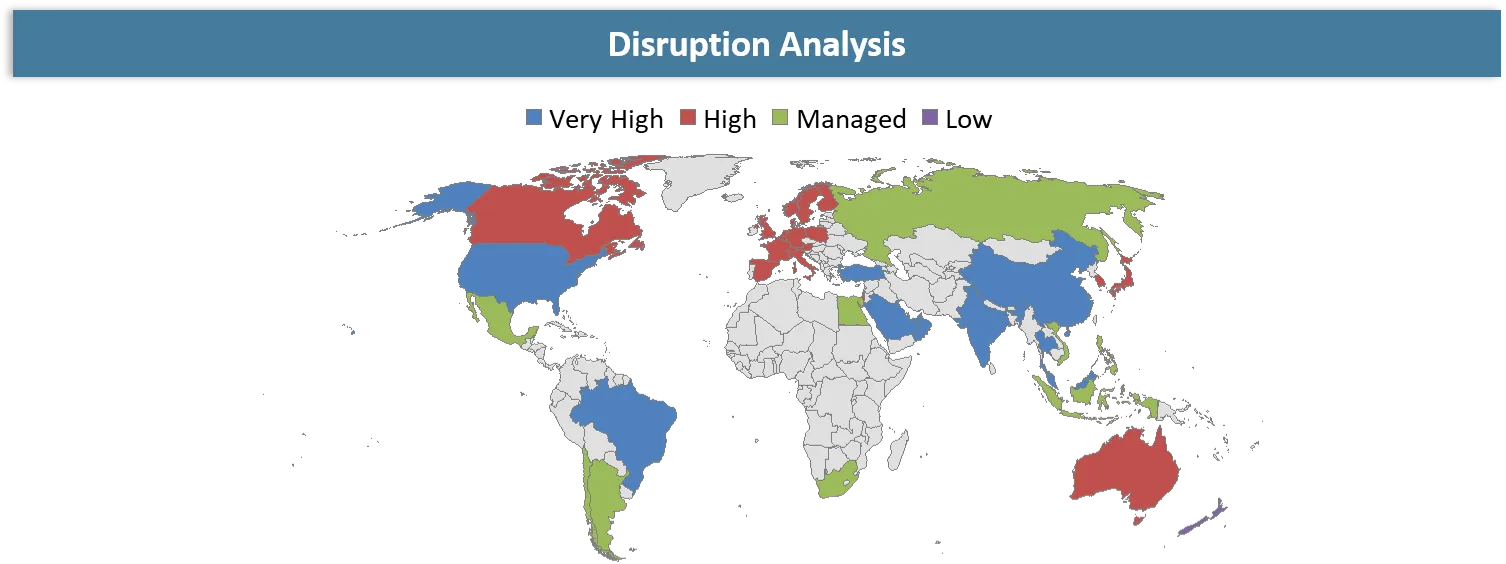
The HVDC cable market is currently undergoing radical changes owing to the quick adoption of renewable energy generation and increased electricity demand as well as modernization of old transmission infrastructures. Traditional AC transmission technologies have limitations in transmitting large volumes of power over long distances making it possible to use new HVDC cable technologies that reduce transmission losses and improve grid reliability and efficient integration of offshore wind and distant renewable energy sources. However, at the same time the market is affected by such problems as scarcity of raw materials for production of HVDC cables, shortage of capacity for manufacturing high-voltage submarine cables, prolonged projects implementation periods and increased competition in the industry among global cable producers. The adoption of the advanced technologies for the production of such products as XLPE-insulated HVDC cables, VSC-based HVDC system, multi-terminal HVDC system is changing the approach to the transmission planning and broadening the range of applications for HVDC cables. Also, cooperation between cable manufacturers, offshore installation companies and transmission companies is becoming more frequent to cope with project difficulties.
HVDC Cable Market BCG Matrix: Company Evaluation

Prysmian Group, Nexans, and NKT A/S are classified as Star competitors owing to their strong competitive positions in the HVDC cable market. These companies have extensive experience in submarine and underground HVDC cable systems, strong involvement in offshore wind transmission and cross-border interconnector projects, and significant manufacturing capabilities that enable them to benefit from the increasing demand for high-capacity electricity transmission infrastructure. Sumitomo Electric Industries, LS Cable & System, and ZTT Group demonstrate strong growth potential, supported by expanding HVDC cable manufacturing capabilities, increasing participation in renewable energy transmission projects, and rising opportunities across Asia-Pacific and global power infrastructure markets. Meanwhile, Taihan Cable & Solution, Furukawa Electric, TELE-FONIKA Kable, Ningbo Orient Cable, and other regional manufacturers occupy the Emerging/Niche Player segment, where growth is driven by regional transmission investments, expanding submarine cable capabilities, and opportunities to participate in future offshore wind and interconnection projects.
HVDC Cable Market Dynamics
Driver Impact Analysis
| Driver | Market Growth Impact (%) | Demand Concentration | Impacted Use Case | Strategic Impact |
Expansion of Offshore Wind Power Projects Increasing Demand for Submarine HVDC Cables | 30% | Strong demand concentration in Europe, particularly the North Sea region, along with growing offshore wind development in China, the U.S., and Asia-Pacific. | Offshore wind power transmission, submarine power links, and renewable energy evacuation systems. | Accelerates investment in high-voltage submarine cable manufacturing, offshore transmission infrastructure, and HVDC cable technology development. |
Increasing Need for Long-Distance Renewable Power Transmission | 25% | High demand in regions with large renewable energy resources located far from consumption centers, including China, India, Europe, and North America. | Bulk power transmission from remote renewable generation areas, inter-regional electricity transfer, and grid expansion projects. | Drives adoption of higher-voltage HVDC cable systems and expansion of long-distance transmission networks. |
Growth of Cross-Border Electricity Interconnections and Regional Grid Integration | 20% | Strong demand in Europe and Asia-Pacific due to increasing electricity trading, energy security initiatives, and interconnected power markets. | Cross-border submarine HVDC links, regional electricity exchange, and interconnector projects. | Supports development of new HVDC cable corridors and increases demand for submarine and underground cable systems. |
Grid Modernization and Transmission Network Reinforcement | 15% | Demand concentrated in developed power markets such as Europe and North America, where aging infrastructure and renewable integration require network upgrades. | Grid reinforcement, power flow management, congestion reduction, and transmission reliability improvement. | Encourages utilities to invest in flexible HVDC systems and advanced transmission technologies. |
Large-Scale Offshore Wind Development Supporting Future Growth of Submarine HVDC Cable Networks
The swift development of offshore wind energy solutions represents a key driver for the market for HVDC cables because large-scale wind parks are now constructed farther away from the shore and conventional AC transmission becomes less efficient. There are intensive developments of offshore wind capacity and HVDC transmission capacity taking place in countries in Europe, especially in those that border the North Sea. Similar developments are emerging in China and the United States as the governments are rapidly promoting renewable energy sources. For instance, Dogger Bank Wind Farm in the United Kingdom is one of the largest offshore wind farms in the world, which utilizes HVDC cable system for the transmission of power generated from the offshore renewable energy plants back to the onshore power grid network. In the United States, offshore wind energy solutions will create high future potential demand for HVDC cable systems. The capacity of offshore wind energy in federal waters can reach up to 4,200 GW, while there are currently 35 federal leases in development for offshore wind capacity of over 55,000 MW. The expansion of these large-scale offshore wind projects is expected to increase the need for submarine HVDC cables for reliable power evacuation and grid connection
Restraint Impact Analysis
| Restraint | Drag on Market Growth (%) | Primary Impact Area | Impacted Use Case | Strategic Impact |
High Capital Investment and Complex Installation Requirements for HVDC Cable Systems | 30% | Cable manufacturing costs, offshore installation, converter station infrastructure, and project financing. | Submarine HVDC cables, cross-border interconnectors, and long-distance transmission projects. | Increases project development costs and extends approval timelines, limiting adoption among regions with constrained infrastructure budgets. |
Long Project Development Timelines and Regulatory Approval Challenges | 25% | Environmental assessments, permitting processes, marine surveys, and grid planning approvals. | Offshore wind connections, submarine cable routes, and cross-border electricity interconnections. | Delays project execution and impacts investment cycles for HVDC cable manufacturers and infrastructure developers. |
Limited Availability of HVDC Cable Manufacturing and Installation Capacity | 20% | Global supply chain capacity, specialized cable production facilities, installation vessels, and skilled workforce availability. | Large-scale submarine HVDC cable projects and high-voltage transmission corridors. | Creates supply bottlenecks, increases lead times, and limits the ability to execute multiple large HVDC projects simultaneously. |
Technical Complexity of HVDC Cable Systems and Converter Integration | 15% | Cable design, insulation technology, converter station compatibility, and system reliability. | High-voltage submarine cables, underground HVDC systems, and renewable energy grid connections. | Requires specialized engineering expertise and increases operational risks associated with complex HVDC infrastructure. |
Complex Regulatory Approvals and Extended Development Timelines Delaying HVDC Cable Project Execution
HVDC cable projects involve complex planning, environmental assessments, marine surveys, land acquisition, and multiple regulatory approvals before construction can begin. The requirement for seabed surveys, environmental impact assessments, grid connection approvals, and coordination between different regulatory authorities can significantly extend project development timelines, particularly for submarine HVDC interconnectors and offshore wind transmission projects. Delays in permitting, financing approvals, or regulatory frameworks can postpone construction schedules and increase overall project costs, creating challenges for faster deployment of HVDC cable infrastructure. For instance, the Celtic Interconnector project between Ireland and France, a 700 MW submarine HVDC link, has experienced timeline adjustments due to challenges associated with marine cable installation activities and additional seabed protection requirements. There has been a delay to the submarine cable manufacturing and installation, adjustments have been required to the subsea marine cable programme which has resulted in an adapted burial programme, extending the time required. As a result, the project’s commissioning date is now expected for spring 2028, rather than 2027.
Similarly, the Grain Belt Express HVDC project in the United States, a 600 kV HVDC transmission project, has undergone extended permitting and environmental review processes involving multiple agencies before advancing toward construction. The project demonstrates how large HVDC infrastructure requires extensive regulatory coordination and approval procedures. Long approval cycles and complex permitting processes can delay HVDC cable project deployment, increase development costs, and create uncertainty for cable manufacturers, suppliers, and infrastructure developers.
HVDC Cable Market Segmentation Analysis
The global HVDC cable market is segmented based on cable technology, voltage rating, installation type, application and region.
Cross-border interconnections are projected to be the fastest-growing application segment in the HVDC cables market
Cross-border interconnections are expected to witness strong growth due to increasing investments in regional electricity networks, renewable energy integration, and energy security initiatives. HVDC cables are widely used for cross-border electricity interconnections, enabling efficient power exchange between different regions and strengthening transmission networks. For instance, the LirIC Interconnector project between Scotland and Northern Ireland will deploy two 320 kV HVDC cables over a 142 km route to provide up to 700 MW of additional transmission capacity between the Irish Integrated Single Electricity Market (I-SEM) and the Great Britain wholesale electricity market. It will utilize HVDC cable technology with commissioning planned for 2032.
LirIC Interconnector HVDC Cable Project Overview
| Parameter | Project Details |
| Connecting Countries | Scotland (Ayrshire region) – Northern Ireland (Belfast region) |
| Cross Border Capacity (MW) | Up to 700 MW |
| Expected Capital Cost (USD) | Not available / TBC |
| Number of Converter Stations | 2 HVDC converter stations (one in Scotland and one in Northern Ireland) |
| Number of HVDC Cables | 2 HVDC cables |
| Voltage of HVDC Cables (kV) | 320 kV HVDC cables |
| Route Length (km) | Approximately 142 km |
| Grid Connection Points | Northern Ireland: 275 kV high-voltage network and Scotland: 400 kV high-voltage network |
| Commissioning Year | 2032 |
HVDC Cable Market Geographical Penetration
Europe’s HVDC Cable Market Growth Supported by Offshore Wind Expansion and Cross-Border Interconnector Development
The European region holds a considerable share in the global HVDC cables market due to the well-developed transmission infrastructure, development of offshore wind energy, and increased attention to the regional connections of electricity. Investments into offshore wind energy production facilities are being implemented both in the North and Baltic Seas, contributing to the growing demand for submarine HVDC cable technology, which helps to establish cross-border connections and increase the security of energy supply. Additionally, due to strict requirements concerning decarbonization and transition to a low-carbon energy system, investments into the high-capacity transmission networks are increasing. For instance, in July 2026, NeuConnect Interconnector project between the United Kingdom and Germany came to a construction milestone, completing over 350 km of the 700 km cabling programme. The $3.2 billion project includes the subsea and underground HVDC cables, establishing connection between two of the biggest electricity markets in Europe, providing a transfer capacity of 1.4 GW of electricity in two directions.
U.K. HVDC Cable Market Trends
The U.K. has established a strong position in Europe HVDC cable market because of established a strong position in offshore wind development, supported by a large installed capacity base and extensive offshore renewable energy infrastructure. With continued expansion of offshore wind projects, the country is expected to generate increasing demand for HVDC cable systems to connect distant offshore generation assets with onshore transmission networks. The UK is now a global leader in offshore wind with over 16GW of operating capacity, providing over 17% of the UK’s electricity needs. The UK has an ambitious target to deliver 43+GW of offshore wind by 2030.
The U.K. is advancing HVDC cable infrastructure through large-scale transmission projects focused on renewable energy integration, grid reinforcement, and sustainable power transmission. In addition to increasing the capacity of the HVDC cables, there are also efforts being made towards ensuring the use of sustainable materials for cable development and low carbon emission in their production process such as the use of recycled copper in HVDC cable manufacturing. For instance, in July 2026, the Eastern Green Link 2 (EGL2) project in the U.K. announced the deployment of the first HVDC cable system using 100% recycled copper. The project has been undertaken by SSEN Transmission and National Grid Electricity Transmission. It is aimed at setting up a 2 GW HVDC subsea cable link from Peterhead in Scotland to Drax in Yorkshire covering about 505 km and scheduled to be completed in 2029. The company Prysmian will provide manufacturing and installation of the cables using 10,000 tons of recycled copper.
Large-Scale Transmission Infrastructure Expansion in Asia-Pacific Supporting HVDC Cable Market Growth
Asia-Pacific is projected to be the fastest-growing market for HVDC cables during the forecast period (2026–2035), registering a CAGR of around 12.4%, driven by large-scale investments in ultra-high-voltage transmission networks, renewable energy integration, offshore wind development, and expansion of cross-border electricity connections. Countries such as China, India, Japan, South Korea, and Australia are increasing deployment of HVDC cable systems to enable long-distance power transmission, strengthen grid reliability, and support the transition toward renewable energy-based power systems. The Asia-Pacific HVDC cables market is expanding due to rapid renewable energy development, increasing electricity demand, and the need for efficient long-distance power transmission. Countries such as China and India are investing heavily in HVDC transmission infrastructure to connect remote renewable energy generation zones with major demand centers. Additionally, offshore wind expansion in coastal regions, island grid connectivity requirements, and cross-border electricity exchange initiatives are creating new opportunities for submarine and underground HVDC cable systems. China has significantly expanded its high-voltage transmission infrastructure over the past decade, with extensive deployment of HVDC and ultra-high-voltage transmission networks to connect remote renewable energy resources with major electricity demand centers. China has both the most HVDC lines and the longest HVDC line globally. The 3,293-kilometer (2,046-mile) Changji-Guquan 1,100 kilovolt (kV) ultrahigh-voltage direct current (UHVDC) link runs all the way from the Xinjiang province in Western China to Anhui province near the East Coast and is capable of transmitting 12,000 megawatts (MW). China's ultrahigh voltage DC transmission network expanded from about 28,000 kilometres to more than 40,000 kilometres in just the 14th Five-Year Plan period (2021–2025). Approximately 45 UHV projects operating in the nation as of late 2025. The majority of these installations operate between 800 and 1100 kV.
Japan’s Expanding Submarine HVDC Cable Deployment Supporting Market Growth
Japan’s HVDC cable market is gaining strong momentum due to the increasing need for long-distance renewable energy transmission, offshore wind integration, and improved grid connectivity across geographically separated regions. The geography of Japan consisting of islands and fewer renewable energy sites around the major demand centers is making it necessary to install submarine HVDC cable systems to transfer power from one region to another. For instance, in March 2024, Japan announced its plans of boosting its inter-regional transmission capabilities with the help of developing the Hokkaido-Honshu HVDC submarine transmission line. The plan involves transferring power that will be produced using renewable resources from northern Japan to consumption centers, including 2 GW submarine HVDC cable line that should be ready for use by 2030.
HVDC Cable Market Competitive Landscape
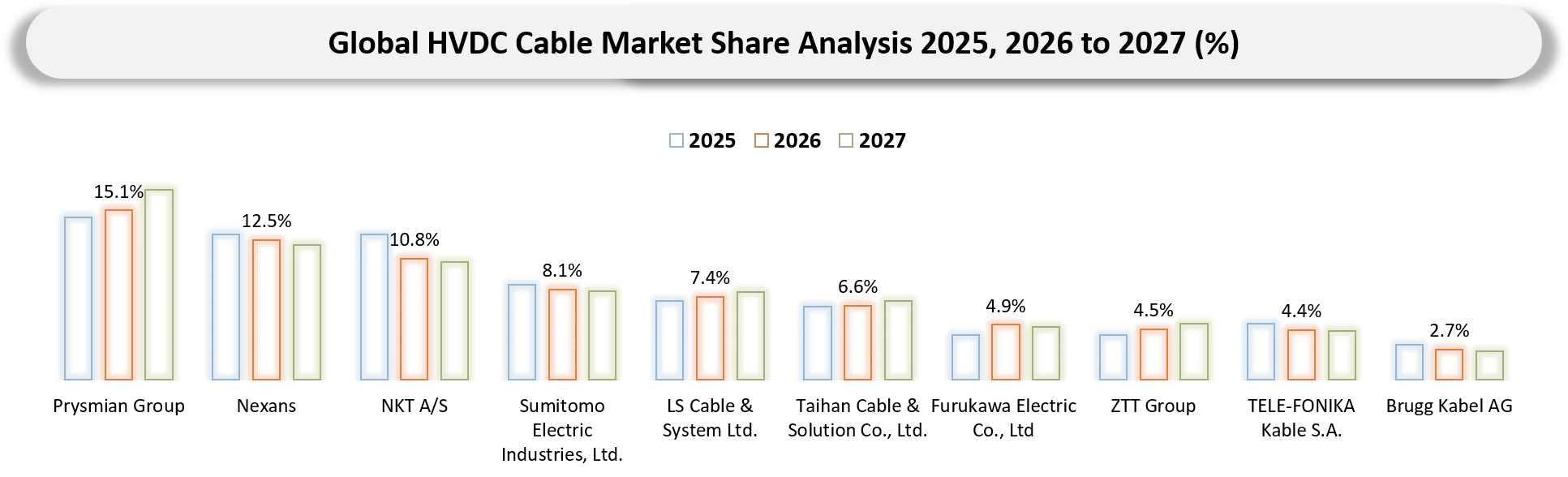
- The HVDC cables market is characterized by the presence of major cable manufacturers, power transmission solution providers, and integrated grid technology companies. Prysmian Group, Nexans, NKT A/S, and Sumitomo Electric Industries are among the leading players due to their extensive capabilities in manufacturing submarine and underground HVDC cable systems, supplying large-scale offshore wind transmission projects, cross-border interconnectors, and long-distance power transmission networks. Prysmian Group, Nexans, and NKT A/S hold strong positions in the European HVDC cable market, supported by their involvement in major submarine HVDC projects across the North Sea and international electricity interconnection networks. Meanwhile, Sumitomo Electric Industries, LS Cable & System, and ZTT Group strengthen the competitive landscape through their expertise in high-voltage cable technologies and expanding presence in Asia-Pacific transmission infrastructure projects. Companies such as Taihan Cable & Solution, Furukawa Electric, Ningbo Orient Cable, and TELE-FONIKA Kable contribute to market competition through their high-voltage cable manufacturing capabilities and participation in regional power transmission developments. Hitachi Energy further supports the HVDC ecosystem through its integrated HVDC transmission solutions, including converter systems and grid connection technologies.
- Key players include Prysmian Group, Nexans, NKT A/S, Sumitomo Electric Industries, LS Cable & System, ZTT Group, Taihan Cable & Solution, Furukawa Electric, Ningbo Orient Cable, and TELE-FONIKA Kable.
HVDC Cable Market Key Developments
- July 2026: SSEN Transmission, Sumitomo Electric, and Van Oord signed a long-term framework agreement to support the development of future HVDC subsea transmission infrastructure in northern Scotland. The partnership will focus on the engineering, supply, transportation, and installation of HVDC subsea cable systems, including initial design and engineering works for the proposed 525 kV Shetland 2 HVDC link. The collaboration combines Sumitomo Electric’s HVDC cable manufacturing expertise with Van Oord’s offshore installation capabilities to support renewable energy integration, grid expansion, and electricity network modernization in the U.K.
- June 2026: Taihan Cable & Solution signed cooperation agreements with Jan De Nul and Boskalis to collaborate on global HVDC submarine cable projects. The partnerships focus on HVDC subsea cable systems and related offshore transmission infrastructure by combining Taihan’s cable manufacturing and project execution capabilities with the marine installation expertise of Jan De Nul and Boskalis. The collaboration supports Taihan’s expansion in the global HVDC cable market, including its investment in a new submarine cable manufacturing facility in South Korea capable of producing 640 kV HVDC cables.
- May 2026: Sumitomo Electric Group has signed an Engineering, Procurement, and Construction (EPC) contract with Amprion for the DC35 project, a 525 kV HVDC cable project spanning 530 km of the route length. A newly established subsidiary, Sumitomo Electric Power Cable (Europe) GmbH (SEP-E), will engage in power cable EPC projects for the Europe market, as well as related sales activities. Completion of this project is scheduled for 2032, and Sumitomo Electric will proceed with its execution in parallel with the two other projects.
- January 2026: NKT signed final contracts with SSEN Transmission for two 525 kV HVDC transmission projects in Scotland, covering the Western Isles and Spittal to Peterhead links. The turnkey projects include the design, manufacturing, and installation of onshore and offshore HVDC cable systems, with a combined contract value of approximately $2.3 billion. The projects are part of Scotland’s “Pathway to 2030” transmission expansion programme and will support renewable energy integration by strengthening electricity transmission capacity across the region.
Key Procurement Priorities and Buyer Evaluation Criteria
- Buyers prioritize HVDC cable systems with proven technical performance, compliance with international standards, and suitability for high-capacity transmission applications, including submarine, underground, and offshore renewable energy projects.
- Evaluation is based on criteria such as HVDC cable voltage capability, manufacturing expertise, project execution experience, quality certifications, reliability record, and successful delivery of large-scale transmission projects.
- Buyers consider cable lifespan, installation capabilities, supply chain reliability, testing and certification processes, raw material quality, and the ability to support complex HVDC infrastructure requirements.
- Preference is given to manufacturers with experience in offshore wind transmission, cross-border interconnectors, grid reinforcement projects, and advanced HVDC technologies such as XLPE-insulated and mass-impregnated cable systems.
Why Choose DataM?
- Technological Innovations: Explores advancements in data center power infrastructure technologies, including intelligent power distribution systems, high-efficiency UPS solutions, medium-voltage switchgear, digital power monitoring platforms and AI-enabled energy management systems that improve reliability, operational efficiency, scalability and power optimization for hyperscale, colocation and enterprise data centers.
- Product Performance & Market Positioning: Evaluates how different players deliver power infrastructure solutions based on power efficiency, system reliability, scalability, uptime performance, energy management capabilities and integration with renewable energy sources, highlighting how leading companies differentiate through advanced electrical architectures, modular designs and solutions optimized for AI-driven high-density computing environments.
- Real-World Evidence: Highlights adoption of advanced power infrastructure solutions across hyperscale data centers, cloud facilities, AI computing campuses and enterprise data centers, demonstrating benefits such as improved power availability, reduced energy losses, enhanced operational continuity, optimized electricity management and support for increasing rack power densities.
- Market Updates & Industry Changes: Tracks key developments such as AI data center expansion, utility partnerships, renewable power integration, hyperscale facility investments, grid infrastructure upgrades and deployment of next-generation power distribution systems across North America, Asia-Pacific and Europe, supporting the transition toward sustainable and resilient data center ecosystems.
- Competitive Strategies: Analyzes how leading companies expand through product innovation, strategic partnerships, acquisitions, global service network expansion and development of integrated power management solutions to address rising demand for reliable electricity supply driven by AI, cloud computing and high-performance computing applications.
- Pricing & Market Access: Explains pricing variations based on power capacity, equipment type, efficiency ratings, customization requirements and integration complexity, along with access through electrical equipment manufacturers, data center infrastructure providers, system integrators and utility partnerships supporting global deployment.
- Market Entry & Expansion: Identifies growth opportunities driven by AI infrastructure growth, hyperscale data center development, edge computing adoption, renewable energy integration and digital transformation, while outlining strategies such as regional manufacturing expansion, energy-efficient product development, ecosystem partnerships and customized power solutions to strengthen global market presence.
Target Audience
- Data Center Operators and Hyperscale Companies
- Cloud Service Providers and Technology Companies
- Electrical Equipment Manufacturers and Power Solution Providers
- Data Center Infrastructure Developers and Investors
- Utility Companies and Energy Providers
- System Integrators and Engineering, Procurement & Construction (EPC) Companies
- Government Bodies and Regulatory Authorities




























































