


Humanoid & Embodied AI Robotics Market Overview
The global humanoid and embodied AI robotics market is positioned for transformative growth as technological maturity converges with long-term labor and productivity challenges.
Visionary initiatives such as Tesla, Inc.’s Optimus program highlight industry expectations that humanoid robots could scale to over one billion operational units by the 2040s.
Market projections indicate the humanoids ecosystem could exceed USD 5 trillion by 2050, encompassing robot sales, component supply chains, and aftermarket services such as repair, maintenance, and software upgrades. While current deployments remain limited and largely pilot-based, rapid advances in generative AI, embodied learning, and hardware efficiency are steadily reducing technical and cost barriers.
Adoption is expected to accelerate significantly in the late 2030s as robots demonstrate higher autonomy, safety, and economic viability. Regulatory clarity and growing societal acceptance will further support large-scale deployment across regions. By 2050, more than 1 billion humanoid robots could be in use globally, with nearly 90% deployed in industrial and commercial applications. Manufacturing, logistics, construction, and facility operations are anticipated to be the primary demand centers.
Humanoid & Embodied AI Robotics Market Industry Trends and Strategic Insights
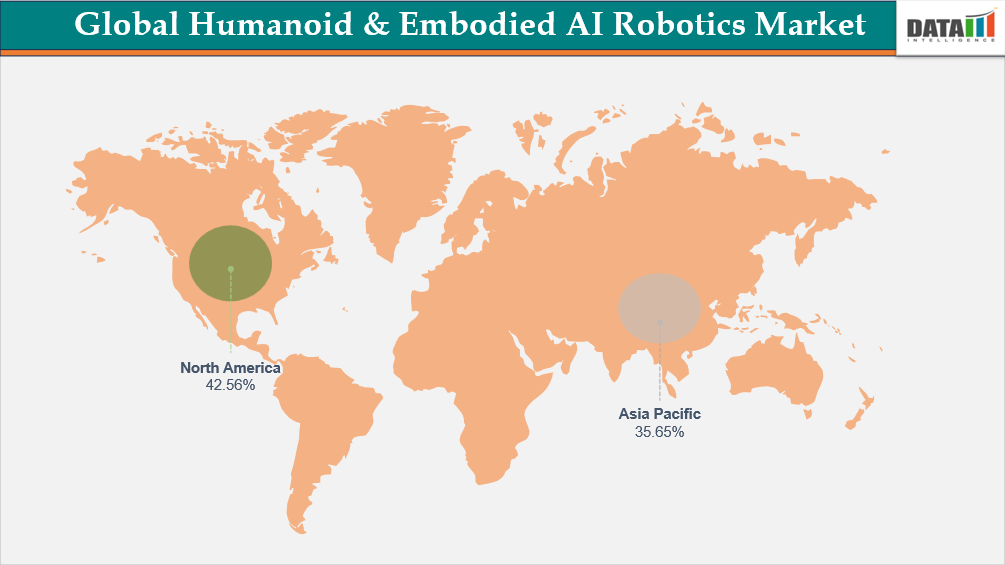
- North America leads the global humanoid & embodied AI robotics market, capturing the largest revenue share of 42.56% in 2024.
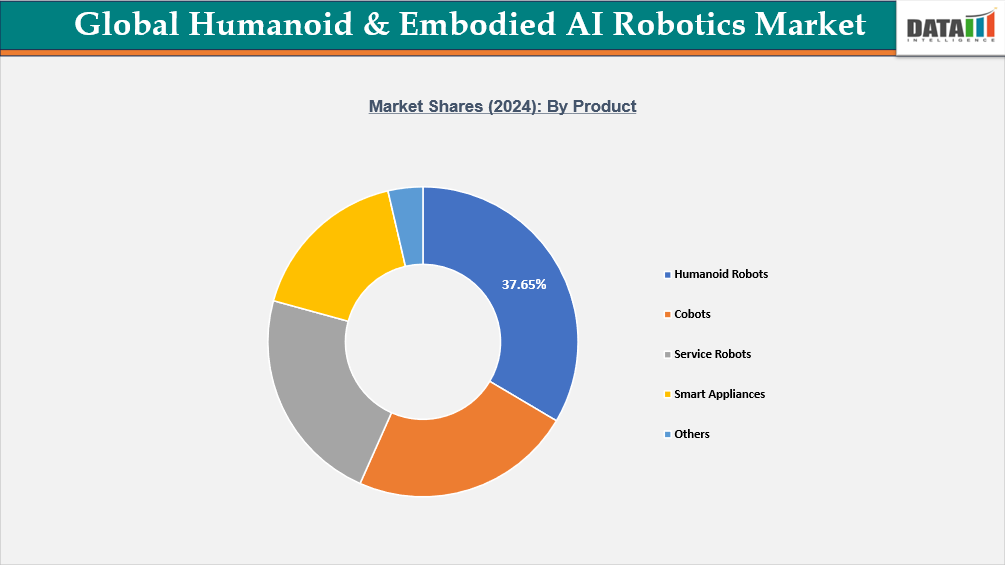
- By product segment, humanoid led the global humanoid & embodied AI robotics market, capturing the largest revenue share of 37.65% in 2024.
Global Humanoid & Embodied AI Robotics Market Size and Future Outlook
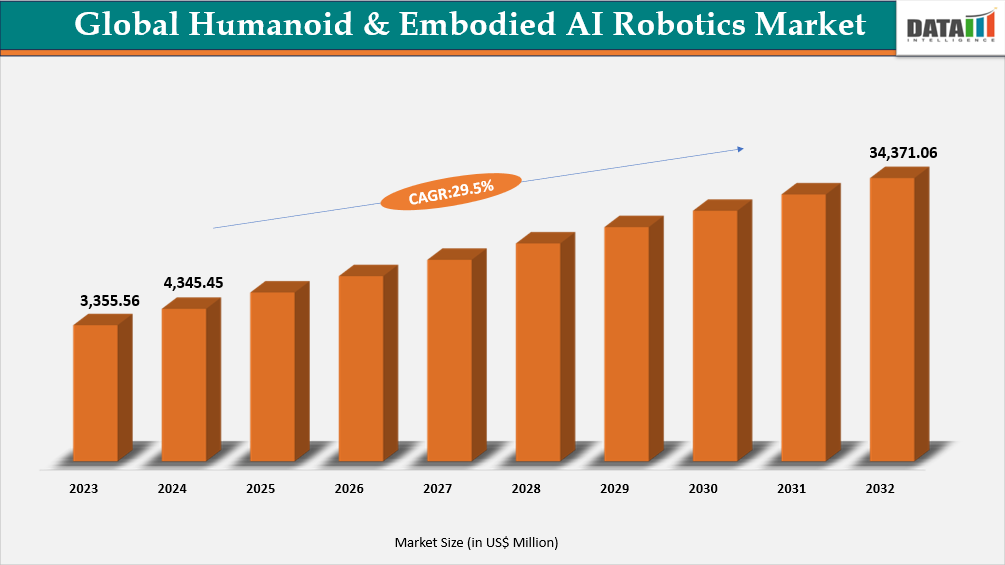
- 2025 Market Size: US$3,765.43 million
- CAGR (2026–2033): 29.5%
- Dominating Market: North America
- Fastest Growing Market: Asia-Pacific
Source: DataM Intelligence
Key Takeaways
- The increasing convergence of artificial intelligence, large language models, computer vision, and advanced robotics is emerging as a key industry trend, enabling humanoid and embodied AI robots to perform complex tasks with greater autonomy, adaptability, and real-world decision-making capabilities.
- Asia-Pacific maintains a leading position due to strong government support, rapid industrial automation adoption, extensive manufacturing ecosystems, growing robotics investments, and increasing deployment of intelligent robots across manufacturing, logistics, healthcare, and service industries.
- North America is projected to record significant growth as leading technology companies, robotics innovators, venture capital investments, and large-scale industrial deployments continue to accelerate commercialization of humanoid and embodied AI robotics solutions.
- Growing labor shortages, rising operational costs, and increasing demand for automation across manufacturing, warehousing, healthcare, logistics, and retail sectors are becoming major factors driving adoption of humanoid and embodied AI robotic systems globally.
- The expanding use of foundation models, multimodal AI systems, tactile sensing technologies, and physical AI platforms is increasing demand for next-generation robots capable of interacting safely and intelligently within dynamic human environments.
- Industry participants are increasingly evaluating investments based on AI capabilities, real-world deployment scalability, hardware-software integration, autonomy performance, and application-specific value creation rather than focusing solely on robotic hardware development.
- Rising investments from technology companies, venture capital firms, industrial enterprises, and robotics developers, along with growing commercialization initiatives in physical AI and humanoid robotics, are creating significant opportunities for market participants worldwide.
Humanoid & Embodied AI Robotics Market Scope
| Metrics | Details |
| By Product | Humanoid Robots, Cobots, Service Robots, Smart Appliances, Others |
| By Component | Hardware, Software & AI Platforms, Services |
| By Application | Healthcare, Education & Research, Hospitality & Entertainment, Personal & Home Assistance, Industrial & Manufacturing, Others |
| By Region | North America, South America, Europe, Asia-Pacific, Middle East and Africa |
| Report Insights Covered | Competitive Landscape Analysis, Company Profile Analysis, Market Size, Share, Growth |
Explore the Future of the Humanoid & Embodied AI Robotics Market
Get a comprehensive sample report covering Humanoid & Embodied AI Robotics Market trends, AI advancements, robotics technologies, competitive landscape, application insights, and growth opportunities. Request your sample today to understand the innovations shaping the next generation of intelligent, autonomous robots. Request Sample Report Today!
Humanoid & Embodied AI Robotics Market Dynamics
Rising Industrial & Service Adoption
Rising industrial and service-sector adoption is accelerating the Humanoid & Embodied AI Robotics market as companies increasingly seek robots capable of handling complex, variable tasks once limited to human workers. This shift is strengthening demand for highly dexterous, AI-driven systems that can collaborate safely on factory floors, reinforcing the broader trend toward Physical AI. As technology matures and regulatory support improves, humanoid deployment is expected to surge through the late 2030s, creating a foundation for widespread commercial use. These advancements are setting the stage for a market where humanoids become integral to productivity, safety, and operational agility.
This growing acceptance is evident in innovations like Germany’s Agile ONE, which demonstrates how fine manipulation, tool handling, and cognitive reasoning can now be combined in a single industrial-grade humanoid. Its layered AI, tactile sensors, and human-friendly design showcase the capabilities needed to meet real-world manufacturing and service demands, linking directly to the sector’s rising adoption. Such breakthroughs validate projections that humanoid populations could exceed 1 billion by 2050, with nearly 90% dedicated to industrial and commercial roles. Together, these trends illustrate how real deployments today are directly shaping the massive expansion expected over the coming decades.
Global Humanoid & Embodied AI Robotics Market, Segmentation Analysis
The global humanoid & embodied AI robotics market is segmented based on product, component, application and region.
Source: DataM Intelligence
Humanoids Lead with 37.65% Share due to Their Versatile Human-Like Interaction Capabilities
Humanoid robots hold the highest share in the Humanoid & Embodied AI Robotics market because their human-like design allows them to operate instantly in spaces built for people, reducing integration barriers across homes, workplaces and public environments. This broad adaptability drives faster adoption than specialized robots, creating a natural preference for humanoids in service, assistance and interactive roles. The shift accelerated in Oct 2025 when 1X launched NEO, the first consumer-ready humanoid capable of chores, personalized help and autonomous learning, proving that humanoids are moving from labs to daily life. As consumers begin pre-ordering such robots, the market perception shifts toward humanoids as practical, scalable solutions rather than futuristic prototypes.
This rising adoption forms a feedback loop where increasing real-world use encourages deeper investment, pushing rapid improvements in AI, dexterity and safety that further widen the gap between humanoids and other robot types. NEO’s advanced tendon-drive system, soft-body design and LLM-powered intelligence highlight how innovation makes humanoids more capable and trustworthy for everyday tasks. As models like NEO enter homes from 2026 with subscription options, they expand the demand for general-purpose robotic helpers that can learn, adapt and handle diverse activities. This continual enhancement keeps humanoids at the top of the market, reinforced by their unmatched ability to deliver human-compatible, flexible and evolving assistance.
Cobots hold a Significant Share due to their Ability to Safely Assist Humans in Industrial and Collaborative Tasks
Cobots hold a significant share in the Humanoid & Embodied AI Robotics market because they are engineered to work safely beside humans, making them easy to deploy in existing production lines without major redesigns. Their lower cost, faster installation, and simpler programming make them attractive to manufacturers seeking automation that enhances—not replaces—human labor. This trend gained further momentum in February 2025 when Delta introduced its D-Bot series cobots at ELECRAMA 2025, showcasing high-speed 6-axis systems with up to 30 kg payloads designed for smart, safe, and precise industrial tasks. Such launches highlight how cobots are becoming integral to real-world factory modernization, strengthening their market presence.
Humanoid & Embodied AI Robotics Market, Geographical Penetration
Source: DataM Intelligence
DOMINATING MARKET:
North America holds 42.56% because of its Strong R&D Ecosystem, Massive AI & Robotics Investments, and Early Enterprise Adoption
North America leads the humanoid and embodied AI robotics market due to a strong ecosystem of tech companies, research institutions, and venture funding. Its adoption across healthcare, logistics, and manufacturing accelerates commercialization and innovation. The region’s concentration of talent and infrastructure attracts further investment, sustaining its dominance.
US Humanoid & Embodied AI Robotics Market Outlook
US drives the region’s leadership with large-scale industrial adoption and cutting-edge R&D. As per a journal, it ranks 7th globally, with 200 industrial robots per 10,000 workers, reflecting a strong but still maturing automation base. Big tech, private R&D, and industrial deployments amplify humanoid robotics adoption, while a skilled workforce ensures successful integration. These elements make the US the engine of North America’s robotic growth.
Canada Humanoid & Embodied AI Robotics Market Trends
Canada contributes through innovation in dexterity and tactile sensing for humanoid robots. In February 2025, Sanctuary AI integrated advanced tactile sensors into its Phoenix general-purpose robots, enabling precise, touch-driven tasks even when vision is occluded. The sensors improve blind picking, slippage detection, and controlled force application, while behavioral data enhances AI model performance. This positions Canada as a key contributor to North America’s leadership in practical and advanced robotics applications.
FASTEST GROWING MARKET:
Asia-Pacific Records the Fastest Growth Driven by High Automation Demand and Strong Government Support
Asia-Pacific holds the largest share in the Humanoid & Embodied AI Robotics market, driven by rapid technological adoption, supportive government policies, and strong industrial demand. The region benefits from robust infrastructure in AI, robotics manufacturing, and sensor technology, creating a favorable environment for innovation and deployment. Countries like China, Japan, South Korea, and India are leading large-scale projects, combining research, production, and real-world application. With growing investments and increasing awareness of automation’s benefits, the Asia-Pacific is projected to maintain its dominance in humanoid and embodied AI robotics over the coming decade.
India Humanoid & Embodied AI Robotics Market Insights
India is emerging as a significant player in industrial and humanoid robotics, with 8,510 industrial robots installed in 2023, a 59% increase over the previous year, according to the World Robotics 2024 report by IFR. This growth positions India seventh globally in annual robot installations and reflects strong adoption across manufacturing and service sectors. Rising labor costs, the push for operational efficiency, and government-backed automation initiatives are driving the demand for humanoid and embodied AI robots. As local startups and tech companies develop industrial-grade robots, India’s contribution to the Asia-Pacific robotics market continues to expand, complementing regional leaders.
China Humanoid & Embodied AI Robotics Market Industry Growth
China showcased its leadership in humanoid robotics at WAIC 2025 in Shanghai, displaying over 150 robots, including 60 new models from 80 companies specializing in embodied AI. Unitree, Deep Robotics, Keenon, and Cyborg unveiled innovations for industrial, service, and consumer applications, highlighting practical deployment beyond concept. Experts emphasized that integration of embodied intelligence and LLMs enables millimeter-level precision, expanding opportunities in retail, healthcare, and logistics. Coupled with strong government support, large-scale investments, and rapid technological advancements, China solidifies its position as the largest contributor to the Asia-Pacific’s humanoid and embodied AI robotics market.
Technology Analysis
The humanoid & embodied AI robotics market is advancing rapidly due to innovations in AI, machine learning, and robotics hardware, enabling robots to perform complex autonomous tasks. Core technologies include dexterous robotic hands, advanced sensors, high-precision actuators, and mobility systems for safe human-centric operations. AI integration through foundation models and real-time learning allows adaptive behavior and intuitive human-robot interaction. In November 2025, Alibaba launched a robotics AI team within its Qwen Lab, combining generative AI with robotics to accelerate embodied intelligence adoption.
This technological growth is supported by open-source AI frameworks and cloud computing platforms, enabling rapid prototyping and scalable deployment of humanoid robots. Large-scale investments, such as Alibaba’s 380-billion-yuan (US$53.46 billion) AI infrastructure plan, fuel advances in autonomous navigation, manipulation, and task learning for robots like Unitree and X Square. Layered AI models combining simulation, real-world data, and cognitive reasoning enhance dexterity and task flexibility, exemplified by Neura Robotics’ 4NE-1 and Humanoid’s HMND-01 pilots. Together, these developments are driving fully integrated, cognitive robots capable of seamless collaboration with humans across industries.
Humanoid & Embodied AI Robotics Competitive Landscape
- The humanoid & embodied AI robotics market is witnessing intense competition driven by rapid technological advancements and increasing demand across healthcare, education, and service sectors.
- The landscape is dominated by a handful of global players, including SoftBank Robotics, Boston Dynamics, Hanson Robotics, Toyota, UBTECH Robotics, Agility Robotics, Tesla, Kawada Robotics, PAL Robotics, and Engineered Arts.
- Key players are focusing on developing highly adaptive, intelligent robots capable of interacting seamlessly with humans. Innovation in AI algorithms, sensor technologies, and mobility solutions is creating differentiation among competitors.
Key Developments of the Humanoid & Embodied AI Robotics Market
July 2026: 1X Technologies introduced 25-degree-of-freedom, tendon-driven hands for its NEO humanoid platform, targeting near-human dexterity, strength, safety and reliability. The development is designed to remove hardware limitations on humanoid manipulation and support a broader range of real-world tasks.
- June 2026: Apptronik unveiled Apollo 2 alongside its expanded Robot Park facility, creating a real-world data-collection and training infrastructure for humanoid intelligence. Apollo 2 is offered in bipedal and wheeled configurations, with collected data supporting development of Gemini Robotics models with Google DeepMind.
- April 2026: Figure reported major production scaling for Figure 03, exceeding 350 third-generation humanoid robots and increasing manufacturing throughput from one robot per day to one per hour. The expanded fleet is also generating larger data streams for autonomous-control research, including perception-conditioned whole-body control.
- January 2026: Figure introduced Helix 02, a unified neural system designed to control a humanoid’s entire body directly from sensor inputs. The system demonstrated autonomous walking, manipulation and balancing during a four-minute dishwasher task without human intervention or resets.
Humanoid & Embodied AI Robotics Market Investment & Funding Landscape
The humanoid & embodied AI robotics market is witnessing robust investment activity, with major funding rounds from global tech giants, venture capital firms, and strategic investors. Key deals include Alibaba’s $100 million investment in China’s X Square Robot, Humanoid Global’s stake in Agility Robotics, and ongoing funding for European developers like Agile Robots. Investments are targeting commercial deployments, AI-driven automation, and real-world applications in warehousing, manufacturing, and service sectors.
| Company | Investment/Funding | Year | Details | |
| Humanoid Global Holdings | Indirect strategic investment of US$145,000 in Agility Robotics | 2025 | Humanoid Global Holdings Corp. has committed an indirect strategic investment of US$145,000 in Agility Robotics, a leading US-based developer of commercially deployed humanoid robots. Agility’s flagship robot, Digit, autonomously handles tasks in warehousing and logistics, augmenting the workforce by performing repetitive and high-turnover jobs safely. | |
| X Square Robot | US$100 million funding round led by Alibaba Cloud | 2025 | Chinese humanoid robotics startup X Square Robot has raised $100 million in a funding round led by Alibaba Cloud, with participation from HongShan, Meituan, Legend Star, Legend Capital, and INCE Capital. The funding supports the startup’s goal of advancing autonomous humanoid robots and integrating AI to expand their capabilities, with commercial “robotic butlers” expected within five years. | |
What Sets This Global Humanoid & Embodied AI Robotics Market Intelligence Report Apart
- Latest Data & Forecasts – Comprehensive, up-to-date insights and projections through 2032. Coverage includes global value by Component, source, distribution channel, end-user and application segments (sleep disorders, jet lag, shift-work). Scenario forecasts with region-level splits (North America, Europe, Asia-Pacific, South America, Middle East and Africa) and sensitivity to factors such as regulatory reclassification and raw-material costs.
- Regulatory Intelligence – Actionable analysis of regulatory frameworks that materially affect Humanoid & Embodied AI Robotics commercialization, revenue by country, allowable label claims, permitted doses, import/export controls and advertising restrictions.
- Competitive Benchmarking – Standardized profiling and benchmarking of leading pharma and nutraceutical players, contract manufacturers and e-commerce specialists active in the market.
- Geographic & Emerging Market Coverage – Region-by-region market sizing, growth drivers, reimbursement dynamics, cultural/consumer behavior and market access considerations. Focus on high-growth or regulatory-uncertain markets.
- Actionable Strategies – Identify opportunities for launching innovative products, while leveraging strategic partnerships and supply chain integration for maximum ROI.
- Pricing & Cost Analysis – In-depth assessment of price trends, raw material costs and sustainability-driven cost efficiencies across regional markets.
- Expert Analysis – Insights from industry experts such as clinical sleep specialists, regulatory affairs professionals and key manufacturing companies.
Target Audience
- Humanoid Robot Manufacturers & Developers
- Embodied AI & Physical AI Companies
- AI Foundation Model & VLA Developers
- Robotics Component & Actuator Manufacturers
- Sensors, Cameras & Tactile Technology Providers
- Robotics AI Compute & Edge Computing Companies
- Industrial Automation & System Integrators




























































