


High Voltage Circuit Breakers Market Size and Overview
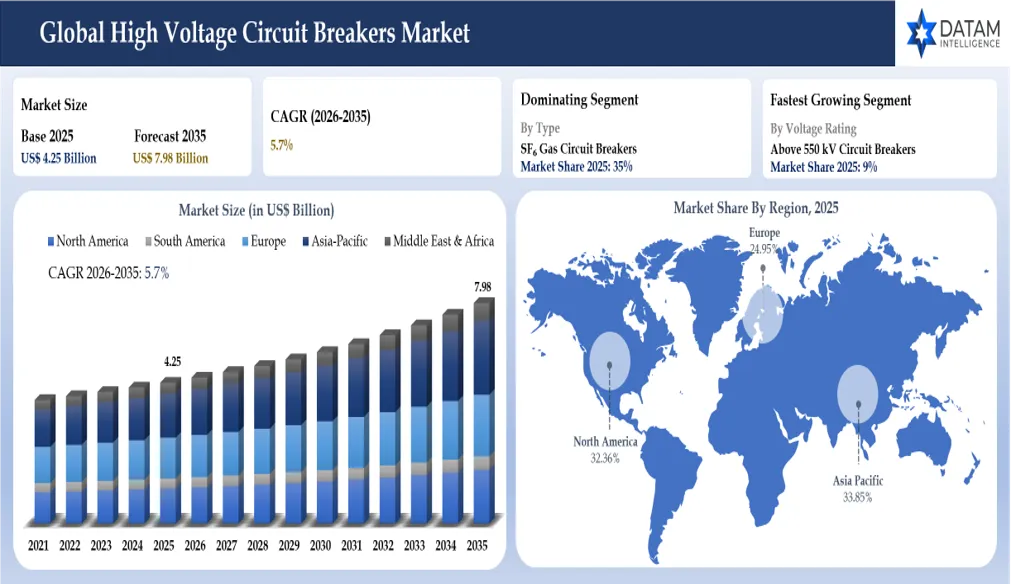
The global high-voltage circuit breaker market reached US$ 4.25 billion in 2025 and is expected to reach US$ 7.98 billion by 2035, growing with a CAGR of 5.7% during the forecast period 2026-2035.
The expansion of transmission infrastructure, upgrading of obsolete substation equipment and increasing requirement for dependable electric networks serve as factors stimulating growth in the high voltage circuit breakers market. The market is being driven by investments in systems with voltages of 245 kV, 400 kV and higher which require breakers that can interrupt an intense current. Integration of renewable energy into the grid, construction of long-distance transmission networks and establishment of new interconnections are reasons for rising demand for advanced switch equipment, especially in countries with the growing capacity of ultra high voltage transmission.
The market is also changing with the introduction of SF₆ free circuit breakers and digitalized condition monitoring, apart from alternative insulation methods. Environmental laws have led to changes in equipment specifications. Utilities are making increasing efforts to evaluate performance of equipment concerning interruptions, reliability, maintenance and lifecycle costs in the process of choosing new switches. The International Energy Agency claims that investments into grid systems should increase by at least 50% from US$400 billion to meet requirements set by 2030, highlighting the significance of upgrading and expanding the power grid.
High Voltage Circuit Breakers Market Key Takeaways
- SF₆ Gas Circuit Breakers occupied the largest market share in terms of product types in 2025, holding 35%, on account of their proven application in high voltage transmission substations, fault interruption capability and large number of installations.
- Circuit Breakers above 550 kV are projected to be one of the fastest growing voltage segments, with a CAGR of 7.2%, higher than the market CAGR of 5.7%. This growth will be fuelled by ultra-high voltage transmission lines and transmission of electricity over large distances.
- Asia-Pacific occupied 33.85% of the overall market share in the high voltage circuit breakers market in 2025, owing to the development of transmission lines in China and India and installation of extra-high-voltage substations.
- The increasing adoption of SF₆-free circuit breakers is motivating manufacturers to focus on developing clean air, alternative gases and vacuum interruption technologies for higher voltage applications owing to environmental laws and decarbonization targets of utilities.
- Increasing capital expenditure in transmission networks, renewable energy integration and old breaker replacements is providing opportunities for next-generation circuit breakers that have high short-circuit breaking ratings and digital condition monitoring capabilities.
High Voltage Circuit Breakers Industry Trends and Strategic Insights
- Due to stringent environmental regulations imposed on SF₆-related emissions, high-voltage circuit breaker makers are focusing on developing eco-friendly SF₆-free breakers based on clean air and alternative insulating gas technology.
- The necessary modernization of aged electric transmission systems means that the demand for new circuit breakers is growing so that the reliability of operations can be improved at the minimum cost of renewing the infrastructure.
- The use of digital monitoring systems gives utility companies the possibility of real-time monitoring of electric circuit breakers and gathering the information on faults that occurred, thus making the power system more reliable.
- The growing demand for power transmission of 420 kV and higher is supported by the increasing need for circuit breakers in extra-high voltage networks, especially in case of long-distance transmission and grid connections.
- The use of renewable energy causes a demand for high-quality switching devices at wind and solar connections and the development of HVDC transmission technologies requires specific switching systems for direct current interruption.
High Voltage Circuit Breakers Market Scope
| Metrics | Details | |
| 2025 Market Size | US$ 4.25 Billion | |
| 2035 Projected Market Size | US$ 7.98 Billion | |
| CAGR (2026-2035) | 5.7% | |
| Largest Market | Asia-Pacific | |
| Fastest Growing Market | North America | |
| By Type | SF₆ Gas Circuit Breakers, Vacuum Circuit Breakers, Alternative-Gas and SF₆-Free Circuit Breakers and Other Types | |
| By Voltage Rating | 72.5–145 kV, Above 145–245 kV, Above 245–362 kV, Above 362–550 kV and Above 550 kV | |
| By Breaker Design | Live-Tank Circuit Breakers, Dead-Tank Circuit Breakers and Disconnecting Circuit Breakers (DCBs) | |
| By Substation Technology | Gas-Insulated Switchgear (GIS) and Air-Insulated Switchgear (AIS) | |
| By Operating Mechanism | Spring-Operated Mechanisms, Hydraulic Operating Mechanisms, Pneumatic Operating Mechanisms and Other Operating Mechanisms | |
| By Installation | Outdoor Circuit Breakers and Indoor Circuit Breakers | |
| By Application | Power Transmission and Distribution, Power Generation, Thermal Power Plants, Industrial Power Systems, Railway Electrification, Oil and Gas Facilities, Data Centers, Critical Infrastructure, Commercial & Institutional Infrastructure and Other Applications | |
| By Region | North America | U.S., Canada, Mexico |
| Europe | Germany, UK, Russia, France, Spain, Italy, Poland | |
| Asia-Pacific | China, India, Japan, Australia, South Korea, Indonesia, Malaysia, Singapore, Vietnam, Thailand, Philippines, Taiwan | |
| South America | Brazil, Argentina | |
| Middle East and Africa | UAE, Saudi Arabia, South Africa, Israel, Turkiye, Nigeria | |
| Report Insights Covered | Competitive Landscape Analysis, Company Profile Analysis, Market Size, Share, Growth | |
Delivered Customizations
| CLIENT REQUEST | CUSTOMIZATION DELIVERED | VALUE ADDED |
| Voltage-Class Demand and Application Analysis | Detailed assessment of demand across 72.5 kV to above 550 kV, covering transmission substations, grid interconnections, renewable energy integration and extra-high-voltage networks. | Identify high-growth voltage classes, prioritize attractive applications and align product portfolios with utility procurement requirements. |
| Competitor Product and Technology Benchmarking | Comparative analysis of leading manufacturers’ voltage ratings, breaking capacities, SF₆-free technologies, GIS/AIS configurations, product portfolios and service capabilities. | Identify competitive gaps, benchmark technology capabilities and support product development, pricing strategies and market positioning. |
| SF₆-Free Technology and Regulatory Assessment | Evaluation of clean-air and alternative-gas circuit breakers, regional environmental regulations, technology readiness and adoption prospects across voltage classes. | Assess regulatory risks, prioritize sustainable technology investments and identify opportunities in emerging low-emission switching solutions. |
Why does this report matter in 2026?
The high-voltage circuit breaker market is poised at a crucial juncture in 2026, with the changing requirements of grid modernization, renewable energy integration and environmental regulation influencing circuit breaker design and purchase considerations. The innovation of SF₆-free circuit breakers that can be used in extra-high voltages is opening up new technological avenues for utilities looking to lower their GHG emissions while not hindering fault interruption capacity. At the same time, expansion of high voltage transmission lines and upgrading of old substation assets is generating demand for efficient switching devices at various voltage levels.
On the other hand, growing power consumption from AI data centers and grid extension efforts are also creating additional challenges within equipment supply chains. High-voltage circuit breaker delivery times in the U.S. stood at about 125 weeks for the second half of 2025 compared to 77 weeks in 2023, emphasizing the need for proactive purchasing, manufacturing capabilities and diversified suppliers. This report assists the stakeholders in analyzing their competitive positioning and in recognizing the opportunities for transmission infrastructure and renewable energy infrastructure, as well as the way SF₆ free technology innovations, digital monitoring systems and supply chain preparedness can influence market growth beyond 2026
High Voltage Circuit Breakers Market White Space & Investment Opportunities
- Clean-air insulators and alternative gas circuit breakers represent an area where growth can be expected due to environmental regulations leading to a phase out of equipment containing SF₆.
- High-voltage and extra high-voltage transmission systems represent another opportunity in terms of manufacturers producing high-end circuit breakers for long-range power transmission.
- The development of an integrated digital system that will monitor contact wear, operating mechanism and insulation status may present some chances of reducing maintenance cost and avoiding any unforeseen breaker failures.
- The establishment of regional manufacturing plants and facilities for performing high-voltage tests would help suppliers reduce lead times, comply with local procurement policies and get involved in utility infrastructure projects.
- Extension of retrofit, replacement and maintenance services would provide possibilities to update outdated substation equipment without full switchyard renovation.
High Voltage Circuit Breakers Future Market Transformation
According to market trends in the high voltage circuit breakers industry, future developments will center around green and sustainable insulation materials, digitally connected systems and application-specific switches for advanced power grids. Future innovations in this market sector will involve the development of SF₆-free circuit breakers for high voltages along with enhanced interrupting capability and integration into digital substations. The rise in demand for HVDC power transmission lines and renewable energy sources will further make application-specific switch technology relevant for harsh transmission conditionsIn the long term, competitive differentiation will probably hinge on interoperability with the current grid system, reliability and performance throughout the life cycle, as well as equipment costs and environmental compliance.
High Voltage Circuit Breakers Market Buyer Decision-Making Criteria
High voltage circuit breakers buyers give preference to electrical performance, reliability and compliance due to the fact that any equipment malfunction may lead to serious blackouts and even the destruction of costly substation infrastructure. Their choice of equipment is determined by the rated voltage, short-circuit breaking capabilities, insulation techniques, installation approach and compatibility with current protection systems. Provider assessment is pursued with regard to total life cycle costs, environmental regulations, qualification of suppliers and delivery times during planning of the extra-high-voltage projects characterized by rigorous testing and commissioning procedures.
Major Buyer Decision-Making Criteria
- Voltage Rating and Breaking Capacity
- Operational Reliability and Service Life
- Insulation Technology and Environmental Compliance
- Compliance with Technical Standards
- Total Cost of Ownership
- Compatibility with Existing Substations
- Supplier Track Record and Technical Support
- Delivery Lead Time and Project Execution
- Digital Monitoring and Diagnostics
- Safety and Site-Specific Requirements
High Voltage Circuit Breakers Market Economic & Investment Analysis
The economics of the high voltage circuit breakers market are affected by the spending by utility companies for capital investments, financing of transmission projects and costs of the lifecycle of high voltage equipment. Circuit breakers that operate at 245 kV and higher voltage levels normally have a need for more advanced insulation, fault interruption capacity and special tests, which raise the costs of production and qualification of the product. From the side of the utility companies, the purchase of such equipment is based not only on the costs of the equipment itself, but also on maintenance, life span, reliability and outage costs. The delay in implementation of the transmission infrastructure may result in delayed purchase orders, thus affecting the income of manufacturers.
Opportunities for investment include areas of extra-high-voltage products manufacturing, development of SF₆ free products, automation and lifecycle services. Those companies that are willing to invest in building up specialized test facilities, manufacturing capacity and regional service centers will be able to increase chances to win big utility deals and fulfill orders. At the same time, it should be noted that high capital expenditures should be carefully considered together with changes in the cost of copper and steel, as well as qualification period of new products and utility budgets. It is important for investors to consider aspects such as the order book quality, production capacity, margin levels, service income generation capability and exposure to transmission investment plans.
High Voltage Circuit Breakers Investment Trends in the Market
- Increased investments are being made by manufacturers in R&D related to SF₆-free insulations, such as clean air and alternative gases, to ensure environmental compliance and to create products for higher voltage levels.
- There have been capital investments in high voltage test laboratories and production lines and special manufacturing equipment to assist in developing extra-high voltage circuit breakers at 420 kV or above voltages.
- The equipment providers are investing to develop monitoring features like condition sensors and predictive maintenance solutions that will increase reliability of their breakers and boost recurring revenue streams through service business.
- Manufacturers are extending their presence through regional production, assembly and service locations to shorten delivery times, satisfy local procurement policies and get access to large-scale transmission projects.
- Firms are growing their investment into retrofit engineering, replacement projects and lifecycle services, as power utilities look to upgrade old circuit breakers without full reconstruction of substations.
Strategic Indicators for High Voltage Circuit Breakers Market
High Regulation Impact
The high voltage circuit breakers market is subjected to a high level of regulation due to the presence of SF₆, an extremely powerful greenhouse gas which finds wide application in high voltage switching devices. According to the EU Regulation (EU) 2024/573, the restrictions on the use of certain high voltage switchgear with fluorinated gases having GWP equal to 1 or more are expected to start from 1 January 2028 for equipment from 52 kV up to 145 kV and from 1 January 2032 for equipment higher than 145 kV or above 50 kA of short-circuit current. These requirements are pushing the development of clean air technology and other gas alternative technologies while raising demands for testing and qualifying products by manufacturers. Timing differences in regulations among the regions will also affect product lines and purchasing strategies, as well as competitive advantage of SF₆-free circuit breakers.
High Investment Activity
The investments being made within the high voltage circuit breakers market are increasing with the addition of production capacities and specialized facilities for high-voltage tests due to increased demands from transmission grids. CG Power inaugurated an ultra-high voltage switchgear plant in Nashik, India in the month of June 2026, with an additional capacity to produce 7,200 units of circuit breakers with 33-245kV ratings annually. The installation is a component of an overall switchgear plant project of ₹748.20 crore and encompasses 350 kV and 500 kV laboratories. Hyosung Heavy Industries, on the other hand, has announced plans to invest KRW 100 billion in an export-oriented ultra-high voltage circuit breaker plant, which has the objective of boosting production capacity by about 1.5 times. These investments demonstrate the significance of manufacturing scale along with high-tech testing technology and trustworthy delivery in winning utility contracts and supporting the development of the transmission infrastructure system.
Supply Chain Disruption
High voltage circuit breakers market is constrained by major challenges in the supply chain related to the insufficient number of specialized plants and lack of precision components for operating mechanisms and the time-consuming process of testing at high voltage. As reported by Rystad Energy in 2026 industry review, the standard lead times for transformers and high-voltage circuit breakers have been around 2-3 years for the manufacturers located in Europe and North America, which is twice as long as before 2019. These challenges are especially difficult for equipment operating at ultra high voltage levels which need special insulations and highly precise contacts. Manufacturers have been able to deal with these challenges through diversifying their suppliers, localization of production and pre-ordering of components while utility companies are now emphasizing on early ordering.
Pricing Volatility
The pricing of high voltage circuit breakers is subject to volatility in the price of copper, aluminum and electrical steel along with the special manufacturing and testing process involved in higher voltage circuits. According to the report of Newton-Evans Research, the price of copper increased by about 64% and the price of aluminum increased by about 44% over the period of 30 months up to July 2026. This could be creating cost pressure for the production of high voltage switchgears and other electrical equipment. Volatility could impact the quotations and profit margins of high-voltage equipment, especially the customized GIS and extra-high-voltage circuit breakers which have longer manufacturing times with fixed price contracts. Manufacturers rely on price adjustment clauses, material sourcing and supply arrangements to cope with input cost uncertainties, whereas buyers should be aware of the possibility of price adjustments when planning large substation constructions.
Procurement Pressure
The high voltage circuit breakers procurement process is complicated due to the necessity of matching equipment deliveries with substation construction and the completion of power grid installations along with technical approvals of equipment. Special voltage class, specific short circuit breaking capability and type test approval can restrict the pool of suitable suppliers especially when it comes to extra high-voltage breakers. In the US market, the delivery time for high voltage circuit breakers was around 125 weeks in the last six months of 2025 compared to 77 weeks in 2023, making it essential to purchase earlier. Therefore, utilities and developers are becoming more interested in early tenders, factory slots, framework agreements and delivery schedules in order to reduce the risk of any procurement uncertainties and commissioning delays for substations.
New Technology Adoption
Technological advancements in the high voltage circuit breakers market are being driven by SF₆ free insulation and alternative gas switching technologies, as well as digital technologies for condition monitoring. In August 2026, GE Vernova released its 420 kV, 63 kA SF₆ free live tank circuit breaker that uses carbon dioxide-oxygen gas (CO₂/O₂) mixture, increasing the options of available technologies for high voltage transmission applications. The adoption of these technologies will rely on their successful qualification and performance in terms of interruption and operational reliability. At the same time, digital monitors and diagnosis tools have been aiding utilities to gauge the status of their breakers and monitor mechanical degradation. The greater use of these technologies, however, would be contingent on successful field performance, compatibility and environmental compliance.
Regional Expansion Opportunity
There is also a growing presence of opportunities for regional expansion in the high voltage circuit breakers market in India, Southeast Asia and the Middle East region due to the rise in the need for high voltage substations and circuit breakers due to transmission networks growth, renewable energy integration and cross border interconnections in these regions. India's National Electricity Plan suggests that the country’s transmission network in 220 kV and above will grow to 648,000 circuit kilometres by 2032, while International Energy Agency expects the investments in the electricity grid of Southeast Asia to be higher than $300 billion from 2025 to 2040. Such trends create possibilities for the manufacture of breakers in new substations, renewable energy evacuation systems and extra high voltage transmission systems with support from local manufacturing, utility approval and regional services.
Government Policy Support
Government policies have been fostering the growth of the high voltage circuit breaker market through initiatives in terms of the expansion of transmission networks, integration of renewable energy sources and measures to mitigate the environmental impact of switching devices. The Indian Government has set out in its National Electricity Plan (Transmission) an opportunity for investment of over ₹9.15 lakh crore by 2032, with investments in transmission lines, substations and grid connections. In April 2026, the Central Electricity Authority committee has recommended financial and development assistance to SF₆-free green gas-insulated switchgear, which includes indigenous research, technology development and testing. These initiatives are intended to create a demand for high voltage circuit breakers while promoting local production, technological localization and the adoption of low emission switching technology.
Pricing Intelligence
Pricing in the high voltage circuit breakers market involves evaluating supplier bids and awards based on different voltage levels, short circuit interrupting capacity, circuit breakers and insulation systems. Equipment rated at 420 kV and higher usually has more complex engineering and insulation coordination and testing needs compared to lower voltage equipment, whereas gas-insulated switchgear (GIS) is usually more expensive than air-insulated switchgear (AIS) due to its compactness and built-in enclosure. Customers are expected to make separate comparisons between the costs of just the equipment without the costs of installation, commissioning, testing, spares and maintenance contracts in order to arrive at meaningful benchmarks. The manufacturing capabilities within the region, qualification of suppliers and the extent of the contract should also be considered during quotation evaluation and cost negotiations.
| HS Code | Reporter | Trade Flow | 2025 Trade Value | Interpretation |
| 853529 | South Korea | Exports | US$ 438 million | Leading listed exporter, supported by established high-voltage electrical equipment manufacturing capabilities. |
| 853529 | China | Exports | US$ 280 million | Major exporter benefiting from its extensive electrical equipment manufacturing base. |
| 853529 | Saudi Arabia | Imports | US$ 349 million | High import demand associated with power infrastructure expansion and transmission network investment. |
| 853529 | United States | Imports | US$ 111 million | Imports support grid modernization, substation upgrades and replacement of existing equipment. |
Note: HS Code 853529 covers automatic circuit breakers rated at 72.5 kV or above. This code is relevant to the high voltage circuit breakers market, although the trade data may not capture every product or service included in the overall market.
AI Impact Analysis of High Voltage Circuit Breakers Market
AI is making advancements in the field of condition monitoring and predictive maintenance of high voltage circuit breakers by studying various parameters like coil current, contact movement, vibrations and contact resistance as well as the condition of insulation gases. Machine learning techniques have the ability to detect anomalies in the performance of these devices and thus predict their failures before any unexpected shut down happens. This allows the utilities to maintain their assets based on their condition and avoid conducting redundant maintenance activities, thereby enhancing the reliability of transmission substations.
AI also contributes to the sophisticated diagnosis of faults and intelligent switching based on the study of electrical signals, breaker operation data and substation monitoring information. The use of artificial intelligence in combination with digital substations and digital twins provides an opportunity for monitoring and evaluation of the health of equipment, detection of patterns of repeated faults, as well as improving the plans of maintenance of high voltage networks. However, the implementation of this technology is dependent on reliable field data, cybersecurity, compatibility with traditional systems of protection and thorough verification. AI is an adjunct of the decision process, not a substitution for conventional protection methodologies like protective trip mechanisms and circuit breakers.
Disruption Analysis of High Voltage Circuit Breakers Market
The most important disruption in the high voltage circuit breaker market is the shift from traditional SF₆ insulated breakers to SF₆ free breakers which include clean air and alternative gas options. This is causing a move in competitive advantage away from the traditional interrupting capability of the breaker towards environmental compliance and insulating capabilities for extra-high voltages. In May 2026, Hitachi Energy revealed its SF₆-free dead-tank breakers of 800 kV and 63kA capacity, indicating a significant step towards the eradication of SF₆ use in ultra-high-voltage transmission. Nevertheless, large scale deployment of this technology will depend on various factors including type testing, lifecycle cost, regulatory restrictions and verified field performance.
The second disruption results from rising demand for grid components along with continued production issues. The growth in AI data centers, renewable energy interconnections and transmission networks is driving demand for high-voltage circuit breakers, prompting utilities to make orders ahead of time. As reported by Reuters, the lead time for high-voltage circuit breakers in the U.S. stood at around 125 weeks in the second half of 2025, which is up from 77 weeks in 2023. Such issues will be contributing to an increased need for early orders, diversification of suppliers and manufacturing capacities, offering a competitive edge to companies capable of delivering qualified products with shortened lead times and good lifecycle management.
High Voltage Circuit Breakers Market BCG Matrix: Company Evaluation
STAR
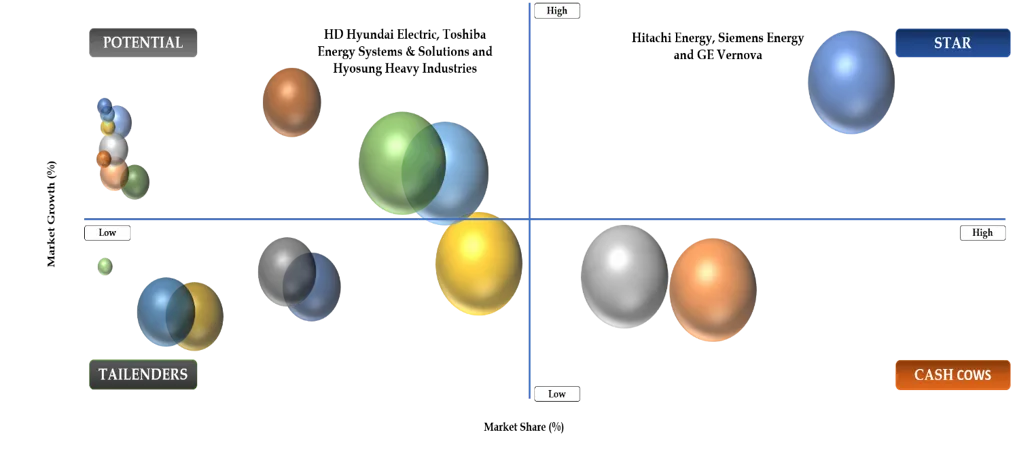
Hitachi Energy, Siemens Energy and GE Vernova represent Star companies owing to their existing product lines of high voltage products, their worldwide utility network and proficiency in advanced transmission equipment. Hitachi Energy launched its 800 kV SF₆-free circuit breaker technology in May 2026, whereas GE Vernova introduced a 420 kV, 63 kA SF₆-free circuit breaker in August 2026. These innovations will help them enhance their standing in the shift to lower emission transmission devices.
POTENTIAL
HD Hyundai Electric, Toshiba Energy Systems & Solutions and Hyosung Heavy Industries can be viewed as growth companies due to product development, technological advancements and the possibilities to grow in the market segments of high voltage. HD Hyundai Electric produced a 420 kV SF₆-free circuit breaker in 2026. Toshiba Energy Systems & Solutions confirmed the viability of its 300 kV SF₆-free technology and plans commercialization for fiscal year 2028. Their future positioning will be based on business orders, approvals from utility companies, production capabilities and expansion into international markets.
High Voltage Circuit Breakers Market Dynamics
Driver Impact Analysis
| Driver | Market Growth Impact (%) | Demand Concentration | Impacted Use Case | Strategic Impact |
Expansion and modernization of high-voltage transmission networks | High | Asia-Pacific, North America, Europe | Transmission substations and interregional transmission networks | Supports demand for new high-voltage breakers and replacement of aging equipment. |
Rising electricity demand and new power infrastructure investments | High | Asia-Pacific, Middle East | Utility substations and power network expansion | Increases procurement of high-voltage switching equipment for new substations and grid capacity additions. |
Renewable energy integration and grid interconnection | High | Europe, Asia-Pacific, North America | Wind and solar grid connections and renewable energy substations | Drives deployment of reliable breakers to protect generation assets and manage grid interconnections. |
Environmental regulations and transition to SF₆-free technologies | Moderate to High | Europe, North America, Asia-Pacific | Gas-insulated substations and high-voltage switching systems | Accelerates product innovation, alternative insulation development and replacement planning. |
Driver: Expansion of High-Voltage Transmission Infrastructure
Investments in power transmission systems, extra high voltage substations and renewable energy grid tie-ups are contributing to the high demand for high voltage circuit breakers. New transmission lines and power grids necessitate the use of reliable switching devices to break high fault current flows to safeguard transformers and busbars and other critical components. The increasing electricity consumption from data centers and industrial electrical power consumption has encouraged utilities to expand their network capacity and replace outdated breakers, thus leading to buying more equipment from 220, 400, 765 kV and higher voltage levels. For illustration, the Indian National Electricity Plan estimates that by 2032 transmission infrastructure of 220 kV and more will grow to 648,000 circuit km, thus increasing the demand for different electrical equipment items needed for transmission and substations.
Restraint Impact Analysis
| Restraint | Drag on Market Growth (%) | Primary Impact Area | Impacted Use Case | Strategic Impact |
High initial procurement and installation costs | High | Capital expenditure and project financing | High-voltage substations and transmission network expansion | Delays procurement in cost-sensitive markets and encourages phased investments or life extension of existing equipment. |
Cost and complexity of transitioning away from SF₆ | Moderate to High | Product development, testing and regulatory compliance | GIS substations and replacement of SF₆-based circuit breakers | Increases qualification costs, manufacturing investment and the need for alternative insulation technologies. |
Lengthy permitting and approval processes for grid infrastructure | High | Project execution and procurement timelines | Transmission substations and cross-border transmission projects | Delays project commissioning and the associated procurement of circuit breakers. |
Shortage of specialized high-voltage engineering skills | Moderate | Installation, commissioning and maintenance | Extra-high-voltage substations and advanced GIS installations | Raises service costs and increases the need for specialist training and technical support. |
Restraint: High Capital and Technology Transition Costs
Highly expensive procurement, installation and qualification processes could limit the deployment of new circuit breakers with higher capacity levels, especially those which have special insulation and operating systems and require type testing at extra-high voltage substation sites. The change of existing systems based on SF₆ gas into alternative or SF₆-less solutions could result in higher costs associated with product qualification, maintenance adaptation and compatibility tests. According to the U.S. Environmental Protection Agency, some alternative solutions for circuit breakers could be initially 10-50%, or even more expensive than corresponding SF₆ breakers, while costs depend on their design and could be reduced with larger adoption rates. These extra costs will delay such replacement initiatives and put more financial strain on utility companies that have limited budgets.
High Voltage Circuit Breakers Market Segment Analysis
The global high voltage circuit breakers market is segmented based on the type, voltage rating, breaker design, substation technology, operating mechanism, installation, application and region .
By Type
SF₆ Gas Circuit Breakers Lead the Market Due to Their Proven Switching Performance
SF₆ Gas Circuit Breakers accounted for 35% of the high voltage circuit breakers market in 2025 due to their high dielectric strength, good arc-quenching performance and widespread use at high voltage transmission substations. The capacity of such circuit breakers to perform challenging switchgear operations and offer compact equipment is one of the reasons why they are increasingly being used in existing transmission networks. Nevertheless, increased environmental concerns along with emerging SF₆-free circuit breakers will influence future purchasing decisions.
By Voltage Rating
Ultra-High-Voltage Transmission Investment Drives Growth in Above 550 kV Circuit Breakers
It is anticipated that the above 550 kV segment will register a CAGR of 7.2% over the period from 2026 through 2035, surpassing the overall market CAGR of 5.7%. This growth is driven by investments in ultra-high voltage transmission lines, which are aimed at transporting power over long distances to link renewable power generation with consumer centers. Such applications need circuit breakers having high interrupting capacity and very good operating reliability, which makes a need for advanced extra-high-voltage switching devices.
High Voltage Circuit Breakers Market Geographical Penetration
China High Voltage Circuit Breakers Market Trends
China’s market for high voltage circuit breakers is propelled by the growth of UHV transmission corridors to move power from the west where the power generation facilities are located to eastern demand centers. Development of 1,000 kV AC and ±800 kV DC power transmission networks will drive the demand for high voltage switching equipment and advanced substations. SF₆-free technology is becoming a trend in the market with new innovations like the 420 kV SF₆-free breaker developed by Hitachi Energy used in China’s State Grid and the installation of 145 kV SF₆-free vacuum circuit breaker in Henan province. There are advantages to domestic manufacturers in terms of existing manufacturing capacity, whereas grid upgrade and equipment upgrade provide further opportunities for improved protection, monitoring and retrofits.
U.S. High Voltage Circuit Breakers Market Landscape
The U.S. high voltage circuit breakers market is driven by an aging transmission system, increasing power consumption needs due to AI data centers and manufacturing plants and interconnectivity with renewables. The utilities are investing in substation upgrades and breaker replacement due to aging assets, with supply issues pushing up lead times for high voltage circuit breakers. In the latter half of 2025, the lead time for high voltage circuit breakers was at around 125 weeks, against 77 weeks in 2023. The competition is based on the existing suppliers like ABB, Siemens Energy, Hitachi Energy and GE Vernova, while demand leans towards reliable technology, good service provision and sophisticated monitoring systems.
India High Voltage Circuit Breakers Market Analysis
The market for India's high voltage circuit breakers is driven by growth in the transmission network, installation of renewable energy and replacement of aged substation equipment. According to the National Electricity Plan (Transmission), India's transmission network of 220kV and above will grow from 400,000 circuit kilometers by 2032. The transformer capacity will grow to 2,345 GVA while the inter regional transmission network will grow to 168GW. The investments are set to drive demand for circuit breakers on 220kV, 400kV and 765kV networks as well as HVDC and renewable energy evacuation substations. Domestic manufacturers such as CG Power, BHEL and Hitachi Energy India are well-positioned to serve utility procurements and grid modernization projects.
Japan High Voltage Circuit Breakers Market Outlook
The market for high voltage circuit breakers in Japan can benefit from the need for replacing old substations, increasing electricity requirements from data centers and the movement towards environmentally friendly switching solutions. In March 2026, Hitachi Energy received an order from Chubu Electric Power Grid to supply 550 kV SF₆-free gas-insulated switchgear and, in April 2026, Toshiba announced successful testing of 300 kV SF₆-free gas-insulated switchgear and circuit breakers with natural-origin gases, planning for commercial release in fiscal year 2028. This opens up chances for suppliers of high-performance circuit breakers for the Japanese power transmission system, as earthquake-resistant and compact equipment are still relevant criteria for purchase decisions.
High Voltage Circuit Breakers Market Competitive Landscape
- Global players like ABB, Siemens Energy, Hitachi Energy and GE Vernova use various competitive advantages to rise. They compete through established high-voltage products, utility relationships and proven products used in transmission substations.
- Competition in the industry over 420 kV is largely determined by its fault-interruption capabilities, insulation properties, operating reliability and proximity to facilities that conduct high voltage tests.
- With the move towards SF₆-free circuit breakers, competition between firms is escalating in the arena of clean air insulation as well as alternate gases without impacting performance standards.
- Chinese, South Korean, Japanese and Indian firms engage in competition based on their local manufacturing abilities, utilities contracts and transmission line construction projects.
- The competitive differentiation of suppliers is no longer limited to equipment sales but has also come to include digital monitoring, retrofitting, installation and maintenance, which allows suppliers to establish utilities contracts for an extended period.
Public Company Q1-Q2 2026 Performance Comparison
The table below compares publicly listed companies with direct exposure to the high voltage circuit breakers market. Financial figures represent company-wide or relevant business-segment performance, not standalone circuit-breaker revenue, which is generally not separately disclosed.
| Company | Q1–Q2 2026 Performance | High Voltage Circuit Breakers Exposure | Key Performance Driver |
| ABB Ltd. | H1 2026 revenue: US$18.21 billion, up 16% year-on-year. | High-voltage circuit breakers, GIS/AIS substation equipment and grid automation. | Grid modernization, electrification demand and strong order growth. |
| GE Vernova Inc. | H1 2026 revenue: ~US$20.44 billion. Q2 revenue was US$11.1 billion, up 22% year-on-year. | High-voltage circuit breakers, transmission equipment and substation solutions. | Transmission investment, grid-system projects and increased equipment demand. |
| Siemens Energy India Limited | H1 FY2026 revenue: ~ US$450 million, up 26.8% year-on-year. Order backlog: ~US$1.93 billion. | High-voltage switching equipment, GIS/AIS and transmission substations. | Strong order execution, export contributions and transmission infrastructure demand. |
| CG Power and Industrial Solutions Limited | Q1 FY2026–27 revenue: ~ US$320 million | High-voltage and extra-high-voltage circuit breakers, switchgear and power systems. | Utility investment, order inflows and manufacturing capacity expansion. |
| Schneider Electric SE | H1 2026 revenue: ~US$23.8 billion | Substation switching solutions, grid equipment and SF₆-free switchgear. | Grid investment, data-center infrastructure and energy management demand. |
Note: Revenue figures reflect overall company performance and should not be interpreted as standalone high voltage circuit breakers market revenue, as this segment is generally not separately disclosed. Financial periods differ because companies follow different fiscal calendars.
Key Companies of High Voltage Circuit Breakers Market
- ABB Ltd. (Switzerland)
- Hitachi Energy Ltd. (Switzerland)
- Siemens Energy AG (Germany)
- GE Vernova Inc. (United States)
- Mitsubishi Electric Corporation (Japan)
- Toshiba Energy Systems & Solutions Corporation (Japan)
- Hyosung Heavy Industries Corporation (South Korea)
- HD Hyundai Electric Co., Ltd. (South Korea)
- China XD Electric Co., Ltd. (China)
- Pinggao Group Co., Ltd. (China)
- TBEA Co., Ltd. (China)
- CG Power and Industrial Solutions Limited (India)
- Bharat Heavy Electricals Limited (BHEL) (India)
- Meidensha Corporation (Japan)
- Fuji Electric Co., Ltd. (Japan)
- LS ELECTRIC Co., Ltd. (South Korea)
- CHINT Group (China)
- Larsen & Toubro Limited (India)
- NARI Technology Co., Ltd. (China)
- Shandong Taikai High-Voltage Switchgear Co., Ltd. (China)
Company Profiles of High Voltage Circuit Breakers Market
ABB Ltd.
ABB is an international company that provides technological solutions for electrics and automation. The company is equipped with power distribution technology, substation technology and high voltage switches technology. ABB's portfolio enables reliable transmission networks, upgrading of substations and development of utility networks. The wider range of ABB's electrification solutions would allow it to offer integrated solutions during modernization of utility networks.
Key competitive advantages are the development of the high-voltage switching portfolio, development of sustainable insulation solutions, condition monitoring and good relationships with utilities and infrastructure of transmission networks.
Hitachi Energy Ltd.
Hitachi Energy is a leading company providing power technologies and equipment. This company offers high-voltage products including gas-insulated switchgear, transmission systems and high-voltage circuit breakers that range from 72.5 kV to 1,200 kV. This range can serve transmission systems that have varying voltage and switching needs. In August 2026, Hitachi added two new EconiQ SF₆-free products to its existing portfolio – 245 kV dead tank and 420 kV, 80 kA live tank circuit breakers.
The company’s competitive advantages involve extending the use of SF₆-free technology at higher voltage levels, preserving interruption capability, participating in transmission projects and digital monitoring.
Siemens Energy AG
Siemens Energy offers high voltage circuit breakers for the transmission system in live tank, dead tank and disconnecting circuit breaker type. The product line includes models from 72.5 kV up to 1,100 kV and Blue range offering SF₆ free solutions for specific applications. In India, Siemens Energy manufactured a 145 kV SF₆ free circuit breaker for the Goa Electricity Department, indicating the use of their lower-emission products in a utility grid.
Competitive strategies are to increase availability of SF₆-free products, enhance the performance of high voltage switchgear, improve digital services and win utility orders for expanding transmission and upgrading substations.
GE Vernova Inc.
Through its Electrification division, GE Vernova delivers high-voltage circuit breakers and grid components to the transmission operators and utility network projects. Its range of products includes circuit breakers, gas-insulated switchgear, instrument transformers and substation automation solutions. Moreover, the company offers equipment to transmission grids reaching ultra-high-voltage levels via its regional businesses.
Competitive advantages of GE Vernova comprise developing technologies for lower-emission switching, expanding manufacturing capacity, developing digital grids and increasing involvement in transmission and substation projects.
Mitsubishi Electric Corporation
A Japanese-based manufacturer of electrical equipment, Mitsubishi Electric has high voltage gas circuit breakers and gas-insulated switchgear suitable for transmission use. Their wider range of power system products is geared towards meeting the needs of utilities when it comes to switching, substation design and equipment life cycle management.
Their competitive priorities are enhanced circuit breaker performance, stronger participation in extra-high voltage transmission projects, sustainable insulation technology and growth in their global utility customer base.
Hyosung Heavy Industries Corporation
Hyosung Heavy Industries is a South Korean company that manufactures power equipment and is specialized in producing switchgear and transmission equipment for various voltages. The firm operates in the utilities sector offering equipment for the purpose of high voltage switching for utilities and infrastructural expansion and modernization.
Its strategic initiatives will be related to mass manufacturing of circuit breakers that emit fewer gases than traditional SF₆ switches, improving competitiveness in exports, meeting technical qualifications abroad and participating in modernization projects for high-voltage grids.
High Voltage Circuit Breakers Market Major Pain Points
- High cost of equipment and installation due to specialized insulation systems and precision parts along with the rigorous testing and skilled installation involved with the operation.
- Difficulty in replacing SF₆ circuit breakers such as insulation performance alternative, compatibility of equipment, testing and related upkeep.
- Extended procurement and qualification cycles resulting from strict utility specifications, testing requirements, reliability standards and requirements for supplier approval.
- Maintenance problems with important substations caused by mechanical wear and tear, contact erosion, insulation decay and need for expert personnel to maintain devices safely.
- Design and technical complexities involved at voltage levels of 420 kV and above because of stringent fault interruption conditions, transient recovery voltages and overvoltages on switching.
High Voltage Circuit Breakers Market Recent Developments
- GE Vernova - October 2026: Entered into an agreement to acquire Trench Group for about US$9 billion, adding to its grid equipment and manufacturing of high voltage grid equipment. This acquisition is expected to be finalized by the end of 2027.
- Hitachi Energy - August 2026: Introduced two new products into its EconiQ SF₆ free product line, including a 245 kV dead tank circuit breaker and a 420 kV, 80 kA live tank circuit breaker. Orders have been received from Hydro One, Wesco and TenneT Germany.
- Hyosung Heavy Industries - September 2026: Made plans to increase manufacturing of U.S. power grid infrastructure, which would include producing 72.5 to 800 kV ultra-high voltage circuit breakers in a joint venture with Quanta Services.
- GE Vernova - July 2026: Made an announcement regarding the expansion of its manufacturing facility for power transmission in Charleroi, Pennsylvania, that manufactures high voltage circuit breakers, switchgear and instrument transformers.
- Pinggao Group - July 2026: Started using a 550 kV, 80 kA high current tank type circuit breaker at Xinzhu Substation in Jiangxi province, China. The use of this breaker will help to manage short circuits and increase protection in ultra-high voltage power transmission systems.
Analyst View / Opinion on High Voltage Circuit Breakers Market
- It is anticipated that demand for high-voltage circuit breakers will be driven by grid modernization and replacement of outdated transmission equipment, especially in the case of transmission substations and long-haul transmission systems.
- SF₆-free technologies are a fundamental change; however, their success is subject to the availability of solutions on the market, results on the performance of the equipment, regulations in force and total cost of ownership depending on the class of voltage.
- Circuit breakers with ratings of 420 kV or higher have growth opportunities in connection with the development of extra-high-voltage transmission lines, although qualification issues and engineering challenges are substantial barriers to entry.
- Condition monitoring and predictive maintenance through digitalization technology may assist in product differentiation in the sense that utilities can be helped to avoid unexpected power failures and schedule their maintenance operations more efficiently.
- Future competitive advantage in this industry will be based on reliability in the field, high voltage testing, regional presence and substation compatibility, rather than equipment costs only.
Target Audience of High Voltage Circuit Breakers Market
| INDUSTRY | WHO SHOULD BUY THIS REPORT? | REASON TO BUY THIS REPORT |
| Electric Utilities and Grid Operators | Transmission and distribution utilities, grid operators | Assess demand driven by grid expansion, modernization and replacement of aging high-voltage circuit breakers. |
| Power Generation | Power plant operators and independent power producers | Evaluate circuit breaker requirements across thermal, hydroelectric, nuclear and renewable power facilities. |
| Renewable Energy | Wind and solar project developers, renewable energy operators | Identify opportunities arising from renewable power connections, dedicated substations and transmission infrastructure. |
| Electrical Equipment Manufacturing | Circuit breaker and switchgear manufacturers | Evaluate competitive positioning, product innovation and the transition toward SF₆-free technologies. |
| Power Transmission Infrastructure | Transmission system developers and infrastructure companies | Identify procurement opportunities associated with new transmission lines, substations and cross-border power networks. |
| Engineering, Procurement and Construction (EPC) | EPC contractors and electrical engineering firms | Understand equipment specifications, technology preferences and demand for high-voltage circuit breakers in substation projects. |
| Industrial Manufacturing | Large industrial facilities and plant operators | Assess high-voltage protection requirements, equipment replacement needs and electrical system reliability. |
| Oil and Gas | Oil and gas companies, refineries and LNG facility operators | Evaluate demand for high-voltage switching equipment in energy-intensive facilities and industrial substations. |
| Data Centers and Critical Infrastructure | Hyperscale data center operators, colocation providers and infrastructure developers | Assess circuit breaker requirements for high-voltage utility connections, dedicated substations and reliable power supply. |
| Investment and Advisory Services | Infrastructure investors, private equity firms, market research firms and strategic consultants | Evaluate market growth prospects, competitive dynamics, regional investment opportunities and technology transition risks. |
Why Choose DATAM?
- Data-Driven insights: Dive into detailed analyses with granular insights such as pricing, market shares and value chain evaluations, enriched by interviews with industry leaders and disruptors.
- Post-Purchase Support and Expert Analyst Consultations: As a valued client, gain direct access to our expert analysts for personalized advice and strategic guidance, tailored to your specific needs and challenges.
- White Papers and Case Studies: Benefit quarterly from our in-depth studies related to your purchased titles, tailored to refine your operational and marketing strategies for maximum impact.
- Annual Updates on Purchased Reports: As an existing customer, enjoy the privilege of annual updates to your reports, ensuring you stay abreast of the latest market insights and technological advancements. Terms and conditions apply.
- Specialized Focus on Emerging Markets: DataM differentiates itself by delivering in-depth, specialized insights specifically for emerging markets, rather than offering generalized geographic overviews. The approach equips our clients with a nuanced understanding and actionable intelligence that are essential for navigating and succeeding in high-growth regions.
- Value of DataM Reports: Our reports offer specialized insights tailored to the latest trends and specific business inquiries. The personalized approach provides a deeper, strategic perspective, ensuring you receive the precise information necessary to make informed decisions. The insights complement and go beyond what is typically available in generic databases.
What DATAM Uniquely Provides
- Demand analysis for all high-voltage categories ranging from 72.5kV to above 550kV for discovering growth areas in transmission network, substations and extra high-voltage technology.
- Assessment of SF₆ circuit breakers and their alternatives such as clean air, other gases and their impact on environment along with regulatory restrictions in various high-voltage categories.
- Study of the application level demand for various high voltage applications such as transmission substation, power generation, renewable energy integration, industrial plants and data center substations.
- Comparison and evaluation of ABB, Siemens Energy, Hitachi Energy, GE Vernova and other related manufacturers on basis of product ranges of high voltages, voltage levels, technology progressions and regional market presence.
- Evaluation of investments made in transmission networks, aging breakers replacement, substations upgrades and purchasing trends for finding commercially viable growth areas.


























































