


High-Density Rack Market Size and Overview
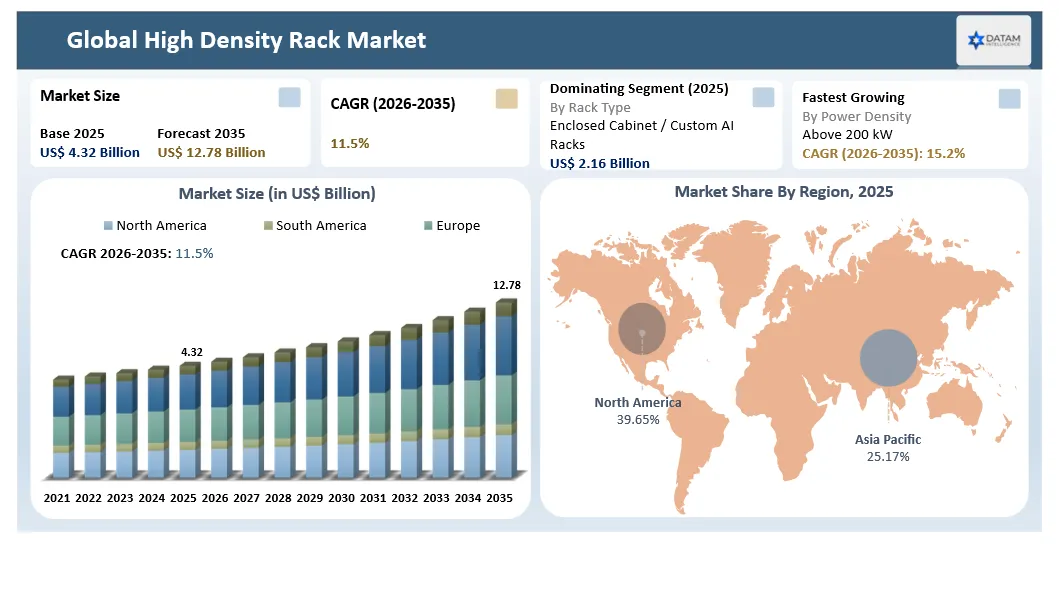
The global high-density rack market reached an estimated US$ 4.32 billion in 2025 and is expected to reach US$ 12.78 billion by 2035, growing with a CAGR of 11.5% during the forecast period 2026-2035. The market is expanding faster than conventional rack infrastructure as AI accelerators, GPU clusters and high-performance computing increase equipment weight, power draw and thermal output per rack.
The defining market shift is the transition from rack density measured in low tens of kilowatts toward 50-100 kW deployments and a rapidly emerging 100-200 kW and above-200 kW tier. This changes rack engineering from a largely mechanical enclosure decision into a tightly integrated power, cooling, structural and serviceability problem. Reinforced frames, wider and deeper cabinets, high-current busway, intelligent rack PDUs, liquid manifolds, rear-door heat exchangers and rack-level telemetry are becoming part of a single infrastructure architecture.
North America leads the market through hyperscale and AI investment, while Asia-Pacific is expected to record the fastest growth through new cloud regions, sovereign AI programs, semiconductor ecosystems and large greenfield data-center campuses. Europe remains an important market for high-efficiency and liquid-cooled deployments where power availability and environmental constraints require higher compute output per megawatt.
| Metric | Details |
| 2025 Market Size | US$ 4.32 Billion |
| 2035 Projected Market Size | US$ 12.78 Billion |
| CAGR (2026-2035) | 11.5% |
| Largest Market | North America |
| Fastest Growing Market | Asia-Pacific |
| Dominating Segment | Enclosed Cabinet / Custom AI Racks |
| Fastest-Growing Density | Above 200 kW |
| Primary Growth Engine | AI and accelerated computing |
High-Density Rack Market Key Takeaways
- AI infrastructure is moving rack design from standardized enclosure procurement toward integrated rack-scale engineering that combines mechanical support, electrical distribution, liquid cooling and monitoring.
- Rack power density above 100 kW is the fastest-growing value pool, while above-200 kW architectures are moving from specialized deployments toward commercial AI clusters.
- Direct-to-chip liquid cooling is becoming the preferred thermal architecture for high-density GPU racks because conventional room air systems cannot economically remove the full heat load at the highest densities.
- North America leads through hyperscale capital expenditure and accelerated-compute deployment, while Asia-Pacific benefits from new cloud regions, domestic AI infrastructure programs and data-center construction.
- High-density racks command materially higher value per rack because reinforced structures, larger dimensions, manifolds, busway interfaces, intelligent PDUs and integrated monitoring add hardware and engineering content.
- Competitive advantage is shifting toward suppliers that can deliver rack, power, cooling and controls as validated systems rather than as disconnected components.
High-Density Rack Industry Trends and Strategic Insights
- Rack-scale AI systems are changing physical design standards. Cabinets are becoming wider, deeper and heavier, with higher static and dynamic load ratings and greater emphasis on service access.
- Liquid-cooling-ready rack platforms are becoming a default specification for new AI white space even when initial deployments use lower density, because operators want to preserve upgrade paths.
- 800 VDC and other higher-voltage power architectures are receiving greater attention as rack power rises and current becomes a major design constraint.
- Operators are standardizing rack-level telemetry for temperature, humidity, coolant flow, leak detection, current draw and branch-level power to improve capacity planning and reduce stranded resources.
- Colocation operators are creating dedicated high-density halls and AI-ready suites to separate extreme power and cooling requirements from legacy enterprise deployments.
- Supply agreements increasingly bundle racks with busway, PDUs, liquid-cooling distribution and deployment services, expanding the addressable value per rack.
High-Density Rack Market Scope
| Metrics | Details |
| 2025 Market Size | US$ 4.32 Billion |
| 2035 Projected Market Size | US$ 12.78 Billion |
| CAGR (2026-2035) | 11.5% |
| By Rack Type | Enclosed Cabinet, Open Frame, OCP/Open Rack, Modular/Pod and Custom AI Racks |
| By Rack Height | Up to 42U, 43-45U, 46-48U, 49-52U and Above 52U |
| By Power Density | Below 20 kW, 20-50 kW, 50-100 kW, 100-200 kW and Above 200 kW |
| By Cooling Architecture | Air, Rear-Door HX, Direct-to-Chip, Immersion-Compatible and Hybrid |
| By Rack Width & Depth | 600 mm, 700-800 mm, 1000-1200 mm Deep and Custom |
| By Application | AI/HPC, Cloud, Storage, Networking and Enterprise |
| By End User | Hyperscale/Cloud, Colocation, Enterprise, Telecom, Government, BFSI, Healthcare and Research |
| By Distribution | Direct, System Integrator, Distributor and Online/Catalog |
Why does this report matter in 2026?
The year 2026 is a structural transition point because AI data-center designs are moving beyond isolated high-density pilots into repeatable rack-scale and pod-scale deployments. Infrastructure vendors are expanding production capacity, acquiring complementary rack and cooling capabilities and developing reference architectures with accelerator and server companies. Decisions made now on rack dimensions, load ratings, cooling interfaces and power topology can determine whether a facility can accept future generations of AI hardware without major reconstruction.
The report matters because high-density rack demand cannot be understood through rack-unit shipments alone. Economic value is increasingly concentrated in integrated power, thermal and monitoring content. A conventional rack and a 100 kW liquid-cooled AI rack can occupy similar floor area but differ significantly in structural requirements, project engineering and installed value. The study therefore evaluates density migration, cooling compatibility and end-user architecture rather than treating all cabinets as comparable products.
High-Density Rack Market White Space & Investment Opportunities
- Above-200 kW and future megawatt-class rack platforms create white space in reinforced frames, high-current or higher-voltage distribution, liquid manifolds, leak detection and service tooling.
- Brownfield colocation retrofits offer an attractive opportunity for rack solutions that increase density without requiring a complete facility rebuild.
- Integrated rack-and-cooling packages can reduce validation risk for customers and shift vendors toward higher-margin engineered systems.
- Rack-level telemetry and digital twins create recurring software and services value around capacity planning, thermal optimization and preventive maintenance.
- Localized manufacturing in North America, Europe, India, Southeast Asia and the Middle East can reduce project lead times and exposure to steel, electronics and logistics disruptions.
- Open rack and OCP-aligned systems provide opportunities for suppliers that can combine interoperability with customization for proprietary AI clusters.
High-Density Rack Future Market Transformation
The market will move from a cabinet-centric model toward rack-scale infrastructure platforms. The physical rack will remain necessary, but differentiation will increasingly come from the integration of power distribution, coolant delivery, telemetry, access control and deployment engineering. This favors vendors with broad critical-infrastructure portfolios and specialist rack companies that form strong partnerships with cooling, busway and server suppliers.
By 2035, a meaningful share of premium rack revenue is expected to come from systems designed for densities above 100 kW. The industry will also become more segmented: conventional enterprise racks will remain price competitive, while AI and HPC racks will be engineered around specific accelerator generations, cooling loops and power architectures. Qualification cycles, factory integration and reference designs will therefore become more important than catalog breadth alone.
High-Density Rack Market Buyer Decision-Making Criteria
Buyers prioritize structural load rating, usable rack dimensions, airflow openness, cooling compatibility, PDU and busway integration, cable-management space, access security, serviceability and delivery lead time. In AI deployments, the rack must also support coolant manifolds, quick disconnects, leak detection and maintenance access without blocking high-speed network cabling.
Procurement is increasingly based on system-level risk. Operators favor suppliers that can demonstrate validated combinations of rack, power and cooling equipment and that can support installation across multiple regions. Price remains important, but schedule certainty, engineering support, supply capacity and interoperability can outweigh unit cabinet cost when a delayed rack prevents deployment of expensive compute hardware.
High-Density Rack Market Economic & Investment Analysis
The economics of high-density racks are tied to the value of deployed compute and to facility power scarcity. When GPUs and associated network equipment represent millions of dollars of hardware per rack, operators can justify premium infrastructure that improves uptime, serviceability and deployable capacity. Higher density can also reduce the floor area needed per unit of compute, but it transfers cost into power delivery, cooling, structural reinforcement and controls.
Investment is flowing into rack factories, automated metal fabrication, liquid-cooling integration, busway and PDU production, CDU capacity and service networks. Acquisitions are increasingly used to assemble broader data-center infrastructure portfolios. The investment case is strongest for suppliers that can capture multiple components per rack and sustain high delivery volumes while engineering rapidly for new server generations.
High-Density Rack Investment Trends in the Market
- Capacity expansion for AI-ready racks, PDUs and liquid-cooling components is accelerating.
- Strategic acquisitions are being used to add rack manufacturing, thermal-management and integration capabilities.
- Cloud and colocation customers are entering longer-term capacity agreements to secure critical infrastructure ahead of compute deployments.
- R&D spending is shifting toward higher load ratings, modular coolant distribution, rack-level monitoring and higher-voltage power architectures.
- Regional manufacturing and assembly are receiving investment to shorten lead times for project-driven demand.
Strategic Indicators For the High-Density Rack Market
High Regulation Impact
The market is shaped by electrical safety, fire protection, seismic requirements, building codes, data-center efficiency rules and equipment certification. Rack structures themselves are not heavily regulated as standalone products, but integrated electrical distribution, access control and liquid systems must comply with multiple standards and site-specific requirements.
High Investment Activity
Data-center and AI infrastructure spending is driving exceptional investment in rack, cooling and power capacity. Vendors are expanding manufacturing, adding automated fabrication and acquiring adjacent technologies to capture more value per rack.
Supply Chain Disruption
Steel, copper, power electronics, breakers, connectors, fans, sensors and liquid-cooling components can create bottlenecks. High-density projects are particularly sensitive to delays because rack delivery must be synchronized with server, electrical and cooling commissioning.
Pricing Volatility
Commodity rack pricing is relatively competitive, but premium AI racks show wider price dispersion because value depends on structural rating, dimensions, integration level, liquid-cooling interfaces and project engineering. Copper and steel prices also influence installed cost.
Procurement Pressure
Hyperscalers and colocation operators demand aggressive delivery schedules, multi-region consistency and transparent capacity commitments. Suppliers are expected to coordinate with server OEMs, cooling vendors and electrical contractors rather than ship standalone cabinets.
New Technology Adoption
Direct-to-chip liquid cooling, rear-door heat exchangers, intelligent PDUs, high-current busway, 800 VDC concepts and rack-level digital twins are advancing rapidly as power density rises.
Regional Expansion Opportunity
North America, India, Southeast Asia and the Middle East offer large greenfield opportunities, while Europe presents strong retrofit and efficiency-driven demand where power and space are constrained.
Government Policy Support
Sovereign AI initiatives, semiconductor incentives, digital infrastructure programs and cloud localization policies indirectly support high-density rack demand by accelerating domestic data-center investment.
Pricing Intelligence
Standard cabinets compete on scale and distribution, whereas 100 kW+ racks are increasingly priced as engineered infrastructure packages. Buyers should compare total installed configuration rather than enclosure price alone.
Disruption Analysis of the High-Density Rack Market
The primary disruption is the collapse of the traditional separation between IT racks and facility infrastructure. High-density AI hardware forces rack design to interact directly with cooling loops, high-capacity power distribution and network topology. Vendors that historically specialized in cabinets now compete with critical-infrastructure companies offering integrated solutions, while server vendors increasingly influence rack standards through rack-scale architectures.
A second disruption is rapid density escalation. A rack platform designed around current 80-120 kW systems may need to accommodate significantly higher power in the next hardware cycle. This is shortening product-development windows and increasing the value of modular designs that can change manifolds, busway connections and cable-management systems without replacing the entire frame.
High-Density Rack Market BCG Matrix: Company Evaluation
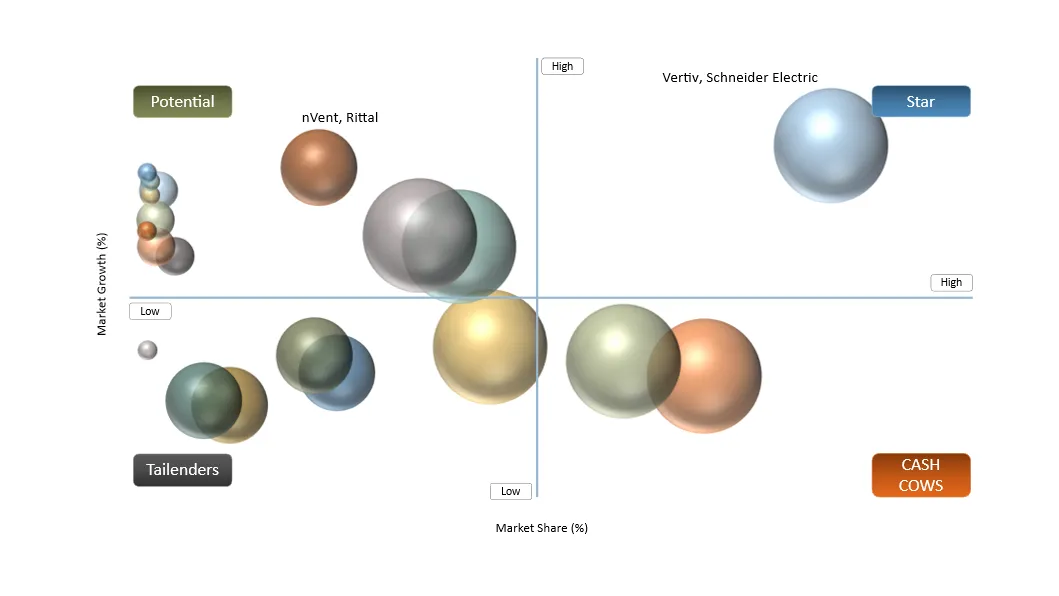
STAR: Vertiv, Schneider Electric and Legrand are positioned as Stars because they combine strong data-center exposure with broad rack, power, thermal or digital infrastructure capabilities and global project reach. Their ability to bundle infrastructure and support high-density AI deployments creates strong growth and share potential.
POTENTIAL: nVent, Rittal, Chatsworth Products, Panduit and selected regional rack specialists represent Potential players. They have strong enclosure or infrastructure capabilities and can gain share by deepening liquid-cooling integration, expanding production and building partnerships with server OEMs and hyperscale customers.
High-Density Rack Market Dynamics
Driver Impact Analysis
| Driver | Market Growth Impact | Demand Concentration | Impacted Use Case | Strategic Impact |
| AI and GPU infrastructure | Very High | Hyperscale and colocation | AI training and inference clusters | Accelerates 100 kW+ rack demand and integrated cooling |
| Migration to liquid cooling | High | AI/HPC facilities | Direct-to-chip deployments | Raises rack content through manifolds and monitoring |
| Cloud and colocation expansion | High | North America, APAC, Middle East | New data-center halls | Increases volume and favors standardized high-density platforms |
| Power and space constraints | Medium-High | Mature data-center markets | Retrofit and densification | Encourages more compute per rack and premium engineering |
Driver: AI Infrastructure and Rapid Density Escalation
AI is the strongest growth driver because accelerator platforms concentrate far more compute and power into a rack than conventional enterprise servers. Operators are therefore increasing rack load ratings, expanding cabinet depth, adopting liquid cooling and installing larger power distribution. This raises both unit demand and value per rack. The strongest opportunity is where vendors can qualify a complete rack configuration for specific AI system architectures and then replicate it across multiple data-center sites.
Restraint Impact Analysis
| Restraint | Drag on Market Growth | Primary Impact Area | Impacted Use Case | Strategic Impact |
| Power availability and interconnection delays | High | Facility deployment | Hyperscale and AI campuses | Can delay rack installation despite equipment demand |
| Brownfield floor-loading limits | Medium-High | Retrofit sites | Dense GPU racks | Restricts achievable rack weight and density |
| High liquid-cooling integration cost | Medium | Project economics | 100 kW+ racks | Slows adoption outside premium AI/HPC workloads |
| Fast hardware-generation cycles | Medium | Product qualification | Custom AI rack systems | Creates redesign and inventory-obsolescence risk |
Restraint: Facility Constraints and Integration Complexity
The market can be constrained by factors outside the rack itself. Utility power, transformer capacity, structural floor loading, chilled-water or facility-water availability and retrofit space can prevent operators from deploying the highest-density systems. As a result, rack vendors increasingly participate earlier in facility design and must offer multiple density and cooling configurations rather than assume that every customer can adopt the maximum technical specification.
High-Density Rack Market Segment Analysis
The global high-density rack market is segmented based on Rack Type, Rack Height, Power Density, Cooling Architecture, Rack Width & Depth, Application, End User, distribution channel, and region.
By Rack Type
Enclosed and Custom AI Racks Will Lead Value
Enclosed cabinet and custom AI rack systems account for the largest value because they combine mechanical protection, cable management, security and the ability to integrate liquid-cooling manifolds and high-capacity power distribution. Open rack formats remain important for hyperscale and OCP deployments, but broader commercial adoption continues to favor cabinetized systems that simplify containment and access control.
By Rack Height
48U and Taller Platforms Gain Share
Traditional 42U remains widely installed, but 48U, 52U and taller platforms gain share as operators seek to maximize vertical space and accommodate larger network, power and cooling components. Taller cabinets are particularly attractive in greenfield hyperscale halls where ceiling height, overhead busway and service clearances are designed around higher rack profiles.
By Power Density
Above 100 kW Will Be the Fastest-Growing Value Pool
The 100-200 kW and above-200 kW categories are expected to grow fastest as rack-scale AI architectures mature. Below-50 kW racks remain substantial in conventional cloud and enterprise workloads, but high-density AI racks command significantly more installed value per unit because of structural, electrical and liquid-cooling requirements.
By Cooling Architecture
Direct-to-Chip Liquid Cooling Will Record the Fastest Growth
Direct-to-chip systems are becoming the preferred architecture for dense GPU deployments because they move a large share of server heat directly into a liquid loop. Rack designs increasingly include manifolds, quick disconnects, leak detection and CDU interfaces. Air cooling remains dominant in lower-density racks, while rear-door heat exchangers provide a practical retrofit path for selected facilities.
By Rack Width & Depth
Wider and Deeper Cabinets Expand with AI Hardware
AI racks require more cable-management space, larger power conductors and liquid manifolds. This favors 700-800 mm widths and cabinet depths of 1200 mm or more. Standard 600 mm racks remain common for network and conventional server deployments but are less flexible for extreme-density systems.
By Application
AI and Accelerated Computing Will Drive the Highest Growth
AI training and inference are the fastest-growing application because GPU clusters require exceptional power, cooling and network density. HPC and cloud computing also support premium racks, while storage and networking create additional demand for deep cabinets and structured cable management.
By End User
Hyperscalers and Colocation Providers Will Dominate Demand
Hyperscale cloud providers lead direct demand for large standardized deployments, while colocation companies are rapidly adding AI-ready capacity to serve enterprise and model-development customers. Research institutions, government programs and BFSI buyers contribute to high-density demand where sovereign, secure or specialized compute is required.
By Distribution Channel
Direct and System-Integrator Sales Will Control Premium Projects
High-density deployments require engineering coordination and therefore favor direct sales, OEM relationships and system integrators. Catalog distribution remains important for conventional racks and accessories, but 100 kW+ projects typically involve site-specific design, qualification and commissioning.
High-Density Rack Architecture Comparison
| Parameter | Conventional Rack | High Density AI Rack | Ultra-High Density Rack |
| Typical Power Density | 5-20 kW | 50-150 kW | Above 150-200 kW |
| Cooling | Air | Direct-to-chip / hybrid | Liquid-first architecture |
| Structural Load | Standard | Reinforced | Heavy-duty / custom |
| Power Distribution | Conventional rack PDU | High-capacity PDU/busway | High-current or higher-voltage architecture |
| Cabinet Depth | 1000-1200 mm | 1200 mm+ | Custom / platform specific |
| Primary Workload | Enterprise/cloud | GPU AI/HPC | Rack-scale AI systems |
High-Density Rack Market Geographical Penetration
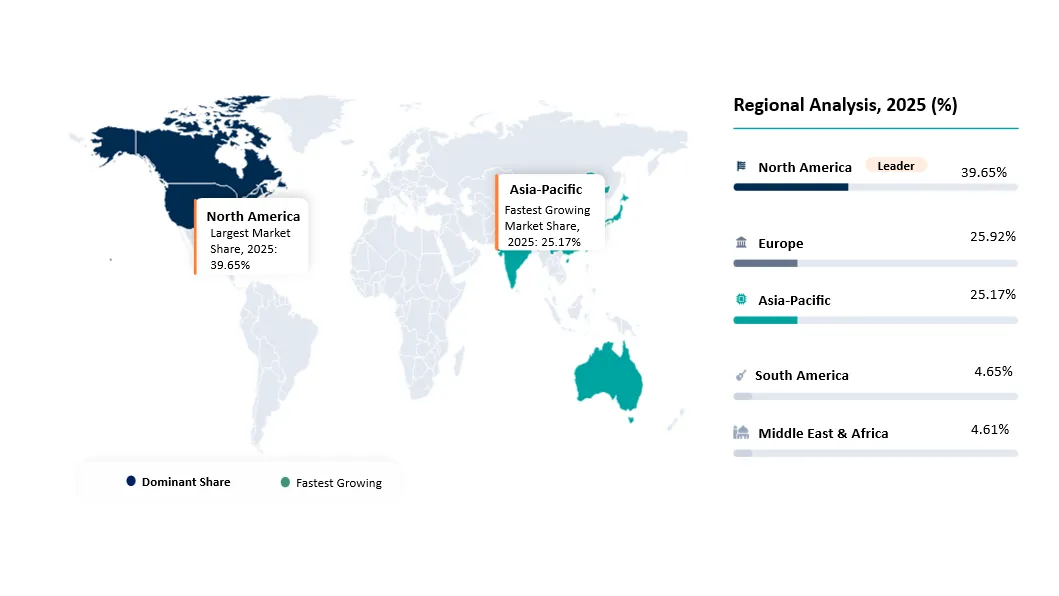
North America is the largest regional market, supported by hyperscale cloud capital expenditure, AI model development, colocation expansion and domestic manufacturing investment. Asia-Pacific is expected to grow fastest as China, India, Japan, South Korea, Singapore, Malaysia and Australia add data-center capacity and sovereign AI programs. Europe remains an important premium market where power constraints and sustainability requirements increase the value of dense, liquid-cooled infrastructure.
U.S. High-Density Rack Market Landscape
The U.S. is the largest national market because it combines hyperscale cloud regions, leading AI developers, GPU infrastructure investment and a large colocation ecosystem. Growth is concentrated in major data-center hubs and emerging power-rich regions. Operators are increasingly specifying 100 kW+ liquid-cooled racks, high-capacity busway and advanced monitoring, while utility interconnection and transformer availability remain important constraints.
Germany High-Density Rack Market Outlook
Germany combines enterprise, colocation, automotive, industrial and research demand with strong requirements for efficiency and infrastructure reliability. High-density adoption is supported by AI and HPC investment, but power pricing and permitting encourage designs that maximize compute output per megawatt and use heat recovery or efficient liquid cooling.
China High Density Rack Market Trends
China has a large domestic cloud and internet ecosystem, strong server manufacturing capacity and extensive data-center construction. High-density demand is supported by AI infrastructure and national computing programs. Domestic rack, power and cooling suppliers create intense competition while export controls on advanced chips influence deployment mix.
India High-Density Rack Market Outlook
India is a major growth market as cloud providers, colocation operators and domestic digital platforms add campuses in Mumbai, Chennai, Hyderabad, Bengaluru, Delhi NCR and other hubs. New facilities are increasingly designed for higher density and liquid cooling, creating opportunities for local assembly, busway, rack PDU and integrated cooling suppliers.
Middle East High-Density Rack Market Outlook
Saudi Arabia and the UAE are investing in cloud regions, sovereign AI, digital government and large data-center campuses. Greenfield projects provide an opportunity to design high-density halls from the outset, reducing retrofit constraints. Partnerships, local service and rapid project delivery are important competitive factors.
High-Density Rack Market Competitive Landscape
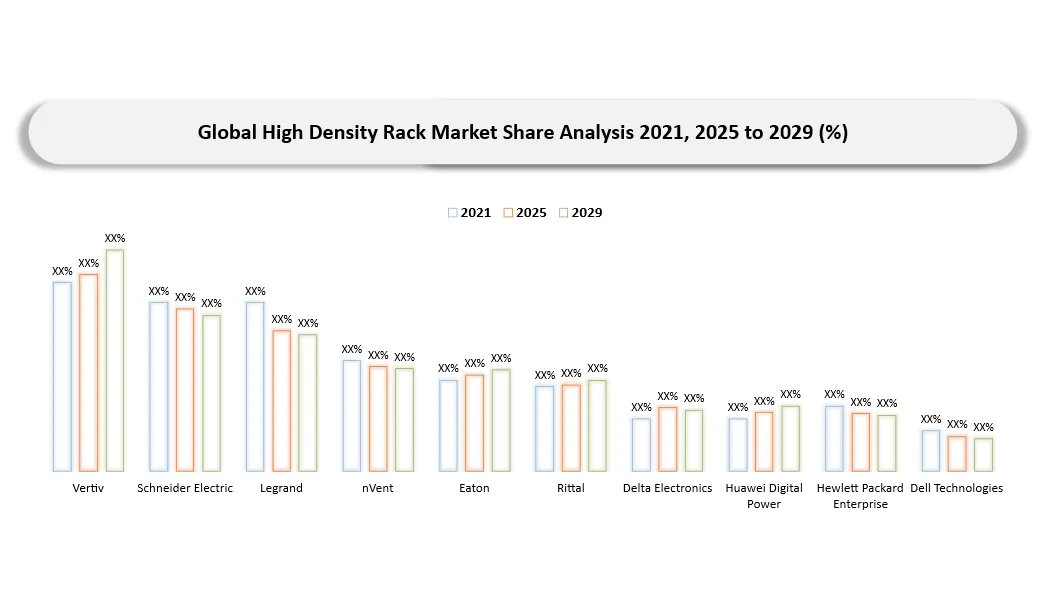
- Competition is shifting from standalone cabinet manufacturing toward integrated rack-scale infrastructure. Vertiv, Schneider Electric, Legrand, nVent and Eaton benefit from broader exposure to data-center power, thermal or electrical infrastructure, while Rittal, Chatsworth Products and Panduit retain strong specialist positions in enclosures and physical infrastructure.
- AI deployments reward suppliers that can validate rack, power and cooling as a system. Partnerships with server OEMs, GPU platform providers, liquid-cooling specialists and EPCs therefore influence design wins.
- Manufacturing capacity and lead time are strategic differentiators. High-density racks require large-format metal fabrication, precise assembly and increasingly factory-installed manifolds, power components and sensors.
- Open standards create both opportunity and pressure. OCP and Open Rack architectures can broaden interoperability, but hyperscalers may require highly customized dimensions and integration, reducing the value of generic catalogs.
Public Company Q1-Q2 2026 Performance Comparison
| Public Company | Q1-Q2 2026 Performance | High-Density Rack Exposure | Key Growth Drivers |
| Vertiv | Q1 2026 net sales US$2.65B, +30% YoY; Q2 2026 net sales US$3.27B, +24% YoY. Full-year guidance raised. | Direct exposure through racks, integrated power, liquid cooling and AI-ready critical infrastructure. | AI and general compute demand, Americas hyperscale growth, capacity expansion, liquid cooling and integrated infrastructure. |
| Schneider Electric | Q1 2026 revenue €9.8B, +11.2% organic; Energy Management +12.8% organic with data centers the main growth driver. H1 reporting continued strong data-center momentum. | NetShelter racks, rack PDUs, UPS, busway, DCIM and data-center power architecture. | Data centers, Systems growth, power and grid investment, AI infrastructure and integrated energy management. |
| Legrand | 2026 performance remained supported by data-center infrastructure, a strategic growth vertical following strong prior-year expansion. | Minkels and Raritan racks, intelligent PDUs, busway, cable management and data-center physical infrastructure. | Data-center mix expansion, acquisitions, hyperscale and colocation demand, intelligent power distribution. |
| Eaton | Q1 2026 reported record results and raised organic growth guidance; data-center investment remained a major Electrical Americas demand driver. | Rack power, busway, PDUs, Tripp Lite racks/enclosures and broader electrical infrastructure. | AI data centers, electrical backlog, switchgear and power distribution demand, thermal and digital infrastructure expansion. |
| nVent | Q1 2026 results and 2026 Investor Day emphasized rapidly expanding data-center exposure; SCHROFF and HOFFMAN platforms support rack and enclosure demand. | SCHROFF racks, cabinets, enclosures, power and thermal integration components. | Data-center and power-utility growth, portfolio transformation, integrated protection solutions and capacity investment. |
Market Ecosystem Table
| Value Chain Sector | Representative Companies | Role in High Density Rack Ecosystem |
| Steel, aluminum and fabricated materials | ArcelorMittal, Nucor, SSAB, regional sheet-metal suppliers | Provide structural material for reinforced rack frames, doors, rails and support systems. |
| Power distribution and electrical components | Eaton, Schneider Electric, ABB, Siemens, Vertiv, Legrand | Provide busway, rack PDUs, breakers, monitoring and high-capacity electrical interfaces. |
| Rack and enclosure platforms | Vertiv, Schneider Electric, Legrand/Minkels, Rittal, nVent/SCHROFF, Chatsworth Products | Design and manufacture standard and high-density cabinets, frames and rack accessories. |
| Liquid cooling and thermal integration | Vertiv, CoolIT Systems, Motivair, Schneider Electric, Boyd, nVent | Provide CDUs, manifolds, cold plates, rear-door heat exchangers, hoses and rack thermal interfaces. |
| Cable management and connectivity | Panduit, CommScope, Legrand, Belden, TE Connectivity, Amphenol | Support high-density fiber, copper, power and liquid routing inside and around racks. |
| Server and rack-scale system OEMs | NVIDIA, Dell Technologies, HPE, Lenovo, Supermicro, Quanta/QCT | Define compute platforms, dimensions, service envelopes and power/cooling requirements. |
| Cloud and hyperscale operators | Amazon Web Services, Microsoft, Google, Meta, Oracle, Alibaba Cloud, Tencent Cloud | Drive large-volume rack specifications and next-generation density requirements. |
| Colocation operators | Equinix, Digital Realty, QTS, NTT Global Data Centers, Vantage, CyrusOne | Develop AI-ready halls and provide high-density capacity to multiple customers. |
| EPCs and systems integrators | AECOM, Jacobs, Schneider, Vertiv, regional MEP contractors | Integrate racks with facility power, cooling, monitoring and commissioning. |
| Standards and industry bodies | Open Compute Project, ASHRAE, IEC, UL, TIA | Develop rack, thermal, electrical, safety and data-center design guidance. |
Key Companies
- Vertiv
- Schneider Electric
- Legrand
- nVent
- Eaton
- Rittal
- Chatsworth Products
- Panduit
- Delta Electronics
- Huawei Digital Power
- Hewlett Packard Enterprise
- Dell Technologies
- Lenovo
- Fujitsu
- Belden
Company Profiles
Vertiv
Vertiv is one of the strongest strategic participants because it combines rack systems with power, cooling, monitoring and services. Its acquisition-led expansion in rack infrastructure strengthens its ability to offer AI-ready rack-scale solutions and to capture more value per deployment. Growth is supported by hyperscale demand, liquid cooling and multi-region capacity investment.
Schneider Electric
Schneider Electric participates through NetShelter rack systems, APC power distribution, busway, UPS, liquid-cooling partnerships and EcoStruxure software. Its advantage is the ability to connect rack-level infrastructure with facility electrical architecture and data-center management.
Legrand
Legrand participates through Minkels cabinets, Raritan intelligent PDUs, Starline busway and broader digital-infrastructure products. Data centers are a strategic growth vertical, and the company benefits from a broad combination of rack, power and connectivity assets.
nVent
nVent serves the market through SCHROFF and HOFFMAN rack and enclosure platforms together with electrical protection and thermal integration capabilities. Its strategy emphasizes expanding data-center exposure and building more integrated solutions.
Eaton
Eaton combines Tripp Lite rack and enclosure offerings with major positions in electrical distribution, busway, UPS, switchgear and thermal infrastructure. Its ability to address upstream facility power and rack-level distribution makes it relevant to high-density AI deployments.
Rittal
Rittal is a major specialist in IT racks, enclosures, modular data-center infrastructure and climate control. Its engineering depth in standardized and customized enclosures supports enterprise, colocation and industrial edge applications.
Chatsworth Products
Chatsworth Products is a specialist in data-center cabinets, containment, cable management and physical infrastructure. The company is positioned strongly where buyers value high static load, airflow optimization and custom project support.
Panduit
Panduit provides racks, cabinets, cable management, fiber and copper connectivity and physical-infrastructure systems. Its strength lies in combining rack hardware with structured connectivity for dense network environments.
High-Density Rack Market Major Pain Points
- Utility power and interconnection delays can defer deployment even when rack and server demand is strong.
- Floor loading and structural limits restrict high-density retrofits in older facilities.
- Rapid GPU platform changes shorten qualification cycles and can create rack-design obsolescence.
- Liquid-cooling integration introduces leak management, water-quality, service and facility-loop complexity.
- High-current distribution at 100 kW+ density increases conductor size, heat and electrical design challenges.
- Supply concentration in breakers, busway, connectors, CDUs and specialized cooling components can extend lead times.
- Different hyperscaler and OEM rack standards increase customization and reduce manufacturing commonality.
- Project coordination between rack, server, cooling, electrical and construction teams remains a major execution risk.
High-Density Rack Market Recent Developments
- July 2026: Vertiv reported Q2 2026 net sales of US$3.27 billion, up 24% year over year, and raised full-year guidance as AI and general-compute infrastructure demand remained strong.
- June 2026: Data-center infrastructure suppliers continued introducing AI reference architectures integrating rack power, thermal management and controls for next-generation accelerator platforms.
- April 2026: Schneider Electric reported record Q1 revenue of €9.8 billion, up 11.2% organically, with data centers identified as the main growth driver in Energy Management.
- March 2026: nVent highlighted rapidly expanding data-center exposure at its 2026 Investor Day, reinforcing the strategic role of SCHROFF/HOFFMAN enclosure and protection platforms.
- 2025-2026: Rack vendors accelerated integration of liquid-cooling manifolds, intelligent rack PDUs, higher load ratings and deeper cabinets to support 100 kW+ AI configurations.
Analyst View/Opinion on High-Density Rack Market
- The high-density rack market is moving from a mechanical enclosure category toward a critical infrastructure platform shaped by AI power density and liquid cooling.
- Rack value will grow faster than rack unit shipments because high-density systems carry more structural, electrical, thermal and monitoring content per cabinet.
- Vendors with integrated power and cooling portfolios will gain strategic influence, but specialist rack manufacturers can remain competitive through customization, fast engineering and deep customer relationships.
- Above-100 kW deployments will become an increasingly important commercial segment, while above-200 kW designs will set the technology direction for the market.
- Colocation retrofits represent a large commercial opportunity because operators need to support AI tenants without abandoning existing campuses.
- Long-term leadership will depend on multi-generation compatibility, global manufacturing capacity, standardized liquid interfaces, high-quality field service and close alignment with server OEM roadmaps.
High-Density Rack Market Target Audience
| INDUSTRY | WHO SHOULD BUY THIS REPORT? | REASON TO BUY THIS REPORT |
| Data Center Operators | Hyperscalers, cloud providers, colocation companies, enterprise data-center teams | Assess rack-density migration, supplier positioning, cooling architectures and procurement risk. |
| Rack & Enclosure Manufacturers | Product managers, engineering leaders, sales teams | Benchmark demand by density, height, width, cooling compatibility and region. |
| Power & Cooling Vendors | PDU, busway, UPS, CDU, heat-exchanger and liquid-cooling suppliers | Identify rack-level integration opportunities and high-growth AI infrastructure segments. |
| Server & AI OEMs | Server, GPU platform and system architects | Understand physical-infrastructure constraints, interoperability requirements and partner landscape. |
| EPC & Engineering | MEP consultants, contractors, systems integrators | Plan high-density facilities, retrofit requirements and supplier ecosystems. |
| Investors & Consulting | Private equity, institutional investors, strategy teams | Evaluate market growth, competitive positioning, M&A targets and white-space opportunities. |
Why Choose DATAM?
- Data-driven insights integrating rack shipments, density migration, data-center capacity, public-company performance and customer procurement trends.
- Post-purchase analyst consultations for product strategy, market entry, partnership identification and customer targeting.
- Annual updates covering AI infrastructure, rack power density, liquid cooling, capacity additions, M&A and competitive changes.
- Specialized focus on high-growth data-center markets and emerging AI infrastructure hubs.
- Actionable analysis connecting rack hardware with power, cooling, network and facility constraints rather than treating the rack as an isolated product.
What DATAM Uniquely Provides
- Ten-year forecasts across rack type, height, power density, cooling architecture, dimensions, application, end user and channel.
- A dedicated high-density framework separating conventional racks from 50-100 kW, 100-200 kW and above-200 kW architectures.
- Public-company Q1-Q2 2026 comparison linking financial performance with data-center and rack exposure.
- Market ecosystem mapping from fabricated materials and electrical components through rack OEMs, cooling vendors, server platforms, cloud operators and standards bodies.
- Country-level analysis connecting AI investment, colocation construction, power availability and infrastructure supplier presence.


























































