


Hereditary Angioedema (HAE) Market Size and overview
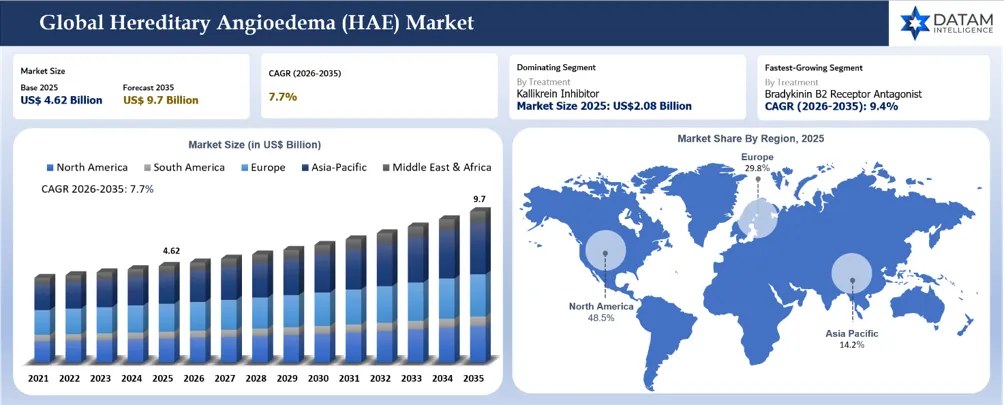
The global hereditary angioedema (HAE) market reached US$4.62 billion in 2025 and is expected to reach US$9.7 billion by 2035, growing with a CAGR of 7.7% during the forecast period 2026-2035.
Growth is being shaped by improving diagnosis, greater disease awareness, pediatric label expansions and increasing adoption of long-term prophylaxis. The market is transitioning from plasma-derived C1 esterase inhibitors and injectable rescue therapies toward oral, monoclonal antibody and RNA-targeted treatments. Kallikrein inhibitors remain the revenue-leading treatment category, supported by established prophylactic products and continued innovation in attack prevention. However, delayed diagnosis, limited specialist access and restrictive payer authorization continue to constrain treatment penetration.
Oral therapies represent a principal growth vector. Products such as Orladeyo and Ekterly reduce injection burden and enable convenient home-based prophylactic or on-demand treatment. Meanwhile, Andembry and Dawnzera strengthen the long-acting preventive landscape through differentiated mechanisms and extended dosing intervals. Competitive advantage will increasingly depend on attack reduction, rapid symptom relief, administration convenience, pediatric coverage, reimbursement and treatment persistence.
The next value-creation cycle will center on oral bradykinin B2 receptor antagonists, long-acting RNA-interference therapies and potentially one-time gene-editing treatments. Intellia Therapeutics, Pharvaris and ADARx Pharmaceuticals are advancing differentiated platforms that could reshape chronic HAE management. Sustainable leadership will require durable disease control, acceptable long-term safety, scalable manufacturing, convincing health-economic evidence and coordinated patient-support programs that improve diagnosis, access and adherence.
Hereditary Angioedema (HAE) Market Key Takeaways
- Sustained Market Expansion Through 2035: The global hereditary angioedema market reached US$4.62 billion in 2025 and is projected to reach US$9.7 billion by 2035, growing at a CAGR of 7.7% during 2026-2035.
- Kallikrein Inhibitors Maintain Market Leadership: Kallikrein inhibitors represented the leading treatment segment, with an estimated market size of US$2.08 billion in 2025, supported by strong adoption of targeted oral and subcutaneous prophylactic therapies.
- Bradykinin B2 Receptor Antagonists Become a Major Growth Engine: The segment is expected to record an estimated CAGR of 9.4% through 2035, driven by oral on-demand therapies, rapid attack intervention and reduced dependence on injectable rescue treatments.
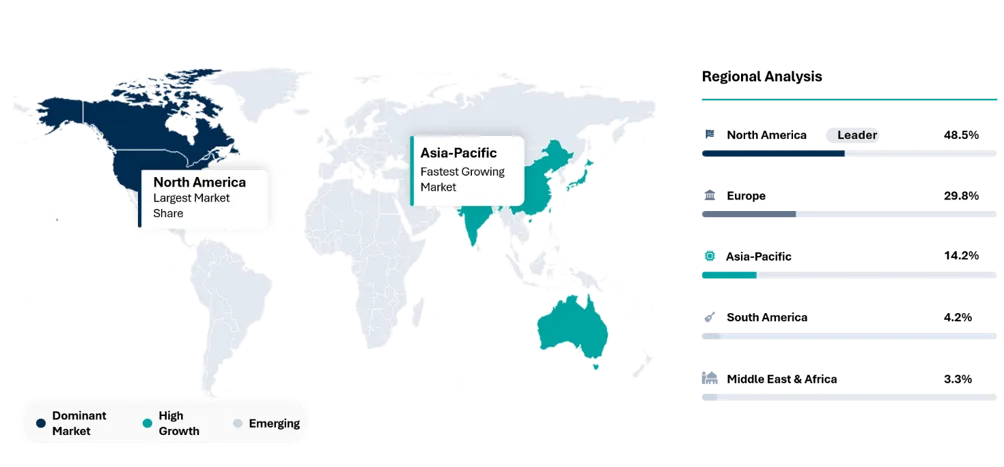
- North America Maintains Regional Dominance: North America accounted for an estimated 48.5% of the global market in 2025, equivalent to approximately US$2.24 billion, supported by advanced diagnosis, favorable reimbursement and early adoption of innovative HAE therapies.
- Treatment Convenience Reshapes Competitive Strategy: Future leadership will depend on oral administration, extended dosing intervals, pediatric expansion, rapid attack control and potentially one-time gene-editing therapies. Companies demonstrating durable efficacy, convenient self-administration and strong payer access will be positioned to capture treatment-switching opportunities.
Hereditary Angioedema (HAE) Market Scope
| Metrics | Details | |
| 2025 Market Size | US$4.62 Billion | |
| 2035 Projected Market Size | US$9.7 Billion | |
| CAGR (2026-2035) | 7.7% | |
| Largest Market | North America | |
| Fastest Growing Market | Asia-Pacific | |
| By Type | Type I HAE, Type II HAE, HAE with Normal C1-INH | |
| By Treatment | C1-esterase Inhibitor, Bradykinin B2 Receptor Antagonist, Kallikrein Inhibitor, Others | |
| By Route of Administration | Intravenous, Subcutaneous, Oral | |
| By Region | North America | U.S., Canada, Mexico |
| Europe | Germany, UK, France, Spain, Italy, Poland | |
| Asia-Pacific | China, India, Japan, Australia, South Korea, Indonesia, Malaysia, Singapore, Vietnam, Thailand, Philippines, Taiwan | |
| South America | Brazil, Argentina | |
| Middle East and Africa | Israel, Saudi Arabia, UAE, Turkiye, South Africa, Nigeria | |
| Report Insights Covered | Competitive Landscape Analysis, Company Profile Analysis, Market Size, Share, Growth | |
Hereditary Angioedema (HAE) Market White Space & Investment Opportunities
- Earlier Diagnosis and Family-Based Screening: Invest in accessible C4 and C1 inhibitor testing, targeted genetic evaluation and family-screening programs. Strengthening referral pathways across allergy, gastroenterology and emergency care can reduce diagnostic delays and identify untreated patients experiencing recurrent unexplained swelling or abdominal attacks.
- Evidence-Based Treatments for HAE With Normal C1 Inhibitor: Develop diagnostic algorithms and dedicated clinical programs for this heterogeneous, underserved population. Genotype-informed patient identification and subtype-specific efficacy evidence could improve treatment selection, clarify regulatory pathways and support reimbursement beyond established C1 inhibitor-deficient HAE populations.
- Low-Burden Oral and Pediatric Formulations: Advance rapid-acting oral rescue therapies, convenient oral prophylaxis and age-appropriate formulations. Differentiation opportunities include easier swallowing, flexible weight-based dosing, fewer preparation steps and reliable symptom control, addressing practical barriers for children, caregivers and patients reluctant to use injections.
- Durable Prevention Through RNA-Targeted and Gene-Editing Therapies: Invest in approaches targeting prekallikrein production or other validated components of the bradykinin pathway. Extended dosing intervals and potentially one-time treatments offer differentiation opportunities, although investment decisions must account for long-term safety, durability, reversibility, manufacturing requirements and regulatory uncertainty.
- Personalized Prophylaxis and Breakthrough-Attack Management: Generate comparative and real-world evidence to guide prophylaxis selection, switching and access to on-demand treatment. Linking attack frequency, severity, treatment burden and patient preferences can identify underserved groups and demonstrate value beyond average attack-rate reduction.
- Geographic Access and Outcomes-Based Reimbursement: Expand diagnostic capacity, specialist networks and sustainable medicine access across underserved markets. Local partnerships and reimbursement models supported by evidence on emergency visits, hospitalization, missed work and quality of life can strengthen affordability and market penetration without assuming that higher drug costs are fully offset.
Hereditary Angioedema (HAE) Market Buyer Decision-Making Criteria
Major Buyer Decision-Making Criteria:
- Reduction in HAE Attack Frequency and Severity
- Speed of Symptom Relief and Complete Attack Resolution
- Durability of Protection and Proportion of Patients Remaining Attack-Free
- Suitability for On-Demand Treatment, Short-Term Prophylaxis and Long-Term Prophylaxis
- Evidence of Effectiveness Across HAE Types and Eligible Patient Populations
- Control of Breakthrough Attacks and Need for Additional Rescue Medication
- Safety, Tolerability, Drug Interactions and Long-Term Clinical Evidence
- Age Eligibility and Evidence in Pediatric and Special Populations
- Route of Administration, Dosing Frequency and Self-Administration Convenience
- Diagnostic Confirmation and Treatment-Eligibility Requirements
- Storage, Preparation, Training and Monitoring Requirements
- Improvement in Daily Functioning, Treatment Confidence and Quality of Life
- Pricing, Reimbursement, Authorization Requirements and Total Treatment Cost
- Guideline Positioning, Approved Indications and Physician Experience
- Supply Reliability, Geographic Availability and Patient-Support Services
Hereditary Angioedema (HAE) Market BCG Matrix: Company Evaluation

STAR
Takeda Pharmaceutical Company Limited, CSL Limited, BioCryst Pharmaceuticals, Inc., KalVista Pharmaceuticals, Inc., Ionis Pharmaceuticals, Inc. and Pharming Group N.V. are positioned in the Star category based on their approved hereditary angioedema therapies, established commercialization capabilities and broad patient access. Takeda maintains a strong position through Takhzyro, Cinryze, Firazyr and Kalbitor, covering long-term prophylaxis and on-demand treatment. CSL competes through Andembry, Haegarda and Berinert, while BioCryst’s Orladeyo provides once-daily oral prophylaxis.
KalVista strengthens the on-demand segment through Ekterly, an oral plasma kallikrein inhibitor, while Ionis competes through Dawnzera, an RNA-targeted prophylactic treatment. Pharming maintains its acute-treatment presence through Ruconest, a recombinant C1 esterase inhibitor. Future leadership will depend on pediatric indication expansion, geographic approvals, longer dosing intervals, rapid attack control, reimbursement coverage, patient-support services and real-world evidence demonstrating sustained attack reduction and improved quality of life.
POTENTIAL
Intellia Therapeutics, Inc., Pharvaris N.V. and ADARx Pharmaceuticals, Inc. are positioned in the Potential category because of their involvement in gene-editing, oral bradykinin-receptor antagonist and RNA-interference therapies that could reshape HAE prevention and on-demand treatment.
Intellia Therapeutics is advancing lonvoguran ziclumeran as a potentially one-time in-vivo gene-editing treatment designed to deliver sustained plasma kallikrein reduction. Pharvaris is developing deucrictibant in immediate-release and extended-release formulations for on-demand treatment and prophylaxis. ADARx Pharmaceuticals is advancing ADX-324, a long-acting small interfering RNA candidate targeting prekallikrein production. Progression toward the Star category will depend on successful late-stage trials, regulatory approvals, durable attack prevention, acceptable long-term safety, manufacturing scalability, competitive pricing, payer acceptance and effective global commercialization partnerships.
Hereditary Angioedema (HAE) Market Dynamics
Driver Impact Analysis
| Driver | Market Growth Impact (%) | Demand Concentration | Impacted Use Case | Strategic Impact |
Expansion of Oral On-Demand and Prophylactic HAE Therapies | 18.5% | High across North America and Europe; expanding in Japan | Acute attack treatment and long-term attack prevention | Oral therapies reduce injection burden, support earlier treatment and improve adherence, expanding uptake among patients reluctant to use intravenous or subcutaneous products. |
Increasing Diagnosis of HAE With C1 Inhibitor Deficiency and Normal C1 Inhibitor | 16.8% | Highest in specialist allergy and immunology centers | Identification of Type I, Type II and normal C1 inhibitor HAE | Improved diagnostic pathways, genetic testing and specialist awareness expand the treatment-eligible population and reduce prolonged misdiagnosis as allergic or gastrointestinal disease. |
Shift Toward Long-Acting and Less-Frequent Prophylaxis | 15.6% | Strong among patients experiencing frequent or severe attacks | Routine prevention of recurrent HAE attacks | Monthly, extended-interval and RNA-targeted therapies improve treatment persistence while intensifying competition against daily oral and frequently administered injectable prophylaxis. |
Pediatric Label Expansion and Earlier Preventive Intervention | 13.9% | Concentrated in developed markets with established rare-disease reimbursement | Pediatric attack prevention and family-managed home treatment | Approvals for younger patients enlarge addressable populations, extend lifetime treatment duration and strengthen demand for weight-appropriate, convenient and home-administered formulations. |
Driver: Expansion of Oral On-Demand and Prophylactic HAE Therapies
The expansion of oral therapies is reshaping hereditary angioedema management by reducing dependence on intravenous and subcutaneous administration. Oral products provide greater portability, eliminate injection preparation and enable patients to initiate treatment rapidly outside clinical settings. BioCryst Pharmaceuticals’ Orladeyo established oral prophylaxis as a viable long-term option, while Chiesi’s Ekterly introduced an oral approach for treating acute attacks. These therapies address important barriers associated with injectable products, including needle aversion, storage requirements, administration training and delayed treatment. Consequently, oral availability can improve adherence, support earlier intervention and expand treatment acceptance among newly diagnosed and undertreated patients.
Competition is expected to intensify as developers pursue oral products combining rapid symptom relief, sustained attack prevention and convenient dosing. Pharvaris is advancing immediate-release and extended-release formulations of deucrictibant for on-demand treatment and prophylaxis, potentially creating a unified oral franchise across the treatment pathway. Commercial success will depend on comparative efficacy, onset of action, attack resolution, breakthrough-attack control, safety and payer coverage. Companies demonstrating injectable-level effectiveness with lower treatment burden can capture switching opportunities, strengthen patient retention and accelerate oral therapy penetration across established and emerging HAE markets.
Restraint Impact Analysis
| Restraint | Drag on Market Growth (%) | Primary Impact Area | Impacted Use Case | Strategic Impact |
High Lifetime Therapy Cost and Restrictive Payer Authorization | 18.2% | Reimbursement, treatment initiation and therapy switching | Long-term prophylaxis with biologic, RNA-targeted and oral therapies | Prior authorization, step therapy and documentation requirements can delay access, restrict switching and favor lower-cost established treatments over newer therapies. |
Persistent Misdiagnosis as Allergic, Gastrointestinal or Abdominal Disorders | 16.7% | Patient identification and treatment eligibility | Diagnosis of Type I, Type II and normal C1 inhibitor HAE | Diagnostic delays leave patients dependent on ineffective antihistamines or corticosteroids, reducing the diagnosed and actively treated population available to therapy providers. |
Limited Access to C1 Inhibitor Testing, Genetic Evaluation and HAE Specialists | 14.9% | Diagnosis and treatment access in underserved markets | Confirmatory testing, prophylaxis selection and emergency treatment planning | Weak laboratory infrastructure and limited specialist networks constrain market penetration outside major urban centers and developed healthcare systems. |
Small and Clinically Heterogeneous Patient Population Complicating Therapy Development | 12.8% | Clinical recruitment, evidence generation and regulatory approval | Development of treatments for pediatric and normal C1 inhibitor HAE populations | Low patient numbers and disease heterogeneity increase trial timelines, recruitment costs and evidence requirements, particularly for genotype-defined and less-characterized HAE subtypes. |
Restraint: High Lifetime Therapy Cost and Restrictive Payer Authorization
The high lifetime cost of hereditary angioedema therapy remains a significant barrier to treatment initiation, sustained access and product switching. Patients may require continuous prophylaxis, recurring on-demand medication or both, creating substantial cumulative expenditure for insurers and healthcare systems. Newer biologic, oral and RNA-targeted therapies can reduce attack frequency and treatment burden, but their premium pricing often triggers prior authorization, step-therapy requirements and detailed clinical documentation. Payers may require evidence of confirmed HAE diagnosis, historical attack frequency, inadequate response to established therapies and specialist prescribing before approving coverage, delaying access to clinically appropriate treatment.
Restrictive reimbursement frameworks also influence competitive positioning by favoring products with established formulary access, contracting arrangements and robust health-economic evidence. Manufacturers must demonstrate that higher acquisition costs are offset by fewer emergency visits, hospitalizations, productivity losses and treatment-related administration expenses. Patient-support programs, copayment assistance and specialty-pharmacy coordination are therefore becoming important commercial differentiators. Companies that generate convincing real-world evidence, secure broad reimbursement and simplify authorization processes will achieve stronger treatment persistence and market penetration. Conversely, inadequate payer engagement may limit adoption, particularly in price-sensitive markets and among patients requiring lifelong preventive therapy.
Hereditary Angioedema (HAE) Market, Segment Analysis
The global hereditary angioedema (HAE) market is segmented based on type, treatment, route of administration, and region.
The minoxidil from the treatment type segment is expected to hold 27% of the market share in 2025 in the Hereditary Angioedema (HAE) market
The C1-esterase inhibitor segment is currently the dominant segment in the Hereditary Angioedema (HAE) market. This dominance is due to its established efficacy, widespread clinical use for both on-demand and prophylactic treatment, and its early approval history compared to newer therapies.
C1-esterase inhibitors such as Cinryze, Berinert, and Haegarda have long been considered the gold standard in HAE management. Their proven ability to reduce the frequency and severity of HAE attacks, combined with physician familiarity and robust clinical data, has secured their leading position in the market.
Additionally, the availability of both plasma-derived and recombinant forms of C1-esterase inhibitors has improved access and reduced the risk of supply disruptions, further reinforcing their dominance. Products like Cinryze and Haegarda, which are approved for routine prophylaxis, offer the advantage of regular prevention of attacks, while Berinert remains a go-to option for on-demand treatment. These therapies have been in the market longer than most alternatives, giving them the first-mover advantage, which continues to influence physician preference and treatment protocols.
Hereditary Angioedema (HAE) Market Geographical Penetration
U.S. Hereditary Angioedema (HAE) Market Landscape
The U.S. hereditary angioedema market is transitioning from injection-dependent management toward differentiated oral, long-acting and RNA-targeted therapies. Takeda, CSL, BioCryst, Chiesi, Ionis and Pharming compete across prophylactic and on-demand treatment, with product selection increasingly influenced by attack control, administration convenience, dosing frequency and payer access. In 2025, the FDA approved three innovative HAE therapies: Andembry for prevention, Ekterly for acute attacks and Dawnzera for prophylaxis, substantially broadening therapeutic choice. Ekterly also became the first FDA-approved oral on-demand HAE treatment for patients aged 12 years and older.
Commercial competition is intensifying around patient switching, specialist engagement, formulary positioning and home-based treatment. BioCryst’s Orladeyo anchors oral prophylaxis, while Andembry and Dawnzera compete through monthly and extended-interval preventive dosing. Early demand indicates strong interest in oral rescue therapy: Ekterly generated 460 U.S. patient start forms by August 29, 2025, shortly after its July launch. Growth will depend on earlier diagnosis, pediatric expansion, broader reimbursement and evidence that premium therapies reduce emergency visits, hospitalization and productivity losses. Meanwhile, Intellia’s gene-editing program and Pharvaris’ oral deucrictibant portfolio could further disrupt chronic-treatment models.
Japan Hereditary Angioedema (HAE) Market Outlook
Japan’s hereditary angioedema market is positioned for strong growth as improved diagnosis, rare-disease policy support and new treatment approvals expand the addressable population. A substantial diagnosis gap remains: approximately 430 patients were diagnosed and receiving treatment in 2025, compared with an estimated 2,500 potential patients based on global prevalence. This gap creates opportunities for C1 inhibitor testing, genetic evaluation, physician education and referral-network development. Treatment competition is also broadening beyond traditional injectable rescue therapies toward long-acting prophylaxis and oral on-demand treatment.
Competitive momentum accelerated when Japan approved CSL’s once-monthly Andembry in February 2025 and Ekterly, the country’s first oral on-demand HAE therapy, in December 2025. In August 2026, BioCryst received approval for Orladeyo in children aged two to below 12 years, extending oral prophylaxis into the pediatric population. BioCryst Market expansion will depend on national reimbursement, specialist awareness and treatment availability outside metropolitan centers. Companies combining convenient administration, pediatric coverage, Japanese clinical evidence and patient-support programs should secure stronger uptake. Partnerships with established domestic companies will remain important for regulatory execution, physician engagement, distribution and long-term commercialization.
Hereditary Angioedema (HAE) Market Competitive Landscape
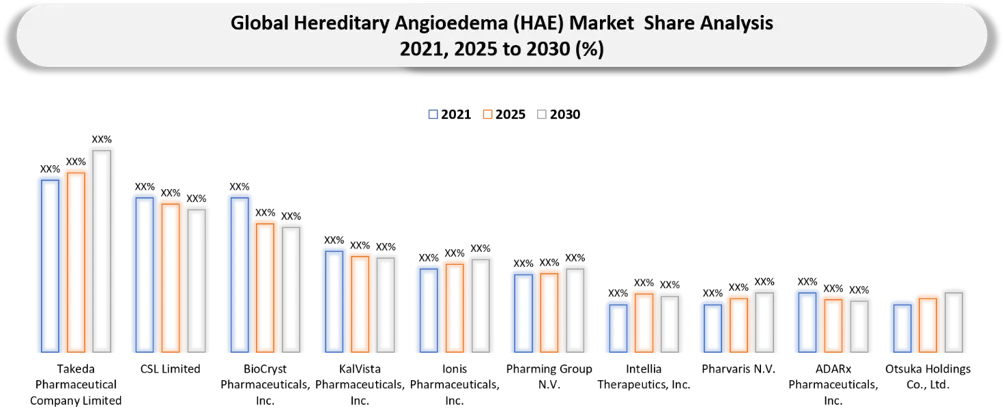
- The global hereditary angioedema market is moderately consolidated, with Takeda Pharmaceutical Company Limited, CSL Limited, BioCryst Pharmaceuticals, KalVista Pharmaceuticals, Ionis Pharmaceuticals and Pharming Group holding strong positions through approved prophylactic and on-demand therapies. Competition increasingly centers on oral administration, extended dosing intervals, rapid attack control, self-administration and reduced treatment burden. Takeda maintains a broad portfolio spanning Takhzyro, Cinryze, Firazyr and Kalbitor, while CSL competes through Andembry, Haegarda and Berinert. BioCryst, KalVista and Ionis are strengthening competition through Orladeyo, Ekterly and Dawnzera, respectively, expanding patient access to differentiated oral and RNA-targeted treatment options.
- Pipeline competition is intensifying as Intellia Therapeutics, Pharvaris and ADARx Pharmaceuticals advance gene-editing, oral bradykinin-receptor antagonist and RNA-interference approaches. Otsuka Holdings and Kaken Pharmaceutical support geographic expansion through regional development and commercialization partnerships. Meanwhile, Fresenius, Teva, Sandoz, Cipla, Aurobindo Pharma, Hansoh Pharmaceutical, Cycle Group, Alembic Pharmaceuticals and Caplin Point Laboratories compete primarily through branded or generic icatibant products. Future leadership will depend on attack reduction, treatment convenience, pediatric expansion, pricing, reimbursement coverage, patient-support capabilities and successful commercialization of long-acting or potentially one-time therapies.
Key Companies of Hereditary Angioedema (HAE) Market
- Takeda Pharmaceutical Company Limited (Japan)
- CSL Limited (Australia)
- BioCryst Pharmaceuticals, Inc. (United States)
- KalVista Pharmaceuticals, Inc. (United States)
- Ionis Pharmaceuticals, Inc. (United States)
- Pharming Group N.V. (Netherlands)
- Intellia Therapeutics, Inc. (United States)
- Pharvaris N.V. (Switzerland)
- ADARx Pharmaceuticals, Inc. (United States)
- Otsuka Holdings Co., Ltd. (Japan)
- Kaken Pharmaceutical Co., Ltd. (Japan)
- Fresenius SE & Co. KGaA (Germany)
- Teva Pharmaceutical Industries Limited (Israel)
- Sandoz Group AG (Switzerland)
- Cipla Limited (India)
- Aurobindo Pharma Limited (India)
- Hansoh Pharmaceutical Group Company Limited (China)
- Cycle Group Holdings Limited (United Kingdom)
- Alembic Pharmaceuticals Limited (India)
- Caplin Point Laboratories Limited (India)
Hereditary Angioedema (HAE) Market Recent Developments
- September 2026: Intellia Therapeutics announced that the FDA accepted its biologics license application and granted Priority Review to lonvoguran ziclumeran, a potentially one-time in-vivo gene-editing treatment for HAE.
- September 2026: Pharvaris reported positive topline results from the Phase III CHAPTER-3 study of once-daily deucrictibant XR. The therapy reduced monthly HAE attack rates by 83% versus placebo across all evaluated HAE types and by 87% among patients with Type I or Type II HAE.
- August 2026: BioCryst Pharmaceuticals received Japanese approval for Orladeyo in pediatric HAE patients aged two to below 12 years, expanding the availability of oral long-term prophylaxis in Japan.
- July 2026: CSL reported positive topline Phase IIIb results supporting a planned pediatric label expansion for Andembry in children with HAE, strengthening its potential reach beyond patients aged 12 years and older.
- July 2026: The FDA accepted Pharvaris’ new drug application for deucrictibant immediate-release 20 mg capsules for on-demand HAE attack treatment. The application incorporates data from more than 1,300 treated HAE attacks, with an FDA target action date of April 23, 2027.
What DATAM Uniquely Provides
- In-depth segmentation of the hereditary angioedema market by HAE type, treatment class, route of administration and region, with additional assessment of on-demand treatment, short-term prophylaxis, long-term prophylaxis, patient age, care setting and distribution channel.
- Competitive analysis of leading HAE companies covering attack-frequency reduction, speed of symptom relief, complete attack resolution, duration of protection, breakthrough attacks, safety, mechanism of action, dosing convenience, pipeline maturity and commercialization strategy.
- Comprehensive assessment of diagnosed and treatment-eligible populations across Type I HAE, Type II HAE and HAE with normal C1 inhibitor, including diagnostic delays, family-screening opportunities, attack burden, pediatric populations, previous treatment experience, unmet clinical needs and regional access gaps.
- Actionable intelligence on pharmaceutical pricing, reimbursement, prior authorization, regulatory pathways, diagnostic testing, prophylaxis selection, treatment switching, rescue-medication access, patient-support programs, licensing activity, strategic partnerships and investment opportunities.
- Analyst forecasts highlighting high-growth treatment classes, commercially attractive patient populations, regional expansion opportunities and emerging competitive threats across C1 esterase inhibitors, bradykinin B2 receptor antagonists, kallikrein inhibitors, Factor XIIa inhibitors, RNA-targeted therapies and investigational gene-editing approaches.


























































