


Hard Seltzer Market Size and Forecast
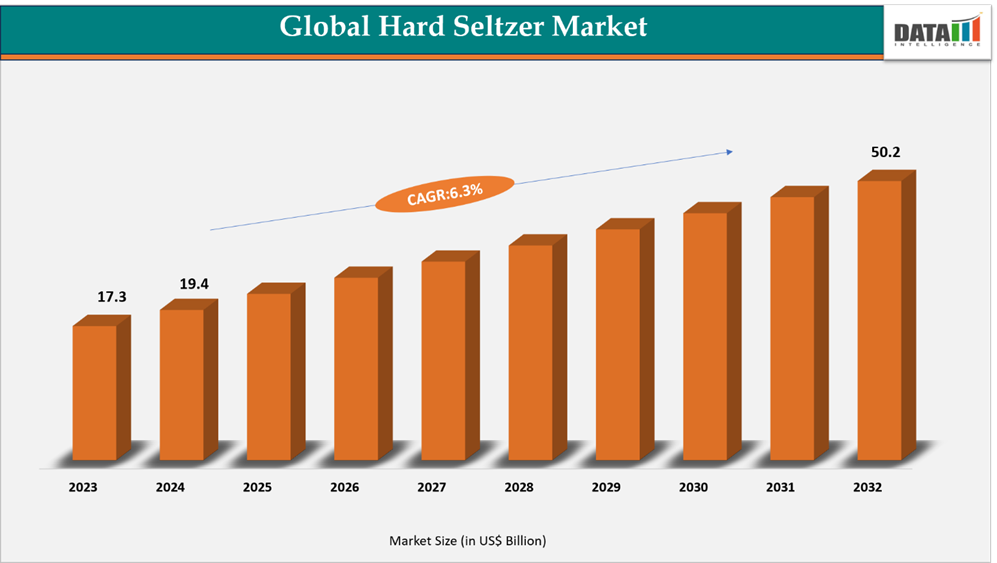
The global hard seltzer market reached US$17.3 billion in 2023, rising to US$19.4 billion in 2024 and is expected to reach US$50.2 billion by 2032, growing at a CAGR of 6.3% from 2025 to 2032.
The global hard seltzer market is experiencing strong growth, fueled by increasing consumer preference for low-calorie, low-sugar, and health-conscious alcoholic beverages. As more consumers adopt wellness-focused lifestyles, hard seltzers are emerging as a popular alternative to traditional beers, wines, and ready-to-drink cocktails.
With a wide variety of flavors, convenient packaging, and lower alcohol content, these beverages appeal especially to millennials and Gen Z, who favor innovative, clean-label, and functional drink options.
Investment in product innovation, marketing, and expanded distribution channels continues to rise, driven by both established beverage giants and emerging craft brands. As hard seltzers become more accessible through supermarkets, convenience stores, e-commerce platforms, and on-premise venues, the segment is rapidly gaining traction within the global alcoholic beverage market.
Hard Seltzer Market Industry Trends and Strategic Insights
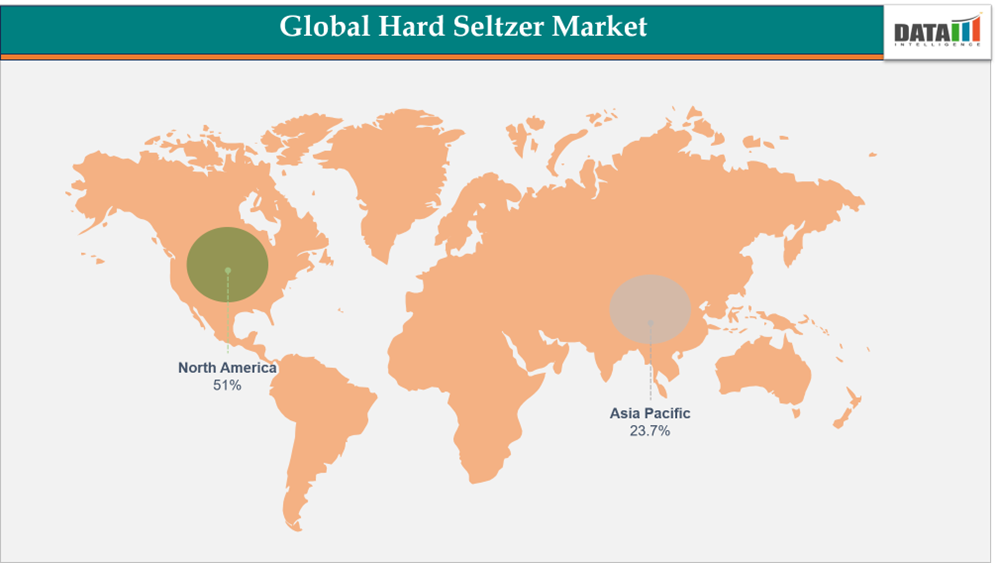
- North America leads the global hard seltzer market, capturing the largest revenue share of 51% in 2024.
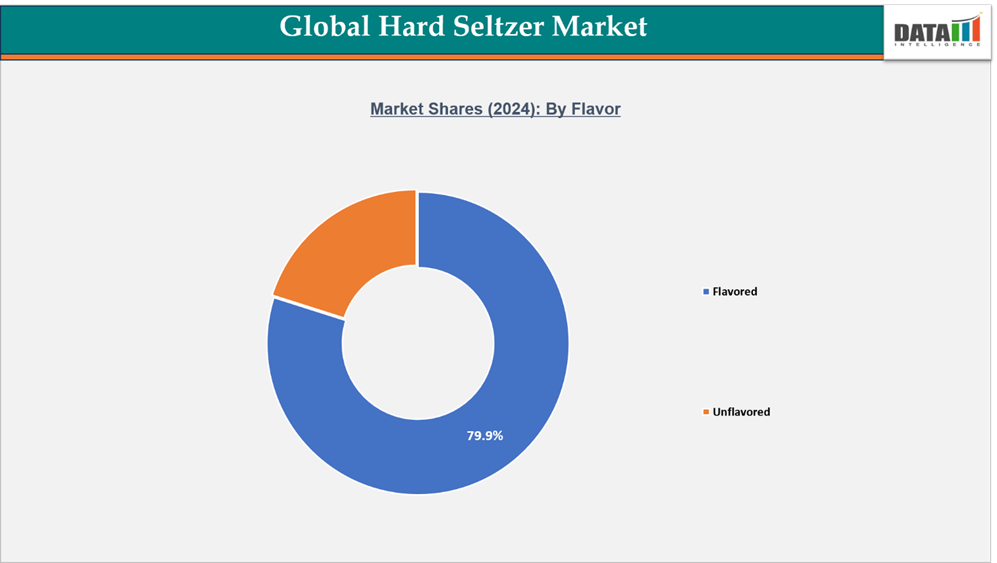
- By Flavor segment, Flavored led the global hard seltzer market, capturing the largest revenue share of 79.9% in 2024.
Global Hard Seltzer Market Size and Future Outlook
- 2024 Market Size: US$19.4 billion
- 2032 Projected Market Size: US$50.2 billion
- CAGR (2025-2032): 6.3%
- Dominating Market: North America
- Fastest Growing Market: Asia-Pacific
Hard Seltzer Market Key Takeaways
- North America accounted for approximately 51% market share in 2024, making it the dominant regional market. Growth is driven by strong consumer adoption of flavored alcoholic beverages, premiumization of low-calorie drinks, and continuous product innovation from major brewers and RTD players such as White Claw, Truly, and Bud Light Seltzer. However, the market is showing early signs of saturation in the U.S., with competition shifting toward flavor differentiation, sugar-free positioning, and hybrid alcoholic beverage formats.
- Europe held around 27.6% market share in 2025, supported by rising demand for low-alcohol and wellness-oriented drinking alternatives. The region is experiencing steady adoption in the UK, Germany, and the Nordics, where younger consumers are increasingly replacing beer and sugary cocktails with hard seltzers. Regulatory acceptance of flavored alcoholic RTDs and expansion of retail availability in supermarkets and convenience channels are accelerating penetration.
- Asia-Pacific accounted for approximately 21.3% market share in 2025 and is projected to grow at the fastest CAGR of 14.8% (2025-2032). Growth is driven by rapid urbanization, expanding young adult populations, and increasing Western beverage influence. Markets such as Japan, Australia, South Korea, and China are seeing rising interest in low-calorie alcoholic beverages, with localized flavor innovation (yuzu, lychee, green tea) becoming a key competitive strategy.
- Latin America and Middle East & Africa together contributed about 9.3% market share in 2025, but are emerging as high-potential growth regions. Brazil, Mexico, UAE, and South Africa are witnessing gradual adoption as premium RTD alcohol categories expand through modern retail and tourism-driven consumption hubs.
- The product landscape is rapidly evolving from basic sparkling alcohol-water formulations to functional and hybrid beverages, including added electrolytes, botanical infusions, and “better-for-you” alcohol alternatives. Brands are increasingly targeting health-conscious consumers who want lower sugar, gluten-free, and low-calorie alcoholic options without compromising taste or social drinking experience.
- Distribution dynamics are also shifting, with off-trade channels (supermarkets, convenience stores, e-commerce) dominating over on-trade consumption. E-commerce and direct-to-consumer alcohol delivery platforms are gaining momentum, especially in urban Asia-Pacific and North American markets, reshaping how brands engage with younger demographics.
Hard Seltzer Market Scope
| Metrics | Details |
| By ABV (Alcohol by Volume) | ≤4.5%, 4.5%-6%, 6%-8%, >8% |
| By Packaging | Metal Cans, Glass Bottles, Other Packaging |
| By Flavor | Flavored, Unflavored |
| By Distribution Channel | On-Trade, Off-Trade |
| By Region | North America, South America, Europe, Asia-Pacific, Middle East and Africa |
| Report Insights Covered | Competitive Landscape Analysis, Company Profile Analysis, Market Size, Share, Growth |
Hard Seltzer Market Dynamics
Rising Demand for Low-Calorie & Health-Forward Alcoholic Beverages
One of the key forces driving the global hard seltzer market is the growing consumer preference for healthier alcoholic options. Today’s drinkers are increasingly aware of calorie intake, sugar content, and overall wellness, pushing them to seek alternatives to traditional beers, sweet cocktails, and high-calorie RTD beverages. Hard seltzers meet this demand by offering a refreshing, flavorful, and low-calorie choice that fits well with active, wellness-oriented lifestyles.
Much of the category’s appeal lies in its clean-label positioning, often low in carbs, gluten-free, and made with natural fruit flavors. Consumers, especially millennials and Gen Z, are gravitating toward drinks that feel lighter, more natural, and better aligned with their health values, without giving up flavor or social enjoyment.
This shift is evident even in emerging markets like India. In 2023, Spyk Hard Seltzer became the country’s first brewed hard seltzer brand and expanded from Bengaluru to Hyderabad. Spyk offers a low-calorie, low-carb beverage made with 100% natural fruit flavors and a balanced 5.5% ABV. Unlike carbonated cocktail mixes, it is freshly brewed, resulting in a crisp, clean, and guilt-free drinking experience. This reflects how health-focused alcohol trends are spreading globally, not just in Western markets.
As more consumers prioritize mindful drinking and clean lifestyles, the demand for low-sugar, low-calorie alcoholic beverages will continue to fuel the growth of hard seltzers worldwide. This health-driven shift is expected to remain one of the most powerful growth drivers for the category in the years ahead.
Hard Seltzer Market Trends & Insights
Hard Seltzer Is Evolving Beyond the Traditional Low-Calorie Positioning
The category is moving beyond its original image as a simple low-calorie alcoholic alternative. Brands are increasingly competing through premium flavors, higher-ABV variants, botanical ingredients, functional positioning, variety packs and cocktail-inspired products.
Competition From Spirits-Based RTDs Is Increasing
Hard seltzers increasingly compete with canned cocktails and spirits-based ready-to-drink beverages for the same consumers and occasions. This is encouraging brands to improve flavor complexity, alcohol-base differentiation and premium positioning.
Flavor Innovation Remains a Core Growth Strategy
Fruit-forward flavors continue to dominate, while tropical, botanical, citrus, berry, tea-inspired and cocktail-style profiles provide opportunities for differentiation. Limited-edition and seasonal flavors can also create repeat purchases and increase consumer engagement.
Premiumization Is Reshaping the Category
Consumers are increasingly willing to pay more for distinctive flavors, premium ingredients, sophisticated packaging and craft-style positioning. Premium hard seltzers provide manufacturers with an opportunity to improve margins in a highly competitive category.
Higher-ABV Products Are Expanding the Addressable Market
The market is gradually expanding beyond traditional lower-ABV products. Higher-ABV and cocktail-inspired seltzers are attracting consumers seeking stronger beverages while retaining the convenience and carbonation associated with the category.
Functional Positioning Is Emerging
Some manufacturers are experimenting with beverages positioned around electrolytes, botanical ingredients, vitamins and other functional attributes. This creates an opportunity to connect hard seltzer with broader wellness-oriented beverage trends, although regulatory requirements remain important.
Metal Cans Remain the Preferred Packaging Format
Cans provide portability, lightweight transportation, recyclability and convenient single-serve consumption. Their suitability for outdoor events, festivals, sporting occasions and social gatherings continues to support adoption.
Off-Trade Channels Remain Critical
Supermarkets, hypermarkets, convenience stores, liquor stores and e-commerce platforms provide broad consumer access and support variety-pack purchases. Off-trade channels are particularly important for household consumption and social occasions.
E-Commerce Is Expanding Brand Reach
Online alcohol retail and delivery platforms are improving product discovery and allowing brands to reach consumers beyond traditional retail shelves. Digital channels also provide opportunities for targeted promotions and consumer engagement.
Younger Adult Consumers Continue to Influence Product Development
Millennial and Gen Z legal-drinking-age consumers are influencing the category through demand for convenience, flavor variety, lower sugar, attractive packaging and social-media-friendly brands.
Sustainability Is Becoming a Packaging Differentiator
Recyclable aluminum, lightweight packaging, reduced packaging material and efficient transportation are becoming increasingly relevant as beverage companies respond to consumer and retailer sustainability expectations.
Mindful Drinking Creates Both Opportunity and Competition
Consumers are increasingly moderating alcohol consumption, creating demand for lower-ABV and alcohol-free alternatives. Hard seltzer brands can respond through sessionable products and adjacent non-alcoholic or reduced-alcohol offerings.
Hard Seltzer Market Segmentation Analysis
The global hard seltzer market is segmented based on ABV (Alcohol by Volume), packaging, flavor, distribution channel and region.
Flavored Segment Leads Market Growth
The flavored segment dominates the global hard seltzer market, driven by strong consumer demand for refreshing, fruit-forward beverages with fewer calories and less sugar. Flavor innovation, including tropical, botanical, and cocktail-inspired profiles, helps brands differentiate and engage consumers through variety packs, seasonal releases, and region-specific offerings. In 2024, products like Topo Chico’s Ranch Water Hard Seltzer showcased how regionally inspired flavors boost market growth. Flavored hard seltzers perform well across retail and on-premise channels, making flavor the key driver of ongoing market expansion.
Unflavored Segment Maintains Core Consumer Base
The unflavored segment supports market stability by catering to consumers who prefer a simple, versatile, and mixable beverage option. Unflavored hard seltzers are popular among health-conscious and low-calorie drinkers, as well as for use in cocktails and mixed drinks. Growth is supported by rising adoption in bars, restaurants, and social events, where unflavored options provide flexibility for customization. With consistent demand for clean, minimal-ingredient beverages, the unflavored segment remains essential to the overall hard seltzer market, ensuring accessibility, functionality, and steady revenue streams for brands worldwide.
Why the Hard Seltzer Market Matters by 2033
The global beverage industry is experiencing a major shift toward low-calorie, ready-to-drink, and health-conscious alcohol alternatives.
Hard seltzer has emerged as one of the fastest-growing beverage categories, reshaping consumer drinking habits by combining convenience, flavor innovation, and lower alcohol content.
Several macroeconomic and consumer-driven factors are fueling market expansion:
- Growing health and wellness awareness among consumers
- Expansion of premium flavored beverage portfolios
- Increasing urbanization and on-the-go consumption trends
- Strong influence of Gen Z and millennial drinkers
- Expanding retail availability across supermarkets and e-commerce channels
- Aggressive brand marketing and celebrity-backed beverage launches
- Shift from traditional beer to lighter alcoholic alternatives
- Growing popularity of social drinking and casual consumption occasions
Hard Seltzer Market Analyst View
DataM Intelligence Analyst Perspective
The hard seltzer market is transitioning from a high-growth novelty category into a stable, competitive beverage segment within the global alcoholic drinks industry.
Long-term market performance will depend on:
- Sustained consumer preference for healthier alcohol alternatives
- Continuous flavor and product innovation
- Brand differentiation in a highly crowded market
- Regulatory frameworks across alcoholic beverage categories
- Expansion into emerging markets beyond North America
- Strategic partnerships with retail and hospitality sectors
- Efficient supply chain and production scalability
North America remains the dominant market, driven by early adoption and strong brand presence. Europe is witnessing steady growth with premium and craft positioning, while Asia-Pacific is emerging as a high-potential market supported by urban youth consumption trends and Western lifestyle influence.
Hard Seltzer Market Geographical Penetration
Hard Seltzer DOMINATING MARKET:
North America Leads the Global Hard Seltzer Market
The global hard seltzer market is expanding rapidly, driven by increasing consumer demand for low-calorie, flavored alcoholic beverages, rising health and wellness trends, and the popularity of on-the-go, convenient drink options. Major investments in product innovation, marketing, and distribution are enabling brands to reach a wider audience and capture new consumer segments.
US Hard Seltzer Market Outlook
The US remains the largest market for hard seltzers, fueled by strong adoption among millennials and Gen Z, who favor low-calorie, fruit-forward beverages. Flavor innovation, variety packs, and seasonal releases continue to attract consumers, while retail and on-premise channels support widespread availability.
In 2024, Dirty Water, the world’s first session hard seltzer, partnered with Throwing Fits hosts Lawrence Schlossman and James Harris to elevate the brand within NYC’s cultural and lifestyle scene. This reflects a broader trend of brands collaborating with influencers and cultural voices to enhance engagement and differentiate themselves in a highly competitive market.
Canada Hard Seltzer Market Trends
Canada is witnessing steady growth in the hard seltzer segment, supported by increasing health-conscious consumer behavior, expanding retail and e-commerce channels, and growing interest in naturally flavored and clean-label products. Craft and established brands are actively innovating in flavors and packaging, catering to regional preferences and social drinking occasions.
Hard Seltzer FASTEST GROWING MARKET:
Asia-Pacific Emerges as the Fastest-Growing Region in the Global Hard Seltzer Market
The global hard seltzer market is experiencing rapid growth, driven by increasing consumer adoption of low-calorie, flavored alcoholic beverages, rising health and wellness awareness, and the popularity of convenient, on-the-go drinking options. Expanding retail, e-commerce, and on-premise channels are accelerating accessibility and adoption across key markets.
In 2024, New Zealand hard seltzer brand Everyday Weekend highlighted that APAC consumer demand for affordability, convenience, and novelty is driving the growth of ready-to-drink (RTD) products in the region. This reflects the broader trend of consumers in Asia-Pacific seeking accessible, innovative beverage options that cater to modern lifestyles.
India Hard Seltzer Market Overview
India’s hard seltzer market is witnessing strong growth, supported by urbanization, rising disposable income, and changing consumer lifestyles. Increasing awareness of health-conscious alcoholic beverages, along with product innovation in flavors and packaging, is driving adoption in both retail and on-premise channels. Brands are experimenting with regional and exotic flavors to appeal to local tastes and enhance consumer engagement.
China Hard Seltzer Market Outlook
China is emerging as a key growth market, fueled by rising demand in metropolitan areas, expanding retail and e-commerce penetration, and increasing interest in low-calorie, refreshing alcoholic beverages. Collaboration between international and local beverage brands, coupled with seasonal and culturally inspired product launches, is helping expand market reach and consumer awareness.
Overall, Asia-Pacific is poised to remain the fastest-growing region in the global hard seltzer market, driven by rapid urbanization, evolving consumer preferences, and strategic investments in flavor innovation, distribution, and marketing initiatives.
Hard Seltzer Market Sustainability and ESG Analysis
Sustainability is becoming a key focus in the global hard seltzer market, shaping product innovation, corporate responsibility, and consumer choices. Brands are increasingly adopting environmentally friendly production processes, sustainable packaging, and responsible sourcing to reduce their ecological footprint and align with ESG standards.
In 2023, Passion Tree, an eco-conscious hard seltzer brand in Southern California, emerged as a sustainability leader with its award-winning beverages. Through a partnership with Eden Reforestation Projects, the company plants a tree for every case sold, supporting local communities and restoring deforested ecosystems. With more than 50,000 trees planted in Madagascar, Passion Tree sets a benchmark for environmental stewardship, showing how sustainability initiatives can positively impact both communities and the planet while resonating with eco-conscious consumers.
Overall, initiatives such as energy-efficient production, eco-friendly packaging, and reforestation projects enhance environmental accountability, bolster corporate reputation, and position hard seltzer brands to meet the growing expectations of socially and environmentally conscious consumers and investors worldwide.
Hard Seltzer Market Competitive Landscape
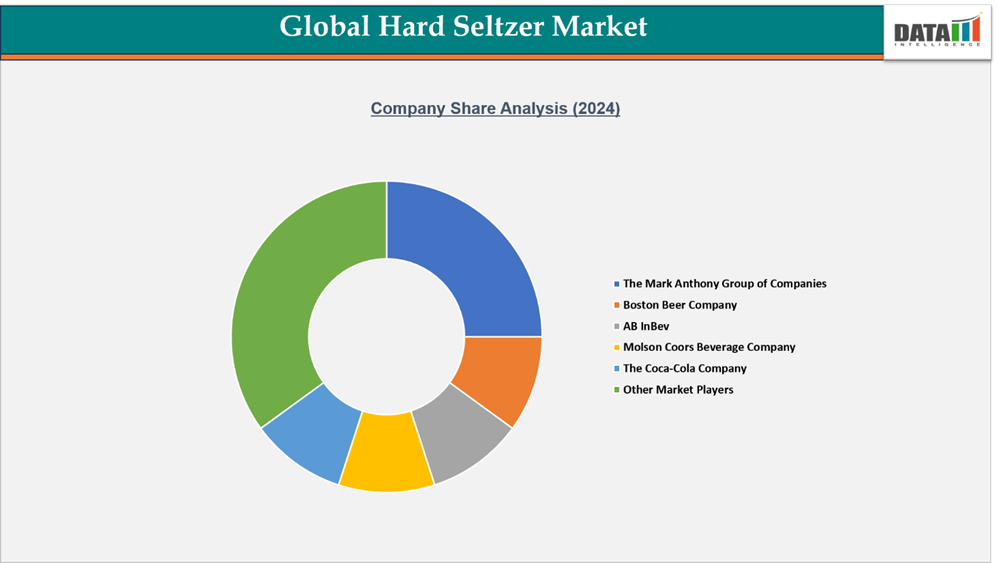
- The global hard seltzer market is intensely competitive, featuring both major multinational beverage companies and dynamic regional players. Top firms such as The Mark Anthony Group, Boston Beer Company, AB InBev, Molson Coors, The Coca‑Cola Company, Heineken N.V., Diageo, Constellation Brands, Carlsberg Breweries, and Kopparberg maintain strong positions through broad product portfolios, innovative flavors, and consistent investment in brand building and marketing.
- Many brands are expanding into emerging markets via strategic partnerships, local collaborations, and acquisitions. These efforts allow companies to scale production, introduce new flavors, and strengthen distribution across retail, e-commerce, and on-premise channels globally.
- Consumer demand for low-calorie, flavored, and health-oriented alcoholic beverages continues to drive market growth. Innovation in flavors, packaging formats, limited-edition releases, and sustainability initiatives, along with effective brand differentiation strategies, remain critical for companies to stay competitive and sustain long-term growth in the global hard seltzer market.
Hard Seltzer Market Investment & Funding Landscape
The global hard seltzer market continues to attract significant investor interest, with capital directed toward innovative beverage brands, flavor innovation, and market expansion initiatives.
In 2022, Ojai, California-based hard kombucha and hard seltzer maker Flying Embers closed a $20 million Series C funding round, led by global spirits giant Beam Suntory. This funding supports product innovation, brand growth, and expanded distribution, highlighting investor confidence in premium, health-conscious alcoholic beverages.
In 2025, Kalyan Hospitality, a leading hospitality group, announced a strategic investment in Happy Dad Seltzers, a fast-growing hard seltzer brand recognized for its bold flavors and innovative marketing. This partnership underscores Kalyan Hospitality’s commitment to diversifying its portfolio and aligning with brands that resonate with modern consumer preferences.
Overall, these investments reflect strong market confidence in the growth potential of hard seltzers, driven by consumer demand for flavorful, low-calorie, and lifestyle-oriented beverages, as well as the opportunity for strategic partnerships and brand expansion in global markets.
| Company | Investment/Funding | Year | Details | |
| Kalyan Hospitality | Investment | 2025 | Kalyan Hospitality, a leading hospitality group, announced a strategic investment in Happy Dad Seltzers, a fast-growing hard seltzer brand recognized for its bold flavors and innovative marketing. This partnership underscores Kalyan Hospitality’s commitment to diversifying its portfolio and aligning with brands that resonate with modern consumer preferences. | |
| Ojai | Funding | 2022 | Ojai, California-based hard kombucha and hard seltzer maker Flying Embers closed a $20 million Series C funding round, led by global spirits giant Beam Suntory. This funding supports product innovation, brand growth, and expanded distribution, highlighting investor confidence in premium, health-conscious alcoholic beverages. | |
Key Developments in the Hard Seltzer Market
- August 2026: The Mark Anthony Group continued strengthening its hard-seltzer portfolio and distribution network, with innovation in flavors and line extensions remaining central to its strategy.
- July 2026: Boston Beer Company continued developing its Truly portfolio, focusing on new flavors, product extensions and marketing initiatives to maintain competitiveness in the U.S. hard-seltzer segment.
- July 2026: AB InBev continued expanding its beyond-beer portfolio, including hard seltzers and flavored alcoholic beverages, while emphasizing premiumization and differentiated flavor profiles.
- June 2026: Molson Coors continued expanding its hard-seltzer and flavored alcoholic beverage portfolio, focusing on innovation and broader distribution across key markets.
- June 2026: The Coca-Cola Company continued developing its alcoholic beverage partnerships and extensions, supporting the broader growth of ready-to-drink and flavored alcoholic beverage categories.
- May 2026: Heineken N.V. continued strengthening its low- and no-alcohol and flavored beverage portfolio, while expanding innovation across its global brand portfolio.
- May 2026: Diageo continued expanding its ready-to-drink and flavored alcoholic beverage portfolio, responding to consumer demand for convenient, lower-complexity drinking occasions.
- April 2026: Constellation Brands continued focusing on premium beer and adjacent beverage categories, with innovation and brand-building supporting its position in the broader U.S. alcoholic beverage market.
- April 2026: Carlsberg Breweries continued expanding its premium and flavored beverage offerings across international markets, supported by product innovation and brand investments.
- April 2026: Kopparberg continued strengthening its fruit-flavored alcoholic beverage portfolio, leveraging its established fruit-forward positioning to compete across the hard-seltzer and broader flavored-alcoholic-beverage categories.
Hard Seltzer Market Investment & Funding Analysis
Global investment in the hard seltzer market continues to evolve as beverage companies diversify into low-calorie, low-alcohol, and flavored alcoholic alternatives.
Major funding areas include:
- Flavored alcoholic beverage innovation
- Low-calorie and clean-label formulations
- RTD (ready-to-drink) beverage expansion
- Sustainable and recyclable packaging solutions
- Digital D2C beverage platforms
- Alcohol-free and hybrid seltzer variants
Why Choose DataM?
Technological Innovations: DataM evaluates advances in beverage formulation, natural flavor technologies, functional ingredients, sustainable packaging, lightweight cans, production efficiency and emerging hard seltzer product formats.
Product Performance & Market Positioning: The report evaluates hard seltzer products based on ABV, flavor profile, alcohol base, packaging, calorie and sugar positioning, premiumization, product variety, convenience and consumer appeal.
Consumer & Market Insights: DataM analyzes changing consumer preferences across millennials, Gen Z legal-drinking-age consumers, health-conscious drinkers, mindful drinkers and premium beverage consumers, along with consumption occasions and purchasing behavior.
Market Updates & Industry Changes: The report tracks new product launches, flavor innovations, packaging developments, RTD competition, e-commerce expansion, regulatory changes, taxation trends, strategic partnerships and market-entry activities.
Competitive Strategies: DataM analyzes how leading beverage companies compete through brand positioning, flavor innovation, premium products, higher-ABV extensions, variety packs, sustainability initiatives, influencer marketing and distribution expansion.
Pricing & Market Access: DataM evaluates pricing based on ABV, alcohol base, ingredients, packaging format, product positioning, retail channel, premiumization and regional taxation and regulatory conditions.
Market Entry & Expansion: DataM identifies opportunities created by premiumization, emerging Asia-Pacific consumption, localized flavors, e-commerce, modern retail, functional product innovation and growing demand for convenient alcoholic beverages.
Target Audience
- Beverage Manufacturers - Product and portfolio strategy.
- Alcoholic Beverage Companies - Category expansion opportunities.
- Retailers & Distributors - Channel and product planning.
- Investors - Brand and market opportunities.
- Packaging Companies - Sustainable packaging demand.
- Ingredient Suppliers - Flavor and formulation opportunities.
- Hospitality Businesses - On-trade product strategy.



























































