


HAMR Market Size and Overview
The global HAMR market reached an estimated US$ 37.1 million in 2025 and is projected to reach approximately US$ 698.1 million by 2035, expanding at a CAGR of about 34.1% during 2026-2035. The market is transitioning from long-cycle technology development into commercial hyperscale deployment as mass-capacity HDD vendors use HAMR to raise platter density and drive capacity while controlling data-center floor space, power per terabyte and total storage cost.
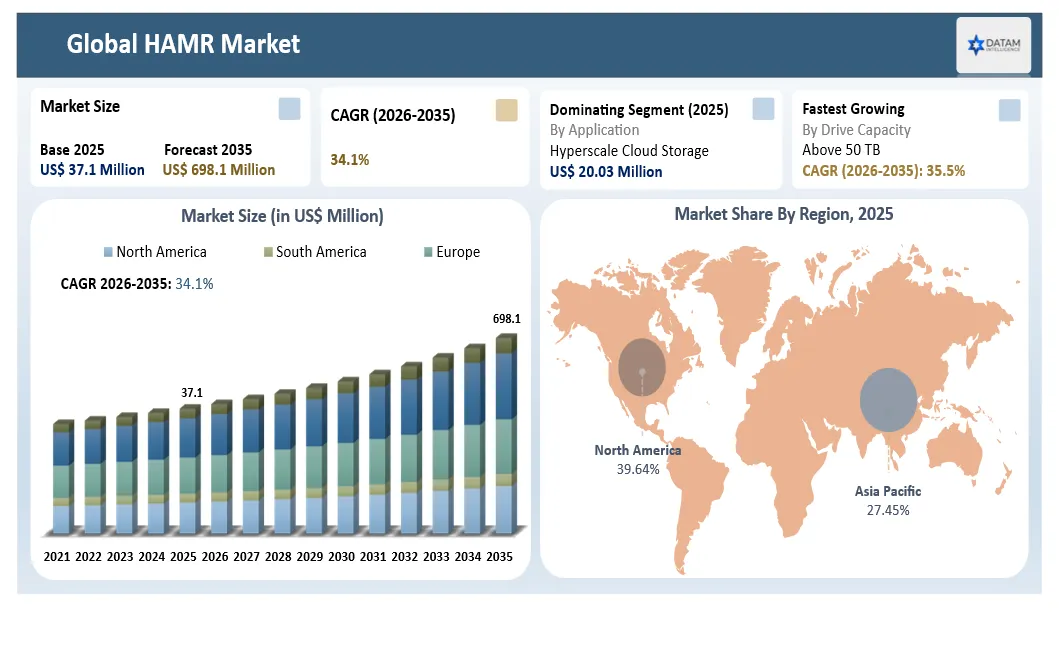
Seagate is the current commercial leader through its Mozaic HAMR platform, with product qualification across major cloud customers and increasing mass-capacity shipments. Western Digital continues to advance energy-assisted recording and has indicated a path toward HAMR-based high-capacity products, while Toshiba and key Japanese component suppliers are preparing next-generation heads, media and precision components. The commercial opportunity therefore extends beyond HDD vendors into recording heads, FePt media, glass substrates, lasers, near-field optical structures, suspension assemblies, controllers and manufacturing equipment.
AI is strengthening the demand case for HAMR because training, inference, video generation, digital twins and agentic workloads create large volumes of persistent data. Flash remains essential for high-performance tiers, but HDDs retain a substantial cost-per-terabyte advantage for capacity storage. As hyperscale customers increase average drive capacity, HAMR enables more exabytes to be deployed within the same rack, power and floor-space envelope.
| Metric | Details |
| 2025 Market Size | US$ 37.1 Million |
| 2035 Projected Market Size | US$ 698.1 Million |
| CAGR (2026-2035) | 34.1% |
| Largest Market | North America / Asia-Pacific production ecosystem |
| Fastest Growing Market | Asia-Pacific |
| Dominant Application | Hyperscale Cloud Storage |
| Fastest Growing Capacity | Above 50 TB |
| Key Commercial Theme | Areal-density scaling and lower cost per terabyte |
HAMR Market Key Takeaways
- Commercial adoption is being led by nearline data-center HDDs rather than consumer storage.
- Seagate has the strongest current HAMR commercialization position through the Mozaic platform and multiple cloud qualifications.
- AI and cloud workloads are increasing exabyte demand, raising the value of storage density, rack efficiency and cost per terabyte.
- Above-40 TB drives and 4 TB-per-platter class media are central near-term milestones, while 5 TB-per-platter and above create the next growth wave.
- Component reliability, especially laser/NFT lifetime, head-media interaction and yield, remains the most important execution risk.
- TDK, HOYA, Resonac and other Japanese suppliers are strategically important to the heads, suspensions, substrates and media ecosystem.
- Competition is shifting from simple drive capacity toward areal-density roadmaps, qualification speed, yield and hyperscale supply commitments.
- Long-term HAMR leadership will depend on manufacturing scale and the ability to translate laboratory density gains into qualified exabyte shipments.
HAMR Industry Trends and Strategic Insights
- Mass-capacity HDD demand is increasingly linked to AI data creation rather than only traditional cloud growth.
- Hyperscalers are evaluating storage platforms on dollars per terabyte, watts per terabyte, rack density and lifecycle reliability.
- The HAMR roadmap is moving toward higher platter density rather than increasing platter count, improving capacity without proportionally increasing mechanical complexity.
- Supplier value is rising for precision heads, suspension assemblies, substrates and magnetic media capable of tolerating tighter thermal and dimensional tolerances.
- Long-term supply agreements are becoming more important as HDD demand visibility improves and component supply remains concentrated.
- Advanced signal processing and firmware are becoming more valuable as narrower tracks and higher densities increase read-channel complexity.
Why does this report matter in 2026?
The year 2026 is a critical commercialization phase for HAMR. Seagate entered the year with Mozaic products qualified by several of the world’s largest cloud customers and reported that the ongoing ramp contributed to record financial performance. At the same time, Western Digital is experiencing strong AI-driven HDD demand and is preparing its own next-generation energy-assisted roadmap. TDK expects nearline HDD head volume to rise sharply and has identified future HAMR heads as a path to higher-value products.
This report matters because the market is no longer defined only by laboratory areal-density demonstrations. Investment decisions now depend on qualification status, exabyte shipments, component capacity, yield, laser reliability and supplier readiness. The study separates the current nearline-HDD opportunity from longer-term technology platforms and maps the component ecosystem that captures value as HAMR penetration rises.
HAMR Market White Space & Investment Opportunities
- High-volume HAMR media production with tighter grain-size distribution and lower defect density.
- Near-field transducers and integrated photonics designed for longer operating life and higher thermal efficiency.
- Glass substrates and precision media stacks optimized for higher platter counts, thinner form factors and lower vibration.
- Advanced head suspension and servo systems capable of supporting narrower tracks and higher track density.
- Storage systems that optimize HAMR drives for object storage, AI data lakes, archive and cold-to-warm data tiers.
- Regional component capacity outside concentrated Asian manufacturing hubs to improve supply-chain resilience.
HAMR Future Market Transformation
HAMR is expected to transform mass-capacity storage from an incremental HDD roadmap into an areal-density platform. As platter capacity moves from roughly 3 TB toward 4 TB, 5 TB and higher, data-center operators can increase exabytes per rack while reducing drive count, bays, power supplies and related infrastructure per petabyte. The economic value therefore extends beyond the drive itself into lower server count, less networking, reduced cooling and simplified fleet management.
The next stage of competition will center on manufacturing execution. The ability to produce heads, media and near-field optical structures at consistently high yield will determine margin and supply availability. Component suppliers that can qualify with multiple HDD vendors will gain strategic value because the market has a limited number of qualified sources and long validation cycles.
HAMR Market Buyer Decision-Making Criteria
Hyperscalers and enterprise buyers evaluate HAMR drives primarily on total cost per terabyte, annualized failure rate, workload reliability, power per terabyte, rack density and fleet qualification. Capacity alone does not guarantee adoption. New drive platforms must demonstrate stable performance under vibration, thermal cycling, sustained workloads and large fleet deployments.
Buyers also consider qualification time, firmware maturity, supply continuity and the vendor’s capacity roadmap. A platform that provides a clear path from 30 TB to 40 TB and beyond can reduce future requalification burden. Long-term supply agreements, transparent reliability data and predictable exabyte availability are increasingly important procurement criteria.
HAMR Market Economic & Investment Analysis
HAMR economics are supported by the widening value of areal density in hyperscale storage. Higher capacity per drive reduces the number of drives needed for a given exabyte target, which lowers chassis, rack, networking, power and maintenance requirements. This system-level saving can outweigh a higher initial drive ASP when the platform is deployed at scale.
Investment requirements remain high because HAMR requires new head, media, optical and process-control capabilities. Returns therefore depend on sustained hyperscale volume, yield improvement and multi-generation platform reuse. Suppliers with specialized IP or difficult-to-replicate manufacturing know-how can capture attractive value even if overall HDD unit shipments remain relatively flat.
HAMR Investment Trends in the Market
- Capital is moving toward higher areal-density media, head manufacturing and optical integration.
- HDD vendors are prioritizing hyperscale qualifications because a small number of cloud customers represent large exabyte commitments.
- Component suppliers are upgrading capacity for nearline heads, suspensions and substrates used in high-capacity drives.
- AI infrastructure growth is improving the long-term demand outlook for mass-capacity storage and supporting multi-year procurement planning.
- R&D investment is shifting toward 4 TB, 5 TB and higher platter-density milestones rather than simply adding platters.
Strategic Indicators For the HAMR Market
High Technology Barrier
HAMR requires precise integration of magnetic media, nanophotonics, write-head fabrication, servo control and advanced read-channel electronics. The difficulty of scaling these processes creates a strong barrier to entry and favors incumbents with decades of HDD manufacturing expertise.
High Investment Activity
Large HDD and component companies are investing in production transitions, new head and media processes and qualification capacity. Investment is concentrated because only a few vendors have the scale to support hyperscale-grade reliability and manufacturing volumes.
Supply Chain Concentration
Critical heads, media, substrates, motors and precision components are concentrated across a limited set of suppliers in Japan, Thailand, Malaysia, China and other Asian manufacturing hubs. Disruptions can materially affect drive ramps.
Pricing Intelligence
HAMR drives can command higher ASPs because they offer substantially more capacity per device. Pricing is negotiated around capacity, long-term commitments and cost per terabyte rather than simple unit price.
Procurement Pressure
Hyperscalers expect high reliability, predictable exabyte supply and transparent roadmaps. Large buyers can influence qualification priorities and negotiate multi-year pricing and volume agreements.
New Technology Adoption
Adoption is governed by fleet qualification and manufacturing yield rather than laboratory performance. Once qualified, a platform can scale quickly because hyperscalers value density and TCO improvements.
Regional Expansion Opportunity
Asia-Pacific is central to manufacturing, while North America drives hyperscale demand. India, Southeast Asia and the Middle East offer longer-term demand growth through data-center construction.
Government Policy Support
Semiconductor, data-center and digital-infrastructure policies indirectly support the HAMR ecosystem through manufacturing incentives, AI infrastructure investment and strategic supply-chain programs.
Disruption Analysis of HAMR Market
HAMR disrupts the HDD market by changing the density-scaling mechanism from conventional magnetic-field writability to thermally assisted switching. This introduces optical components and heat-management challenges into a traditionally magnetic and electromechanical device, altering supplier requirements and manufacturing economics.
The technology is also part of a wider storage hierarchy disruption. NAND and QLC flash continue to move downward in cost, while HAMR pushes HDD density upward. Rather than eliminating one another, the technologies are increasingly segmented by workload. HAMR is strongest where capacity and cost per terabyte dominate, while SSDs lead latency-sensitive tiers.
HAMR Market BCG Matrix: Company Evaluation
STAR
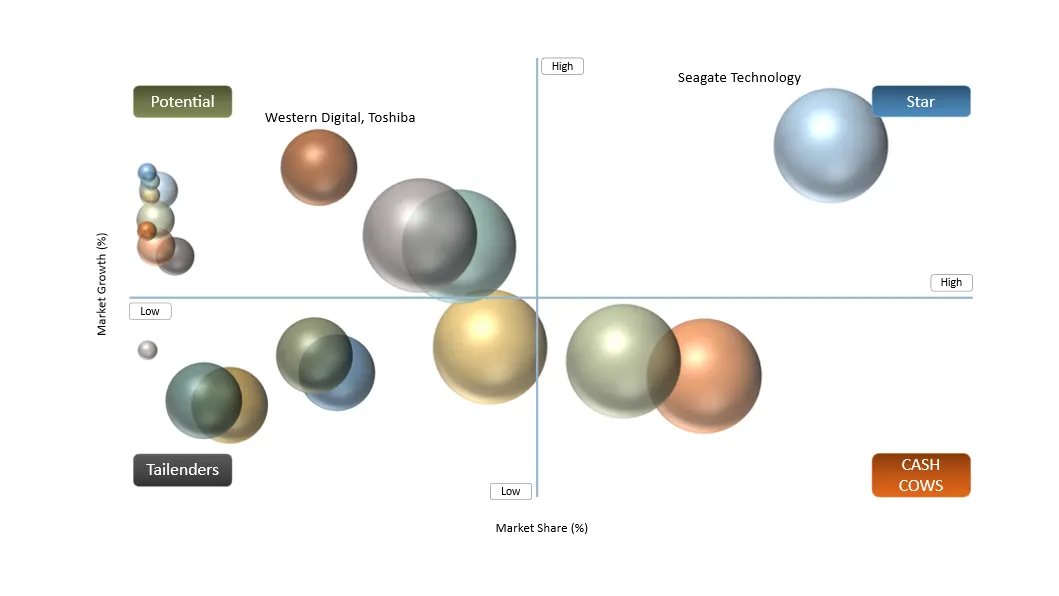
Seagate is positioned as the principal Star because it has the most advanced commercial HAMR deployment, multiple hyperscale qualifications, a multi-generation Mozaic roadmap and direct evidence that HAMR is contributing to higher-value mass-capacity shipments. TDK is also strategically important in the component ecosystem as nearline HDD head and suspension demand expands.
POTENTIAL
Western Digital, Toshiba, HOYA, Resonac, Marvell and other component suppliers represent Potential players. Their position depends on qualification timing, head and media technology, substrate capability, controller integration and the speed at which they participate in the next wave of HAMR-based capacity growth.
HAMR Market Dynamics
Driver Impact Analysis
| Driver | Market Growth Impact | Demand Concentration | Impacted Use Case | Strategic Impact |
| AI and cloud exabyte growth | High | Hyperscale data centers | AI data lakes and object storage | Accelerates adoption of higher-capacity HDDs and long-term supply commitments. |
| Higher areal density | High | Mass-capacity nearline HDD | 30-50 TB+ drives | Improves cost per terabyte and data-center rack density. |
| HDD TCO advantage versus flash | High | Capacity storage | Archive, backup and warm data | Preserves HDD role in large persistent datasets. |
| Multi-generation HAMR roadmaps | Medium-High | Cloud and enterprise | Fleet refresh and future capacity planning | Reduces requalification risk and supports predictable platform transitions. |
Driver: AI and Cloud Data Growth Creates Structural Demand for Mass-Capacity Storage
AI training, inference, video generation and enterprise data retention are increasing the volume of data that must be stored economically. Although high-performance AI compute relies heavily on flash and memory, most persistent data eventually moves into capacity tiers. HAMR allows HDD vendors to increase capacity without proportional growth in drive count, supporting lower infrastructure cost per petabyte.
Restraint Impact Analysis
| Restraint | Drag on Market Growth | Primary Impact Area | Impacted Use Case | Strategic Impact |
| Manufacturing complexity and yield | High | Heads, media and optical integration | Volume ramp | Can delay qualification and constrain supply. |
| Long hyperscaler qualification cycles | High | Commercial adoption | Cloud fleet deployment | Slows conversion despite technical readiness. |
| Competition from advanced PMR/MAMR | Medium | Transition timing | 30-40 TB capacity tiers | Allows incumbents to extend existing platforms before HAMR. |
| Falling NAND cost | Medium | Storage hierarchy | Warm/cold data economics | Creates substitution pressure in selected workloads. |
Restraint: Manufacturing Complexity and Qualification Risk
HAMR introduces laser integration, near-field optical structures, specialized media and tighter head-media tolerances. Small defects can affect lifetime and reliability, so yield improvement is essential to commercial economics. Hyperscalers also require lengthy fleet qualification because a failure pattern that appears small at the individual-drive level becomes significant when deployed across hundreds of thousands of drives.
HAMR Market Segment Analysis
The global HAMR market is segmented based on Product Type, Drive Capacity, Recording Density, Drive Configuration, Interface, Application, end-use industry, distribution channel, and region.
By Product Type
HAMR Hard Disk Drives Will Dominate Revenue
Drive-level revenue will dominate because the highest commercial value is captured in complete mass-capacity HDDs. Recording heads, media and optical components represent smaller but strategically important pools with high technical barriers.
By Drive Capacity
30-40 TB Will Lead Near-Term Adoption, Above 50 TB Will Grow Fastest
Commercial deployment is initially concentrated in 30-40 TB nearline drives. As 4 TB- and 5 TB-per-platter platforms mature, above-50 TB products will become the fastest-growing segment.
By Recording Density
3-4 Tb/in² Will Be the Near-Term Commercial Sweet Spot
This density range supports current-generation HAMR commercialization. Above 5 Tb/in² represents the longer-term growth frontier as media, NFT and head technologies improve.
By Drive Configuration
CMR HAMR Will Lead, SMR HAMR Will Expand Capacity Further
CMR provides simpler workload compatibility and is favored for broad hyperscale deployment. SMR can add additional capacity where software and storage architecture are optimized for sequential write behavior.
By Interface
SATA Will Remain the Largest Interface
Nearline HDD infrastructure is heavily standardized around SATA and SAS. Interface choice matters less than density, reliability and system-level workload design for HAMR adoption.
By Application
Hyperscale Cloud Storage Will Dominate
The largest near-term opportunity is hyperscale object storage and cloud infrastructure because these customers operate at exabyte scale and directly monetize density and power-per-terabyte improvements.
By End Use Industry
Cloud Service Providers Will Hold the Largest Share
Cloud providers control the largest mass-capacity HDD fleets and are the first to qualify new recording technologies. Enterprise, government and media markets follow after field reliability is established.
By Distribution Channel
Direct OEM / Hyperscale Sales Will Dominate
HAMR commercialization is initially driven through direct relationships between HDD manufacturers and large cloud customers. Distribution and retail channels become more important only after products broaden into enterprise and channel markets.
HAMR Market Geographical Penetration
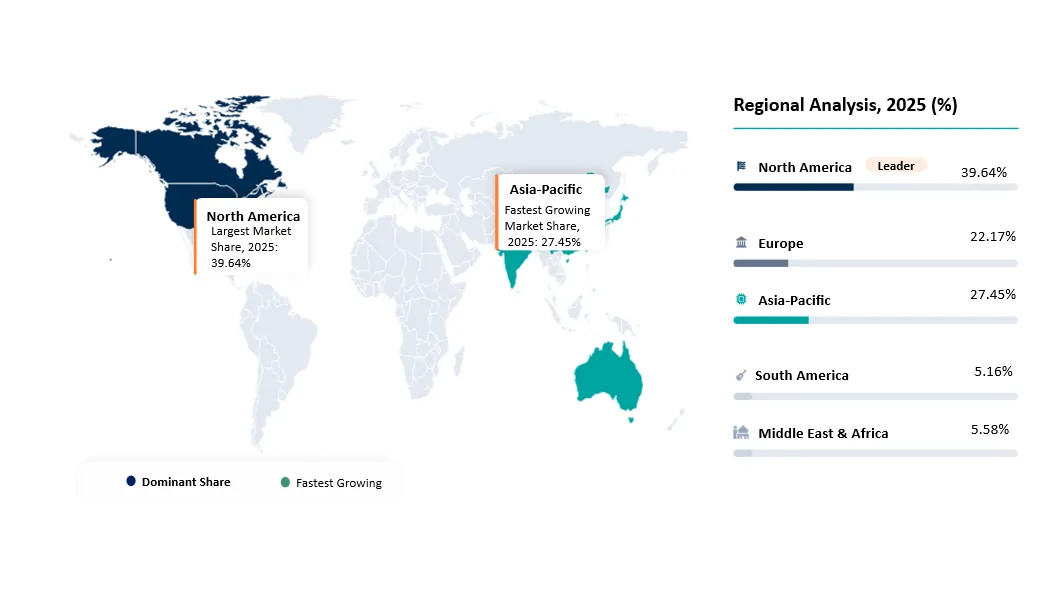
North America leads demand because U.S.-based hyperscalers and cloud platforms are major consumers of mass-capacity HDDs. Asia-Pacific is the manufacturing center, with Thailand, Malaysia, China, Japan and Taiwan supplying HDD assembly, heads, suspensions, substrates, media, controllers and precision components. The region is also expected to record the fastest growth as data-center investment expands.
U.S. HAMR Market Landscape
The U.S. is the most important demand market because hyperscale cloud companies operate large nearline HDD fleets. AI infrastructure investment, object storage and data-retention requirements create strong demand for high-capacity drives. Seagate and Western Digital also maintain major engineering and customer relationships in the country.
Japan HAMR Market Outlook
Japan is strategically important through Toshiba, TDK, HOYA, Resonac, Nidec and other precision-component suppliers. The country contributes heads, suspensions, substrates, media, motors and advanced materials required for high-density HDDs.
Thailand HAMR Manufacturing Outlook
Thailand is a core HDD manufacturing hub for Western Digital and Seagate-related supply chains. Government-supported R&D and electronics manufacturing capabilities make the country important for next-generation HDD transitions.
China HAMR Market Trends
China has large cloud and internet infrastructure demand but limited domestic HDD manufacturing. Demand growth is supported by data centers and digital services, while technology access and trade restrictions create strategic supply concerns.
South Korea HAMR Market Outlook
South Korea is important through semiconductor, memory and electronics ecosystems that support controllers, materials and data-center infrastructure. Large cloud and AI investments also create downstream storage demand.
Europe HAMR Market Outlook
Europe is a significant enterprise and cloud demand region. Data-sovereignty requirements, AI infrastructure and scientific computing support high-capacity storage, although most HAMR drive manufacturing remains outside the region.
HAMR Market Competitive Landscape
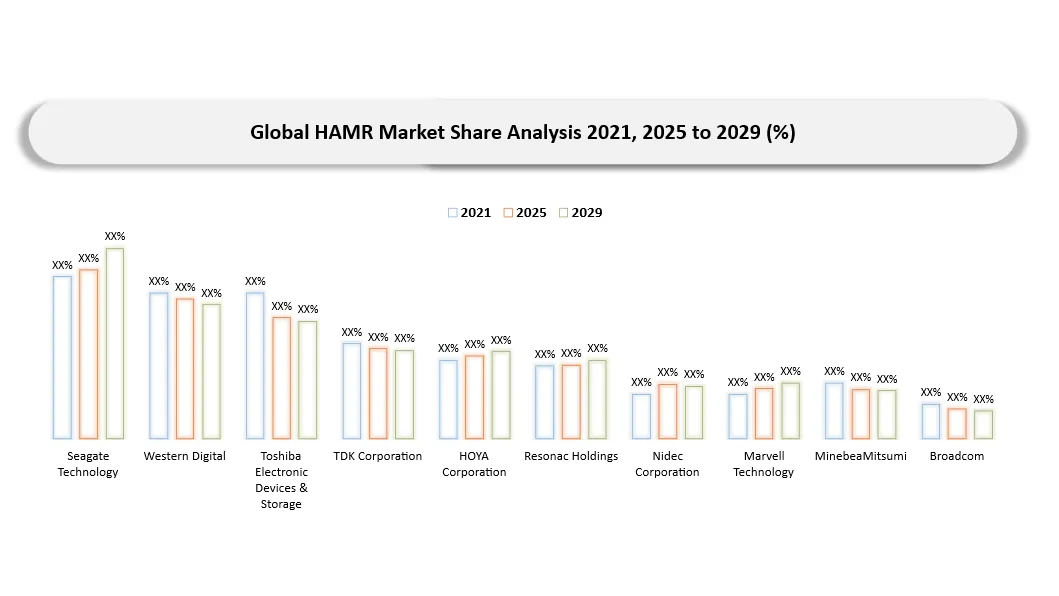
- Seagate holds the strongest current commercial HAMR position through Mozaic 3+ and subsequent areal-density roadmaps.
- Western Digital remains the primary HDD competitor and is advancing its own high-capacity technology roadmap, creating the most important medium-term competitive challenge.
- Toshiba is strategically relevant in enterprise and nearline HDDs, while Japanese component suppliers such as TDK, HOYA and Resonac influence the pace of industry-wide technology transitions.
- Competition increasingly depends on qualified exabyte shipments, manufacturing yield, customer roadmaps and long-term supply commitments rather than headline laboratory density.
Public Company Q1-Q2 2026 Performance Comparison
| Public Company | Q1-Q2 2026 Performance | HAMR Exposure | Key Growth Drivers |
| Seagate Technology | Fiscal Q2 2026 revenue was US$2.83B and fiscal Q3 revenue US$3.11B. Management linked record margin performance to strong data-center demand and the ongoing ramp of HAMR-based Mozaic products. | Highest direct exposure; commercial Mozaic HAMR platform qualified with multiple major cloud customers. | AI-driven exabyte demand, higher areal density, hyperscale qualifications, mix shift to mass-capacity drives and HAMR ramp. |
| Western Digital | Fiscal Q2 2026 revenue was US$3.02B, +25% YoY; fiscal Q3 was US$3.34B, +45% YoY with gross margin above 50%. | Major HDD competitor preparing next-generation energy-assisted recording and high-capacity platforms; direct HAMR timing trails Seagate. | AI/cloud storage demand, high-capacity drive adoption, stronger pricing, long-term customer agreements and technology transition. |
| TDK Corporation | FY March 2026 results and 2026 guidance highlighted robust nearline HDD demand. TDK expects HDD head volume for nearline products to rise sharply and sees future HAMR heads as a high-value growth opportunity. | Critical HDD head and suspension supplier; future HAMR head mass production is part of its roadmap. | Nearline HDD demand, higher-capacity drives, head mix improvement, Tri-SA suspension growth and future HAMR head commercialization. |
| Marvell Technology | Q1 FY2027 revenue reached US$2.42B, +28% YoY. Data-center growth included storage products alongside custom silicon, switching and electro-optics. | Provides storage controllers/read-channel and data-infrastructure semiconductor technology relevant to advanced HDDs. | AI data-center demand, storage silicon, custom infrastructure, controller complexity and higher-performance data paths. |
| HOYA Corporation | FY2025 results through March 2026 showed continued operations across life-care and information-technology businesses; standalone HDD substrate revenue is not separately disclosed in headline reporting. | Major glass-substrate supplier to HDD manufacturers, strategically relevant as high-capacity drives require precision, thin and reliable media substrates. | Higher platter density, substrate precision, high-capacity nearline HDD demand and next-generation media requirements. |
Market Ecosystem Table
| Value Chain Sector | Representative Companies | Role in HAMR Ecosystem |
| Magnetic media & materials | Seagate, Resonac, Toshiba, specialty FePt/material suppliers | Develop high-anisotropy media, underlayers and recording stacks capable of thermal cycling and ultra-small grains. |
| Substrates | HOYA, HDD media manufacturers, precision glass suppliers | Provide highly flat glass or aluminum substrates supporting thinner media, higher platter counts and tight tolerances. |
| Recording heads & suspensions | Seagate, Western Digital, TDK, NHK Spring, MinebeaMitsumi | Manufacture write/read heads, suspension assemblies and precision mechanics for nanoscale track positioning. |
| Lasers & near-field optics | HDD OEM internal teams, photonics suppliers, specialty optical component makers | Provide integrated laser sources, waveguides and near-field transducers used to heat media during writing. |
| HDD OEMs | Seagate, Western Digital, Toshiba Electronic Devices & Storage | Integrate HAMR components, firmware, servo, mechanics and qualification into mass-capacity HDD products. |
| Controllers & semiconductors | Marvell, Broadcom, internal HDD silicon teams | Provide read channels, controllers, motor control and signal processing for higher-density drives. |
| Motors & precision components | Nidec, MinebeaMitsumi, specialized bearing and actuator suppliers | Supply spindle motors, bearings, actuators and precision components required for high-capacity HDDs. |
| Manufacturing equipment | Applied Materials, Tokyo Electron, KLA, specialty deposition/metrology suppliers | Support thin-film deposition, lithography, metrology and process control for heads and media. |
| Storage system integrators | Dell Technologies, HPE, Supermicro, JBOD/object-storage vendors | Integrate high-capacity HAMR drives into servers, storage arrays and hyperscale systems. |
| Cloud & end users | AWS, Microsoft, Google, Meta, Oracle, enterprise and research data centers | Qualify and deploy HAMR drives at fleet scale, driving exabyte demand and reliability requirements. |
Key Companies of HAMR Market
- Seagate Technology
- Western Digital
- Toshiba Electronic Devices & Storage
- TDK Corporation
- HOYA Corporation
- Resonac Holdings
- Marvell Technology
- Nidec Corporation
- MinebeaMitsumi
- Broadcom
- Coherent Corp.
- Applied Materials
- Tokyo Electron
- ASE Technology
- Amkor Technology
Company Profiles
Seagate Technology
Seagate is the current commercial leader in HAMR through its Mozaic platform. Its strategy combines internally developed heads, media, laser/NFT technology, firmware and vertically integrated manufacturing. The company has emphasized qualification with the largest cloud customers and a roadmap toward 4 TB, 5 TB and higher platter capacities. HAMR is strategically important because it supports higher ASPs, better margins and stronger cost-per-terabyte economics for customers.
Western Digital
Western Digital is one of the two largest global HDD vendors and a major supplier of nearline capacity drives. The company benefits from strong hyperscale demand and a high-capacity product roadmap. Its competitive position in HAMR will depend on the timing of customer qualification, manufacturing readiness and how quickly it transitions from existing energy-assisted recording approaches to laser-based HAMR at scale.
Toshiba Electronic Devices & Storage
Toshiba supplies enterprise and nearline HDDs and remains an important third global HDD manufacturer. The company has advanced energy-assisted recording technologies and provides diversification for customers seeking an alternative to the two U.S.-listed HDD vendors. Its HAMR opportunity is strongest in high-capacity cloud drives once technology and component ecosystems are qualified.
TDK Corporation
TDK is a strategically important supplier of HDD heads and suspension assemblies. Nearline demand supports volume growth, while future HAMR heads represent a higher-value technology transition. TDK’s expertise in magnetic materials, precision fabrication and suspension technology positions it to capture value as track density and head complexity increase.
HOYA Corporation
HOYA is a major supplier of precision glass substrates used in HDD media. HAMR requires extremely flat, stable substrates capable of supporting tight media tolerances and higher platter density. Growth is linked to mass-capacity HDD demand, thinner substrates and the need for reliable platforms that can support additional platters and higher areal density.
Resonac Holdings
Resonac participates in advanced materials and magnetic-media ecosystems. Its relevance to HAMR comes from high-performance recording media and materials capability. As HAMR adoption expands, suppliers with expertise in thin-film magnetic media and high-volume process control can benefit from stricter material specifications.
Marvell Technology
Marvell provides data-infrastructure semiconductor solutions including storage controllers and related silicon. Higher-density HDDs require sophisticated read-channel, error-correction and control functions, increasing the value of controller and signal-processing capability. AI data-center growth also supports the broader storage semiconductor opportunity.
Nidec Corporation
Nidec is a leading supplier of precision motors, including technologies used in data storage. Higher-capacity HDDs require stable spindle performance, low vibration and high reliability. HAMR-driven capacity growth can support demand for premium motor and precision-mechanical solutions even if overall drive unit growth remains moderate.
MinebeaMitsumi
MinebeaMitsumi is profiled for its role in the HAMR and mass-capacity HDD ecosystem. Competitive relevance depends on technology capability, qualification status, manufacturing scale, customer relationships and the ability to support next-generation areal-density roadmaps.
Broadcom
Broadcom is profiled for its role in the HAMR and mass-capacity HDD ecosystem. Competitive relevance depends on technology capability, qualification status, manufacturing scale, customer relationships and the ability to support next-generation areal-density roadmaps.
Coherent Corp.
Coherent Corp. is profiled for its role in the HAMR and mass-capacity HDD ecosystem. Competitive relevance depends on technology capability, qualification status, manufacturing scale, customer relationships and the ability to support next-generation areal-density roadmaps.
Applied Materials
Applied Materials is profiled for its role in the HAMR and mass-capacity HDD ecosystem. Competitive relevance depends on technology capability, qualification status, manufacturing scale, customer relationships and the ability to support next-generation areal-density roadmaps.
Tokyo Electron
Tokyo Electron is profiled for its role in the HAMR and mass-capacity HDD ecosystem. Competitive relevance depends on technology capability, qualification status, manufacturing scale, customer relationships and the ability to support next-generation areal-density roadmaps.
ASE Technology
ASE Technology is profiled for its role in the HAMR and mass-capacity HDD ecosystem. Competitive relevance depends on technology capability, qualification status, manufacturing scale, customer relationships and the ability to support next-generation areal-density roadmaps.
Amkor Technology
Amkor Technology is profiled for its role in the HAMR and mass-capacity HDD ecosystem. Competitive relevance depends on technology capability, qualification status, manufacturing scale, customer relationships and the ability to support next-generation areal-density roadmaps.
HAMR Market Major Pain Points
- Laser and near-field transducer lifetime under continuous hyperscale workloads.
- Manufacturing yield across head, media and optical integration.
- Long customer qualification cycles that can delay large-volume revenue.
- Concentrated supplier base for precision HDD components.
- Tight thermal and mechanical tolerances at higher areal density.
- Competition from extended PMR/MAMR products during the transition period.
- Falling NAND cost in selected storage workloads.
- Need for multi-generation reliability evidence as capacity rises rapidly.
HAMR Market Recent Developments
- July 2026: Seagate scheduled fiscal-year results after a period in which management repeatedly highlighted the ramp of HAMR-based Mozaic products and strong mass-capacity demand.
- April 2026: Seagate reported fiscal Q3 revenue of US$3.11 billion and record margins, citing strong data-center demand and continued structural growth in mass-capacity storage.
- April 2026: Western Digital reported fiscal Q3 revenue of US$3.34 billion, up 45% year over year, with management emphasizing AI-driven demand for persistent, cost-efficient HDD storage.
- April 2026: TDK’s full-year briefing projected strong growth in HDD heads and suspension assemblies for nearline drives and described future HAMR heads as part of the high-value roadmap.
- 2026: Industry roadmaps increasingly shifted toward 40 TB-class and higher-capacity drives, with HAMR positioned as the principal long-term route to 50 TB and eventually much higher capacities.
Analyst View / Opinion on HAMR Market
- HAMR has moved beyond the technology-validation phase and is entering a commercial scaling cycle led by hyperscale nearline storage.
- Seagate holds the strongest near-term competitive position because it has qualified products, a visible customer base and a multi-generation areal-density roadmap.
- The market opportunity is larger than drive revenue alone because heads, media, substrates, lasers, controllers and precision components all gain technical value as density increases.
- Western Digital’s eventual HAMR transition is a major competitive inflection point because a second scaled supplier would broaden ecosystem demand and reduce single-vendor dependence for cloud customers.
- AI is a structural demand catalyst because it increases persistent data creation even when much of the active compute layer uses flash and high-bandwidth memory.
- Long-term winners will be the companies that combine density leadership with fleet reliability, high manufacturing yield and predictable exabyte supply.
HAMR Market Target Audience
| INDUSTRY | WHO SHOULD BUY THIS REPORT? | REASON TO BUY THIS REPORT |
| HDD Manufacturers | Product strategy, engineering, sourcing and business development teams | Benchmark HAMR roadmaps, component availability, qualification timing and hyperscale demand. |
| Component Suppliers | Head, media, substrate, motor, photonics and controller companies | Identify technology requirements, capacity opportunities and customer qualification priorities. |
| Cloud & Data Centers | Storage architects, procurement teams and infrastructure planners | Evaluate capacity roadmaps, cost per terabyte, rack density and technology-transition risks. |
| Semiconductor Companies | Storage-controller, read-channel and signal-processing teams | Assess silicon requirements created by higher areal density and advanced HDD platforms. |
| Equipment & Materials | Deposition, metrology and specialty-material suppliers | Identify process-control and manufacturing opportunities in heads and media. |
| Investors & Consulting | Institutional investors, private equity, strategy and advisory teams | Assess competitive positioning, commercialization milestones and supply-chain leverage. |
Why Choose DATAM?
- Data-driven insights combining market sizing, technology roadmaps, exabyte demand, component analysis and company benchmarking.
- Post-purchase analyst consultations for competitive strategy, sourcing, market-entry and investment questions.
- Annual report updates covering qualification milestones, product launches, capacity roadmaps and customer adoption.
- Specialized focus on emerging technologies and supply-chain dependencies rather than generalized storage-market summaries.
- Actionable analysis connecting HAMR technology progress with hyperscale economics, component suppliers and investment implications.
What DATAM Uniquely Provides
- Ten-year forecasts across product type, capacity, recording density, drive configuration, interface, application, end-use industry and region.
- Component-level ecosystem analysis spanning heads, media, substrates, lasers, controllers and precision mechanics.
- Public-company performance comparison tied specifically to HAMR and mass-capacity storage exposure.
- Country-level analysis linking demand centers with the Asian HDD manufacturing ecosystem.
- Strategic analysis of cost per terabyte, AI data growth, qualification barriers and technology roadmaps.


























































