


Grid Sensor Market Overview
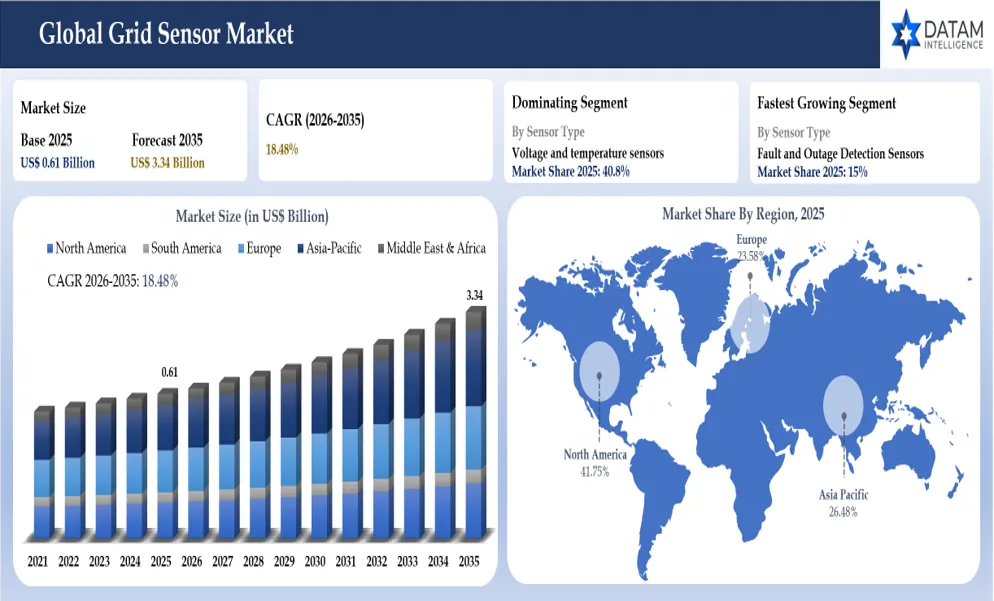
The global grid sensor market reached US$ 0.61 billion in 2025 and is expected to reach US$ 3.34 billion by 2035, growing with a CAGR of 18.48% during the forecast period 2026-2035.
The grid sensor market is becoming increasingly significant as utilities upgrade their old transmission and distribution networks in order to enhance visibility, reliability and response time in case of a fault. Electrical parameters are continuously monitored at different points of the grid by voltage, current, temperature and fault detection sensors. The modern line monitoring systems allow dynamic line rating, enabling utilities to evaluate the status of the conductor and efficiently use the transmission capacity at present. Solar and wind power generation and battery energy storage systems are adding up to demand for bidirectional measurement of power flows and load of equipment in electric networks.
The market is moving towards an advanced sensing system that integrates precision sensing and wireless communication, as well as fiber optics. The integration with SCADA systems, protection relays and digital substations allows the utilities to enhance their ability to pinpoint faults, monitor their assets and perform condition based maintenance. The increasing focus on grid automation and renewable energy integration presents numerous possibilities for companies that manufacture electrical equipment as well as sensors. Market adoption will be affected by the cost of installation, measurement accuracy, compatibility, security issues and availability of communication. Suppliers who provide solutions that are scalable, retrofit-friendly and result in measurable gains in terms of asset utilization, maintenance and network performance have a good chance of succeeding in this market.
Grid Sensor Market Key Takeaways
- Voltage and temperature sensors constituted the largest sensor type segment in 2025, making up 40.8% market share, fueled by their wide-scale implementation in substations, transformers and transmission lines for voltage measurements, thermal evaluation and preventive maintenance.
- Fault and outage detection sensors are expected to have the highest CAGR over the forecast period at 20.2%. This is due to the rising demands from the utilities for real-time fault detection, quicker outages and enhanced reliability in transmission and distribution grids.
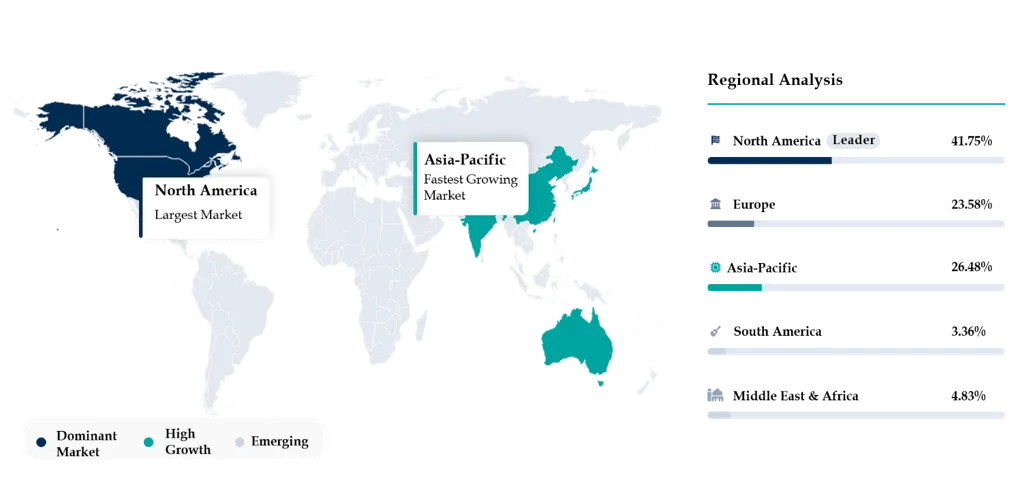
- The North America region held the largest share in the global grid sensor market in 2025 at 41.75%. This was on account of the modernizing grids, digital substations and the need for resilient networks.
- The rising implementation of renewable energy and the use of battery storage and distributed energy resources have ensured that the need for grid sensors needs to be met along with the ability to measure the flow of energy in all directions.
- The use of various technologies such as wireless sensors, fiber-optic sensors, dynamic line rating systems and AI-based forecasting is assisting energy companies in maximizing the efficiency of their transmission lines, recognizing potential faults and decreasing the outages that may occur.
Grid Sensor Industry Trends and Strategic Insights
- Utility companies are gradually using sensors for monitoring current, voltage and faults in order to enhance the ability of detecting fault conditions and minimizing power outage times.
- The use of temperature, sag and loading sensors is growing as utility companies make use of dynamic line rating in order to maximize the efficiency of power transmissions.
- Increased adoption of solar, wind and battery storage systems is creating an increased need for grid sensors that can track two-way electricity flow, voltage levels and stability.
- Adoption of edge computing technologies and predictive analytics in grid sensor systems will allow better fault detection and identification of equipment degradation earlier to plan maintenance.
- There is a growing demand for grid sensors that are interoperable and have built-in cybersecurity and can interface with existing SCADA and protection equipment.
Grid Sensor Market Scope
| Metrics | Details | |
| 2025 Market Size | US$ 0.61 Billion | |
| 2035 Projected Market Size | US$ 3.34 Billion | |
| CAGR (2026-2035) | 18.48% | |
| Largest Market | North America | |
| Fastest Growing Market | Asia-Pacific | |
| By Sensor Type | Voltage Sensors, Current Sensors, Temperature Sensors, Power Quality Sensors, Fault and Outage Detection Sensors, Frequency and Phase Measurement Sensors, Line Monitoring and Dynamic Line Rating Sensors and Other Sensor Types | |
| By Technology | Electromagnetic Sensors, Optical and Fiber-Optic Sensors, Hall-Effect Sensors, Rogowski Coil Sensors, Resistive and Shunt-Based Sensors, Capacitive and Inductive Sensors and Other Sensor Technologies | |
| By Application | Transmission Grid Monitoring, Distribution Grid Monitoring and Automation, Substation Monitoring and Automation, Advanced Metering Infrastructure (AMI), Power Quality Monitoring, Fault Detection, Location, Isolation and Service Restoration (FDIR/FLISR), Renewable Energy Integration, Grid Stability and Wide-Area Monitoring, Predictive Maintenance and Asset Health Monitoring and Other Applications | |
| By Grid Network | Transmission Networks, Distribution Networks, Substations, Microgrids and Renewable Energy Collection & Interconnection Networks | |
| By Connectivity | Wired Sensors, Wireless Sensors and Hybrid Connectivity Sensors | |
| By End-User | Electric Utilities, Transmission System Operators (TSOs), Distribution System Operators (DSOs), Renewable Energy Operators, Industrial and Commercial Power Users, Government and Public-Sector Grid Operators and Microgrid Operators | |
| By Region | North America | U.S., Canada, Mexico |
| Europe | Germany, UK, Russia, France, Spain, Italy, Poland | |
| Asia-Pacific | China, India, Japan, Australia, South Korea, Indonesia, Malaysia, Singapore, Vietnam, Thailand, Philippines, Taiwan | |
| South America | Brazil, Argentina | |
| Middle East and Africa | UAE, Saudi Arabia, South Africa, Israel, Turkiye, Nigeria | |
| Report Insights Covered | Competitive Landscape Analysis, Company Profile Analysis, Market Size, Share, Growth | |
Why does this report matter in 2026?
The grid sensor market is becoming increasingly significant in 2026 due to higher demands for electricity because of growing data center power consumption, industrial electrification and the growth of renewable energy sources that put a strain on transmission and distribution networks. The need for measurements such as current, voltage, conductor temperature and faults in real time is important for utilities to find limitations and to maximize the use of current infrastructure. This report will help stakeholders evaluate the demand for particular sensor technology on transmission lines, distribution feeders, substations and underground cables and commercial opportunities resulting from grid modernization and dynamic line rating applications.
This report is also vital in 2026 due to the need of sensor manufacturers to contend with the changing investment priorities of utilities, inter-operability issues and competition amongst existing electrical equipment makers and dedicated sensor makers. The increasing growth of battery storage, distributed energy resources and digital substations highlights the necessity for reliable monitoring techniques of bidirectional flows of energy as well as the changes in the network dynamics. Through the evaluation of the industry’s competitive landscape, technology development and implementation capabilities, procurement barriers and emerging trends, the study aids manufacturers, utilities, investors and construction firms in determining priority investments, assessing local opportunities and discovering the tools for enhanced grid performance, effectiveness of asset deployment and maintenance efficiency.
Grid Sensor Market White Space & Investment Opportunities
- There are opportunities in the deployment of smaller retrofit-able sensors for aging distribution feeders, transformers and substations, allowing utilities to increase their ability to monitor and identify faults without having to replace their current infrastructure.
- The deployment of sensors that measure the temperature of the conductors, sags of the wires and weather conditions allows the opportunity to maximize the use of the available corridors for transmission lines.
- Renewable energy integration provides opportunities for investments in the installation of grid sensors at solar plants, wind farms, battery storage plants and points of grid connection to measure power flows, voltages and grid stability.
- The latest technologies for underground cables and transformers monitoring, including distributed temperature sensing and partial discharge detection, provide opportunities for diagnosing insulation degradation, overheating and equipment failures prior to them causing outages.
- There are opportunities for affordable, low-energy grid sensors that have wireless connectivity and edge computing capabilities in rural and developing grid environments where there is poor communications infrastructure and where utility budgets are constrained.
Grid Sensor Future Market Transformation
The grid sensors market will gradually move from standalone sensors for electric measurements towards advanced sensors, which offer a smart approach through which visibility into the grid condition can be achieved. The new sensors will incorporate highly accurate measurements of the current, voltage along with the ability to measure the temperature of the conductors, sag and faults. As a result, utility companies will be able to evaluate the capacity of the grid, spot any impending failure and optimize the existing infrastructure. Advanced sensors incorporated in the digital substations and automated distribution networks will speed up the process. Besides, the implementation of edge computing and AI-driven analytics will further enhance dynamic line rating, predictive maintenance and fast fault localization, while advanced sensors installed at the interconnection point of renewable energy sources and battery storage will enable monitoring of bidirectional flows of energy and voltage variations. The adoption of digital substations and automated distribution grids will increase the need for compact, retrofittable and interoperable sensors even more. Nonetheless, this transformation will be reliant on efficient implementation, cybersecurity, communication and compatibility with existing grid systems.
Grid Sensor Market Buyer Decision-Making Criteria
The criteria buyers use to select grid sensor market solutions include the accuracy and reliability of the measurement, as well as the capacity of the product to provide actionable information under harsh electrical and environmental conditions. Electric utilities and transmission and distribution companies are especially interested in precise measurements and quick response time, wide operating ranges and long-term stability for the purposes of measuring voltages and currents on high voltage lines, in substations, underground cables and feeders. Compatibility with current SCADA systems, protective relays and substation automation systems based on IEC 61850 is crucial because problems related to integration add additional cost and delays to deployment process. The requirements of installation, communication reliability, security issues and lifecycle costs are also taken into account. For applications such as dynamic line rating and fault detection, real-time information, which can be trusted for making decision-making, is especially vital. Ultimately, purchasing decisions will depend on improvements in grid visibility and asset usage, fault reaction and network reliability, which have to be proved in field practice, standard compliance and technical support.
Major buyer decision-making criteria:
- Measurement Accuracy and Reliability
- Grid Compatibility and Interoperability
- Real-Time Monitoring and Response
- Installation and Retrofit Flexibility
- Total Cost of Ownership
- Environmental Durability and Operational Safety
- Connectivity and Data Availability
- Cybersecurity and Data Protection
- Scalability and Analytics Readiness
- Vendor Qualification and Technical Support
Grid Sensor Market Economic & Investment Analysis
There are numerous investment opportunities emerging in the grid sensor market because utilities invest in the upgrading of transmission and distribution networks, digital substations and distribution automation. There is high investment interest in current and voltage sensors, fault detection instruments, conductor monitoring technologies and transformer condition monitoring sensors that have the capability of improving asset utilization, reducing power outages and minimizing maintenance costs. Dynamic line rating provides more economic benefits in the sense that utilities can maximize the usage of transmission lines when the conditions allow without the need to expand the existing infrastructure. Investment opportunities are not only limited to sensors that can be used as retrofit solutions, but also include wireless sensors and edge analytics. Investment choices, on the other hand, are determined by lifecycle costs, installation considerations, sensor reliability, communication accessibility and integration with grid systems. Suppliers with evidence of network reliability, maintenance efficiency and infrastructure usage are more likely to succeed in investment choices and generate economic benefits.
Grid Sensor Investment Trends in the Market
- The sensor providers serving the grid sector are allocating their research and development efforts towards development of highly accurate sensors capable of measuring current and voltage, dynamic line rating and other sophisticated measurement techniques due to increasing demands of modern transmission systems.
- Strategic investments are being made in intelligent sensing platforms, which use edge processing capabilities, wireless communication and remote diagnostics and technology vendors have been emphasizing their efforts in minimizing data transmission and improving the performance of sensors within geographically scattered networks.
- Power utilities and electrical equipment manufacturers are investing in digital substations and automated distribution systems, involving integrated sensing devices, providing opportunities for technology suppliers offering interoperable systems that work with existing protection and control systems.
- The capital investments made in grid monitoring infrastructure are now getting in line with the development of renewables and battery storage systems, especially when it comes to grid interconnections, where installation of sensors becomes necessary for the monitoring of bi-directional electricity flow, voltage changes and other network dynamics.
- Development in technology and investments in infrastructure are growing in the field of transformer, underground cables and high-voltage equipment condition monitoring, such as temperature sensing and partial discharge detection.
Strategic Indicators for Grid Sensor Market
High Regulation Impact
Regulatory impact is high in the grid sensor market due to requirements for reliable electricity grid operation, electric safety, cybersecurity and grid modernization. Sensors installed at substations, transmission lines and distribution networks need to satisfy certain criteria in terms of measuring accuracy, insulation, EMC and environmental performance, among others, in order to be qualified for procurement by utilities. IEC 61850 provides a means for interoperability in digital substation automation and cybersecurity and security policies affect the design of remote sensors. Furthermore, grid codes and policies concerning renewable energies arrangement raise the need to ensure the measurement of voltage changes, power quality and power flow variations. Thus, the analytical aspect of these issues will play a role in product development, compliance costs, acquisition timelines and market entry of sensor makers.
High Investment Activity
Grid sensor market investments are spurred by investments in utilities related to upgrading lines, digital substations, distribution automation and resilience of grids. Increased capital is flowing towards the development of line-mounted fault indicators, highly accurate sensors for measuring currents and voltages, dynamic line rating technology and transformer condition monitoring systems. Investments in modernization of aging grid infrastructure have created an opportunity for smaller sensors that offer enhanced visibility within the network without necessitating the replacement of many assets. Sensing technology is being invested in due to renewable energy integration and batteries in order to measure bidirectional flow of energy, voltage variations and equipment loads.
Supply Chain Disruption
A supply chain disruption in the grid sensor market could occur due to a shortage of precise semiconductors, magnetic cores, optical fibers, communication modules and other electronic parts utilized in the existing and fault-detection sensors. Manufacturers that depend on specialized high-voltage measuring equipment and ruggedized electronics may encounter long lead times and additional expenses since suppliers with specialized know-how may have limited capacity. Trade restrictions, transport bottlenecks and component shortages may contribute to the delays in the provision of sensors for renewable power projects, digital substations and automation of distribution systems. Component substitution may also call for calibration, testing of performance and requalification by utilities. Manufacturers can avoid these problems by means of supplier diversity, appropriate inventory management, standard designs and regional sourcing, depending on sensor technology and components used.
Pricing Volatility
The grid sensor market experience a major impact due to swing in costs of various items such as semiconductors, copper, magnetic and fiber-optic materials. Moreover, shifting fluctuations in exchange rates, supplier capacity and procurement also impact pricing volatility. In September 2026, Lytica reported an increase of 2.98% in the electronic component price index on month-to-month basis, as compared to 1.23% recorded in August. This indicates that manufacturers are facing overall increase in costs in their electronic components. However, this report does not indicate the prices of grid sensors specifically. Price fluctuations may hit production margins, quotation timeframes and project budgets of sensor manufacturers, especially in case of contracting fixed-price utility and tender processes.
Procurement Pressure
Buyers are experiencing increased procurement pressure due to the need to update their extensive transmission and distribution systems while keeping their capital and operational costs down. The buyers will have to strike a delicate balance between accuracy, robustness, security and interoperability on one hand and costs of installation, maintenance and lifespan on the other hand. Bidding and the long technical evaluation process involved in procurement increase the price negotiations, especially when it comes to big orders in terms of distribution feeders and substations. The utilities will also try to find out if dynamic line rating sensors, fault indicators and transformer monitoring sensors can actually provide them with tangible benefits in the form of reduction in outage time, maintenance costs or infrastructure costs. Nevertheless, measuring these benefits prior to implementation poses a challenge, leading to a focus on payback periods and lifecycle benefits. Manufacturers have, therefore, to come up with solutions that are scalable, standards-compliant, with predictable delivery timelines and reliable technical support.
New Technology Adoption
Adoption of new technology is increasing in the grid sensor market because of the move of utilities from traditional measuring instruments to smart and networked measuring technologies. Fiber-optic sensors, non-invasive current sensors, wireless fault indicators and sophisticated conductor monitoring sensors are helping increase monitoring capacity on transmission lines, substations and distribution systems. Edge computing will allow some sensors to make their measurements locally and help decrease reliance on continuous communication with central platforms. With AI-powered analytics, fault detection, conductor capacity monitoring and predictive maintenance will be further improved provided that sensor measurements can be trusted. Self-powered and maintenance-free sensors, as well as distributed sensing technologies, can provide more options for remote transmission systems and extensive distribution systems. However, successful deployment requires proven results in practice, compatibility with existing SCADA systems, protection from cyber attacks and economical deployment.
Regional Expansion Opportunity
The availability of regional expansion in the grid sensor market depends on the level of development of infrastructure, focus on grid modernization and the extent of adoption of renewable energy sources. The Indian market provides scope for growth in fault indicators, feeder monitor sensors and retrofittable products as utilities work towards improving distribution stability and automation of networks. China is a market with scope for development in monitoring ultra-high voltage transmissions, digitized substations and renewable energy connections. The Japanese market demands advanced solutions for asset condition monitoring, fault detection and resilience of grids. In North America and Europe, aging infrastructure, the adoption of dynamic line rating technology and digital substations have led to the need for monitoring and prediction technologies that ensure the proper operation of conductors. Suppliers have the opportunity to develop regions by cooperating with local utilities and offering optimized products.
Government Policy Support
Support from government policies can affect the grid sensor market by way of public investment and utility investment schemes designed towards grid modernization, expansion of transmission and automation of distribution and renewable energy integration. Infrastructure initiatives have the potential to prompt utility companies to invest in embedding sensors for faults detection, smart monitoring technology and smart substation technology to enhance reliability of the power supply, hasten outage recovery and boost visibility of the network. Legislation aimed at promoting renewable energy connections and making the grid more flexible lead to further demand for devices that can analyze voltage variations, loading of wires and two-way electricity flows. In India, smart grid projects and reform in the distribution sector enable monitoring and automation of the network, while modernization of the grid in the USA, Europe and Japan opens new possibilities for advanced sensing technologies. The exact effect on the market will depend on the availability of funding, procurement preferences and timelines for the implementation.
Pricing Intelligence
The price of products in the grid sensor market differs with each product and depends on its sensing technology, voltage class, communication capabilities and deployment possibilities. Predicted pricing of the products in 2026 might be as follows: the price of basic fault indicators may be US$200–800 per unit; the price of monitoring devices for temperature of electricity conductors may range between US$1,500 and US$4,000 per monitoring point; the price of dynamic line rating systems which also include weather stations may be US$10,000–25,000. All these figures seem to be samples rather than real averages for the whole market, thus single sensor devices cannot be compared to complete monitoring systems. There are also installation, communication, commissioning, software and maintenance costs that will increase the total price.
| HS Code | Reporter | Trade Flow | 2025 Trade Value | Interpretation |
| 853690 | China | Exports | US$12.0 billion | Indicates China's substantial export capacity in electrical connection and circuit-related apparatus used in electrical infrastructure. |
| 853690 | Hong Kong, China | Exports | US$6.4 billion | Reflects trade in electrical connection and circuit apparatus, including re-export activity; not all exports represent locally manufactured products. |
| 853690 | China | Imports | US$7.9 billion | Indicates demand for imported electrical connection and circuit-related components for domestic manufacturing and infrastructure applications. |
| 853690 | Hong Kong, China | Imports | US$5.5 billion | Reflects demand associated with electrical-component distribution, electronics manufacturing and re-export supply chains. |
Note: Trade data for HS Code 853690 represents the broader category of electrical apparatus used for making connections in or to electrical circuits, rather than grid sensors specifically. The 2025 export and import values provide contextual insight into global electrical-component trade flows but should not be interpreted as the grid sensor market's actual trade value.
AI Impact Analysis of Grid Sensor Market
The use of artificial intelligence in grid sensors will improve their performance by transforming the measured parameters of current, voltage, conductor temperature, power quality and equipment status into valuable operational information. Machine learning techniques may be applied for the analysis of the obtained data to determine abnormalities in electricity flow and to foresee the degradation of transformers, cables and overhead lines. With edge computing, AI analytics could facilitate quicker anomaly detection closer to the point of measurement and minimize unnecessary transmission of the data to the central platform. This will be useful for improving fault localization and scheduling maintenance to minimize unexpected network outages.
Additionally, artificial intelligence is enhancing the monitoring of grid through the integration of renewable sources, batteries and other DER in the complex power grids. Analytics on data from grid sensors would help in the detection of voltage fluctuations, power flow changes, congestion dangers and grid instability. Nevertheless, the success of implementation would be determined by factors such as the right calibration of the sensors, historical data accuracy, system compatibility and cyber security measures. Mismatched readings, modeling problems and poor connectivity at remote places would limit the performance of artificial intelligence.
Disruption Analysis of Grid Sensor Market
In the grid sensor market, disruption is taking place due to the shift from the conventional grid infrastructure which undergoes periodic inspections to the more modern system that monitors the grid on a real-time basis. With the increasing use of the traditional instrument transformers and stand-alone fault detectors, there is an increase in the use of smaller and non-invasive sensor systems such as fiber-optic sensors and wireless line monitors which offer visibility of the transmission lines, underground cables and distribution feeders. There is also the introduction of dynamic line rating system whereby there is an estimation of the transmission line capacity based on conductor temperature and sag and not just static ratings. Such advances are opening up possibilities for specialist sensor manufacturers while forcing established manufacturers to upgrade in terms of compatibility, precision and cost-effectiveness of their solutions.
The convergence of grid sensing technology with edge computing, artificial intelligence analytics and energy management also poses another disruptive trend. Utilities are employing sensor-generated information to assist in carrying out predictive maintenance, quicker detection of faults and monitoring of two-way flows of energy generated from photovoltaics, batteries and other distributed sources of energy. The trend makes security of communications, data architecture that is interoperable and sensors which can operate effectively under adverse conditions in the field more important. There are several challenges which impede adoption, including legacy system integration, cyber security issues, poor quality of data and cost of network upgrades.
Grid Sensor Market BCG Matrix: Company Evaluation
STAR
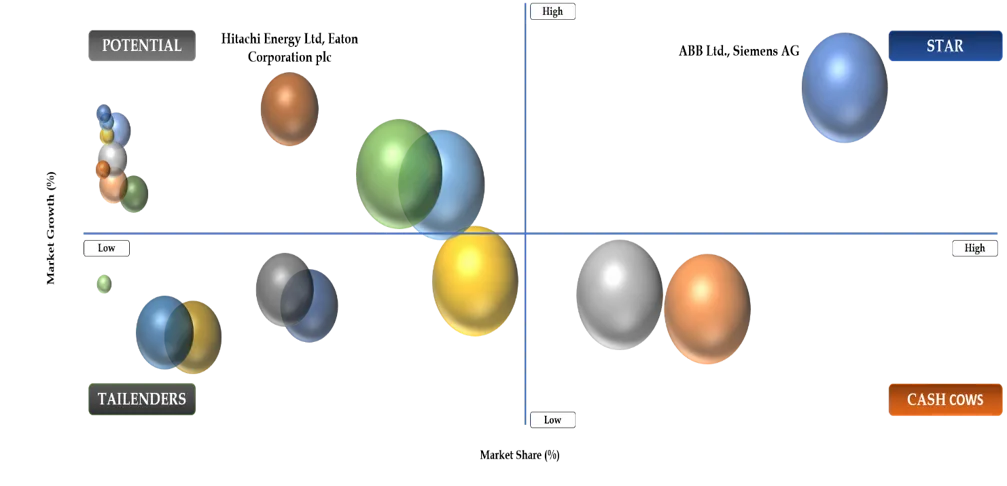
Some of the potential candidates of Stars in the grid sensor market include ABB Ltd., Siemens AG, Schneider Electric SE and GE Vernova Inc. due to their strong associations with utilities, vast portfolios of electrical equipment and expertise in grid automation, digital substations and intelligent grid monitoring. Since they have been able to incorporate current and voltage measurements, grid protection, fault detection and grid analytics in infrastructure services, they can be set to capitalize on modernization initiatives in transmission and distribution. There is an increasing need for renewable energy integration, dynamic line rating and real-time grid monitoring.
POTENTIAL
Hitachi Energy Ltd, Eaton Corporation plc, Itron, Inc., Landis+Gyr Group AG along with specialty players like Ampacimon SA and Synaptec Ltd. offer prospects in the grid sensor market. Hitachi Energy and Eaton could leverage their expertise in the high voltage equipment monitoring, distribution automation and protective systems integrating sensors, whereas Itron and Landis+Gyr could capitalize on the demand for grid edge monitoring and distribution networks visibility. With the dynamic line rating offered by Ampacimon and fiber-optic sensors from Synaptec being solutions catering to the specific needs of transmission capacity management and asset condition monitoring respectively. The future market positioning of these companies would hinge upon their adoption and deployment prospects.
Grid Sensor Market Dynamics
Driver Impact Analysis
| Driver | Market Growth Impact (%) | Demand Concentration | Impacted Use Case | Strategic Impact |
Increasing Investments in Smart Grid Modernization and Digitalization | 32% | North America, Europe and Asia-Pacific | Real-time transmission and distribution monitoring, substation automation and grid visibility | Accelerates deployment of intelligent voltage, current and line-monitoring sensors, supporting utility digitalization and automated grid operations. |
Rising Demand for Real-Time Grid Monitoring and Fault Detection | 28% | North America, Europe and high-density urban power networks in Asia-Pacific | Fault localization, outage detection, power quality monitoring and service restoration | Increases demand for sensors with high measurement accuracy, low-latency communication and continuous fault-monitoring capabilities, helping utilities reduce outage duration. |
Growing Integration of Renewable Energy and Distributed Energy Resources | 22% | Europe, China, India and other renewable-energy expansion markets | Renewable power interconnection, distributed generation monitoring and grid stability management | Creates demand for advanced sensing systems that monitor variable power flows, voltage fluctuations and changing grid conditions, enabling higher renewable-energy penetration. |
Increasing Need for Predictive Maintenance and Grid Asset Optimization | 18% | North America, Europe and regions with aging transmission and distribution infrastructure | Transformer condition monitoring, overhead line monitoring, thermal monitoring and asset health assessment | Encourages adoption of condition-monitoring sensors and analytics-enabled solutions to identify equipment deterioration early, optimize maintenance schedules and extend asset service life. |
Driver: Increasing Grid Modernization and Real-Time Network Monitoring
Modernization of aging transmission and distribution systems is a key trend boosting the growth of the grid sensor market, because the utilities require monitoring of current, voltage, conductor temperature and faults in order to increase system awareness and reliability. The deployment of sensors in lines, smart fault indicators and substation monitors helps with fault localization and outage management, as well as helps utilities to make better use of their existing resources. Increasing power consumption by data centers, electric cars and renewable generation raises the necessity of monitoring the changed flows and loads in the power grid. Such requirements are inspiring utility companies to integrate sophisticated sensors in their efforts towards automation and digitization of infrastructure.
Restraint Impact Analysis
| Restraint | Drag on Market Growth (%) | Primary Impact Area | Impacted Use Case | Strategic Impact |
High Initial Installation and Deployment Costs | 32% | Capital-constrained utilities and distribution network upgrades | Large-scale sensor installation across transmission lines, substations and distribution feeders | Extends project payback periods and encourages phased deployments, prioritization of high-risk assets and adoption of retrofit-compatible sensors. |
Interoperability Challenges with Legacy Grid Infrastructure | 27% | Aging grid infrastructure and heterogeneous utility systems | Integration of sensors with existing SCADA, protection relays, communication networks and grid management platforms | Increases integration complexity and deployment time, strengthening demand for interoperable devices, standardized communication protocols and flexible architectures. |
Cybersecurity and Data Privacy Concerns | 23% | Digitally connected grids and remotely monitored infrastructure | Wireless sensor networks, remote asset monitoring and cloud-connected grid analytics | Raises requirements for secure communications, device authentication, encryption and lifecycle security, potentially increasing deployment costs and procurement timelines. |
Data Management and Skilled Workforce Constraints | 18% | Utilities with limited digital infrastructure and technical expertise | Continuous sensor-data analysis, predictive maintenance and advanced grid monitoring | Slows adoption where utilities lack analytics capabilities and trained personnel, increasing the importance of managed services, simplified deployment and workforce training. |
Restraint: High Deployment Costs and Legacy Infrastructure Integration
Expensive deployment continues to be a significant constraint in the grid sensor market since the cost of deploying sensors on various transmission lines and feeders as well as in substations covers not only the sensors but also their installation, communication network setup, calibration, security as well as their integration with existing SCADA systems and protective devices. Incompatibility of communication standards with the existing grid control system architectures may call for further integration gateways, engineering services and testing which makes the process of deployment even more complicated and time consuming. Such challenges tend to hold back smaller utilities and budget constrained companies from implementing sensors throughout their grids.
Grid Sensor Market Segment Analysis
The global grid sensor market is segmented based on the sensor type, technology, application, grid network, connectivity, end-user and region.
By Sensor Type
Voltage and Temperature Sensors Represent a Major Share of Grid Sensing Demand
Voltage and temperature sensors was the major type of sensors in 2025 with a 40.8% market share as these sensors find a wide application in substations, transformers, transmission lines and distribution networks. The voltage sensors assist utility companies in monitoring voltage conditions and detecting voltage discrepancies in order to provide good power quality. At the same time, temperature sensors can detect overheating of conductors and equipment in order to avoid overloading. The wide range of applications in existing grid infrastructures, digital substations and renewable energy interconnections ensures continued demand.
By Sensor Type
Rising Grid Complexity Increases Demand for Real-Time Fault Detection
It is expected that fault and outage detection sensors will constitute one of the most rapidly growing types of sensors, with a CAGR of 20.2% over the forecast period. Such growth will be driven by the rising demand from utilities to detect the faults in feeders, detect any abnormal electrical condition and restore services as quickly as possible amid increasingly complex systems of power transmission and distribution. Information provided by intelligent fault indicators and connected sensors can be used for FDIR/FLISR, which can help decrease the duration of outages and unnecessary field inspections. Growth in renewable energy use, age of grid infrastructure and distribution automation investments support increased adoption.
Grid Sensor Market Geographical Penetration
U.S. Grid Sensor Market Landscape
Investments made toward improving the transmission and distribution systems, grid resiliency and utility management will be the driving force behind the U.S. grid sensor market. Utility companies are using current, voltage, fault and conductor sensors to enhance their outage response time, maximize asset utilization and ensure the grid's reliability even in severe weather conditions. Increased electricity consumption due to higher usage of data centers, electric cars and renewable energy sources requires utilities to implement sensors to monitor the loading of the lines, voltage and bidirectional power flow. Dynamic line rating systems can become an important part of the market as they provide an opportunity to increase transmission capacity without additional infrastructure construction.
China Grid Sensor Market Trends
The growth of the grid sensor market in China is fueled by investments in ultra-high-voltage (UHV) transmission, digital substations and automation of electrical distribution networks. Companies like the State Grid Corporation of China and China Southern Power Grid are leading efforts in the modernization of grids, which causes the rising demand for precise current, voltage, temperature and fault sensors. In addition, active growth of solar energy and wind energy allows for the implementation of real-time power flow monitoring, voltage monitoring and stability of the grid at the moment of renewable energy connection. The availability of sensors equipped with edge processing technology and remote diagnostics is presenting an opportunity for state-of-the-art equipment and predictive maintenance. Domestic manufacturers are at an advantage due to their solid production capacity, even though the accuracy of the sensors and reliability of their performance throughout the power grid would remain the key competitive factors.
Germany Grid Sensor Market Analysis
Germany grid sensors market is driven by the ongoing energy transformation in the country, increasing production of renewable energy and development of power transmission and distribution infrastructure. Increasing production of wind and solar energy is leading to rising requirements of current sensors, voltage sensors, power quality and line monitoring sensors to control the flow of electricity and to stabilize the grid. Deployment of digital substations and upgrading of the distribution grid are creating growth opportunities for sensors that can interface with the IEC 61850-based automation and utility control system. Germany’s industrial base is another reason why there is demand for transformers temperature, partial discharge and condition monitoring systems to detect equipment degradation and save on maintenance expenses. The further development of grid digitalization is increasing the demand for accurate and interoperable sensors.
Japan Grid Sensor Market Outlook
Grid sensor market in Japan is driven by grid modernization, renewable energy adoption and digitization of electricity distribution networks. There has been an increase in smart-metering and installation of smart current, voltage, power quality and fault detectors. An increase in solar and offshore wind power plants in Japan is driving the need for monitoring solutions for handling variable loads and identifying any transmission bottlenecks in the network. There has been a demand for transformer condition monitoring, temperature sensing and predictive maintenance solutions owing to the aging electrical grid in Japan. In addition to this, there has been an increase in the importance of high precision sensor technology and interoperable monitoring systems due to transmission capacity augmentation and grid expansion across regions in order to integrate renewables in the grid.
Grid Sensor Market Competitive Landscape
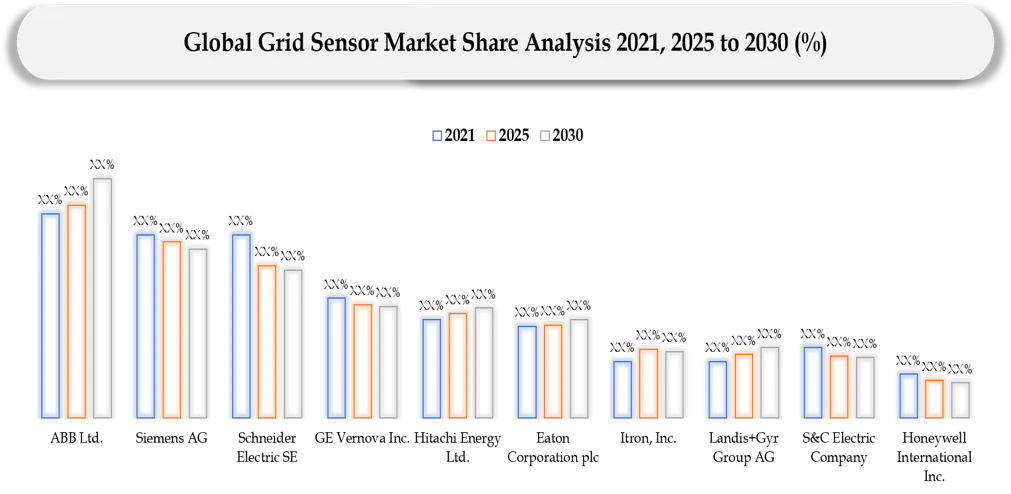
- The competitive environment consists of well-established electrical equipment manufacturers like ABB, Siemens, Schneider Electric and Hitachi Energy, who take advantage of existing connections in utilities, experience in automation and substation systems integration to improve their positions in grid sensing.
- Specialists compete using technologies that have particular applications, such as dynamic line rating, overhead conductor monitoring, fiber-optic sensing and fault detection. Specialized firms like Ampacimon, Synaptec and Gridware focus on monitoring challenges that regular protection and measurement devices might not be able to solve completely.
- Increased competition exists in relation to accuracy of sensors, measurement reliability, versatility in installation and the ability to integrate with existing SCADA, protection and communication networks of utilities. Vendors that supply sensors that fit retrofits for utilities that want increased grid visibility without changing much of their existing network can take advantage of this.
- Increasing competition exists between vendors of integrated electrical equipment supplying both sensors along with protection, automation and monitoring systems and vendors of specialty sensors with their specific applications. Differentiation is achieved using unique performance, flexible deployment and application-specific solutions.
- Utility positioning is also shaped by qualification criteria for utilities, prolonged purchasing process, reliability in the field and support of far-flung infrastructure. Supplier companies that show reliable operations under high voltage and harsh weather conditions are in a better position to get long-term utility contracts.
Public Company Q1-Q2 2026 Performance Comparison
The following table compares five publicly listed companies with direct or strategically relevant exposure to the grid sensor market. Financial figures reflect company-wide or relevant business-segment performance, rather than standalone grid sensor revenue, which is generally not separately disclosed.
| Company | Q1-Q2 2026 Performance | Grid Sensor Exposure | Key Performance Driver |
| ABB Ltd. | US$18.21 Billion H1 Revenue (Q1: US$8.73B; Q2: US$9.48B) | Current and voltage sensing, substation monitoring, grid automation and intelligent electrical distribution technologies. | Strong electrification demand, grid modernization investments and expanding data center infrastructure supported equipment orders and automation demand. |
| Siemens AG | US$45.37 Billion H1 Revenue (Q1: US$22.37B; Q2: US$23.01B) | Digital substations, power quality monitoring, grid automation, synchrophasor measurement and wide-area monitoring systems. | Strong demand for Smart Infrastructure solutions, grid electrification projects and digital automation technologies supported business performance. |
| Schneider Electric SE | US$24.80 Billion H1 Revenue (Q1: US$11.44B; Q2: US$13.36B) | Distribution grid monitoring, power quality sensors, intelligent electrical equipment and grid-edge monitoring solutions. | Data center electrification, Energy Management demand and investment in digital electrical infrastructure supported revenue growth. |
| GE Vernova Inc. | US$20.44 Billion H1 Revenue (Q1: US$9.34B; Q2: US$11.10B) | Grid measurement equipment, instrument transformers, substation monitoring and transmission grid automation technologies. | Rising demand for transmission infrastructure, grid equipment and electrification solutions supported order growth and project execution. |
| Itron, Inc. | US$1.15 Billion H1 Revenue (Q1: US$587M; Q2: US$563M) | Grid-edge measurement, smart metering, distribution network monitoring and utility data analytics. | Utility modernization, recurring software revenue and grid-edge intelligence adoption supported profitability despite lower hardware revenue. |
Note: These are company-wide or relevant segment-level financial indicators, not grid sensor market revenue. Financial periods differ because companies follow different fiscal calendars.
Key Companies of Grid Sensor Market
- ABB Ltd. (Switzerland)
- Siemens AG (Germany)
- Schneider Electric SE (France)
- GE Vernova Inc. (United States)
- Hitachi Energy Ltd. (Switzerland)
- Eaton Corporation plc (Ireland)
- Itron, Inc. (United States)
- Landis+Gyr Group AG (Switzerland)
- S&C Electric Company (United States)
- Honeywell International Inc. (United States)
- LEM International SA (Switzerland)
- Arteche Group (Spain)
- Qualitrol Company LLC (United States)
- Kamstrup A/S (Denmark)
- Aclara Technologies LLC (United States)
- Sentient Energy (United States)
- Synaptec Ltd. (United Kingdom)
- Ampacimon SA (Belgium)
- Trilliant Holdings Inc. (United States)
- Ubicquia, Inc. (United States)
Company Profiles of Grid Sensor Market
ABB Ltd.
ABB is an important technology vendor for electrification and automation solutions that also have substantial involvement in the business of grid sensing in terms of electrical measurement, protection and monitoring systems. Among the offerings of ABB are solutions for current and voltage measurement, instrument transformers, substation automation and digital systems that assist in monitoring the condition of electrical grids.
Competitive considerations for ABB involve increasing its expertise in the field of intelligent measurements and digital substations, enhancing the ability to integrate sensors with protection and control systems and implementing retrofit solutions in aging electrical grids amid the rising interest in the area.
Siemens AG
These technologies from Siemens help monitor and manage the increasingly complex electricity grids through providing grid automation, digital substation and monitoring systems for power systems. The company’s offerings consist of substation automation and protection and control systems as well as platforms employing electrical measurements and synchrophasors.
Competitive strengths lie in the development of digital monitoring of grids, increased interoperability with existing utility assets, integration of measurement data into automation platforms and management of variable renewable energy generation and network congestion.
Schneider lectric SE
Schneider Electric’s focus areas include energy management, electrical distribution and digital automation, providing solutions for grid monitoring, power quality management and grid distribution visibility. Schneider Electric uses its EcoStruxure platform to interconnect electrical devices, monitoring sensors and analytics to help utilities and infrastructure owners operate more efficiently. Exposure of Schneider Electric is especially relevant in areas of distribution grids, digital substations and renewable energy integration.
Key competitive priorities include expansion of digital grid monitoring and automation, integration of sensor data into grid management systems, interoperability of electrical infrastructures and demand generated by data centers, electrification and renewable energy connections.
GE Vernova Inc.
GE Vernova supplies solutions such as transmission and distribution solutions, grid automation and digital solutions that enable electricity network monitoring and control. The Grid Solutions of GE Vernova comprises high voltage products, instrument transformers, protection and control solutions and grid automation solutions that assist utility companies in improving their substation processes and reliability. These competencies link GE Vernova to the grid sensors ecosystem via measurement infrastructure and data from sensors.
Strategic initiatives comprise increasing adoption of grid automation and digital monitoring solutions, integration of measurement devices with grid control solutions, development of transmission capacity and analytics-based solutions for fault detection and asset performance management.
Hitachi Energy Ltd.
Hitachi Energy offers high voltage equipment, substation automation and protection, control and digital grid technology for transmission and distribution grids. The monitoring and asset management offered by the company enables the utility companies to assess equipment status and enhance their visibility. It is clear that the offerings of Hitachi Energy are specifically pertinent for high voltage substations, transformer health monitoring and integration of renewable energy into the grid.
The competitive challenges for the company include development of digital substations, integration of measurements with asset health analytics, monitoring of high voltage equipment and utilities with transmission limitations and aging infrastructure.
Eaton Corporation plc
Eaton provides equipment for electrical distribution, power protection and monitoring and automation of electric power grids for the utility, industrial and commercial markets. Eaton’s electrical line of products includes equipment for monitoring and managing electrical power distribution, while Eaton’s Cooper Power Systems products enable the protection and automation of distribution grids. Eaton’s relevance to the grid sensor market is mainly linked to the integrated electrical monitoring, protection and control applications, not sensor manufacturing as such.
The competitive priorities of the company include developing intelligent distribution solutions, combining monitoring with protection and control equipment, better retrofitting solutions and grid modernization. Higher demand in the data center market and due to electrification and distributed energy resource technologies also presents an opportunity for integrated electrical monitoring solutions.
Grid Sensor Market Major Pain Points
- High installation and maintenance costs continue to pose a big obstacle to utilities as far as installation of grid sensors is concerned, especially where installation calls for service outage, special tools and equipment or difficult access to sites.
- Integration of the new generation of sensors with the old SCADA systems, protection relays and multiple communication protocols presents technical difficulties and may call for installation of additional gateways.
- Accuracy of measurements in such extreme temperatures, magnetic field interference, presence of moisture, vibration and in other challenging environments continues to be difficult, especially for line mounted outdoor sensors exposed to weather changes and tough electrical environment.
- Limited communication coverage in remote transmission corridors and rural distribution networks can result in delayed data transmission of sensors and limited real-time fault detection and monitoring due to lack of reliable cellular connection or communication systems in the utilities industry.
- Security of connected grid sensors from cyberattacks is another issue, which requires device authentication, encryption, software updates and vulnerability management for safeguarding grid-monitoring system from any unauthorized access.
Grid Sensor Market Recent Developments
- September 2026 - Itron, Inc.: On September 22, Itron introduced the launch of its Riva S and Riva T IEC electricity meters in Asia-Pacific. These devices have been designed to combine metrology technology, high-frequency sampling and communications modules for enhancing visibility on the low-voltage network and monitoring distributed energy resources. Despite not being a sensor per se, but a smart meter, it is pertinent to the topic of grid measurement and monitoring.
- September 2026 - Arteche Group: On September 3, Arteche released technical information regarding medium voltage sensors, sensor kits and PLC couplers for distribution automation purposes. The technical information pertained to current and voltage sensing applications in order to achieve electrical measurements and monitoring in medium voltage distribution systems.
- August 2026 - Siemens AG: On August 26, Siemens made an announcement regarding a strategic partnership with Electric Power Group to incorporate synchrophasor technology as well as wide area monitoring system technology into their suite of power automation technologies.
- August 2026 - Corinex: On August 24, Corinex introduced the Grid Intelligence Node. The solution integrates current, voltage and power quality monitoring with broadband powerline communications. It is used by utilities to detect overloads, imbalance of phases and voltage disturbances on low voltage feeders.
- July 2026 - Ampacimon SA: Ampacimon has deployed its Sense X dynamic line rating sensors with Winter Wind d.o.o. on seven transmission lines. The solution helps in providing real-time monitoring of overhead lines to assist in optimizing their capacity and minimize congestion.
Analyst View / Opinion on Grid Sensor Market
- The grid sensor market will see strong growth due to the modernization of the existing transmission and distribution infrastructure by utility companies, as well as the growing need for current, voltage and fault detection sensors that help in improving network visibility and quickening the process of outage detection.
- Dynamic line rating and overhead conductor monitoring are two sectors that present significant potential for use of the grid sensors since the utilities can measure the actual capacity of their transmission lines based on different environmental conditions.
- Renewables are increasing the need for sensors both at substations and points of grid connection where it becomes critical to monitor the bidirectional flow of electrical energy, fluctuations of voltages and load levels of the equipment used.
- Vendor competitiveness will be determined by not only the accuracy of their sensors but also the compatibility with existing SCADA systems and protection devices. The companies which can provide a solution that is compatible with the old system and performs efficiently under extreme conditions will have an edge.
- Prospects in the long run seem to be in favor of providers who can offer sensors along with edge processing and condition monitoring features. However, high costs of implementation, cybersecurity issues and lengthy procurement cycles at the utilities might hamper the implementation of such technology.
Target Audience of Grid Sensor Market
| INDUSTRY | WHO SHOULD BUY THIS REPORT? | REASON TO BUY THIS REPORT |
| Electrical Equipment Manufacturing | Grid sensor manufacturers and electrical measurement device manufacturers | Identify product development opportunities, sensor technology trends and demand for advanced voltage, current and line-monitoring solutions. |
| Power Utilities | Electric utilities and power generation companies | Evaluate grid-monitoring requirements, reliability challenges and opportunities to improve operational efficiency. |
| Transmission and Distribution | Transmission system operators (TSOs) and distribution system operators (DSOs) | Assess sensor deployment opportunities for fault detection, outage reduction, network visibility and grid optimization. |
| Smart Grid Technology | Smart-grid solution providers and grid automation companies | Identify opportunities to integrate sensors into digital substations, automated distribution networks and intelligent grid management systems. |
| Renewable Energy | Solar and wind power developers and operators | Assess sensor requirements for renewable energy integration, variable power-flow monitoring, voltage regulation and grid stability. |
| Energy Storage and Microgrids | Battery energy storage providers and microgrid developers | Evaluate grid-interconnection monitoring requirements and opportunities to improve coordination between distributed energy resources and power networks. |
| Semiconductor and Sensor Components | Semiconductor manufacturers and sensor component suppliers | Assess demand for measurement components, grid-grade sensing technologies and communication-enabled sensor hardware. |
| Industrial Manufacturing | Energy-intensive industries and captive power operators | Identify solutions for power quality monitoring, electrical fault detection and predictive maintenance of internal power networks. |
Engineering, Procurement and Construction (EPC) | Grid infrastructure contractors and electrical engineering firms | Evaluate sensor specifications, installation requirements and technology options for transmission, distribution and substation projects. |
| Investment and Consulting | Infrastructure investors, energy-sector consultants and market research firms | Assess market opportunities, competitive positioning, technology adoption trends and long-term investment potential in grid sensing. |
Why Choose DATAM?
- Data-Driven insights: Dive into detailed analyses with granular insights such as pricing, market shares and value chain evaluations, enriched by interviews with industry leaders and disruptors.
- Post-Purchase Support and Expert Analyst Consultations: As a valued client, gain direct access to our expert analysts for personalized advice and strategic guidance, tailored to your specific needs and challenges.
- White Papers and Case Studies: Benefit quarterly from our in-depth studies related to your purchased titles, tailored to refine your operational and marketing strategies for maximum impact.
- Annual Updates on Purchased Reports: As an existing customer, enjoy the privilege of annual updates to your reports, ensuring you stay abreast of the latest market insights and technological advancements. Terms and conditions apply.
- Specialized Focus on Emerging Markets: DataM differentiates itself by delivering in-depth, specialized insights specifically for emerging markets, rather than offering generalized geographic overviews. The approach equips our clients with a nuanced understanding and actionable intelligence that are essential for navigating and succeeding in high-growth regions.
- Value of DataM Reports: Our reports offer specialized insights tailored to the latest trends and specific business inquiries. The personalized approach provides a deeper, strategic perspective, ensuring you receive the precise information necessary to make informed decisions. The insights complement and go beyond what is typically available in generic databases.
What DATAM Uniquely Provides
- An analysis of the demand for sensors in the grids along the transmission lines, feeders, substations and underground cables based on application specific demands of current, voltage, fault detection and conductor monitoring technologies.
- An analysis of dynamic line ratings and conductor monitoring of overhead conductors with sensor deployment to enhance the capacity of the existing transmission, solve problems of network congestion and defer investments in new grid infrastructure.
- An analysis of the sensor adoption on traditional power grids, digital substations and renewable energy interconnection with the grid based on the effect of bidirectional power flow and fluctuating voltages on sensor demands.
- An evaluation framework for benchmarking between competing manufacturers of existing electrical equipment and specialty sensing companies, taking into consideration the product functionality, application coverage in the grid, interoperability, retrofit capabilities and suitability for extreme operating conditions.
- An investigation of applications that are not yet served and commercialization hurdles related to emerging grid sensors technologies such as edge enabled sensing, underground cable sensing and low-cost distribution sensing.