


Grid Scale Energy Storage Market Size and Overview
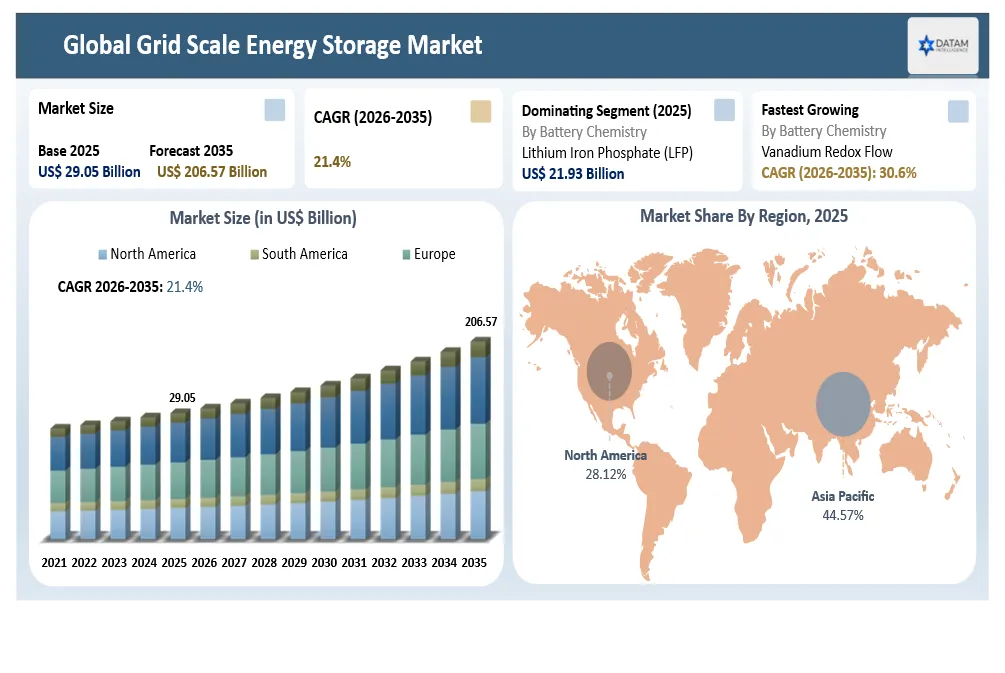
The global grid scale energy storage market reached US$ 29.05 billion in 2025 and is expected to reach US$ 206.57 billion by 2035, growing with a CAGR of 21.4% during the forecast period 2026-2035.
The market is being redefined through the fast growth of utility-scale battery storage. According to the International Energy Agency (IEA), 108 gigawatts of battery-storage additions were made across the globe in 2025, marking the growth of battery storage as the fastest-growing power technology. 80% of the battery storage was in the form of utility scale battery storage, with LFP batteries making up around 90% of the total additions owing to their economic feasibility and applicability in grid-related cycling. China made up for around 60% of global battery storage additions in 2025, followed by the United States and Europe.
The IEA also indicates that the additions of battery-storage capacity grew by about 40% in 2025, with the installed global capacity growing to 11 times the 2021 figure. The storage projects are also increasingly shifting towards longer durations; whereas most projects are still focused around the two-hour range, there are now more and more projects designed for more than four hours as higher solar PV systems require more flexibility. It will result in increasing demand for grid-scale energy storage in terms of renewable energy shifting, capacity, frequency regulation, peaking and grid resilience.
Grid-Scale Energy Storage Market Key Takeaways
- Lithium Iron Phosphate (LFP) led the grid scale energy storage market in 2025, capturing about 75.5% of market share owing to their longevity in cycling, thermal stability, cost-effectiveness, efficiency in cycling and compatibility with high cycling needs.
- The Vanadium Redox Flow segment is expected to witness the highest CAGR of 30.6% between 2026 to 2035, attributed to the increasing need for 8+ hour of energy storage, no degradation, high cycle life, decoupling of power from energy capacity and shifting renewable energy.
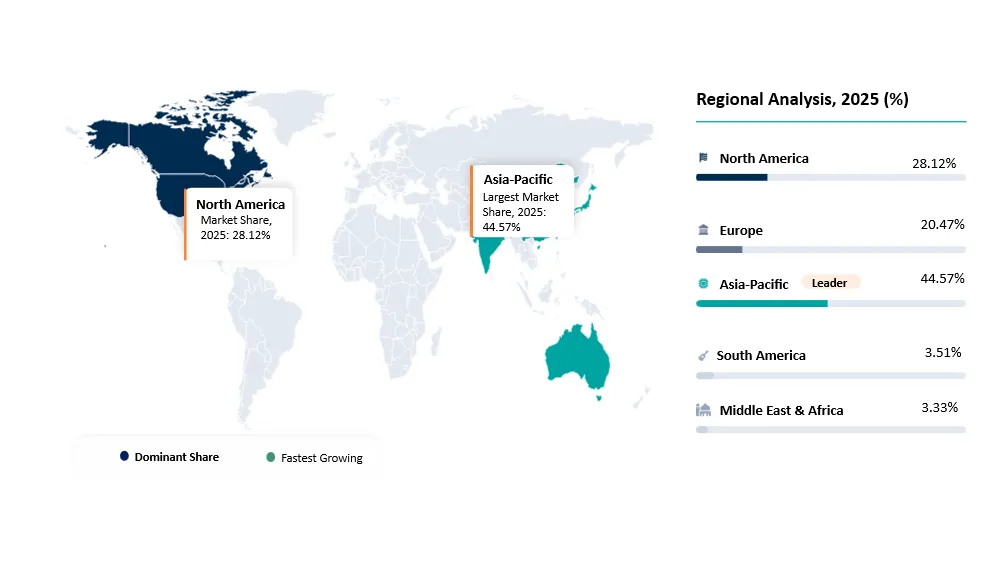
- The Asia-Pacific region captured the largest share, with 44.57% market share in the global srid scale energy storage market in 2025, attributed to the wide adoption of renewable energy sources, battery manufacturing facilities, grid modernization and utility scale storage installation in China, India, Japan and Australia.
- More investment in high-capacity LFP BESS, grid-forming inverters, energy management systems, thermal management and long-duration storage is contributing to better performances and making utility-scale projects possible.
- Increased demands for renewable-plus-storage and grid-flexibility projects are providing possibilities in solar and wind energy shifting, peak load management, capacity, frequency regulation, transmission, grid resiliency and renewable curtailment.
Grid Scale Energy Storage Industry Trends and Strategic Insights
- Shift Toward Longer-Duration Systems: The average utility-scale battery project had a duration of 3 hours in 2025, opening up possibilities for suppliers who can provide 4, 8 and even longer-duration batteries.
- Storage Revenue Is Shifting Toward Energy Shifting: As more than 90% of new battery projects in 2025 were energy shifting focused, developers will start focusing on batteries that can store cheap renewable energy and discharge in periods of peak value.
- BESS Competition Is Moving Beyond Cell Cost: With LFP batteries comprising nearly 90% of battery-storage systems in 2025, competitive advantage is moving towards system density, degradation warranties, thermal management, PCS efficiency, safety and software dispatch.
- Long-Duration Technologies Are Entering Strategic Procurement: The emergence of 8-hour-plus procurement mechanisms are generating opportunities for pumped hydro, flow battery, CAES, LAES, iron air and gravity storage in addition to traditional lithium-ion BESS.
- Project Siting Is Becoming a Competitive Advantage: Over 2,500 GW of renewable, storage and load generation projects have entered global interconnection queues, giving strategic value to storage facilities with interconnection, renewable co-location and access to congested grid nodes.
Grid-Scale Energy Storage Market Scope
| Metrics | Details | |
| 2025 Market Size | US$ 29.05 Billion | |
| 2035 Projected Market Size | US$ 206.57 Billion | |
| CAGR (2026-2035) | 21.4% | |
| Largest Market | Asia-Pacific | |
| Fastest Growing Market | Asia-Pacific | |
| By Storage Technology | Battery Energy Storage Systems (BESS), Pumped Hydro Storage, Compressed Air Energy Storage (CAES), Liquid Air Energy Storage (LAES), Flywheel Energy Storage, Gravity Energy Storage, Thermal Energy Storage, Hydrogen & Other Chemical Storage, Supercapacitor Energy Storage and Other Technologies | |
| By Battery Chemistry | Lithium Iron Phosphate (LFP), Nickel Manganese Cobalt (NMC), Nickel Cobalt Aluminum (NCA), Lead-acid, Sodium-ion, Sodium-sulfur (NaS), Vanadium Redox Flow, Zinc-bromine Flow and Other Chemistries | |
| By Power Capacity | Below 10 MW, 10–50 MW, 51–100 MW, 101–250 MW, 251–500 MW and Above 500 MW | |
| By Storage Duration | Less than 1 Hour, 1–2 Hours, 2–4 Hours, 4–8 Hours, 8–24 Hours, 24–100 Hours and More than 100 Hours | |
| By Configuration | Standalone Storage, Solar + Storage, Wind + Storage, Solar + Wind + Storage, Thermal Generation + Storage and Other Hybrid Renewable + Storage | |
| By Application | Renewable Energy Integration, Energy Shifting, Energy Arbitrage, Peak Shaving, Frequency Regulation, Capacity Provision, Grid Resilience, Transmission & Distribution Support, Black Start and Other Grid Services | |
| By Ownership | Utility-Owned, Independent Power Producer (IPP)-Owned, Independent Storage Developer-Owned, Government/Public-Owned and Others | |
| By Region | North America | U.S., Canada, Mexico |
| Europe | Germany, UK, Russia, France, Spain, Italy, Poland | |
| Asia-Pacific | China, India, Japan, Australia, South Korea, Indonesia, Malaysia, Singapore, Vietnam, Thailand, Philippines, Taiwan | |
| South America | Brazil, Argentina | |
| Middle East and Africa | UAE, Saudi Arabia, South Africa, Israel, Turkiye, Nigeria | |
| Report Insights Covered | Competitive Landscape Analysis, Company Profile Analysis, Market Size, Share, Growth | |
Why does this report matter in 2026?
The grid-scale energy storage market has emerged as an important strategic segment in 2026 due to the rapid growth of solar and wind installations, which have created a need to match fluctuating energy production with demand on the grid. The global battery storage installation was 108 GW in 2025 out of which around 87 GW comprised the utility-scale installations and the duration of new installations has been 3 hours in the same period which highlights the emergence of large battery systems with long durations. LFP batteries were installed for around 90% of the battery-storage installations in 2025, which reflects the rise in importance of lithium-ion chemistry in the utility scale battery business. In addition to energy shifting, battery storage systems are now getting deployed for frequency regulation, capacity provision, grid-forming, black start, renewable curtailment management and for transmission and distribution operations.
Grid Scale Energy Storage Market White Space & Investment Opportunities
- Long-Duration Energy Storage: There is significant white space available in 8 to 24-hour and 24 to 100+ hour energy storage solutions which presents investment opportunities for flow battery, compressed air, liquid air, gravitational and new iron air technologies as power grids will need long-term energy balancing solutions from renewable energy sources.
- Solar-Plus-Storage in High-Curtailment Markets: Utility-scale co-located storage with utility-scale solar projects presents investment opportunities in curtailment and evening peak deficit markets where solar energy storage can be monetized.
- Grid-Forming Energy Storage: The advent of grid forming battery energy storage systems that can provide voltage support, frequency regulation and black-start amongst others presents an investment opportunity as grid power sources become increasingly renewable based.
- Storage for Transmission and Distribution Constraints: Implementation of storage in congested substations and constrained grid points provides options for non-wires solutions, whereby utilities can avoid costly network investments while improving grid capacity and reliability.
- Hybrid Multi-Technology Storage: Short-duration lithium-ion BESS together with pumped hydro, flow batteries, thermal storage, hydrogen, or any other extended-duration storage solutions creates possibilities for investments in portfolios that can meet both short and extended duration energy needs.
Grid-Scale Energy Storage Future Market Transformation
The grid-scale energy storage market is projected to transition from being mainly a lithium-ion short-duration balancing system to become a multi-duration and grid-forming infrastructure segment as renewable penetration increases. In the future, storage projects will be increasingly combining 2-4 hour LFP batteries to perform daily energy shifts and other types of storage like flow batteries, compressed air, pumped hydro and new types of iron-air systems to help in balancing long durations of renewable energy. Future storage projects will become solar or wind plus storage systems to dispatch renewable energy when needed and avoid curtailment. At the grid level, advanced inverter controls will make the storage projects involved in grid-forming, frequency regulation, voltage regulation, black-start capability and management of transmission congestion. Other technological developments in batteries, BESS, battery recycling and AI in energy management systems will also be making a difference in the economics of storage projects.
Grid Scale Energy Storage Market Buyer Decision-Making Criteria
Buyers in the grid-scale energy storage market consider how well each system can deliver robust grid services while having good project economics during the operational lifetime of the installation. Total system cost, storage duration, storage capacity, round-trip efficiency, degradation, cycle lifetime, reliability, safety and warranties are among the factors considered by utilities, independent power producers, energy storage providers and grid companies. In addition to the above factors, the decision on the project may be influenced by the grid inter connectability needs, profitability from energy arbitrage, capacity markets and ancillary services in addition to compatibility with solar and wind installations.
Major Decision-Making Criteria
- Total Project Cost / Levelized Cost of Storage
- Power Capacity and Usable Energy Capacity
- Storage Duration
- Round-Trip Efficiency
- Battery Degradation Rate
- Cycle Life and Operating Life
- System Availability and Reliability
- Response Time and Grid-Forming Capability
- Thermal Management and Fire Safety
- Warranty and Performance Guarantees
- Operation and Maintenance Costs
- Grid Interconnection Compatibility
- Energy Management System and Software
- Supplier Bankability
- Supply Chain and Delivery Capability
- Regulatory and Grid-Code Compliance
- Cybersecurity and Remote Monitoring
- Recycling and End-of-Life Management
- Renewable Energy Integration Capability
Grid Scale Energy Storage Market Economic & Investment Analysis
Grid scale energy storage market is emerging as a key infrastructure investment category as utilities and power generators use the flexible capacity to deal with renewable generation, peaking electricity demand and grid congestion. The economic feasibility of the project is dependent on battery cost, battery system cost, storage time, round-trip efficiency, degradation percentage, cycles, grid interconnection cost and requirement for battery replacement. Revenue stacking is highly important in determining investment feasibility and projects earn money from arbitraging of electricity price, capacity payment, frequency regulation, reserves and grid support. Hence, there is a wide variation in the economics of the project depending on electricity price volatility, renewable penetration and grid constraints.
The growth in investment into storage technologies is also being driven by investment into long-duration energy storage (LDES) as there is a need for power systems to deploy storage technologies that go beyond the existing 2-4 hour BESS. The investors are looking at LFP based battery systems for their proven applications while flow batteries, pumped hydro, compressed air, liquid air, gravity storage and other long duration systems are being considered for their extended-duration applications. Investment is becoming more technology-driven as the bankability of technology, performance warranties, guarantees of performance, fire safety, supply chain security, recycling and long-term contracts become critical aspects of investments.
Grid Scale Energy Storage Investment Trends in the Market
- Utility-Scale BESS Portfolio Expansion: Utilities, IPPs and BESS developers are putting money into portfolios of multiple BESS projects, rather than individual BESS installations.
- Rising Capital Allocation to LFP Systems: Money is being invested in utility-scale LFP-based BESS due to their well-developed supply chains, economic competitiveness, long life cycle and ability to cycle frequently on the grid.
- Growth of Co-Located Renewable Storage: The developers are investing in renewable storage such as solar-storage and wind-storage projects that use dispatchable storage in conjunction with renewables.
- Increasing Investment in Grid-Forming Storage: The money is moving into BESS that is grid-forming, especially in grids with high penetration of inverter-based solar and wind power.
- Diversification into Long-Duration Storage: The investors are shifting from lithium-ion projects to pumped hydro, flow battery, compressed air, liquid air, gravity and iron-air storage to meet the new need for long-duration balancing.
Strategic Indicators For the Grid-Scale Energy Storage Market
High Regulation Impact
The grid scale energy storage market experiences high regulatory impacts due to the fact that the economics and timing of the project heavily depend on the electricity market rules, interconnection of the system to the grid, permitting, safety and ability to earn revenues from providing grid services. The regulations related to battery fire safety, environmental permits, grid interconnection, capacity market regulations, ancillary service payments, renewable energy subsidies and recycling of batteries at the end of their lifetime are among the regulations having direct impact on the cost of projects and investment returns.
High Investment Activity
Grid scale energy storage market is witnessing increasing investments coming from utility companies, independent power producers, renewable energy producers, infrastructure investment funds and standalone energy storage companies owing to the need for flexibility in electricity grids to incorporate the increased share of renewable energy. The trend of investments is gradually moving towards grid-scale battery energy storage projects, renewable plus storage projects, grid forming projects and long duration energy storage projects. Investors are also showing keen interest in projects that can earn revenue from the use of energy storage in the form of energy arbitrage, capacity market, ancillary services and grid services.
Supply Chain Disruption
The grid scale energy storage market is exposed to moderate to high risks in the supply chain, as large-scale energy storage solutions rely on battery cells, critical minerals, power converters, transformers, switchgears and specialized thermal and safety systems. High concentration in battery cell production, volatility in the price of lithium and other critical minerals, trade sanctions, tariffs, geopolitical conflicts and grid interconnection components shortage may affect the cost of procurement and delivery time for projects. Restrictions in transformer and high-voltage equipment production are especially relevant, as energy storage projects may be completed technologically but cannot be connected to the grid.
Pricing Volatility
Grid scale energy storage market is susceptible to volatility in the price of batteries, critical materials, power conversion units, transformers and other balance of systems. According to BloombergNEF, in 2025, the cost of a lithium-ion battery pack went down to US$108/kWh, while the battery energy storage systems costs were reduced to US$70/kWh, a drop of 45% from previous year. Even though the falling prices of batteries can positively affect the economic feasibility of new projects, variations in the prices of lithium and other raw materials, production capability, tariffs, freight rates and availability of grid systems can result in large differences in costs for procurement of different projects.
Procurement Pressure
Increased procurement challenges are emerging in the grid scale energy storage market because developers will have to source battery cells, battery racks, power conversion systems (PCS), transformers, switchgear, thermal management and fire safety components within the construction program of their projects. Procurement is becoming more complex where there is a need for coordination between the time when batteries are sourced, approvals are granted for grid connections and renewables are commissioned. Increasingly, buyers are putting more importance on issues such as supplier bankability, warranty performance, warranties for degradation, cybersecurity, material traceability and equipment availability prior to awarding contracts.
New Technology Adoption
Grid scale energy storage market will evolve from traditional lithium-ion based BESS to new solutions that can offer longer duration, higher cycle life and grid-forming capabilities. Technologies such as sodium-ion, vanadium redox flow, iron-air batteries, LAES, gravity storage and next-generation pumped hydro storage are being investigated for applications where extended durations of discharges are required and dependency on traditional lithium-ion solutions needs to be minimized. From the system perspective, use of grid-forming inverters, AI-based energy management systems, battery degradation prediction, advanced BMS and improved thermal management systems is on the rise, allowing the storage system to offer frequency and voltage control as well as increased safety and longevity.
Regional Expansion Opportunity
The areas offering regional expansion potential in the grid scale energy storage market include Asia Pacific, North America and Europe on account of growing penetration of renewables, grid congestion, peak demand and flexible capacity requirements. China provides huge scope for the development of utility-scale BESS systems, whereas India constitutes an emerging region on the back of rapid installation of solar and wind capacities to create demand for peak shifting and grid balancing needs. North America has opportunities in the U.S. owing to utilities' storage procurement programs, renewables + storage projects, capacity needs and grid modernization. Europe is creating opportunities for storage owing to renewables integration and balancing needs. Apart from the above regions, Australia, the Middle East and South America provide expansion potential for solar + storage and long duration storage projects.
Government Policy Support
Government policy support is one of the key factors in the growth of the grid scale energy storage market, with government authorities introducing procurement programs related to energy storage, capacity market schemes, clean energy incentives, viability gap funding and grid modernization programs to encourage the adoption of storage technologies. In the US, federal government incentives for clean energy generation have been supportive of both stand-alone and combined projects for energy storage along with renewable energy production and state-level procurement mandates and utility resource planning programs are creating new opportunities for deployment of storage technology. In India, energy storage deployment is encouraged by initiatives like Viability Gap Funding program that seeks to make utility scale energy storage projects economically viable.
Pricing Intelligence
Intelligence regarding Pricing in the grid scale energy storage market deals not only with battery cell prices but also with system-level BESS costs and the economics of the projects. According to the information provided by BloombergNEF, the average price of the lithium-ion battery energy storage system in 2025 dropped to $70 per kilowatt-hour whereas the average price of the battery pack was $108 per kilowatt-hour. This means that the system integration, power conversion systems, energy management systems, thermal management systems, fire protection equipment, transformers and installation will become increasingly significant criteria used for procurement comparisons. The buyers of such equipment can now compare their US$/kWh, US$/kW, LCOS, round-trip efficiency, depreciation-adjusted costs, warranty coverage, augmentations needs and lifespan.
| HS Code | Reporter | Trade Flow | 2025 Trade Value | Interpretation |
850760 (Lithium-ion accumulators) | China | Exports | US$76.60 Billion | China is a major global supply base for lithium-ion batteries supporting utility-scale BESS and other applications. |
850760 (Lithium-ion accumulators) | United States | Imports | US$12.37 Billion | Reflects strong U.S. demand for lithium-ion batteries, including batteries used in stationary energy storage. |
850760 (Lithium-ion accumulators) | South Korea | Imports | US$4.95 Billion | Indicates significant battery-related imports into a major battery and energy-storage manufacturing market. |
850760 (Lithium-ion accumulators) | United States | Exports | US$4.20 Billion | Shows the U.S. also has a substantial lithium-ion battery manufacturing and export base. |
AI Impact Analysis of the Grid-Scale Energy Storage Market
With the rise in the adoption of artificial intelligence in the field of energy storage, it has now become possible to make decisions about charging and discharging the batteries based on electricity prices, generation from renewables, grid demands and the condition of the battery through the use of intelligent energy management systems. With such systems, one can optimize their BESS involvement in the areas of energy arbitrage, frequency regulation, capacity markets and many other grid services while also predicting the state of health, degradation, residual lifetime and unusual cell or inverter behavior. It can also help in predicting the solar and wind generation, which enables the storage owners to charge their assets when they expect excess generation from these sources and then discharge them during periods of peak demand, thus minimizing curtailment.
Disruption Analysis of the Grid-Scale Energy Storage Market
There are three major disruptive trends in the grid-scale energy storage including the movement away from traditional short-duration lithium-ion BESS to multi-duration storage and software-optimized and grid-forming storage. The proliferation of LFP technology and other emerging battery technologies such as sodium-ion, flow batteries, iron-air, liquid-air and gravity storage diversifies the technology space and reduces reliance on a particular battery chemistry. On the project scale, there is the transition to solar-plus-storage, wind-plus-storage, and thermal-generation-plus-storage projects that change the way electricity is produced, stored and dispatched. Furthermore, artificial intelligence enabled energy management systems are changing the way traditional storage works through optimizing the dispatch of electricity not only for energy arbitrage, capacity and ancillary services but also predicting the degradation and maintenance needs.
Grid Scale Energy Storage Market BCG Matrix: Company Evaluation
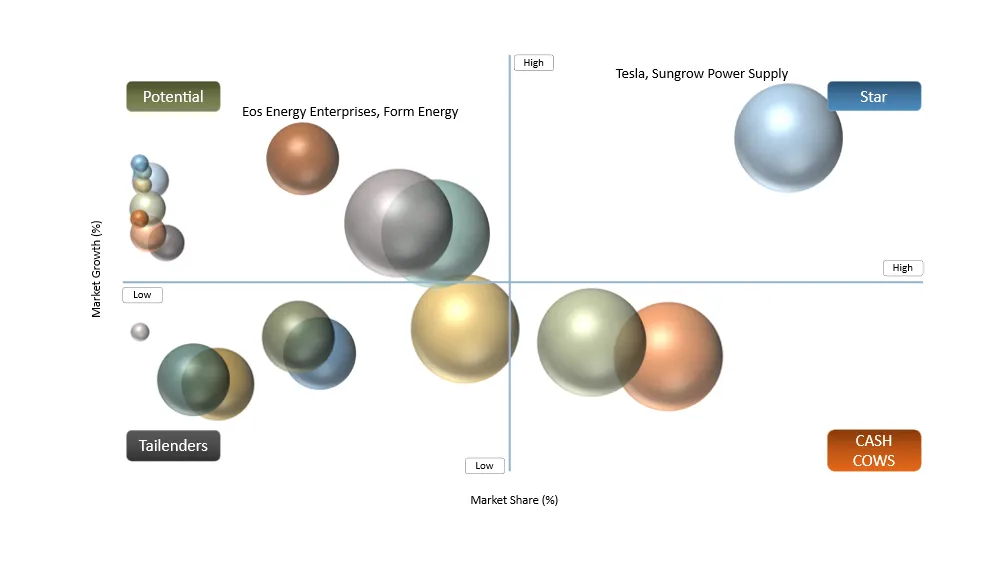
STAR
Tesla, Sungrow Power Supply, CATL, BYD and Fluence Energy can be classified as Stars in the grid scale energy storage market since they hold favorable competitive positions in an ever-growing utility scale storage market. This is because of their broad portfolios that include large-scale BESS, battery technologies, system integration, power conversion solutions and energy management systems and their project experience and existing customer connections that make them well suited to meet ongoing demand for renewables integration, energy shifting, grid balancing and capacity storage.
POTENTIAL
Eos Energy Enterprises, Form Energy, Invinity Energy Systems, Nidec ASI and Trina Storage may be classified as Potential because they have opportunities to grow their market share as the market increases its need for long-duration energy storage, utility-scale BESSs and alternatives to energy storage. The chances of their growth are aided by their unique technologies and project pipeline expansion, but their chances of becoming Stars depend on factors such as commercial scalability, manufacturing, bankability of technology, cost advantage, project execution and successful transition from announced projects to operational facilities.
Grid-Scale Energy Storage Market Dynamics
Driver Impact Analysis
| Driver | Market Growth Impact (%) | Demand Concentration | Impacted Use Case | Strategic Impact |
Rapid Renewable Energy Integration | 24% | Solar- and wind-rich grids | Renewable integration & energy shifting | Prioritize storage deployment alongside high-growth renewable capacity |
Growing Peak Electricity Demand | 19% | High-demand regions and constrained grids | Peak shaving & capacity provision | Develop storage with sufficient duration for evening and peak-demand periods |
Grid Modernization & Flexibility Requirements | 17% | Aging and congested transmission networks | Frequency regulation & grid support | Position BESS as a grid-flexibility asset rather than only an energy-storage system |
Declining BESS System Costs | 15% | Utility-scale lithium-ion projects | Energy arbitrage & renewable-plus-storage | Improve project economics through larger systems, standardized designs and long-term procurement |
Driver: Rapid Renewable Energy Integration
With the quick build-up of utility-scale solar and wind capacity, there will be increased demand for energy storage solutions on a grid scale owing to the fact that renewable energy production does not correlate with peak electricity consumption. There will be an application of large BESS to store the excess of solar energy produced at midday and release them at peak times in the evening. Energy storage combined with wind generation facilities will have the ability to reschedule the intermittent generation for higher value hours. It will also be used for purposes like avoiding renewable energy curtailment, frequency regulation, transmission congestion management and for firming the renewable energy generation. The highest demand will be witnessed in China, US, India, Australia and Europe.
Restraint Impact Analysis
| Restraint | Drag on Market Growth (%) | Primary Impact Area | Impacted Use Case | Strategic Impact |
Grid Interconnection Delays | 18% | Project development timelines | Renewable integration & capacity provision | Prioritize projects with available grid capacity and secured interconnection agreements |
High Upfront Project Costs | 15% | Project economics | Utility-scale BESS deployment | Improve system economics through cost optimization, long-term procurement and financing structures |
| Battery Degradation | 13% | Lifecycle performance | Energy arbitrage & frequent cycling | Strengthen degradation modelling, warranties, augmentation planning and battery-management systems |
Safety & Thermal Management Risks | 10% | System operation | High-density BESS installations | Invest in advanced thermal monitoring, fire detection, suppression and safety-certified system designs |
Restraint: Grid Interconnection Constraints
Grid interconnection limitations are one of the key limiting factors of the Growth of the grid scale energy storage market because large Battery Energy Storage Systems (BESS) are dependent on the availability of grid import capacity for charging and grid export capacity for injecting power into the grid. Projects that are located in renewable-rich regions may suffer from congested flow points instead of the availability of established flow points and the impact of the project on congested grids proved through time-consuming interconnection studies and network upgrades, as well as the possibility of providing energy into the electric grid at a limited time. These limitations result in delays of BESS commissioning, participation in capacity markets, receiving energy arbitrage revenues and conducting renewable-plus-storage operations due to increasing costs of project development and financing.
Grid Scale Energy Storage Market Segment Analysis
The global grid-scale energy storage market is segmented based on the Storage Technology, Battery Chemistry, Power Capacity, Storage Duration, Configuration, Application, Ownership and region.
By Battery Chemistry
LFP Emerges as the Preferred Chemistry for Mainstream Grid-Scale BESS
In 2025, the grid scale energy storage market was led by Lithium Iron Phosphate (LFP), which held a share of 75.5%. There are several reasons for this dominance, such as the long lifespan, high thermal stability, affordable cost of energy storage and high suitability for rapid packing and unpacking of energy from utility-scale battery energy storage systems (BESS) that are required for grid-level applications. In addition, the applications for LFP technology tend to be particularly suitable for applications such as energy shifting, renewable-energy integration, frequency control, provision of capacity and peak demand management, which would explain why lithium iron phosphate is currently one of the most widely used types of chemistry for grid-level battery installations.
By Battery Chemistry
Vanadium Redox Flow Gains Momentum in Long-Duration Grid Storage
Vanadium Redox Flow is expected to be the fastest in the battery chemistry segment with an estimated CAGR of 30.6 % for the years from 2026 to 2035. The factors contributing to its growth are its long discharge ability, significant high life cycle, low degradation and power and energy capacity size independent scaling. These properties make it an attractive solution for 8-hour long storage, renewable energy shifting, extended grid balancing and repeated deep cycling applications, where a longer operating period and longer asset life matter more than compactness of the system.
Grid-Scale Energy Storage Market Geographical Penetration
U.S. Grid-Scale Energy Storage Market Landscape
Key characteristics of the U.S. grid scale energy storage market include rapid utility-scale BESS installations in the U.S., especially in California and Texas, due to high levels of renewable energy, electricity peaks, curtailment and constrained transmission. The total capacity of batteries used in utility-scale projects in the U.S. amounted to 43.6 GW at the end of 2025 because of the growing importance of storage for shifting electricity, energy capacity, frequency regulation and grid balancing. The competitive environment comprises BESS manufacturers, system integrators, power conversion equipment providers and energy storage developers. 4-hour storage, renewable-energy plus storage, grid-forming solutions and long duration technologies are the focal points of project development.
Japan Grid-Scale Energy Storage Market Outlook
There is great potential for growth in the Japan grid scale energy storage market due to higher renewable energy penetration levels, limited grids and the need for more flexible power systems, thus requiring grid-scale BESS. There is a rapid deployment of grid-scale batteries due to subsidies, capacity markets and more involvement of storage technologies in the wholesale and balancing markets. Japan's grid scale energy storage market is highly favorable for solutions that provide energy time-shifting capability, frequency regulation, capacity availability and renewable energy integration and the constrained nature of the grid makes strategic location an even more important factor. High costs, limited grid connections and changing regulations of the electricity market have to be taken into consideration.
China Grid-Scale Energy Storage Market Trends
The China grid scale energy storage market is evolving towards the development of bigger standalone BESS, longer storage time and higher integration with renewable sources as the renewable energy capacities increase. By the end of 2025, the cumulative installed capacity of China's new-type energy storage capacity was 144.7 GW, with the addition of 66.43 GW/ 189.48 GWh in the year. The trend of standalone storage capacity is growing, taking up 58% of all new-type storage use cases in 2025, while the average storage time increased to 2.58 hours. The market is also evolving towards storage systems that can deliver energy shifting, peak management, frequency control and curtailment reduction, with decreasing costs of equipment and the vast domestic manufacturing industry of batteries in China.
India Grid-Scale Energy Storage Market Analysis
The grid scale energy storage market of India is now moving towards large scale BESS and pumped-storage projects as rapid growth of renewable energy capacity has enhanced the requirement for peak shifting, renewables integration and grid balancing. As per data available up to January 2026, there was a total capacity of 10.66 GW/28.74 GWh of BESS under construction, 22.35 GW/69.84 GWh of BESS under tendering and 13.12 GW/78.72 GWh of pumped storage projects under construction, indicating a large number of projects in the pipeline. In addition, the market will also be driven by government funding for BESS feasibility gap at 43 GWh, ISTS-charge waiver, ancillary service eligibility and deployment guidelines for solar + storage.
Grid-Scale Energy Storage Market Competitive Landscape
- Chinese Integrator Dominance: Chinese companies have been strong players in global BESS system integration due to their high manufacturing scale, end-to-end integrated supply chains and competitive pricing of systems. Chinese integrators made up 76% of the total global BESS system-integrator market share in 2025, as per Wood Mackenzie.
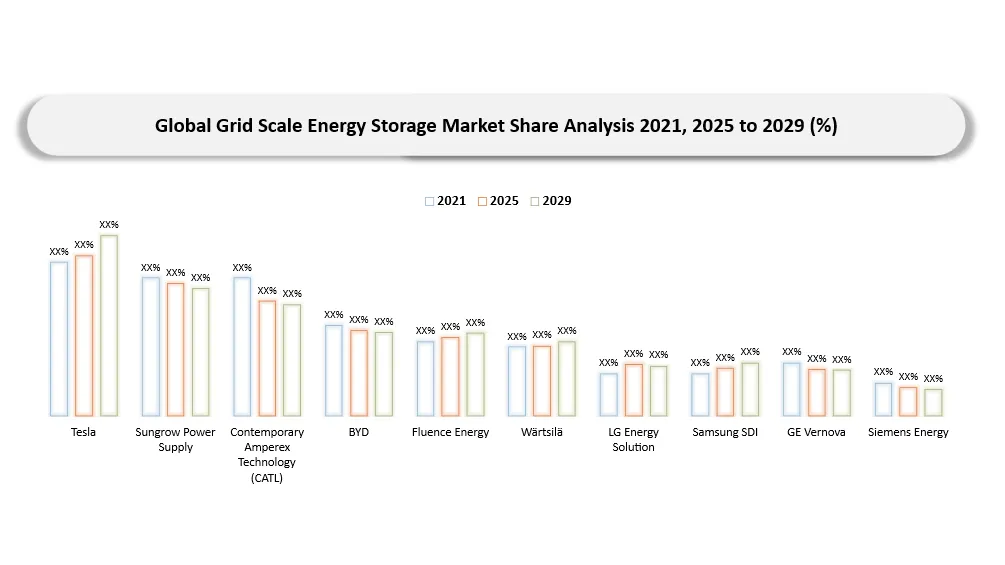
- Strong Position of Global BESS Leaders: BYD, Tesla and Sungrow ranked first, second and third, respectively, on the list of global BESS system shipment in 2025, making up around one-third of total system shipments. The competitive strengths of these companies include high project execution capability, proven technology platforms and global deployment network.
- Growing Importance of System Integration: Competition in the industry is moving away from simply the battery cell production to full system integration, power conversion systems, energy management software, grid forming and operation and maintenance services. This provides an advantage to businesses able to provide systems and software beyond battery cells.
- Technology-Based Differentiation: Firms are leveraging LFP, sodium-ion, flow, iron-air, liquid-air, gravity and many more long-duration technologies for differentiation, especially because consumers are looking to buy storage that extends beyond the traditional 2–4-hour BESS.
- Bankability and Project Execution as Key Differentiators: Competitive advantages are not just about the cost of batteries anymore but rather about the bankability of the supplier, warranties on degradation and performance, production capacity, successful delivery of projects, financing, compliance and ability to form the grid. This is especially crucial for utility-scale projects.
Public Company Q1-Q2 2026 Performance Comparison
The following table provides comparison of five companies that are listed in stock exchanges and have business dealings in the Grid Scale Energy Storage Market. Financial parameters are stated on a company basis whereas operational parameters are stated wherever relevant to the grid scale storage market.
| Company | Q1–Q2 2026 Performance | Grid-Scale Energy Storage Exposure | Key Performance Driver |
| Tesla | Q2 2026 energy-storage deployments reached 13.5 GWh, while total Q2 revenue reached US$28.24 billion. | Megapack utility-scale BESS, Powerwall, and energy-management solutions | Strong Megapack deployment growth, utility-scale storage demand, and expansion of domestic battery manufacturing |
| CATL | H1 2026 revenue reached approximately US$39.9 billion, up 55% YoY, with energy storage emerging as a major growth contributor. | Grid-scale battery cells, LFP systems, TENER, and energy-storage solutions | Rapid growth in energy-storage shipments, LFP adoption, and expansion of large-scale BESS supply |
Sungrow Power Supply | Q1 2026 revenue reached approximately US$2.25 billion, with net profit of approximately US$332 million. | PowerTitan utility-scale BESS, PCS, and integrated energy-storage systems | Utility-scale BESS deployment, high-density storage systems, PCS demand, and international expansion |
| Fluence Energy | Q2 FY2026 revenue reached approximately US$464.9 million, up 7.7% YoY. | Grid-scale BESS, Smartstack/Gridstack systems, energy-storage software, and lifecycle services | Large utility-scale project pipeline, high-density BESS, software optimization, and grid-flexibility demand |
| Wärtsilä | H1 2026 net sales reached approximately US$3.51 billion; order intake was approximately US$5.77 billion, up 23% YoY, while comparable operating result reached approximately US$481 million. | Utility-scale BESS, GridSolv Quantum, GEMS energy-management software, and lifecycle services | Growing need for renewable balancing and flexible grid capacity, although Energy Storage faced tariff, regulatory, and competitive pressures. |
Note: Financial periods differ because companies follow different fiscal calendars. Company-level revenue should not be interpreted as grid-scale storage revenue unless separately disclosed; the comparison combines financial performance with storage-specific operating indicators to assess each company's position in the market.
Key Companies of Grid Scale Energy Storage Market
- Tesla (U.S.)
- Sungrow Power Supply (China)
- Contemporary Amperex Technology (CATL) (China)
- BYD (China)
- Fluence Energy (U.S.)
- Wärtsilä (Finland)
- LG Energy Solution (South Korea)
- Samsung SDI (South Korea)
- GE Vernova (U.S.)
- Siemens Energy (Germany)
- Hitachi Energy (Switzerland)
- ABB (Switzerland)
- Invinity Energy Systems (UK)
- Powin (U.S.)
- Eos Energy Enterprises (U.S.)
- Form Energy (U.S.)
- Saft (France)
- Trina Storage (China)
- Huawei Digital Power (China)
- Nidec ASI (Italy)
Company Profiles
Sungrow Power Supply
Sungrow is a major global supplier of grid-scale energy storage systems, including its PowerTitan BESS solution, power conversion system (PCS), and energy management system. Sungrow came top in the 2026 Global BESS Integrator Comprehensive Ranking published by Wood Mackenzie.
The competitive priorities involve high density BESS technology, liquid-cooled technology, advanced PCS, grid forming capability, better thermal management, and increasing large-scale storage adoption internationally.
Tesla
Tesla is one of the largest grid-scale energy storage companies because of the Megapack batteries it supplies for utilities at scale. The company’s battery technology includes battery manufacturing, power electronics, software, and energy management. These systems cater to renewable integration, energy shifting, capacity provision, and grid balancing.
Priority areas are the expansion of Megapack production, storage deployment volumes, higher energy density, domestic battery sourcing, and software-based dispatch optimization.
Contemporary Amperex Technology (CATL)
CATL is a battery manufacturer who offers LFP batteries, TENER energy storage systems, and comprehensive BESS systems. Being a vertically integrated battery manufacturer, CATL has the ability to deliver batteries with high cycle life, safety, energy density, and lifecycle economics to its utility customers. CATL was ranked third in the Wood Mackenzie 2026 global BESS integrators ranking.
Main objectives include minimizing degradation, increasing the amount of energy per cell, enhancing production on a global scale, improving long-term storage solutions, and deploying renewable energy storage systems in larger capacities.
BYD
BYD engages in the grid-scale storage industry through Battery-Box and utility-scale BESS systems by integrating batteries, power electronics, and energy management. The company’s LFP-based systems have applications in renewable energy integration, energy shifting, peak management, grid balancing, and energy arbitrage.
Competitive priorities include dense LFP batteries, BESS scaling, safety, production scaling, and pairing storage with renewable generation sources including solar energy. BYD was rated fourth in the Wood MacKenzie 2026 global ranking.
Envision
The Envision company offers energy storage and renewable energy solutions, with greater involvement in utility scale BESS and renewable energy storage. The strengths of its positioning lie in the broad range of expertise in batteries, renewable energy generation, digital energy management, and system integration.
Priorities for competitiveness will involve scaling up utility storage, increasing efficiency in batteries, enhancing renewable energy plus storage integration, international project implementation, and solutions that meet local grid needs. Visions for a tied fifth position at Wood Mackenzie’s ranking in 2026.
Trina Storage
Trina Storage specializes in utility-scale battery energy storage systems and provides solutions for shifting renewable energy, flexibility, capacity, and solar-plus-storage applications. The company's competitive advantage includes the entire solar value chain of Trina and integration of energy storage into the renewable generation.
The competitive priorities are high density storage systems, system safety, large scale project implementation, solar and storage systems integration, and the penetration of international utility scale markets. Trina Storage was ranked at number five by Wood Mackenzie for its global BESS integrators’ ranking in 2026.
Grid-Scale Energy Storage Market Major Pain Points
- Grid Interconnection Delays: Long interconnection queues, transmission restrictions and insufficient grid capacity may result in project delays and postponement of commissioning. The IEA notes grid connection queues as one of the key bottlenecks to the development of both generation and storage facilities globally.
- Uncertain Storage Revenue Streams: Many storage facilities depend on several types of revenue streams, such as energy arbitrage, capacity payments, frequency regulation and reserves, but there is no unified set of rules on revenue calculation and compensation.
- Battery Degradation and Lifecycle Risk: Repetitive charging can diminish the usable capacity of the battery overtime, presenting problems such as guarantee of degradation, augmentation, insurance coverage and performance of the asset.
- Safety and Operational Complexity: Larger batteries are required to have advanced thermal control, fire detection and extinguishing systems, as well as response systems, due to rising safety standards in energy storage.
- Long-Duration Technology Bankability: The flow battery, iron-air battery, liquid-air energy storage, gravity storage and other long-duration energy storage technologies have many hurdles when compared to conventional lithium-ion batteries.
Grid-Scale Energy Storage Market Recent Developments
- June 2026 - Fluence Energy: Unveiled Smartstack 10 MWh energy storage platform, helping to accommodate the growing industry trend toward bigger capacity in containerized solutions.
- June 2026 - Invinity Energy Systems: Secured an order to provide North America's largest vanadium flow battery systems for the sustainable production of clean steel in California.
- March 2026 - Form Energy: Signed an agreement to provide 12 GWh multi-day iron air batteries to Crusoe, marking a shift towards greater business interest in multi-day energy storage solutions for firming power use cases, particularly the fast-growing AI data center loads.
- January 2026 - Tesla: Announced installation of 46.7 GWh of utility-scale energy storage deployments in 2025, which saw an increase by 49% from the previous year, emphasizing further expansion of megapack installations and rising demand for BESS in containers.
- January 2026 - Sungrow Power Supply: Released PowerTitan 3.0 solution in Europe, offering 7.14 MWh of capacity in a 20 ft. container and employing integrated liquid cooling technology with SiC power conversion, in line with the growing trend towards high-density and integrated BESS solutions.
Analyst View/Opinion on Grid-Scale Energy Storage Market
- The LFP battery-based BESS will continue to be the major near-term technology, driven by manufacturing capabilities, proven project experience and compatibility with frequent energy swapping and grid support services.
- Energy storage that can operate over long durations is going to be an essential requirement as renewable energies begin to penetrate further. Flow batteries, pumped hydro, CAES, LAES, gravitational storage and iron air battery technologies are poised to fulfill this role.
- Storage is becoming an essential part of the grid infrastructure, serving as a means of energy storage, capacity, frequency regulation, voltage support, black start ability and renewables integration and not just backup capacity.
- Renewable plus storage hybrid plants will become increasingly important, especially solar plus storage and wind plus storage plants, as project developers attempt to turn the intermittent renewable energy into dispatchable capacity.
- Competitive advantage is gradually shifting towards a combination of battery hardware and PCS, energy management software, grid-forming controls, degradation management, safety and O&M over time rather than purely based on the pricing of the batteries.
Grid Scale Energy Storage Market Target Audience
| INDUSTRY | WHO SHOULD BUY THIS REPORT? | REASON TO BUY THIS REPORT |
Battery & BESS Manufacturers | BESS manufacturers, battery-cell producers, battery-system suppliers | Identify demand by storage technology, chemistry, duration, power capacity and regional deployment to guide capacity expansion and product strategy. |
Energy Storage System Integrators | BESS system integrators and turnkey solution providers | Benchmark competitors, project pipelines, system configurations and procurement requirements to strengthen utility-scale project bids. |
Renewable Energy Developers | Solar, wind and hybrid renewable project developers | Evaluate solar-plus-storage, wind-plus-storage and hybrid configurations and identify markets where storage can improve dispatchability and reduce curtailment. |
| Utilities & Grid Operators | Electric utilities, transmission operators, distribution companies | Assess storage requirements for capacity provision, frequency regulation, peak shifting, grid resilience and renewable integration. |
Independent Power Producers (IPPs) | IPPs and power-generation companies | Identify attractive storage applications and evaluate energy arbitrage, capacity, ancillary-service and hybrid-project revenue opportunities. |
Long-Duration Energy Storage Companies | Flow battery, iron-air, CAES, LAES, gravity and other LDES providers | Identify opportunities to commercialize technologies for 8–24-hour, 24–100-hour and 100+ hour storage applications. |
Power Electronics & PCS Suppliers | PCS, inverter, transformer, switchgear and grid-control suppliers | Understand BESS deployment trends and requirements for grid-forming, voltage support, frequency response and high-power conversion systems. |
Battery Materials & Component Suppliers | Cathode, anode, electrolyte, separator, thermal-management and battery-component suppliers | Assess future demand by battery chemistry and storage technology and identify regional supply opportunities. |
Investors & Financial Institutions | Infrastructure funds, private-equity firms, project financiers, banks | Evaluate project pipelines, technology maturity, regional opportunities, competitive positioning and investment risks before financing storage assets or companies. |
EPC & O&M Providers | EPC contractors, commissioning firms and storage O&M providers | Identify upcoming projects and assess demand for installation, commissioning, augmentation, monitoring, maintenance and lifecycle services. |
Why Choose DATAM?
- Data-Driven insights: Dive into detailed analyses with granular insights such as pricing, market shares and value chain evaluations, enriched by interviews with industry leaders and disruptors.
- Post-Purchase Support and Expert Analyst Consultations: As a valued client, gain direct access to our expert analysts for personalized advice and strategic guidance, tailored to your specific needs and challenges.
- White Papers and Case Studies: Benefit quarterly from our in-depth studies related to your purchased titles, tailored to refine your operational and marketing strategies for maximum impact.
- Annual Updates on Purchased Reports: As an existing customer, enjoy the privilege of annual updates to your reports, ensuring you stay abreast of the latest market insights and technological advancements. Terms and conditions apply.
- Specialized Focus on Emerging Markets: DataM differentiates itself by delivering in-depth, specialized insights specifically for emerging markets, rather than offering generalized geographic overviews. The approach equips our clients with a nuanced understanding and actionable intelligence that are essential for navigating and succeeding in high-growth regions.
- Value of DataM Reports: Our reports offer specialized insights tailored to the latest trends and specific business inquiries. The personalized approach provides a deeper, strategic perspective, ensuring you receive the precise information necessary to make informed decisions. The insights complement and go beyond what is typically available in generic databases.
What DATAM Uniquely Provides
- Technology and Duration Intelligence: In-depth analysis of BESS, Pumped Hydro, CAES, LAES, Gravity, Flywheel, Thermal, Hydrogen and Supercapacitor storage for short-, medium- and long-duration applications.
- Project-Level Market Intelligence: Monitoring of storage project installations, pipelines, tenders, announcements, project configurations, project developers and technology providers in key countries and regions.
- Grid-Service Revenue Mapping: Analysis of storage requirements in relation to energy arbitrage, renewable energy integration, capacity delivery, frequency control, peak-shaving, black start and transmission & distribution support and mapping these services with revenues.
- Competitive and Supplier Benchmarking: Comparison of BESS manufacturers, system integrators, technology providers and long-duration energy storage companies based on technology offering, project footprint, capability and partnerships.
- Investment and Emerging-Technology Intelligence: High-potential storage technology identification, regional expansion, purchasing opportunities and investment whitespace identification, backed up with technology maturity analysis, economics of projects, policy considerations and market adoption.


























































