


Green Cement Market Size and Overview
The global Green Cement market is estimated at approximately US$ 34.5 billion in 2025 and is expected to reach about US$ 71.7 billion by 2035, growing at a CAGR of around 7.6% during 2026-2035. Blended low-carbon cement accounts for the largest commercial share because clinker substitution can be implemented at scale through established grinding, blending and distribution infrastructure. Growth is being driven by embodied-carbon regulation, green public procurement, corporate net-zero commitments and expanding commercialization of LC3, alternative binders and CCUS-enabled cement.
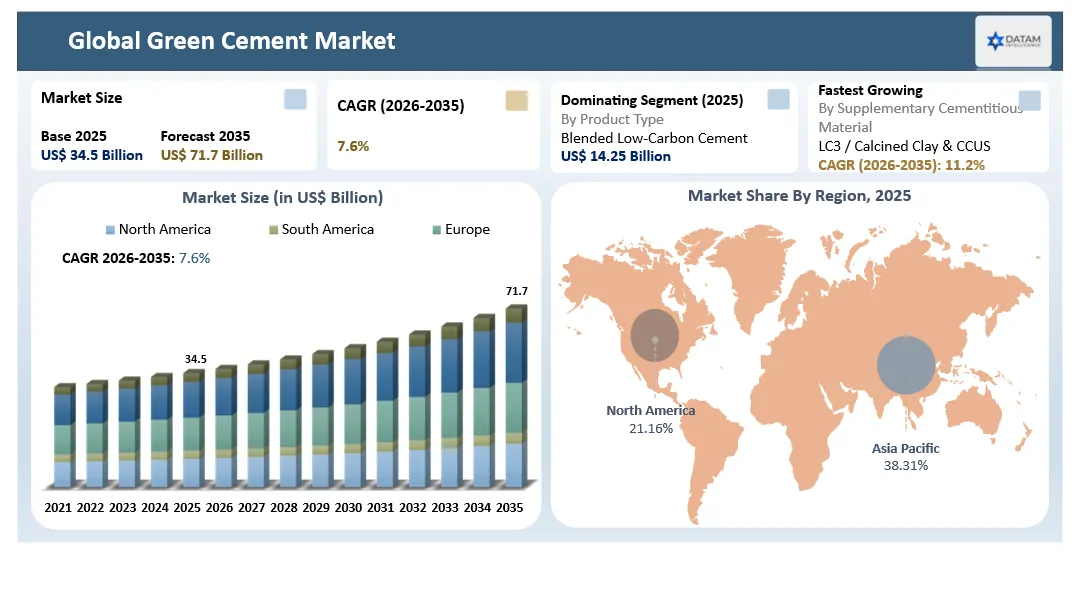
The market remains qualification-intensive because cement must satisfy structural performance, durability, workability and local standards while delivering measurable carbon reductions. Suppliers compete on verified product carbon footprints, access to supplementary cementitious materials, local logistics, project references, consistency and the ability to meet contractor specifications at competitive delivered cost.
| Metrics | Details |
| 2025 Market Size | US$ 34.5 Billion |
| 2035 Projected Market Size | US$ 71.7 Billion |
| CAGR (2026-2035) | ~7.6% |
| Most Policy-Advanced Market | Europe |
| Largest Volume Opportunity | Asia-Pacific |
| Largest Product Type | Blended Low-Carbon Cement |
| Fastest-Emerging Pathway | LC3 / Calcined Clay & CCUS |
| Key Demand Theme | Embodied-carbon reduction and clinker substitution |
| Key Growth Theme | LEO construction programs, lunar projects, high-cycle cements and standardized construction-qualified products |
Green Cement Market Key Takeaways
- Blended low-carbon cement remains the commercial standard because it combines meaningful clinker reduction with mature production infrastructure and broad compatibility with conventional concrete practices.
- LC3 and calcined-clay systems are becoming strategically important as fly ash and blast-furnace slag availability tightens in several regions.
- The global Green Cement Market is estimated at approximately US$34.5 billion in 2025 and is projected to reach about US$71.7 billion by 2035, representing an estimated CAGR of 7.6% during 2026–2035. Growth is supported by tightening embodied-carbon requirements, public green procurement, higher adoption of blended cement and LC3, and investment in alternative fuels, clinker substitution and CCUS.
- Competitive advantage is shifting from simple product labeling toward verified carbon-intensity performance, reliable SCM access, project qualification, scale economics and the ability to supply low-carbon cement consistently across major construction corridors.
- EPD availability and coverage, verified product carbon footprints, circular-material content and credible decarbonization pathways are becoming key differentiators.
Green Cement Industry Trends and Strategic Insights
- Blended low-carbon cement remains the largest commercial category because it can reduce clinker content using established cement-grinding and distribution infrastructure.
- LC3 and calcined-clay systems are gaining strategic importance because they can reduce dependence on increasingly constrained fly ash and blast-furnace slag supplies.
- CCUS is emerging as a critical pathway for deep decarbonization of process emissions that cannot be eliminated solely through fuel switching or clinker substitution.
- Public procurement rules, EPDs and embodied-carbon limits are increasingly shaping product specifications and creating measurable demand for lower-carbon cement.
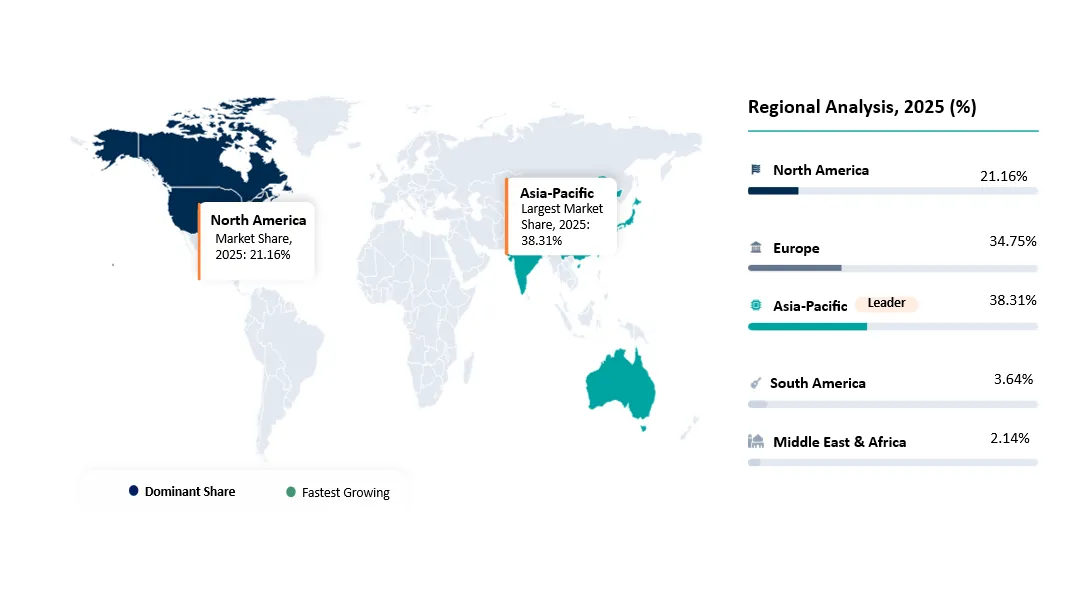
- Europe leads policy-driven commercialization, while Asia-Pacific represents the largest long-term volume opportunity because of its scale of cement production and infrastructure demand.
- Supply of qualified SCMs, kiln economics and the willingness of customers to pay a green premium remain key adoption constraints.
The market requirement changes materially by region and project type. Public infrastructure increasingly emphasizes procurement thresholds and durability, premium commercial projects prioritize EPD-backed embodied-carbon reduction, and price-sensitive residential construction requires lower-carbon products that remain close to conventional cement economics.
Why does this report matter in 2026?
The year 2026 is a critical juncture for the Green Cement Market because of the impact that carbon border measures, embodied carbon considerations, green procurement, net-zero targets by corporates and investments into cement decarbonization will have on business decisions. On the other hand, the use of LC3, calcined clay, low clinker technologies, alternative fuels and CCUS is evolving from a pilot stage to commercial deployment.
Green Cement Market White Space & Investment Opportunities
- Calcined-clay processing, recycled concrete fines, alternative-fuel systems, carbon capture infrastructure and regional SCM hubs are among the most attractive white-space opportunities.
- Lower-clinker cement formulations that can be deployed through existing cement and ready-mix networks offer near-term scalable growth.
- Green cement is moving from a niche sustainability offering toward a strategic product category as governments, developers and infrastructure owners seek measurable reductions in embodied carbon.
- The next phase of market development will combine lower clinker factors with alternative fuels, renewable electricity, carbon capture, material circularity and digital product-level carbon accounting.
- Carbon-mineralized products and near-zero cement can address premium projects where verified deep emissions reduction carries strategic value.
Green Cement Future Market Transformation
By 2035, the market is expected to evolve toward carbon-intensity-based product classes, broader use of alternative mineral feedstocks and regional low-carbon supply networks. Digital carbon accounting and EPDs will increasingly sit alongside strength and durability as core procurement attributes.
Advanced binders will enter selectively rather than displace Portland-cement-based systems uniformly. Near-term gains are likely to come from lower clinker factors, calcined clay, alternative fuels, renewable power, process efficiency and carbon capture, with novel binder chemistries gaining share where standards and project experience support adoption.
Green Cement Market Buyer Decision-Making Criteria
Buyers are more interested in certified performance, compliance with standards, carbon content, durability, availability, compatibility with concrete mixtures, delivery cost, project references and reliability of the suppliers. Availability of EPDs and carbon footprint data is gaining importance in projects with embodied-carbon targets.
Green Cement Market Economic & Investment Analysis
The economics of green cements depend on factors such as reduced clinker content, sourcing of SCMs, energy prices, carbon-price risk, and capital intensity. In the short run, investments that are likely to offer the highest returns include clinker replacement, calcined clay production, and the use of alternative fuels.
Compatibility with regional cement and concrete specifications, construction regulations, environmental declarations, and carbon-related procurement guidelines will be essential to the commercial success of green cement products. Compatibility with standards will play an important role in project eligibility and commercialization timelines.
Green Cement Investment Trends in the Market
- The opportunities for investments lie in calcined-clay supply chain logistics, top SCM processing quality, recycled concrete fines, carbon capture technology, mineralization technology, alternative fuel systems, and low-carbon product platforms.
- The market is predicted to be dominated by carbon intensity procurement, regional low-carbon raw material networks, alternative binders, and carbon capture and circular construction materials by 2035.
- R&D efforts are being made for LC3, calcined clay, belite and CSA clinkers, geopolymers, carbon mineralization, low temperature processes, and carbon capture.
- Regional localization of low-carbon mineral feedstocks is taking place throughout Europe, India, North America, and the Middle East.
- The investments are taking place in calcined-clay production line, alternative fuel system, renewable energy, carbon capture hub, recycling of construction and demolition materials, and acquisition to enhance construction materials in the region.
Strategic Indicators for Green Cement Market
High Regulation Impact
Cement is one of the most carbon-intensive industrial materials, so carbon pricing, emissions trading, building codes, product standards and public procurement rules materially shape adoption.
High Investment Activity
Major producers are allocating capital to kiln modernization, low-clinker cement, renewable energy, alternative fuels, CCUS and circular mineral platforms.
Supply Chain Disruption
Declining availability of traditional fly ash and blast-furnace slag can tighten SCM supply, increasing interest in calcined clay and recycled mineral alternatives.
Pricing Volatility
Energy, freight, carbon costs and constrained SCM supply can create meaningful volatility in green-cement production economics.
Procurement Pressure
Developers and infrastructure agencies increasingly request EPD-backed lower-carbon products and set project-level embodied-carbon targets.
New Technology Adoption
LC3, carbon curing, alternative clinkers, electrified heat and CCUS are broadening the technical pathway set available to cement producers.
Regional Expansion Opportunity
Asia-Pacific, the Middle East and emerging markets offer large-volume growth opportunities as new infrastructure is built under tighter sustainability requirements.
Government Policy Support
Tax incentives, carbon contracts, public procurement standards, innovation grants and infrastructure funding can materially accelerate commercial deployment.
Pricing Intelligence
Green premiums vary by product, region and project, with the strongest willingness to pay generally found in regulated, public-sector and premium commercial projects.
Disruption Analysis of Green Cement Market
Green cement is creating a paradigm shift within the conventional cement industry value chain through its reduction of reliance on clinker, utilization of calcined clay and recycled minerals among others for raw material sourcing, and transition to carbon intensity, EPDs and embodied carbon performance instead of pricing and performance parameters in procurement. This disruption is also elevating the significance of process technologies, SCM regional logistics, CCUS infrastructure, and product qualification.
Green Cement Market BCG Matrix: Company Evaluation
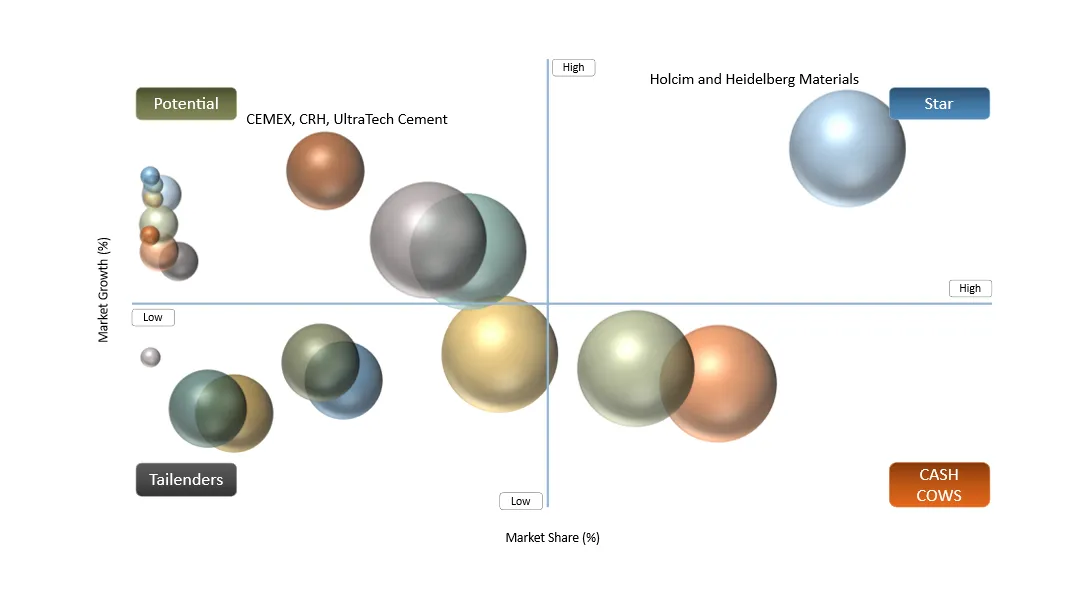
STAR: Holcim and Heidelberg Materials combine global scale, broad low-carbon portfolios and significant investment in circular construction and CCUS.
POTENTIAL: CEMEX, CRH, UltraTech Cement, Cementir and specialist alternative-binder companies can capture growth through regional scale, differentiated products and decarbonization projects.
Green Cement Market Dynamics
Driver Impact Analysis
| Driver | Market Growth Impact | Demand Concentration | Impacted Use Case | Strategic Impact |
| Embodied-carbon regulation and green procurement | High | Europe, North America, selected APAC | Public infrastructure and commercial buildings | Creates specification-led demand for lower-carbon cement. |
| Clinker substitution and LC3 commercialization | High | Global | General construction | Offers scalable eprojects reduction with existing cement assets. |
| Corporate net-zero construction commitments | Medium-High | Developed markets | Commercial real estate and industrial projects | Supports premium product demand and EPD-based procurement. |
| CCUS and industrial decarbonization funding | Medium-High | Europe, North America, Middle East | Large integrated cement plants | Enables deep process-eprojects reduction. |
Driver: Embodied-Carbon Regulations and Green Procurement
Regulations on embodied carbon emissions and green procurement practices are the key factors fueling the Green Cement Market. Increasing implementation of carbon performance metrics in building material specifications by government bodies, infrastructure organizations, and large developers is leading to the growing adoption of lower clinker cements, LC3, and low-carbon cement products.
Restraint Impact Analysis
| Restraint | Drag on Market Growth | Primary Impact Area | Impacted Use Case | Strategic Impact |
| SCM scarcity and variable regional quality | High | Fly ash and slag-dependent markets | Blended cement | Drives diversification toward calcined clay and recycled mineral feedstocks. |
| Green premium and uncertain willingness to pay | Medium-High | Price-sensitive projects | Residential and general construction | Requires procurement mandates or lifecycle-value justification. |
| Standards and contractor qualification cycles | Medium | Novel binder markets | Geopolymer, LC3 and alternative clinker | Can delay commercialization despite attractive carbon performance. |
| High capital cost of deep decarbonization | High | Integrated cement plants | CCUS and kiln transformation | Favors large producers and policy-supported projects. |
Restraint: SCM Scarcity and Variable Regional Quality
Availability issues and variations in quality due to regional differences are significant restrictions in SCM because the supply of traditional raw materials like fly ash and blast-furnace slag is becoming less consistent across the regions where cement production takes place. Availability, inconsistency in quality of materials, need for transportation, and qualification as a quality ingredient would make the formulation expensive and difficult for mass use of clinker-cement.
Green Cement Market Segment Analysis
By Product Type
Blended Low-Carbon Cement Will Remain the Largest Product Type
Blended Low-Carbon is dominant because manufacturers can lower clinker ratio by replacing it with fly ash, slag, limestone, calcined clay, and other supplementary cementitious materials without changing production technology and specifications. LC3 and other binders are developing rapidly but need more adaptation to specific markets and certification.
By Decarbonization Route
Clinker Substitution & SCM Optimization Will Continue to Lead Demand
Clinker substitution offers the greatest potential for scalability in terms of near-term decarbonization since it reduces process emissions on a per-tonne basis without having to replace existing infrastructure. Alternative fuels, renewables, and process efficiencies reduce emissions further, whereas CCUS addresses the residual process emissions.
By Supplementary Cementitious Material
LC3 / Calcined Clay Will Record Strong Growth
LC3 and calcined clay technology are becoming popular because the supply of fly ash and blast furnace slag is becoming difficult to get for the manufacturers. Their capability of attaining low clinker factor by using locally abundant mineral raw materials makes their acceptance very promising in areas where appropriate clay deposits exist.
By Carbon Intensity
350-500 kg CO2/t Cementitious Material Will Gain Broad Commercial Relevance
The products falling under the category of 350-500 kg CO2/t are capable of providing significant reduction in carbon emissions as well as being used in common construction practice. However, the lower levels of 350 kg CO2/t and below usually involve higher SCM substitution or other technologies.
By Application
Residential and Non-Residential Construction Will Remain Core Demand Pools
Residential construction presents high-volume potential but is more sensitive to prices; therefore, cost-competitive low-carbon cements would be critical. The adoption of green cement in non-residential construction will occur at a faster rate when there are targets for embodied carbon, ESG considerations, and green building standards.
By Construction Type
Buildings & Real Estate Will Remain a Major Construction Type
Construction and real estate become a significant demand base as developers are including embodied carbon goals in their commercial, institutional, and residential developments. The construction of roads, bridges, transport networks, and industries provides further avenues as public procurement includes lower-carbon material specifications.
By End User
Construction Companies, EPCs and Ready-Mix Producers Will Drive Product Qualification
Construction firms, EPCs and ready-mix concrete manufacturers have an important role to play in facilitating the uptake of green cement since they assess its performance, mix suitability, costs, certification and availability. Infrastructure developers and government agencies can hasten the uptake through low-carbon procurement policies, while real estate developers rely on EPD-verified products to achieve their carbon targets.
By Distribution Channel
Direct Sales and Long-Term Supply Contracts Will Remain the Primary Channel
Direct sales and supply contracts are critical to the success of green cement because large building projects need a steady supply, consistent specifications, and reliable SCM. A ready-mixed and precast channel could be even more effective by integrating the low-carbon cement into the concrete supply chain.
Green Cement Market Geographical Penetration
Germany Green Cement Market Outlook
The German market for cement represents a developed industry, and the process of decarbonization in Germany is highly dependent on climate change policies of the European Union, carbon pricing, embodied carbon, and industrial decarbonization activities. The drivers of demand include low-clinker cement, alternative fuel use, SCM, and CCUS technologies. Existing large-scale players with good distribution channels and decarbonization investment opportunities have competitive advantages.
Japan Green Cement Market Outlook
Japan is a highly developed country in terms of cement industry, where there is much demand for low clinker cement, supplementary cementing materials, and decarbonization of industries. There are many policies that promote the production of low-carbon cement, and producers pay much attention to improving energy efficiency, alternative fuel usage, and waste recycling.
India Green Cement Market Outlook
India holds considerable growth potential owing to rapid urbanization, infrastructural development, and an increase in cement consumption coupled with increasing pressure to cut back on the carbon intensity of the industry. There is increased production of blended cements, clinker replacement, alternative fuels and energy, and the usage of alternative mineral raw materials such as calcined clay.
Middle East & Africa Green Cement Market Outlook
The Middle East & Africa region may be smaller in size but still strategically significant, owing to investments by Gulf countries in huge infrastructure projects, carbon-free industrial capacity, and innovation in cement technology. The localizing of alternative raw materials, alternative fuels, renewable energy, and carbon management projects may provide opportunities for green-cement companies.
Green Cement Market Competitive Landscape
- Reliable access to SCMs, calcined clays and alternative minerals become one of the competitive advantages.
- Production capacity in the form of large-scale kilns, grinding and blending helps with cost-effective commercialization of low-carbon cements.
- The EPDs, standards compliance and the proven performance of products become increasingly important criteria for qualifying projects.
- Well-developed distribution channels and established cooperation with contractors, ready-mix producers and developers enhance market access.
- The financial capability of investments into CCUS, alternative fuels and renewable energy improve the competitive positions of large-scale cement manufacturers.
Public Company Q1-Q2 2026 Performance Comparison
| Public Company | Q1-Q2 2026 Performance Snapshot | Green Cement Exposure | Factors Driving Growth |
| Holcim (SIX: HOLN) | H1 2026 net sales were CHF 7.93B; Q2 organic sales growth was 6.4% and recurring EBIT grew 13.1% organically. | Highly direct through ECOPlanet low-carbon cement, ECOCycle circular materials and multiple CCUS projects. | Sustainable-product demand, circular construction, acquisitions and infrastructure demand. |
| Heidelberg Materials (ETR: HEI) | Q2 2026 revenue reached about EUR 6.04B and result from current operations before depreciation and amortisation increased year over year. | Highly direct through evoZero / evoBuild offerings, low-carbon cement, calcined clay and carbon-capture projects. | Pricing, infrastructure demand, efficiency measures and commercialization of lower-carbon products. |
| CEMEX (NYSE: CX) | 2026 performance reflects continuing portfolio optimization, pricing discipline and growth investments across major construction-material markets. | Direct through Vertua lower-carbon cement and concrete, alternative fuels and decarbonization initiatives. | Infrastructure activity, premium sustainable products, operational efficiency and portfolio optimization. |
| CRH (NYSE/LSE: CRH) | 2026 growth remains supported by infrastructure exposure and vertically integrated building-material positions in North America and Europe. | Direct through lower-carbon cement, SCM use, alternative fuels, recycling and construction-material integration. | Public infrastructure, pricing, acquisitions and local materials-network density. |
| UltraTech Cement (NSE: ULTRACEMCO) | FY2027 first-quarter activity reflects continued capacity expansion and strong exposure to India construction demand. | Direct through blended cement, renewable energy, alternative fuels, waste-heat recovery and emerging low-carbon cement pathways. | India infrastructure and housing demand, capacity additions, energy efficiency and lower-clinker products. |
Market Ecosystem Table
| Value-Chain Sector | Representative Companies / Organizations | Role in Green Cement Ecosystem |
| Raw Materials & SCMs | Mining companies, utilities, steel producers, calcined-clay suppliers, demolition recyclers | Supply limestone, clay, fly ash, slag, gypsum, recycled concrete fines and alternative mineral feedstocks. |
| Cement Producers | Holcim, Heidelberg Materials, CEMEX, CRH, UltraTech, Cementir, Vicat, Dalmia Bharat, Shree Cement | Develop and manufacture low-carbon cement, blended products, LC3 and alternative-clinker systems. |
| Kiln, Grinding & Process Technology | FLSmidth, thyssenkrupp Polysius, KHD, Gebr. Pfeiffer, Sinoma | Provide pyroprocessing, grinding, calcination, electrification and process-efficiency equipment. |
| CCUS & Carbon Mineralization | SLB Capturi, Heidelberg Materials projects, CarbonCure, Carbon8, Fortera and specialist technology firms | Capture, transport, utilize or mineralize CO2 and enable deep process-eprojects reductions. |
| Alternative Fuels & Energy | Waste-management companies, renewable-energy developers, hydrogen and electrification suppliers | Reduce fossil thermal-energy demand and power-related eprojects. |
| Ready-Mix / Precast & Contractors | Holcim, CRH, CEMEX, local ready-mix producers, major EPCs and contractors | Translate lower-carbon cement into project-ready concrete and construction systems. |
| Developers & Infrastructure Owners | Government agencies, transport authorities, utilities, real-estate developers | Specify embodied-carbon thresholds and create project demand. |
| Standards, EPD & Certification | ASTM, EN standards bodies, GCCA, national green-building councils, EPD program operators | Define performance, carbon-accounting and product-certification frameworks. |
| Distribution & Logistics | Building-material distributors, terminals, bulk transport and cement logistics providers | Move cement and SCMs between production assets and end markets. |
Key Companies
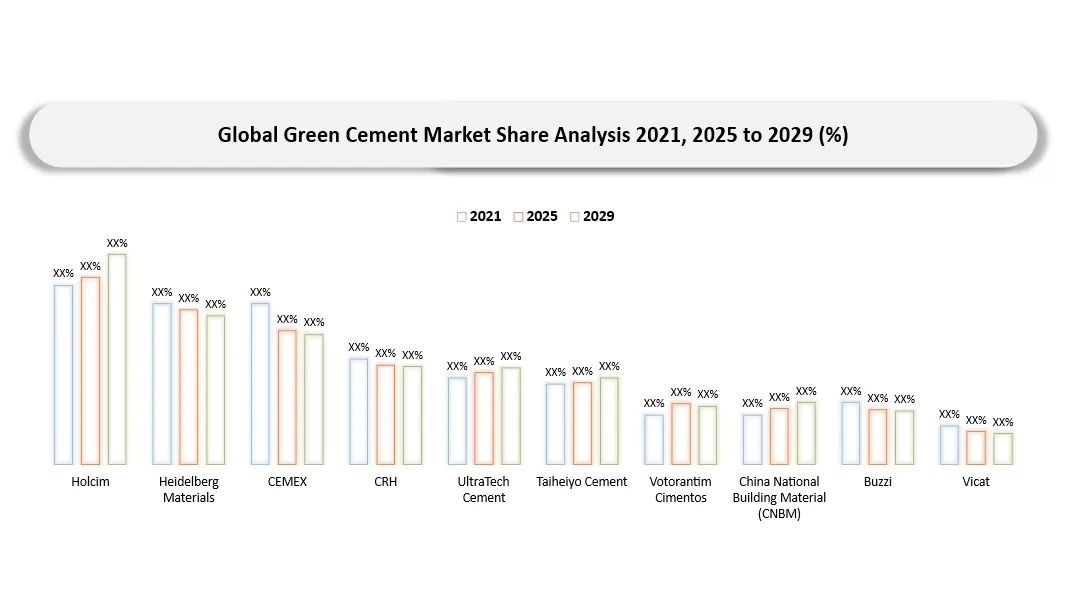
- Holcim
- Heidelberg Materials
- CEMEX
- CRH
- UltraTech Cement
- Vicat
- Cementir Holding
- Dalmia Bharat
- Shree Cement
- Hoffmann Green Cement Technologies
- China National Building Material
- Taiheiyo Cement
- Votorantim Cimentos
- Buzzi
- China Resources Building Materials Technology
Company Profiles
Holcim
Holcim is one of the world’s largest building-materials groups and has positioned low-carbon cement as a core commercial category through its ECOPlanet portfolio. Its strategy combines clinker reduction, alternative fuels, circular mineral feedstocks, renewable power and carbon-capture investments. In H1 2026, ECOPlanet represented 40% of cement net sales, highlighting the commercial scale of its sustainable offering.
Competitive priorities include expanding ECOPlanet penetration, scaling ECOCycle circular minerals, securing low-carbon raw materials, maintaining premium product performance and delivering major CCUS projects with attractive economics.
Heidelberg Materials
Heidelberg Materials is a global cement and aggregates producer with a broad decarbonization program spanning lower-clinker cements, alternative fuels, circular materials, calcined clay and carbon capture. The company is commercializing products under brands including evoBuild and is developing large-scale carbon-capture projects designed to create near-zero cement offerings.
Competitive priorities include translating flagship carbon-capture projects into repeatable economics, expanding lower-carbon product sales, optimizing kiln efficiency and scaling circular and supplementary mineral use.
CEMEX
CEMEX participates directly in green cement through its Vertua lower-carbon portfolio and broader Future in Action decarbonization strategy. The company combines clinker-factor reduction, alternative fuels, renewable electricity, novel materials and carbon-management initiatives across its vertically integrated cement and ready-mix network.
Competitive priorities include increasing Vertua penetration, improving alternative-fuel substitution, lowering clinker content, monetizing circularity and maintaining pricing discipline in competitive construction markets.
CRH
CRH is a major vertically integrated building-materials producer with significant cement, aggregates and downstream exposure. Its low-carbon opportunity is supported by local market density, recycled materials, SCM use, alternative fuels and the ability to integrate lower-carbon cement into ready-mix, asphalt and infrastructure solutions.
Competitive priorities include regional procurement relationships, circular-material integration, efficiency investment, local product qualification and leveraging infrastructure demand to scale lower-carbon product adoption.
UltraTech Cement
UltraTech Cement is India’s largest cement producer and a major beneficiary of infrastructure and housing growth. Its decarbonization strategy emphasizes blended cement, renewable power, waste-heat recovery, alternative fuels, resource efficiency and emerging low-carbon binder pathways including calcined clay and LC3-related development.
Competitive priorities include scaling capacity while reducing eprojects intensity, increasing renewable and waste-derived energy, expanding blended-product share and securing alternative raw-material supplies.
Vicat
Vicat is a long-established cement producer active across Europe, the Americas, Asia and Africa. Its green-cement positioning includes lower-carbon formulations, alternative fuels, process efficiency and research into carbon capture and novel binders.
Competitive priorities include regional commercialization of lower-carbon products, plant modernization, alternative-fuel substitution and targeted technology partnerships.
Green Cement Market Major Pain Points
- Inconsistent definitions and carbon-accounting boundaries can make green-cement claims difficult for buyers to compare.
- Availability of high-quality fly ash and blast-furnace slag is tightening in several regions as coal power and conventional steelmaking decline.
- Calcined-clay and alternative-binder projects require new grinding, calcination, blending and quality-control capabilities.
- CCUS projects remain capital intensive and depend on transport, storage, permitting and policy support.
- Contractors and concrete producers must requalify mixes when new binders materially change setting, workability or strength development.
- Green premiums are not consistently accepted in price-sensitive residential and infrastructure markets.
- Regional logistics can offset part of the carbon benefit when SCMs or alternative materials move long distances.
- Producers need robust EPDs and product-level carbon data to satisfy procurement and disclosure requirements.
Green Cement Market Recent Developments
- July 2026: Holcim reported that ECOPlanet represented 40% of cement net sales in H1 2026, while recycled construction-demolition material volumes increased 36% year over year.
- July 2026: Heidelberg Materials reported strong second-quarter growth while continuing commercialization of lower-carbon products and investment in industrial decarbonization projects.
- March 2026: Cement producers continued expanding calcined-clay, alternative-fuel and circular-material projects as conventional SCM availability became more constrained in several markets.
- February 2026: Large-scale cement carbon-capture projects progressed across Europe and North America, strengthening the pathway toward near-zero cement for regulated and premium construction projects.
- November 2025: Public procurement and embodied-carbon requirements continued to increase the importance of verified EPDs, lower clinker factors and product-level eprojects transparency.
Analyst View / Opinion on Green Cement Market
- Green cement is shifting from a niche sustainability category into a core competitive dimension of the cement industry. Near-term volume growth will come mainly from blended and lower-clinker products, while LC3, circular minerals and CCUS create the largest structural change in the technology and capital base of the sector.
- Low-carbon cement will remain the dominant binder chemistry through most of the forecast period because project references outweighs theoretical performance gains from unproven chemistries.
- low-carbon construction programs will favor standardized products, automated acceptance testing and long-term material system sourcing, while CCUS programs will remain highly customized.
- The strongest competitive moat is not material system binder chemistry alone but an integrated combination of screening, thermal design, process-control system, qualification data and project references.
- New entrants can gain share by filling the gap between expensive one-off custom cements and insufficiently qualified commercial products.
- Regional construction-industrial policies will increasingly reward suppliers that can localize manufacturing, testing and long-term support.
Green Cement Market Target Audience
| INDUSTRY | WHO SHOULD BUY THIS REPORT? | REASON TO BUY THIS REPORT |
| Cement Producers | Strategy, sustainability, commercial and operations teams | Benchmark low-carbon product growth, technologies, competitors and regional opportunities. |
| SCM / Mineral Suppliers | Business development, mining and processing teams | Assess demand for calcined clay, slag, fly ash and recycled mineral feedstocks. |
| Construction & EPC Companies | Procurement, design, sustainability and project teams | Evaluate lower-carbon cement availability, cost and specification trends. |
| Infrastructure Agencies / Developers | Procurement, engineering and decarbonization teams | Benchmark embodied-carbon requirements and supplier capabilities. |
| Equipment & CCUS Providers | Commercial, technology and partnerships teams | Identify cement decarbonization projects and investment pipelines. |
| Investors & Consulting | PE, public-market investors and strategy teams | Evaluate growth, policy support, technology risk and competitive positioning. |
Why Choose DATAM?
- Data-driven insights combining construction project demand, cement architecture, qualification economics and supplier benchmarking.
- Post-purchase analyst consultations for supplier selection, market entry, partnership screening and custom forecasting.
- DataM Intelligence combines market sizing, technology analysis, policy assessment, company benchmarking and project-level commercial intelligence to provide an actionable view of the Green Cement market.
- Specialized focus on emerging markets and low-carbon construction supply chains rather than generalized construction-market coverage.
What DATAM Uniquely Provides?
- Detailed segmentation across product, decarbonization route, SCM, carbon intensity, application, construction type, end user and distribution channel.
- Regional and country-level analysis linking cement demand to policy, industrial capacity and low-carbon procurement.
- Ten-year forecasts across eight segmentation categories and five regions.
- Technology analysis covering clinker substitution, LC3, alternative fuels, carbon mineralization and CCUS.
- Competitive benchmarking of global cement majors and emerging low-carbon binder specialists.
- Market ecosystem mapping from mineral feedstocks and kiln technology through distributors, contractors and infrastructure owners.
- Public-company performance comparison linked to green-cement growth drivers.


























































