


GPU Server Market Size and Overview
The global GPU Server market is estimated at approximately US$ 115.8 billion in 2025 and is projected to reach about US$ 848.3 billion by 2035, expanding at a modeled CAGR of approximately 22.0% during 2026-2035. Growth is being driven by the rapid deployment of GPU-dense systems for generative AI, model training, inference, scientific computing and rendering. Market value is increasingly shifting from conventional multi-GPU servers toward integrated rack-scale systems because GPU density, HBM capacity, scale-up interconnects, networking, power delivery and liquid cooling now determine system architecture and price.
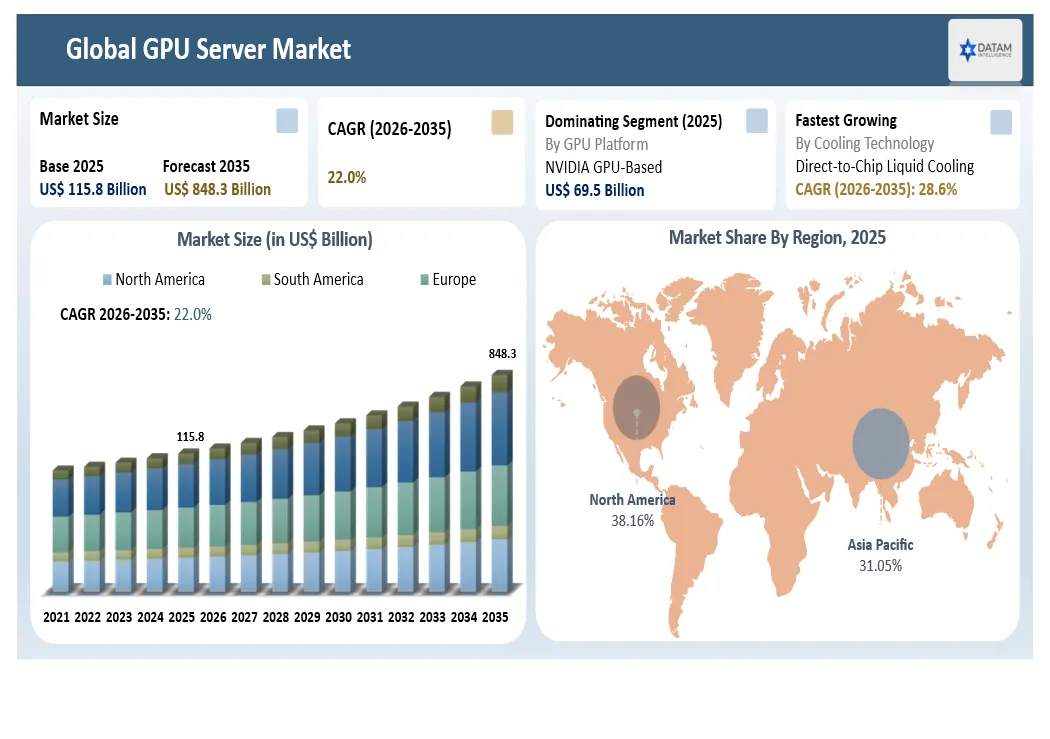
The market entered 2026 with extraordinary momentum. Dell reported US$16.1 billion of AI-optimized server revenue in fiscal Q1 2027, a category dominated by GPU-accelerated platforms, and raised its FY27 AI-server revenue expectation to approximately US$60 billion. HPE reported fiscal Q2 2026 Cloud & AI revenue of US$7.7 billion, including US$5.5 billion of server revenue. Supermicro reported US$12.7 billion of fiscal Q2 2026 net sales, supported by large AI and GPU-system deployments. These disclosures illustrate the scale at which GPU servers are becoming the core infrastructure layer for accelerated computing.
| Metric | Details |
| 2025 Market Size | US$ 115.8 Billion (DataM modeled estimate) |
| 2035 Projected Market Size | US$ 848.3 Billion (DataM modeled estimate) |
| CAGR (2026-2035) | 22.0% |
| Largest Market | North America |
| Fastest Growing Market | Asia-Pacific |
| Dominating Accelerator | GPU-Based Systems |
| Fastest Growing Cooling | Direct-to-Chip Liquid Cooling |
| Primary Growth Engine | Hyperscale and enterprise generative AI infrastructure |
GPU Server Market Key Takeaways
- NVIDIA-based GPU servers remain the commercial core of the market because CUDA software, HGX platforms, NVLink/NVSwitch interconnects and broad OEM support create a mature deployment ecosystem, while AMD Instinct platforms are expanding competition in large-scale training and inference.
- Rack-scale GPU architectures are gaining share as buyers procure validated compute, switching, cabling, power shelves and liquid-cooling loops as a single deployment unit rather than assembling individual servers.
- Liquid cooling is moving from a specialist option to a standard requirement for high-density AI racks as accelerator power rises and rack densities exceed conventional air-cooling limits.
- North America leads market value through hyperscaler capital expenditure and GPU-cluster construction, while Asia-Pacific combines ODM manufacturing scale with rapid sovereign and cloud AI expansion.
- AI inference is becoming a second major GPU demand wave after large-scale model training, broadening requirements toward cost-per-token, memory capacity, power efficiency and geographically distributed inference clusters.
- Power availability, transformer/switchgear lead times, cooling-water access and grid interconnection are increasingly as important as GPU supply in determining deployment schedules.
- Buyer decisions are shifting toward time-to-compute, rack-level performance, power efficiency, software compatibility, serviceability and accelerator allocation rather than server price alone.
- The market is consolidating around coordinated GPU ecosystems linking accelerator vendors, server OEMs and ODMs, HBM suppliers, networking vendors, liquid-cooling specialists, cloud operators and data-center infrastructure providers.
GPU Server Industry Trends and Strategic Insights
- GPU infrastructure procurement is moving from individual server BOMs toward validated rack and cluster designs that combine GPU compute trays, scale-up fabrics, Ethernet or InfiniBand networks, storage, power shelves, cooling distribution and orchestration software.
- NVIDIA remains the dominant merchant GPU platform, while AMD Instinct deployments are scaling and cloud providers continue to use custom accelerators alongside GPUs. This creates a heterogeneous infrastructure market but preserves strong demand for general-purpose GPU servers across multi-cloud and enterprise environments.
- Direct liquid cooling, rear-door heat exchangers and warm-water loops are becoming design assumptions for next-generation high-density deployments.
- Ethernet-based GPU fabrics are gaining ground alongside InfiniBand as 800G and 1.6T networking move into scale-out clusters.
- Supply-chain advantage increasingly depends on secured HBM, GPU modules, advanced substrates, high-current power components and liquid-cooling production capacity.
- Sovereign AI programs are broadening demand beyond U.S. hyperscalers into national laboratories, public cloud regions and government-backed compute infrastructure.
GPU Server Market Scope
| Metrics | Details |
| By Component | GPU Server Systems; GPU Modules & Accelerator Subsystems; Memory & Storage; Networking; Power & Cooling Integration |
| By GPU Platform | NVIDIA GPU-Based; AMD GPU-Based; Intel & Other GPU-Based; Multi-Vendor / Hybrid GPU Platforms |
| By Server Architecture | Rack GPU Servers; Modular/Blade GPU Systems; Rack-Scale GPU Systems; Edge GPU Servers |
| By Cooling Technology | Air-Cooled; Direct-to-Chip Liquid Cooling; Immersion Cooling; Hybrid Cooling |
| By Deployment Model | Hyperscale & Public GPU Cloud; Neocloud, Colocation & Hosted GPU; Enterprise & Private GPU Infrastructure; Edge & Distributed GPU Compute |
| By Application | Generative AI / LLM Training; AI Inference; HPC & Scientific Computing; Rendering, Simulation & Digital Content; Computer Vision & Data Analytics; Others |
| By End Use Industry | Cloud Service Providers; IT & Telecom; BFSI; Healthcare; Government & Defense; Automotive; Manufacturing; Research & Education; Others |
| By Distribution Channel | Direct OEM/ODM Sales; System Integrators & VARs; Distributors; Cloud/Consumption-Based |
| By Region | North America; Europe; Asia-Pacific; South America; Middle East & Africa |
Why does this report matter in 2026?
The year 2026 represents a transition from the first wave of GPU infrastructure purchases toward sustained production deployment. Training clusters remain large, but inference, agentic AI, sovereign AI and scientific computing are creating more diversified GPU demand. Platform transitions from Blackwell/Blackwell Ultra toward next-generation architectures, larger HBM configurations, denser rack designs and faster scale-up fabrics are forcing buyers to redesign power, cooling and networking architecture.
The report matters because GPU server competition is no longer determined only by raw FLOPS or GPU count. Delivery schedules and economics depend on GPU allocation, HBM supply, rack integration, scale-up fabrics, liquid-cooling availability, high-current power distribution, firmware validation and facility readiness. The study therefore evaluates the full GPU server ecosystem, including ODMs, networking vendors, memory suppliers, cooling specialists, data-center operators and system integrators.
GPU Server Market White Space & Investment Opportunities
- Enterprise GPU compute clusters packaged as validated, liquid-cooled racks with integrated software and managed services.
- Inference-optimized servers using lower-cost GPUs, custom ASICs and high-capacity memory for production agent workloads.
- Rack-level power distribution and cooling products for 100-300+ kW AI racks.
- Regional sovereign AI infrastructure with local data residency, security and managed capacity.
- AI cluster observability, power optimization and workload-aware thermal management.
- Refurbishment, secondary-market accelerators and lifecycle services for earlier-generation GPU fleets.
GPU Server Future Market Transformation
By 2035, the market is expected to evolve from server-centric procurement toward AI infrastructure platforms purchased in rack, pod and cluster units. Compute, networking, power, liquid cooling and orchestration will be co-designed. Accelerators will diversify, but the economic requirement will remain the same: maximize useful tokens, training throughput or inference transactions per watt and per dollar of installed infrastructure.
Enterprise adoption will also change the supplier mix. Hyperscalers will continue to buy at enormous scale, but private AI deployments will create demand for smaller prevalidated clusters that can operate inside enterprise data centers or colocation facilities. Vendors that can integrate hardware, software, networking, cooling and lifecycle services will capture a larger share of wallet than component-only suppliers.
GPU Server Market Buyer Decision-Making Criteria
Buyers prioritize accelerator availability, performance per watt, software compatibility, memory capacity, network bandwidth, rack density, cooling architecture, deployment lead time, serviceability and total cost of ownership. Large buyers increasingly evaluate the entire cluster, including fabric performance, failure domains, cable complexity and power conversion losses. Enterprise customers additionally emphasize support, validated software stacks, financing, managed services and the ability to deploy AI close to proprietary data.
GPU Server Market Economic & Investment Analysis
GPU server economics are dominated by accelerator content and the supporting infrastructure required to keep those accelerators utilized. The value of a high-density rack can rise sharply as GPU count, HBM content, switch capacity, optical connectivity and cooling hardware increase. For buyers, utilization is the critical economic variable: underutilized accelerators can destroy project returns even when hardware acquisition is successful.
Investment is therefore spreading beyond server assembly into networking, optics, memory, power conversion, liquid cooling, data-center capacity and grid infrastructure. The strongest suppliers are those positioned at bottlenecks or able to provide validated integration across multiple bottlenecks. Capital intensity is also rising because vendors must reserve component supply, expand rack-integration factories and support large customer-specific deployments.
GPU Server Investment Trends in the Market
- Capacity investment is moving toward rack-scale integration and liquid-cooling manufacturing rather than conventional server assembly alone.
- Cloud providers and sovereign AI programs are signing multi-year capacity agreements to secure compute, power and data-center space.
- Networking, optics and memory suppliers are expanding capacity to support larger accelerator clusters.
- Enterprise infrastructure vendors are investing in turnkey GPU-cluster offers combining compute, storage, networking, software and services.
- Financing models are broadening through GPU-as-a-service, capacity leasing and consumption-based infrastructure.
Strategic Indicators for GPU Server Market
High Regulation Impact
Export controls on advanced accelerators, data-sovereignty rules, AI governance requirements and energy-efficiency standards influence where systems can be sold and deployed. Suppliers need country-specific compliance and configuration strategies.
High Investment Activity
AI infrastructure is absorbing unprecedented capital from hyperscalers, sovereign programs, colocation developers and enterprises. Investment extends from compute to power generation, substations, cooling and fiber connectivity.
Supply Chain Disruption
HBM, advanced packaging, accelerator modules, optics and liquid-cooling components remain critical constraints. Concentrated manufacturing and geopolitical exposure can delay complete rack delivery even when one subsystem is available.
Pricing Volatility
System ASPs fluctuate with accelerator generation, memory content, networking configuration and supply scarcity. Buyers increasingly negotiate at rack or cluster level and use multi-year agreements to secure availability.
Procurement Pressure
Procurement teams face pressure to secure scarce accelerators while avoiding stranded capacity. Vendor selection increasingly includes facility readiness, financing, software portability and lifecycle support.
New Technology Adoption
Rubin-class accelerators, custom ASICs, CXL memory architectures, 800G/1.6T networking, co-packaged optics and warm-water direct liquid cooling are changing server design.
Regional Expansion Opportunity
Asia-Pacific offers the largest manufacturing ecosystem, while Middle East sovereign AI projects and European GPU-cluster initiatives create new demand centers.
Government Policy Support
National AI strategies, semiconductor incentives, sovereign cloud policy and research-compute programs are supporting domestic GPU server deployment.
Pricing Intelligence
The market is shifting from per-server price comparison to cost per unit of useful AI output. Power, cooling, software and utilization must be included in procurement economics.
Disruption Analysis of GPU Server Market
The market is being disrupted by rack-scale architecture, custom accelerators, direct liquid cooling and the move from training-centric AI to continuous inference. These shifts alter value capture across the supply chain. Conventional server chassis become a smaller part of total system value while accelerators, fabrics, power and cooling gain importance. ODMs are moving closer to hyperscalers, while branded OEMs differentiate through enterprise integration, support and software.
GPU Server Market BCG Matrix: Company Evaluation
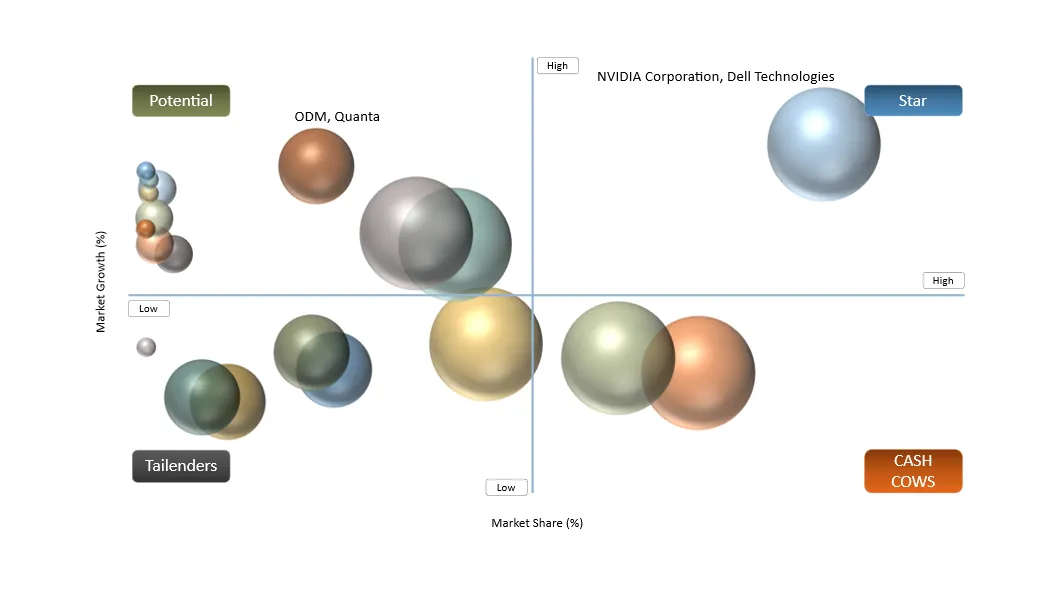
STAR
NVIDIA-linked system ecosystems, Dell Technologies, Supermicro, HPE and Lenovo occupy the Star category because they combine high exposure to GPU infrastructure growth with scale, platform breadth and major customer relationships. Their ability to secure GPUs and HBM, integrate rack-scale platforms and deploy liquid cooling is central to maintaining leadership.
POTENTIAL
ODM and specialist GPU infrastructure players such as Quanta, Wiwynn, Giga Computing and selected regional system builders remain high-potential participants. Their growth depends on hyperscaler design wins, GPU platform access, manufacturing capacity and the ability to scale complete liquid-cooled racks rather than barebone servers.
GPU Server Market Dynamics
Driver Impact Analysis
| Driver | Market Growth Impact | Demand Concentration | Impacted Use Case | Strategic Impact |
Generative AI, LLM training and agentic inference | Very High | Hyperscalers and large enterprises | GPU training and inference clusters | Accelerates GPU/server spending and rack-scale adoption |
Hyperscaler capex expansion | Very High | North America and Asia-Pacific | GPU clusters and cloud capacity | Supports multi-year server and network demand |
Sovereign AI programs | High | Europe, Middle East, Asia | National AI clouds and research compute | Broadens geographic demand and local-infrastructure requirements |
Enterprise private GPU infrastructure | High | BFSI, healthcare, manufacturing | Secure inference and fine-tuning | Expands demand beyond hyperscalers |
Driver: Rapid Growth in Generative AI, Inference and GPU-Accelerated Computing
The primary driver is the movement of GPU-accelerated AI from experimentation into production. Frontier-model training requires very large GPU clusters, while inference is widening the addressable market because production workloads run continuously and increasingly need regional, sovereign or enterprise-local capacity. HPC, simulation and rendering provide additional non-AI demand for GPU servers.
Restraint Impact Analysis
| Restraint | Drag on Growth | Primary Impact Area | Impacted Use Case | Strategic Impact |
Power availability and grid interconnection | Very High | Facility deployment | High-density AI clusters | Can delay hardware installation even after systems are procured |
GPU/HBM and advanced-packaging concentration | High | Server production | Latest-generation GPU systems | Creates allocation risk and favors scaled buyers |
| Liquid-cooling readiness | High | Data center retrofit | 100 kW+ racks | Limits deployment in legacy facilities |
| High capital intensity | Medium-High | Enterprise adoption | Private AI infrastructure | Pushes buyers toward leasing, colocation and consumption models |
Restraint: Power Availability, Cooling Complexity and Capital Cost
Power is becoming the gating factor for many GPU server deployments. The growth of rack densities beyond conventional enterprise design levels requires new busway, switchgear, transformers, cooling loops and water-management systems. Enterprises with legacy facilities may be unable to deploy the latest rack-scale GPU platforms without significant retrofit expenditure, shifting demand toward colocation, neocloud and hosted GPU capacity.
GPU Server Market Segmentation Analysis
The global GPU Server market is segmented based on Component, GPU Platform, Server Architecture, Cooling Technology, Deployment Model, Application, end-use industry, distribution channel, and region.
By GPU Platform
GPU-Based Systems Will Continue to Lead Market Value
NVIDIA-based GPU systems account for the largest share of current GPU server value because CUDA, HGX reference platforms, NVLink/NVSwitch and broad OEM support create a mature deployment ecosystem. AMD Instinct systems are gaining share in hyperscale and HPC deployments, while Intel and other GPU platforms serve selected enterprise, scientific and regional workloads.
By Server Architecture
Rack-Scale GPU Systems Will Record the Fastest Growth
Rack-scale GPU architectures integrate dozens of GPUs, scale-up fabrics, shared power delivery and liquid cooling in validated configurations. This reduces deployment complexity and shifts buyer evaluation from server-by-server specifications to rack throughput, cost per token and cluster efficiency.
By Cooling Technology
Direct-to-Chip Liquid Cooling Will Record the Fastest Growth
Direct liquid cooling is becoming standard for the highest-density AI racks because air cooling cannot economically remove the thermal load created by next-generation accelerators. Adoption is expanding from hyperscale environments into colocation and enterprise AI deployments.
By Deployment Model
Hyperscale & Public GPU Cloud Will Remain the Largest Segment
Hyperscalers and public GPU clouds remain the largest buyers due to frontier-model training, AI services and large inference fleets. Neoclouds are also scaling rapidly by offering dedicated GPU capacity, while enterprise/private GPU infrastructure grows from a smaller base for secure inference, fine-tuning and sovereign workloads.
By Application
AI Inference Will Gain Share Rapidly
Training drives very large individual projects, while inference broadens demand across more organizations and geographies. Production agents, copilots, recommendation engines and multimodal applications will create continuous server utilization and repeated refresh cycles.
By End Use Industry
Cloud Service Providers & Neoclouds Will Continue to Dominate
Cloud service providers and neoclouds aggregate demand from model developers and enterprises, enabling higher utilization of expensive GPU assets. Government, financial services, healthcare and manufacturing will expand as data-sovereignty, latency and security requirements support private infrastructure.
GPU Server Market Geographical Penetration
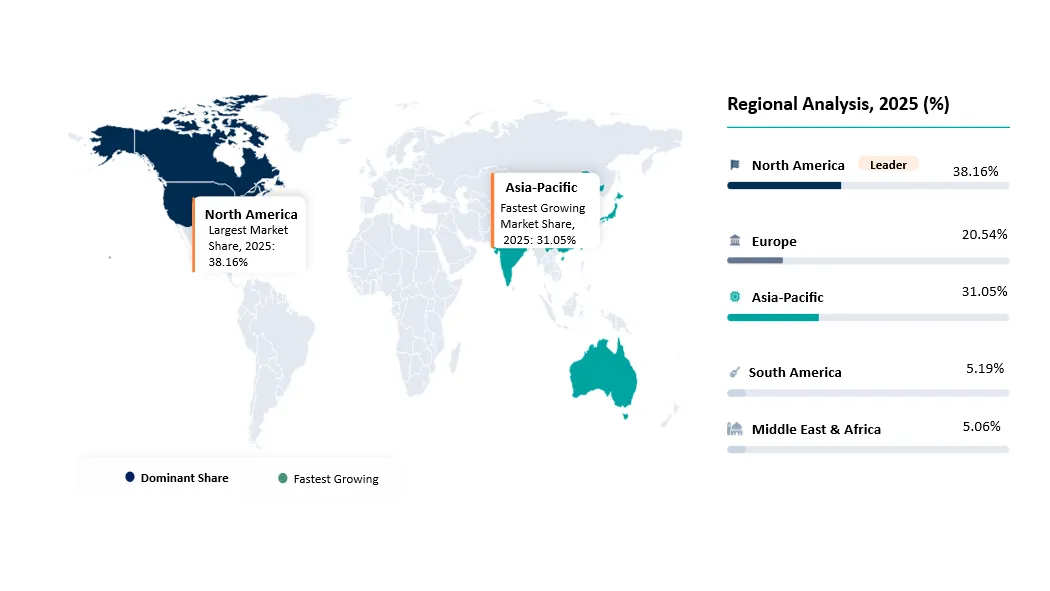
U.S. GPU Server Market Landscape
The U.S. is the largest market due to hyperscaler capital expenditure, leading AI model developers, accelerator ecosystem concentration and rapid GPU-cluster construction. Demand is increasingly constrained by power availability and data-center delivery schedules, making colocated and purpose-built campuses central to growth.
China GPU Server Market Trends
China remains a major manufacturing and deployment market, supported by cloud providers, internet platforms and domestic accelerator development. Export controls on leading-edge U.S. accelerators are accelerating local chip and server ecosystems while creating a more segmented global market.
Japan GPU Server Market Outlook
Japan is expanding AI infrastructure through cloud regions, research computing, semiconductor investment and enterprise modernization. Power efficiency and high-density cooling are important because data-center land and power constraints favor compact infrastructure.
Germany GPU Server Market Outlook
Germany is a leading European enterprise and industrial AI market, with demand from manufacturing, automotive, research and sovereign-cloud initiatives. Data protection, energy costs and sustainability requirements shape procurement.
Middle East GPU Server Market Outlook
Saudi Arabia and the UAE are emerging as important sovereign AI markets through state-backed compute capacity, new data centers and partnerships with global technology vendors. Access to energy and investment capital supports large projects, while accelerator access and talent remain strategic dependencies.
GPU Server Market Competitive Landscape
- The competitive landscape is structured around accelerator ecosystems, OEM/ODM integration capability, rack-scale manufacturing, networking partnerships and liquid-cooling readiness.
- Dell, HPE, Supermicro and Lenovo are competing aggressively for enterprise and cloud AI infrastructure, while Taiwan-based ODMs remain critical to hyperscale supply.
- NVIDIA exercises significant platform influence through accelerator modules, reference architectures, networking and rack-scale systems, while AMD and custom ASIC ecosystems increase competitive alternatives.
- Market share can shift quickly between hardware generations because accelerator allocation and customer-specific design wins materially affect quarterly shipments.
- Differentiation increasingly depends on time-to-deploy, rack validation, cooling integration, software stack, managed services and global support rather than chassis design.
Market Ecosystem Table
| Value Chain Sector | Representative Companies | Role in GPU Server Market |
| GPU Platforms & Host CPUs | NVIDIA, AMD, Intel, Broadcom, Marvell, Google custom silicon ecosystem | GPU accelerator platforms and host CPU ecosystems |
| HBM, DRAM & Storage | SK hynix, Samsung Electronics, Micron, Kioxia, Solidigm | High-bandwidth memory and storage |
| GPU Server OEMs | Dell Technologies, HPE, Supermicro, Lenovo, Cisco, Giga Computing | Branded GPU server and rack systems |
| GPU ODMs / Rack Integrators | Quanta, Wiwynn, Foxconn, Inventec, Wistron | Hyperscale design and manufacturing |
| Networking & Optics | NVIDIA, Broadcom, Arista Networks, Cisco, Marvell, Coherent | InfiniBand/Ethernet fabrics and optical interconnects |
| Liquid Cooling | Vertiv, Schneider Electric, CoolIT Systems, Boyd, Motivair, nVent | CDUs, cold plates and facility loops |
| Power Infrastructure | Eaton, Schneider Electric, Vertiv, ABB, Delta Electronics | UPS, busway, PDUs and power conversion |
| Cloud & AI Operators | Microsoft, Amazon, Google, Meta, Oracle, CoreWeave | Primary large-scale GPU server buyers/operators |
| Colocation / Hosted AI | Equinix, Digital Realty, QTS, NTT GDC, Vantage | Power-ready capacity for AI clusters |
| System Integrators / VARs | Accenture, CDW, WWT, SHI, regional integrators | Enterprise integration and deployment |
| Standards & Ecosystems | OCP, UEC, UALink Consortium, PCI-SIG, CXL Consortium | Rack, interconnect and component standards |
Public Company Q1-Q2 2026 Performance Comparison
| Public Company | Reporting Period | Q1-Q2 2026 Performance | Growth Indicator | Factors Driving GPU Server Growth |
| Dell Technologies | Q1 FY2027 ended May 1, 2026 | US$43.8B total revenue; US$29.0B ISG revenue; US$16.1B AI-optimized server revenue | AI-optimized server revenue +757% YoY; US$24.4B AI orders | NVIDIA and AMD GPU platforms, rack-scale PowerEdge systems, Dell AI Factory, enterprise channel, accelerator allocation and global integration capacity |
| Hewlett Packard Enterprise | Q2 FY2026 | US$7.7B Cloud & AI revenue; US$5.5B server revenue | Cloud & AI +22.9% YoY; server +32.7% YoY | HPE ProLiant and Cray GPU systems, liquid cooling, HPC heritage, GreenLake consumption model and high-speed networking |
| Super Micro Computer | Q2 FY2026 ended Dec. 31, 2025; reported Feb. 2026 | US$12.7B net sales versus US$5.7B in Q2 FY2025 | Net sales more than doubled YoY | Rapid GPU platform qualification, DLC-ready server portfolio, rack-scale manufacturing and large cloud/AI deployments |
| Lenovo Group | Quarter ended Mar. 31, 2026 | US$21.6B group revenue; Infrastructure Solutions Group remained a major growth engine | Group revenue +27% YoY in the Mar. 2026 quarter; AI infrastructure pipeline remained strong | ThinkSystem/ThinkAgile GPU servers, Neptune liquid cooling, NVIDIA GB-class racks, global manufacturing and hybrid AI strategy |
| NVIDIA Corporation | Q1 FY2027 ended Apr. 26, 2026 | US$81.6B total revenue; US$75.2B Data Center revenue | Revenue +85% YoY; Data Center +92% YoY | Blackwell/Blackwell Ultra GPU platforms, NVLink/NVSwitch, Spectrum-X/InfiniBand networking, CUDA ecosystem and rack-scale reference architectures |
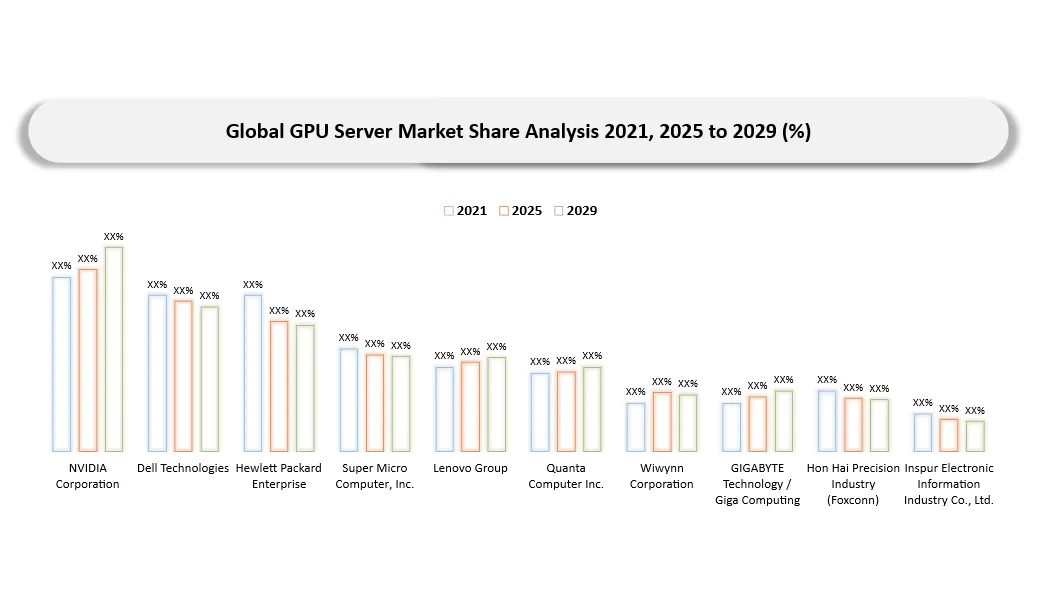
Key Companies
- NVIDIA Corporation
- Dell Technologies
- Hewlett Packard Enterprise
- Super Micro Computer, Inc.
- Lenovo Group
- Inspur Electronic Information Industry Co., Ltd.
- Quanta Computer Inc.
- Wiwynn Corporation
- GIGABYTE Technology / Giga Computing
- Hon Hai Precision Industry (Foxconn)
- Cisco Systems, Inc.
- ASUSTeK Computer Inc.
- Advanced Micro Devices, Inc.
- Intel Corporation
- NEC Corporation
Company Profiles
NVIDIA Corporation
NVIDIA is the platform leader shaping the GPU server market through GPUs, NVLink/NVSwitch, networking, rack-scale systems and the CUDA software ecosystem. Its Blackwell and Rubin roadmaps increasingly define server power, cooling, memory and networking requirements. Competitive strength comes from full-stack integration and developer adoption, while major strategic risks include supply concentration, export controls and customer development of custom accelerators.
Dell Technologies
Dell is a leading branded GPU server supplier with strong enterprise distribution and a rapidly scaling AI-optimized server business. Its Dell GPU Compute Factory strategy combines servers, storage, networking, services and NVIDIA-based systems. Fiscal Q1 2027 AI-optimized server revenue of US$16.1 billion demonstrates the scale of current demand and the company’s ability to convert accelerator supply into integrated customer deployments.
Hewlett Packard Enterprise
HPE combines enterprise servers, HPC, AI systems, networking and consumption-based GreenLake offerings. Its Cloud & AI segment benefits from both traditional server demand and accelerated AI infrastructure. HPE can differentiate through enterprise software integration, networking and long-standing supercomputing capabilities.
Super Micro Computer, Inc.
Supermicro is a specialist high-performance server and rack integrator with rapid platform refresh cycles and broad direct-liquid-cooling support. The company has benefited from large AI deployments and close alignment with accelerator roadmaps. Its competitive position depends on manufacturing execution, working-capital discipline and continued access to high-demand components.
Lenovo Group
Lenovo is expanding AI infrastructure through its Infrastructure Solutions Group, hyperscaler relationships, enterprise server business and Neptune liquid-cooling portfolio. Its global manufacturing footprint and hybrid AI strategy support deployments from enterprise racks to large CSP systems. A US$21 billion GPU server pipeline and GB300 NVL72 shipments demonstrate its growing role in rack-scale infrastructure.
Quanta Computer Inc.
Quanta is a major ODM with deep hyperscaler relationships and large-scale server manufacturing. GPU server growth benefits its cloud and data-center businesses through customer-specific rack and motherboard designs. Competitive advantage comes from scale, engineering integration and Taiwan supply-chain proximity.
Wiwynn Corporation
Wiwynn specializes in hyperscale data-center infrastructure and is strongly exposed to cloud AI expansion. The company focuses on rack-level design, manufacturing and integration for large customers, positioning it to benefit from the migration toward standardized and semi-custom AI racks.
GIGABYTE Technology / Giga Computing
Giga Computing provides GPU servers, high-density systems and enterprise AI platforms. It competes through rapid support for multiple accelerators and flexible configurations, serving enterprises, research institutions and regional cloud providers.
Hon Hai Precision Industry (Foxconn)
Foxconn is expanding GPU server and rack manufacturing as part of its cloud network products business. Its scale in electronics manufacturing and ability to integrate components across large customer programs make it an important infrastructure supplier.
Cisco Systems, Inc.
Cisco participates through UCS servers, networking and integrated AI infrastructure partnerships. Its strongest differentiation is the ability to combine compute with enterprise networking, security and lifecycle management for customers that prefer integrated infrastructure.
GPU Server Market Major Pain Points
- Limited power availability and lengthy utility interconnection timelines for large AI campuses.
- Accelerator, HBM and advanced-packaging supply concentration.
- Rapid hardware generation changes that can shorten economic refresh cycles.
- High rack density requiring new cooling, power-distribution and facility standards.
- Networking bottlenecks that reduce accelerator utilization in large clusters.
- Large working-capital requirements for OEMs and ODMs procuring expensive components.
- Export controls and geopolitical fragmentation affecting system availability by region.
- Difficulty forecasting the mix between training, inference, merchant GPUs and custom accelerators.
GPU Server Market Recent Developments
- May 2026: Dell Technologies reported fiscal Q1 2027 AI-optimized server revenue of US$16.1 billion, up 757% year over year, and raised its full-year AI-optimized server revenue expectation to about US$60 billion. GPU-accelerated platforms represent the core of this portfolio.
- May 2026: NVIDIA reported fiscal Q1 2027 Data Center revenue of US$75.2 billion, up 92% year over year, while advancing the Vera Rubin platform and GPU-cluster architecture.
- May 2026: Lenovo reported record quarterly ISG revenue of US$5.6 billion, an AI server pipeline of US$21 billion and first GB300 NVL72 rack shipments, highlighting rapid growth in GPU-dense rack-scale infrastructure.
- June 2026: Dell expanded its GPU Compute Factory with NVIDIA around supercomputing-class infrastructure and next-generation AI/HPC systems.
- Fiscal Q2 2026: HPE reported Cloud & AI revenue of US$7.7 billion, including US$5.5 billion of server revenue, reflecting continued accelerated-compute demand.
- February 2026: Supermicro reported fiscal Q2 2026 net sales of US$12.7 billion as it scaled AI and enterprise deployments and expanded global manufacturing.
Analyst View / Opinion on GPU Server Market
- The GPU server market is moving from extraordinary early-cycle growth toward a structurally larger infrastructure category in which AI becomes a standard data-center workload.
- Near-term leadership will be determined by accelerator access and rack-scale execution, while long-term leadership will depend on software, serviceability, power efficiency and ability to support multiple accelerator ecosystems.
- Inference will become the principal source of broad-based adoption because it spreads AI infrastructure across more enterprises and geographies than frontier-model training alone.
- Liquid cooling and high-current power distribution will become standard components of GPU server procurement rather than separate facility decisions.
- Enterprise buyers will increasingly prefer validated GPU compute clusters and consumption models because they reduce integration risk and shorten time to useful compute.
- Infrastructure suppliers with strong positions in networking, power, cooling and services can capture value even if accelerator market share becomes more diversified.
GPU Server Market Target Audience
| INDUSTRY | WHO SHOULD BUY THIS REPORT? | REASON TO BUY THIS REPORT |
| GPU Server OEMs & ODMs | Strategy, product, sales and capacity-planning teams | Benchmark architecture trends, demand growth, pricing and competitive positioning. |
| Semiconductors | GPU, CPU, ASIC, memory, networking and component suppliers | Assess server attach opportunities, platform transitions and regional demand. |
| Data Centers | Hyperscalers, colocation operators and infrastructure developers | Plan power, cooling, rack density and customer demand. |
| Enterprise IT | CIOs, infrastructure architects and procurement teams | Evaluate AI infrastructure architectures, vendor options and deployment economics. |
| Power & Cooling | Electrical and thermal management suppliers | Quantify high-density AI infrastructure opportunities and technology requirements. |
| Investors & Consulting | PE, VC, institutional investors and strategy teams | Assess growth, competitive positioning, supply bottlenecks and investment white spaces. |
Why Choose DATAM?
- Data-driven insights combining vendor disclosures, shipment modeling, infrastructure economics and country-level demand analysis.
- Post-purchase analyst consultations for market entry, competitive benchmarking, technology positioning and customer targeting.
- Annual report updates covering platform launches, accelerator roadmaps, capacity expansion, partnerships and market-share shifts.
- Specialized focus on emerging markets and sovereign AI infrastructure rather than generalized regional summaries.
- Actionable analysis connecting server demand with power, cooling, networking and facility constraints.
What DATAM Uniquely Provides
- Ten-year forecasts across component, accelerator, architecture, cooling, deployment, application, end use and channel.
- Rack-scale analysis linking compute density with networking, power and cooling requirements.
- Competitive benchmarking of branded OEMs, ODMs, accelerator platforms and infrastructure ecosystems.
- Public-company 2026 performance comparison tied to GPU server growth drivers.
- Market ecosystem mapping from semiconductors and memory through rack integration, cloud operators and facility infrastructure.


























































