Germany Industrial Lighting Market Size and Overview
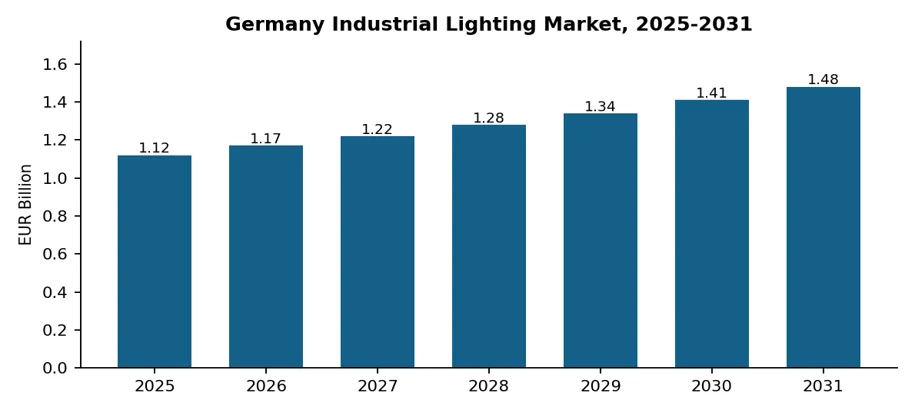
The Germany Industrial Lighting Market is estimated at EUR 1.12 billion in 2025 and projected to reach EUR 1.48 billion by 2031, representing approximately 4.75% annualized growth. Demand covers luminaires and lighting controls specified for manufacturing plants, industrial warehouses, process facilities and outdoor industrial sites.
German industrial lighting demand is increasingly driven by replacement of fluorescent and HID installations, higher efficiency requirements and networked controls. New factory construction remains sensitive to industrial capital expenditure, making refurbishment of existing sites a major source of opportunities. Robust fixtures, reliable thermal management and lighting performance are important buying criteria.
| 2025 MARKET SIZE | 2031 FORECAST | CAGR (2026-2031) |
| EUR 1.12 Billion | EUR 1.48 Billion | 4.75% |
Germany Industrial Lighting Key Takeaways
Germany industrial lighting revenue is estimated at EUR 1.12 billion in 2025 and projected to reach EUR 1.48 billion by 2031.
Refurbishment of existing factories and warehouses supports demand despite soft investment in some German manufacturing industries.
LED high-bay, linear and sealed industrial luminaires represent the principal fixture categories for production and logistics buildings.
Connected lighting with occupancy sensing and daylight control is gaining relevance in warehouses with variable operating schedules.
Hazardous-area, food-grade, cold-store and high-temperature applications support specialist product premiums and certification needs.
Project timing depends on industrial investment budgets, installation labor, payback periods and supplier availability.
Germany Industrial Lighting Industry Trends and Strategic Insights
Industrial buyers increasingly evaluate total installed cost, measured energy savings, service life and downtime during retrofits.
DALI control, wireless sensors and integrated monitoring expand the role of lighting in automated production and logistics operations.
Industrial luminaire design prioritizes ingress protection, impact resistance, washdown compatibility and consistent light distribution.
Domestic manufacturers compete through installation support, specification engineering and dependable industrial service coverage.
Germany Industrial Lighting Market Scope
| METRICS | DETAILS |
| 2025 Market Size | EUR 1.12 Billion |
| 2031 Projected Market Size | EUR 1.48 Billion |
| CAGR (2026-2031) | 4.75% |
| By Product Type | High-bay, low-bay, linear, sealed, flood, hazardous-area and task luminaires |
| By End-Use Industry | Automotive, machinery, chemicals, food processing, logistics, metals and pharmaceuticals |
| By Lighting Technology | LED, legacy HID and fluorescent replacement |
| By Controls | DALI, occupancy sensors, daylight dimming, wireless controls and BMS integration |
| By Application | Factories, warehouses, cleanrooms, process buildings and industrial yards |
| By Installation | New-build, replacement, retrofit and maintenance |
| Market Data Coverage | 2025-2031 Germany industrial lighting market and equipment applications |
Germany Industrial Lighting Market White Space & Investment Opportunities
Factory retrofits: target automotive, machinery and metalworking plants replacing aging HID and fluorescent systems with efficient LED lighting.
Smart warehouse upgrades: supply continuous-row luminaires and sensor-based controls for logistics buildings with uneven occupancy patterns.
Specialist applications: offer washdown, impact-resistant, temperature-tolerant and hazardous-area fixtures for process plants and heavy industry.
Suppliers can differentiate through lighting audits, documented energy savings, reliable installation scheduling and support for industrial certifications. Repeat orders are more likely when standard fixture families are approved across multiple manufacturing or logistics locations.
Driver Impact Analysis
Industrial energy costs and pressure to reduce operating expenses support replacement of inefficient lighting in German factories and distribution facilities. Retrofit projects can improve illumination while reducing electrical loads, especially where legacy high-intensity discharge fixtures operate for long shifts. Larger operators increasingly seek standardized lighting specifications across plant networks.
| DRIVER | AFFECTED PRODUCT / SIGNAL | 2026–2031 CAGR | STRATEGIC IMPACT |
| Industrial LED retrofit | High | Replacement of legacy high-bay and linear fixtures | Supply energy-audited retrofit packages for operating plants |
| Factory safety and visibility | High | Task, inspection and high-output production lighting | Offer controlled glare, uniformity and robust enclosure ratings |
| Warehouse automation | Medium-High | Aisle lighting, sensors and networked controls | Integrate lighting with warehouse occupancy and automation |
| Industrial energy management | Medium-High | Dimmable fixtures and site-level monitoring | Provide documented savings and multi-site programmes |
Automation, warehouse expansion and stricter operational efficiency expectations support demand for connected lighting controls. Occupancy and daylight sensors can reduce hours of operation in storage aisles and utility areas. At the same time, demanding production environments create value for durable fixtures that withstand heat, dust, moisture and vibration.
Restraint Impact Analysis
Weakness in some manufacturing segments and delayed capital spending can push industrial lighting replacement projects beyond planned maintenance windows. The long service life of existing LED installations also limits near-term repeat purchases. Many buyers prioritize core process equipment over lighting when capital budgets tighten.
| RESTRAINT | PRIMARY EXPOSURE | RISK LEVEL | STRATEGIC IMPACT |
| Weak industrial investment | New plant and major upgrade programmes | High | Target maintenance-funded retrofits and staged upgrades |
| Long LED replacement cycles | Already-modernised facilities | High | Sell controls and efficiency upgrades where payback is measurable |
| Plant shutdown and installation costs | High-bay and process-area projects | Medium-High | Plan modular replacement during scheduled stoppages |
| Price competition and certification | Standard and specialist fixtures | Medium-High | Differentiate on compliance, optical quality and lifecycle support |
Installation complexity is another constraint in operating plants. Luminaires may require shutdown windows, high-level access equipment, hazardous-area certifications and compatibility checks with existing controls. Low-cost imports add price pressure, while uncertain energy-savings calculations can delay approval for retrofit projects.
Germany Industrial Lighting Market Competitive Landscape
Germany has a strong base of professional-lighting manufacturers supplying factories, logistics facilities and specialist industrial environments. Competition centres on optical design, fixture ruggedness, efficient LED platforms, connected controls, installation support and long-term replacement availability.
| COMPANY | LIGHTING POSITIONING |
| TRILUX | Industrial high-bay, linear, rugged luminaires and networked lighting controls. |
| Zumtobel Group | Professional industrial and logistics lighting with connected controls. |
| LEDVANCE | Industrial LED luminaires, high-bays and retrofit lighting solutions. |
| Signify | Professional industrial fixtures, LED systems and connected lighting. |
| RZB Rudolf Zimmermann | Technical luminaires for demanding commercial and industrial spaces. |
| SITECO | Industrial halls, warehouses and professional lighting infrastructure. |
| Regiolux | Linear, industrial and logistics-site LED lighting. |
| Waldmann | Machine, workstation and industrial production lighting. |
| Schuch | Rugged and hazardous-area industrial luminaires. |
| NORKA | Protected industrial lighting for damp, dusty and demanding environments. |
Industrial projects are often specified through electrical engineering firms, plant maintenance teams, facility operators and electrical distributors. Providers with repeatable product families and reliable commissioning support are better positioned for multi-site industrial upgrade programmes.
Germany Industrial Lighting Market Recent Developments
March 19, 2026: TRILUX highlighted its IntuSens sensor portfolio at Light + Building 2026, extending its connected-lighting capabilities for industrial and other professional spaces.
April 16, 2026: TRILUX detailed a smart lighting installation for OBO Bettermann’s 23,000-square-metre warehouse in Menden, using E-Line Pro fixtures and LiveLink Premium controls.
April 30, 2026: TRILUX presented E-Line Pro, Fidesca and Lensible optics as part of its industrial lighting technology portfolio at Light + Building 2026.
July 27, 2026: TRILUX announced investments exceeding EUR 80 million over three years at its Arnsberg headquarters, supporting its domestic lighting operations.
August 28, 2026: TRILUX described Germany’s updated building-modernisation requirements and their implications for automatic lighting controls in non-residential facilities.
October 5, 2026: TRILUX outlined automated lighting-control solutions, including LiveLink and IntuSens, in response to updated requirements affecting non-residential buildings.