Germany Industrial Drives Market Size and Overview
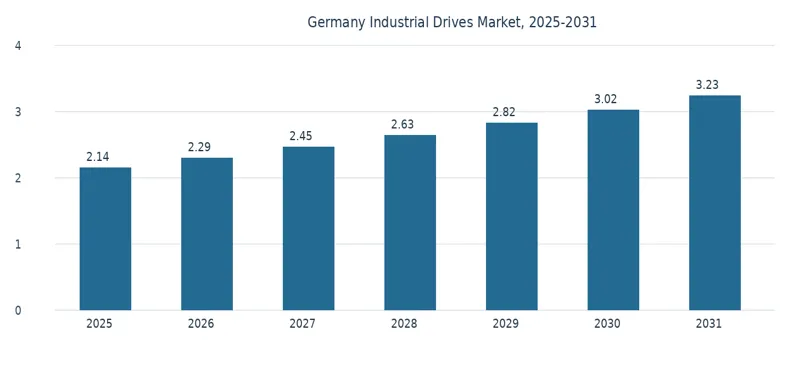
The Germany Industrial Drives Market is estimated at US$ 2.14 billion in 2025 and is forecast to reach US$ 3.23 billion by 2031, representing approximately 7.10% annualized growth. Demand covers low-voltage variable-frequency drives, medium-voltage drives, servo drives, regenerative drives and decentralized motor-control electronics. German machinery makers, process industries and building-service operators buy drive systems to control energy use, throughput and equipment reliability.
Industrial drives regulate the speed and torque of motors in pumps, fans, compressors, machine tools, conveyors and production lines. Germany has a substantial installed base of motor-driven equipment, with upgrading concentrated in applications where energy savings, improved process control or replacement of aging drives justify capital spending. Drive hardware revenue is measured separately from the motor hardware and broader automation-system value.
| 2025 MARKET SIZE | 2031 FORECAST | CAGR (2026-2031) |
| US$ 2.14 Billion | US$ 3.23 Billion | 7.10% |
Germany Industrial Drives Key Takeaways
Industrial drive revenue is estimated to increase from US$ 2.14 billion in 2025 to US$ 3.23 billion in 2031.
Variable-frequency drives support measurable electricity savings in continuously operated pumps, fans, compressors and industrial ventilation.
German machinery builders require compact servo drives and connected motor controls for packaging, machine tools, robotics and production equipment.
Factory operators increasingly require drive-level cybersecurity, predictive diagnostics, safe motion and compatibility with plant networks.
Aging inverter replacement creates demand for parameter migration, electrical compatibility assessment and local commissioning support.
Medium-voltage drives, regenerative systems and decentralized inverters address process plants and energy-intensive industrial applications.
Germany Industrial Drives Industry Trends and Strategic Insights
Drive manufacturers are integrating industrial Ethernet, secure firmware and functional safety into a broader range of AC inverters.
The next generation of drives increasingly connects speed control to plant energy management, condition monitoring and digital engineering.
German machine builders favor common engineering tools and standardized drive platforms that can be reused across equipment variants.
Decentralized drives reduce central cabinet and cabling requirements in conveyors, material handling and modular production lines.
Germany Industrial Drives Market Scope
| METRICS | DETAILS |
| 2025 Market Size | US$ 2.14 Billion |
| 2031 Projected Market Size | US$ 3.23 Billion |
| CAGR (2026-2031) | 7.10% |
| By Drive Type | Low-voltage VFDs, medium-voltage drives, servo amplifiers, regenerative drives |
| By End-Use Industry | Manufacturing, machinery, chemicals, metals, utilities and other process industries |
| By Power Rating | Fractional-kW to multi-megawatt industrial drives |
| By Drive Control | V/f, vector, closed-loop, PM motor, regenerative and servo control |
| By Application | Pumps, fans, compressors, conveyors, extruders, machine tools and robotics |
| By Installation Setting | OEM-mounted, panel-mounted, indoor, outdoor and heavy-duty applications |
| By Installation Stage | New machinery, expansion, inverter retrofit, testing and lifecycle support |
| Market Data Coverage | 2025-2031 Germany industrial drives market, equipment applications and trends |
Germany Industrial Drives Market White Space & Investment Opportunities
Installed-base VFD replacement: target existing plant pumps, fans, compressors and conveyors where operating hours allow measurable electricity savings.
Machinery OEM integration: qualify connected AC drives and servo systems with German automation, packaging, intralogistics and machine-tool manufacturers.
Lifecycle and service contracts: combine harmonic review, parameter conversion, retrofit engineering, commissioning and remote diagnostics.
Projects depend on the installed motor, load profile and integration requirements. The most attractive accounts have variable-load operation, high annual operating hours, recurring maintenance problems or modernization programs where the drive can be specified early.
Driver Impact Analysis
Industrial energy-efficiency programs are encouraging German factories and utility operators to optimize motor-driven pumps, fans and compressors. Variable-frequency drives offer the strongest opportunity when equipment operates for long periods below its maximum duty point. Drive replacement also improves protection, control accuracy and visibility into energy usage. For suppliers, the key commercial opportunity is to identify the installed motors and operating cycles that support a measurable payback rather than targeting every fixed-speed installation.
| DRIVER | AFFECTED PRODUCT / SIGNAL | 2026–2031 IMPACT | STRATEGIC IMPACT |
| Energy-efficient speed control | High | VFD replacement on pumps, fans and compressors | Target variable-load applications with measured payback |
| Factory automation and machine tools | High | Servo drives, networked inverters and motion modules | Engage machinery OEMs early in design cycles |
| Connected and safe motion | Medium-High | Integrated diagnostics, safety and industrial Ethernet | Offer standard engineering and secure drive platforms |
| Installed-base modernization | Medium-High | Parameter migration and retrofit inverter demand | Provide compatible replacements and onsite support |
Germany’s machinery and automation sector creates demand for compact servo controls, industrial networking, functional safety and repeatable drive platforms. Packaging, logistics, food processing, automotive manufacturing and machine tools require precise speed and positioning. Digital drive systems also support predictive maintenance and easier diagnostics. Suppliers able to provide commissioning tools, engineering support and compatibility with existing controllers can capture retrofit business alongside new equipment programs.
Restraint Impact Analysis
Germany’s industrial drives market is affected by uncertain capital expenditure, machine-builder order cycles and price competition across standard low-voltage inverters. Many plants keep existing drives in service until a failure, major equipment upgrade or clear energy-saving case emerges. High-efficiency systems also involve higher initial cost, particularly where filters, cabling or motors require modification. Customers compare total installed cost and expected downtime against the savings from replacement.
| RESTRAINT | PRIMARY EXPOSURE | RISK LEVEL | STRATEGIC IMPACT |
| Capital investment uncertainty | Machinery orders and discretionary drive upgrades | High | Emphasize uptime and energy savings with short payback |
| Installed-equipment compatibility | Motors, cables, controllers and safety interfaces | High | Complete electrical and parameter compatibility checks |
| Price competition | General-purpose low-voltage inverters | Medium-High | Compete on reliability, support and lifecycle cost |
| Engineering and EMC complexity | Medium-voltage, regenerative and integrated servo systems | Medium-High | Provide harmonics, EMC and commissioning expertise |
Technical integration can slow upgrades. Drive changes must accommodate existing motor insulation, switching frequency, bearing current protection, harmonic distortion, electromagnetic compatibility, safety functions and controller interfaces. Legacy equipment often requires parameter migration and extensive commissioning. Medium-voltage drives and customized servo systems can face longer engineering and qualification cycles. Vendors offering detailed application assessment and local service can reduce these barriers.
Germany Industrial Drives Market Competitive Landscape
Competition in Germany includes major domestic industrial automation manufacturers and international suppliers of low-voltage inverters, servo drives and medium-voltage systems. Siemens, SEW-EURODRIVE, Bosch Rexroth, Lenze and NORD DRIVESYSTEMS compete through installed bases and local machinery-OEM relationships. ABB, Danfoss, Schneider Electric, Mitsubishi Electric and KEB also address industrial speed control and motion applications.
| COMPANY | INDUSTRIAL DRIVE POSITIONING |
| Siemens | SINAMICS low- and medium-voltage inverters and integrated motion systems. |
| SEW-EURODRIVE | MOVI-C drives, decentralized motor controls and drive engineering. |
| Bosch Rexroth | ctrlX DRIVE servo technology and integrated automation platforms. |
| Lenze | i500 and i650 inverters, decentralized drives and motion solutions. |
| NORD DRIVESYSTEMS | NORDAC inverter portfolio for decentralized and industrial motion. |
| ABB | Industrial and machinery drive portfolio, including low- and medium-voltage systems. |
| Danfoss Drives | VACON and VLT industrial frequency converters and services. |
| Schneider Electric | Altivar variable-speed drives for industrial and infrastructure loads. |
| KEB Automation | COMBIVERT drives, servo motion and industrial control equipment. |
| Mitsubishi Electric | FREQROL variable-frequency drives and servo motion systems. |
Manufacturers are differentiated by reliability, power coverage, software integration, safety features, harmonic and EMC performance, lifecycle support and delivery capacity. German customers often value local engineering assistance and low-risk migration from existing drive families.
Germany Industrial Drives Market Recent Developments
March 24, 2026: Lenze presented its IE5/IE6 motor drive system with the decentralized i650 motec inverter at LogiMAT 2026, focusing on efficient intralogistics applications.
April 2, 2026: Lenze outlined compact motion-control solutions for packaging machinery ahead of Interpack, highlighting its drive and automation offerings.
May 7, 2026: Lenze presented inline robotic motion solutions designed to improve handling efficiency in high-throughput production lines.
June 17, 2026: NORD DRIVESYSTEMS introduced NORDAC FUSION, combining a motor with a compact decentralized inverter for machinery applications.
October 13, 2026: Bosch Rexroth expanded ctrlX DRIVE with an Economy Line of servo drives and announced enhancements to safety and engineering capabilities.
October 28, 2026: Siemens introduced the next-generation SINAMICS G200, G210C, G210 and G210X drives with integrated safety, cybersecurity and digital engineering features.