Germany Explosion-Proof Lighting Market Size and Overview
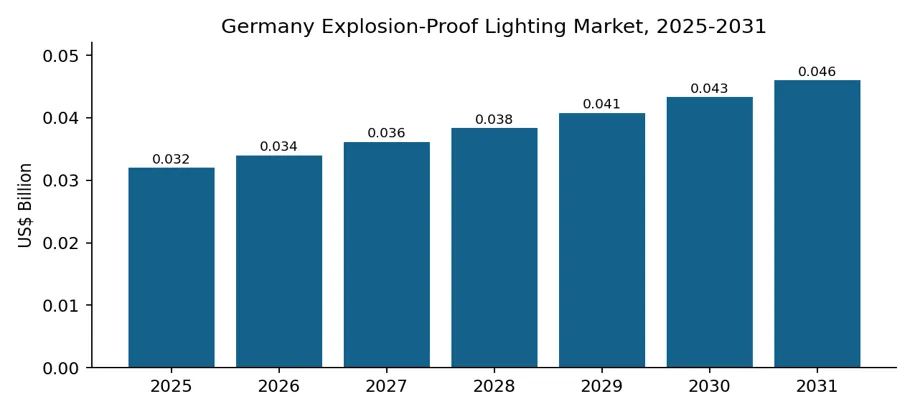
The Germany Explosion-Proof Lighting Market is estimated at US$ 0.032 billion in 2025 and is forecast to reach US$ 0.046 billion by 2031, corresponding to approximately 6.23% annual growth. Demand comes from certified lighting installed where flammable gases, vapours or combustible dust may create an explosive atmosphere. German chemical, pharmaceutical, oil and gas, food processing and energy facilities are the key customer groups.
The German market is shaped by strict ATEX workplace requirements, IECEx-aligned product specifications, inspection requirements and plant-modernisation budgets. Buyers replace legacy fluorescent lighting with certified LED fittings to reduce maintenance in hazardous locations. Procurement decisions also depend on temperature class, zone rating, corrosion resistance, ingress protection and long-term availability of replacement parts.
| 2025 MARKET SIZE | 2031 FORECAST | CAGR (2026-2031) |
| US$ 0.032 Billion | US$ 0.046 Billion | 6.23% |
Germany Explosion-Proof Lighting Key Takeaways
Germany's explosion-proof lighting equipment demand is estimated at US$ 32 million in 2025, reaching approximately US$ 46 million by 2031.
Chemical processing, petrochemicals, pharmaceuticals and combustible-dust facilities are important sources of certified lighting demand.
Fixed explosion-protected LED linear luminaires, high-bay fixtures and industrial floodlights are major product categories.
Legacy fluorescent and discharge-lamp replacement increases the importance of retrofit-compatible luminaires and engineering support.
Zone 1, Zone 2, Zone 21 and Zone 22 installations require specific protection methods, markings and temperature classes.
Certification, installation conditions, limited shutdown windows and long equipment service lives shape replacement spending.
Germany Explosion-Proof Lighting Industry Trends and Strategic Insights
Buyers are moving to certified LED systems with improved efficacy, fewer lamp changes and a wider operating-temperature range.
Product selection increasingly accounts for ATEX markings, IECEx documentation, ingress protection and installation labour.
Modular replacement parts and accessible electrical connections are valued where maintenance can interrupt plant operations.
German and international suppliers compete through application engineering, test documentation, certified product range and service.
Germany Explosion-Proof Lighting Market Scope
| METRICS | DETAILS |
| 2025 Market Size | US$ 0.032 Billion |
| 2031 Projected Market Size | US$ 0.046 Billion |
| CAGR (2026-2031) | 6.23% |
| By Product Type | Linear, high-bay, bulkhead, floodlight, portable and emergency Ex luminaires |
| By Zone | Zone 0, 1, 2 and dust Zones 20, 21 and 22 |
| By Lighting Technology | LED, fluorescent installed base and emergency battery systems |
| By Controls | ATEX, IECEx, Ex d, Ex e and related certified constructions |
| By Application | Chemical, oil and gas, pharmaceutical, food processing and energy |
| By Installation | Indoor, outdoor, fixed, portable and maintenance retrofit |
| By End Use | New-build, replacement, retrofit and lifecycle services |
| Market Data Coverage | 2025-2031 Germany explosion-proof lighting trends and applications |
Germany Explosion-Proof Lighting Market White Space & Investment Opportunities
Retrofit programmes: replace aging fluorescent Ex luminaires during planned turnaround windows and reduce future access costs.
Dust hazard applications: develop robust certified solutions for grain, powders, pharmaceuticals, battery materials and wood processing.
High-value applications: supply corrosion-resistant process-area floodlights, emergency units and long-life fixtures for difficult sites.
Suppliers can differentiate through zone-specific engineering, complete certification documentation, retrofit mounting compatibility and inspection-friendly product design. Early engagement with plant operators and electrical contractors helps align approvals with maintenance windows.
Driver Impact Analysis
Certified lighting is a core safety requirement in areas where flammable gases or dust can be present. German chemical complexes, storage terminals and process plants periodically renew their lighting as part of facility upgrades and safety programmes. ATEX classification and engineering review can increase equipment value per fitting because specialist enclosures, tested cable entries and certified components are required. Demand is linked to operating industrial sites as well as new installations.
| DRIVER | AFFECTED PRODUCT / SIGNAL | 2026–2031 CAGR | STRATEGIC IMPACT |
| ATEX and process safety | High | Certification-driven replacement in classified gas and dust zones | Build certified portfolios mapped to each plant zone |
| LED replacement economics | High | Lower maintenance and lighting energy usage at operating plants | Offer retrofit-compatible luminaires for planned shutdowns |
| Dust-hazard investment | Medium-High | Zone 21/22 installations in powder, grain and battery processes | Expand dust-certified fixture specifications |
| Specialist service needs | Medium-High | High-temperature, corrosion-resistant and emergency fittings | Bundle application engineering and lifecycle support |
Energy savings and maintenance reduction further support replacement of older fluorescent and HID fittings. In high-risk areas, access permits, shutdowns and specialised electrical labour can make a lamp replacement expensive. Long-life LED luminaires therefore offer lifecycle benefits beyond electricity savings. Additional growth comes from pharmaceutical powders, hydrogen-related equipment and dust-hazard processing, where each installation must match its precise classification.
Restraint Impact Analysis
Explosion-proof lighting carries a higher purchase price and longer qualification process than ordinary industrial lighting. Each project must account for hazardous zones, gas and dust groups, thermal limits, cable entry specifications and documentation. Retrofit programmes may be postponed if existing certified equipment remains serviceable or if access requires a plant shutdown. Lower industrial investment and delayed chemical-sector capital spending can also slow new orders.
| RESTRAINT | PRIMARY EXPOSURE | RISK LEVEL | STRATEGIC IMPACT |
| High equipment and approval costs | Specially certified luminaires and installation engineering | High | Document lifecycle savings and match approved specifications |
| Long replacement intervals | Installed certified LED luminaires with long service life | High | Develop inspection and planned retrofit pipelines |
| Shutdown and installation restrictions | Operating chemical and hazardous process facilities | Medium-High | Synchronise work with plant turnaround windows |
| Certification and product qualification | Variant-specific ATEX / IECEx documents and spare parts | Medium-High | Maintain compliant documentation and local service support |
Supplier competition is constrained by certification requirements and product-specific testing. The cost of maintaining multiple ATEX variants can limit available stock and increase delivery time for special configurations. Buyers may prefer previously approved models, making it difficult for new suppliers to displace incumbents. Installation mistakes or substitutions with non-equivalent fittings pose safety and compliance risks.
Germany Explosion-Proof Lighting Market Competitive Landscape
Germany is a central European market for specialised explosion-protected electrical equipment. R. STAHL, Eaton CEAG, BARTEC and Adolf Schuch provide prominent certified lighting portfolios. International suppliers compete in fixed luminaires, floodlighting, portable worklights and rugged specialist applications. Customer selection emphasises suitable zone ratings, documented conformity, serviceability and pricing across long replacement cycles.
| COMPANY | EXPLOSION-PROOF LIGHTING POSITIONING |
| R. STAHL | German specialist in explosion-protected fixed and portable luminaires. |
| Eaton (CEAG) | Hazardous-area LED lighting, emergency fittings and certified installations. |
| BARTEC | Explosion-protected equipment and lighting for process plants. |
| Adolf Schuch | German-produced explosion-proof LED linear, high-bay and flood luminaires. |
| Pepperl+Fuchs | Explosion-protected equipment and industrial hazardous-area solutions. |
| Glamox | Industrial and marine hazardous-area lighting systems. |
| PRACHT | ATEX/IECEx-certified LED luminaires including GECKO range. |
| Cortem | Certified explosion-proof industrial luminaires and accessories. |
| Peli Products | Portable certified worklights, flashlights and inspection lighting. |
| ZALUX | Rugged, ATEX/IECEx-certified lighting for hazardous industrial areas. |
Plant owners, hazardous-area engineers, maintenance contractors and industrial distributors all influence procurement. Suppliers with local technical support and certified alternatives for older models are well placed to win large brownfield programmes.
Germany Explosion-Proof Lighting Market Recent Developments
January 16, 2026: Adolf Schuch issued product documentation for the ExSTREAM explosion-protected LED high-bay floodlight for Zone 1 and Zone 21 industrial applications.
March 2026: Adolf Schuch presented its technical lighting and explosion-protected luminaire expertise at Light + Building in Frankfurt.
March 2026: PRACHT highlighted its GECKO L ATEX and IECEx-certified explosion-proof linear luminaire through its Light + Building product presentation.
March 2026: Schuch reported strong interest in its modular luminaires and lighting-management solutions following Light + Building 2026.
March 25, 2026: ZALUX reported showcasing certified ATEX/IECEx lighting for hazardous areas at Light + Building alongside its industrial luminaire portfolio.
2026: R. STAHL published updated technical information for its 6036 compact explosion-protected LED tubular lighting series, including extreme-temperature and ingress-protection specifications.