

Germany Data Center Transformer Market Size and Overview
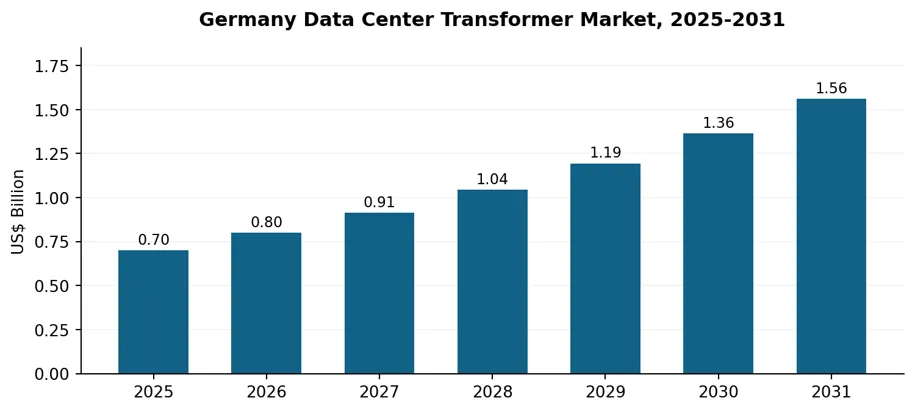
The Germany Data Center Transformer Market is estimated at US$ 0.70 billion in 2025 and is forecast to reach US$ 1.56 billion by 2031, equivalent to an estimated 14.3% compound annual growth rate. Hyperscale construction, AI infrastructure and new colocation campuses are increasing demand for utility interconnection, medium-power and distribution transformers. Orders are increasingly tied to grid-connection milestones and campus energization schedules.
Transformers connect high-voltage utility networks to data center substations and medium-voltage systems inside each campus. Germany is a major European data center location, with significant investment in Frankfurt, Berlin-Brandenburg and emerging secondary clusters. Operators need proven equipment, low electrical losses and dependable manufacturing slots to bring new capacity online.
| 2025 MARKET SIZE | 2031 FORECAST | CAGR (2026–2031) |
| US$ 0.70 billion in 2025 | US$ 1.56 billion by 2031 | 14.3 % |
Germany Data Center Transformer Key Takeaways
Estimated data center transformer revenue increases from US$ 0.70 billion in 2025 to US$ 1.56 billion in 2031.
Hyperscale and AI campuses require primary substation transformers and repeatable medium-voltage distribution packages.
Grid availability and connection approval can determine when projects proceed, particularly around Frankfurt.
New sites in Berlin-Brandenburg and other regions provide demand for substations and modular power blocks.
Lower-loss transformers and monitoring are increasingly important for energy-intensive data center operations.
Early factory reservations, grid-operator approvals and commissioning support strengthen supplier positions.
Germany Data Center Transformer Industry Trends and Strategic Insights
Developers are making transformer and grid-connection decisions earlier because energization dates can govern the full construction schedule.
AI-heavy facilities favor scalable transformer blocks, multiple incoming feeds and protection arrangements that support future upgrades.
Operators evaluate equipment losses, fire protection, noise and maintenance access together with lead time and purchase cost.
Suppliers able to coordinate utility specifications, engineering and installation across several German sites gain an advantage.
Germany Data Center Transformer Market Scope
| METRICS | DETAILS |
| 2025 Market Size | US$ 0.70 billion in 2025 |
| 2031 Projected Market Size | US$ 1.56 billion by 2031 |
| CAGR (2026–2031) | 14.3 % |
| By Transformer Type | Distribution, medium-power, large-power, modular substations and lifecycle services |
| By Data Center Type | Hyperscale, AI campuses, colocation, cloud, enterprise and edge |
| By Voltage Rating | Low voltage, medium voltage, high voltage and extra-high voltage |
| By Insulation and Cooling | Oil-immersed, natural ester, dry-type and cast resin |
| By Power Architecture | Utility interconnection, primary substations, onsite distribution and behind-the-meter systems |
| By Phase and Installation | Indoor, outdoor, pad-mounted and prefabricated substations |
| By Installation Stage | Greenfield campus, phased expansion, replacement and aftermarket |
Coverage: Germany. The report covers transformers used in data center substations and onsite electrical distribution, including hyperscale, cloud, colocation, enterprise, edge and AI campuses. It covers utility connection, transformer type, voltage, insulation and cooling, installation and lifecycle services.
Germany Data Center Transformer Market White Space & Investment Opportunities
Hyperscale primary substations: win early specification opportunities with campus developers and utility contractors.
Standardized power blocks: provide modular medium-voltage transformers and packaged substations for repeat campus deployments.
High-efficiency and service offerings: combine low-loss units, condition monitoring, spare equipment and commissioning support.
The best opportunities depend on engagement with grid operators, consultants, campus developers and EPC companies before equipment orders are finalized. Suppliers that can confirm German grid compatibility, credible delivery dates and local service coverage are better positioned to secure framework contracts.
Driver Impact Analysis
Germany’s data center buildout is expanding the need for medium- and large-power transformers, particularly at campuses that require new utility substations. AI compute demand creates higher electrical loads while cloud and colocation providers continue phased expansions. Equipment suppliers can benefit from repeat transformer orders when electrical blocks are standardized across sites. The German grid expansion program also raises competition for transformer factory capacity.
| DRIVER | AFFECTED PRODUCT / SIGNAL | 2026–2031 CAGR | STRATEGIC IMPACT |
| Hyperscale and AI campus growth | High | Utility interconnection and multiple medium-voltage transformers | Reserve factory slots before major construction milestones |
| Colocation campus extensions | High | Repeat standardized power blocks and substation packages | Offer site-to-site framework supply agreements |
| Expansion beyond Frankfurt | Medium-High | New substations serving emerging data center corridors | Build local EPC and utility partnerships |
| Efficiency and availability needs | Medium-High | Low-loss transformers, online monitoring and modular systems | Prove lifecycle efficiency and service response |
Higher load density and operator reliability requirements increase demand for equipment that limits electrical losses and supports redundancy. Site selection increasingly reflects available grid capacity and realistic energization schedules. Suppliers can improve their position by coordinating transformer design, efficiency performance, utility approval and factory testing early in the development cycle.
Restraint Impact Analysis
Grid connection delays are a major constraint because high-voltage infrastructure work and utility capacity allocation can take longer than building construction. Production slots for large transformers remain competitive as grid upgrades, renewable integration and data center projects draw on the same suppliers. Copper, electrical steel and insulation price changes can further affect procurement budgets and fixed-price tenders.
| RESTRAINT | PRIMARY EXPOSURE | RISK LEVEL | STRATEGIC IMPACT |
| Grid connection uncertainty | Primary substations and high-voltage energization | High | Coordinate design and purchase orders with utility milestones |
| Extended transformer lead times | Large-power and custom medium-power units | High | Freeze specifications and qualify alternative production sources |
| Material cost pressure | Core steel, copper, insulation and bushings | Medium-High | Plan procurement and contractual price-adjustment terms |
| Complex site and compliance requirements | Urban sites, fire protection and grid acceptance | Medium-High | Complete approval, noise and layout reviews ahead of orders |
Project changes in incoming voltage, transformer rating, redundancy or cooling design can trigger fresh engineering reviews and longer delivery windows. Large units also need transport, cranage and factory testing coordination. Buyers can reduce schedule exposure through early specification freezes, staged capacity planning and verified alternative suppliers.
Germany Data Center Transformer Market Competitive Landscape
Competition includes German and other European transformer manufacturers, international grid-equipment suppliers and packaged power-system providers. Data center buyers compare grid acceptance, transformer losses, engineering capability, manufacturing availability, factory testing and maintenance coverage. Established local utility relationships remain important for medium-voltage and high-voltage interconnections.
| COMPANY | DATA CENTER TRANSFORMER POSITIONING |
| Siemens Energy | Large-power transformers and grid integration for critical-load substations |
| Hitachi Energy | Utility and medium-power transformers for new campus power supply |
| SGB-SMIT Group | European power and distribution transformer manufacturing |
| Maschinenfabrik Reinhausen | Tap changers, voltage regulation and solid-state transformer development |
| GE Vernova | Grid and power transformer solutions for major utility interfaces |
| Schneider Electric | Dry-type transformers and packaged power distribution systems |
| Eaton | Transformer and electrical distribution solutions for critical facilities |
| ABB | Grid connection and distribution electrical systems for campus infrastructure |
| TMC Transformers | Dry-type and cast-resin distribution transformers for indoor applications |
| Koncar D&ST | Power transformers for utility-connected infrastructure |
Large-power transformer suppliers compete for incoming campus substations while dry-type and medium-power specialists target indoor distribution and modular power systems. Increasingly, differentiating factors are confirmed delivery slots, low-loss designs, local commissioning capacity and the ability to supply repeat systems across multiple campuses.
Germany Data Center Transformer Market Recent Developments
January 28, 2026: NTT DATA reported that the land-use and development plan for its Frankfurt 6 data center campus in Nierstein had come into force, advancing the project’s grid and site planning.
July 1, 2026: Siemens announced a EUR 300 million German investment in electrical distribution equipment manufacturing, including Frankfurt facilities serving rising data center demand.
July 7, 2026: HOCHTIEF won a contract to build a 36 MW NTT data center in Berlin, with electrical and mechanical systems included in the development.
August 14, 2026: Siemens and Maschinenfabrik Reinhausen announced joint development of a solid-state transformer intended for AI data centers, supporting 36 kV input and 800 V DC output.
August 27, 2026: Schwarz Group advanced a large 240 MW data center development near Rostock, adding to future demand for grid connections and electrical infrastructure.
September 2026: The German Datacenter Association’s 2026/27 outlook emphasized grid connection capacity and project readiness as major determinants of data center investment and delivery.