Germany Data Center Switchgear Market Size and Overview
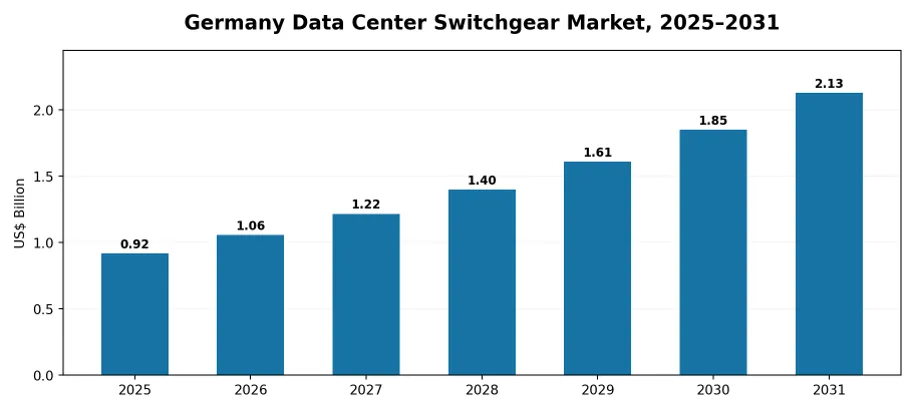
The Germany Data Center Switchgear Market is estimated at US$ 0.92 billion in 2025 and is forecast to reach US$ 2.13 billion by 2031, equivalent to an estimated 15.0% compound annual growth rate. Data center construction, AI infrastructure and colocation expansions are raising demand for medium-voltage switching, low-voltage power distribution and high-reliability protection equipment. Grid connection timelines and SF6-free product transitions increasingly influence procurement decisions.
Switchgear protects and controls electrical supply from the incoming grid connection through the campus distribution network and into critical computing spaces. Germany remains a major European data center hub, with continued development around Frankfurt and growth in Berlin-Brandenburg and other regions. Developers seek resilient equipment, fast fault isolation, repeatable specifications and dependable factory delivery.
| 2025 MARKET SIZE | 2031 FORECAST | CAGR (2026–2031) |
| US$ 0.92 Billion | US$ 2.13 Billion | 15.0% |
Germany Data Center Switchgear Key Takeaways
Estimated data center switchgear revenue increases from US$ 0.92 billion in 2025 to US$ 2.13 billion by 2031.
AI and hyperscale campuses require redundant medium-voltage feeders, selective protection and scalable low-voltage switchboards.
Connection approval and available utility capacity can influence the timing of switchgear tenders and deliveries.
Projects outside Frankfurt create demand for modular electrical rooms and standardized MV/LV switching assemblies.
SF6-free solutions, arc-resistant designs and digital condition monitoring are increasingly important purchasing criteria.
Suppliers benefit from early specification involvement, proven short-circuit ratings and local testing and commissioning support.
Germany Data Center Switchgear Industry Trends and Strategic Insights
Developers are aligning switchgear specifications with utility connection schedules earlier in the project cycle to avoid rework.
High-density AI facilities need selective protection, maintainable electrical rooms and expansion without extended shutdowns.
Buyers increasingly compare arc safety, SF6-free insulation, digital monitoring and lifecycle service alongside initial equipment cost.
Suppliers that offer coordinated MV and LV systems with local factory acceptance testing gain advantages in repeat campus programs.
Germany Data Center Switchgear Market Scope
| METRICS | DETAILS |
| 2025 Market Size | US$ 0.92 Billion |
| 2031 Projected Market Size | US$ 2.13 Billion |
| CAGR (2026–2031) | 15.0% |
| By Switchgear Type | Low-voltage, medium-voltage and high-voltage switching assemblies |
| By Data Center Type | Hyperscale, cloud, AI, colocation, enterprise and edge facilities |
| By Voltage Rating | Low voltage, medium voltage, high voltage and utility interconnection |
| By Insulation and Cooling | Air-insulated, gas-insulated, SF6-free and vacuum switching |
| By Power Architecture | Utility-fed substations, primary power distribution and downstream switchboards |
| By Phase and Installation | Indoor, outdoor, modular and metal-enclosed installations |
| By Installation Stage | New campuses, phased expansions, retrofit and maintenance |
| Market Data Coverage | 2025–2031 equipment demand and market trends |
Germany Data Center Switchgear Market White Space & Investment Opportunities
Early campus power design: secure MV switchgear positions during utility connection planning and electrical one-line design.
Modular distribution: supply standardized low-voltage boards, MV panels and packaged electrical rooms for phased deployments.
SF6-free and service solutions: pair alternative insulation technology with monitoring, factory testing, retrofit and commissioning.
Opportunity capture depends on early contact with operators, grid utilities, MEP designers and electrical EPC firms. Suppliers with approved protective schemes, credible manufacturing slots, high short-circuit ratings and local service capability are well positioned for multi-site purchasing programs.
Driver Impact Analysis
Germany’s expanding data center pipeline is increasing demand for medium-voltage and low-voltage switching assemblies across new and existing campuses. Higher AI workloads make electrical selectivity, redundancy and fault containment more important because any interruption can affect high-value compute assets. Operators are standardizing electrical blocks across multiple data halls, creating repeat orders for protection relays, MV panels, busbar systems and low-voltage switchboards. The shift toward SF6-free medium-voltage equipment adds another replacement and specification driver.
| DRIVER | AFFECTED PRODUCT / SIGNAL | 2026–2031 CAGR | STRATEGIC IMPACT |
| Hyperscale and AI campus expansion | High | MV feeders, LV switchboards and electrical redundancy | Engage early on single-line diagrams and feeder ratings |
| Colocation growth and repeat campus blocks | High | Standardized switchgear rooms and protection packages | Create multi-site framework supply agreements |
| SF6-free transition and equipment renewal | Medium-High | Low-emission MV and HV switchgear systems | Qualify alternative-insulation portfolios early |
| Reliability and power density requirements | High | Arc-resistant designs and digital condition monitoring | Demonstrate selectivity, safety and service response |
Growing power densities also raise requirements for arc-resistant enclosures, continuous monitoring and maintainable feeder arrangements. Data center projects need electrical systems that can support staged commissioning without disturbing energized sections of a campus. Suppliers who coordinate switchgear design, digital protection, factory testing and utility approvals during the early development phase can reduce execution risk and improve their competitive position.
Restraint Impact Analysis
Grid-connection uncertainty remains a major constraint because utility capacity and high-voltage approvals may delay the release of switchgear packages. Manufacturing lead times for specialized MV and HV assemblies can be stretched by competing grid and industrial orders. A change in incoming fault level, voltage, redundancy or feeder count may require re-engineering panels and relay settings. These revisions can disrupt factory slots and create higher costs for developers.
| RESTRAINT | PRIMARY EXPOSURE | RISK LEVEL | STRATEGIC IMPACT |
| Utility energization uncertainty | Incoming substations and MV feeders | High | Link delivery milestones to grid operator approvals |
| Factory lead times and specialist components | MV breakers, relays and HV GIS assemblies | High | Freeze ratings and confirm factory slots early |
| Technical and qualification requirements | SF6-free products, arc ratings and relay protection | Medium-High | Complete design approval and factory testing ahead of site works |
| Project reconfiguration and space limits | Panel lineups, busbars and electrical rooms | Medium-High | Reserve expansion space and validate fault studies early |
The transition toward SF6-free technologies adds product qualification and supply challenges, particularly where utility standards and certified designs differ across voltage classes. Germany’s urban data center sites can also have limited electrical-room space, strict noise requirements and complex installation logistics. Suppliers can manage exposure through early short-circuit studies, specification freezes, factory acceptance tests and qualified alternative component sources.
Germany Data Center Switchgear Market Competitive Landscape
The market includes major German and international switchgear manufacturers and specialist distributors of critical-power equipment. Purchasers assess protection performance, breaker technology, digital monitoring, insulation choice, factory capacity, installation footprint and after-sales service. Local familiarity with utility specifications is especially important for medium-voltage and high-voltage campus interfaces.
| COMPANY | DATA CENTER SWITCHGEAR POSITIONING |
| Siemens | MV and LV switchgear portfolios, including Frankfurt production for critical-power projects |
| Schneider Electric | Power distribution switchgear, breakers and integrated data center electrical infrastructure |
| ABB | MV/LV switchgear and control technologies for critical-facility distribution |
| Eaton | Low-voltage power distribution, circuit breakers and data center electrical systems |
| Hitachi Energy | HV GIS and transmission-grade switching for grid-connected substations |
| GE Vernova | Grid switching and protection equipment for utility-connected data center campuses |
| Ormazabal | Medium-voltage switchgear, ring main units and compact substation offerings |
| Rittal | Enclosures and modular power distribution infrastructure for data centers |
| Mitsubishi Electric | Medium-voltage and low-voltage switching equipment for industrial and critical facilities |
| LS ELECTRIC | Medium-voltage and low-voltage distribution and protection products |
The main areas of competition are standardized medium-voltage panels, high-reliability low-voltage power distribution, modular electrical rooms and SF6-free switching solutions. Firms with integrated MV/LV engineering support and dependable installation and commissioning networks are better positioned for large, multi-phase data center programs.
Germany Data Center Switchgear Market Recent Developments
February 27, 2026: Siemens Energy highlighted a German 110 kV clean-air switchgear deployment at FERALPI STAHL, demonstrating high-voltage alternatives to SF6 for critical infrastructure.
July 1, 2026: Siemens announced EUR 300 million in German manufacturing investment, including expansion of its Frankfurt switchgear facilities and an Offenbach supplier site to support data center and electrification demand.
July 7, 2026: HOCHTIEF won the contract to deliver a 36 MW NTT Global Data Centers facility in Berlin, including electrical and mechanical engineering works.
August 2026: Large German data center developments continued to add demand for medium-voltage distribution, protection and modular switching systems, alongside new utility connections.
August 27, 2026: Schwarz Group advanced a 240 MW data center development near Rostock, creating future demand for campus substations and electrical switching infrastructure.
October 2026: Industry project tracking showed continued data center development activity across Germany, with grid access and connection readiness influencing electrical procurement schedules.