Germany Data Center Lighting Market Size and Overview
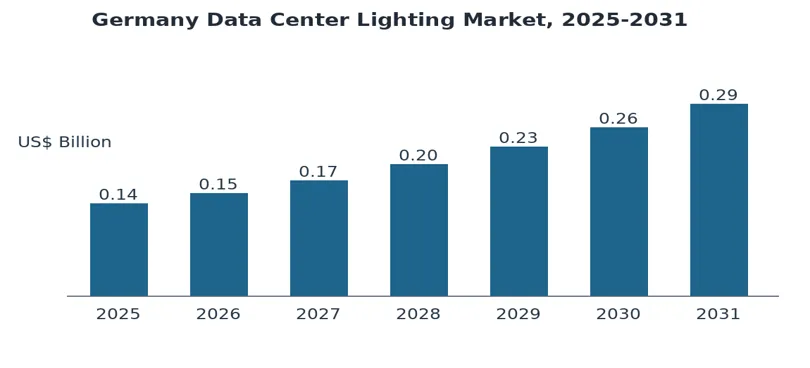
The Germany Data Center Lighting Market is estimated at US$ 0.14 billion in 2025 and is projected to reach US$ 0.29 billion in 2031, representing approximately 12.9% annualized growth. New hyperscale campuses, colocation expansion and upgrades to existing facilities are increasing demand for reliable LED, emergency and digitally controlled lighting.
Data center lighting includes fixtures in white space, electrical rooms, UPS and battery rooms, mechanical areas, corridors, security zones and external campus spaces. Buyers prioritize reliable illumination during maintenance, efficient operation, and safe evacuation during power failures. LED systems with occupancy controls reduce unnecessary operating hours while compliant emergency lighting supports business continuity.
| 2025 MARKET SIZE | 2031 FORECAST | CAGR (2026-2031) |
| US$ 0.14 Billion | US$ 0.29 Billion | 12.9% |
Germany Data Center Lighting Key Takeaways
Germany data center lighting revenue is estimated to rise from US$ 0.14 billion in 2025 to US$ 0.29 billion in 2031.
Frankfurt remains the leading deployment cluster while Berlin, Brandenburg and additional regional sites create new lighting procurement opportunities.
New data halls require lighting packages for white space, electrical rooms, corridors, mechanical areas and external security zones.
Emergency luminaires, escape-route lighting and backup-power integration are critical to safe facility operation.
Sensor-based LED lighting supports efficient part-load operation in intermittently occupied data halls and support rooms.
Suppliers with reliable emergency-testing systems, fast fixture replacement and strong electrical-contractor relationships are well placed.
Germany Data Center Lighting Industry Trends and Strategic Insights
Facility owners increasingly specify LED lighting and controls alongside building management systems during the engineering stage.
Low occupancy in live data halls supports motion-based dimming where visibility and safety requirements permit.
Operators are standardizing durable luminaire types across multiple sites to simplify maintenance and spare-part inventories.
Integrated emergency lighting tests, fault alerts and documented compliance checks are becoming important lifecycle requirements.
Germany Data Center Lighting Market Scope
| METRICS | DETAILS |
| 2025 Market Size | US$ 0.14 Billion |
| 2031 Projected Market Size | US$ 0.29 Billion |
| CAGR (2026-2031) | 12.9% |
| By Lighting Type | LED data hall fixtures, industrial linear and high-bay, exterior and emergency lighting |
| By End-Use Industry | Hyperscale/cloud, colocation, enterprise and edge |
| By Power Rating | Normal supply, UPS-backed lighting, centralized emergency batteries |
| By Voltage | LED modules, driver electronics, sensors, DALI and BMS lighting controls |
| By Control Method | Data halls, electrical rooms, plant rooms, egress routes and perimeter |
| By Application | New construction, fit-out, retrofit, maintenance and replacement |
| By Installation Stage | 10 lighting and electrical systems providers serving German facilities |
| Market Data Coverage | 2025-2031 equipment-revenue estimates, cooling-system applications and market trends |
Germany Data Center Lighting Market White Space & Investment Opportunities
New campus packages: supply standard LED and emergency lighting schedules for hyperscale and colocation construction.
Control upgrades: retrofit lighting occupancy controls and digital fault monitoring into operating facilities without disturbing critical loads.
Compliance services: provide emergency-lighting inspections, battery replacement, centralized testing and spare-fixture contracts.
Lighting suppliers benefit from early engagement with MEP designers, general contractors and data center operators. Standardized product approvals and reliable service coverage help secure repeat orders across campuses.
Driver Impact Analysis
Germany’s data center construction pipeline increases the need for lighting in each new technical room, service corridor, exterior access zone and operations area. Multi-building campuses multiply the number of fixtures, control circuits and emergency-lighting points to be specified. Lighting packages are often designed before a hall is commissioned, making early relationships with electrical contractors and consultants important.
| DRIVER | AFFECTED PRODUCT / SIGNAL | 2026–2031 IMPACT | STRATEGIC IMPACT |
| Hyperscale and colocation buildout | High | New indoor and exterior lighting packages | Engage MEP teams during design and secure approved fixture schedules |
| Energy efficiency investment | High | LED upgrades, occupancy controls and monitoring | Bundle efficient luminaires with lighting controls and commissioning |
| Safety and uptime requirements | High | Emergency luminaires, exit signs and batteries | Offer verified autonomy, digital testing and lifecycle service |
| Campus standardization | Medium-High | Repeat orders for standardized luminaires | Create multi-site framework agreements and spare-part programs |
Energy efficiency, site safety and asset uptime add further momentum. LED lighting consumes less electricity than older technologies, while zoning and occupancy sensors limit operating hours in rarely occupied technical spaces. Emergency lighting and automated testing are particularly relevant because electrical rooms and exit routes must remain usable during an outage.
Restraint Impact Analysis
The primary restraint is the relatively small lighting share of total data center capital expenditure. Developers prioritize utility connection, cooling, server infrastructure and switchgear, leaving lighting packages exposed to value engineering. Standard indoor fixtures also face intense price competition and limited differentiation unless suppliers can demonstrate reliability, controls integration or service benefits.
| RESTRAINT | PRIMARY EXPOSURE | RISK LEVEL | STRATEGIC IMPACT |
| Lighting cost pressure | Standard LED fixtures | High | Demonstrate lifecycle savings and maintenance reliability |
| Grid and project delays | New data center fit-out schedules | High | Link delivery to confirmed commissioning milestones |
| Safety and emergency compliance | Escape routes and backup lighting | High | Verify autonomy, documentation and testing requirements early |
| Controls integration complexity | DALI, sensors and BMS interfaces | Medium-High | Standardize protocols and test systems before deployment |
Project schedules are another constraint. Grid delays and phased commissioning can postpone lighting orders even after building shells are finished. Compliance specifications vary with room use and fire-safety design, while custom control interfaces can raise engineering and commissioning costs. Suppliers must coordinate emergency power, cable routes and lighting control requirements early to avoid rework.
Germany Data Center Lighting Competitive Landscape
Competition includes German and international LED luminaire manufacturers, emergency-lighting specialists and building-control suppliers. Buyers compare fixture life, energy consumption, battery autonomy, emergency testing, availability and service response. Large contractors may combine luminaires and controls in a single electrical package.
| COMPANY | DATA CENTER LIGHTING POSITIONING |
| TRILUX | Industrial and commercial LED luminaires, emergency and smart lighting solutions. |
| Zumtobel Group | Professional LED products, controls and lighting management for technical buildings. |
| Signify | Connected LED lighting and professional luminaires for large facilities. |
| LEDVANCE | LED fixtures and controls for industrial and commercial applications. |
| SITECO | German professional lighting for demanding indoor and outdoor applications. |
| RZB Rudolf Zimmermann | German LED and emergency-lighting products for complex facilities. |
| Glamox | Industrial and technical luminaires with emergency-lighting options. |
| Eaton | Emergency lighting, exit signs and electrical safety systems. |
| Schneider Electric | Building automation, lighting interfaces and electrical infrastructure integration. |
| RP-Technik | German emergency lighting and central-battery systems. |
Suppliers gain an advantage through approved product ranges, DALI and BMS integration, documentation for electrical safety and maintenance support. Data center operators also value repeatable solutions across multiple facilities.
Germany Data Center Lighting Recent Developments
March 2026: Zumtobel presented new adaptive and modular lighting solutions at Light + Building 2026, highlighting developments in LED lighting and controls relevant to modern technical buildings.
March 2026: Germany’s Light + Building event featured smart lighting controls, emergency-lighting technology and efficient commercial luminaires relevant to data center facility specification.
March 2026: A German data center development pipeline assessment listed the 57 MW VIRTUS Marienpark campus and the 54 MW Greenrocks Mainz project among major 2026 milestones.
May 2026: VIRTUS progressed its Wustermark data center campus development in Brandenburg, supporting future demand for electrical fit-out and lighting packages.
July 2026: NTT DATA advanced Frankfurt-area data center construction activity, extending the pipeline for interior and emergency lighting installation.
September 2026: The German Datacenter Association’s 2026/27 outlook highlighted Germany’s growing data center capacity and the rising importance of project readiness and efficiency requirements.