


Germany Certified Reference Material Market Size and Overview
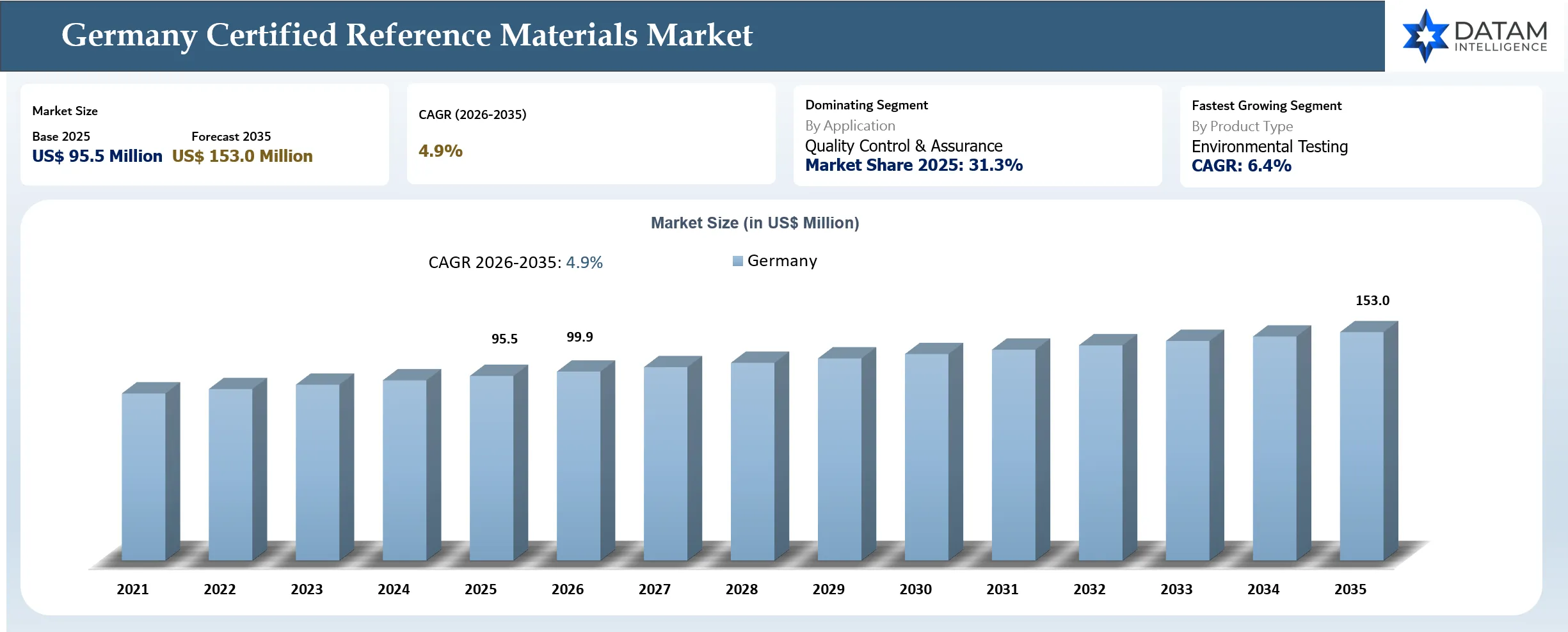
The Germany certified reference material market reached USD 95.5 billion in 2025 and is expected to reach USD 153.0 billion by 2035, growing with a CAGR of 4.9% during the forecast period 2026-2035. The Germany certified reference materials market is driven by increasing demand for accredited laboratory testing and quality assurance, stringent environmental and food safety monitoring requirements, rising pharmaceutical and industrial analytical testing, expanding research and development activities, and the need for traceable measurements and specialized reference materials for advanced analytical methods.
Germany’s official food safety surveillance programmes support demand for certified pesticide standards and reference materials used to detect chemical residues and contaminants. For instance, the Federal Office of Consumer Protection and Food Safety (BVL) reported that 21,142 food samples were analyzed for pesticide residues in 2024, covering cereals, animal-origin foods, fruits and vegetables, processed foods, and infant foods. This testing activity supports demand for certified pesticide standards and multi-residue reference materials used in regulatory testing and laboratory quality control.
Germany’s growing focus on drinking-water quality and emerging contaminant monitoring is supporting demand for reliable environmental testing and certified reference materials. The Drinking Water Ordinance sets a limit of 100 ng/L for the sum of 20 specified PFAS, effective from 12 January 2026, followed by a separate limit of 20 ng/L for four specified PFAS from 12 January 2028. These requirements increase the need for accurate PFAS analysis, validated testing methods, and laboratory quality assurance.
Germany Certified Reference Material Market Key Takeaways
- Quality Control & Assurance dominated the Germany Certified Reference Materials Market by application in 2025, accounting for 31.3% market share. Demand is supported by the need for instrument calibration, analytical method validation, measurement traceability, and routine laboratory quality control across pharmaceutical, chemical, food safety, and environmental testing applications.
- Environmental Testing is the fastest-growing product-type segment, with a projected CAGR of 6.4%. Growth is driven by increasing requirements for water quality monitoring, soil contamination assessment, wastewater analysis, and testing for pollutants such as PFAS. These applications require reliable reference materials to verify analytical accuracy and support environmental monitoring.
- Specialized reference-material production supports analytical quality assurance across Germany’s testing laboratories. For instance, WITEGA Laboratorien Berlin-Adlershof GmbH manufactures reference materials for pesticide and veterinary-drug residue analysis, including metabolites and stable-isotope-labelled derivatives. Its ISO 17034-related production capabilities support reliable analytical measurements and quality control in residue testing.
Germany Certified Reference Material Market Scope
| Metrics | Details |
| 2025 Market Size | USD 95.5 Billion |
| 2035 Projected Market Size | USD 153.0 Billion |
| CAGR (2026-2035) | 4.9% |
| By Product Type | Organic, Inorganic |
| By Application | Quality Control & Assurance, Method Validation, Regulatory Compliance Testing, R&D & Analytical Development, Calibration & Instrument Validation |
| By End-Use Industry | Consumer Industry, Contract Testing, University / Non-Profit, Energy Industry, Environmental Testing, Health Care, Industrial / Manufacturing, Materials / Mining |
| Report Insights Covered | Competitive Landscape Analysis, Company Profile Analysis, Market Size, Share, Growth |
Germany Certified Reference Material Market Disruption Analysis
Expansion of Specialized Environmental Testing and Precision Analytical Standards Disrupting Germany’s Certified Reference Materials Market
The Germany certified reference materials market is being reshaped by stricter environmental monitoring, food safety controls, pharmaceutical quality requirements, and increasing demand for traceable analytical measurements. Growing attention to emerging contaminants such as PFAS, alongside the need for accredited laboratory testing and advanced analytical method validation, is increasing demand for specialized reference materials. These developments are encouraging suppliers to expand certified standards portfolios for environmental analysis, chemical testing, food safety, and industrial applications.
The expansion of environmental monitoring is creating demand for reference materials used in groundwater, soil, and contaminant analysis. For instance, Germany’s Federal Institute for Materials Research and Testing (BAM) develops and supplies reference materials for chemical and environmental analysis, including materials used to support reliable measurements and laboratory quality assurance. Its reference material production capabilities support laboratories requiring traceable measurements for regulatory monitoring, analytical validation, and industrial quality control.
Germany Certified Reference Material Market BCG Matrix: Company Evaluation
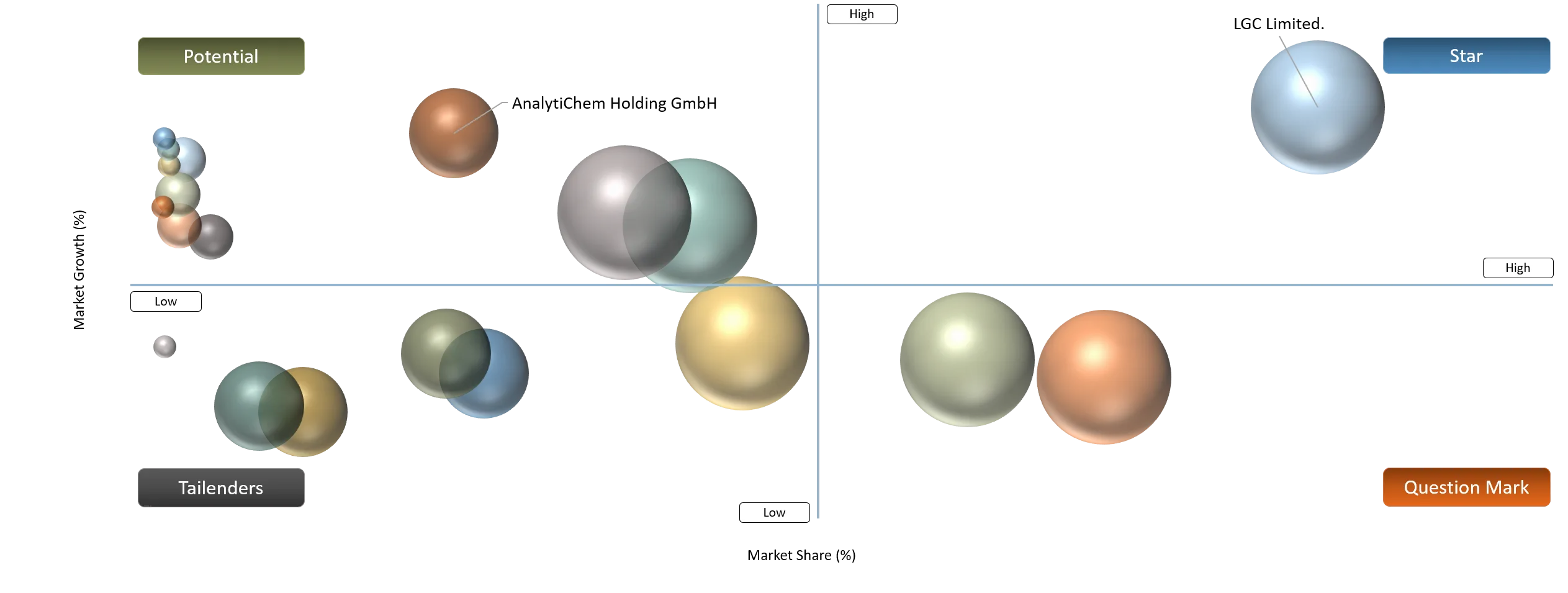
In the Germany Certified Reference Materials (CRM) Market, Merck KGaA and LGC Limited / LGC GmbH are positioned as Stars due to their broad reference-material portfolios and established presence across pharmaceutical, chemical, environmental, and analytical testing applications. AnalytiChem Holding GmbH, FLUXANA GmbH & Co. KG, Hach Lange GmbH, Antylia Scientific, Inorganic Ventures (I.V. Labs, Inc.), Starna Scientific Limited, and WITEGA Laboratorien Berlin-Adlershof GmbH are classified as Potential Stars, supported by their specialized capabilities in areas such as inorganic analysis, X-ray fluorescence, water testing, spectroscopy, and pesticide-residue analysis.
Anton Paar GmbH, CPAChem, and AccuStandard are categorized as Question Marks, with growth potential linked to their CRM product portfolios, competitiveness, and penetration across Germany’s analytical testing applications. No companies assigned to the Tailenders category in this qualitative BCG Matrix. The classifications are based on portfolio breadth, application coverage, and potential market growth rather than verified Germany-specific market-share data.
Germany Certified Reference Material Market Segment Analysis
The Germany certified reference material market is segmented based on product type, application, end-user, and region.
Environmental Testing Dominates Amid Stricter Contaminant Monitoring
Environmental testing holds the largest share in end-use industry, supported by growing demand for soil analysis, PFAS monitoring, and contamination assessment. Stricter environmental monitoring requirements and research into emerging pollutants are increasing the need for accurate analytical testing and laboratory quality assurance. For instance, in August 2026, Eurofins Umwelt West GmbH, in partnership with Arcadis Germany GmbH, joined a German Federal Environment Agency (UBA) research project investigating PFAS contamination in densely populated areas and selected contaminated sites. Running from January 2026 to April 2029, the project involves site investigations and chemical analyses to support soil assessment and environmental protection.
Germany’s environmental testing segment is supported by companies such as DRRR, which provides environmental reference materials and proficiency testing for soil, water, and air, including PFAS testing, HPC Standards GmbH, which manufactures reference materials for pesticide residue analysis, and WITEGA Laboratorien Berlin-Adlershof GmbH, which supplies certified reference materials for pesticide and veterinary-drug residue analysis.
Germany Certified Reference Material Market Competitive Landscape
Key Developments
- August 2026: Eurofins Umwelt West GmbH, in partnership with Arcadis Germany GmbH, joined a German Federal Environment Agency (UBA) research project investigating PFAS contamination in densely populated areas and selected contaminated sites. Running from January 2026 to April 2029, the project involves site investigations and chemical analyses to support soil assessment and environmental protection.
- August 2026: The Federal Institute for Materials Research and Testing (BAM) introduced BAM-N010, a certified reference material comprising a polypropylene nanoplastic dispersion with a defined particle size. The material supports analytical method validation and measurement verification for nanoplastic detection in liquid samples, strengthening the need for specialized reference materials to improve measurement reliability and environmental contaminant analysis.
- May 2025: Germany's Federal Institute for Materials Research and Testing (BAM) announced a certified reference material made from used outdoor clothing. BAM-B003 contains 18 characterized PFAS, including PFHxA, and helps laboratories verify whether their methods accurately measure these substances at low concentrations in textiles.
Key Procurement Priorities and Buyer Evaluation Criteria
- Organizations procuring certified reference materials (CRMs) in the Germany increasingly evaluate suppliers based on certification quality, measurement traceability, stated uncertainty, material homogeneity, stability, and suitability for specific analytical methods and sample matrices.
- Procurement decisions are influenced by regulatory compliance, laboratory accreditation requirements, contaminant monitoring, analytical method validation, and quality assurance across environmental testing, food safety, pharmaceuticals, healthcare, and industrial applications.
- Buyers assess factors such as ISO 17034 accreditation, certified property values, measurement uncertainty, traceability to recognized standards, matrix compatibility, analyte concentration, documentation quality, and batch-to-batch consistency when selecting CRM suppliers.
- Product availability, shelf life, storage requirements, packaging formats, delivery lead times, technical support, and supplier reliability also influence purchasing decisions, particularly for laboratories handling routine testing and time-sensitive analyses.
- For specialized applications, buyers additionally evaluate the availability of matrix-matched materials, emerging-contaminant standards such as PFAS, customized reference materials, relevant proficiency testing services, and compatibility with analytical techniques such as chromatography and mass spectrometry.
Why Choose DataM?
- Technological Innovations: Explores developments in reference material production, characterization, analytical measurement, high-purity standards, matrix-matched materials, and certified standards for emerging contaminants such as PFAS, supporting reliable testing across Germany laboratories.
- Product Performance & Market Positioning: Evaluates how CRM suppliers differentiate through certification quality, measurement uncertainty, traceability, homogeneity, stability, product range, matrix compatibility, accreditation, and suitability for specialized analytical applications.
- Real-World Evidence: Examines the use of certified reference materials in environmental monitoring, drinking water analysis, pesticide residue testing, food contaminant detection, pharmaceutical quality control, and analytical method validation across Germany testing laboratories.
- Market Updates & Industry Changes: Tracks developments in laboratory accreditation, contaminant monitoring requirements, reference material launches, distribution partnerships, supplier expansions, proficiency testing programmes, and regulatory changes affecting CRM demand in the Germany.
- Competitive Strategies: Analyzes how leading suppliers strengthen market presence through expanded reference material portfolios, ISO 17034 accreditation, distributor partnerships, custom material development, technical support, and integration of reference materials with proficiency testing services.
- Pricing & Market Access: Examines CRM pricing, certification and characterization costs, procurement budgets, shipping and storage requirements, and access through direct sales, distributors, and laboratory supply channels, alongside their influence on purchasing decisions.
- Market Entry & Expansion: Identifies opportunities arising from environmental contaminant monitoring, PFAS analysis, food safety testing, pharmaceutical research, and specialized analytical development, while assessing expansion through local distribution, laboratory partnerships, new product certification, and customized reference material offerings.
Target Audience 2026
- Certified Reference Material Manufacturers and Producers
- Analytical Standards and Laboratory Reagent Suppliers
- Environmental Testing Laboratories
- Food Safety and Contaminant Testing Laboratories
- Pharmaceutical and Biotechnology Companies
- Contract Testing and Analytical Service Providers
- Universities and Non-Profit Research Institutions
- Healthcare and Clinical Testing Laboratories
- Industrial and Manufacturing Quality-Control Laboratories
- Energy, Mining, and Materials Testing Companies
- Laboratory Accreditation Bodies and Regulatory Authorities
- Laboratory Equipment Distributors and Procurement Teams


























































