


Gas Turbine MRO Market Overview
The global Gas Turbine MRO market reached US$ 17.59 billion in 2025 and is projected to reach US$ 26.47 billion by 2035, expanding at a CAGR of 4.17% during 2026-2035. The market is supported by a large installed base of heavy-duty and aeroderivative turbines, aging fleets, higher cycling caused by renewable integration, stricter availability requirements and growing demand for controls, combustion and emissions upgrades. Revenue is increasingly shaped by outcome-based service agreements, rotor and hot-gas-path.
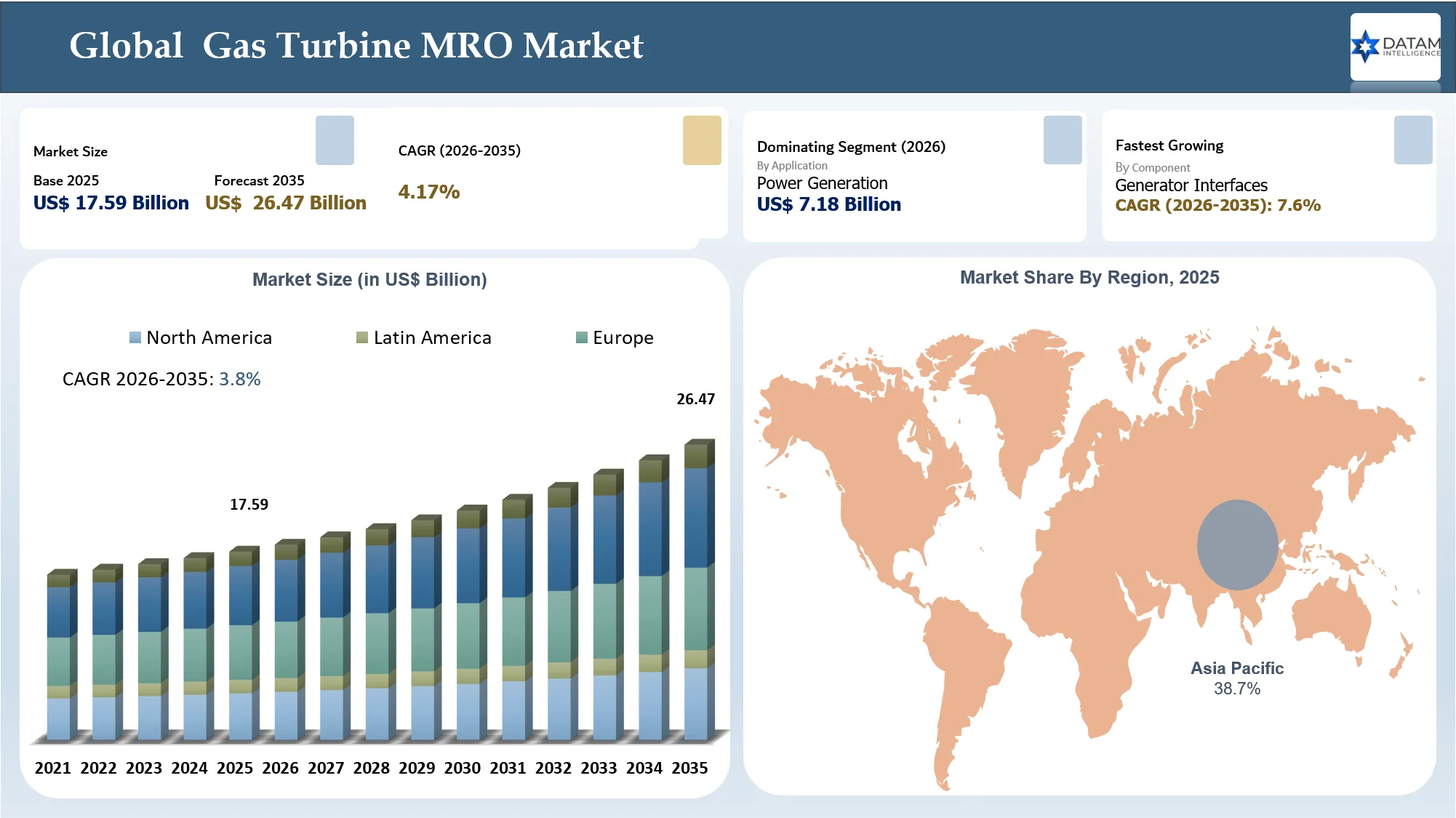
The market is being reshaped by digitalization, turbine modernization, component refurbishment and long-term service agreements. Market scope must distinguish industrial. Driven by an unprecedented surge in data center power demands, AI workloads, and global grid modernization, the global gas turbine market is experiencing a massive supply-demand crisis that has pushed manufacturer order books out to 2027 and driven turbine prices up by nearly 195% since 2019.
Gas Turbine MRO Market Key Takeaways
- Asia-Pacific accounted for an estimated 36.8% of 2025 market revenue, supported by large installed fleets, rising electricity demand and service localization across China, India, Japan, South Korea and Southeast Asia.
- North America remains a major installed-base and independent-service market, with strong demand for F-class parts, rotor work, controls modernization and flexible-operations upgrades.
- Mitsubishi Power signed a June 2026 long-term parts and services agreement for the 1,200 MW Ilihan plant in the Philippines, covering M501G hot parts, spares, repair work and technical advisory services.
- EthosEnergy acquired Turbine Services Limited in May 2025 and added Frame 9FA.03 intellectual property in February 2026, strengthening non-OEM parts and hot-gas-path service capabilities.
- GE Vernova reports more than 1,000,000 installed MW across over 120 countries under its gas-power service footprint, supporting a broad addressable base for long-term agreements and upgrades.
- Localized service centers are becoming strategic assets because they shorten outage duration, reduce cross-border logistics risk and support local-content requirements.
- Flexible operation increases starts, thermal cycling and part-life consumption, changing maintenance demand even where annual running hours decline.
- Hydrogen and fuel-flexibility upgrades create new inspection, combustion tuning, controls and materials requirements, but broad commercial demand will develop gradually by turbine class and fuel blend.
Gas Turbine MRO Industry Trends and Strategic Insights
- Flexible grid operation is increasing starts and thermal cycles, shifting service planning from running-hour assumptions toward equivalent operating hours and component-specific life consumption.
- Independent service providers are gaining share where they can offer qualified F-class repairs, exchange parts, shorter turnaround times and multi-OEM support without compromising warranty or traceability.
- Digital monitoring is moving from dashboard-only offerings toward closed-loop maintenance planning that connects anomaly detection with inspection scope, spare-parts reservation and outage execution.
- Regional repair centers and local-content partnerships are becoming decisive in Asia-Pacific and the Middle East because operators seek shorter logistics cycles, local currency spending and stronger parts availability.
- Rotor life extension, advanced coatings, additive repair and controls modernization are becoming investable service pools as operators extend mature assets while maintaining efficiency and emissions compliance.
Gas Turbine MRO Market Scope
| Metric | Details |
| 2025 Market Size | US$ 17.59 Billion |
| 2035 Projected Market Size | US$ 26.47 Billion |
| CAGR (2026-2035) | 4.17% |
| Largest Region | Asia-Pacific |
| Fastest Growing Region | Middle East and Africa |
| Largest Service Type | Maintenance |
| Fastest Growing Capability | Digital diagnostics and life-extension upgrades |
| Forecast Period | 2026-2035 |
| By Service Type | Maintenance, repair, overhaul and upgrade or retrofit services |
| By Turbine Type | Heavy-duty frame turbines and aeroderivative industrial turbines |
| By Service Provider | OEMs, independent service providers, in-house utility teams, specialist component shops and Others |
| By Component | Compressor, combustor, hot-gas-path, rotor, controls, auxiliaries and generator interfaces |
| By Application | Power generation, oil and gas, industrial, marine, district energy and Others |
| By Contract Model | LTSA, transactional outage, time-and-materials, performance-based and managed inventory |
| By Region | North America, Europe, Asia-Pacific, South America, Middle East and Africa |
Why does this report matter in 2026?
Gas turbine operators are entering a more complex maintenance cycle. Mature fleets require rotor life assessment, replacement-part strategies and controls obsolescence management, while newer H-class and advanced F-class units require highly specialized repair, data access and OEM engineering support. At the same time, renewable penetration is increasing start-stop duty and low-load operation, which can accelerate thermal fatigue, combustion instability and inspection demand. The report helps buyers separate installed-fleet opportunity from headline new-build activity and identifies where service revenue is protected by recurring outages, specialized intellectual property and regional workshop capacity.
Gas Turbine MRO Market White Space & Investment Opportunities
Regional Advanced Repair Centers
Localized hot-gas-path, rotor, coating and controls capability can shorten turnaround and support local-content goals. Investment cases are strongest where installed fleets are large enough to sustain repeat volume across multiple operators. Investors should assess installed-base density, qualification timelines, warranty exposure, utilization and the ability to secure multi-year customer commitments before funding new capacity.
Non-OEM F-Class Parts and Repair
Mature 7FA, 9FA and comparable fleets create demand for qualified alternatives. EthosEnergy’s 2025 TSL acquisition and 2026 Frame 9FA.03 IP expansion demonstrate the strategic value of parts engineering and repair intellectual property. Investors should assess installed-base density, qualification timelines, warranty exposure, utilization and the ability to secure multi-year customer commitments before funding new capacity.
Rotor Life Extension and Exchange Pools
Rotor replacement and life-extension programs reduce outage risk for aging fleets. Exchange pools create recurring value through inventory rotation, inspection and refurbishment. Investors should assess installed-base density, qualification timelines, warranty exposure, utilization and the ability to secure multi-year customer commitments before funding new capacity.
Digital Monitoring and Remote Expert Services
Platforms that combine diagnostics with field execution can capture higher customer retention and enable performance-based contracts. Investors should assess installed-base density, qualification timelines, warranty exposure, utilization and the ability to secure multi-year customer commitments before funding new capacity.
Hydrogen, Fuel Flexibility and Emissions Retrofits
Combustion tuning, fuel-system changes, controls, materials assessment and emissions validation create an emerging upgrade market, though economics depend on actual fuel availability and policy support. Investors should assess installed-base density, qualification timelines, warranty exposure, utilization and the ability to secure multi-year customer commitments before funding new capacity.
Gas Turbine MRO Market Cost Analysis
Gas Turbine MRO costs vary based on turbine capacity, frame type, maintenance scope, component condition, outage duration, spare-parts requirements and service provider. Major inspections and complete overhauls typically involve higher costs due to extensive component replacement, repair and testing requirements. Hot gas path inspections, rotor repairs, turbine blade replacement and advanced coating services can significantly influence overall maintenance expenditure. Long-term service agreements can help operators manage costs through planned maintenance, fixed service terms and improved equipment reliability. AI-based predictive maintenance, remote monitoring and component refurbishment can reduce unplanned outages and optimize lifecycle maintenance costs.
Gas Turbine MRO Future Market Transformation
By 2035, the global gas turbine market is projected to undergo a profound structural transformation, evolving from traditional, natural gas baseload hardware into highly flexible, simulation-driven digital energy systems. Future market growth will be deeply intertwined with strict corporate net-zero pledges and methane reduction mandates. Hardware technology will shift away from pure capacity expansion toward 100% green hydrogen co-firing, integrated carbon capture arrays, and advanced ceramic matrix composite component designs. This structural evolution is driving massive investment into AI-powered digital twin monitoring platforms and cloud-native simulation tools to maximize asset longevity. Consequently, the industry is increasingly prioritizing specialized operation and maintenance services to manage these high-efficiency, multi-fuel plants effectively.
Gas Turbine MRO Market Buyer Decision-Making Criteria
Lead times and immediate inventory availability have become the primary criteria driving current buyer decisions. Because major manufacturer backlogs stretch through 2027, buyers are heavily prioritizing suppliers who can guarantee short-term equipment access, which has fueled a massive surge in demand for certified pre-owned or surplus inventory to bypass 24-to-36-month original equipment manufacturer (OEM) waitlists. When evaluating equipment, procurement managers strictly assess net electrical efficiency and fuel flexibility envelopes under ISO conditions to manage sky-high operational expenditures. Furthermore, as grids face unprecedented volatility from both renewable integration and 24/7 AI data center demand, current purchasers place an absolute premium on performance guarantees related to ultra-fast start times, high part-load efficiencies, and rapid ramping rates. This is accompanied by a mandatory checklist requirement for a clear engineering roadmap toward immediate hydrogen blending and strict localized emissions compliance (such as sub-9 ppm NOx outputs) to eliminate the future financial risk of late-stage retrofits.
Gas Turbine MRO Market Concentration
The Gas Turbine MRO Market is moderately concentrated, with major OEMs maintaining strong positions through large installed bases, proprietary technologies and long-term service agreements.
Leading providers benefit from established relationships with utilities, power producers and industrial operators, creating high barriers for new entrants. Independent service providers are expanding their presence through multi-OEM maintenance, component repair and cost-effective overhaul services. Competition is increasing in mature turbine fleets, where operators seek flexible contracts, shorter turnaround times and lower maintenance costs. Strategic partnerships, service agreements, digital maintenance solutions and regional repair capabilities are expected to influence competitive positioning.
Gas Turbine MRO Market Economic & Investment Analysis
The current gas turbine Maintenance, Repair, and Overhaul (MRO) market is experiencing a massive capital influx. Unprecedented equipment backlogs for new turbines have forced operators to run existing fleets harder and longer. This shift redirects corporate budgets away from new asset CapEx and directly into heavy lifecycle-extension OpEx. High demand forces operators to postpone retirements. They are heavily investing in comprehensive Component Life Assessment (CLA) programs. This trend significantly extends the operational lifespan of older hot-gas-path components.
Independent Service Providers (ISPs) and Original Equipment Manufacturers (OEMs) are seeing record revenue growth. This boost is fueled by shifting power grid dynamics and modern data infrastructure demands.The Peaker Ramping Premium: Intermittent renewable energy forces baseload plants to operate as cyclical peaking units. This frequent cycling accelerates thermal fatigue. Consequently, it shortens the interval between required Hot Gas Path Inspections (HGPI) and Major Overhauls. The mission-critical nature of AI data centers has driven a surge in premium LTSAs. Operators gladly pay a premium for guaranteed field-service response times and round-the-clock remote diagnostic monitoring.
Gas Turbine MRO Investment Trends in the Market
- OEMs like GE Vernova and Siemens Energy are aggressively expanding their LTSA backlogs, locking buyers into highly predictable, multi-decade contractual revenue streams.
- ISPs are securing heavy private equity backing to expand their reverse-engineering capabilities, capturing market share by offering flexible component repairs at lower price points than OEMs.
- Financial capital is flowing heavily into AI-powered digital twins and continuous vibration/thermal monitoring software to predict component failures early and avoid catastrophic un-planned outages.
- Advanced Material Repair R&D: Investment is shifting toward high-margin, specialized repair technologies such as laser powder bed fusion and advanced Thermal Barrier Coatings to service complex, high-temperature turbine blades.
- Venture and corporate capital are targeting modernization and retrofit packages for aging baseload plants, optimizing them for rapid-cycling and fast-ramping operations to support intermittent renewable grids.
- Regional Hub Infrastructure: Investors are funding the construction of localized, regional MRO component repair facilities in high-demand zones like North America and the Middle East to bypass global shipping bottlenecks and reduce turnaround times
Strategic Indicators For Gas Turbine MRO Market
Porter’s Five Force Analysis
Supplier power is high for advanced hot-gas-path components, proprietary controls and certified repairs. Buyer power is also strong because utilities and oil and gas operators negotiate large multi-year scopes. Entry barriers arise from intellectual property, repair qualification, test capability, inventory and installed-base references. Independent providers compete strongly on mature frames, while OEMs retain advantages on advanced platforms and performance guarantees.
Government Policy Support
Energy security policy, local-content rules, sanctions, trade controls and public-utility procurement shape service access. Currency volatility affects imported parts and long-term contracts. Gas-fired generation remains important for dispatchable capacity in many regions, but utilization varies with fuel prices, carbon policy and renewable output.
Supply Chain Disruption
The value chain begins with fleet assessment and outage planning, followed by parts engineering, material sourcing, repair or manufacturing, logistics, field execution, commissioning and digital follow-up. Bottlenecks concentrate in castings, single-crystal airfoils, coatings, rotor forgings, control-system electronics and qualified field labor.
Pricing Volatility
Pricing varies by turbine frame, inspection scope, parts consumption, repairability, outage duration, warranty, service geography and contract risk. LTSAs improve budget predictability but may carry minimum-use, escalation and exclusivity terms. Transactional procurement can lower immediate cost but transfers availability and parts risk back to the operator.
New Technology Adoption
Key innovation areas include digital twins, AI-assisted anomaly detection, robotic inspection, additive repair, advanced thermal barrier coatings, low-NOx combustion, hydrogen blending, automated borescope analytics and life-consumption modeling.
Sustainability and ESG Analysis
Life extension can avoid premature equipment replacement and reduce material consumption. Efficiency upgrades lower fuel use and emissions per MWh. ESG scrutiny also covers worker safety, supply-chain traceability, waste coatings, solvent use and claims around hydrogen readiness.
Go-To-Market Strategy
New entrants should focus on a defined frame family, component class or geography. Credible entry requires reference units, qualified repair procedures, engineering depth, warranty capacity and partnerships with local field-service organizations.
High Investment Activity
Rotor life extension, advanced component repair and predictive monitoring are high-growth services. Mature inspection and basic field labor generate stable cash flow. Hydrogen retrofits are emerging bets, while unsupported legacy platforms may become selective or declining niches.
AI Impact Analysis of Gas Turbine MRO Market
AI can detect anomalies in vibration, exhaust temperature spread, combustion dynamics, oil debris, emissions and performance data. Computer vision can accelerate borescope review and coating-defect classification. The strongest use case is decision support that combines operating history, inspection evidence and engineering limits. Adoption will remain governed by false-alarm cost, data quality, cybersecurity and the need for human approval on safety-critical decisions.
Disruption Analysis of Gas Turbine MRO Market
Digital platforms can shift value from periodic inspection toward continuous lifecycle management. Independent providers may gain access through multi-OEM analytics, while OEMs can reinforce installed-base lock-in through proprietary models and connected service agreements. Automated inspection and additive repair may reduce labor intensity, but qualification and liability will slow complete substitution of engineering judgment.
Gas Turbine MRO Market BCG Matrix

STAR
GE Vernova, Siemens Energy, Mitsubishi Power, Solar Turbines and Baker Hughes occupy the star category because they combine extensive installed-fleet access, proprietary engineering data, global outage execution networks, advanced component repair capability and long-term service agreement coverage. Their competitive position is reinforced by digital monitoring platforms, rotor and hot-gas-path engineering expertise, parts supply scale and the ability to support major frame and aeroderivative fleets across power generation, oil and gas and industrial applications.
POTENTIAL
Independent providers including EthosEnergy, Sulzer, Chromalloy, PROENERGY, Mechanical Dynamics and Analysis, TransCanada Turbines and regional specialist workshops represent the potential category. Their growth depends on expanding non-OEM repair approvals, localized parts availability, multi-OEM service capability, rotor life-extension programs, digital diagnostics and faster turnaround models. Providers that build credible engineering documentation and regional workshop density can gain share where owners seek alternatives to OEM pricing and contract rigidity.
Gas Turbine MRO Market Dynamics
Driver Impact Analysis
| Driver | Growth Impact | Demand Concentration | Impacted Capability | Strategic Effect |
| Aging installed fleet | 27% | North America, Europe, Asia | Rotor and hot-gas-path life extension | Creates recurring overhaul and component demand |
| Flexible generation and cycling | 22% | Renewable-heavy power systems | Combustion tuning, inspections, controls | Raises starts-based service intensity |
| Service localization | 18% | Middle East, Asia-Pacific | Repair shops and spare-parts hubs | Reduces turnaround time and logistics risk |
| Digital condition monitoring | 16% | Large utilities and IPPs | Remote diagnostics and predictive maintenance | Improves outage planning and contract retention |
| Hydrogen and emissions upgrades | 12% | Europe, Japan, Middle East | Combustion, controls and materials | Creates retrofit and validation demand |
Driver: Aging Gas Turbine Fleets and Higher Cycling Requirements
Gas turbines remain long-life assets, and operators frequently choose refurbishment, upgrade and life-extension programs rather than replacement. Older E- and F-class fleets need rotor inspection, blade and vane restoration, controls migration and obsolete-parts replacement. Newer units generate a different service mix, including advanced coatings, tightly controlled hot-gas-path repair and digital performance guarantees. Renewable integration increases starts and ramping, which can consume component life faster than baseload operation. MRO demand therefore depends on equivalent operating hours, factored starts, fuel quality, ambient conditions and dispatch behavior rather than simple calendar age.
Restraint Impact Analysis
| Restraint | Drag on Growth | Primary Impact | Affected Segment | Strategic Effect |
| High parts and outage cost | 23% | Operator budgets | Major inspections and overhauls | Encourages scope deferral and competitive bidding |
| OEM data and IP restrictions | 20% | Independent access | Advanced frames and controls | Limits non-OEM penetration |
| Skilled labor shortage | 17% | Outage execution | Field service and repair shops | Extends turnaround and raises labor cost |
| Long component lead times | 15% | Availability | Hot-gas-path and rotor parts | Increases inventory and exchange-pool needs |
| Longer maintenance intervals | 10% | Visit frequency | Newer turbine platforms | Moderates routine service volume per unit |
Restraint: High Cost of Advanced Repairs and Replacement Parts
Major inspections can require long planning cycles, significant capital and outage windows that are difficult to secure during periods of high electricity demand. OEM control over drawings, repair limits, software and life-consumption models can restrict independent provider access on newer frames. Skilled labor shortages affect borescope inspection, rotor balancing, welding, coating, NDT and field supervision. Operators respond through multi-year planning, exchange rotors, pooled parts, resident engineering and mixed-provider strategies, but these measures require careful warranty and liability management.
Gas Turbine MRO Market Technology Trends
- AI-Powered Predictive Maintenance: AI analyzes operational and sensor data to identify potential component failures before breakdowns occur.
- Digital Twins: Virtual turbine models simulate equipment performance, helping operators assess component condition and plan maintenance more accurately.
- Remote Monitoring: Real-time monitoring systems track temperature, vibration, pressure and other parameters to support continuous turbine health assessment.
- Robotic Inspection: Inspection robots and drones improve access to difficult turbine areas while reducing inspection time and worker exposure.
- Additive Repair: Additive manufacturing supports the refurbishment of complex turbine components and helps reduce replacement lead times.
- Advanced Coatings: Thermal barrier and protective coatings improve component durability and resistance to high-temperature operating conditions.
- Automated Borescope Inspection: Automated visual inspection improves the detection of cracks, corrosion, deposits and other internal turbine defects.
- Digital MRO Platforms: Cloud-based platforms integrate maintenance, inspection and asset data to improve scheduling, reporting and lifecycle management.
Gas Turbine MRO Market Segment Analysis
The global Gas Turbine MRO market is segmented based on Service Type, Turbine Type, Service Provider, Application and region. Each category is assessed through installed fleet exposure, maintenance intensity, outage frequency, parts value, technical complexity, contract accessibility and the degree to which service providers can convert engineering capability into repeatable lifecycle revenue.
Gas Turbine MRO Market by Capacity
The Gas Turbine MRO Market is segmented into below 30 MW, 31–120 MW, and above 120 MW. Large-capacity turbines represent a significant MRO opportunity because of their high-value components, extended operating life, frequent inspections and complex overhaul requirements. Smaller turbines support demand across distributed generation, industrial facilities and oil and gas applications.
Gas Turbine MRO Market By Service Type
Maintenance Will Continue to Lead Recurring Service Demand
Maintenance remains the largest service category because every operating gas turbine requires scheduled inspections, combustion checks, borescope assessment, filtration and lubrication service, controls support and outage preparation. The segment generates recurring revenue across baseload, cycling and standby fleets. Demand is becoming more data-led as operators combine equivalent operating hours, starts, exhaust-temperature spreads, vibration and emissions trends to refine inspection scope. Maintenance providers that link monitoring, field service, parts forecasting and outage planning can reduce unplanned downtime and improve customer retention. The segment also benefits from ageing fleets that need more frequent condition assessment even when full overhaul intervals are extended.
Gas Turbine MRO Market By Turbine Type
Heavy-Duty Frame Turbines Will Remain the Core Revenue Pool
Heavy-duty frame turbines account for the largest share of MRO value because they represent a substantial installed capacity base in utility and industrial power generation, carry high-value hot-gas-path hardware and remain in service for several decades. Mature E- and F-class fleets support broad independent competition, component repair and life-extension programs. Advanced H-, J- and HL-class turbines are more closely tied to OEM engineering, digital monitoring and long-term service agreements because of higher firing temperatures and tighter design tolerances. Cycling caused by renewable integration increases starts-based wear, thermal fatigue and inspection complexity. The most attractive opportunities combine fleet density, ageing units, accessible technical data and sufficient outage volume to justify regional repair capability.
Gas Turbine MRO Market By Service Provider
Original Equipment Manufacturers Retain Leadership in Advanced Platforms
Original equipment manufacturers lead the market through proprietary engineering, fleet data, controls access, advanced-frame expertise, global parts networks and the ability to provide performance or availability guarantees. Their strongest position is in recently installed turbines and units covered by long-term service agreements. OEM offerings increasingly combine monitoring, outage execution, upgrades, parts and lifecycle planning. Buyers value accountability and technical authority, although concerns may include price escalation, contract rigidity and limited sourcing flexibility. OEMs are expanding regional service centers and localization partnerships to shorten lead times. Their competitive priority is to protect lifecycle capture while adapting contracts to changing dispatch, fuel strategies and customer demand for greater transparency.
Gas Turbine MRO Market By Application
Power Generation Will Continue to Dominate Market Revenue
Power generation is the largest application because utilities operate extensive heavy-duty fleets under demanding availability and efficiency requirements. Combined-cycle plants create service demand across gas turbines, generators and balance-of-plant interfaces, while simple-cycle peakers accumulate starts and thermal cycles. Renewable penetration is changing dispatch patterns and increasing the value of flexible-operation upgrades, starts-based maintenance and predictive diagnostics. Capacity-market obligations and grid reliability requirements make outage execution critical. Providers that can reduce outage duration, improve heat rate and support variable operation are positioned to capture premium contracts. Ageing fleets also create opportunities for life extension where new-build timelines, interconnection constraints or capital costs favor continued operation.
Gas Turbine MRO Market Geographical Penetration
U.S. Gas Turbine MRO Market Landscape
north america industrial gas turbine mro combines a large mature fleet, extensive independent-service capability and high demand for F-class life extension, controls upgrades and flexible-operation packages. The U.S. leads through merchant generation, utility fleets and oil and gas applications. Canada adds cogeneration, pipelines and remote industrial demand, while Mexico offers service opportunities around CFE and industrial fleets. Country attractiveness depends on fleet size, turbine mix, utilization, local-content rules, workshop capacity, sanctions exposure and the maturity of long-term contracting.
Canada Gas Turbine MRO Market Outlook
Canada's gas turbine MRO demand is supported by utility generation, cogeneration, oil and gas operations and industrial facilities. Mature turbine fleets require inspections, component refurbishment, controls modernization and reliability upgrades to extend operating life. Gas turbines used in remote and industrial locations create additional demand for field services, spare parts and specialized maintenance support. Increasing operational flexibility can also raise inspection requirements as turbines experience more frequent starts and load changes. Market growth depends on installed capacity, turbine age, industrial activity, service availability and maintenance outsourcing.
Japan Gas Turbine MRO Market Outlook
Japan has a mature gas turbine fleet across utility power generation, industrial facilities and cogeneration applications. Aging assets require regular inspections, hot gas path repairs, rotor maintenance, efficiency upgrades and component refurbishment. Demand is also supported by efforts to improve power-plant efficiency, operational reliability and lower-emission generation. Advanced monitoring, predictive maintenance and long-term service agreements are increasingly important for managing mature assets. Market attractiveness depends on fleet age, turbine technology, utilization, replacement cycles and the availability of specialized service providers.
India Gas Turbine MRO Market Landscape
India's gas turbine MRO market is supported by power generation, refineries, petrochemical facilities, industrial plants and captive generation. Existing turbines require maintenance, component repair, inspections and modernization to improve reliability and extend operating life. Growing electricity demand and the need for flexible generation can support higher utilization of gas-based assets in selected applications. Local repair capabilities and cost-effective independent services provide opportunities alongside major OEMs. Market development depends on fleet condition, gas availability, industrial investment, turbine capacity and maintenance outsourcing.
South Korea Gas Turbine MRO Market Trends
South Korea has a developed gas turbine fleet serving utilities, industrial facilities, LNG-related operations and cogeneration applications. MRO demand includes planned inspections, component refurbishment, hot-section maintenance, controls upgrades and efficiency improvements. Mature assets require specialized services to extend operating life while maintaining availability under changing load conditions. Local engineering and manufacturing capabilities can support domestic component repair and maintenance activities. Market opportunities depend on fleet modernization, turbine technology, utilization, power-sector investment and service capabilities.
UK Gas Turbine MRO Market Trends
The UK gas turbine MRO market benefits from gas-fired generation supporting grid reliability alongside increasing renewable power penetration. Frequent starts, load changes and flexible operating conditions can increase maintenance requirements for turbine components and auxiliary systems. Operators are investing in inspections, predictive maintenance, controls upgrades and efficiency improvements to maintain asset availability. Independent service providers have opportunities in component repair, refurbishment and multi-OEM maintenance. Demand depends on fleet age, operating cycles, capacity requirements, emissions regulations and service-contract structures.
France Gas Turbine MRO Market Landscape
France's gas turbine MRO market is supported by combined-cycle power plants, industrial facilities and gas-fired generation used to complement variable renewable energy. Aging equipment requires regular inspections, component repairs, upgrades and life-extension programs to maintain efficiency and reliability. Operators are also adopting digital monitoring and predictive maintenance to improve outage planning and reduce unexpected failures. Specialized repair providers can benefit from demand for component refurbishment and shorter maintenance cycles. Market potential depends on turbine fleet composition, utilization, regulatory requirements and modernization investments.
Australia Gas Turbine MRO Market Outlook
Australia's gas turbine MRO market is supported by flexible power generation, mining, LNG, industrial facilities and remote energy applications. Gas turbines can experience changing operating patterns as renewable generation increases, creating demand for inspections, component repairs and reliability upgrades. Remote assets also require strong field-service networks, spare-parts availability and efficient maintenance planning. Predictive monitoring can help operators reduce unplanned outages and optimize service intervals. Market attractiveness depends on fleet location, turbine age, operating conditions, industrial activity and access to qualified MRO providers.
Saudi Arabia Gas Turbine MRO Market Landscape
Saudi Arabia is an important Middle Eastern gas turbine MRO market due to large utility, industrial, oil and gas and petrochemical turbine fleets. High-temperature operating conditions increase the importance of hot gas path inspections, component refurbishment, coatings and reliability-focused maintenance. Large power projects and industrial expansion create opportunities for long-term service agreements and major overhaul programs. Operators are also adopting digital monitoring and efficiency upgrades to improve asset performance. Market potential depends on installed capacity, turbine technology, operating environment, localization requirements and service infrastructure.
UAE Gas Turbine MRO Market Trends
The UAE gas turbine MRO market is supported by large power-generation, desalination, LNG and industrial facilities. High utilization and demanding climatic conditions create sustained requirements for inspections, repairs, component replacement and efficiency improvements. Combined-cycle plants require specialized maintenance for turbines and associated systems to maintain availability and performance. Regional service centers and spare-parts facilities can improve turnaround times for major maintenance activities. Market opportunities depend on fleet size, operating intensity, turbine technology, local service capacity and long-term maintenance agreements.
Brazil Gas Turbine MRO Market Outlook
Brazil's gas turbine MRO market is supported by thermal power generation, industrial facilities, oil and gas operations and flexible electricity supply requirements. Gas turbines require scheduled inspections, hot-section repairs, component refurbishment and controls modernization to maintain reliability. Increasing integration of variable renewable generation can create additional demand for flexible gas-fired assets and associated maintenance services. Independent providers have opportunities through multi-OEM repairs and localized field services. Market growth depends on fleet age, gas availability, operating cycles, industrial investment and regional MRO infrastructure.
Germany Gas Turbine MRO Market Outlook
Europe’s market is shaped by renewable balancing, capacity adequacy, decarbonization policy and aging fleets. Lower annual hours do not necessarily reduce MRO because starts, cycling and reserve duty can increase fatigue. Germany, the UK, Italy, Spain and the Netherlands are important service markets, while Eastern Europe contains mature frames requiring modernization. Country attractiveness depends on fleet size, turbine mix, utilization, local-content rules, workshop capacity, sanctions exposure and the maturity of long-term contracting.
China Gas Turbine MRO Market Trends
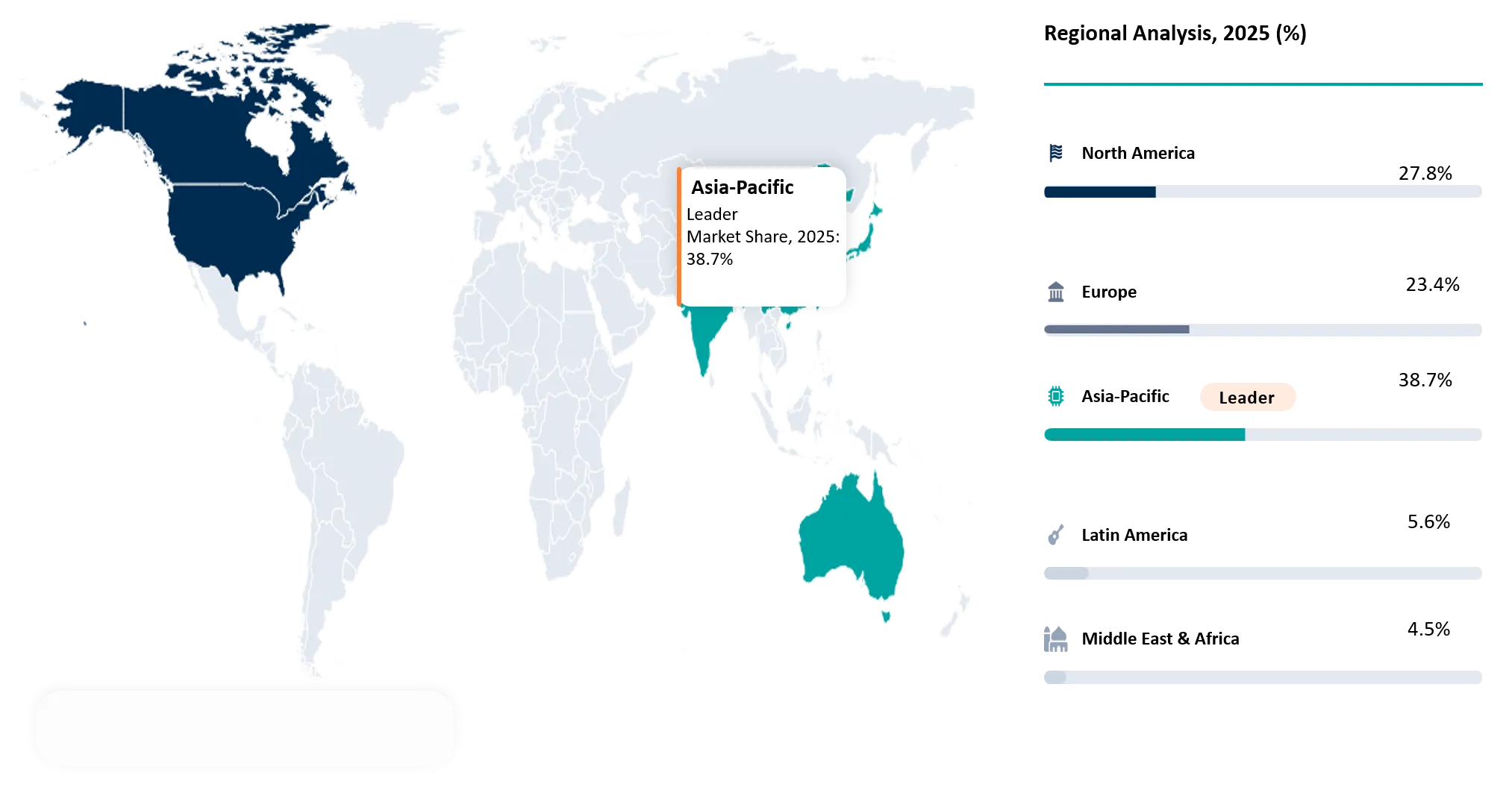
Asia-Pacific is the largest regional market. China, Japan, South Korea, India, Australia and Southeast Asia operate large fleets across utilities, LNG, refineries and industry. Mitsubishi Power’s June 2026 LTPSA for the 1,200 MW Ilihan plant confirms sustained demand for hot parts, spares, repair and advisory services on mature G-class assets. Country attractiveness depends on fleet size, turbine mix, utilization, local-content rules, workshop capacity, sanctions exposure and the maturity of long-term contracting.
| Region | 2025 Share | Strategic Position |
| Asia-Pacific | 38.7% | Largest market, broad installed base and localization demand |
| North America | 27.8% | Mature fleet, strong ISP activity and digital adoption |
| Europe | 23.4% | Cycling, modernization and emissions upgrades |
| Middle East and Africa | 4.5% | Fast growth, new advanced-class fleets and service localization |
| South America | 5.6% | Targeted fleet-life extension and import substitution |
Gas Turbine MRO Market Competitive Landscape
Competition is divided among global OEMs, independent service providers, specialist component shops, engineering contractors and regional workshops. OEMs dominate advanced frames and performance guarantees. ISPs are strongest on mature fleets, multi-OEM contracts and cost-sensitive repairs. Specialist firms create defensible positions in coatings, airfoils, rotors, controls and NDT. Competitive advantage depends on installed-base access, frame-specific intellectual property, repair qualification, parts inventory, field execution and regional presence.
| Company | Positioning | Core Strength | 2025-2026 Signal |
| GE Vernova | Global OEM lifecycle provider | Large installed base, LTSAs, upgrades, monitoring | Dammam rotor capability and broad service footprint |
| Siemens Energy | Global OEM and service provider | SGT fleet, controls, digital and field service | Continued focus on long-term lifecycle services |
| Mitsubishi Power | Advanced-class OEM | J/G-class expertise and LTPSAs | 2026 Ilihan LTPSA, 2025 Morocco order |
| EthosEnergy | Independent multi-OEM provider | Mature frames, parts, repair and field service | 2025 TSL acquisition, 2026 9FA.03 IP |
| Sulzer | Independent rotating-equipment specialist | Repair shops, field service and component work | Broad industrial service footprint |
| Chromalloy | Component repair specialist | Airfoils, coatings and advanced repair | High-value hot-section capability |
| PROENERGY | Independent power and service platform | LM and frame services, parts and generation | Integrated fleet and service model |
Key Companies of Gas Turbine MRO Market
- GE Vernova
- Siemens Energy
- Mitsubishi Power
- Solar Turbines
- Baker Hughes and Aero Alliance
- EthosEnergy
- Sulzer
- Chromalloy
- PROENERGY
- Ansaldo Energia
- Kawasaki Heavy Industries
- MAN Energy Solutions
- MTU Maintenance Berlin-Brandenburg
- TransCanada Turbines
- Mechanical Dynamics and Analysis
- Turbine Services Limited
- TGM
- Doosan Enerbility
- Wood Group
- Fluor
Gas Turbine MRO Market Supply Chain
The Gas Turbine MRO supply chain connects component manufacturers, OEMs, independent service providers, repair specialists, logistics providers and power-plant operators. Critical components such as turbine blades, rotors, vanes, bearings, coatings and control systems require specialized manufacturing and repair capabilities. Supply disruptions, limited component availability, long lead times and transportation delays can increase maintenance costs and extend planned outages. Regional repair facilities, spare-parts inventories and localized service networks help improve component availability and shorten turnaround times. Digital supply-chain management, predictive parts planning and long-term supplier agreements are helping operators improve MRO reliability, cost control and maintenance efficiency.
Gas Turbine MRO Market Regulatory Landscape
Gas Turbine MRO providers must comply with emissions, safety, quality, environmental and export-control requirements. Regulations related to NOx emissions, turbine efficiency, hydrogen blending and equipment safety are increasing demand for combustion upgrades, controls modernization, emissions monitoring and component inspections.
Gas Turbine MRO Market Major Pain Points
- Long lead times for hot-gas-path parts, rotor components and control-system electronics.
- Shortage of qualified outage supervisors, welders, coating specialists, NDT personnel and controls engineers.
- Limited data access and proprietary repair limits on newer turbine platforms.
- Difficulty aligning outage windows with power-market and production requirements.
- Cost escalation in superalloys, coatings, logistics and specialist labor.
- Cybersecurity and data-governance concerns around remote monitoring.
- Uncertain economics for hydrogen retrofits before fuel supply and operating profiles are defined.
- Warranty and liability complexity when multiple providers work on the same asset.
Gas Turbine MRO Market Recent Developments
- June 2026: Mitsubishi Power and LNGPH signed an LTPSA for the 1,200 MW Ilihan Combined Cycle Power Plant in the Philippines. The scope covers hot parts, spares, repair work and technical advisory services for M501G turbines.
- February 2026: EthosEnergy announced acquisition of intellectual property supporting Frame 9FA.03 hot-gas-path and combustion component service capability.
- May 2025: EthosEnergy acquired Turbine Services Limited, adding non-OEM parts manufacturing and a customer base of more than 1,000 operators worldwide.
- February 2025: Mitsubishi Power secured a major turbine and service order for Morocco’s 990 MW Al Wahda open-cycle project, supporting future J-class lifecycle demand.
- GE Vernova expanded regional rotor-life-extension capability at its Dammam GEMTEC center through an approximately US$3 million investment and reports more than 15 rotor life extensions completed over four years.
Analyst View / Opinion on Gas Turbine MRO Market
The Gas Turbine MRO market is attractive because the installed fleet creates recurring inspection, parts and life-extension demand even when new turbine orders fluctuate. The strongest opportunities are not uniform. Mature-frame independent repair, rotor programs, regional localization and digital-enabled lifecycle agreements offer the clearest value pools. Providers should avoid relying on generic aging-fleet narratives and instead quantify accessible units, outage timing, contract status and component exposure. The attached material’s emphasis on digitalization and modernization is directionally correct, but aviation engine MRO and unsupported contract claims were removed to preserve market-scope accuracy.
Gas Turbine MRO Market Target Audience
| Industry | Who Should Buy? | Reason |
| OEMs and ISPs | Strategy, service and regional leaders | Prioritize frames, capabilities and markets |
| Utilities and IPPs | Asset management, procurement and operations | Benchmark contracts, providers and outage strategy |
| Oil and Gas Operators | Reliability and rotating-equipment teams | Reduce production downtime and parts risk |
| Component Specialists | Coating, repair, machining and NDT leaders | Identify demand gaps and partnerships |
| Investors | Private equity, infrastructure and corporate development | Screen recurring aftermarket opportunities |
| Governments and Local Partners | Industrial policy and localization teams | Plan service hubs and workforce development |
Why Choose DATAM?
- Data-Driven insights: Dive into detailed analyses with granular insights such as pricing, market shares and value chain evaluations, enriched by interviews with industry leaders and disruptors.
- Post-Purchase Support and Expert Analyst Consultations: As a valued client, gain direct access to our expert analysts for personalized advice and strategic guidance, tailored to your specific needs and challenges.
- White Papers and Case Studies: Benefit quarterly from our in-depth studies related to your purchased titles, tailored to refine your operational and marketing strategies for maximum impact.
- Annual Updates on Purchased Reports: As an existing customer, enjoy the privilege of annual updates to your reports, ensuring you stay abreast of the latest market insights and technological advancements. Terms and conditions apply.
- Specialized Focus on Emerging Markets: DataM differentiates itself by delivering in-depth, specialized insights specifically for emerging markets, rather than offering generalized geographic overviews. The approach equips our clients with a nuanced understanding and actionable intelligence that are essential for navigating and succeeding in high-growth regions.
- Value of DataM Reports: Our reports offer specialized insights tailored to the latest trends and specific business inquiries. The personalized approach provides a deeper, strategic perspective, ensuring you receive the precise information necessary to make informed decisions. The insights complement and go beyond what is typically available in generic databases.
What DATAM Uniquely Provides
- Ten-year forecasts by service type, turbine type, provider, component, maintenance model, application, contract model and region.
- Installed-fleet and outage-driven opportunity assessment rather than relying only on new-build trends.
- OEM versus ISP analysis, including intellectual-property, warranty and contract-access constraints.
- Regional localization, repair-shop and spare-parts opportunity mapping.
- Strategic analysis of digital MRO, rotor life extension, flexible generation and hydrogen-readiness services.




























































