


Gamma Butyrolactone Market Size and Overview
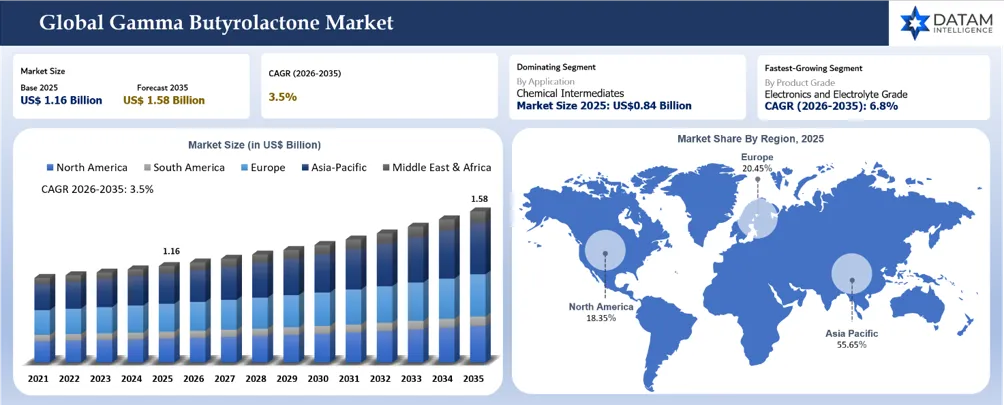
The global gamma butyrolactone market reached US$1.16 billion in 2025 and is expected to reach US$1.58 billion by 2035, growing with a CAGR of 3.5% during the forecast period 2026-2035.
Market growth is supported by increasing consumption of GBL as a chemical intermediate in the production of N-methyl-2-pyrrolidone (NMP), 2-pyrrolidone, pharmaceutical intermediates, and specialty chemicals. Chemical intermediates remain the dominant application, supported by established downstream manufacturing infrastructure and integrated chemical production. Expanding requirements for industrial solvents, specialty formulations, and high-purity chemicals are creating additional demand opportunities. However, raw material price volatility, stringent precursor chemical regulations, and concentrated production capabilities continue to influence supply availability, procurement strategies, and manufacturing profitability.
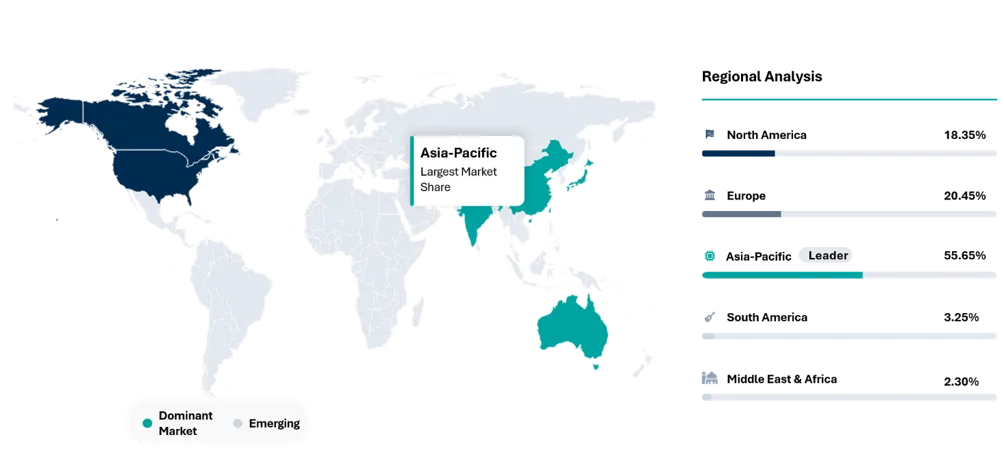
Growing demand for electronics and electrolyte grade GBL is encouraging manufacturers to invest in advanced purification technologies, stringent impurity control, and application-specific product development. Semiconductor processing, electronic materials manufacturing, and selected battery and capacitor electrolyte applications represent opportunities for higher-value product differentiation. Asia-Pacific remains the leading regional market, supported by established chemical manufacturing clusters in China, Japan, India, and Taiwan. Competitive differentiation increasingly depends on production efficiency, consistent product quality, downstream integration, and reliable merchant supply, particularly among customers requiring specialized chemical specifications.
The next phase of market development will be shaped by deeper integration across the 1,4-butanediol (BDO)-GBL-NMP value chain, energy-efficient manufacturing, and regional supply-chain diversification. Producers are expected to prioritize feedstock security, operational optimization, and long-term supply agreements to manage cost pressures and improve capacity utilization. Investments in high-purity grades, digital process monitoring, sustainable production technologies, and regulatory compliance will further influence competitive positioning. Long-term market leadership will depend on the ability to balance cost competitiveness with product differentiation, supply reliability, and access to high-value downstream applications.
Gamma Butyrolactone Market Key Takeaways
- Steady Market Expansion Through 2035: The global gamma-butyrolactone market is estimated to reach US$1.16 billion in 2026 and is projected to grow to US$1.58 billion by 2035, registering a CAGR of 3.5% during 2026-2035, supported by downstream chemical demand, specialty solvent applications, and expanding industrial manufacturing activities.
- Chemical Intermediates Maintain Market Leadership: Chemical intermediates generated an estimated US$0.84 billion in 2025, representing approximately 75% of global market revenue, supported by extensive GBL consumption in N-methyl-2-pyrrolidone (NMP), 2-pyrrolidone, pharmaceutical intermediates, and specialty chemical manufacturing.
- Electronics and Electrolyte Grade Emerges as the Fastest-Growing Segment: Electronics and electrolyte grade GBL is projected to register an estimated 6.8% CAGR during 2026-2035, driven by increasing requirements for high-purity chemicals in semiconductor processing, electronic materials, and selected battery and capacitor electrolyte applications.
- Asia-Pacific Maintains Regional Dominance: Asia-Pacific accounted for an estimated 55.65% of the global gamma-butyrolactone market in 2025, supported by established chemical manufacturing infrastructure in China, Japan, India, and Taiwan, integrated GBL production capabilities, and downstream demand from pyrrolidone derivatives and specialty chemical industries.
- Downstream Integration and High-Purity Manufacturing Reshape Competitive Strategy: Future market leadership will increasingly depend on integrated BDO-GBL-NMP manufacturing capabilities, competitive feedstock sourcing, advanced purification technologies, and reliable merchant supply. Manufacturers investing in specialty-grade differentiation, regulatory compliance, energy-efficient production, and long-term industrial partnerships will be better positioned to strengthen margins and capture emerging growth opportunities.
Gamma Butyrolactone Market Industry Trends and Strategic Insights
- The market is transitioning toward greater downstream chemical integration, with manufacturers strengthening the 1,4-butanediol (BDO)-GBL-N-methyl-2-pyrrolidone (NMP) value chain to improve feedstock security, optimize production costs, and capture additional value from specialty chemical applications. Competitive advantage is increasingly influenced by integrated manufacturing capabilities, capacity utilization, and reliable merchant supply.
- Chemical intermediates remain the dominant application, supported by established GBL consumption in NMP, 2-pyrrolidone, pharmaceutical intermediates, and specialty chemical synthesis. However, growing requirements for high-purity chemicals in electronics, semiconductor processing, and selected electrolyte applications are encouraging manufacturers to diversify their product portfolios and invest in advanced purification capabilities.
- Electronics and electrolyte grade GBL represents a high-growth opportunity, with an estimated CAGR of 6.8% during 2026-2035, driven by increasingly stringent impurity specifications, moisture-control requirements, and demand for consistent product quality. Commercial expansion will depend on customer qualification, application-specific performance, competitive pricing, and dependable supply to advanced manufacturing industries.
- Regional manufacturing dynamics are increasingly influenced by Asia-Pacific's established chemical production infrastructure, particularly in China, Japan, India, and Taiwan. Growing emphasis on supply-chain localization, feedstock diversification, and regional sourcing is encouraging manufacturers to evaluate capacity expansion, strategic partnerships, and long-term supply agreements. However, precursor chemical regulations, energy costs, and international trade conditions remain important considerations for investment decisions.
- Sustainable competitive advantage will require more than production capacity expansion. Manufacturers combining energy-efficient processing, advanced purification, digital quality monitoring, regulatory compliance, and differentiated product grades will be better positioned to strengthen margins and customer retention. Future market leadership will increasingly depend on operational efficiency, lower production costs, high-purity manufacturing expertise, and the ability to serve specialized downstream applications while maintaining reliable supply.
Gamma Butyrolactone Market Scope
| Metrics | Details | |
| 2025 Market Size | US$1.16 Billion | |
| 2035 Projected Market Size | US$1.58 Billion | |
| CAGR (2026-2035) | 3.5% | |
| Largest Market | Asia-Pacific | |
| Fastest Growing Market | Asia-Pacific | |
| By Product Grade | Industrial Grade, Electronics and Electrolyte Grade, Laboratory and Reagent Grade, Other Specialty Grades | |
| By Purity | Below 99.5%, 99.5% to Below 99.9%, 99.9% and Above | |
| By Production Process | 1,4-Butanediol Dehydrogenation, Maleic Anhydride Hydrogenation, Integrated or Hybrid Production Processes, Other Production Processes | |
| By Supply Type | Merchant Sales, Captive Consumption | |
| By Packaging Format | Bulk Packaging, Intermediate Bulk Containers (IBCs), Drums, Cans and Jerry Cans, Bottles, Others | |
| By Application | Chemical Intermediates, Industrial and Formulation Solvents, Electronics Manufacturing Solvents, Electrolyte Solvents, Laboratory and Research Applications, Other Applications | |
| By End-Use Industry | Chemical Manufacturing, Paints, Coatings, and Printing Inks, Electronics and Semiconductors, Batteries and Electrical Components, Pharmaceuticals and Life Sciences, Agriculture and Agrochemicals, Industrial Manufacturing and Processing, Research and Laboratory Services, Other End-Use Industries | |
| By Sales Channel | Direct, Industrial Chemical Distributors, Specialty Chemical Distributors, Chemical Traders and Wholesalers, Laboratory and Reagent Suppliers | |
| By Region | North America | U.S., Canada, Mexico |
| Europe | Germany, UK, France, Spain, Italy, Poland | |
| Asia-Pacific | China, India, Japan, Australia, South Korea, Indonesia, Malaysia, Singapore, Vietnam, Thailand, Philippines, Taiwan | |
| South America | Brazil, Argentina | |
| Middle East and Africa | Israel, Saudi Arabia, UAE, Turkiye, South Africa, Nigeria | |
| Report Insights Covered | Competitive Landscape Analysis, Company Profile Analysis, Market Size, Share, Growth | |
Why does this report matter in 2026?
In 2026, the global gamma-butyrolactone market is gaining strategic importance as manufacturers reassess chemical supply chains, downstream integration, and demand opportunities across specialty chemicals, pharmaceuticals, electronics, and energy storage. GBL serves as an essential intermediate in producing pyrrolidone derivatives, particularly N-methyl-2-pyrrolidone (NMP), which supports advanced manufacturing applications, including battery electrode processing and semiconductor materials. Increasing requirements for high-purity chemicals, evolving production economics, and investments in integrated chemical manufacturing are influencing competitive positioning. For chemical producers, investors, and procurement teams, understanding regional production capabilities, captive consumption, merchant supply availability, and application-specific demand is critical for evaluating market opportunities and improving sourcing strategies.
The report provides decision-makers with actionable intelligence on market size, growth prospects, pricing dynamics, production technologies, and competitive developments across major consuming regions. It also examines how regulatory compliance, raw material availability, and evolving sustainability priorities could influence future investments and supplier relationships. With regulatory scrutiny intensifying in certain markets, including proposed changes to UK controls in 2026, businesses require reliable insights to assess risks and maintain operational resilience. The analysis supports capacity planning, market entry, portfolio diversification, and long-term investment decisions.
Gamma Butyrolactone Market White Space & Investment Opportunities
- High-Purity GBL for Electronics and Energy Storage: Invest in high-purity gamma-butyrolactone production, advanced purification technologies, and impurity-control capabilities to address specialized requirements in semiconductor processing, electronic materials, lithium battery electrolytes, and capacitor manufacturing. Differentiated purity specifications and reliable quality assurance offer opportunities for premium product positioning.
- Downstream Integration into Pyrrolidone Derivatives: Expand integrated manufacturing capabilities connecting 1,4-butanediol (BDO), gamma-butyrolactone, N-methyl-2-pyrrolidone (NMP), and other pyrrolidone derivatives to improve feedstock security, optimize production costs, and capture additional value across specialty chemical supply chains. Investments in integrated facilities can strengthen operating margins and reduce dependence on external intermediates.
- Regional Manufacturing and Supply Chain Localization: Establish or expand GBL manufacturing capabilities in regions dependent on imported specialty chemicals, particularly where electronics, pharmaceutical intermediates, and downstream chemical manufacturing are expanding. Regional production partnerships, long-term supply agreements, and strategically located distribution infrastructure can improve supply reliability, reduce logistics exposure, and strengthen customer relationships.
- Sustainable and Energy-Efficient GBL Production: Develop lower-emission manufacturing processes, energy-efficient purification systems, and alternative feedstock strategies to reduce production costs and environmental impact. Investments in process optimization, resource efficiency, and reduced-carbon-footprint chemical production can create competitive advantages as industrial customers increasingly incorporate sustainability requirements into procurement decisions.
- Specialty Solvent Substitution and Application Development: Expand GBL adoption in high-performance coatings, specialty resins, electronic formulations, and industrial processing applications requiring specific solvency, thermal stability, and formulation characteristics. Application-specific product development, technical customer support, and qualification programs offer opportunities to enter specialized industrial segments and reduce dependence on conventional chemical-intermediate demand.
- Merchant Market Expansion and Strategic Partnerships: Strengthen merchant GBL supply through dedicated production capacity, customized purity grades, regional warehousing, and direct supply agreements with specialty chemical manufacturers. Partnerships with downstream processors, electronics manufacturers, and industrial customers can improve demand visibility, support long-term contractual revenues, and address supply gaps in markets dominated by captive consumption and integrated producers.
Gamma Butyrolactone Market Future Transformation
The global gamma-butyrolactone market is expected to undergo significant transformation as chemical manufacturers prioritize downstream integration, high-purity product development, and operational efficiency. Growing demand for specialty chemical intermediates, electronics manufacturing materials, and advanced energy storage applications is likely to reshape production strategies and investment priorities. Manufacturers are expected to strengthen integration between 1,4-butanediol, GBL, and pyrrolidone derivatives to improve feedstock security, enhance cost competitiveness, and capture greater value across chemical supply chains. Advancements in purification technologies, process automation, and energy-efficient manufacturing will further support product differentiation, particularly in applications requiring stringent quality specifications.
Looking ahead, the market's transformation will increasingly depend on regional supply-chain resilience, sustainability performance, and strategic partnerships between GBL producers and downstream manufacturers. Companies are likely to pursue localized production, long-term supply agreements, and selective capacity expansion to manage raw material volatility and changing trade conditions. Greater emphasis on lower-carbon feedstocks, improved energy efficiency, and responsible chemical handling will influence capital allocation and procurement decisions. Meanwhile, tighter regulatory oversight and increasing customer qualification requirements could favor established producers with integrated operations, consistent product quality, and strong compliance capabilities. These shifts will create opportunities for technology-led differentiation, portfolio diversification, and sustainable long-term growth.
Gamma Butyrolactone Market Buyer Decision-Making Criteria
Major Buyer Decision-Making Criteria:
- Product Purity and Chemical Composition
- Consistency of Quality and Batch-to-Batch Performance
- Impurity Profile, Moisture Content and Contamination Levels
- Suitability for Specific Industrial and Chemical Applications
- Product Grade and Compliance with Technical Specifications
- Supplier Production Capacity and Long-Term Supply Reliability
- Pricing Competitiveness and Total Procurement Cost
- Packaging Options, Storage Stability and Transportation Safety
- Regulatory Compliance, Chemical Handling and Documentation Requirements
- Supplier Technical Expertise, Quality Certifications and Application Support
- Lead Times, Geographic Availability and Supply Chain Resilience
- Contract Flexibility, Minimum Order Quantities and After-Sales Support Services
Gamma Butyrolactone Market Investment Trends
- Capital allocation is increasingly focused on expanding gamma-butyrolactone production capacity, modernizing manufacturing facilities, and strengthening downstream integration with 1,4-butanediol (BDO), N-methyl-2-pyrrolidone (NMP), and other pyrrolidone derivatives to improve cost competitiveness and supply-chain efficiency.
- Investments in high-purity and specialty-grade GBL are gaining strategic importance as manufacturers target electronics, semiconductor processing, lithium battery electrolytes, and capacitor applications requiring stringent impurity control, consistent product quality, and advanced purification capabilities.
- Chemical manufacturers are prioritizing investments in energy-efficient production technologies, catalytic process optimization, advanced distillation systems, and automated quality monitoring to reduce operating costs, improve production yields, and strengthen environmental performance.
- Regional manufacturing expansion and supply-chain localization are emerging as investment priorities, particularly in Asia-Pacific, where established chemical manufacturing clusters, electronics production, and downstream specialty chemical industries create opportunities for integrated production facilities and strategic supply agreements.
- Investors are increasingly evaluating opportunities in merchant GBL production, specialty chemical diversification, and long-term supply partnerships to address demand from pharmaceutical intermediates, industrial solvents, coatings, electronic materials, and chemical processing applications while reducing dependence on captive production networks.
- Sustainability-focused investments are targeting lower-carbon feedstocks, improved energy efficiency, waste minimization, solvent recovery, and enhanced chemical-handling infrastructure. Companies are also allocating resources toward regulatory compliance, product traceability, and quality certifications to strengthen market access, operational resilience, and long-term customer relationships.
Strategic Indicators for Global Gamma Butyrolactone Market
High Regulation Impact
The global gamma-butyrolactone market faces significant regulatory scrutiny due to its classification as a controlled or monitored chemical precursor in several jurisdictions, alongside requirements governing chemical safety, transportation, storage, and industrial handling. Manufacturers and distributors must navigate country-specific regulations, including precursor chemical reporting, customer verification, import and export documentation, and restrictions on unauthorized distribution. Regulatory frameworks such as the European Union's chemical registration requirements and the United States' Drug Enforcement Administration (DEA) List I chemical controls influence compliance costs and international trade. Increasing emphasis on supply-chain traceability, workplace safety, and responsible chemical management is encouraging investments in documentation systems, quality assurance, and compliance infrastructure. These requirements create operational barriers for smaller suppliers while strengthening the competitive position of established producers with integrated manufacturing capabilities, regulatory expertise, and reliable distribution networks.
High Investment Activity
Investment activity in the gamma-butyrolactone market is increasingly directed toward downstream chemical integration, high-purity product development, manufacturing efficiency, and regional supply-chain resilience. Producers are evaluating opportunities to strengthen production chains connecting 1,4-butanediol, GBL, N-methyl-2-pyrrolidone, and other pyrrolidone derivatives to improve raw material security and capture additional value from specialty chemical demand. Capital expenditure priorities include advanced purification systems, catalytic process improvements, production automation, energy-efficient distillation, and dedicated storage infrastructure. Investment opportunities are also emerging in electronics-grade and specialty-grade GBL, where stringent quality specifications and customer qualification requirements support product differentiation. However, capital allocation remains sensitive to feedstock pricing, plant utilization, downstream demand, and the balance between captive consumption and merchant sales. Manufacturers with established customer relationships, competitive production costs, and flexible operating capabilities are better positioned to justify capacity expansion and long-term investments.
High Specialty-Grade Adoption
The gamma-butyrolactone market is witnessing growing interest in higher-purity and application-specific grades as manufacturers seek consistent performance in electronics processing, specialty chemical synthesis, and selected energy-storage applications. Industrial-grade GBL remains important for chemical intermediate production and general solvent applications, while specialized grades require tighter control over moisture, metallic impurities, residual contaminants, and batch-to-batch variability. Electronics and electrolyte applications place greater emphasis on chemical consistency, analytical validation, and compatibility with demanding production processes. Adoption of specialty grades depends on technical qualification, formulation performance, customer specifications, and the economic benefits of improved process reliability. Producers investing in precision purification, advanced testing equipment, and customized product specifications can strengthen their positioning in higher-value applications. Nevertheless, specialty-grade growth will depend on direct GBL demand rather than broader market expansion in downstream derivatives such as NMP.
Regional Expansion Opportunity
Regional expansion opportunities in the gamma-butyrolactone market are being shaped by differences in chemical manufacturing capacity, downstream industrial demand, and dependence on imported specialty chemicals. Asia-Pacific remains strategically important due to established chemical production clusters in China, Japan, India, and Taiwan, alongside demand from electronics, battery materials, and specialty chemical manufacturing. North America and Europe offer opportunities for high-purity GBL, reliable merchant supply, and specialized industrial applications, although regulatory compliance and production costs influence investment decisions. The Middle East presents potential for integrated chemical manufacturing supported by petrochemical feedstock availability and existing industrial infrastructure. Latin America and emerging Asian economies may provide selective opportunities through chemical imports, distribution partnerships, and expanding industrial processing activities. Successful geographic expansion requires regional demand assessments, competitive feedstock economics, customer qualification, regulatory compliance, and dependable logistics networks.
Government Policy Support
Government policies influence the gamma-butyrolactone market through chemical manufacturing regulations, industrial investment incentives, environmental standards, and controls on regulated chemical precursors. Industrial development initiatives supporting specialty chemicals, petrochemical integration, electronics manufacturing, and domestic supply-chain resilience can create indirect opportunities for GBL producers. However, regulatory support is accompanied by strict requirements for chemical registration, occupational safety, environmental protection, transportation, and prevention of unauthorized chemical diversion. In the United States, GBL is classified as a DEA List I chemical, while European manufacturers and importers must consider applicable REACH obligations. Government policies promoting energy-efficient manufacturing, emissions reduction, and industrial modernization may also influence future production investments. Companies that align capacity expansion with regional industrial priorities while maintaining strong compliance systems, traceability, and responsible chemical-handling practices will be better positioned to secure market access and establish long-term customer relationships.
Value-Based Pricing Intelligence
Value-based pricing in the gamma-butyrolactone market is increasingly influenced by product purity, impurity specifications, supply reliability, application suitability, and total procurement costs rather than chemical volume alone. Industrial-grade GBL competes primarily on consistent quality, production economics, and supply availability, while high-purity and specialty-grade products can command pricing premiums when supported by stringent specifications, validated analytical testing, and customer qualification. Pricing differences also reflect feedstock costs, energy expenses, production scale, packaging formats, regional logistics, and regulatory compliance requirements. Buyers in electronics, specialty chemicals, and advanced manufacturing place additional value on moisture control, batch consistency, technical documentation, and dependable delivery schedules. Long-term contracts, volume commitments, and integrated supply arrangements can improve price predictability and reduce procurement risks. Manufacturers offering differentiated grades, flexible packaging, reliable technical support, and competitive lifecycle costs will be better positioned to preserve margins and develop durable customer relationships.
Disruption Analysis of Gamma Butyrolactone Market
The global gamma-butyrolactone market faces structural disruption driven by feedstock price volatility, evolving chemical regulations, supply-chain concentration, and shifting downstream demand patterns. Fluctuations in 1,4-butanediol (BDO) and maleic anhydride prices directly influence production economics, while energy costs and manufacturing utilization affect profitability. Increasing regulatory oversight of GBL as a monitored chemical precursor creates additional compliance requirements for manufacturers, distributors, and international buyers. Meanwhile, integrated producers with captive downstream operations can influence merchant market availability, creating procurement challenges for independent chemical processors. Potential substitution by alternative solvents and changes in demand for N-methyl-2-pyrrolidone (NMP) and other pyrrolidone derivatives could further reshape traditional consumption patterns and competitive positioning.
Technological and sustainability-related disruptions are also expected to redefine competitive advantages across the GBL value chain. Advances in catalytic manufacturing, high-efficiency purification, solvent recovery, and digital process optimization may reduce operating costs and challenge producers relying on less efficient facilities. Growing requirements for high-purity chemicals in electronics and specialized industrial applications could accelerate investments in differentiated grades, while environmental standards may increase capital expenditure on emissions control and resource efficiency. Regional supply-chain localization, trade restrictions, and changing customer qualification requirements could alter sourcing relationships and investment priorities. Manufacturers that diversify feedstock exposure, strengthen regulatory capabilities, adopt advanced production technologies, and establish resilient downstream partnerships will be better positioned to mitigate disruption and capture emerging growth opportunities.
Gamma Butyrolactone Market BCG Matrix: Company Evaluation
STAR
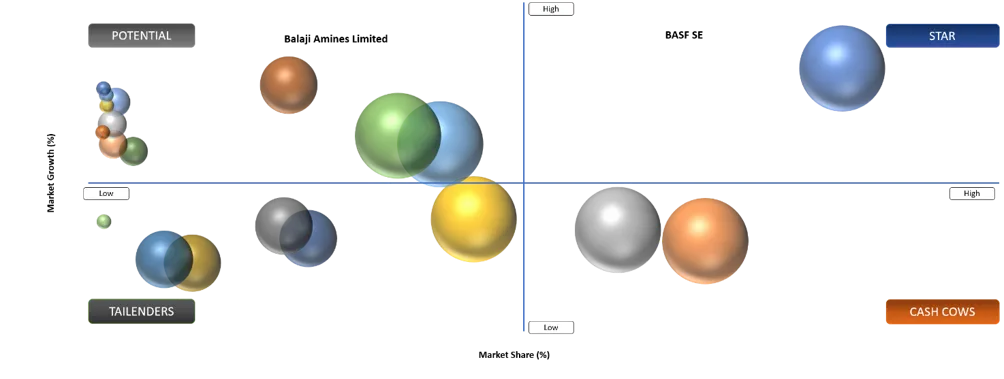
BASF SE, Mitsubishi Chemical Corporation, Dairen Chemical Corporation, Ashland Inc., and Sahara International Petrochemical Company (Sipchem) are positioned in the Star category based on their established chemical manufacturing capabilities, integrated production infrastructure, downstream value-chain participation, and international market presence. BASF benefits from its integrated 1,4-butanediol (BDO) and derivatives manufacturing network, supporting production efficiency and feedstock security. Mitsubishi Chemical maintains a competitive position through its GBL manufacturing operations in Japan, serving chemical intermediate and specialty industrial applications.
Dairen Chemical strengthens its position through established GBL production capabilities and integration with downstream pyrrolidone derivatives, while Ashland maintains a presence in specialty chemical intermediates and industrial solvent applications. Sipchem benefits from integrated petrochemical manufacturing infrastructure and GBL production through its industrial operations in Saudi Arabia. Future competitive leadership will depend on manufacturing cost efficiency, capacity utilization, high-purity product development, regulatory compliance, and the ability to secure long-term supply agreements with downstream chemical manufacturers.
POTENTIAL
Balaji Amines Limited, NEM Materials Co., Ltd., Sichuan Tianhua Chemical Group Co., Ltd., Zhejiang Realsun Chemical Co., Ltd., Wanhua Chemical Group Co., Ltd., BYN Chemical Co., Ltd., Shandong Changxin Chemical Science-Tech Co., Ltd., and Kenli Gengxin Chemical Co., Ltd. are positioned in the Potential category based on their reported chemical manufacturing capabilities, regional industrial presence, and opportunities to expand participation in the GBL value chain. Balaji Amines offers growth potential through its specialty chemical portfolio, including GBL and pyrrolidone derivatives, while NEM Materials and Sichuan Tianhua have established production backgrounds supporting their positioning within China's chemical manufacturing ecosystem.
Wanhua Chemical presents potential opportunities through its integrated chemical manufacturing capabilities, while Zhejiang Realsun and other regional manufacturers may strengthen their competitiveness through specialized product portfolios, customer diversification, and manufacturing improvements. Progression toward the Star category will depend on verified GBL production scale, merchant-market penetration, sustained capacity utilization, product purity differentiation, geographic expansion, and competitive production economics. Investments in advanced purification, downstream integration, and long-term industrial partnerships could further strengthen their positioning in specialty chemical applications.
Gamma Butyrolactone Market Dynamics
Driver Impact Analysis
| Driver | Market Growth Impact (%) | Demand Concentration | Impacted Use Case | Strategic Impact |
Expansion of GBL-Based NMP and Pyrrolidone Derivative Production | 14.8% | High in China, Japan, India, Europe, and North America | NMP Production, 2-Pyrrolidone Synthesis, Pharmaceutical Intermediates, and Specialty Chemicals | Strengthens GBL consumption in downstream chemical manufacturing, supports integrated production investments, and increases demand for reliable intermediate supply. |
Increasing High-Purity GBL Requirements in Semiconductor and Electronic Materials Manufacturing | 11.6% | High in China, Taiwan, Japan, and South Korea; expanding in North America | Semiconductor Processing, Photoresists, Photosensitive Resins, and Electronic Materials | Encourages specialty-grade GBL production, advanced purification investments, and premium pricing opportunities through stringent product specifications and supplier qualification. |
Expansion of Lithium-Ion Battery Manufacturing and Electrolyte Applications | 9.4% | High in China, South Korea, Japan, Europe, and North America | GBL-Based Electrolytes, Battery Materials, and GBL-Derived NMP for Electrode Processing | Supports downstream chemical demand, strengthens battery-material supply partnerships, and creates opportunities for integrated manufacturing and specialized electrolyte formulations. |
Capacity Expansion and Supply Security Investments Across the BDO-GBL Value Chain | 7.2% | High in China and other established Asian chemical manufacturing hubs, with opportunities in Europe and the Middle East | Integrated GBL Production, Captive Chemical Consumption, Industrial Solvents, and Chemical Intermediate Supply | Improves production economics, enhances supply reliability, reduces feedstock exposure, and strengthens competitiveness through backward and forward integration. |
Driver: Expansion of GBL-Based NMP and Pyrrolidone Derivative Production
The expansion of N-methyl-2-pyrrolidone (NMP) and other pyrrolidone derivative production is a key growth driver for the global gamma-butyrolactone (GBL) market, supported by demand from pharmaceutical manufacturing, specialty chemicals, electronics, and battery electrode processing. GBL serves as an important chemical intermediate in pyrrolidone synthesis, making its consumption closely linked to downstream manufacturing activity and capacity utilization. In March 2026, BASF reported an annual production capacity of 350,000 metric tons across its two 1,4-butanediol (BDO) and derivatives production plants, demonstrating the industrial scale of the upstream value chain supporting GBL-related manufacturing. This capacity is not exclusively dedicated to GBL production.
Growing investments in integrated chemical manufacturing are expected to strengthen GBL demand by improving feedstock availability, production economics, and downstream supply reliability. Manufacturers are increasingly prioritizing operational efficiency, process optimization, and specialty-grade development to address changing customer requirements. In FY2026, Balaji Amines reported over 293,600 metric tons per annum of installed manufacturing capacity across its chemical portfolio, which includes GBL, NMP, and 2-pyrrolidone. This company-wide capacity highlights the scale of integrated specialty chemical operations rather than GBL-specific output. As downstream pyrrolidone applications expand, manufacturers with integrated production capabilities, competitive feedstock costs, and established customer relationships are positioned to capture additional opportunities across regional chemical value chains.
Restraint Impact Analysis
| Restraint | Drag on Market Growth (%) | Primary Impact Area | Impacted Use Case | Strategic Impact |
Stringent Precursor Chemical Controls and Compliance Burden | 13.2% | Regulatory compliance, customer qualification, trade approvals, and distribution controls | Merchant GBL sales for Chemical Intermediates, Industrial Solvents, and Specialty Chemical Supply | Increases documentation, licensing, traceability, and customer-screening requirements, which can slow transactions, raise compliance costs, and restrict participation by smaller suppliers and distributors. |
Regulatory Pressure on Downstream NMP and Related Solvent Applications | 11.1% | Downstream demand risk, application substitution, and product portfolio exposure | GBL Used in NMP Production, Pyrrolidone Derivatives, Electronics Processing, and Industrial Solvents | Weakens growth visibility for integrated GBL producers exposed to downstream solvent restrictions, encouraging customers to reassess formulations, reduce solvent intensity, or shift toward alternative processing chemistries. |
Feedstock and Energy Cost Volatility Across the BDO-GBL Value Chain | 9.3% | Production economics, operating margins, and pricing stability | Captive GBL Production, Merchant Supply, Chemical Intermediate Manufacturing, and Industrial Solvent Applications | Raises manufacturing cost variability and compresses margins, making it harder for producers to maintain pricing discipline, plan capacity utilization, and secure long-term offtake agreements. |
High Market Concentration, Captive Consumption, and Limited Merchant Availability | 7.8% | Supply availability, sourcing flexibility, and regional procurement resilience | High-Purity GBL, Specialty Solvents, Battery-Related Applications, and Electronics Manufacturing | Reduces spot-market liquidity and buyer bargaining power, increases dependence on a limited producer base, and can delay customer qualification or regional expansion where reliable merchant supply is limited. |
Restraint: Stringent Precursor Chemical Controls and Compliance Burden
Stringent precursor chemical regulations represent a significant restraint on the global gamma-butyrolactone (GBL) market, increasing compliance costs, administrative complexity, and barriers to international trade. GBL's potential diversion into illicit activities has prompted governments to strengthen oversight of its production, distribution, transportation, and end-use verification. In August 2026, the UK government launched a consultation proposing tighter licensing controls for high-purity GBL and 1,4-butanediol, with the consultation scheduled to conclude in November 2026. Under the proposed framework, initial controlled-drug licensing fees could reach £4,700 (US$6,234), creating additional financial and operational burdens for industrial users if implemented.
Regulatory uncertainty is expected to influence procurement strategies, supplier qualification, and cross-border chemical trade, particularly among smaller manufacturers and specialty chemical distributors. In the United States, GBL is classified as a List I chemical, with regulated transactions subject to recordkeeping and reporting requirements irrespective of transaction size. These obligations can increase administrative costs, extend transaction processing times, and discourage participation by suppliers lacking established compliance infrastructure. Consequently, manufacturers with strong regulatory capabilities, traceable supply chains, and established customer verification systems are better positioned to maintain market access, while compliance-intensive operating conditions may constrain merchant-market expansion.
Gamma Butyrolactone Market Segment Analysis
The global gamma butyrolactone market is segmented based on the product grade, purity, production process, supply type, packaging format, application, end-use industry, sales channel and region.
Chemical Intermediates Lead GBL Market Revenue, While Electronics and Electrolyte Grade Emerges as the Fastest-Growing Segment
The chemical intermediates segment dominated the global gamma-butyrolactone market in 2025, accounting for an estimated USD 0.84 billion, representing approximately 75% of global market revenue. This dominance is primarily attributed to extensive GBL consumption in the production of N-methyl-2-pyrrolidone (NMP), 2-pyrrolidone, pharmaceutical intermediates, and specialty chemicals. Established manufacturing infrastructure, large-scale downstream chemical integration, and consistent demand for pyrrolidone derivatives reinforce the segment's leading position. Integrated chemical manufacturers benefit from improved feedstock availability, production cost optimization, and captive consumption capabilities, strengthening their competitiveness. Asia-Pacific remains a major demand center, supported by established chemical manufacturing clusters and expanding downstream industrial applications.
The electronics and electrolyte grade segment is projected to register the fastest growth, with an estimated CAGR of 6.8% during 2026-2035, driven by demand for high-purity chemicals in semiconductor processing, electronic materials, and selected battery and capacitor electrolyte applications. Increasing requirements for stringent impurity control, consistent product quality, and specialized chemical formulations are encouraging investments in advanced purification technologies. Manufacturers offering application-specific grades, reliable supply, and technical qualification support are positioned to capture higher-value opportunities across advanced manufacturing industries.
Global Gamma Butyrolactone Market Geographical Penetration
U.S. Gamma Butyrolactone Market Landscape
The U.S. gamma-butyrolactone market is characterized by established specialty chemical manufacturing, demand for pyrrolidone intermediates, and stringent regulatory oversight. GBL consumption is supported by N-methyl-2-pyrrolidone (NMP) production, pharmaceutical intermediates, industrial solvents, and specialized electronics applications. Domestic manufacturers and industrial buyers are increasingly focused on feedstock security, consistent product quality, and procurement cost optimization. In March 2025, Ashland announced a minimum global GBL price increase of US$0.33 per kilogram, effective March 15, reflecting pricing adjustments across its industrial chemical portfolio. Additionally, BASF announced an NMP price increase of US$0.10 per pound in the United States and Canada, effective April 2025, highlighting pricing pressures across the interconnected chemical value chain.
Looking ahead, U.S. market development will depend on downstream manufacturing activity, competitive feedstock economics, specialty-grade demand, and regulatory compliance capabilities. GBL's classification as a Drug Enforcement Administration (DEA) List I chemical creates additional obligations involving registration, transaction documentation, and prevention of unauthorized diversion. These requirements can increase operating costs and complicate merchant-market participation, particularly for smaller suppliers. Meanwhile, opportunities in high-purity chemical processing and integrated pyrrolidone manufacturing could encourage selective investments in purification, supply-chain traceability, and long-term customer agreements. Manufacturers combining reliable domestic supply, competitive pricing, technical expertise, and regulatory compliance are positioned to strengthen their presence in the U.S. market.
Japan Gamma Butyrolactone Market Outlook
Japan's gamma-butyrolactone market is supported by established specialty chemical manufacturing, advanced electronics production, and demand for high-purity industrial solvents. Mitsubishi Chemical Corporation maintains a strong domestic position through its integrated GBL and N-methyl-2-pyrrolidone (NMP) manufacturing operations. The company previously announced an expansion of its Okayama facility's GBL production capacity from 18,000 to 20,000 metric tons annually, targeting growing demand from semiconductor cleaning, capacitor electrolytes, and downstream NMP applications. Japan's semiconductor industry provides additional opportunities for specialty-grade GBL. In July 2026, the Semiconductor Equipment Association of Japan forecast Japanese-made semiconductor manufacturing equipment sales to increase 26% to approximately JPY 6.55 trillion in FY2026, indicating strong investment momentum across advanced electronics manufacturing.
Looking ahead, Japan's GBL market development will increasingly depend on high-purity product differentiation, downstream chemical integration, and supply-chain resilience. Demand opportunities are expected to emerge from semiconductor materials, specialty chemical intermediates, and selected battery-related applications, although broader electronics investment does not translate directly into proportional GBL consumption. Manufacturers are likely to prioritize advanced purification, stringent impurity control, energy-efficient processing, and long-term customer qualification to maintain competitiveness. Japan's established chemical manufacturing expertise and quality standards position domestic producers to pursue premium applications, while feedstock costs, regulatory compliance, and competition from lower-cost Asian suppliers remain important considerations for future investment and sourcing strategies.
Gamma Butyrolactone Market Competitive Landscape
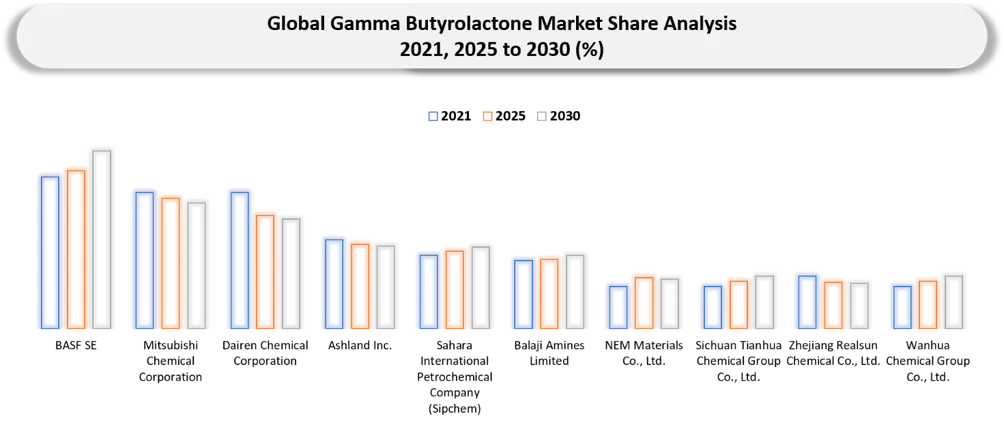
- The global gamma-butyrolactone market features a competitive structure comprising integrated chemical manufacturers, regional producers, and specialty chemical companies, with competition centered on production economics, downstream integration, product purity, and supply reliability. Established players such as BASF SE, Mitsubishi Chemical Corporation, Dairen Chemical Corporation, Ashland Inc., and Sahara International Petrochemical Company (Sipchem) benefit from manufacturing capabilities, established industrial relationships, and access to downstream chemical value chains. Asian manufacturers, including Balaji Amines Limited, Sichuan Tianhua Chemical Group, and NEM Materials Co., Ltd., contribute to regional supply and competitive dynamics. Vertical integration across 1,4-butanediol, GBL, and pyrrolidone derivatives remains an important competitive differentiator, allowing manufacturers to optimize feedstock utilization, manage production costs, and strengthen captive consumption networks.
- Competitive differentiation is increasingly influenced by high-purity product capabilities, regulatory compliance, regional supply availability, and long-term customer qualification. Manufacturers are expected to prioritize advanced purification, energy-efficient processing, and specialized grades for electronics, chemical intermediates, and selected electrolyte applications. Meanwhile, precursor chemical regulations, feedstock price volatility, and concentrated production infrastructure create operational challenges for smaller producers. Strategic partnerships, supply agreements, and selective capacity investments will shape competitive positioning, while companies combining manufacturing efficiency, application-specific quality, and diversified customer exposure are better positioned to capture profitable growth.
Key Companies of Gamma Butyrolactone Market
- BASF SE (Germany)
- Mitsubishi Chemical Corporation (Japan)
- Dairen Chemical Corporation (Taiwan)
- Ashland Inc. (United States)
- Sahara International Petrochemical Company (Saudi Arabia)
- Balaji Amines Limited (India)
- NEM Materials Co., Ltd. (China)
- Sichuan Tianhua Chemical Group Co., Ltd. (China)
- Zhejiang Realsun Chemical Co., Ltd. (China)
- Wanhua Chemical Group Co., Ltd. (China)
- BYN Chemical Co., Ltd. (China)
- Shandong Changxin Chemical Science-Tech Co., Ltd. (China)
- Binzhou City Zhanhua District Ruian Chemical Co., Ltd. (China)
- Kenli Gengxin Chemical Co., Ltd. (China)
- Ganzhou Zhongneng Industrial Co., Ltd. (China)
- Shandong Tsaker Dongao Chemical Co., Ltd. (China)
- Jinyao Ruida (Xuchang) Biology Technology Co., Ltd. (China)
- Ningbo Zheti Jiangning Chemical Co., Ltd. (China)
- Chongqing Zhongrun New Materials Co., Ltd. (China)
- Puyang Guangming Chemical Co., Ltd. (China)
Gamma Butyrolactone Market Major Pain Points
- Feedstock Price Volatility and Production Cost Pressures: Fluctuations in 1,4-butanediol (BDO), maleic anhydride, energy, and utility costs create uncertainty in GBL manufacturing economics. Producers with limited upstream integration face margin compression, pricing instability, and challenges in maintaining competitive supply contracts, particularly during periods of feedstock shortages or production disruptions.
- High Dependence on Captive Production and Limited Merchant Supply: A significant portion of GBL production is integrated into downstream chemical manufacturing, particularly N-methyl-2-pyrrolidone (NMP) and other pyrrolidone derivatives. Captive consumption can restrict merchant-market availability, reducing sourcing flexibility for independent buyers and increasing dependence on a relatively concentrated manufacturing base.
- Stringent Chemical Precursor Regulations and Compliance Complexity: GBL is subject to strict precursor chemical controls in several jurisdictions due to its potential misuse. Licensing obligations, customer verification, transaction reporting, import and export documentation, and storage requirements increase operational complexity and compliance expenditure. Regulatory differences across countries further complicate international trade and market expansion.
- Complex High-Purity Manufacturing and Quality Consistency Requirements: Electronics, semiconductor processing, and specialty electrolyte applications require stringent control over moisture, metallic impurities, residual contaminants, and batch-to-batch variability. Achieving consistent high-purity specifications requires advanced purification infrastructure, specialized analytical testing, and rigorous quality assurance, increasing manufacturing costs and limiting participation by smaller producers.
- Downstream Demand Concentration and Exposure to NMP Market Dynamics: GBL consumption remains closely linked to NMP and pyrrolidone derivative manufacturing, creating exposure to fluctuations in downstream chemical demand. Regulatory restrictions on certain solvent applications, changes in industrial production, and substitution by alternative processing chemicals can influence GBL requirements, complicating capacity planning and long-term demand forecasting.
- Regional Supply Chain Concentration and Logistics Challenges: GBL manufacturing capacity is concentrated within established chemical production regions, particularly Asia-Pacific, creating potential sourcing risks for import-dependent markets. Transportation regulations, hazardous chemical handling requirements, specialized packaging, customs procedures, and international trade disruptions can increase delivery costs, extend lead times, and affect procurement reliability.
- High Capital Requirements for Manufacturing Modernization: Establishing or upgrading GBL production facilities requires substantial investment in chemical processing equipment, catalytic systems, distillation units, emissions controls, and quality-testing infrastructure. Additional expenditure on automation, energy efficiency, and high-purity production capabilities can extend investment payback periods, particularly for producers facing uncertain utilization rates and competitive pricing pressures.
- Pricing Transparency Gaps and Long-Term Supply Contract Complexity: Limited publicly available GBL-specific pricing data, differences between industrial and specialty grades, and the prevalence of negotiated supply contracts complicate procurement benchmarking and market valuation. Buyers must evaluate purity specifications, minimum order quantities, logistics costs, regulatory obligations, and supplier reliability, while manufacturers face challenges in balancing pricing competitiveness, margin protection, and long-term customer commitments.
Gamma Butyrolactone Market Recent Developments
- October 2026: The Chemical Hazards Communication Society highlighted proposed UK regulatory changes affecting gamma-butyrolactone (GBL) and 1,4-butanediol (BDO), emphasizing potential licensing requirements and compliance obligations for chemical manufacturers, importers, and industrial users.
- August 2026: The UK Home Office launched a public consultation on tighter controls for high-purity GBL and BDO, proposing revised licensing and exemption requirements to prevent chemical misuse while maintaining legitimate industrial applications.
- June 2026: The European Commission imposed definitive anti-dumping duties on BDO imports from China, Saudi Arabia, and the United States, potentially influencing European GBL feedstock procurement costs, sourcing strategies, and downstream manufacturing competitiveness.
- June 2026: The UK Home Office completed an impact assessment examining stricter controls on high-purity GBL and BDO, evaluating licensing costs, concentration thresholds, and potential compliance burdens for industrial chemical businesses.
- March 2026: BASF SE introduced lower-carbon-footprint variants of BDO, tetrahydrofuran, PolyTHF, and N-methyl-2-pyrrolidone (NMP), targeting at least a 10% reduction in product carbon footprint compared with conventional alternatives and supporting sustainability across the GBL-related chemical value chain.
- February 2026: BASF SE announced a gradual increase in BDO production at its Ludwigshafen facility in Germany, aiming to strengthen European supply reliability and support downstream chemical derivative manufacturing, including products associated with the GBL value chain.
- December 2025: The UK Home Office reaffirmed the existing Class B controlled-drug classification of GBL and BDO, maintaining regulatory oversight of chemicals with legitimate industrial applications and potential misuse risks.
- August 2025: The European Commission introduced mandatory registration of BDO imports originating from China, Saudi Arabia, and the United States under Implementing Regulation (EU) 2025/1718, strengthening trade monitoring during anti-dumping proceedings.
- June 2025: The European Commission initiated an anti-dumping investigation into BDO imports from China, Saudi Arabia, and the United States, introducing potential trade-policy risks for European manufacturers dependent on imported chemical feedstocks.
- March 2025: BASF SE announced price increases for BDO and NMP in the United States and Canada, including US$0.08 per pound for BDO and US$0.10 per pound for NMP, reflecting pricing adjustments across chemical intermediates associated with GBL manufacturing.
- March 2025: Ashland Inc. announced global price increases for its BDO and solvent portfolio, including a minimum increase of US$0.33 per kilogram for GBL, effective March 15, 2025, or as contractual agreements permitted, reflecting adjustments in industrial chemical pricing.
Analyst View / Opinion on Gamma Butyrolactone Market
- The market is transitioning toward greater downstream chemical integration, with manufacturers strengthening the 1,4-butanediol (BDO)-GBL-N-methyl-2-pyrrolidone (NMP) value chain to improve feedstock security, optimize production costs, and capture additional value from pyrrolidone derivatives and specialty chemical applications.
- Chemical intermediates will remain the primary demand driver, supported by GBL consumption in NMP, 2-pyrrolidone, pharmaceutical intermediates, and specialty chemical synthesis, while expanding electronics and electrolyte applications create opportunities for product diversification and higher-value market participation.
- Competitive differentiation will increasingly depend on product purity, impurity control, manufacturing efficiency, feedstock availability, and supply reliability. Manufacturers capable of consistently delivering electronics and electrolyte grade GBL will be better positioned to serve specialized applications requiring stringent technical specifications and customer qualification.
- Investments in advanced purification, catalytic process optimization, energy-efficient production, digital process monitoring, and solvent recovery technologies could reshape manufacturing economics while enabling producers to improve product consistency, reduce operating costs, and address evolving sustainability requirements.
- Sustainable market leadership will require manufacturers to balance captive consumption with merchant-market opportunities, diversify downstream customer exposure, strengthen regulatory compliance, and establish long-term supply agreements. Regional production capabilities and integrated chemical infrastructure will remain critical determinants of competitive positioning.
- Commercial success will increasingly depend on application-specific product development, competitive pricing, transparent quality documentation, reliable distribution networks, and strategic partnerships with chemical manufacturers, electronics companies, and specialty material producers. Companies combining cost-efficient operations, high-purity manufacturing capabilities, and resilient supply chains will be better positioned to capture long-term market opportunities.
Global Gamma Butyrolactone Market Target Audience
| INDUSTRY | WHO SHOULD BUY THIS REPORT? | REASON TO BUY THIS REPORT |
| Chemical and Petrochemical Manufacturers | GBL producers, 1,4-butanediol manufacturers, integrated petrochemical companies, and specialty chemical manufacturers | Assess market demand, production capacity, feedstock economics, competitive positioning, and opportunities for downstream integration across the BDO-GBL-NMP value chain. |
| Pharmaceutical and Fine Chemical Companies | Pharmaceutical intermediate manufacturers, active pharmaceutical ingredient (API) producers, contract manufacturers, and fine chemical synthesis companies | Evaluate GBL availability, purity requirements, sourcing alternatives, supplier reliability, and opportunities in pharmaceutical and specialty chemical intermediate production. |
| Electronics and Semiconductor Manufacturers | Semiconductor material manufacturers, electronic chemical formulators, photoresist manufacturers, and precision cleaning chemical companies | Identify high-purity GBL demand opportunities, electronic-grade specifications, supplier qualification requirements, and regional sourcing strategies for advanced electronics manufacturing. |
| Battery and Electrolyte Manufacturers | Lithium-ion battery manufacturers, electrolyte formulators, capacitor manufacturers, and battery material suppliers | Assess GBL applications in specialty electrolytes, GBL-derived NMP supply chains, high-purity chemical requirements, and emerging opportunities across energy-storage technologies. |
| Paints, Coatings, and Industrial Solvent Companies | Coating formulators, industrial solvent manufacturers, resin producers, printing ink manufacturers, and industrial cleaning chemical companies | Evaluate solvent application opportunities, product substitution potential, procurement economics, regulatory restrictions, and GBL suitability for specialized industrial formulations. |
| Chemical Distributors and Trading Companies | Industrial chemical distributors, specialty chemical distributors, importers, exporters, and chemical wholesalers | Identify regional supply gaps, merchant-market opportunities, distribution partnerships, pricing dynamics, regulatory obligations, and potential expansion into specialty-grade GBL distribution. |
| Chemical Engineering and Technology Providers | Process technology licensors, chemical plant engineering companies, purification equipment manufacturers, and industrial automation providers | Assess opportunities in GBL production technologies, catalytic processing, advanced distillation, plant modernization, energy efficiency, and high-purity manufacturing infrastructure. |
| Packaging, Storage, and Chemical Logistics Companies | Industrial packaging manufacturers, ISO tank operators, chemical warehousing providers, and specialized logistics companies | Evaluate GBL transportation requirements, packaging demand, storage regulations, distribution infrastructure, and opportunities in compliant chemical handling and supply-chain services. |
| Government and Regulatory Bodies | Chemical regulatory authorities, environmental agencies, industrial development organizations, customs authorities, and trade policymakers | Support chemical safety assessments, precursor control policies, industrial development planning, import-export monitoring, and evaluation of regional manufacturing capabilities. |
| Investors and Financial Institutions | Private equity firms, venture capital investors, institutional investors, investment banks, and corporate investment teams | Evaluate market growth, manufacturing economics, capacity expansion opportunities, competitive risks, potential acquisition targets, and investment prospects across the GBL value chain. |
| Market Research and Consulting Firms | Strategy consultancies, competitive intelligence teams, market research companies, and corporate advisory firms | Support market entry assessments, competitive benchmarking, demand forecasting, pricing analysis, portfolio diversification, and commercial due diligence. |
| Research and Development Organizations | Chemical research institutes, universities, industrial R&D laboratories, and advanced materials research centers | Identify innovation opportunities in GBL synthesis, catalytic technologies, alternative feedstocks, solvent formulations, high-purity grades, and sustainable chemical manufacturing. |
| Procurement and Supply Chain Organizations | Strategic sourcing teams, chemical procurement managers, supply-chain directors, and vendor development specialists | Benchmark suppliers, assess supply concentration, optimize sourcing costs, evaluate captive versus merchant availability, and develop resilient procurement strategies. |
Why Choose DATAM?
- Data-Driven Insights: Access granular gamma-butyrolactone (GBL) market intelligence covering market size, growth forecasts, product grade and purity shares, application-level demand, production technologies, captive versus merchant consumption, pricing dynamics, competitive positioning, and regional supply-demand trends, supported by primary interviews with chemical manufacturers, distributors, and industry experts.
- Post-Purchase Support and Expert Analyst Consultations: Engage directly with our chemical industry analysts for customized guidance on GBL market segmentation, production economics, feedstock sourcing, downstream integration, supplier benchmarking, market entry strategies, competitive assessment, and investment opportunities across industrial and specialty chemical applications.
- White Papers and Case Studies: Receive periodic insights on GBL manufacturing developments, advanced purification technologies, BDO-GBL-NMP value-chain integration, high-purity applications, regulatory changes, pricing trends, and emerging opportunities in electronics, battery electrolytes, and specialty chemical manufacturing.
- Annual Updates on Purchased Reports: Stay informed through annual updates covering GBL production capacity developments, manufacturing investments, technological advancements, feedstock price movements, regulatory changes, strategic partnerships, mergers and acquisitions, and competitive developments across major producing and consuming regions. Terms and conditions apply.
- Specialized Focus on Emerging Markets: Gain country-specific intelligence on GBL production capabilities, import dependence, downstream chemical demand, industrial infrastructure, regulatory requirements, merchant supply availability, and investment opportunities across emerging markets, particularly India, China, Southeast Asia, the Middle East, and Latin America.
- Value of DataM Reports: Obtain tailored market intelligence addressing specific business questions related to GBL manufacturing profitability, high-purity product differentiation, captive versus merchant supply, regional demand gaps, feedstock volatility, downstream pyrrolidone applications, supplier concentration, regulatory compliance, and long-term capacity expansion opportunities beyond conventional market databases.
What DATAM Uniquely Provides
- In-depth segmentation of the global gamma-butyrolactone market by Product Grade, Purity, Production Process, Supply Type, Packaging Format, Application, End-Use Industry, Sales Channel, and Region, providing detailed insights into market size, revenue distribution, growth opportunities, and demand patterns across industrial and specialty chemical applications.
- Detailed competitive analysis of leading GBL manufacturers, including BASF SE, Mitsubishi Chemical Corporation, Dairen Chemical Corporation, Ashland Inc., Sipchem, and Balaji Amines Limited, covering production capabilities, downstream integration, product purity, manufacturing technologies, geographic presence, pricing strategies, capacity expansion, and competitive positioning.
- Comprehensive assessment of 1,4-butanediol (BDO) and maleic anhydride feedstock availability, GBL manufacturing capacity, captive consumption, merchant-market supply, regional import dependence, and downstream demand across N-methyl-2-pyrrolidone (NMP), 2-pyrrolidone, pharmaceutical intermediates, electronics, industrial solvents, and specialty chemicals.
- Actionable intelligence on GBL pricing dynamics, production cost structures, feedstock price volatility, precursor chemical regulations, import-export requirements, supplier qualification, high-purity product specifications, manufacturing investments, strategic partnerships, and emerging investment opportunities across the global chemical value chain.
- Analyst-driven forecasts highlighting high-growth product grades, dominant applications, regional manufacturing opportunities, emerging electronics and electrolyte requirements, and competitive developments. The analysis identifies strategic opportunities in advanced purification technologies, integrated BDO-GBL-NMP production, sustainable manufacturing, supply-chain localization, and specialty chemical portfolio diversification.





























































