


Functional Safety Products Market Size and Overview
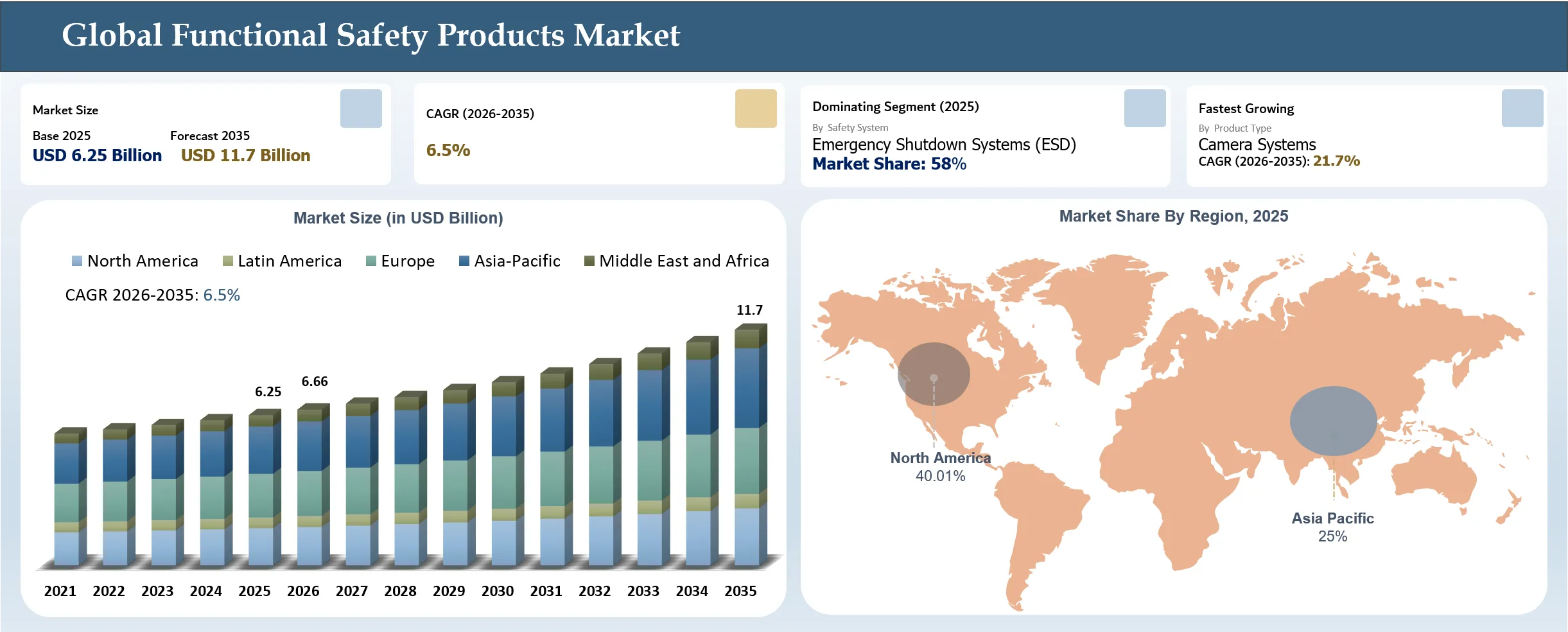
The global functional safety products market reached USD 6.25 billion in 2025 and is expected to reach USD 11.7 billion by 2035, growing with a CAGR of 6.5% during the forecast period 2026-2035. The market expansion is reinforced by the rapid transition to software-controlled, connected, and autonomous industrial machinery, which increases the need for safety features built into controllers, drives, and robotics. In July 2026, KUKA became the first robotics firm to receive Security Level 2 certification under IEC 62443-4-2 for its iiQKA.OS2 robotics system and KR C5 controller solution; furthermore, the solution complied with EN ISO 10218-1:2025 standards and provided safety features such as Normal Stop, Restart Interlock, and monitoring of all robot axes.
Development of products is going hand-in-hand with the design of compact and highly power-dense motion control products that have certified functional safety built into the drives. In June 2026, Elmo Motion Control, a subsidiary of Bosch Rexroth, showcased its new product family called Titanium and Platinum servo drive and motion control product line at the Automate 2026 event, wherein the products offered up to 17 certified functional safety features, including the Titanium Harmonica offering support for up to 50A/100V and 35A/200V, and Titanium Maestro motion controller up to 256 axes versus 16 axes earlier.
White-Space Opportunities for Functional Safety Products in Automotive Electronic Systems and Intelligent Vehicle Technologies
In 2025, the U.S. Department of Transportation’s National Highway Traffic Safety Administration (NHTSA) planned the Vehicle Electronic Systems and Intelligent Technologies Research IDIQ, with an estimated value of more than USD 100 million, creating a significant government-supported opportunity for the functional safety products market. The largest investment area relevant to the market is vehicle component testing and functional safety assessments, which directly covers the functional safety of vehicle electronic components and subsystems.
Additional investment areas include controlled-environment and test-track evaluation, virtual testing and simulation/modeling, on-road and naturalistic testing, safety-impact assessment, cybersecurity, and AI/ML methods, algorithms, and software for advanced vehicle technologies. The procurement supports research related to ADAS, automated driving systems, vehicle electronic systems, and safety-critical technologies, with functional safety specifically identified as one of NHTSA’s core research domains.
The investment is expected to create opportunities across the automotive functional-safety and intelligent-vehicle technology value chain, particularly for companies providing vehicle electronic components, ADAS, automated-driving systems, testing and validation, simulation, cybersecurity, and safety-assessment technologies. Companies such as Bosch, Continental, ZF, Aptiv, Valeo, Magna, Mobileye, and Forvia could benefit from the functional-safety and vehicle-component-testing area through development, validation, and assessment of safety-critical electronic components, ADAS systems, braking and steering technologies, sensors, and automated-driving platforms.
Ansys, dSPACE, and Siemens could benefit from the virtual-testing and simulation area through modeling, digital validation, and software-based testing of vehicle electronic and automated-driving systems, while NVIDIA and Qualcomm could benefit from AI/ML and advanced vehicle-computing research supporting intelligent vehicle technologies.
Functional Safety Products Market Key Takeaways
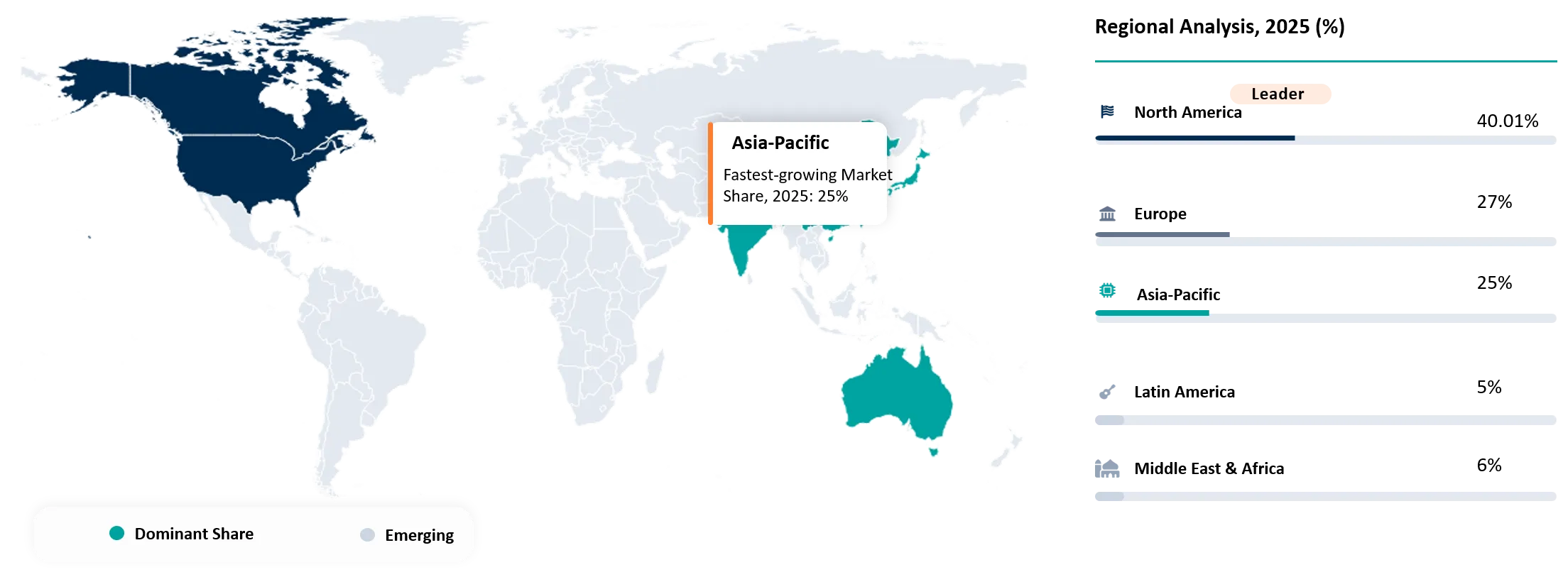
- North America led the global market in 2025 with a 40.01% share, while Asia-Pacific held a 25% share and is identified as the fastest-growing region.
- Camera Systems represent the fastest-growing product type in the market, projecting a CAGR of 21.7% over the forecast period from 2026 to 2035.
- Emerson secured a multi-million-dollar contract from BP to supply integrated control and safety systems for the USD 2.9 billion Shah Deniz Compression project.
- A survey by ICTC and NGen in 2026 revealed that only 23% of Canadian manufacturers reported full success with their digital-technology adoption initiatives.
Functional Safety Products Market Industry Trends and Strategic Insight
- Functional safety is converging with industrial cybersecurity, with manufacturers increasingly designing safety controllers, robot platforms, and automation systems so that safety functions remain protected from unauthorized access, manipulation, and cyberattacks.
- Software-defined safety architectures are becoming central to product development, as programmable safety controllers and software-configured safety functions increasingly replace fixed-function protection and provide greater flexibility for automated machinery.
- Safety is moving toward network-level architectures rather than isolated devices, with safety products increasingly communicating across industrial networks while maintaining separation between safety-critical and standard automation functions.
- Strategic product development is increasingly focused on interoperable safety architectures, allowing safety products from different automation layers to communicate while preserving required safety integrity and cybersecurity boundaries.
- Retrofit-oriented safety products represent an important strategic opportunity, as manufacturers modernize legacy machinery with programmable safety controllers, networked safety I/O, sensors, and cybersecurity protections rather than replacing entire production assets.
Functional Safety Products Market Scope
| Metrics | Details | |
| 2025 Market Size | USD 6.25 Billion | |
| 2035 Projected Market Size | USD 11.7 Billion | |
| CAGR (2026-2035) | 6.5% | |
| Largest Market | North America | |
| Fastest Growing Market | Asia-Pacific | |
| By Product Type | Safety Sensors, Safety Relays, Safety PLCs, Safety Light Curtains & Optical Safety Devices, Emergency Stop Devices, Safety I/O Modules, Safety Drives & Motion Control, Safety Mats, Edges & Bumpers, Safety Motor Control, Safety Switches, Others | |
| By Safety System | Emergency Shutdown Systems (ESD), Fire & Gas Monitoring Systems, High-Integrity Pressure Protection Systems (HIPPS), Burner Management Systems (BMS), Safety Instrumented Systems (SIS), Turbomachinery Control Systems (TMC), Safety SCADA/DCS Systems, Others | |
| By Safety Integrity Level | SIL 1/PL c, SIL 2/PL d, SIL 3/PL e | |
| By End User | Automotive, Manufacturing, Oil & Gas, Chemicals & Petrochemicals, Power Generation, Food & Beverages, Pharmaceuticals, Metals & Mining, Aerospace & Defense, Railways, Water & Wastewater, Others | |
| By Region | North America | U.S., Canada, Mexico |
| Europe | Germany, UK, France, Spain, Italy, Poland, Netherlands, Switzerland | |
| Asia-Pacific | China, India, Japan, Australia, South Korea, Indonesia, Malaysia | |
| Latin America | Brazil, Argentina | |
| Middle East and Africa | UAE, Saudi Arabia, South Africa, Israel, Türkiye | |
| Report Insights Covered | Competitive Landscape Analysis, Company Profile Analysis, Market Size, Share, Growth | |
Functional Safety Products Market Disruption Analysis
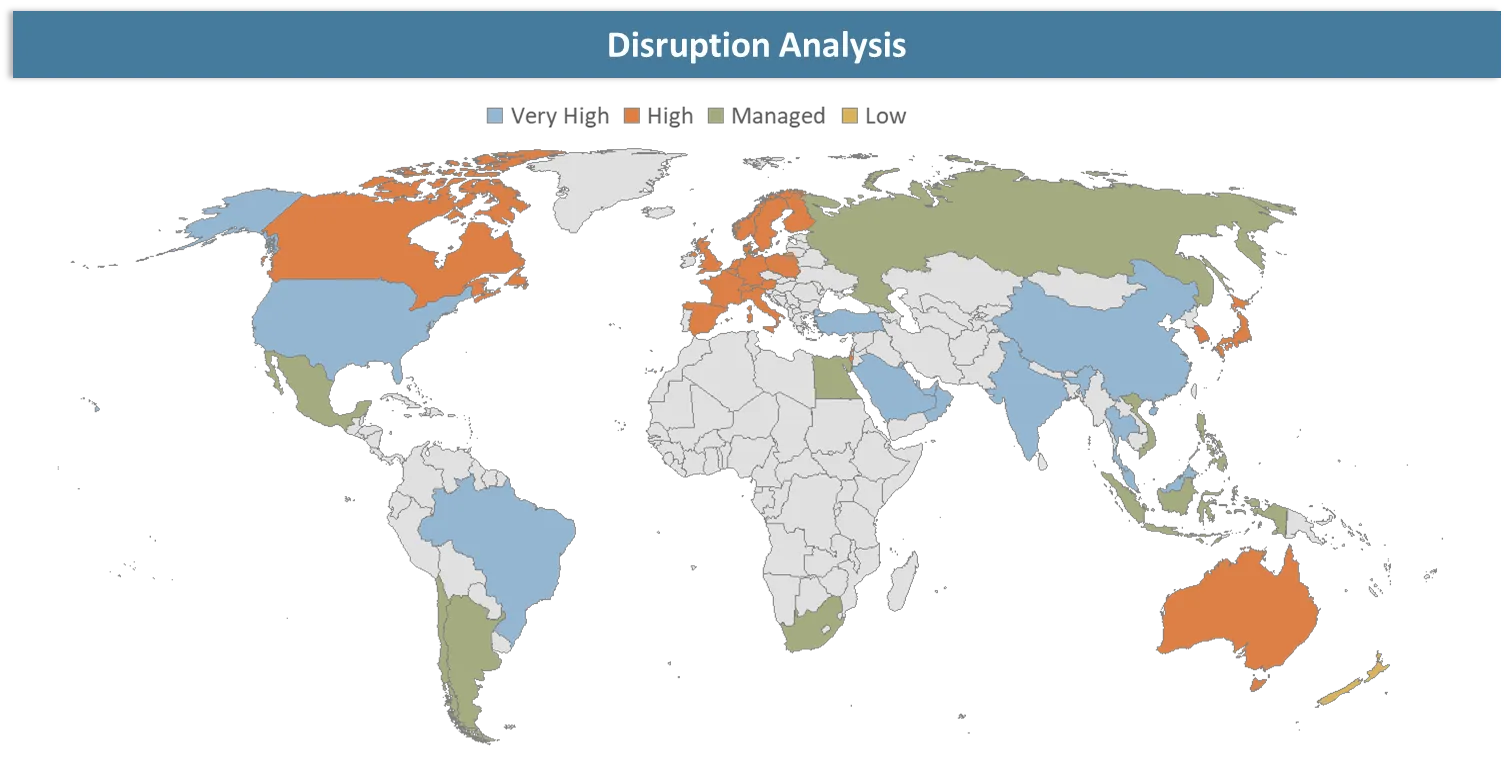
Shift Toward 3D Safety Perception and Networked Safety Architectures Reshaping Functional Safety Products
The disruption in the functional safety products market is primarily associated with the shift from conventional 2D detection of safety towards 3D safety perception in the case of autonomous and man-machine environments. Traditional safety products have largely employed technologies such as 2D LiDAR, light curtains, and other types of planar sensing. However, in order to operate autonomously in a modern environment, robots need safety products that can detect people and objects in a three-dimensional space.
The disruption continues to speed up as functional safety products progress towards 3D perception, embedded safety, and certified sensing for autonomous and collaborative robots. In July 2026, according to Automation World, the ADAR One 3D ultrasonic sensor from Sonair was evaluated using IEC 61496 and fulfills IEC 61508 and ISO 13849 functional safety standards. It is SIL 2 and PL d, with a probability of dangerous failure rate of less than 1.5 × 10⁻⁷ per hour. It uses the technology to deliver full 3D spatial awareness for person and obstacle detection. The product is used for autonomous mobile robots, automated guided vehicles, collaborative robots, and humanoid robots. The innovation is indicative of the evolution from 2D safety sensors to embedded 3D safety perception technology.
Functional Safety Products Market BCG Matrix: Company Evaluation
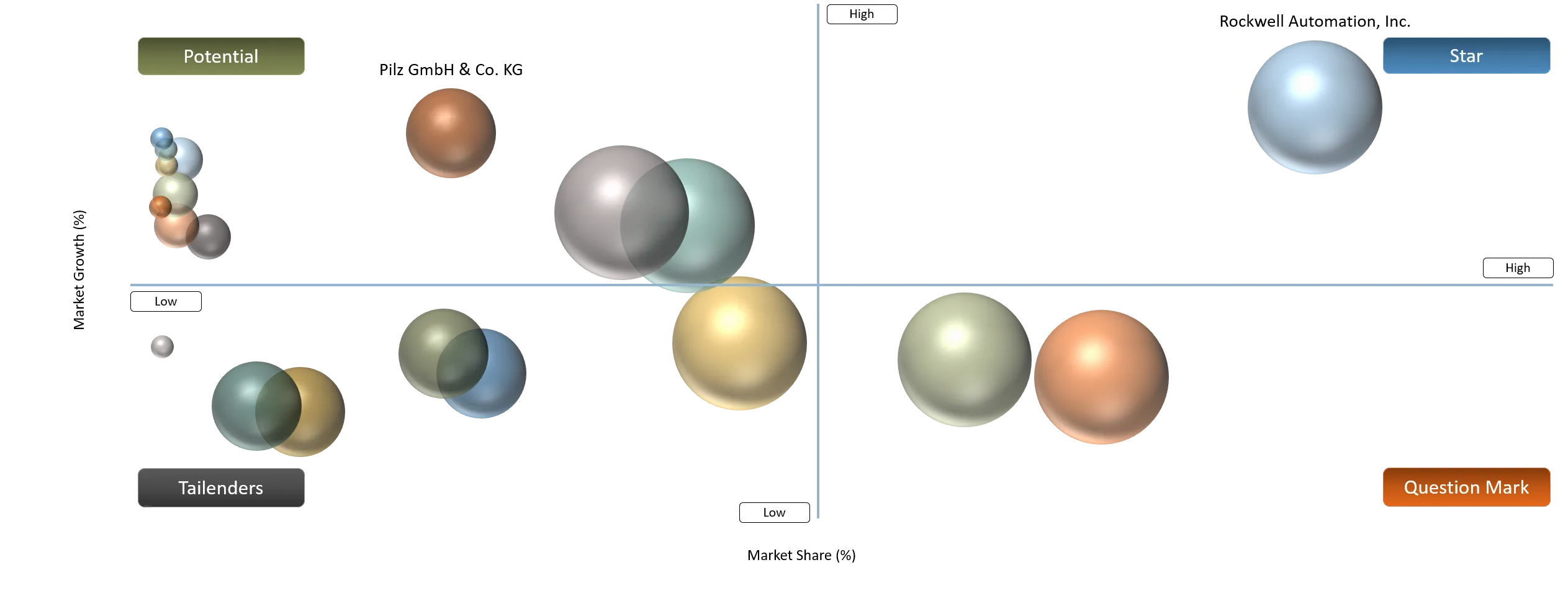
Stars include Siemens AG, Rockwell Automation, Inc., Schneider Electric SE, and ABB Ltd. because they have broad functional-safety portfolios, strong positions across industrial automation and process safety, and established safety PLC, controller, relay, sensor, and safety-system capabilities. The Question Mark category includes OMRON Corporation, Mitsubishi Electric Corporation, and SICK AG. These companies have strong capabilities in safety controllers, safety sensors, scanners, light curtains, and automation technologies, but face intense competition from larger integrated automation suppliers.
The category of Potential includes Pilz GmbH & Co. KG, Phoenix Contact GmbH & Co. KG, and Eaton Corporation plc. The companies benefit from specialized expertise in safety relays, safety controllers, safety switches, industrial control systems, and electrical safety products, while their established presence in industrial automation and electrical infrastructure provides opportunities to capture additional demand from machine modernization and connected safety applications. Tailenders include Honeywell International Inc. and Leuze electronic GmbH because their functional-safety activities are more concentrated in particular application areas.
Functional Safety Products Market Dynamics
Driver Impact Analysis
| Driver | Market Growth Impact (%) | Demand Concentration | Impacted Use Case | Strategic Impact |
Expansion of robotics, humanoid robots, and physical AI is driving demand for integrated functional safety products. | 24% | High concentration in North America, Europe, and Asia-Pacific, particularly in robotics, logistics, automotive, and advanced manufacturing | Humanoid robots, cobots, AMRs/AGVs, robotic cells, AI-enabled industrial machinery, human–robot collaboration | Accelerates development of integrated safety sensors, safety controllers, 3D perception, safe motion control, and safety-certified AI architectures |
Growing adoption of industrial automation and smart manufacturing is increasing demand for safety PLCs, sensors, relays, controllers, and emergency-stop systems. | 30% | Strongest in Asia-Pacific, Europe, and North America, with high demand across automotive, electronics, machinery, food & beverage, and process manufacturing | Automated production lines, machine safety, robotic manufacturing, smart factories, automated material handling | Encourages suppliers to integrate functional safety with PLCs, industrial networking, motion control, diagnostics, and Industry 4.0 platforms |
Increasing vehicle electrification and autonomous-driving complexity is accelerating demand for functional safety. | 23% | Concentrated in North America, Europe, China, Japan, and South Korea, particularly across EV and automotive electronics ecosystems | EV battery systems, ADAS, autonomous-driving systems, vehicle controllers, electric powertrains, braking and steering systems | Drives demand for safety MCUs, redundant controllers, monitoring systems, safety sensors, and ISO 26262-compliant architectures |
Stricter machinery and automotive safety standards are encouraging manufacturers to adopt certified safety controllers, sensors, and safety-related control systems. | 23% | High concentration in Europe and North America, with increasing adoption across Asia-Pacific due to international safety requirements | Machinery safety, automotive electronics, industrial control systems, robotics, process safety | Increases demand for SIL/PL-certified products, strengthens certification requirements, and raises entry barriers for suppliers without safety validation capabilities |
Expansion of robotics, humanoid robots, and physical AI is driving demand for integrated functional safety products
The rapid expansion of robotics and autonomous machines is increasing the need for integrated solutions of functional safety products which can help protect humans and machinery in complex environments. In June 2026, according to the International Federation of Robotics (IFR), the installations of robots in the U.S. rose by 11% annually to reach 38,000 units in 2025, and the use of robots in the U.S. food industry rose by 30% during the same period. In general, the whole field of robotics is becoming more dependent on AI-based machines.
In parallel, the rise of humanoid robots and physical AI is raising the need for full-stack functional safety architectures that incorporate AI computing, sensors, software, and safety features. In June 2026, according to NVIDIA, NVIDIA Halos for Robotics relies on over 18,600 years of engineering expertise gained from developing autonomous vehicle safety and includes more than 40 companies in its Halos AI Systems Inspection Lab, including manufacturers, certification authorities, and safety vendors. Moreover, NVIDIA reports that humanoid robotics firm Agility is incorporating NVIDIA IGX Thor and Halos Core into the Digit humanoid robot used in logistics, manufacturing, and warehouse applications, where safety-related software, AI elements, and cybersecurity solutions are developed according to IEC 61508, ISO 13849, and ISO/IEC TR 5469 standards.
Restraint Impact Analysis
| Restraint | Drag on Market Growth (%) | Primary Impact Area | Impacted Use Case | Strategic Impact |
Complexity of integrating functional safety products into legacy brownfield machinery and industrial systems. | 30% | System integration, retrofit costs, downtime, compatibility | Legacy production lines, brownfield factories, aging process-control systems, machinery modernization | Drives demand for modular retrofit solutions, backward-compatible safety products, simplified commissioning, and integration services |
Shortage of certified functional safety engineers is limiting the design, validation, installation, and maintenance of safety-critical systems. | 25% | Engineering, validation, commissioning, maintenance | Industrial automation, robotics, process safety, automotive safety systems | Encourages suppliers to provide pre-certified products, automated safety engineering tools, remote support, training, and simplified configuration platforms |
Increasing complexity of AI-enabled and software-intensive safety systems makes functional safety verification and certification more difficult. | 23% | Software validation, safety verification, certification | Autonomous robots, physical AI, ADAS, autonomous machinery, intelligent industrial systems | Increases investment in safety software, simulation, verification tools, redundant architectures, and AI-safety validation capabilities |
Long certification and validation requirements for safety-critical products can delay product launches and increase development costs. | 22% | Product development, certification, time-to-market | Safety PLCs, safety sensors, automotive electronics, robotic safety systems, process-safety equipment | Favors manufacturers with established certification frameworks, reusable safety architectures, standardized components, and in-house compliance expertise |
Complexity of integrating functional safety products into legacy brownfield machinery and industrial systems
One of the main restraints limiting the rapid deployment of functional safety products is the complexity of integrating modern safety technologies into legacy brownfield machinery and industrial systems. Legacy machinery typically runs on outdated control systems, hard-wired safety circuits, legacy sensors, and limited networking capability, hence making it challenging to incorporate new-generation safety PLCs, safety relays, sensors, and networked safety devices. According to Pilz, the firm upgraded a 60-year-old hydraulic press with a capacity of 120 tonnes used by an Italian firm, Mencarelli Pompe e Valvole.
In addition, brownfield integration will need thorough risk assessment, safety function design, validation, cabling, configuration, and documentation, because alteration to the existing safety system may result in changes in the system’s safety performance certification. In May 2025, according to TXOne Networks, 44% of surveyed organizations were worried that implementing protective mechanisms would have a negative impact on system performance, 42% were worried about potential conflicts with the OT application, and 13% did not have knowledge of how to implement protection. Furthermore, 62% planned to purchase an OT security solution for their legacy system, where factors such as easy integration (50%) and implementation disruption (49%) were among the main purchase drivers.
Functional Safety Products Market Segment Analysis
The global functional safety products market is segmented based on product type, safety system, safety integrity level, end user, and region.
Emergency Shutdown Systems (ESD) Driving Dominance in the Functional Safety Products Market
The emergency shutdown systems (ESD) dominate the safety system segment of the functional safety products market, accounting for 58% of the market in 2025. Their leading position is supported by widespread deployment across high-hazard industries such as oil & gas, petrochemicals, chemicals, power generation, and offshore production, where ESD systems automatically place critical processes into a safe state when dangerous operating conditions occur. The importance of ESD is being reinforced by continued investment in large-scale energy infrastructure. In August 2026, Emerson received a multi-million-dollar contract from BP to provide integrated control and safety systems for the USD 2.9 billion Shah Deniz Compression project offshore Azerbaijan.
The dominance of ESD systems is further supported by the industry's transition toward integrated and digitally monitored safety architectures rather than standalone shutdown devices. In September 2026, Emerson updated its AMS 6500 ATG online protection system and AMS Machine Works software to enable continuous, unlimited machine-data transmission from protection systems into analytics platforms, allowing operators to analyze complex startup and shutdown activities over longer periods.
Functional Safety Products Market Geographical Penetration
North America Leading the Functional Safety Products Market Through Industrial Automation and Safety-Critical Infrastructure Investment
The North American region dominates the functional safety products market, accounting for 40.01% of global revenue in 2025, supported by early adoption of industrial automation, established workplace and process-safety regulations, and the strong presence of major functional-safety and automation manufacturers. The U.S. represents the principal demand center within the region, particularly across smart manufacturing, oil and gas, automotive, chemicals, and power generation.
The deployment of its safety system across 800+ maintenance vehicles highlights growing demand for safety-critical rail technologies. In September 2025, Piper Networks, a U.S.-based rail safety technology company, launched an NTSB-compliant version of its Limits Compliance and Collision Avoidance System (LCCAS) to help railroads meet functional-safety recommendations for rail-bound maintenance vehicles. The system combines GPS, RTK, LiDAR, and Ultra-Wideband sensors to provide positioning, obstacle detection, worker protection, and collision avoidance, with the new kit capable of delivering alerts and braking when required. Piper reported that its LCCAS was already installed on more than 800 maintenance vehicles in the U.S., with most operating on Amtrak’s Northeast Corridor.
U.S. Functional Safety Products Market Trends
The U.S. holds a dominant position in North America’s functional safety products market, supported by its large installed base of industrial automation, advanced manufacturing capabilities, established machinery-safety requirements, and strong adoption of robotics across automotive, food, logistics, and other industries.
The ASIL-B certification strengthens the role of thermal imaging in safety-critical ADAS and autonomous driving applications. In January 2026, Teledyne FLIR OEM, a U.S.-based thermal imaging and infrared technology company, a business unit of Teledyne Technologies Incorporated, launched Tura, an automotive-qualified long-wave infrared (LWIR) thermal camera at CES for autonomous vehicles and ADAS. Tura is the first ASIL-B thermal LWIR camera developed in compliance with ISO 26262 functional-safety standards, featuring a 640 × 512 thermal sensor designed to detect pedestrians, animals, and other vulnerable road users in darkness, fog, smoke, and glare.
Canada Functional Safety Products Market Outlook
Canada is an important country in the North American functional safety products market, supported by its advanced manufacturing base, growing adoption of robotics and industrial automation, and increasing investment in automotive, aerospace, food and beverage, and other safety-critical manufacturing industries. According to the Information and Communications Technology Council (ICTC) and Next Generation Manufacturing Canada (NGen) in 2026, only 23% of Canadian manufacturers reported that their digital-technology adoption initiatives had been fully successful over the previous five years.
The new modules simplify safety implementation while supporting critical machine-protection functions and reliable safety monitoring. In September 2025, WAGO, a Germany-based industrial automation and electrical interconnection technology company, launched three new functional-safety I/O modules for its PFC controllers, providing SIL3/PLe safety logic for compact and decentralized systems without requiring a separate safety PLC. The modules feature four safe inputs paired with either two safe 10 A/24 VDC outputs or four safe 2 A/24 VDC outputs, with integrated monitoring of short circuits, cross circuits, and separate 24 V power supplies.
Rapid Automation Adoption and Intelligent Manufacturing Expansion in Asia-Pacific Region
The Asia-Pacific is the fastest-growing region in the functional safety products market, accounting for 25% of the global market in 2025, driven by rapid industrial automation, expansion of robotics, electronics and automotive manufacturing, and increasing adoption of intelligent production technologies across China, Japan, South Korea, Southeast Asia, and other manufacturing economies. The region's strong combination of large-scale manufacturing, robotics deployment, and automation investment is increasing demand for safety PLCs, safety sensors, safety switches, emergency-stop devices, safety relays, and safety motion-control products.
Its multi-level SIL and PL certifications strengthen its suitability for safety-critical automation and machine-protection applications. In March 2026, ABB, a Switzerland-based electrification and automation technology company, highlighted its AC500-S safety PLC with integrated fail-safe condition monitoring, expanding functional-safety capabilities for safety-critical machinery. The system can monitor vibration signals with a bandwidth of up to 20 kHz and support safety functions up to SIL CL 2 under IEC 62061, SIL2 under IEC 61511, and PL d under ISO 13849-1.
Japan Functional Safety Products Market Trends
Japan is one of the major countries in the Asia-Pacific functional safety products market owing to its highly developed industrial automation ecosystem, strong robotics manufacturing base, and extensive adoption of automated production across automotive, electronics, machinery, and other safety-critical industries.
The certifications and secure communication upgrades strengthen functional-safety system reliability in increasingly connected industrial environments. In April 2026, Yokogawa Electric Corporation, a Japan-based industrial automation and control technology company, strengthened the cybersecurity of its Integrated Control and Safety System, CENTUM VP and ProSafe-RS, with the systems obtaining ISASecure SSA Level 1 certification based on IEC 62443-3-3 security requirements. Yokogawa also obtained CIS Benchmark certification for its IT Security Tool and added OPC UA support to its Exaopc OPC interface package to strengthen secure communication between information and control systems.
Functional Safety Products Market Competitive Landscape
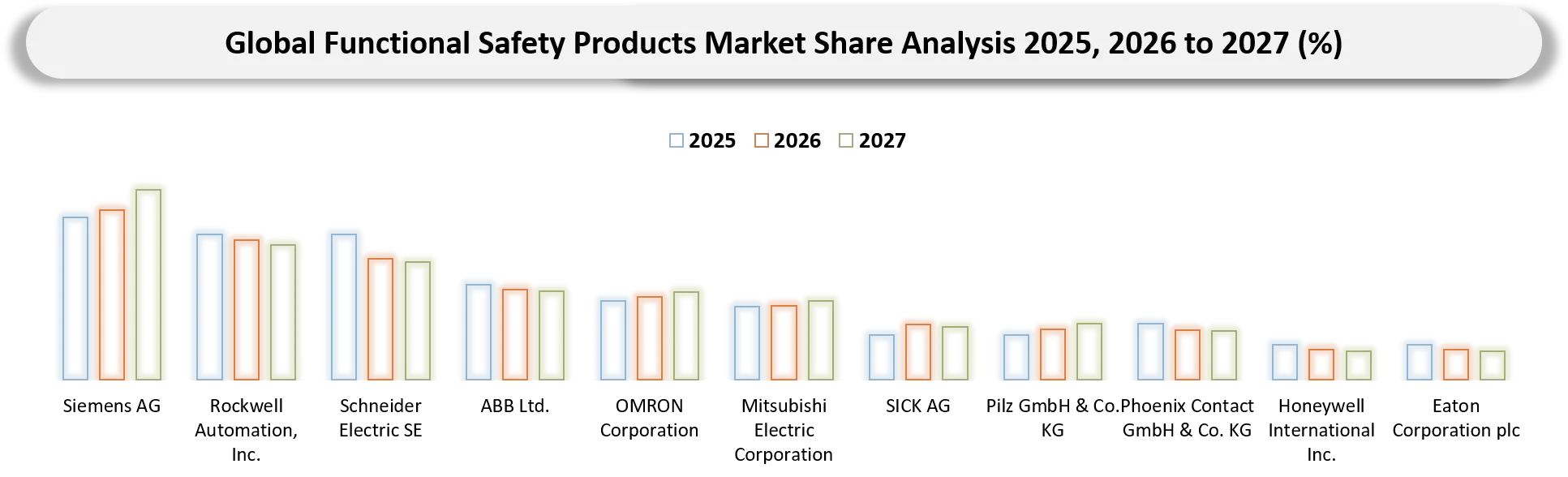
- The functional safety products market is characterized by three broad participant groups: integrated industrial automation providers, functional-safety and machine-safety specialists, and process-safety/industrial control companies. Siemens AG, Rockwell Automation, Inc., Schneider Electric SE, ABB Ltd., and Mitsubishi Electric Corporation compete through broad automation platforms combining safety PLCs, controllers, safety I/O, relays, drives, sensors, and industrial software. OMRON Corporation, SICK AG, Pilz GmbH & Co. KG, Phoenix Contact GmbH & Co. KG, and Leuze electronic GmbH have stronger specialization in machine-safety sensors, safety switches, light curtains, safety relays, safety controllers, and industrial communication. Meanwhile, Honeywell International Inc. and Eaton Corporation plc strengthen competition through process safety, safety control, electrical protection, and industrial automation portfolios. Creating an ecosystem-driven competitive environment in which installed automation base, certification expertise, product breadth, integration capability, and global service networks are major determinants of competitiveness.
- Key players include Siemens AG (Germany), Rockwell Automation, Inc. (United States), Schneider Electric SE (France), ABB Ltd. (Switzerland), OMRON Corporation (Japan), Mitsubishi Electric Corporation (Japan), SICK AG (Germany), Pilz GmbH & Co. KG (Germany), Phoenix Contact GmbH & Co. KG (Germany), Honeywell International Inc. (United States), Eaton Corporation plc (Ireland), and Leuze electronic GmbH (Germany).
Key Developments
- October 2025: HMS Networks AB, a Sweden-based industrial communication and automation technology company, launched the Anybus Safe2Link Remote IO-CS, a functional-safety remote I/O solution designed to add safety functions to AGVs, AMRs and other mobile machines.
- April 2025: Ottawa Infotainment Inc., a Canada-based automotive infotainment and domain-controller technology company, launched DragonFire Spark, a compact smart digital instrument cluster designed for commercial and specialty vehicle OEMs.
- June 2026: TÜV Rheinland, a Germany-based testing, inspection and certification company headquartered in Cologne, announced support for NVIDIA’s, a U.S.-based technology company headquartered in Santa Clara, California, Halos safety framework for robotics.
- April 2026: QNX, a Canada-based embedded software company and division of BlackBerry Limited, expanded its collaboration with NVIDIA, a U.S.-based semiconductor and AI technology company, by integrating QNX OS for Safety 8.0 with NVIDIA IGX Thor and the Halos Safety Stack.
- September 2025: WAGO GmbH & Co. KG, a Germany-based industrial automation and electrical interconnection technology company, expanded its 750 Series with three new functional-safety I/O modules for PFC controllers.
- January 2026: FORT Robotics, a U.S.-based robotics safety technology company, launched Wireless E-Stop Pro, a wearable emergency-stop solution designed to provide wireless safety control for industrial machines and robots.
Key Procurement Priorities and Buyer Evaluation Criteria
- Organizations investing in the Functional Safety Products Market increasingly select suppliers based on their ability to provide certified, reliable, and integrated safety solutions that can detect hazardous conditions, initiate safe shutdowns, and maintain machine or process safety under fault conditions.
- The procurement decision-making process is increasingly influenced by the adoption of industrial automation, robotics, AI-enabled machinery, autonomous systems, and connected manufacturing, which requires functional safety products to integrate seamlessly with PLCs, industrial networks, motion-control systems, robotics platforms, and existing automation architectures.
- Buyers consider factors such as SIL/PL certification, safety integrity performance, response time, diagnostic coverage, reliability, fail-safe operation, interoperability, cybersecurity, lifecycle support, and total cost of ownership when evaluating safety sensors, safety PLCs, safety relays, safety switches, emergency-stop devices, safety I/O, and safety drives.
Why Choose DataM?
- Technological Innovations: Explores advancements in functional safety technologies, including safety PLCs, intelligent safety sensors, safety-rated motion control, 3D safety perception, connected safety systems, and AI-enabled safety architectures, supporting safer operation of robotics, autonomous machinery, smart factories, and process-control environments.
- Product Performance & Market Positioning: Evaluates how different players deliver functional safety solutions based on SIL/PL certification, response time, diagnostic coverage, reliability, interoperability, fail-safe performance, scalability, and integration capabilities, highlighting how leading companies differentiate through comprehensive safety portfolios and integration with industrial automation platforms.
- Real-World Evidence: Highlights adoption of functional safety products across automotive manufacturing, robotics, food and beverage, oil and gas, chemicals, power generation, logistics, and advanced manufacturing, demonstrating their role in machine protection, emergency shutdown, human–robot collaboration, safe motion, process protection, and accident-risk reduction.
- Market Updates & Industry Changes: Tracks key developments such as new safety-certified sensors and controllers, robotics safety platforms, safety-related software, cybersecurity integration, automation investments, brownfield modernization, and regulatory changes across North America, Europe, and Asia-Pacific, supporting analysis of the transition toward connected and intelligent functional safety ecosystems.
- Competitive Strategies: Analyzes how leading companies expand through product innovation, safety certification, automation-platform integration, strategic partnerships, robotics applications, software development, and geographic expansion to address increasing demand for functional safety across automated and safety-critical industries.
- Pricing & Market Access: Explains pricing variations according to safety integrity level, product complexity, certification requirements, sensing technology, connectivity, integration requirements, and application criticality, while evaluating market access through automation distributors, system integrators, OEMs, industrial automation platforms, and direct manufacturer channels.
- Market Entry & Expansion: Identifies growth opportunities driven by industrial automation, collaborative and humanoid robotics, AI-enabled machinery, autonomous mobile robots, smart manufacturing, automotive electrification, process safety, and legacy-machine modernization, while outlining strategies such as localized product support, certification-led differentiation, modular retrofit solutions, and partnerships with automation and robotics ecosystems.
Target Audience
- Functional Safety Product Manufacturers
- Industrial Automation & Control Companies
- Robotics & Autonomous-System Manufacturers
- Automotive OEMs & Tier Suppliers
- Process & Energy Industry Operators
- Manufacturing & Factory Operators
- System Integrators & Engineering Firms



























































