France Lighting Market Overview
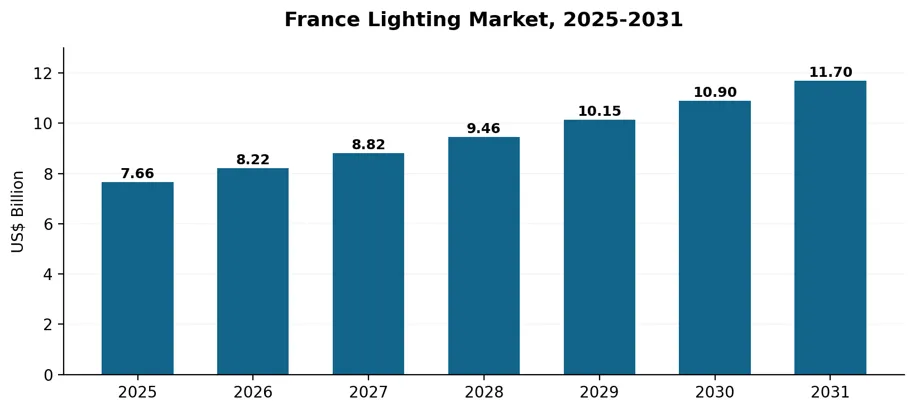
The France Lighting Market is estimated at US$ 7.66 billion in 2025 and is forecast to reach US$ 11.70 billion by 2031, representing 7.30% annualized growth. The market covers lamps, integrated luminaires, lighting control systems and related lighting equipment sold into residential, commercial, industrial, municipal and infrastructure applications. Renovation of existing building stock, replacement of older light sources and demand for energy-efficient connected lighting support spending. The 2025-2031 series is a directional extrapolation based on a published broader France lighting-market forecast, not a standalone audited market series.
Lighting demand in France spans apartments and homes, office and retail buildings, health and education estates, manufacturing sites, road networks and public facilities. LED lighting dominates new projects and retrofits, while controls and emergency lighting increase the value of specification-led work. French urban-lighting manufacturers compete alongside multinational suppliers and distributors. Buyers prioritize operating cost, comfort, photometric performance, reliability and ease of installation. High-end decorative and architectural projects remain a distinct opportunity.
| 2025 MARKET SIZE | 2031 FORECAST | CAGR (2026-2031) |
| US$ 7.66 Billion | US$ 11.70 Billion | 7.30% |
France Lighting Key Takeaways
France lighting market revenue is estimated at US$ 7.66 billion in 2025 and is forecast to reach US$ 11.70 billion by 2031.
LED lamps and integrated luminaires account for a major share of new installation and replacement demand, from residences to public streets.
Energy renovation of commercial and public buildings supports LED fixture upgrades, better control systems and emergency-lighting replacement.
Connected lighting, presence detection and daylight dimming are raising the value of commercial, architectural and municipal projects.
Urban-lighting suppliers in France differentiate through local design, circular materials, optical performance and project engineering.
Construction delays, municipal budget pressure and intense price competition can slow procurement even when energy savings are attractive.
France Lighting Industry Trends and Strategic Insights
French renovation programmes increasingly prioritize complete luminaire upgrades and controls rather than simple one-for-one lamp replacement.
Street-lighting modernization combines efficient optical systems with remote control, night-time dimming and fault monitoring.
Circular design, repairable LED modules and lower-carbon materials are gaining importance in public procurement and commercial specifications.
Suppliers are moving toward project-based technical assistance with energy models, photometric design and commissioning support.
France Lighting Market Scope
| METRICS | DETAILS |
| 2025 Market Size | US$ 7.66 Billion |
| 2031 Projected Market Size | US$ 11.70 Billion |
| CAGR (2026-2031) | 7.30% |
| By Product Type | LED lamps, luminaires, professional and architectural fixtures, street lighting, emergency and controls |
| By End-Use Industry | Residential, commercial, healthcare, education, industry, municipal, road and transport |
| By Lighting Technology | LED, legacy replacement, specialty, architectural and emergency lighting |
| By Controls | Occupancy, daylight, DALI, wireless, connected and remotely monitored controls |
| By Application | Indoor, exterior, public realm, industrial, commercial, residential and municipal |
| By Installation | New-build, retrofit, replacement, modernization and lifecycle services |
| Competitive Landscape | 10 domestic and international lighting suppliers serving French buyers |
| Market Data Coverage | 2025-2031 France lighting market value, product segmentation and market trends |
| Currency | France; market values in US dollars |
Coverage: France. This report covers lighting equipment and associated controls for residential, commercial, industrial, municipal, public and outdoor applications. Product categories include LED lamps, integrated luminaires, architectural fixtures, industrial high-bay lighting, street and amenity lighting, emergency luminaires and connected controls. It excludes standalone vehicle headlamps and unrelated electronic components. Value forecasts are expressed in US dollars.
France Lighting Market White Space & Investment Opportunities
Renovation programmes: target office landlords, healthcare networks, universities and municipal facilities with efficient LED and control packages.
Circular luminaires: expand replaceable LED engines, recyclable housings, repair services and documented environmental product information.
Connected municipalities: supply intelligent streetlights, remote monitoring, solar-integrated equipment and adaptive dimming for public spaces.
Commercial opportunities depend on engagement with municipal buyers, design practices, distributors, electrical installers and facility managers. Suppliers that can combine reliable stock with photometric calculations, verified energy savings and technical commissioning support are well placed. Public tenders favor clear compliance documentation, product durability and responsive aftersales support. Further revenue can come from controls upgrades, emergency testing and planned replacement programmes.
Driver Impact Analysis
Energy efficiency and refurbishment are the main demand drivers in France. Owners of offices, shops, schools, hospitals and warehouses are upgrading older fluorescent, halogen and discharge lighting with LED equipment to lower power consumption and maintenance costs. Building-energy requirements create a stronger business case for retrofit work in large tertiary properties, while occupancy sensors and daylight-responsive controls can deliver additional savings. Public infrastructure programmes support the replacement of aging street lighting with efficient luminaires and better night-time operation. The biggest opportunities are often multi-building or municipal programmes where standardized specifications support repeated orders.
| DRIVER | AFFECTED PRODUCT / SIGNAL | 2026–2031 CAGR | STRATEGIC IMPACT |
| Energy renovation and retrofits | High | LED luminaires, lamps, efficient lighting controls | Engage property owners and energy-retrofit contractors with payback analyses |
| Municipal lighting upgrades | High | Street, roadway, amenity and remote-managed fixtures | Bid for public frameworks with robust optics and connected monitoring |
| Building and workplace controls | Medium-High | DALI, occupancy sensing and daylight-responsive systems | Bundle controls with specification-grade fixtures and commissioning |
| Premium architectural lighting | Medium-High | Decorative, hospitality, retail and public-realm luminaires | Develop designer relationships and higher-value customized portfolios |
The shift to connected lighting provides another growth channel. DALI-based systems, wireless controls and building-management integration make lighting part of broader energy-performance projects. Cities can monitor outdoor fixtures remotely and alter brightness based on location, traffic and operating schedules. In housing, connected and decorative lighting products support premium purchases, while professional customers continue to demand color consistency, glare control, serviceability and dependable emergency operation. Manufacturers that offer luminaires, controls and installation support together can capture higher-value work with contractors, lighting designers and building operators.
Restraint Impact Analysis
The main restraint is the uneven pace of property investment and public spending. New residential construction is sensitive to financing costs and some building owners postpone lighting refurbishment despite attractive operating savings. Municipal tenders can face approval delays and multi-year budget constraints. Replacement cycles differ widely by end use and fully functional LED fixtures often remain in service longer than conventional light sources, reducing recurring unit demand. The benefits of connected lighting can be difficult to quantify when occupancy patterns and existing wiring are poorly documented.
| RESTRAINT | PRIMARY EXPOSURE | RISK LEVEL | STRATEGIC IMPACT |
| Construction and budget delays | Commercial properties, housing and public tenders | High | Prioritize renovation pipelines and multi-year tender visibility |
| Low-priced imports | Commodity lamps, panels and basic fixtures | High | Compete through photometry, service life and warranty rather than price alone |
| Retrofit compatibility | Existing wiring, controls and emergency systems | Medium-High | Provide installer-ready retrofit kits and technical assistance |
| Controls integration and sourcing | Drivers, sensors, wireless gateways and software | Medium | Use open controls where possible and diversify electronic-component supply |
Intense competition and technical integration add further pressure. Low-cost imported lamps and basic LED panels constrain pricing for standard products, while professional projects require testing, photometry, compatibility and warranty support. Connected installations may need integration with DALI gateways, building-control systems and emergency circuits. Retrofit sites can contain mixed fixture generations, difficult cable routes and restricted access hours. Suppliers also face exposure to electronic components, driver availability and evolving product environmental requirements. Serviceable designs, clear specification guidance and diversified sourcing can mitigate these risks.
France Lighting Market Competitive Landscape
France lighting competition combines large international brands with strong domestic manufacturers and project specialists. Signify, LEDVANCE, Legrand, Zumtobel Group and TRILUX address substantial parts of the general and professional market. Groupe RAGNI, Technilum and Schréder are particularly relevant in urban, exterior and public-space lighting. CLAREO supplies professional lighting products, while Lucibel is associated with specialized architectural and premium applications. Competitive position differs between commodity lamps, commercial luminaires, smart controls and municipal infrastructure.
| COMPANY | France LIGHTING POSITIONING |
| Signify | Professional LED lamps, connected systems, municipal and commercial luminaires, and Philips Hue consumer lighting. |
| Legrand | Building electrical and connected-control systems, including lighting control and commercial automation interfaces. |
| LEDVANCE | General LED lamps and professional luminaires distributed through French electrical and retail channels. |
| Zumtobel Group | Zumtobel and Thorn product lines for office, architectural, industrial and outdoor projects. |
| TRILUX | Professional building and industrial LED lighting, connected controls and project retrofit programs. |
| Groupe RAGNI | French urban, roadway, architectural and connected public-space lighting manufacturer. |
| Technilum | French public-realm lighting, designed columns and luminaires for urban and architectural projects. |
| CLAREO | Professional LED luminaires, commercial ranges and solar-powered exterior lighting. |
| Schreder | Street, roadway and public-space lighting systems, connected infrastructure and outdoor project support. |
| Lucibel | French brand associated with specialty, premium and architectural LED applications; underwent restructuring in 2026. |
Purchasing decisions reflect product quality, energy efficiency, photometric design, delivery reliability, certification and total installed cost. Large commercial and municipal projects use lighting designers, engineering consultancies, wholesalers and contractors. Residential replacement demand is more retail and installer led. French-made design, material traceability and circular product features can strengthen bids where public procurement gives weight to environmental criteria.
France Lighting Market Recent Developments
January 13, 2026: French specialist Lucibel entered court-supervised restructuring, illustrating the financial pressure on premium and project-led lighting suppliers.
January 20, 2026: CLAREO announced FloodPark Solaire TECH, its first standalone high-efficiency solar floodlight for outdoor applications.
March 2026: Groupe RAGNI presented new professional and urban-lighting ranges, including FINE and LEXA, at Light + Building 2026.
July 23, 2026: Signify expanded the positioning of Xitanium as a standalone endorsed brand for OEM LED drivers and related electronic components.
September 3, 2026: Signify announced new Philips Hue smart-lighting products and software, including AI automation and architectural decorative luminaires.
September 2026: French outdoor-lighting manufacturer Technilum highlighted its new Caladoc street-lighting range and updated urban-lighting designs.